

EN 12001:2003+A1:2009
(Main + Amendment)Conveying, spraying and placing machines for concrete and mortar - Safety requirements
- Abstract
This standard specifies the safety requirements for:
- conveying machines;
- spraying machines;
- placing machines for concrete and mortar or their components.
The machinery can be stationary or mobile.
This standard covers the machines described in 3.3 to 3.7.
This standard does not cover:
- machines that are mobile during conveying, spraying and placing;
- cabins for any machines covered by this standard.
This standard does not concern the undercarriage of the truck and the engine(s) of the machines that are not driven by the main engine during conveying, spraying and placing. One other possibility is the combination with a truck mixer (see 3.3).
This standard does not establish the additional requirements for operation subject to special rules (e. g. potentially explosive atmosphere, supply by electrical networks where voltage, fre¬quency and tolerance differ from those of the public supply, if relevant due to e. g. electronic components, earth¬quake, lightning, using on public roads, hazards occurring during construction, transportation, commissioning, de¬commissioning, cableless remote controls other than radio controls, compressors and pressure vessels).
1.2 This standard deals with all significant hazards, hazardous situations and events relevant to conveying, spraying and placing machines when they are used as intended and under the conditions foreseen by the manu-facturer (see clause 4). This standard specifies the appropriate technical measures to eliminate or reduce risks arising from the significant hazards.
This document is not applicable to machines which are manufactured before the date of publication of this document by CEN.
- Status
- Withdrawn
- Publication Date
- 24-Nov-2009
- Withdrawal Date
- 28-Aug-2012
- Technical Committee
- CEN/TC 151 - Construction equipment and building material machines - Safety
- Drafting Committee
- CEN/TC 151/WG 8 - Concrete preparation and handling equipment - Safety
- Current Stage
- 9960 - Withdrawal effective - Withdrawal
- Start Date
- 29-Aug-2012
- Completion Date
- 29-Aug-2012
- Directive
- 2006/42/EC - Directive 2006/42/EC of the European Parliament and of the Council of 17 May 2006 on machinery, and amending Directive 95/16/EC (recast)OJ Ref: C, C 136 OJ Date: 26-May-2010

Relations
- Effective Date
- 19-Jan-2023
- Effective Date
- 18-Jan-2023
- Effective Date
- 26-Sep-2009
- Effective Date
- 28-Jan-2026
- Effective Date
- 28-Jan-2026
Get Certified
Connect with accredited certification bodies for this standard

DIBt (Deutsches Institut für Bautechnik)
German Institute for Building Technology.
DIN CERTCO
DIN Group product certification.

Aboma Certification B.V.
Specialized in construction, metal, and transport sectors.
Sponsored listings
Frequently Asked Questions
EN 12001:2003+A1:2009 is a standard published by the European Committee for Standardization (CEN). Its full title is "Conveying, spraying and placing machines for concrete and mortar - Safety requirements". This standard covers: This standard specifies the safety requirements for: - conveying machines; - spraying machines; - placing machines for concrete and mortar or their components. The machinery can be stationary or mobile. This standard covers the machines described in 3.3 to 3.7. This standard does not cover: - machines that are mobile during conveying, spraying and placing; - cabins for any machines covered by this standard. This standard does not concern the undercarriage of the truck and the engine(s) of the machines that are not driven by the main engine during conveying, spraying and placing. One other possibility is the combination with a truck mixer (see 3.3). This standard does not establish the additional requirements for operation subject to special rules (e. g. potentially explosive atmosphere, supply by electrical networks where voltage, fre¬quency and tolerance differ from those of the public supply, if relevant due to e. g. electronic components, earth¬quake, lightning, using on public roads, hazards occurring during construction, transportation, commissioning, de¬commissioning, cableless remote controls other than radio controls, compressors and pressure vessels). 1.2 This standard deals with all significant hazards, hazardous situations and events relevant to conveying, spraying and placing machines when they are used as intended and under the conditions foreseen by the manu-facturer (see clause 4). This standard specifies the appropriate technical measures to eliminate or reduce risks arising from the significant hazards. This document is not applicable to machines which are manufactured before the date of publication of this document by CEN.
This standard specifies the safety requirements for: - conveying machines; - spraying machines; - placing machines for concrete and mortar or their components. The machinery can be stationary or mobile. This standard covers the machines described in 3.3 to 3.7. This standard does not cover: - machines that are mobile during conveying, spraying and placing; - cabins for any machines covered by this standard. This standard does not concern the undercarriage of the truck and the engine(s) of the machines that are not driven by the main engine during conveying, spraying and placing. One other possibility is the combination with a truck mixer (see 3.3). This standard does not establish the additional requirements for operation subject to special rules (e. g. potentially explosive atmosphere, supply by electrical networks where voltage, fre¬quency and tolerance differ from those of the public supply, if relevant due to e. g. electronic components, earth¬quake, lightning, using on public roads, hazards occurring during construction, transportation, commissioning, de¬commissioning, cableless remote controls other than radio controls, compressors and pressure vessels). 1.2 This standard deals with all significant hazards, hazardous situations and events relevant to conveying, spraying and placing machines when they are used as intended and under the conditions foreseen by the manu-facturer (see clause 4). This standard specifies the appropriate technical measures to eliminate or reduce risks arising from the significant hazards. This document is not applicable to machines which are manufactured before the date of publication of this document by CEN.
EN 12001:2003+A1:2009 is classified under the following ICS (International Classification for Standards) categories: 91.220 - Construction equipment. The ICS classification helps identify the subject area and facilitates finding related standards.
EN 12001:2003+A1:2009 has the following relationships with other standards: It is inter standard links to EN 12001:2003/prA1, EN 12001:2003, EN 12001:2012, EN ISO 15473:2020, EN ISO 15175:2011. Understanding these relationships helps ensure you are using the most current and applicable version of the standard.
EN 12001:2003+A1:2009 is associated with the following European legislation: EU Directives/Regulations: 2006/42/EC, 98/37/EC; Standardization Mandates: M/079, M/396. When a standard is cited in the Official Journal of the European Union, products manufactured in conformity with it benefit from a presumption of conformity with the essential requirements of the corresponding EU directive or regulation.
EN 12001:2003+A1:2009 is available in PDF format for immediate download after purchase. The document can be added to your cart and obtained through the secure checkout process. Digital delivery ensures instant access to the complete standard document.
Standards Content (Sample)
2003-01.Slovenski inštitut za standardizacijo. Razmnoževanje celote ali delov tega standarda ni dovoljeno.Stroji za transport, brizganje in polaganje betona in malte - Varnostne zahteveFörder-, Spritz- und Verteilmaschinen für Beton und Mörtel - SicherheitsanforderungenMachines pour le transport, la projection et la distribution de béton et mortier - Prescriptions de sécuritéConveying, spraying and placing machines for concrete and mortar - Safety requirements91.220Gradbena opremaConstruction equipmentICS:Ta slovenski standard je istoveten z:EN 12001:2003+A1:2009SIST EN 12001:2004+A1:2010en,fr01-februar-2010SIST EN 12001:2004+A1:2010SLOVENSKI
STANDARD
EUROPEAN STANDARD NORME EUROPÉENNE EUROPÄISCHE NORM
EN 12001:2003+A1
November 2009 ICS 91.220 Supersedes EN 12001:2003English Version
Conveying, spraying and placing machines for concrete and mortar - Safety requirements
Machines pour le transport, la projection et la distribution de béton et mortier - Prescriptions de sécurité
Förder-, Spritz- und Verteilmaschinen für Beton und Mörtel - Sicherheitsanforderungen This European Standard was approved by CEN on 11 March 2003 and includes Amendment 1 approved by CEN on 17 October 2009.
CEN members are bound to comply with the CEN/CENELEC Internal Regulations which stipulate the conditions for giving this European Standard the status of a national standard without any alteration. Up-to-date lists and bibliographical references concerning such national standards may be obtained on application to the CEN Management Centre or to any CEN member.
This European Standard exists in three official versions (English, French, German). A version in any other language made by translation under the responsibility of a CEN member into its own language and notified to the CEN Management Centre has the same status as the official versions.
CEN members are the national standards bodies of Austria, Belgium, Bulgaria, Cyprus, Czech Republic, Denmark, Estonia, Finland, France, Germany, Greece, Hungary, Iceland, Ireland, Italy, Latvia, Lithuania, Luxembourg, Malta, Netherlands, Norway, Poland, Portugal, Romania, Slovakia, Slovenia, Spain, Sweden, Switzerland and United Kingdom.
EUROPEAN COMMITTEE FOR STANDARDIZATION
COMITÉ EUROPÉEN DE NORMALISATION EUROPÄISCHES KOMITEE FÜR NORMUNG
Management Centre:
Avenue Marnix 17,
B-1000 Brussels © 2009 CEN All rights of exploitation in any form and by any means reserved worldwide for CEN national Members. Ref. No. EN 12001:2003+A1:2009: ESIST EN 12001:2004+A1:2010
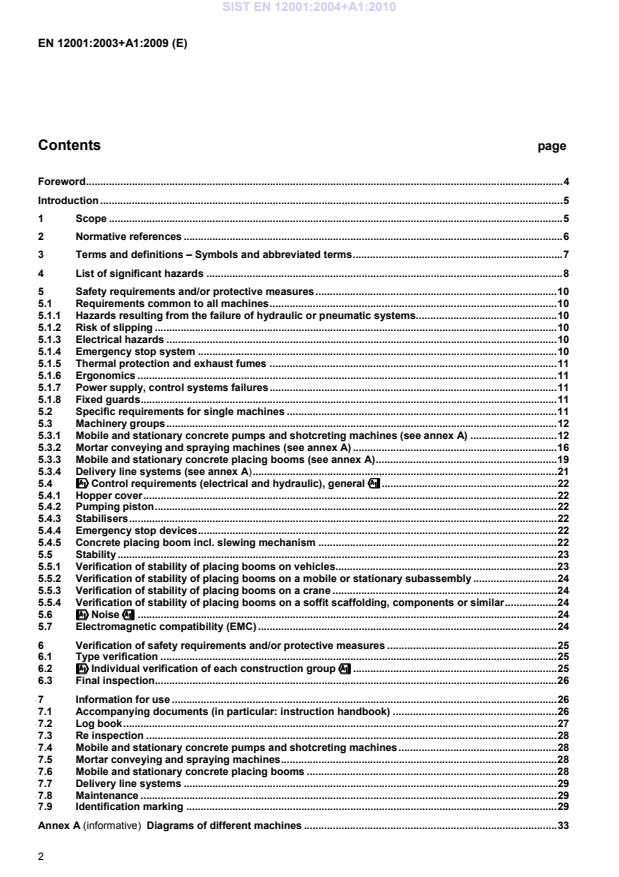
page Foreword . 4Introduction . 51 Scope . 52 Normative references . 63 Terms and definitions – Symbols and abbreviated terms . 74 List of significant hazards . 85 Safety requirements and/or protective measures . 105.1 Requirements common to all machines . 105.1.1 Hazards resulting from the failure of hydraulic or pneumatic systems. 105.1.2 Risk of slipping . 105.1.3 Electrical hazards . 105.1.4 Emergency stop system . 105.1.5 Thermal protection and exhaust fumes . 115.1.6 Ergonomics . 115.1.7 Power supply, control systems failures . 115.1.8 Fixed guards . 115.2 Specific requirements for single machines . 115.3 Machinery groups . 125.3.1 Mobile and stationary concrete pumps and shotcreting machines (see annex A) . 125.3.2 Mortar conveying and spraying machines (see annex A) . 165.3.3 Mobile and stationary concrete placing booms (see annex A) . 195.3.4 Delivery line systems (see annex A) . 215.4 !!!!Control requirements (electrical and hydraulic), general"""" . 225.4.1 Hopper cover . 225.4.2 Pumping piston . 225.4.3 Stabilisers . 225.4.4 Emergency stop devices . 225.4.5 Concrete placing boom incl. slewing mechanism . 225.5 Stability . 235.5.1 Verification of stability of placing booms on vehicles. 235.5.2 Verification of stability of placing booms on a mobile or stationary subassembly . 245.5.3 Verification of stability of placing booms on a crane . 245.5.4 Verification of stability of placing booms on a soffit scaffolding, components or similar . 245.6
!!!!Noise"""" . 245.7 Electromagnetic compatibility (EMC) . 246 Verification of safety requirements and/or protective measures . 256.1 Type verification . 256.2 !!!!Individual verification of each construction group"""" . 256.3 Final inspection . 267 Information for use . 267.1 Accompanying documents (in particular: instruction handbook) . 267.2 Log book . 277.3 Re inspection . 287.4 Mobile and stationary concrete pumps and shotcreting machines . 287.5 Mortar conveying and spraying machines . 287.6 Mobile and stationary concrete placing booms . 287.7 Delivery line systems . 297.8 Maintenance . 297.9 Identification marking . 29Annex A (informative)
Diagrams of different machines . 33SIST EN 12001:2004+A1:2010
!!!!Logbook for concrete pump and concrete-placing boom*)"""" . 41B.1 Preliminary remarks and assemblies . 42B.2 Master record sheet . 42B.3 Master record sheet for verification of stationary machines . 43B.4 Master record sheet for verification of the other machines . 43B.5 Supplements to the master record sheet . 43B.6 Inspection records . 43B.6.2 Master record sheet for inspection prior to initial commissioning (initial inspection) by the competent expert, by manufacturer . 46B.6.3 Classification of mobile subassemblies . 49B.6.4 Example of subassemblies . 50B.6.5 Inspection report for concrete placing boom by contractor . 51Annex C (normative)
!!!!Noise-test code for machines and equipment for conveying, spraying and placing concrete and mortar"""" . 59C.1 Scope . 59C.2 Determination of the A-weighted sound-power level . 59C.2.1 General. 59C.2.2 Measurement surface and microphone positions . 59C.2.3 Test procedure . 59C.2.4 Operator’s positions . 60C.3 Determination of the A-weighted emission sound pressure level at workstations . 60Annex ZA (informative)
Relationship between this European Standard and the Essential Requirements of EU Directive 98/37/EC . 61Annex ZB (informative)
!!!!Relationship between this European Standard and the Essential Requirements of EU Directive 2006/42/EC"""" . 62Bibliography . 63 SIST EN 12001:2004+A1:2010
For machines with remote control, the control station on/at the machine is an emergency control station. !!!!3.8 normal operation operation of the machine with all systems functioning NOTE Exceptions: repair and maintenance, emergency operation" 4 List of significant hazards This clause contains all the significant hazards, hazardous situations and events, as far as they are dealt with in this standard, identified by risk assessment as significant for this type of machinery and which require action to eliminate or reduce the risk.
Hazards Locations/circumstances/consequences See clause/annex: !4.1 Mechanical hazards (according to EN ISO 12100-1:2003, 4.2)
" 4.1.1 Crushing Accessibility to zones between fixed and moving parts 5.3.1.1, 5.3.1.2, 5.3.1.6, 5.3.1.7, 5.3.2.1, 5.3.2.2, 5.3.2.3, 5.3.2.6, 5.3.2.7, 5.3.3.2, 5.3.3.3 4.1.2 Shearing Access to areas between fixed and moving parts outside and inside conveying and spraying machines Access to fixed and moving parts inside the hopper, either from the inlet or from another point
5.3.2.2 4.1.3 Entanglement Access to unprotected shafts
5.3.1.4, 5.3.2.3 4.1.4 Entrapment Access to moving parts inside the hopper Access to the moving parts of the mixer Access to feed points of V-belt or chain sprocket drives 5.3.1.4, 5.3.2.3 4.1.5 Impact Access to moving parts of stabilisers and concrete placing boom
5.3.3.4, A.5 4.1.6 High-pressure fluid ejection Access to the hydraulic system Access to the delivery line system 5.3.4.1 4.1.7 Ejection of parts or material Access to outlet and wear of piping 5.3.1.5, 5.3.2.4, 5.3.4.1 4.1.8 Strength loss of strength 5.3.1.5, 5.3.3.1 4.1.9 Stability Loss of stability 5.3.1.5, 5.3.2.4, 5.3.2.5, 5.3.3.1 4.1.10 Slipping Access to areas where slipping is possible 5.1.2, 5.3.1.5, 5.3.2.5, 5.3.3.1 !4.2 Electrical hazards (according to EN ISO 12100-1:2003, 4.3) Electrocution, electric shocks or burns 5.1.3 4.3 Thermal hazards (according to EN ISO 12100-1:2003, 4.4) Access to hot machine parts 5.1.5 4.4 Hazardous noise (according to EN ISO 12100-1:2003, 4.5) Hearing loss and other physiological damage, impaired oral communication and perception of warning signals 5.6, 7.1.13,
Annex C 4.5 Hazards from materials and consumables used (according to EN ISO 12100-1:2003, 4.8) Contact with or inhalation of harmful fluids, gases, dust or aerosols 5.1.1, 5.1.5, 5.3.4, 7 4.6 Ergonomics (according to EN ISO 12100-1:2003, 4.9) Injury due to poor design of control stations/panels Inadequate lighting Unsuitable operator's position for fuelling Inadequate access and departure facilities 5.1.6
5 5 5 4.7 Hazards resulting from system failures (according to EN ISO 12100-1:2003, 4.3) Failure of power supply Failure of control systems 5.1.1, 5.1.4, 5.3.1.3, 5.3.1.4, 5.3.1.5, 5.3.2.4, 5.3.3.2 4.8 Electromagnetic compatibility (EMC) Unforeseeable functions of the machine and/or disturb of external devices 5.7" SIST EN 12001:2004+A1:2010
EN 894-3:2000, EN 982:1996, EN 1088:1995, EN 60204-1:2006, EN ISO 13850:2008, EN ISO 13857:2008, the manufacturer shall carry out an adequate risk assessment for the requirements thereof where choice is necessary." NOTE This specific risk assessment is part of the general risk assessment relating to the hazards not covered by this C standard. The general section (see 5.1) deals with hazards common to all conveying, spraying and placing machines. The specific section (see 5.2) covers the hazards specific to the individual type of machines. 5.1 Requirements common to all machines 5.1.1 Hazards resulting from the failure of hydraulic or pneumatic systems The hydraulic system shall be designed in accordance with EN 982:1996. The following shall be especially taken into account: line breaks during operation (e. g. line-break safety facilities); maintenance and servicing work is to be carried out (provision of check/vent valves, mechanical locking de-vices, etc.). With the exception of dual cylinder drive the check valves shall be connected with the pressure chamber of the cylinder without additional connecting lines.
For dual cylinder drive only one check valve shall be used. The connection piping between these check valves and both cylinders shall:
have an safety factor increased by 25 % and
be protected against mechanical damage. 5.1.2 Risk of slipping Work stations, access walkways and gangways shall be of an anti slip type e. g. checker plates or gratings.
5.1.3 Electrical hazards Electrical installations shall comply with !EN 60204-1:2006". 5.1.4 Emergency stop system Machines shall have an emergency stop device at the control station. Where more than one control station is fore-seen each main control station (not the local control) on the machine shall be equipped with an emergency stop. Cable remote control stations are considered as being control stations on the machine. For cableless controls the emergency stop shall be at the control station on the machine. The remote control station shall be equipped with a stop function. The emergency stop system: stops all machine functions in the shortest time compatible with the system; SIST EN 12001:2004+A1:2010
Hopper Mechanical Crushing between agitator, valve, hopper wall and grille cover 4.2.1 Grilles on openings of hoppers of concrete pumps and shotcreting machines, which are intended to be opened once a day or more often shall be interlocked with the drives of the agitators/valves in such a way that the drives are stopped as the covers are opened. Grilles on openings of hoppers of concrete pumps and shotcreting machines, which are not intended to be opened once a day or more often shall be secured with bolt(s) (see also 7, cleaning procedure). At concrete pumps and shot-creting machines, the filler open-ings of the hopper shall be se-cured by rod-type or grille-type guards in the following dimen-sions: Rods Grilles a 70 mm 35 mm h 200 mm 100 mm b 80 mm 70 mm 40 mm h 180 mm 150 mm 90 mm a = maximum permissible clear-ance between rods in mm b = maximum permissible mesh width in mm h = minimum permissible clear-ance of covers from crushing point between agitator and mixing vessel/r hopper wall in mm NOTE These clearances between the rods or mesh widths are the best compromise between safety and performance to allow the bulk mate-rial „concrete“ to be filled (other clearances hamper the bulk material). SIST EN 12001:2004+A1:2010
Figure 1 — Grille – crushing point clearance Figure 2 — Hopper wall – grille clearance
Figure 3 — Mesh width – grille Figure 4 — Clearance – bars SIST EN 12001:2004+A1:2010
Component Hazard group Hazard According to !!!!EN ISO 12100-1:2003"""" Safety measures 5.3.1.2
Hopper
Mechanical Crushing between fixed and movable parts
4.2.1 Hinged covers or hinged hoppers shall be lockable in their ultimate up-per position. The control device(s) for power-oper-ated covers or hoppers, shall be of hold to run type. The distance from the control de-vice(s) to the crushing points shall be large enough to ensure that, when the control device(s) is(are) released, the hazard points are accessible only when the hazardous movement is ended. !!!!5.3.1.3 Pump
Crushing between fixed and movable parts 4.2.1Screwed covering with distances according to EN ISO 13857:2008 or if the covering is movable, a fixed guard shall be provided as per EN 953:1997. Screwed coverings shall only be able to be opened with tools. 5.3.1.4 Drive area
Crushing between hinged covers and machine parts 4.2.1Hinged covers shall be lockable in opened position.
Entanglement by free-running shafts 4.2.1 Screwed covering with distances according to EN ISO 13857:2008. Screwed coverings shall only be able to be opened with tools.
Entrapment between V-belt and driving pulleys 4.2.1 Screwed covering with distances according to EN ISO 13857:2008. Screwed coverings shall only be able to be opened with tools.
Unexpected machine movements
If starting the engine, an unintentional and unexpected hazardous movement shall be avoided." 5.3.1.5 Entire machine Mechanical strength 4.2.2 The design of the machine shall be carried out corresponding to the state of the art. The intended use of the machine shall be considered (see Introduction).
Stability due to faulty support on the subsoil 4.2.2 The maximum support forces occur-ring shall be marked on the outrig-gers.
Loss of stability by the machine or parts thereof while being moved by lifting gear on the construction site 4.2.2 Machines or their individual compo-nents which are moved or lifted with lifting gear for assembly purposes on construction sites shall be equipped with attachment points.
Slipping in connection with the machine !4.10" For maintenance, assembly and dis-mantling work and for inspections which cannot be carried out from ground level, working stands or plat-forms shall be available. These shall be safely accessible and shall permit working to be done from them without any risk to those involved (see 5.1.2).
Ejection of parts or material !4.2.1" The machines shall be constructed in such a way that blockages in the de-livery lines shall be removed without any risk. This can be achieved with a reverse-pumping device.
Inadvertent, uncon-trolled movements of machine parts due to reciprocal controlling facilities at more than one control panel !4.11" Operation shall be only possible from the one pre selected control panel (positive switchover essential). Actuating elements shall be secur-able against unauthorized operation and shall be positioned, designed and marked in such a way as to pre-vent mistaken identity. 5.3.1.6 Stabilisers Mechanical Crushing between movable supports and fixed machine parts or de-vices not belonging to the machine 4.2.1 See 5.3.3.2 5.3.1.7 Concrete placing boom Mechanical Crushing between movable concrete placing boom parts and fixed machine parts, be-tween moving ma-chine parts and de-vices not belonging to the machine 4.2.1 See 5.3.3.3 SIST EN 12001:2004+A1:2010
Hopper Mechanical Crushing between agitator, hopper wall and grille cover 4.2.1 Hoppers containing agitators or worm conveyors shall be equipped with a grille cover. Distances with dimensions according to !EN ISO 13857:2008". If the grille-bar clearance specified in !EN ISO 13857:2008" is too narrow for the material concerned, e.g. due to wet or coarse-grained material, the grille-bar clearance can be increased. The mesh width may be at a maximum of 60 mm and the distance between grille bar and crushing point shall be at least 120 mm. In contrast, grille covers of mortar-conveyance machinery using com-pressors whose air chamber has to be pressure-sealed with a cover prior to conveyance after each filling and mix-ing operation may have a maximum mesh width of 70 mm. The grille cover shall have a minimum clearance of 120 mm from the crushing point be-tween agitator or worm conveyor and hopper wall. In the case of grille covers which are either not screwed down or opened once a day or more often, it shall be ensured that the agitator or the worm conveyor is positively stopped and is secured against restarting when the grille cover is opened. The cut out mechanism shall not be circumvent-able by simple means. Hinged grille covers shall be positioned and equipped in such a way that they can-not close inadvertently from opened position. Outlet openings shall be secured by a hopper or a guard, at the base of which a grille complying with the fol-lowing specifications is mounted: Max. permissible mesh width of grille 70 mm and min. clearance between covers and crushing points 150 mm. or
max. permissible mesh width of grille 40 mm and min. clearance between covers and crushing points 120 mm. Interpolations are possible.
Hopper Mechanical Crushing between hinged hopper and fixed machine parts 4.2.1 Movable hoppers shall be lockable in their limit position to prevent any inad-vertent movement. To control the closing movement of power-operated hoppers, a hold to run device using control device(s) shall be provided. The control device(s) shall have sufficient clearance from the crushing points shall be large enough to prevent contact with moving parts.
Shearing between agitator and hopper 4.2.1 Feeder hoppers must be designed in such a way that inadvertent movement by the agitator is avoided when covers are opened. The cover of the opening for cleaning purposes can also be se-cured in such a way as to prevent ac-cess to crushing parts. 5.3.2.3
Driving area Mechanical Crushing between hinged cov-ers and fixed ma-chine parts 4.2.1 If hazardous movements are possible without the use of tools during work on the machine, it shall be ensured that access to hazardous points is pre-vented (e. g. covers with automatic cut-out). If this is done by automatic stopping of the drive, a safety facility shall be installed against inadvertent restarting. Hinged covers shall be located or equipped in such a way that they can-not close inadvertently when in opened position.
Entanglement by free-running drive shafts 4.2.1 Screwed covering with distances ac-cording to !EN ISO 13857:2008". Screwed coverings shall only be able to be opened with tools.
Entrapment between V-belts and drive units 4.2.1 Screwed covering with distances ac-cording to !EN ISO 13857:2008". Screwed coverings shall only be to open with tools. 5.3.2.4
Entire machine Mechanical Loss of stability by the machine or parts thereof while being moved by lifting gear on the construction site 4.2.2 Conveying and spraying machines or their individual components which are moved or lifted with lifting gear for as-sembly purposes on construction sites shall be equipped with attachment points.
Inadvertent, uncon-trolled movements of machine parts due to reciprocal controlling facilities at more than one con-trol console !4.11" Operation possible from one pre se-lected control console only (positive switchover essential).
Component Hazard group Hazard According to!!!!EN ISO 12100-1:2003"""" Safety measures
Inadvertent initiation of hazardous move-ments !4.11" Actuating elements initiating hazard-ous movements shall be equipped with control device(s) using hold to run control device(s). Actuating elements shall be securable against unauthorized operation and shall be positioned, designed and marked in such a way as to prevent mistaken identity.
Mechanical Ejection of parts or material when the lock of the conveying vessel lid is being opened !4.2.1" The lock of the conveying vessel lid shall be equipped in such a way that it can be opened only when the system is depressurized.
While removing blockages !4.2.1" The machines shall be designed in such a way that persons are not en-dangered by ejection of returning ma-terial. Blockages in the delivery lines shall be removed without any risk.
This can be achieved, for example, through appropriate designing of the return nozzle or by ejection-proof at-tachment of the return hose to the re-turn nozzle and the mortar hopper or with a reverse-pumping mechanism. 5.3.2.5
Entire machine
Mechanical Slipping on the way to work-places for mainte-nance work !4.10" For maintenance, assembly and dis-mantling work and for inspections which cannot be carried out from ground level, working stands or plat-forms shall be available. These shall be safely accessible and shall permit working to be done from them without any risk to those involved (see 5.1.2).
Loss of stability through faulty design 4.2.2 Accessible covers including grilles shall be designed for an individual load of 1,5 kN. 5.3.2.6
Stabilizers Mechanical Crushing between movable supports and fixed machine parts or de-vices not belonging to the machine 4.2.1 See 5.3.3.2 5.3.2.7
Concrete placing boom Mechanical Crushing between movable concrete placing boom and fixed ma-chine parts or de-vices not belonging to the machine 4.2.1 See 5.3.3.3 SIST EN 12001:2004+A1:2010
Entire ma-chine Mechanical strength 4.2.2 The design of the machine shall be car-ried out corresponding to the state of the art. The intended use of the machine shall be considered (see Introduction).
Loss of stability by the machine or parts thereof while being moved by lifting gear on the construction site 4.2.2 Machines or their individual components which are moved or lifted with lifting gear for assembly purposes on construction sites shall be equipped with attachment points.
Mechanical Slipping on the way to workplaces for maintenance work !4.10" For maintenance, assembly and disman-tling work and for inspections which can-not be carried out from ground level, working stands or platforms shall be available. These shall be safely accessi-ble and shall permit working to be done from them without any risk to those in-volved (see 5.1.2).
5.3.3.2
Stabilizers System f
...