


EN 13749:2011
(Main)Railway applications - Wheelsets and bogies - Method of specifying the structural requirements of bogie frames
General Information
- Abstract
This European Standard specifies the method to be followed to achieve a satisfactory design of bogie frames and includes design procedures, assessment methods, verification and manufacturing quality requirements. It is limited to the structural requirements of bogie frames including bolsters and axlebox housings. For the purpose of this European Standard, these terms are taken to include all functional attachments, e.g. damper brackets.
- Status
- Withdrawn
- Publication Date
- 29-Mar-2011
- Withdrawal Date
- 16-Sep-2026
- Technical Committee
- CEN/TC 256 - Railway applications
- Drafting Committee
- CEN/TC 256/SC 2 - Wheelsets - Bogies
- Current Stage
- 9960 - Withdrawal effective - Withdrawal
- Start Date
- 24-Mar-2021
- Completion Date
- 17-Sep-2026
- Directive
- Not Harmonized2001/16/EC - Directive 2001/16/EC of the European Parliament and of the Council of 19 March 2001 on the interoperability of the trans-European conventional rail system
Not Harmonized2008/57/EC - DIRECTIVE 2008/57/EC OF THE EUROPEAN PARLIAMENT AND OF THE COUNCIL of 17 June 2008 on the interoperability of the rail system within the Community (Recast)OJ Ref: C, C 214 OJ Date: 20-Jul-2011
Buy Documents


Relations
- Effective Date
- 22-Dec-2008
- Effective Date
- 31-Mar-2021
- Effective Date
- 28-Jan-2026
- Effective Date
- 28-Jan-2026
- Effective Date
- 28-Jan-2026
- Effective Date
- 28-Jan-2026
- Effective Date
- 28-Jan-2026
- Effective Date
- 28-Jan-2026
- Effective Date
- 28-Jan-2026
- Effective Date
- 28-Jan-2026
- Effective Date
- 28-Jan-2026
- Effective Date
- 28-Jan-2026
- Effective Date
- 28-Jan-2026
Buy Documents
Get Certified
Connect with accredited certification bodies for this standard

IRIS Certification (UNIFE)
International Railway Industry Standard certification.

TÜV SÜD Rail GmbH
TÜV SÜD railway certification services.

Bureau Veritas Railway Certification
Railway and transportation certification.
Sponsored listings
Frequently Asked Questions
EN 13749:2011 is a standard published by the European Committee for Standardization (CEN). Its full title is "Railway applications - Wheelsets and bogies - Method of specifying the structural requirements of bogie frames". This standard covers: This European Standard specifies the method to be followed to achieve a satisfactory design of bogie frames and includes design procedures, assessment methods, verification and manufacturing quality requirements. It is limited to the structural requirements of bogie frames including bolsters and axlebox housings. For the purpose of this European Standard, these terms are taken to include all functional attachments, e.g. damper brackets.
This European Standard specifies the method to be followed to achieve a satisfactory design of bogie frames and includes design procedures, assessment methods, verification and manufacturing quality requirements. It is limited to the structural requirements of bogie frames including bolsters and axlebox housings. For the purpose of this European Standard, these terms are taken to include all functional attachments, e.g. damper brackets.
EN 13749:2011 is classified under the following ICS (International Classification for Standards) categories: 45.040 - Materials and components for railway engineering. The ICS classification helps identify the subject area and facilitates finding related standards.
EN 13749:2011 has the following relationships with other standards: It is inter standard links to EN 13749:2005, EN 13749:2021, EN 15085-3:2022+A1:2023, EN 15085-4:2023, EN 15085-2:2020+A2:2025, EN 15663:2017+A2:2024, EN 15085-1:2023, EN 15085-5:2023, EN 15827:2011, EN 14198:2016+A2:2021, EN 14033-1:2017, EN 14198:2016, EN 14198:2016+A1:2018. Understanding these relationships helps ensure you are using the most current and applicable version of the standard.
EN 13749:2011 is associated with the following European legislation: EU Directives/Regulations: 2001/16/EC, 2008/57/EC, 93/38/EEC, 96/48/EC; Standardization Mandates: M/024, M/275, M/334. When a standard is cited in the Official Journal of the European Union, products manufactured in conformity with it benefit from a presumption of conformity with the essential requirements of the corresponding EU directive or regulation.
EN 13749:2011 is available in PDF format for immediate download after purchase. The document can be added to your cart and obtained through the secure checkout process. Digital delivery ensures instant access to the complete standard document.
Standards Content (Sample)
2003-01.Slovenski inštitut za standardizacijo. Razmnoževanje celote ali delov tega standarda ni dovoljeno.YBahnanwendungen - Radsätze und Drehgestellte - Spezifikationsverfahren für Festigkeitsanforderungen an DrehgestellrahmenApplications ferroviaires - Essieux montés et bogies - Méthode pour spécifier les exigences en matière de résistance des structures de châssis de bogieRailway applications - Wheelsets and bogies - Method of specifying the structural requirements of bogie frames45.040Materiali in deli za železniško tehnikoMaterials and components for railway engineeringICS:Ta slovenski standard je istoveten z:EN 13749:2011SIST EN 13749:2011en,fr,de01-oktober-2011SIST EN 13749:2011SLOVENSKI
STANDARDSIST EN 13749:20051DGRPHãþD
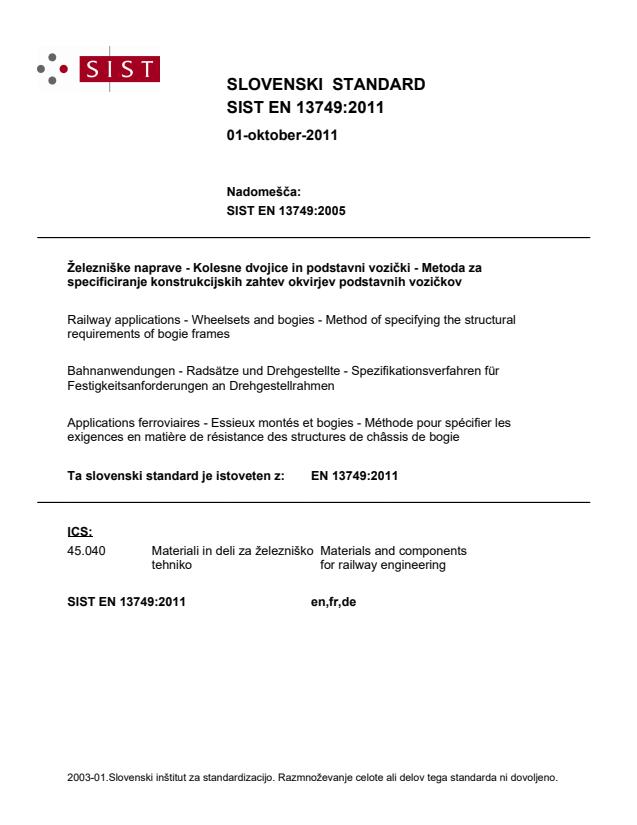
EUROPEAN STANDARD NORME EUROPÉENNE EUROPÄISCHE NORM
EN 13749
March 2011 ICS 45.040 Supersedes EN 13749:2005English Version
Railway applications - Wheelsets and bogies - Method of specifying the structural requirements of bogie frames
Applications ferroviaires - Essieux montés et bogies - Méthode pour spécifier les exigences en matière de résistance des structures de châssis de bogie
Bahnanwendungen - Radsätze und Drehgestelle - Festlegungsverfahren für Festigkeitsanforderungen an Drehgestellrahmen This European Standard was approved by CEN on 26 February 2011.
CEN members are bound to comply with the CEN/CENELEC Internal Regulations which stipulate the conditions for giving this European Standard the status of a national standard without any alteration. Up-to-date lists and bibliographical references concerning such national standards may be obtained on application to the CEN-CENELEC Management Centre or to any CEN member.
This European Standard exists in three official versions (English, French, German). A version in any other language made by translation under the responsibility of a CEN member into its own language and notified to the CEN-CENELEC Management Centre has the same status as the official versions.
CEN members are the national standards bodies of Austria, Belgium, Bulgaria, Croatia, Cyprus, Czech Republic, Denmark, Estonia, Finland, France, Germany, Greece, Hungary, Iceland, Ireland, Italy, Latvia, Lithuania, Luxembourg, Malta, Netherlands, Norway, Poland, Portugal, Romania, Slovakia, Slovenia, Spain, Sweden, Switzerland and United Kingdom.
EUROPEAN COMMITTEE FOR STANDARDIZATION
COMITÉ EUROPÉEN DE NORMALISATION EUROPÄISCHES KOMITEE FÜR NORMUNG
Management Centre:
Avenue Marnix 17,
B-1000 Brussels © 2011 CEN All rights of exploitation in any form and by any means reserved worldwide for CEN national Members. Ref. No. EN 13749:2011: ESIST EN 13749:2011
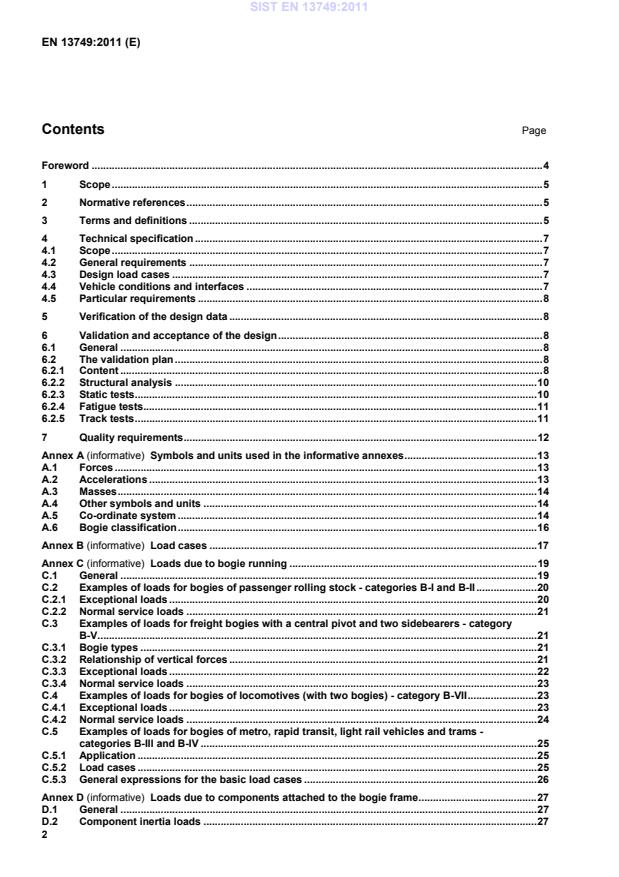
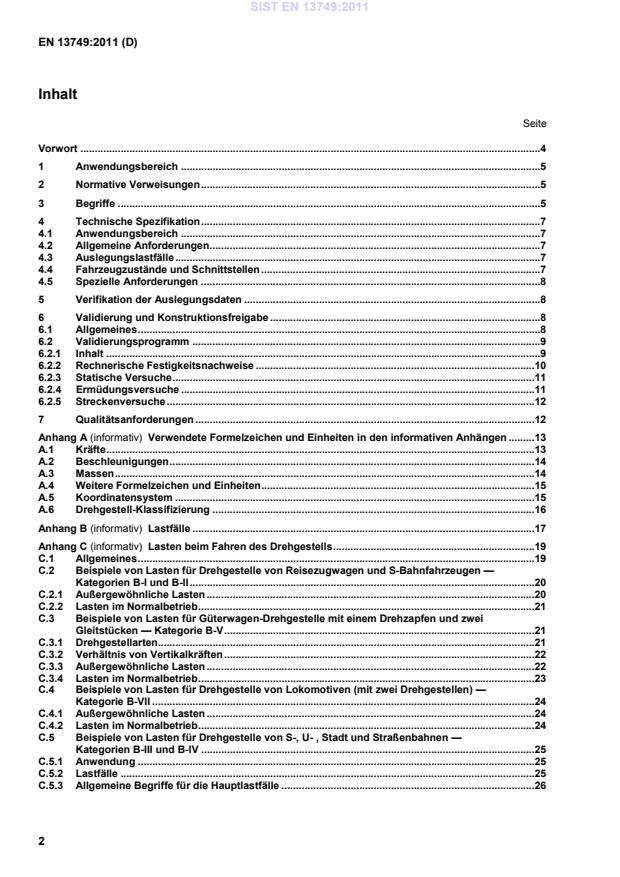
Symbols and units used in the informative annexes . 13A.1Forces . 13A.2Accelerations . 13A.3Masses . 14A.4Other symbols and units . 14A.5Co-ordinate system . 14A.6Bogie classification . 16Annex B (informative)
Load cases . 17Annex C (informative)
Loads due to bogie running . 19C.1General . 19C.2Examples of loads for bogies of passenger rolling stock - categories B-I and B-II . 20C.2.1Exceptional loads . 20C.2.2Normal service loads . 21C.3Examples of loads for freight bogies with a central pivot and two sidebearers - category B-V . 21C.3.1Bogie types . 21C.3.2Relationship of vertical forces . 21C.3.3Exceptional loads . 22C.3.4Normal service loads . 23C.4Examples of loads for bogies of locomotives (with two bogies) - category B-VII . 23C.4.1Exceptional loads . 23C.4.2Normal service loads . 24C.5Examples of loads for bogies of metro, rapid transit, light rail vehicles and trams - categories B-III and B-IV . 25C.5.1Application . 25C.5.2Load cases . 25C.5.3General expressions for the basic load cases . 26Annex D (informative)
Loads due to components attached to the bogie frame . 27D.1General . 27D.2Component inertia loads . 27SIST EN 13749:2011
Analysis methods and acceptance criteria. 30E.1General . 30E.2Loads . 30E.3Analysis and acceptance . 30E.4Structural acceptance criteria . 30E.4.1Principle . 30E.4.2Utilisation . 31E.4.3Safety factor . 31E.4.4Material strength . 32E.4.4.1Requirement . 32E.4.4.2Static strength . 33E.4.4.3Fatigue strength . 34E.4.4.4Stiffness criteria . 36Annex F (informative)
Examples of static test programmes . 37F.1General . 37F.2Static test programme for bogies of passenger rolling stock with body supported directly to the sideframes (categories B-I and B-II) . 38F.2.1Tests under exceptional loads . 38F.2.2Tests under normal service loads . 38F.3Static test programme for bogies with central pivot and two sidebearers (category B-V) . 40F.3.1Bogie types . 40F.3.2Tests under exceptional loads . 40F.3.3Tests under normal service loads . 40F.4Static test programme for bogies of locomotives . 42F.5Static test programme for bogies of light rail vehicles and trams . 42F.5.1General . 42F.5.2Tests under exceptional loads . 42F.5.3Tests under normal service loads . 43Annex G (informative)
Examples of fatigue test programmes . 44G.1General . 44G.2Fatigue test programme for bogies with the body supported directly on the sideframes (categories B-I and B-II) . 45G.3Fatigue test programme for a freight bogie with a central pivot and two sidebearers (category B-V) . 48G.3.1General . 48G.3.2Vertical loads . 48G.3.3Transverse loads . 48G.4Fatigue test programme for locomotive bogies (category B-VII) . 50G.5Fatigue test programme for bogies of light rail vehicles and trams (category B-IV) . 50Annex ZA (informative)
Relationship between this European Standard and the Essential Requirements of EU Directive 2008/57/EC . 51Bibliography . 53 SIST EN 13749:2011
Changes were necessary to make the standard compatible with more recent Euronorms. Certain areas of the normative text had to be revised to make correct reference to the structural analysis and validation processes now specified in the new bogie and running gear standard EN 15827. Other new normative references are to EN 15085 and
EN 15663. The other main changes that have been made concern the informative annexes and are summarized as follows: a) to comply with CEN rules, the symbols and units have been removed from the normative text and added as informative Annex A, as they apply only to the other informative annexes; b) the old informative Annex C has been removed and reference made to EN 15663, which now covers vehicle mass data; c) the informative Annex E has been re-written to present the structural analysis and acceptance process as specified in EN 15827; d) a number of errors in the example load case equations in informative Annex C have been corrected; e) the guidance on component loads in informative Annex D has been revised to better reflect present practice; f) the limitations of the example load case data in informative Annexes C, D, F and G have been given greater emphasis and it has been stressed that the loads should be used as presented only when it can be shown that they are applicable to the specific design. This document has been prepared under a mandate given to CEN by the European Commission and the European Free Trade Association to support Essential Requirements of EU Directive 2008/57/EC. For relationship with EU Directive 2008/57/EC, see informative Annex ZA, which is an integral part this document. According to the CEN/CENELEC Internal Regulations, the national standards organizations of the following countries are bound to implement this European Standard: Austria, Belgium, Bulgaria, Croatia, Cyprus, Czech Republic, Denmark, Estonia, Finland, France, Germany, Greece, Hungary, Iceland, Ireland, Italy, Latvia, Lithuania, Luxembourg, Malta, Netherlands, Norway, Poland, Portugal, Romania, Slovakia, Slovenia, Spain, Sweden, Switzerland and United Kingdom.
— Part 4: Production requirements EN 15085-5, Railway applications — Welding of railway vehicles and components — Part 5: Inspection, testing and documentation EN 15663, Railway applications — Definition of vehicle reference masses
EN 15827:2011, Railway applications — Requirements for bogies and running gear 3 Terms and definitions For the purposes of this document, the terms and definitions given in EN 15827:2011 and the following apply. NOTE Annex A identifies the symbols, units, co-ordinate system and bogie categories used in the informative annexes to this European Standard. 3.1 axlebox assembly comprising the box housing, rolling bearings, sealing and grease 3.2 bogie frame load-bearing structure generally located between primary and secondary suspension 3.3 bolster transverse load-bearing structure between vehicle body and bogie frame 3.4 static force force which is constant with time NOTE Force due to gravity is an example of static force. SIST EN 13749:2011
3.11 sideframe longitudinal structural member of the bogie frame 3.12 primary suspension suspension system consisting of the resilient elements (and associated connecting and locating parts) generally located between the axlebox and bogie frame 3.13 secondary suspension suspension system consisting of the resilient elements (and associated connecting and locating parts) generally located between the bogie frame and vehicle body or bolster 3.14 track testing performing of tests under expected service conditions, on railway infrastructure that represents the actual operating environment, and monitoring and recording the responses 3.15 validation process of demonstrating by analysis and/or test that the system under consideration meets in all respects the technical specification, including requirements due to regulations, for that system
3.16 verification process of demonstrating by comparison or testing that an analytical result or estimated value is of an acceptable level of accuracy SIST EN 13749:2011
The technical specification shall also identify all appropriate mandatory regulations and define the parts of the validation and acceptance procedure (Clause 6) and the quality requirements (Clause 7), which are specifically required, and the way in which evidence to show that the requirements have been met is to be provided. NOTE If the customer is unable to define the technical specification completely the supplier may propose a technical specification and submit it to the customer (and the approval authority where relevant) for agreement. 4.2 General requirements The technical specification shall indicate the type of bogie required in terms of its use. It shall also indicate the intended life of the bogie, its average annual distance run and its total distance run and all the information that is applicable to a bogie frame associated with the Essential Requirements of a TSI as indicated in EN 15827. Information that is particularly relevant to bogie frame design is indicated in the following clauses. 4.3 Design load cases The technical specification for the bogie frame shall consist primarily of the load cases required for the design of the bogie as specified in EN 15827, plus any additional load cases required by that standard or arising from the application. The load cases shall be based on the vehicle mass states given in EN 15663. However, for some applications and fatigue assessment methods it will be necessary to use additional vehicle loading conditions (expressed as functions of the cases in EN 15663) to obtain an accurate description of the vehicle payload spectrum for design purposes. The development of the design load cases is discussed in Annex B and examples of design load cases associated with bogie running and due to the attachment of equipment are given in Annexes C and D respectively. NOTE If it is proposed to use the endurance limit approach to fatigue strength assessment the data on the number of events is not required and only the extreme repetitive load conditions need to be defined. 4.4 Vehicle conditions and interfaces The technical specification shall also include the following information from the requirements of EN 15827 interpreted for applicability to the bogie frame: vehicle body interfaces and clearances; gauge reference profile and bogie movement envelope; suspension geometry and attachments; interfaces to traction and braking systems and all other attached equipment; electrical and pneumatic system connections; environmental requirements; maintenance requirements. SIST EN 13749:2011
and static tests, programmes for fatigue tests, routes for track tests); the values of the different load cases; the acceptance criteria (treatment of measured or calculated values, limiting stresses, criteria for completion of fatigue tests, etc.). 6.2 defines which parts of the validation plan should be included in any particular case. NOTE In order that the acceptance procedure is completely defined, the supplier should identify the methods of demonstrating conformance to the requirements if they are not incorporated into the technical specification. 6.2 The validation plan 6.2.1 Content The validation plan shall comprise a list of the validation steps planned to demonstrate compliance to the requirements defined in the technical specification. SIST EN 13749:2011
This will determine the scope and objectives for the laboratory and track tests. The load cases for freight wagon bogies are often based on the experience of the railways over a long period of time and these loads are generally applicable to all similar freight bogie designs. It is common practice that a freight bogie which has passed an appropriate fatigue test will not be subject to structural assessment track tests (only to those validating the dynamic behaviour). The general requirements of the individual validations records are: definition of the validation objective; documentation of the method applied (including its limitations); presentation of the results; definition of acceptance criteria; statement of compliance. In principle the same acceptance criteria should be applied to both the design and testing phases. For example, if the endurance limit approach is used for the analytical verification of the design it shall also be applied for the testing phase. However if during testing the design cannot be verified using the basis of the endurance limit approach then a life assessment using an appropriate cumulative damage approach can be undertaken. Where the design is a development of an earlier product any previous data, or other evidence of satisfactory performance that is still applicable, can be offered as validation of the revised product. In the case of an existing design of bogie frame intended for a new application, or a modification to an existing design, a reduced programme can be used, depending on the significance of the differences.
If the differences are small, analysis, supported if necessary by measurements made during a limited test programme, will be sufficient to validate the design. Static tests and fatigue tests shall be carried out in accordance with the technical specification and applicable regulations and to a level that is considered necessary to validate the design satisfactorily. SIST EN 13749:2011
Annexes C and D does not take account of differences in the bogie suspension or the vehicle body characteristics or of load changes resulting from active suspension (e.g. tilt) systems, etc. The structural analysis shall be carried out using the validation process and acceptance criteria as required by EN 15827. Annex E gives further guidance on factors to be considered in defining an analysis programme and includes the structural acceptance criteria as specified in EN 15827. 6.2.3 Static tests The purpose of static tests is described in F.1. In addition to the general requirements for validation records in 6.2.1, laboratory static test reports shall include the following: documentation of the test program performed including magnitudes and combinations, direction and position of the loads (nominal values and actual values that have been applied); SIST EN 13749:2011
simplification is unavoidable in the extrapolation of the test results to the total design life of bogie and the assessment of the results has to take into account the degree to which the test program was able to represent the total real life conditions; the design life prediction is based on a theoretical fatigue hypothesis and therefore has a level of confidence limited by the hypothesis itself (including any uncertainties in the classification of the assessed detail). 7 Quality requirements For the validation to be applicable, all manufactured bogie frames shall be of a quality consistent with the requirements of the technical specification and the assumptions and data used as the basis of the design. The bogie frame design and manufacture shall be covered by a quality plan as required by EN 15827. Welded fabrication shall be carried out in accordance with the requirements of EN 15085-1 to EN 15085-5 or to a process that gives an equivalent level of control. SIST EN 13749:2011
Symbols and units used in the informative annexes NOTE Certain symbols used in this European Standard may have a different meaning to those adopted in related standards (e.g. EN 13103, EN 13104 and EN 13979-1). A.1 Forces Table A.1 — Forces Force
(N) Position Symbol Static Quasi-Static Dynamic Vertical Load applied to bogie Fz
Force on sideframe 1 or sidebearer 1 Fz1
Fz1qs Fz1d Force on sideframe 2 or sidebearer 2 Fz2
Fz2qs Fz2d Force on centre pivot Fzp Fzpqs Fzpd Force at (vehicle body) c of g Fzc
Transverse Load applied to bogie Fy
Force on axle 1 Fy1 Fy1qs Fy1d Force on axle 2 Fy2 Fy2qs Fy2d Force at (vehicle body) c of g Fyc
Force due to wind Fw1
Longitudinal Force at each wheel Fx1
Force at (vehicle body) c of g Fxc
Force at (vehicle bogie) c of g Fx
A.2 Accelerations Table A.2 — Accelerations Acceleration (m/s2) Symbol
Vehicle body Bogie (primary spring) Vertical zca zba Transverse (dynamic) yca yba Centrifugal (quasi-static) ycca ycba Longitudinal xca xba
The values assigned to the above symbols should be based on the descriptions of the quantities in EN 15663. A.4 Other symbols and units Table A.4 — Other symbols and units Other Symbol Unit Acceleration due to gravity g 9,806 65 m/s2 Wind pressure q N/m2 Stress σ N/mm2 Determined stress cσ N/mm2 Material proof or yield stress eHR N/mm2 Material 0,2 % proof stress p0,2R N/mm2 Material ultimate stress mR N/mm2 Uncertainty factor or Factor of safety 1S
Car body surface area wA m2 Roll coefficient α
Bounce coefficient β
Adhesion or friction coefficient µ
A.5 Co-ordinate system Figure A.1 shows the co-ordinate system adopted in this European Standard. SIST EN 13749:2011
Key 1 twist 2 lozenge (shear) Figure A.1 — Co-ordinate system
Table A.5 defines movements and deformations and their directions. Table A.5 — Movements and deformations in railway bogie assemblies Direction Symbol Description Longitudinal x Linear in the direction of travel Transverse y Linear parallel to the plane of the track, perpendicular to the direction of travel Vertical z Linear perpendicular to the plane of the track Roll θx Rotation about the longitudinal axis Pitch θy Rotation about the transverse axis Yaw θz Rotation about the vertical axis Twist — Out-of-plane (x-y) movement resulting in relative rotation of the sideframes Lozenging — Shear due to relative longitudinal movement of sideframes
...
2003-01.Slovenski inštitut za standardizacijo. Razmnoževanje celote ali delov tega standarda ni dovoljeno.YBahnanwendungen - Radsätze und Drehgestellte - Spezifikationsverfahren für Festigkeitsanforderungen an DrehgestellrahmenApplications ferroviaires - Essieux montés et bogies - Méthode pour spécifier les exigences en matière de résistance des structures de châssis de bogieRailway applications - Wheelsets and bogies - Method of specifying the structural requirements of bogie frames45.040Materiali in deli za železniško tehnikoMaterials and components for railway engineeringICS:Ta slovenski standard je istoveten z:EN 13749:2011SIST EN 13749:2011en,fr,de01-oktober-2011SIST EN 13749:2011SLOVENSKI
STANDARDSIST EN 13749:20051DGRPHãþD
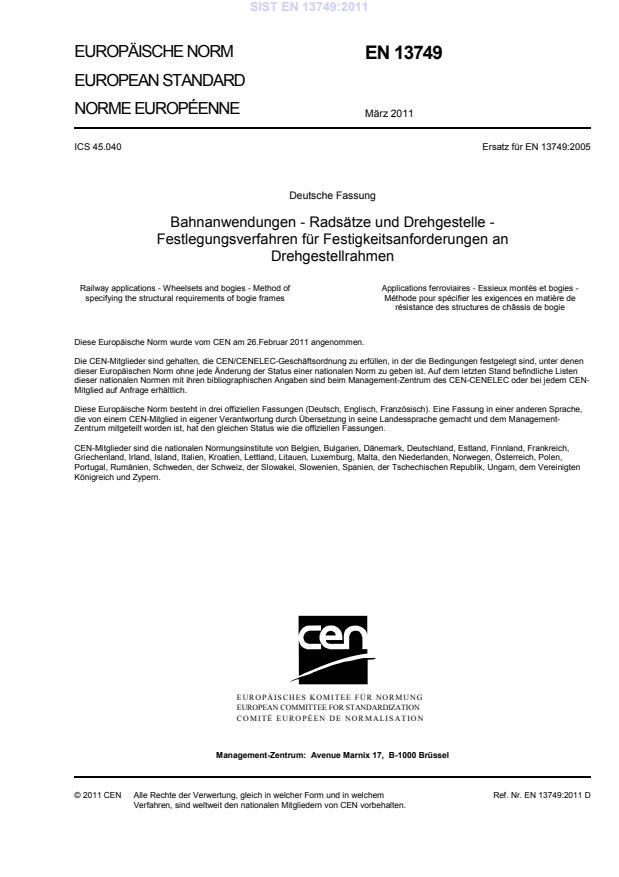
EUROPÄISCHE NORM EUROPEAN STANDARD NORME EUROPÉENNE
EN 13749
März 2011 ICS 45.040 Ersatz für EN 13749:2005Deutsche Fassung
Bahnanwendungen - Radsätze und Drehgestelle - Festlegungsverfahren für Festigkeitsanforderungen an Drehgestellrahmen
Railway applications - Wheelsets and bogies - Method of specifying the structural requirements of bogie frames
Applications ferroviaires - Essieux montés et bogies - Méthode pour spécifier les exigences en matière de résistance des structures de châssis de bogie Diese Europäische Norm wurde vom CEN am 26.Februar 2011 angenommen.
Die CEN-Mitglieder sind gehalten, die CEN/CENELEC-Geschäftsordnung zu erfüllen, in der die Bedingungen festgelegt sind, unter denen dieser Europäischen Norm ohne jede Änderung der Status einer nationalen Norm zu geben ist. Auf dem letzten Stand befindliche Listen dieser nationalen Normen mit ihren bibliographischen Angaben sind beim Management-Zentrum des CEN-CENELEC oder bei jedem CEN-Mitglied auf Anfrage erhältlich.
Diese Europäische Norm besteht in drei offiziellen Fassungen (Deutsch, Englisch, Französisch). Eine Fassung in einer anderen Sprache, die von einem CEN-Mitglied in eigener Verantwortung durch Übersetzung in seine Landessprache gemacht und dem Management-Zentrum mitgeteilt worden ist, hat den gleichen Status wie die offiziellen Fassungen.
CEN-Mitglieder sind die nationalen Normungsinstitute von Belgien, Bulgarien, Dänemark, Deutschland, Estland, Finnland, Frankreich, Griechenland, Irland, Island, Italien, Kroatien, Lettland, Litauen, Luxemburg, Malta, den Niederlanden, Norwegen, Österreich, Polen, Portugal, Rumänien, Schweden, der Schweiz, der Slowakei, Slowenien, Spanien, der Tschechischen Republik, Ungarn, dem Vereinigten Königreich und Zypern.
EUROPÄISCHES KOMITEE FÜR NORMUNG EUROPEAN COMMITTEE FOR STANDARDIZATION
COMITÉ EUROPÉEN DE NORMALISATION
Management-Zentrum:
Avenue Marnix 17,
B-1000 Brüssel © 2011 CEN Alle Rechte der Verwertung, gleich in welcher Form und in welchem Verfahren, sind weltweit den nationalen Mitgliedern von CEN vorbehalten.Ref. Nr. EN 13749:2011 DSIST EN 13749:2011
Verwendete Formelzeichen und Einheiten in den informativen Anhängen.13 A.1 Kräfte.13 A.2 Beschleunigungen.14 A.3 Massen.14 A.4 Weitere Formelzeichen und Einheiten.15 A.5 Koordinatensystem.15 A.6 Drehgestell-Klassifizierung.16 Anhang B (informativ)
Lastfälle.17 Anhang C (informativ)
Lasten beim Fahren des Drehgestells.19 C.1 Allgemeines.19 C.2 Beispiele von Lasten für Drehgestelle von Reisezugwagen und S-Bahnfahrzeugen — Kategorien B-I und B-II.20 C.2.1 Außergewöhnliche Lasten.20 C.2.2 Lasten im Normalbetrieb.21 C.3 Beispiele von Lasten für Güterwagen-Drehgestelle mit einem Drehzapfen und zwei Gleitstücken — Kategorie B-V.21 C.3.1 Drehgestellarten.21 C.3.2 Verhältnis von Vertikalkräften.22 C.3.3 Außergewöhnliche Lasten.22 C.3.4 Lasten im Normalbetrieb.23 C.4 Beispiele von Lasten für Drehgestelle von Lokomotiven (mit zwei Drehgestellen) — Kategorie B-VII.24 C.4.1 Außergewöhnliche Lasten.24 C.4.2 Lasten im Normalbetrieb.24 C.5 Beispiele von Lasten für Drehgestelle von S-, U- , Stadt und Straßenbahnen — Kategorien B-III und B-IV.25 C.5.1 Anwendung.25 C.5.2 Lastfälle.25 C.5.3 Allgemeine Begriffe für die Hauptlastfälle.26 SIST EN 13749:2011
Lasten durch Anbauteile an Drehgestellrahmen.27 D.1 Allgemeines.27 D.2 Trägheitslasten für Anbauteile.27 D.2.1 Ableitung.27 D.2.2 Auslegung der Beschleunigungen für am Drehgestellrahmen angebrachte Ausrüstungsgegenstände.28 D.2.3 Auslegung der Beschleunigungen für am Radsatzlager angebrachte Ausrüstungsgegenstände.28 D.3 Lasten durch viskose Dämpfer.29 D.4 Lasten durch Bremsen.29 D.5 Lasten durch Antriebsmotoren.29 D.6 Auf Wankstützen wirkende Kräfte.30 Anhang E (informativ)
Nachweismethoden und Abnahmekriterien.31 E.1 Allgemeines.31 E.2 Lasten.31 E.3 Analyse und Freigabe.31 E.4 Bauliche Abnahmekriterien.32 E.4.1 Prinzip.32 E.4.2 Ausnutzung.32 E.4.3 Sicherheitsfaktor.33 E.4.4 Werkstofffestigkeitseigenschaften.34 Anhang F (informativ)
Beispiele für statische Versuchsprogramme.38 F.1 Allgemeines.38 F.2 Statische Versuchsprogramme für Drehgestelle von Reisezugwagen, bei denen der Wagenkasten direkt auf den Langträgern gelagert ist (Kategorien B-I und B-II).39 F.2.1 Versuche unter außergewöhnlichen Lasten.39 F.2.2 Versuche unter Lasten im Normalbetrieb.39 F.3 Statisches Versuchsprogramm für Drehgestelle mit Drehzapfen und zwei Gleitstücken (Kategorie BV).41 F.3.1 Drehgestellarten.41 F.3.2 Versuche unter außergewöhnlichen Lasten.41 F.3.3 Versuche unter Lasten im Normalbetrieb.42 F.4 Statisches Versuchsprogramm für Drehgestelle von Lokomotiven.43 F.5 Statisches Versuchsprogramm für Drehgestelle von S-, U- und Straßenbahnen.43 F.5.1 Allgemeines.43 F.5.2 Versuche unter außergewöhnlichen Lasten.43 F.5.3 Versuche unter Lasten im Normalbetrieb.44 Anhang G (informativ)
Beispiele von Ermüdungsversuchsprogrammen.45 G.1 Allgemeines.45 G.2 Ermüdungsversuchsprogramme für Drehgestelle, bei denen der Wagenkasten direkt auf den Langträgern gelagert ist (Kategorien B-I und B-II).46 G.3 Ermüdungsversuchsprogramm für Güterwagen-Drehgestelle mit Drehzapfen und zwei Gleitstücken (Kategorie B-V).49 G.3.1 Allgemeines.49 G.3.2 Vertikale Lasten.49 G.3.3 Querlasten.49 G.4 Ermüdungsversuchsprogramm für Drehgestelle von Lokomotiven (Kategorie B-VII).51 G.5 Ermüdungsversuchsprogramm für Drehgestelle von S-, U- und Straßenbahnen (Kategorie B-IV).51 Anhang ZA (informativ)
Zusammenhang zwischen dieser Europäischen Norm und den grundlegenden Anforderungen der EU-Richtlinie 2008/57/EG.52 Literaturhinweise.55
EN 15085-1, Bahnanwendungen — Schweißen von Schienenfahrzeugen und -fahrzeugteilen — Teil 1: Allgemeines EN 15085-2, Bahnanwendungen — Schweißen von Schienenfahrzeugen und –fahrzeugteilen — Teil 2: Qualitätsanforderungen und Zertifizierung von
Schweißbetrieben EN 15085-3, Bahnanwendungen — Schweißen von Schienenfahrzeugen und -fahrzeugteilen — Teil 3: Konstruktionsvorgaben EN 15085-4, Bahnanwendungen — Schweißen von Schienenfahrzeugen und -fahrzeugteilen — Teil 4: Fertigungsanforderungen EN 15085-5, Bahnanwendungen — Schweißen von Schienenfahrzeugen und -fahrzeugteilen — Teil 5: Prüfung und Dokumentation EN 15663, Bahnanwendungen — Fahrzeugmassedefinitionen
EN 15827:2011, Bahnanwendungen — Anforderungen für Drehgestelle und Fahrwerke
3 Begriffe Für die Anwendung dieses Dokuments gelten die Begriffe nach EN 15827:2011 und die folgenden Begriffe. ANMERKUNG In Anhang A sind Formelzeichen, Einheiten, Koordinatensystem und Drehgestell-Kategorien angegeben, die in den informativen Anhängen dieser Europäischen Norm verwendet werden. 3.1 Radsatzlager Baugruppe einschließlich Lagergehäuse, Wälzlager, Dichtung und Schmierfett
3.2 Drehgestellrahmen tragendes Bauteil, im Allgemeinen zwischen Primär- und Sekundärfederung angeordnet 3.3 Traverse quer verlaufendes tragendes Bauteil zwischen Wagenkasten und Drehgestellrahmen 3.4 statische Kraft Kraft, die zeitlich konstant ist ANMERKUNG
Die Erdanziehungskraft ist ein Beispiel statischer Kraft. SIST EN 13749:2011
3.15 Validierung Verfahren, welches durch Berechnung und/oder Versuch nachweist, dass das zur Diskussion stehende System in jeder Hinsicht die technische Spezifikation erfüllt, einschließlich der Anforderungen aufgrund von Vorschriften für dieses System
3.16 Verifizierung Verfahren, welches durch Vergleich oder Versuch nachweist, dass ein analytisches Ergebnis oder ein Schätzwert eine ausreichende Genauigkeit aufweist SIST EN 13749:2011
ANMERKUNG Falls vorgeschlagen wird, die Dauerfestigkeitsmethode zur Ermüdungsbewertung heranzuziehen, sind die Angaben über Anzahl der Ereignisse nicht erforderlich und es müssen nur die sich wiederholenden extremen Lastzustände festgelegt werden. 4.4 Fahrzeugzustände und Schnittstellen Die technische Spezifikation muss auch folgende Informationen über Anforderungen der EN 15827 zur Auslegung der Drehgestellrahmen enthalten: ⎯ Fahrzeugschnittstellen und Freiräume; ⎯ Begrenzungslinie und Hüllkurve fürs Drehgestell; ⎯ Geometrie der Federung und Anbauteile; ⎯ Schnittstellen zu Antriebs- und Bremsausrüstung sowie sonstiger angebauter Ausrüstung; ⎯ Elektrische und pneumatische Systemanschlüsse; ⎯ Umgebungsbedingungen ⎯ Wartungsanforderungen. SIST EN 13749:2011
ANMERKUNG Um die vollständige Festlegung des Abnahmeverfahrens zu ermöglichen, sollte der Lieferant die Verfahren zum Nachweis der Anforderungserfüllung angeben, wenn diese nicht in der technischen Spezifikation enthalten sind. SIST EN 13749:2011
Zusätzlich zu den allgemeinen Anforderungen für Validierungsaufzeichnungen in 6.2.1 müssen die Berichte statischer Laborversuche Folgendes enthalten: ⎯ Dokumentation des ausgeführten Versuchsprogramms einschließlich Größen und Kombinationen, Richtung und Lage der Lasten (Nennwerte und tatsächlich aufgebrachte Werte); ⎯ Dokumentation für Versuchsaufbau einschließlich Vorrichtungen und Aktuatoren (Betätigungszylinder) und allen innewohnenden Vereinfachungen und Einschränkungen; ⎯ Dokumentation für Messausrüstung, einschließlich Typ und Einsatzstelle für Sensoren (Dehnmess-streifen, Kraftmessdosen, Wegaufnehmer usw.) und die dazugehörigen Kalibrierzertifikate. ⎯ Bewertungsverfahren und Interpretation für die gemessenen Dehnungen/Spannungen und zulässige Werte; ⎯ Ausnutzungsergebnisse der einzelnen Messstellen. Die in den Versuchen aufgebrachten Lasten müssen auf den Auslegungslastfällen basieren. Anhang F zeigt allgemeine Betrachtungen und gibt Beispiele für statische Versuchsprogramme an. Diese Daten können wiederum nicht generell angewendet werden, da die Lastfälle Unterschiede bei Drehgestellfederung oder Wagenkastencharakteristik nicht berücksichtigen. Daher darf diesen Beispielen nur entsprochen werden, wenn sie als geeignet dargestellt werden können. 6.2.4 Ermüdungsversuche Der Zweck von Ermüdungsversuchen wird in Anhang G.1 beschrieben.
Zusätzlich zu den allgemeinen Anforderungen für Validierungsaufzeichnungen in 6.2.1 müssen die Berichte für Ermüdungsversuche im Labor Folgendes enthalten: ⎯ Dokumentation des ausgeführten Versuchsprogramms einschließlich Größen und Kombinationen, Richtung und Lage der Lasten, Anzahl der Lastwechsel (Nennwerte und tatsächliche aufgebrachte Werte); ⎯ Dokumentation des Versuchsaufbaus einschließlich Vorrichtungen und Aktuatoren und allen innewohnenden Vereinfachungen und Einschränkungen; ⎯ Dokumentation der Messausrüstung, einschließlich Typ und Messstelle der Sensoren (Dehnmessstreifen, Kraftmessdosen usw.) und die dazugehörigen Kalibrierzertifikate; ⎯ Abnahmekriterien (einschließlich Ablaufpläne und Methoden zerstörungsfreier Prüfung); ⎯ Prüfprotokolle für zerstörungsfreie Prüfung; ⎯ Ergebnisauslegung in Bezug auf die Abnahmekriterien. Das Ermüdungsversuchsprogramm muss für die spezifische Anwendung festgelegt werden. Anhang G enthält allgemeine Hinweise und Beispiele für Programme von Ermüdungsversuchen. So wie für die statischen Versuche berücksichtigen diese Programme weder Unterschiede in der Drehgestellaufhängung noch der Wagenkastencharakteristik und dürfen nur angewendet werden, wenn gezeigt werden kann, dass sie dafür geeignet sind. SIST EN 13749:2011
Verwendete Formelzeichen und Einheiten in den informativen Anhängen ANMERKUNG Gewisse in dieser Norm verwendete Formelzeichen können eine unterschiedliche Bedeutung zu denen in ähnlichen Normen haben (z. B. EN 13103, EN 13104 und EN 13979-1). A.1 Kräfte Tabelle A.1 — Kräfte Formelzeichen Kraft N Lage Statisch Quasi-statisch Dynamisch Auf Drehgestell wirkende Kraft Fz
Kraft auf Langträger 1 oder Gleitstück 1 Fz1
Fz1qs Fz1d Kraft auf Langträger 2 oder Gleitstück 2 Fz2
Fz2qs Fz2d Kraft auf Drehzapfen Fzp Fzpqs Fzpd Vertikal Kraft auf Schwerpunkt (Wagenkasten)
Fzc
Auf Drehgestell wirkende Kraft Fy
Kraft auf Radsatz 1 Fy1 Fy1qs Fy1d Kraft auf Radsatz 2 Fy2 Fy2qs Fy2d Kraft auf Schwerpunkt (Wagenkasten)
Fyc
Quer Windkraft Fw1
Kraft auf jedes Rad Fx1
Kraft auf Schwerpunkt (Wagenkasten) Fxc
Längs Kraft auf Schwerpunkt (Fahrwerk)
Fx
A.3 Massen Tabelle A.3 — Massen Masse kg Formelzeichen Betriebsbereites Fahrzeug Mv Fahrzeug-Wagenkasten m1 Drehgestellmasse ohne Sekundärfedermassen (falls vorhanden) m+ Drehgestell-Primärfederungsmasse m2 Außergewöhnliche Zuladung P1 Zuladung im Normalbetrieb P2
Die Werte für vorstehe
...