

EN 13936:2014
(Main)Workplace exposure - Procedures for measuring a chemical agent present as a mixture of airborne particles and vapour - Requirements and test methods
- Abstract
This European Standard specifies performance requirements and test methods for the evaluation of procedures for measuring a chemical agent present as a mixture of airborne particles and vapour in workplace air.
This European Standard establishes general principles to enable developers and users of mixed-phase samplers and methods to adopt a consistent approach to method validation and provides a framework for the assessment of method performance in accordance with EN 482.
Annex A of this European Standard gives guidance on possible approaches to sample mixtures of airborne particles and vapour and Annex B gives information about their physical behaviour.
This European Standard is not applicable to methods that differentiate between the sampled airborne particles and vapour.
This European Standard is not applicable to a chemical agent present in different chemical and physical forms (for example, mercury in the form of Hg (0) and Hg (II)).
- Status
- Withdrawn
- Publication Date
- 21-Jan-2014
- Withdrawal Date
- 06-Oct-2026
- Technical Committee
- CEN/TC 137 - Assessment of workplace exposure
- Drafting Committee
- CEN/TC 137/WG 2 - General requirements for measuring procedures
- Current Stage
- 9960 - Withdrawal effective - Withdrawal
- Start Date
- 26-Oct-2022
- Completion Date
- 07-Oct-2026

Relations
- Effective Date
- 09-Nov-2022
- Effective Date
- 28-Jan-2026
- Effective Date
- 28-Jan-2026
- Effective Date
- 28-Jan-2026
- Effective Date
- 28-Jan-2026
- Effective Date
- 28-Jan-2026
- Effective Date
- 28-Jan-2026
- Effective Date
- 28-Jan-2026
- Effective Date
- 28-Jan-2026
Get Certified
Connect with accredited certification bodies for this standard

CIS Institut d.o.o.
Personal Protective Equipment (PPE) certification body. Notified Body NB-2890 for EU Regulation 2016/425 PPE.

Kiwa BDA Testing
Building and construction product certification.
Kmetijski inštitut Slovenije
Agricultural Institute of Slovenia. Soil testing, plant health, agricultural product analysis.
Sponsored listings
Frequently Asked Questions
EN 13936:2014 is a standard published by the European Committee for Standardization (CEN). Its full title is "Workplace exposure - Procedures for measuring a chemical agent present as a mixture of airborne particles and vapour - Requirements and test methods". This standard covers: This European Standard specifies performance requirements and test methods for the evaluation of procedures for measuring a chemical agent present as a mixture of airborne particles and vapour in workplace air. This European Standard establishes general principles to enable developers and users of mixed-phase samplers and methods to adopt a consistent approach to method validation and provides a framework for the assessment of method performance in accordance with EN 482. Annex A of this European Standard gives guidance on possible approaches to sample mixtures of airborne particles and vapour and Annex B gives information about their physical behaviour. This European Standard is not applicable to methods that differentiate between the sampled airborne particles and vapour. This European Standard is not applicable to a chemical agent present in different chemical and physical forms (for example, mercury in the form of Hg (0) and Hg (II)).
This European Standard specifies performance requirements and test methods for the evaluation of procedures for measuring a chemical agent present as a mixture of airborne particles and vapour in workplace air. This European Standard establishes general principles to enable developers and users of mixed-phase samplers and methods to adopt a consistent approach to method validation and provides a framework for the assessment of method performance in accordance with EN 482. Annex A of this European Standard gives guidance on possible approaches to sample mixtures of airborne particles and vapour and Annex B gives information about their physical behaviour. This European Standard is not applicable to methods that differentiate between the sampled airborne particles and vapour. This European Standard is not applicable to a chemical agent present in different chemical and physical forms (for example, mercury in the form of Hg (0) and Hg (II)).
EN 13936:2014 is classified under the following ICS (International Classification for Standards) categories: 13.040.30 - Workplace atmospheres. The ICS classification helps identify the subject area and facilitates finding related standards.
EN 13936:2014 has the following relationships with other standards: It is inter standard links to EN ISO 23861:2022, EN 1540:2011, EN ISO 22065:2020, EN ISO 21832:2020, EN 13205-1:2014, EN ISO 13137:2022, EN 482:2021, EN 481:1993, EN 13710:2011. Understanding these relationships helps ensure you are using the most current and applicable version of the standard.
EN 13936:2014 is available in PDF format for immediate download after purchase. The document can be added to your cart and obtained through the secure checkout process. Digital delivery ensures instant access to the complete standard document.
Standards Content (Sample)
2003-01.Slovenski inštitut za standardizacijo. Razmnoževanje celote ali delov tega standarda ni dovoljeno.HQVRYExposition am Arbeitsplatz - Messung eines als Mischung aus luftgetragenen Partikeln und Dampf vorliegenden chemischen Arbeitsstoffes - Anforderungen und PrüfverfahrenExposition sur les lieux de travail - Mesurage de l'agent chimique sous forme de mélange de particules aériennes et de vapeur - Exigences et méthodes d'essaiWorkplace exposure - Procedures for measuring a chemical agent present as a mixture of airborne particles and vapour - Requirements and test methods13.040.30Kakovost zraka na delovnem mestuWorkplace atmospheresICS:Ta slovenski standard je istoveten z:EN 13936:2014SIST EN 13936:2014en,fr,de01-julij-2014SIST EN 13936:2014SLOVENSKI
STANDARD
EUROPEAN STANDARD NORME EUROPÉENNE EUROPÄISCHE NORM
EN 13936
January 2014 ICS 13.040.30 English Version
Workplace exposure - Procedures for measuring a chemical agent present as a mixture of airborne particles and vapour - Requirements and test methods
Exposition sur les lieux de travail - Mesurage de l'agent chimique sous forme de mélange de particules aériennes et de vapeur - Exigences et méthodes d'essai
Exposition am Arbeitsplatz - Messung eines als Mischung aus luftgetragenen Partikeln und Dampf vorliegenden chemischen Arbeitsstoffes - Anforderungen und Prüfverfahren This European Standard was approved by CEN on 30 November 2013.
CEN members are bound to comply with the CEN/CENELEC Internal Regulations which stipulate the conditions for giving this European Standard the status of a national standard without any alteration. Up-to-date lists and bibliographical references concerning such national standards may be obtained on application to the CEN-CENELEC Management Centre or to any CEN member.
This European Standard exists in three official versions (English, French, German). A version in any other language made by translation under the responsibility of a CEN member into its own language and notified to the CEN-CENELEC Management Centre has the same status as the official versions.
CEN members are the national standards bodies of Austria, Belgium, Bulgaria, Croatia, Cyprus, Czech Republic, Denmark, Estonia, Finland, Former Yugoslav Republic of Macedonia, France, Germany, Greece, Hungary, Iceland, Ireland, Italy, Latvia, Lithuania, Luxembourg, Malta, Netherlands, Norway, Poland, Portugal, Romania, Slovakia, Slovenia, Spain, Sweden, Switzerland, Turkey and United Kingdom.
EUROPEAN COMMITTEE FOR STANDARDIZATION
COMITÉ EUROPÉEN DE NORMALISATION EUROPÄISCHES KOMITEE FÜR NORMUNG
CEN-CENELEC Management Centre:
Avenue Marnix 17,
B-1000 Brussels © 2014 CEN All rights of exploitation in any form and by any means reserved worldwide for CEN national Members. Ref. No. EN 13936:2014 ESIST EN 13936:2014
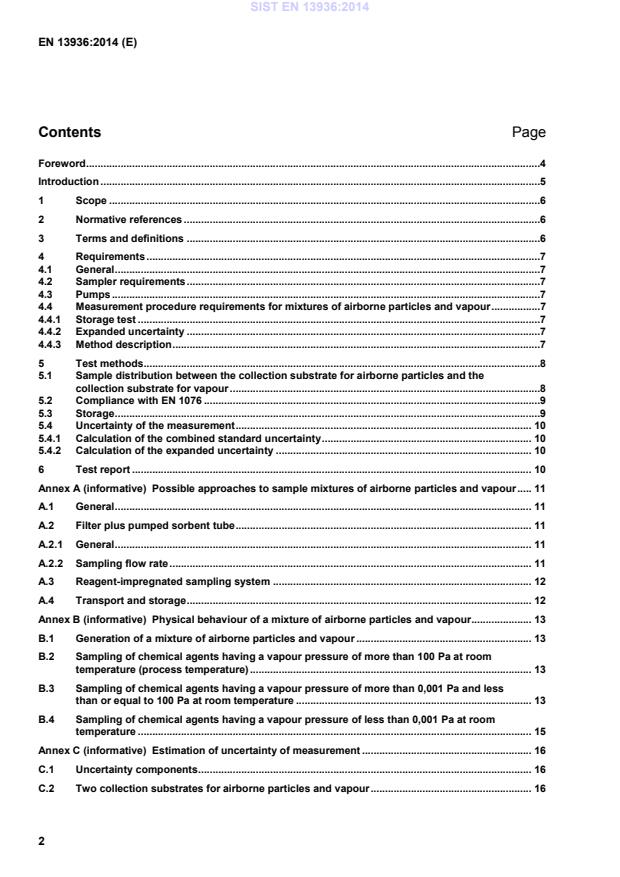
Possible approaches to sample mixtures of airborne particles and vapour . 11 A.1 General . 11 A.2 Filter plus pumped sorbent tube . 11 A.2.1 General . 11 A.2.2 Sampling flow rate . 11 A.3 Reagent-impregnated sampling system . 12 A.4 Transport and storage . 12 Annex B (informative)
Physical behaviour of a mixture of airborne particles and vapour . 13 B.1 Generation of a mixture of airborne particles and vapour . 13 B.2 Sampling of chemical agents having a vapour pressure of more than 100 Pa at room temperature (process temperature) . 13 B.3 Sampling of chemical agents having a vapour pressure of more than 0,001 Pa and less than or equal to 100 Pa at room temperature . 13 B.4 Sampling of chemical agents having a vapour pressure of less than 0,001 Pa at room temperature . 15 Annex C (informative)
Estimation of uncertainty of measurement . 16 C.1 Uncertainty components . 16 C.2 Two collection substrates for airborne particles and vapour . 16 SIST EN 13936:2014
1) To be published. SIST EN 13936:2014
or recommended sampling time 2 times limit value short-term 1 time limit value e.g. 15 min 5.1.2 Perform sample distribution tests under each of the following two combinations of test conditions: — relative humidity: (50 ± 5) %; — temperature: (10 ± 2) °C and (40 ± 2) °C; — flow rate: recommended flow rate. NOTE One way to obtain air with the required conditions of temperature and relative humidity is to use a climatic test chamber as defined in EN 60068–3–11. 5.1.3 Set up at least six mixed-phase samplers per test and add a known mass of analyte to each collection substrate or, where the mixed-phase sampler includes more than one collection substrate, to each of the first collection substrates. Add the analyte using a micropipette or syringe, if necessary, with the analyte diluted in a non-interfering solvent. 5.1.4 Immediately after adding the analyte, draw air through the mixed-phase samplers under the prescribed test conditions. SIST EN 13936:2014
Possible approaches to sample mixtures of airborne particles and vapour A.1 General General considerations for the sampling of mixtures of airborne particles and vapour have been reviewed by PEREZ and SODERHOLM (see [1]). Sampling mixtures of airborne particles and vapour require an efficient combination of an airborne particle collector placed in series with a vapour collector. According to EN 481, the aspiration characteristics of system inlets are required to follow the inhalable sampling convention. This limits the design flow rate of the devices and their inlet geometry. In general, it will not be possible to quantify the distribution of (airborne) particle and vapour components separately at the moment of sampling, unless specific conditions are met, e.g. the particle component is non-volatile. For the sampling of mixtures of airborne particles and vapour, filter plus pumped sorbent tube (see A.2) and reagent-impregnated systems (see A.3) are most commonly used. Other systems, e.g. denuder and filter or impinger and filter, can be used alternatively for specific chemical agents. A.2 Filter plus pumped sorbent tube A.2.1 General A filter is a particle collection substrate which is used in combination with a device that samples the inhalable fraction according to EN 481. A sorbent tube mounted in series is used to sample vapour. This sampling train will require a specified design flow rate that cannot be altered unless it has been demonstrated to meet the performance requirements for inhalable samplers at other flow rates. In general, a sorbent tube requires a lower flow rate in order to meet the performance requirements for pumped sorbent tubes (such as breakthrough volume). To combine the sorbent tube and the inhalable sampler, for example, the flow downstream of the filter can be split in order to achieve the desired value. The flow split can only be maintained without active flow control if the pressure drop across the sorbent tube remains constant during the sampling period. Volatile and semi-volatile compounds (particles) collected on the filter can evaporate when air is drawn through the sampler. Some chemical agents in vapour form can also be adsorbed by the filter or particles collected on the filter. Thus the original separation of the chemical agents between the particle and vapour phases cannot always be preserved, only the sum of particles and vapour can be quantified. A.2.2 Sampling flow rate Inhalable samp
...