

EN 15316-3-2:2007
(Main)Heating systems in buildings - Method for calculation of system energy requirements and system efficiencies - Part 3-2: Domestic hot water systems, distribution
- Abstract
This European Standard is part of a set of standards covering methods for calculation of system energy requirements and system efficiencies of heating systems in buildings. In particular this European Standard is one of a number of standards dealing with domestic hot water systems.
The scope of this specific part is to standardise the methods for calculation of:
- thermal losses from the domestic hot water distribution system;
- recoverable thermal losses for space heating from the domestic hot water distribution system;
- auxiliary energy of the domestic hot water distribution system.
These values are input data for calculation of the overall energy use according to prEN 15603 and
EN 15316-1.
This European Standard specifies the:
- inputs;
- calculation methods;
outputs.
- Status
- Withdrawn
- Publication Date
- 02-Oct-2007
- Withdrawal Date
- 06-Oct-2026
- Technical Committee
- CEN/TC 228 - Heating systems in buildings
- Current Stage
- 9960 - Withdrawal effective - Withdrawal
- Start Date
- 26-Apr-2017
- Completion Date
- 07-Oct-2026



Relations
- Effective Date
- 23-Oct-2013
- Effective Date
- 28-Jan-2026
Get Certified
Connect with accredited certification bodies for this standard

DIBt (Deutsches Institut für Bautechnik)
German Institute for Building Technology.
DIN CERTCO
DIN Group product certification.

Aboma Certification B.V.
Specialized in construction, metal, and transport sectors.
Sponsored listings
Frequently Asked Questions
EN 15316-3-2:2007 is a standard published by the European Committee for Standardization (CEN). Its full title is "Heating systems in buildings - Method for calculation of system energy requirements and system efficiencies - Part 3-2: Domestic hot water systems, distribution". This standard covers: This European Standard is part of a set of standards covering methods for calculation of system energy requirements and system efficiencies of heating systems in buildings. In particular this European Standard is one of a number of standards dealing with domestic hot water systems. The scope of this specific part is to standardise the methods for calculation of: - thermal losses from the domestic hot water distribution system; - recoverable thermal losses for space heating from the domestic hot water distribution system; - auxiliary energy of the domestic hot water distribution system. These values are input data for calculation of the overall energy use according to prEN 15603 and EN 15316-1. This European Standard specifies the: - inputs; - calculation methods; outputs.
This European Standard is part of a set of standards covering methods for calculation of system energy requirements and system efficiencies of heating systems in buildings. In particular this European Standard is one of a number of standards dealing with domestic hot water systems. The scope of this specific part is to standardise the methods for calculation of: - thermal losses from the domestic hot water distribution system; - recoverable thermal losses for space heating from the domestic hot water distribution system; - auxiliary energy of the domestic hot water distribution system. These values are input data for calculation of the overall energy use according to prEN 15603 and EN 15316-1. This European Standard specifies the: - inputs; - calculation methods; outputs.
EN 15316-3-2:2007 is classified under the following ICS (International Classification for Standards) categories: 91.140.10 - Central heating systems. The ICS classification helps identify the subject area and facilitates finding related standards.
EN 15316-3-2:2007 has the following relationships with other standards: It is inter standard links to EN 15316-3:2017, EN 15232:2012. Understanding these relationships helps ensure you are using the most current and applicable version of the standard.
EN 15316-3-2:2007 is associated with the following European legislation: Standardization Mandates: M/343. When a standard is cited in the Official Journal of the European Union, products manufactured in conformity with it benefit from a presumption of conformity with the essential requirements of the corresponding EU directive or regulation.
EN 15316-3-2:2007 is available in PDF format for immediate download after purchase. The document can be added to your cart and obtained through the secure checkout process. Digital delivery ensures instant access to the complete standard document.
Standards Content (Sample)
2003-01.Slovenski inštitut za standardizacijo. Razmnoževanje celote ali delov tega standarda ni dovoljeno.Heating systems in buildings - Method for calculation of system energy requirements and system efficiencies - Part 3-2: Domestic hot water systems, distributionXþLQNRYLWRVWLSystemes de chauffage dans les bâtiments - Méthode de calcul des exigences énergétiques et des rendements du systeme - Partie 3.2 : Systemes d'eau chaude domestique, distributionHeizsysteme in Gebäuden - Verfahren zur Berechnung der Energieanforderungen und Nutzungsgrade der Anlagen - Teil 3-2: Trinkwassererwärmung, VerteilungTa slovenski standard je istoveten z:EN 15316-3-2:2007SIST EN 15316-3-2:2007en,de91.140.10Sistemi centralnega ogrevanjaCentral heating systemsICS:SLOVENSKI
STANDARDSIST EN 15316-3-2:200701-december-2007
EUROPEAN STANDARDNORME EUROPÉENNEEUROPÄISCHE NORMEN 15316-3-2October 2007ICS 91.140.10 English VersionHeating systems in buildings - Method for calculation of systemenergy requirements and system efficiencies - Part 3-2:Domestic hot water systems, distributionSystèmes de chauffage dans les bâtiments - Méthode decalcul des besoins énergétiques et des rendements dessystèmes - Partie 3-2 : Systèmes de production d'eauchaude sanitaire, distributionHeizungsanlagen in Gebäuden - Verfahren zur Berechnungder Energieanforderungen und Nutzungsgrade der Anlagen- Teil 3-2: Trinkwassererwärmung, VerteilungThis European Standard was approved by CEN on 18 August 2007.CEN members are bound to comply with the CEN/CENELEC Internal Regulations which stipulate the conditions for giving this EuropeanStandard the status of a national standard without any alteration. Up-to-date lists and bibliographical references concerning such nationalstandards may be obtained on application to the CEN Management Centre or to any CEN member.This European Standard exists in three official versions (English, French, German). A version in any other language made by translationunder the responsibility of a CEN member into its own language and notified to the CEN Management Centre has the same status as theofficial versions.CEN members are the national standards bodies of Austria, Belgium, Bulgaria, Cyprus, Czech Republic, Denmark, Estonia, Finland,France, Germany, Greece, Hungary, Iceland, Ireland, Italy, Latvia, Lithuania, Luxembourg, Malta, Netherlands, Norway, Poland, Portugal,Romania, Slovakia, Slovenia, Spain, Sweden, Switzerland and United Kingdom.EUROPEAN COMMITTEE FOR STANDARDIZATIONCOMITÉ EUROPÉEN DE NORMALISATIONEUROPÄISCHES KOMITEE FÜR NORMUNGManagement Centre: rue de Stassart, 36
B-1050 Brussels© 2007 CENAll rights of exploitation in any form and by any means reservedworldwide for CEN national Members.Ref. No. EN 15316-3-2:2007: E
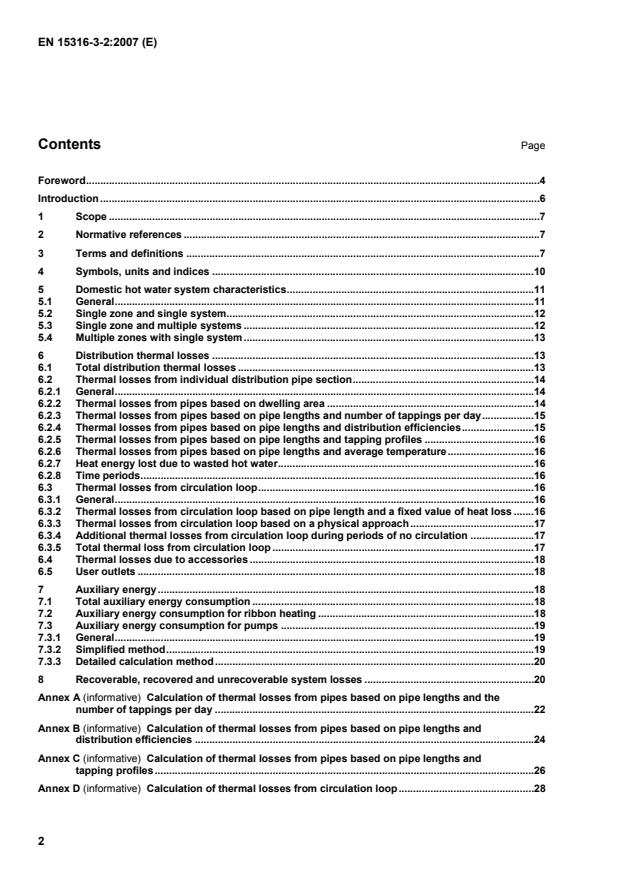
Calculation of thermal losses from pipes based on pipe lengths and the number of tappings per day.22 Annex B (informative)
Calculation of thermal losses from pipes based on pipe lengths and distribution efficiencies.24 Annex C (informative)
Calculation of thermal losses from pipes based on pipe lengths and tapping profiles.26 Annex D (informative)
Calculation of thermal losses from circulation loop.28
Calculation of thermal losses from user outlets.35 Annex F (informative)
Calculation of auxiliary energy requirement of a circulation pump.36 F.1 Simplified method for calculation of auxiliary energy requirement of a circulation pump.36 F.2 Detailed method for calculation of auxiliary energy requirement of a circulation pump.36 F.2.1 Hydraulic energy requirement.36 F.2.2 Hydraulic power required by the pump.36 F.2.3 Duration of the provision of domestic hot water.37 F.2.4 Pump performance coefficient.38 F.2.5 Intermittent pump operation.39 F.2.6 Expenditure value coefficient.39 F.3 Auxiliary energy recoverable factor.40 Bibliography.41
EN 15316-1. This European Standard specifies the: inputs; calculation methods; outputs. 2 Normative references The following referenced documents are indispensable for the application of this document. For dated references, only the edition cited applies. For undated references, the latest edition of the referenced document (including any amendments) applies. Not applicable 3 Terms and definitions For the purposes of this document, the following terms and definitions apply. 3.1 auxiliary energy electrical energy used by technical building systems for heating, cooling, ventilation and/or domestic hot water to support energy transformation to satisfy energy needs NOTE 1 This includes energy for fans, pumps, electronics etc. Electrical energy input to a ventilation system for air transport and heat recovery is not considered as auxiliary energy, but as energy use for ventilation. NOTE 2 In EN ISO 9488, the energy used for pumps and valves is called "parasitic energy". 3.2 building construction as a whole, including its envelope and all technical building systems, for which energy is used to condition the indoor climate, to provide domestic hot water and illumination and other services related to the use of the building NOTE The term can refer to the building as a whole or to parts thereof that have been designed or altered to be used separately.
J/(kg K) e system performance coefficient (expenditure factor) - D diameter m f conversion factor
- h height m L length m m mass
kg n
number of operating times -
t time, period of time
s Q quantity of heat, energy
J φ thermal power
W P electrical power W ψ heat loss coefficient
W/mK V volume
m3 W auxiliary (electrical) energy
J . energy loss factor - η efficiency
- θ celsius temperature
°C
heat conductivity
W/mK Table 2 — Indices amb ambient gen generation nom nominal avg average hs heated space on
circulation B building hydr hydraulic off
no circulation col circulation loop (collective) in input to system out output from system dis distribution ind individual pmp pump e external int internal rib trace heating em emission ls losses tap deliveries f floor nhs non heated space W domestic hot water
Figure 1.
Key
generation
storage
distribution
emission
Figure 1 — Basic domestic hot water system components If the building is used for different applications or is divided between different users, the method can be applied to the entire building or to part of the building, as required. The calculation method can also be applied to a building or to part of a building, where there is more than one domestic hot water system installed. For the
Figure 2). In non-domestic buildings, the installation depends on the building sector.
Figure 2 — Domestic hot water system, single zone and multiple systems Calculation of system losses shall be carried out separately for each system. The total system loss for the zone is the sum of the system losses of each system. Each distribution system shall be kept separate in order to define the heat load on the heat generator along with the corresponding domestic hot water demand.
Figure 3 — Domestic hot water system, multiple zones and single system The total system loss is calculated for the system, and the total thermal loss is the sum of thermal losses of each zone. 6 Distribution thermal losses 6.1 Total distribution thermal losses For the calculations, the distribution system is considered divided into two parts: a circulation loop, if present, and the individual distribution pipes to the user outlet or outlets. The thermal losses of each part are calculated separately. The total thermal loss lsdisWQ,, of the distribution system is calculated by adding the thermal losses of each part as follows: collsdisWindlsdisWindlsdisWQQQ,,,,,,,,+=∑ (MJ/day) (1) where ∑indindlsdisWQ,,, is the sum of thermal loss from the individual distribution pipes of the distribution system (no circulation loop), MJ/day;
is the specific mass of water (kg/m3); wc
is the specific heat capacity of water (kJ/kg⋅K); disWV,
is the volume of water contained in the pipes (m3); ambθ
is the average ambient temperature around the pipes (°C); nomdisW,,θ is the nominal hot water temperature in the pipes (°C); tapn
is the number of hot water draw-offs during a day. Details on this method shall be given in a national annex. It is possible to take into account other parameters, e.g. the thermal capacity of the pipes. An example is described in Annex A. It is possible also to include the thermal losses from the user outlets in this method. A reduction of thermal losses in case of short intervals between the tapping cycles is not taken into account in this calculation method. If this is to be considered, details shall be given in a national annex, and for this purpose, the effect of pipe insulation on thermal losses shall be taken into account. An example is described in Annex A. 6.2.4 Thermal losses from pipes based on pipe lengths and distribution efficiencies This method is based on estimates of proportion of the heat energy reaching the user outlets for different pipe lengths. A distinction is made between supplies to kitchens and supplies to bathrooms. Detailed knowledge of the domestic hot water distribution system is not required for this method, however, an approximation of the length and diameter of each of the delivery pipes shall be made. The proportion of heat energy reaching the user outlets is tabulated against pipe lengths and diameters. This method is applicable only for domestic hot water distribution pipes that are not part of a circulation loop. If this method is applicable, details for the calculation and suitable tabulated values shall be given in a national annex. A table of default values is given in Annex B.
is the specific mass of water (kg/m3); wc
is the specific heat capacity of water (kJ/kg⋅K); idisWV,,
is the volume of water contained in pipe section i (m3); nnorm
is the number of circulation pump operating cycles during a day. 6.3.5 Total thermal loss from circulation loop The total thermal loss from a circulation loop is the sum of thermal losses during periods of circulation and thermal losses during periods of no circulation: offcollsdisWoncollsdisWcollsdisWQQQ,,,,,,,,,,,+= (MJ/day) (5) The weekly, monthly or annual thermal losses are obtained by multiplying the thermal loss per day by the appropriate number of days.
is the hydraulic energy requirement (MJ/day); pmpdisWe,,
is the performance coefficient for circulation pump (-). Details of the method are given in F.2. The weekly, monthly or annual auxiliary energy consumptions are obtained by multiplying the auxiliary energy consumption per day by the appropriate number
...