


EN 15355:2008+A1:2010
(Main)Railway applications - Braking - Distributor valves and distributor-isolating devices
Railway applications - Braking - Distributor valves and distributor-isolating devices
This European Standard applies to distributor valves and distributor-isolating devices.
The distributor valves contained in this European Standard are of graduated release type. Direct release types are not included.
Functionally they are regarded as not containing relay valves of any type, even if the relay valves are physically an integral part of the distributor valves.
This European Standard applies to both distributor-isolating devices mounted separate from the distributor valve and distributor-isolating devices integral with the distributor valve.
This European Standard specifies the requirements for the design, testing and quality assurance of distributor valves and distributor-isolating devices.
For interoperable freight wagons, these devices which are operated by compressed air according to EN 14198 are assessed according to the respective technical specification of interoperability.
Bahnanwendungen - Bremse - Steuerventile und Bremsabsperreinrichtungen
Dieses Dokument gilt für Steuerventile, die nach den TSI Spezifikationen als Interoperabilitätskomponenten für Druckluftbremsen von interoperablen Schienenfahrzeugen, die durch Druckluft betätigt werden, bewertet werden.
Die Steuerventile, wie sie in diesem Dokument enthalten sind, sind von mehrlösiger Bauart. Einlösige Ventile werden nicht behandelt.
Die Betrachtung der Funktionen erfolgt so als ob kein Relaisventil enthalten wäre, auch wenn die Relaisventile physikalisch in das Steuerventil integriert sein können.
Dieses Dokument definiert die Anforderungen an Konstruktion, Abmessungen, Prüfung und Qualitätssicherung des Steuerventiles. Diese Anforderungen können nicht ausreichend genau beschrieben werden, um die fachgerechte Herstellung oder zweckmäßige Konstruktion sicherzustellen. Daher ist jeder Hersteller dafür verantwortlich, alle notwendigen Schritte zu unternehmen, die die Qualität von Konstruktion, Bearbeitung und Herstellung im Einklang mit fachgerechter Ingenieurspraxis sowie ausreichender Fertigungsqualität sicherstellen.
Applications ferroviaires - Freinage - Distributeurs de freinage et robinet d'isolement
Le présent document s’applique aux distributeurs de freinage et aux robinets d’isolement.
Les distributeurs de freinage décrits dans la présente norme européenne sont de type à desserrage gradué.
Les types à desserrage direct ne sont pas couverts.
Sur un plan fonctionnel, ils sont considérés comme ne comportant pas de relais pneumatique d’aucune sorte, même
si les relais pneumatiques font partie intégrante des distributeurs de freinage.
La présente norme européenne s’applique aux robinets d’isolements montés séparément du distributeur de freinage
ainsi qu’aux robinets d’isolement intégrés au distributeur de freinage.
Elle spécifie les exigences à respecter pour la conception, les essais et l’assurance qualité des distributeurs
de freinage et des robinets d’isolement.
Pour les wagons de marchandises interopérables, ces dispositifs fonctionnant à l’air comprimé conformément
à l’EN 14198, sont évalués selon les Spécifications Techniques d’Interopérabilité concernées.
Železniške naprave - Zavore - Krmilni ventili in naprave za ločitev krmilnih ventilov od zavornega voda
Ta evropski standard velja za krmilne ventile in naprave za ločitev krmilnih ventilov od zavornega voda. Krmilni ventili, ki jih vključuje ta evropski standard, so ventili s postopnim razbremenjevanjem. Ventili z neposrednim razbremenjevanjem niso vključeni. Glede njihove funkcionalnost velja, da ne vsebujejo relejnih ventilov, tudi če so ti fizično integralni del krmilnih ventilov. Ta evropski standard velja za naprave za ločitev krmilnih ventilov od zavornega voda, nameščene ločeno od krmilnega ventila, in za naprave za ločitev krmilnih ventilov od zavornega voda, integrirane s krmilnim ventilom. Ta evropski standard določa zahteve za načrtovanje, preskušanje in zagotavljanje kakovosti krmilnih ventilov in naprav za ločitev krmilnih ventilov od zavornega voda. Pri medobratovalnih tovornih vagonih se naprave, ki delujejo na stisnjeni zrak v skladu z EN 14198, ocenjujejo glede na ustrezno tehnično specifikacijo medobratovalnosti.
General Information
- Status
- Withdrawn
- Publication Date
- 05-Oct-2010
- Withdrawal Date
- 10-Feb-2026
- Technical Committee
- CEN/TC 256 - Railway applications
- Drafting Committee
- CEN/TC 256/SC 3/WG 24 - Components
- Current Stage
- 9960 - Withdrawal effective - Withdrawal
- Start Date
- 15-May-2019
- Completion Date
- 11-Feb-2026
- Directive
- Not Harmonized2008/57/EC - DIRECTIVE 2008/57/EC OF THE EUROPEAN PARLIAMENT AND OF THE COUNCIL of 17 June 2008 on the interoperability of the rail system within the Community (Recast)OJ Ref: C 214, C 214, C 214, C 214, C 214, C 214, C 214, C OJ Date: 20-Jul-2011
Relations
- Effective Date
- 18-Jan-2023
- Effective Date
- 14-Aug-2010
- Effective Date
- 08-Jun-2022
- Effective Date
- 09-Feb-2026
- Effective Date
- 09-Feb-2026
- Effective Date
- 09-Feb-2026
- Effective Date
- 28-Jan-2026
- Effective Date
- 28-Jan-2026



Get Certified
Connect with accredited certification bodies for this standard

Bureau Veritas Railway Certification
Railway and transportation certification.

Deutsch Quality Systems (India) Pvt. Ltd. (DQS India)
Subsidiary of DQS Holding GmbH, founding member of IQNet. CDSCO Notified Body.

Excellence Ireland Quality Association (EIQA)
Irish quality certification organization.
Sponsored listings
Frequently Asked Questions
EN 15355:2008+A1:2010 is a standard published by the European Committee for Standardization (CEN). Its full title is "Railway applications - Braking - Distributor valves and distributor-isolating devices". This standard covers: This European Standard applies to distributor valves and distributor-isolating devices. The distributor valves contained in this European Standard are of graduated release type. Direct release types are not included. Functionally they are regarded as not containing relay valves of any type, even if the relay valves are physically an integral part of the distributor valves. This European Standard applies to both distributor-isolating devices mounted separate from the distributor valve and distributor-isolating devices integral with the distributor valve. This European Standard specifies the requirements for the design, testing and quality assurance of distributor valves and distributor-isolating devices. For interoperable freight wagons, these devices which are operated by compressed air according to EN 14198 are assessed according to the respective technical specification of interoperability.
This European Standard applies to distributor valves and distributor-isolating devices. The distributor valves contained in this European Standard are of graduated release type. Direct release types are not included. Functionally they are regarded as not containing relay valves of any type, even if the relay valves are physically an integral part of the distributor valves. This European Standard applies to both distributor-isolating devices mounted separate from the distributor valve and distributor-isolating devices integral with the distributor valve. This European Standard specifies the requirements for the design, testing and quality assurance of distributor valves and distributor-isolating devices. For interoperable freight wagons, these devices which are operated by compressed air according to EN 14198 are assessed according to the respective technical specification of interoperability.
EN 15355:2008+A1:2010 is classified under the following ICS (International Classification for Standards) categories: 45.060.01 - Railway rolling stock in general. The ICS classification helps identify the subject area and facilitates finding related standards.
EN 15355:2008+A1:2010 has the following relationships with other standards: It is inter standard links to EN 15355:2008/FprA1, EN 15355:2008, EN 15355:2019, ISO 8573-1:2010, EN 60721-3-5:1997, EN 61373:1999, EN 14198:2016+A2:2021, EN 14478:2005. Understanding these relationships helps ensure you are using the most current and applicable version of the standard.
EN 15355:2008+A1:2010 is associated with the following European legislation: EU Directives/Regulations: 2008/57/EC; Standardization Mandates: M/334. When a standard is cited in the Official Journal of the European Union, products manufactured in conformity with it benefit from a presumption of conformity with the essential requirements of the corresponding EU directive or regulation.
EN 15355:2008+A1:2010 is available in PDF format for immediate download after purchase. The document can be added to your cart and obtained through the secure checkout process. Digital delivery ensures instant access to the complete standard document.
Standards Content (Sample)
2003-01.Slovenski inštitut za standardizacijo. Razmnoževanje celote ali delov tega standarda ni dovoljeno.Bahnanwendungen - Bremse - Steuerventile und BremsabsperreinrichtungenApplications ferroviaires - Freinage - Distributeurs de freinage et robinet d'isolementRailway applications - Braking - Distributor valves and distributor-isolating devices45.040Materiali in deli za železniško tehnikoMaterials and components for railway engineeringICS:Ta slovenski standard je istoveten z:EN 15355:2008+A1:2010SIST EN 15355:2008+A1:2010en,fr01-december-2010SIST EN 15355:2008+A1:2010SLOVENSKI
STANDARD
EUROPEAN STANDARD NORME EUROPÉENNE EUROPÄISCHE NORM
EN 15355:2008+A1
October 2010 ICS 45.060.01 Supersedes EN 15355:2008English Version
Railway applications - Braking - Distributor valves and distributor-isolating devices
Applications ferroviaires - Freinage - Distributeurs de freinage et robinet d'isolement
Bahnanwendungen - Bremse - Steuerventile und Bremsabsperreinrichtungen This European Standard was approved by CEN on 24 August 2008 and includes Amendment 1 approved by CEN on 30 August 2010.
CEN members are bound to comply with the CEN/CENELEC Internal Regulations which stipulate the conditions for giving this European Standard the status of a national standard without any alteration. Up-to-date lists and bibliographical references concerning such national standards may be obtained on application to the CEN Management Centre or to any CEN member.
This European Standard exists in three official versions (English, French, German). A version in any other language made by translation under the responsibility of a CEN member into its own language and notified to the CEN Management Centre has the same status as the official versions.
CEN members are the national standards bodies of Austria, Belgium, Bulgaria, Croatia, Cyprus, Czech Republic, Denmark, Estonia, Finland, France, Germany, Greece, Hungary, Iceland, Ireland, Italy, Latvia, Lithuania, Luxembourg, Malta, Netherlands, Norway, Poland, Portugal, Romania, Slovakia, Slovenia, Spain, Sweden, Switzerland and United Kingdom.
EUROPEAN COMMITTEE FOR STANDARDIZATION
COMITÉ EUROPÉEN DE NORMALISATION EUROPÄISCHES KOMITEE FÜR NORMUNG
Management Centre:
Avenue Marnix 17,
B-1000 Brussels © 2010 CEN All rights of exploitation in any form and by any means reserved worldwide for CEN national Members. Ref. No. EN 15355:2008+A1:2010: ESIST EN 15355:2008+A1:2010
Single wagon test bench – Type A . 55Annex B (normative)
Handle for operating the distributor-isolating device . 57Annex C (normative)
In-service trial . 58Annex ZA (informative)
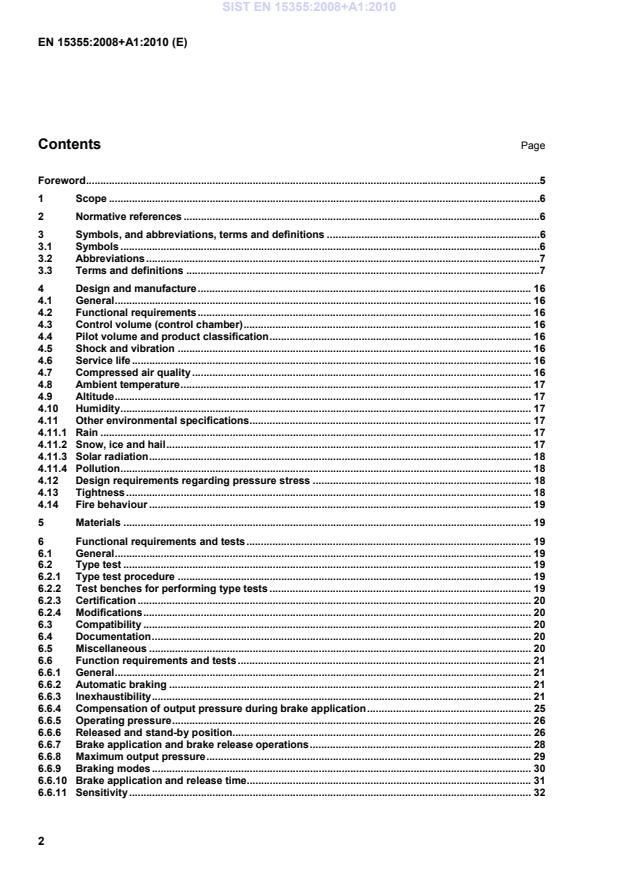
!!!!Relationship between this European Standard and the Essential Requirements of EU Directive 2008/57/EC of the European Parliament and of the Council of 17 June 2008 on the interoperability of the rail system within the Community (Recast)"""" . 59!!!!deleted text"""" Bibliography . 65 Figures Figure 1 — Distributor valve – Main function, block diagram . 7Figure 2 — Distributor valve – Main function, pressure diagram. 8Figure 3 — Service and emergency brake application . 9Figure 4 — Emergency braking (emergency brake application) . 10Figure 5 — Brake release . 11Figure 6 — Sensitivity respectively insensitivity areas and limits . 13Figure 7 — Inshot function, comparision between output pressure development with and without inshot function . 14Figure 8 — Test 6.6.3.2-1 . 22Figure 9 — Test 6.6.3.2-2 recorded on the first single wagon . 24Figure 10 — Test 6.6.4-1 . 25Figure 11 — Test 6.6.4-2 . 26Figure 12 — Test 6.6.6-1 . 27Figure 13 — Test 6.6.6-2 . 28Figure 14 — Test 6.6.6-3 . 28SIST EN 15355:2008+A1:2010
(IEC 61373:1999) EN ISO/IEC 17025, General requirements for the competence of testing and calibration laboratories
(ISO/IEC 17025:2005) ISO 8573-1, Compressed air — Part 1: Contaminants and purity classes 3 Symbols, and abbreviations, terms and definitions For the purposes of this document, the terms and definitions given in EN 14478:2005 and the following symbols, abbreviations, terms and definitions apply. 3.1 Symbols t time p pressure SIST EN 15355:2008+A1:2010
Key 1 input pressure 2 distributor valve 3 output pressure Figure 1 — Distributor valve – Main function, block diagram SIST EN 15355:2008+A1:2010
Key 1 operating pressure 2 input pressure 3 output pressure Figure 2 — Distributor valve – Main function, pressure diagram 3.3.3 brake application defined drop of input pressure (brake pipe pressure) in the range of pressure from the released position (operating pressure) to the pressure which causes the distributor valve to establish a corresponding output pressure level fed by the auxiliary (supply) reservoir NOTE See Figure 3. SIST EN 15355:2008+A1:2010
Key 1
operating pressure 2
input pressure 3
maximum output pressure 4
output pressure
service brake application
emergency brake application Figure 3 — Service and emergency brake application 3.3.3.1 service brake application defined drop of input pressure (brake pipe pressure) beginning at the operating pressure level down to a value between the minimum reduction and the level of input pressure necessary for reaching maximum output pressure NOTE This pressure drop causes the distributor valve to establish a corresponding output pressure. 3.3.3.2 graduated braking incremental increase of the output pressure controlled by an incremental reduction of the input pressure in the range of pressure from released position to the pressure corresponding to a full service braking 3.3.3.3 full service brake application defined drop of input pressure (brake pipe pressure) beginning at the operating pressure level down to the input pressure level which causes the distributor valve to establish maximum output pressure 3.3.3.4 emergency braking (emergency brake application) increase of output pressure up to the maximum output pressure caused by a drop of input pressure starting with the value for operating pressure down to the level necessary for reaching the maximum output pressure in time t1, faster than the specified time for reaching the maximum output pressure, t2 NOTE 1 This causes the distributor valve to operate at his maximum capacity, meeting the system requirements (see Figure 4). SIST EN 15355:2008+A1:2010
Key 1 operating pressure 2 input pressure 3 input pressure level necessary for reaching maximum output pressure 4 maximum output pressure 5 output pressure t1 time to reach the input pressure necessary to establish maximum output pressure t2 time to reach the maximum output pressure Figure 4 — Emergency braking (emergency brake application) 3.3.4 brake release increase of input pressure (brake pipe pressure) after a brake application which causes the distributor valve to vent the output pressure to atmosphere NOTE See Figure 5.
Key 1 operating pressure 2 input pressure 3 output pressure Figure 5 — Brake release 3.3.4.1 full release increase of input pressure (brake pipe pressure) after a brake application up to the operating pressure level, causing the complete venting of output pressure 3.3.4.2 graduated release incremental reduction of output pressure by an incremental increase of input pressure in the range of pressure from full service braking to full release 3.3.5 brake application time time for increasing output pressure from when it starts to rise from 0 bar up to 95 % of the maximum output pressure, when input pressure is reduced from operating pressure level down to 0 bar with a time of less than 2 s for the first pressure drop of 1,5 bar 3.3.6 release time time for reducing the output pressure from when it starts to fall from maximum down to 0,4 bar, when input pressure is increased up to the operating pressure level, starting from 1,5 bar below it, in less than 2 s 3.3.7 manual release function which requires deliberate and intentional manual action in order to cancel brake application (to release the distributor valve) provided by one distributor valve NOTE Manual release function can be achieved in two ways as defined in 3.3.7.1 and 3.3.7.2. 3.3.7.1 automatic manual release operation requires short action by the command element after which the release function is completed automatically SIST EN 15355:2008+A1:2010
NOTE 1 See Figure 6. NOTE 2 If a certain value is specified, it gives the minimum gradient of input pressure reduction which causes the distributor valve to react after a certain time. 3.3.14 insensitivity ability of the distributor valve to avoid supplying an output pressure under certain conditions of input pressure reduction
NOTE If a certain value is specified it gives the maximum (fastest) gradient of the input pressure reduction which will not cause the distributor valve to react. SIST EN 15355:2008+A1:2010
Key
distributor valve shall react distributor valve may react distributor valve shall not react 1 input pressure 2 operating pressure 3 insensitivity area 4 sensitivity area 5 sensitivity limit 6 insensitivity limit Figure 6 — Sensitivity respectively insensitivity areas and limits 3.3.15 quick service function function of a distributor valve which allows, when applying the brake from stand-by and released position, the local fast venting of brake pipe pressure by a certain specified amount and at a certain specified gradient, to provide pneumatic brake signal transmission through a train 3.3.16 propagation time time between the initiation of a brake application by the driver’s brake handle and the beginning of brake cylinder pressure build-up on the last vehicle of a train 3.3.17 propagation speed propagation time related to the length of brake pipe NOTE The length of brake pipe is measured from the driver’s brake valve to the end cock located at the end of the last vehicle of the train and does not take into consideration any branches. 3.3.18 operating pressure overcharge build up of distributor valve input pressure above operating pressure to reduce the release time of a train and/or to adjust the distributors control reservoir pressure of all vehicles of a complete train 3.3.19 inshot function function of the distributor valve which allows, when operated in the braking mode “goods” (“freight”), a faster increase of the output pressure at the beginning of brake application (t1 against t2 without inshot function). The purpose is quick build up of the necessary pressure for initiating the friction braking process (see Figure 7) SIST EN 15355:2008+A1:2010
Key 1 operating pressure 2 output pressure 3 pressure necessary for starting the friction process t1 with inshot function t2 without inshot function Figure 7 — Inshot function, comparision between output pressure development with and without inshot function 3.3.20 released condition (related to distributor valve) distributor valve's condition in which the output pressure is having a value which does not produce a brake force 3.3.21 auxiliary (supply) reservoir protected and dedicated source of pressure energy for local brake actuation [EN 14478:2005] 3.3.22 brake force force generated by the brake and applied to the train [EN 14478:2005] 3.3.23 brake pipe pipe enabling train brake control [EN 14478:2005] 3.3.24 brake system combination of means (hardware and software) to achieve, with a chosen level of safety, the whole or part of the braking requirements of the train NOTE 1 The brake system should act with a level of availability compatible with the operating requirements. SIST EN 15355:2008+A1:2010
3.3.26 direct release complete reduction of brake cylinder pressure in one step [EN 14478:2005] 3.3.27 driver's brake valve component or combination of components by which the driver's intent is converted to a train brake control signal NOTE The driver's brake valve includes the brake handle. [EN 14478:2005] 3.3.28 graduable (graduated [am]) release reduction of brake cylinder pressure in more than one step [EN 14478:2005] 3.3.29 train single vehicle or a number of coupled vehicles operating on a guided ground transport system [EN 14478:2005] 3.3.30 maximum output pressure
maximum output pressure is the output pressure which is reached after an emergency braking NOTE 1 See Figure 3. NOTE 2 It is the highest possible output pressure. 3.3.31 control sensitivity control sensitivity defines the ability of the distributor valve to respond accurately and sensitively to input pressure modifications by delivering corresponding output pressure variations 3.3.32 distributor-isolation device device which isolates the distributor valve from the brake pipe SIST EN 15355:2008+A1:2010
4.5 Shock and vibration The distributor valve and distributor-isolating device shall operate without restrictions under shock and vibration conditions as specified by EN 61373:1999, category 1, class A and class B. 4.6 Service life This document gives no rigid specification for service life performance. Specifications shall be specified upon an agreement between manufacturer and customer regarding operating conditions. 4.7 Compressed air quality It shall be possible to operate the distributor valve and distributor-isolating device without restrictions with at least the compressed air quality according to the following classes defined by ISO 8573-1:2001: class 4 — for the maximum particle size and the maximum concentration of solid contaminants; SIST EN 15355:2008+A1:2010
Table 1. Table 1 — Pollution requirements Pollution Requirements
Chemically active substances Class 5C2 of EN 60721-3-5:1997. Contaminating fluids Class 5F2 (electrical engine) of EN 60721-3-5:1997. Class 5F3 (thermal engine) of EN 60721-3-5:1997. Biologically active substances
Class 5B2 of EN 60721-3-5:1997. Dust Defined by class 5S2 of EN 60721-3-5:1997. Stones and other objects Objects of max. 15 mm diameter and ballast Distributor valves shall be designed so as to prevent intrusion of grasses and leaves, pollen, flying insects, fibres etc. For the design of ventilation ducts. Sand According to EN 60721-3-5:1997. Sea spray According to EN 60721-3-5:1997 Class 5C2.
4.12 Design requirements regarding pressure stress The design of the distributor valve and distributor-isolating device shall allow safe required performance with a maximum supply pressure according to 6.6.21. It shall be taken in consideration that maximum supply pressure can be reached even in other pneumatic circuits of the distributor valve and distributor-isolating device such as brake pipe pressure circuit (input pressure for the distributor valve) when this European Standard requires such a function. The distributor valve and distributor-isolating device shall be designed to be able to support pressure up to 50 % more than the pressure specified by 6.6.21 in all chambers, without safety risk for the personnel. The specified requirements regarding the pressure stress can be proven by theoretical calculation. 4.13 Tightness Tightness of the distributor valve and distributor-isolating device shall be such that technical performance as specified by this European Standard is met without restrictions. This requirement is tested in accordance with 6.6.22. SIST EN 15355:2008+A1:2010
Simulated long train consist as described in 6.6.15.2. SIST EN 15355:2008+A1:2010
...
Questions, Comments and Discussion
Ask us and Technical Secretary will try to provide an answer. You can facilitate discussion about the standard in here.
Loading comments...