


EN 933-6:2022
(Main)Tests for geometrical properties of aggregates - Part 6: Assessment of surface characteristics - Flow coefficient of aggregates
Tests for geometrical properties of aggregates - Part 6: Assessment of surface characteristics - Flow coefficient of aggregates
This document specifies the reference method used for type testing, and in case of dispute, for determining the flow coefficient of coarse and fine aggregates. Other methods can be used for other purposes, such as factory production control, provided that an appropriate working relationship with the reference method has been established. Examples of advanced test methods can be found in the Bibliography.
This document applies to coarse aggregate of sizes between 4 mm and 20 mm and to fine aggregate of size up to 2 mm. It does not apply to lightweight aggregates.
NOTE 1 For coarse aggregates between 4 mm and 20 mm, the flow coefficient is linked with the percentage of crushed or broken surfaces of an aggregate and can therefore be used in association with the method specified in EN 933-5. Shape and surface texture characteristics also influence the result.
NOTE 2 Experience of this test has been generally limited to natural aggregates.
Examples of test data sheets are given in informative Annexes A and C.
Annex B (informative) contains precision data.
WARNING - The use of this part of EN 933 can involve hazardous materials, operations and equipment (such as dust, noise and heavy lifts). It does not purport to address all of the safety or environmental problems associated with its use. It is the responsibility of users of this document to take appropriate measures to ensure the safety and health of personnel and the environment prior to application of the standard, and fulfil statutory and regulatory requirements for this purpose.
Prüfverfahren für geometrische Eigenschaften von Gesteinskörnungen - Teil 6: Beurteilung der Oberflächeneigenschaften - Fließkoeffizienten von Gesteinskörnungen
Dieses Dokument legt das Referenzverfahren fest, das für die Erstprüfung und im Streitfall für die Bestimmung des Fließkoeffizienten von groben und feinen Gesteinskörnungen angewendet wird. Für andere Zwecke, speziell im Rahmen der werkseigenen Produktionskontrolle, können andere Verfahren angewendet werden, sofern ein ausreichender Zusammenhang mit dem Referenzverfahren nachgewiesen wurde. Beispiele für andere Prüfverfahren können in den Literaturhinweisen gefunden werden.
Das vorliegende Dokument ist anzuwenden für grobe Gesteinskörnungen mit Korngrößen zwischen 4 mm und 20 mm und feine Gesteinskörnungen mit Korngrößen bis zu 2 mm. Es ist nicht anzuwenden für leichte Gesteinskörnungen.
ANMERKUNG 1 Bei groben Gesteinskörnungen zwischen 4 mm und 20 mm hängt der Fließkoeffizient mit dem Prozentsatz an gebrochenen Körnern einer Gesteinskörnung zusammen und kann daher in Verbindung mit dem in EN 933-5 angegebenen Verfahren angewendet werden. Das Ergebnis wird auch durch die Form und die Oberflächenbeschaffenheit beeinflusst.
ANMERKUNG 2 Erfahrungen mit diesem Prüfverfahren sind allgemein auf natürliche Gesteinskörnungen begrenzt.
Beispiele für Prüf-Datenblätter sind im informativen Anhang A und im informativen Anhang C enthalten.
Anhang B (informativ) enthält Daten zur Präzision.
WARNUNG - Die Durchführung der in diesem Teil von EN 933 beschriebenen Referenzverfahren kann gefährliche Materialien, Verfahrensschritte oder Gerätschaften (wie Staub, Lärm und Hebezeuge) umfassen. Dieses Dokument erhebt nicht den Anspruch, auf alle Sicherheits- oder Umweltprobleme hinzuweisen, die mit seiner Anwendung verbunden sind. Es liegt in der Verant¬wortung des Anwenders dieses Dokuments, vor der Anwendung geeignete Maßnahmen für die Sicherheit und den Gesundheitsschutz des Personals sowie für den Umweltschutz zu ergreifen und dafür Sorge zu tragen, dass behördliche und gesetzliche Maßnahmen eingehalten werden.
Essais pour déterminer les caractéristiques géométriques des granulats - Partie 6 : Evaluation des caractéristiques de surface - Coefficient d'écoulement des granulats
Le présent document décrit la méthode de référence servant aux essais de type et, en cas de litige, pour la détermination du coefficient d’écoulement des gravillons et des sables. D’autres méthodes peuvent être utilisées pour d’autres besoins, tels que la maitrise de la production des granulats, sous réserve qu’une corrélation appropriée avec la méthode de référence ait été établie. Des exemples de méthodes d’essais avancés se trouvent éventuellement dans la Bibliographie.
Le présent document s’applique aux gravillons de classe granulaire comprise entre 4 mm et 20 mm et des sables de classe granulaire inférieure ou égale à 2 mm. Il ne s’applique pas aux granulats légers.
NOTE 1 Pour les gravillons compris entre 4 mm et 20 mm, le coefficient d’écoulement est lié au pourcentage de surfaces cassées de granulat et peut donc être utilisé pour remplacer la méthode spécifiée dans l’EN 933-5. Les caractéristiques de forme et de texture de surface influent également sur le résultat.
NOTE 2 L'application de cette norme a généralement été limitée aux granulats naturels.
Des exemples de fiches d'essais sont donnés dans les annexes informatives A et C.
L'annexe B (informative) contient des données de fidélité.
AVERTISSEMENT - L'utilisation de cette partie de l'EN 933 peut impliquer des matériaux, des opérations et des équipements dangereux (tels que la poussière, le bruit et les ascenseurs lourds). Elle ne prétend pas traiter de tous les problèmes de sécurité ou d'environnement liés à son utilisation. Il est de la responsabilité des utilisateurs de ce document de prendre les mesures appropriées pour assurer la sécurité et la santé du personnel et de l'environnement avant l'application de la norme, et de satisfaire aux exigences légales et réglementaires à cet effet.
Preskusi geometričnih lastnosti agregatov - 6. del: Ocenjevanje značilnosti površine - Količnik sipkosti agregatov
Ta dokument določa referenčno metodo, ki se uporablja za tipsko preskušanje in v primeru spora za določevanje koeficienta pretoka grobih in finih agregatov. Za druge namene, na primer za kontrolo proizvodnje v obratu, je mogoče uporabiti druge metode, če obstaja primerna delovna povezava z referenčno metodo. Primeri naprednih preskusnih metod so opisani v bibliografiji.
Ta dokument se uporablja za grobe agregate v velikosti od 4 mm do 20 mm in za fine agregate v velikosti do 2 mm.
OPOMBA 1: Pri grobih agregatih velikosti od 4 do 20 mm je koeficient pretoka povezan z odstotkom zdrobljenih ali zlomljenih površin agregata in se zato lahko uporabljajo v povezavi z metodo, določeno v standardu EN 933-5. Na rezultat vplivajo tudi značilnosti oblike in teksture površine.
OPOMBA 2: Izkušnje s tem preskusom so bile na splošno omejene na naravne agregate.
Primeri preskusnih podatkovnih listov so podani v informativnih dodatkih A in C.
Dodatek B (informativni) vsebuje podatke o natančnosti.
OPOZORILO: Uporaba tega dela standarda EN 933 lahko vključuje nevarne materiale, postopke in opremo (na primer prah, hrup in dvigovanje težkih bremen). Ni namenjen obravnavi vseh varnostnih ali okoljskih težav, povezanih z njegovo uporabo. Za sprejetje ustreznih ukrepov za zagotavljanje varnosti oziroma zdravja osebja in okolja pred uporabo standarda ter izpolnjevanje zakonskih in regulativnih zahtev za ta namen so odgovorni uporabniki tega dokumenta.
General Information
- Status
- Published
- Publication Date
- 20-Dec-2022
- Technical Committee
- CEN/TC 154 - Aggregates
- Drafting Committee
- CEN/TC 154/SC 6/WG 2 - Physical Testing
- Current Stage
- 6060 - Definitive text made available (DAV) - Publishing
- Start Date
- 21-Dec-2022
- Due Date
- 30-Sep-2022
- Completion Date
- 21-Dec-2022
Relations
- Effective Date
- 28-Dec-2022
- Effective Date
- 28-Jan-2026
- Effective Date
- 28-Jan-2026
- Effective Date
- 28-Jan-2026
- Effective Date
- 28-Jan-2026
- Effective Date
- 28-Jan-2026
- Effective Date
- 28-Jan-2026
- Effective Date
- 28-Jan-2026
- Effective Date
- 28-Jan-2026
- Effective Date
- 28-Jan-2026
Overview
EN 933-6:2022 - Tests for geometrical properties of aggregates (Part 6) defines the reference method for determining the flow coefficient of aggregates, a metric used to assess surface characteristics and flow behaviour of coarse and fine aggregates. The standard applies to coarse aggregate (4–20 mm) and fine aggregate (up to 2 mm) and excludes lightweight aggregates. The flow coefficient is measured as the time (seconds) for a specified volume of aggregate to flow through a defined opening using a standard apparatus.
This part of the EN 933 series is intended as the reference method for type testing and for settling disputes. Other methods may be used (for example, in factory production control) only when an appropriate relationship to this reference method has been established.
Key Topics and Requirements
- Scope and applicability
- Coarse aggregates 4–20 mm; fine aggregates ≤2 mm; not applicable to lightweight aggregates.
- Reference materials
- Defined reference aggregates (e.g., CEREMA quartzite reference coarse aggregate with E = 100 s and pre-dried density 2.70 Mg/m3) are specified for calibration and comparison.
- Test principle
- Flow coefficient = time for a fixed volume of aggregate to pass through a given aperture under specified conditions.
- Apparatus and verification
- Standardized test apparatus and procedures are described for both coarse and fine aggregate tests, including verification of aperture dimensions.
- Sampling and preparation
- Requirements for preparing reference and test portions, including drying to constant mass where relevant.
- Procedure, calculation and reporting
- Common procedures for reference and sample tests, calculation of flow coefficient and required test report data are specified.
- Precision and examples
- Informative Annex B provides precision data; Annexes A and C provide example test data sheets.
- Safety notice
- The standard includes a warning about hazards (dust, noise, heavy lifts) and the responsibility to ensure personnel and environmental safety.
Applications and Users
- Who uses EN 933-6:2022:
- Materials testing laboratories, quarry and aggregate producers, quality control teams, road and civil engineers, specification writers, and regulatory bodies.
- Practical uses:
- Type testing of aggregate products, assessing surface texture and crushed-particle influence (can be used alongside EN 933-5), acceptance testing, and dispute resolution for contract compliance.
- Establishing correlations for factory production control when alternative test methods are employed.
Related Standards
- EN 933 series (other geometrical tests: Parts 1–11)
- EN 933-5 (percentage of crushed particles)
- EN 932 (general properties and sampling)
- EN 1097 (mechanical and physical properties of aggregates)
Keywords: EN 933-6:2022, flow coefficient, aggregate testing, surface characteristics, coarse aggregate, fine aggregate, EN 933.

Get Certified
Connect with accredited certification bodies for this standard

ICC Evaluation Service
Building products evaluation and certification.

QAI Laboratories
Building and construction product testing and certification.

Aboma Certification B.V.
Specialized in construction, metal, and transport sectors.
Sponsored listings
Frequently Asked Questions
EN 933-6:2022 is a standard published by the European Committee for Standardization (CEN). Its full title is "Tests for geometrical properties of aggregates - Part 6: Assessment of surface characteristics - Flow coefficient of aggregates". This standard covers: This document specifies the reference method used for type testing, and in case of dispute, for determining the flow coefficient of coarse and fine aggregates. Other methods can be used for other purposes, such as factory production control, provided that an appropriate working relationship with the reference method has been established. Examples of advanced test methods can be found in the Bibliography. This document applies to coarse aggregate of sizes between 4 mm and 20 mm and to fine aggregate of size up to 2 mm. It does not apply to lightweight aggregates. NOTE 1 For coarse aggregates between 4 mm and 20 mm, the flow coefficient is linked with the percentage of crushed or broken surfaces of an aggregate and can therefore be used in association with the method specified in EN 933-5. Shape and surface texture characteristics also influence the result. NOTE 2 Experience of this test has been generally limited to natural aggregates. Examples of test data sheets are given in informative Annexes A and C. Annex B (informative) contains precision data. WARNING - The use of this part of EN 933 can involve hazardous materials, operations and equipment (such as dust, noise and heavy lifts). It does not purport to address all of the safety or environmental problems associated with its use. It is the responsibility of users of this document to take appropriate measures to ensure the safety and health of personnel and the environment prior to application of the standard, and fulfil statutory and regulatory requirements for this purpose.
This document specifies the reference method used for type testing, and in case of dispute, for determining the flow coefficient of coarse and fine aggregates. Other methods can be used for other purposes, such as factory production control, provided that an appropriate working relationship with the reference method has been established. Examples of advanced test methods can be found in the Bibliography. This document applies to coarse aggregate of sizes between 4 mm and 20 mm and to fine aggregate of size up to 2 mm. It does not apply to lightweight aggregates. NOTE 1 For coarse aggregates between 4 mm and 20 mm, the flow coefficient is linked with the percentage of crushed or broken surfaces of an aggregate and can therefore be used in association with the method specified in EN 933-5. Shape and surface texture characteristics also influence the result. NOTE 2 Experience of this test has been generally limited to natural aggregates. Examples of test data sheets are given in informative Annexes A and C. Annex B (informative) contains precision data. WARNING - The use of this part of EN 933 can involve hazardous materials, operations and equipment (such as dust, noise and heavy lifts). It does not purport to address all of the safety or environmental problems associated with its use. It is the responsibility of users of this document to take appropriate measures to ensure the safety and health of personnel and the environment prior to application of the standard, and fulfil statutory and regulatory requirements for this purpose.
EN 933-6:2022 is classified under the following ICS (International Classification for Standards) categories: 91.100.15 - Mineral materials and products. The ICS classification helps identify the subject area and facilitates finding related standards.
EN 933-6:2022 has the following relationships with other standards: It is inter standard links to EN 933-6:2014, EN 932-5:2012, EN 1097-6:2022, EN 933-3:2012, EN 933-2:2020, EN 16236:2018, EN 12697-37:2022, EN 13242:2013, EN 12697-37:2003, EN 13043:2013. Understanding these relationships helps ensure you are using the most current and applicable version of the standard.
EN 933-6:2022 is associated with the following European legislation: EU Directives/Regulations: 305/2011; Standardization Mandates: M/124, M/125. When a standard is cited in the Official Journal of the European Union, products manufactured in conformity with it benefit from a presumption of conformity with the essential requirements of the corresponding EU directive or regulation.
EN 933-6:2022 is available in PDF format for immediate download after purchase. The document can be added to your cart and obtained through the secure checkout process. Digital delivery ensures instant access to the complete standard document.
Standards Content (Sample)
SLOVENSKI STANDARD
01-maj-2023
Nadomešča:
SIST EN 933-6:2014
Preskusi geometričnih lastnosti agregatov - 6. del: Ocenjevanje značilnosti
površine - Količnik sipkosti agregatov
Tests for geometrical properties of aggregates - Part 6: Assessment of surface
characteristics - Flow coefficient of aggregates
Prüfverfahren für geometrische Eigenschaften von Gesteinskörnungen - Teil 6:
Beurteilung der Oberflächeneigenschaften - Fließkoeffizienten von Gesteinskörnungen
Essais pour déterminer les caractéristiques géométriques des granulats - Partie 6 :
Evaluation des caractéristiques de surface - Coefficient d'écoulement des granulats
Ta slovenski standard je istoveten z: EN 933-6:2022
ICS:
91.100.15 Mineralni materiali in izdelki Mineral materials and
products
2003-01.Slovenski inštitut za standardizacijo. Razmnoževanje celote ali delov tega standarda ni dovoljeno.
EN 933-6
EUROPEAN STANDARD
NORME EUROPÉENNE
December 2022
EUROPÄISCHE NORM
ICS 91.100.15 Supersedes EN 933-6:2014
English Version
Tests for geometrical properties of aggregates - Part 6:
Assessment of surface characteristics - Flow coefficient of
aggregates
Essais pour déterminer les caractéristiques Prüfverfahren für geometrische Eigenschaften von
géométriques des granulats - Partie 6 : Evaluation des Gesteinskörnungen - Teil 6: Beurteilung der
caractéristiques de surface - Coefficient d'écoulement Oberflächeneigenschaften - Fließkoeffizienten von
des granulats Gesteinskörnungen
This European Standard was approved by CEN on 7 November 2022.
CEN members are bound to comply with the CEN/CENELEC Internal Regulations which stipulate the conditions for giving this
European Standard the status of a national standard without any alteration. Up-to-date lists and bibliographical references
concerning such national standards may be obtained on application to the CEN-CENELEC Management Centre or to any CEN
member.
This European Standard exists in three official versions (English, French, German). A version in any other language made by
translation under the responsibility of a CEN member into its own language and notified to the CEN-CENELEC Management
Centre has the same status as the official versions.
CEN members are the national standards bodies of Austria, Belgium, Bulgaria, Croatia, Cyprus, Czech Republic, Denmark, Estonia,
Finland, France, Germany, Greece, Hungary, Iceland, Ireland, Italy, Latvia, Lithuania, Luxembourg, Malta, Netherlands, Norway,
Poland, Portugal, Republic of North Macedonia, Romania, Serbia, Slovakia, Slovenia, Spain, Sweden, Switzerland, Türkiye and
United Kingdom.
EUROPEAN COMMITTEE FOR STANDARDIZATION
COMITÉ EUROPÉEN DE NORMALISATION
EUROPÄISCHES KOMITEE FÜR NORMUNG
CEN-CENELEC Management Centre: Rue de la Science 23, B-1040 Brussels
© 2022 CEN All rights of exploitation in any form and by any means reserved Ref. No. EN 933-6:2022 E
worldwide for CEN national Members.
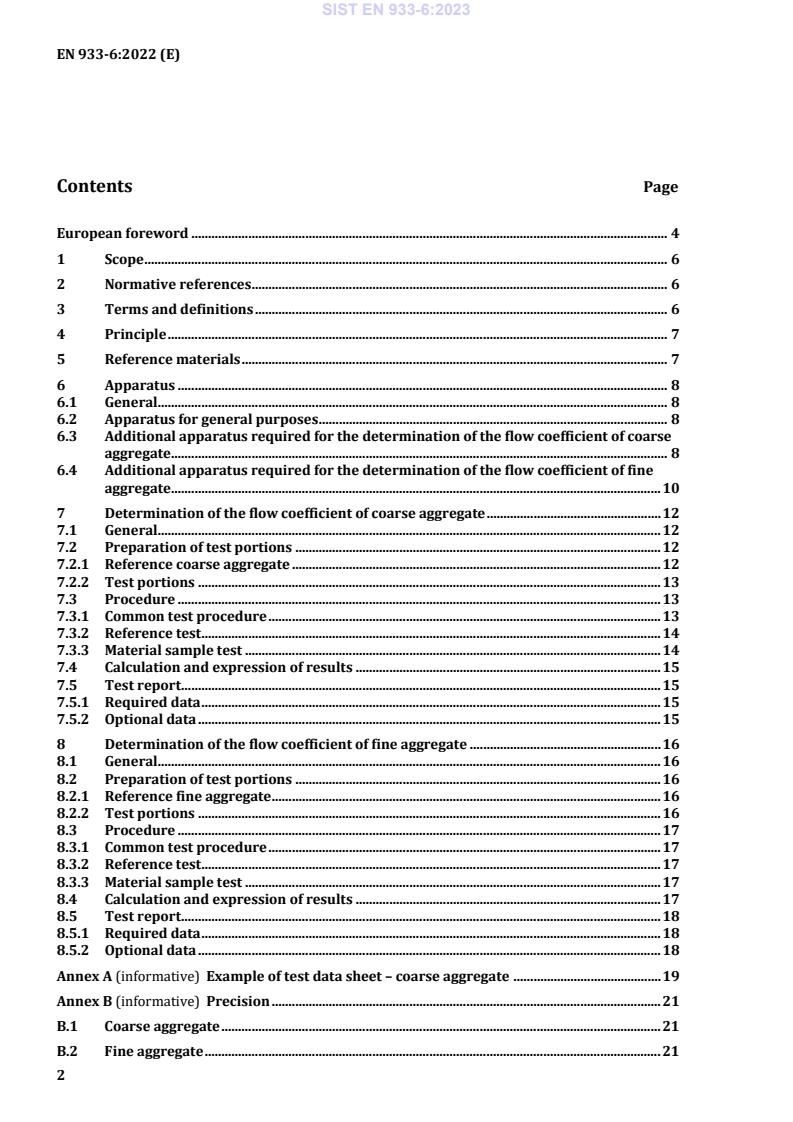
Contents Page
European foreword . 4
1 Scope . 6
2 Normative references . 6
3 Terms and definitions . 6
4 Principle . 7
5 Reference materials . 7
6 Apparatus . 8
6.1 General. 8
6.2 Apparatus for general purposes . 8
6.3 Additional apparatus required for the determination of the flow coefficient of coarse
aggregate . 8
6.4 Additional apparatus required for the determination of the flow coefficient of fine
aggregate . 10
7 Determination of the flow coefficient of coarse aggregate . 12
7.1 General. 12
7.2 Preparation of test portions . 12
7.2.1 Reference coarse aggregate . 12
7.2.2 Test portions . 13
7.3 Procedure . 13
7.3.1 Common test procedure . 13
7.3.2 Reference test . 14
7.3.3 Material sample test . 14
7.4 Calculation and expression of results . 15
7.5 Test report . 15
7.5.1 Required data . 15
7.5.2 Optional data . 15
8 Determination of the flow coefficient of fine aggregate . 16
8.1 General. 16
8.2 Preparation of test portions . 16
8.2.1 Reference fine aggregate . 16
8.2.2 Test portions . 16
8.3 Procedure . 17
8.3.1 Common test procedure . 17
8.3.2 Reference test . 17
8.3.3 Material sample test . 17
8.4 Calculation and expression of results . 17
8.5 Test report . 18
8.5.1 Required data . 18
8.5.2 Optional data . 18
Annex A (informative) Example of test data sheet – coarse aggregate . 19
Annex B (informative) Precision . 21
B.1 Coarse aggregate . 21
B.2 Fine aggregate . 21
Annex C (informative) Example of test data sheet – fine aggregate . 22
Bibliography . 24
European foreword
This document (EN 933-6:2022) has been prepared by the Technical Committee CEN/TC 154
“Aggregates”, the secretariat of which is held by BSI.
This European Standard shall be given the status of a national standard, either by publication of an
identical text or by endorsement, at the latest by June 2023, and conflicting national standards shall be
withdrawn at the latest by June 2023.
Attention is drawn to the possibility that some of the elements of this document may be the subject of
patent rights. CEN shall not be held responsible for identifying any or all such patent rights.
This document supersedes EN 933-6:2014.
In comparison with the previous edition EN 933-6:2014, the following technical modifications have
been made:
a) amendment to the Scope, clarifying that the standard does not apply to lightweight aggregates;
b) amendment to the Scope according to the current rules, introducing the three annexes and adding
a warning about potential hazardous materials, operations and equipment;
c) change of the dated normative references to Annex A of EN 1097-6:2013 to undated references. The
references are given for the calculations of masses in 7.2.2, 7.3.1 and 8.2.2. As a consequence, new
notes to 7.2.2 and 8.2.2 have been added, informing that the test method generally applies to
aggregates with water absorption less than about 1,5 %;
d) rewording of Clause 5 Reference materials, using the same text structure as in EN 1097-8. The
information about alternative sources of reference materials has been moved to a new Note;
e) amendment to 6.4.1, including Figure 3, to clarify the verification of aperture dimension;
f) updating of the test reports in 7.5 and 8.5 according to the current rules;
g) amendment to the expressions of numerical results in 8.3, 8.4 and Annex C, for a better precision of
the final result.
This document forms part of a series of tests for geometrical properties of aggregates. Test methods for
other properties of aggregates are covered by the following European standards:
— EN 932 (all parts), Tests for general properties of aggregates
— EN 1097 (all parts), Tests for mechanical and physical properties of aggregates
— EN 1367 (all parts), Tests for thermal and weathering properties of aggregates
— EN 1744 (all parts), Tests for chemical properties of aggregates
— EN 13179 (all parts), Tests for filler aggregate used in bituminous mixtures
The other parts of EN 933 include:
— Part 1: Determination of particle size distribution — Sieving method
— Part 2: Determination of particle size distribution — Test sieves, nominal size of apertures
— Part 3: Determination of particle shape — Flakiness index
— Part 4: Determination of particle shape — Shape index
— Part 5: Determination of percentage of crushed particles in coarse and all-in natural aggregates
— Part 7: Determination of shell content — Percentage of shells in coarse aggregates
— Part 8: Assessment of fines — Sand equivalent test
— Part 9: Assessment of fines — Methylene blue test
— Part 10: Assessment of fines — Grading of filler aggregates (air jet sieving)
— Part 11: Classification test for the constituents of coarse recycled aggregate
Any feedback and questions on this document should be directed to the users’ national standards body.
A complete listing of these bodies can be found on the CEN website.
According to the CEN-CENELEC Internal Regulations, the national standards organisations of the
following countries are bound to implement this European Standard: Austria, Belgium, Bulgaria, Croatia,
Cyprus, Czech Republic, Denmark, Estonia, Finland, France, Germany, Greece, Hungary, Iceland, Ireland,
Italy, Latvia, Lithuania, Luxembourg, Malta, Netherlands, Norway, Poland, Portugal, Republic of North
Macedonia, Romania, Serbia, Slovakia, Slovenia, Spain, Sweden, Switzerland, Türkiye and the United
Kingdom.
1 Scope
This document specifies the reference method used for type testing, and in case of dispute, for
determining the flow coefficient of coarse and fine aggregates. Other methods can be used for other
purposes, such as factory production control, provided that an appropriate working relationship with
the reference method has been established. Examples of advanced test methods can be found in the
Bibliography.
This document applies to coarse aggregate of sizes between 4 mm and 20 mm and to fine aggregate of
size up to 2 mm. It does not apply to lightweight aggregates.
NOTE 1 For coarse aggregates between 4 mm and 20 mm, the flow coefficient is linked with the percentage of
crushed or broken surfaces of an aggregate and can therefore be used in association with the method specified in
EN 933–5. Shape and surface texture characteristics also influence the result.
NOTE 2 Experience of this test has been generally limited to natural aggregates.
Examples of test data sheets are given in informative Annexes A and C.
Annex B (informative) contains precision data.
WARNING — The use of this part of EN 933 can involve hazardous materials, operations and equipment
(such as dust, noise and heavy lifts). It does not purport to address all of the safety or environmental
problems associated with its use. It is the responsibility of users of this document to take appropriate
measures to ensure the safety and health of personnel and the environment prior to application of the
standard, and fulfil statutory and regulatory requirements for this purpose.
2 Normative references
The following documents are referred to in the text in such a way that some or all of their content
constitutes requirements of this document. For dated references, only the edition cited applies. For
undated references, the latest edition of the referenced document (including any amendments) applies.
EN 932-2, Tests for general properties of aggregates — Part 2: Methods for reducing laboratory samples
EN 932-5, Tests for general properties of aggregates — Part 5: Common equipment and calibration
EN 933-2, Tests for geometrical properties of aggregates — Part 2: Determination of particle size
distribution — Test sieves, nominal size of apertures
EN 933-3, Tests for geometrical properties of aggregates — Part 3: Determination of particle shape —
Flakiness index
EN 1097-6, Tests for mechanical and physical properties of aggregates — Part 6: Determination of particle
density and water absorption
3 Terms and definitions
For the purposes of this document, the following terms and definitions apply.
ISO and IEC maintain terminological databases for use in standardization at the following addresses:
— ISO Online browsing platform: available at https://www.iso.org/obp/ui
— IEC Electropedia: available at https://www.electropedia.org/
3.1
aggregate size
designation of aggregate in terms of lower (d) and upper (D) sieve sizes expressed in terms as d/D
Note 1 to entry: This designation accepts the presence of some particles which will be retained on the upper
sieve (oversize) and some which will pass the lower sieve (undersize).
3.2
constant mass
mass determined by successive weighings performed at least 1 h apart and not differing by more than
0,1 %
Note 1 to entry: In many cases constant mass can be achieved after a test portion has been dried for a pre-
determined period in a specified oven at (110 ± 5) °C. Test laboratories can determine the time required to achieve
constant mass for specific types and sizes of sample dependent upon the drying capacity of the oven used.
3.3
laboratory sample
sample intended for laboratory testing
3.4
size fraction
d /D
i i
fraction of an aggregate passing the larger (D ) of two sieves and retained on the smaller (d )
i i
3.5
test portion
sample used as a whole in a single test
4 Principle
The flow coefficient of an aggregate is the time, expressed in seconds, for a specified volume of aggregate
to flow through a given opening, under specified conditions using a standard apparatus.
5 Reference materials
5.1 Reference coarse aggregate, from a recognized source, with a size fraction of 6,3/10 mm and a
flow time E of (100 ± 2) s when the shutter has an opening of (42,0 ± 0,2) mm. In the various
R
calculations, E shall be taken as equal to 100 s and its pre-dried particle density ρ shall be taken as
R p
equal to 2,70 Mg/m .
NOTE 1 At present, the only recognized source of reference coarse aggregate is a stock of quartzite aggregate
controlled by the CEREMA, Direction territoriale Normandie Centre, Laboratoire Régional de Rouen, 10 chemin de
la Poudrière, CS 90245, 76121 Le Grand-Quevilly cedex, France. lrr.dternc@cerema.fr.
NOTE 2 An alternative source of reference coarse aggregate, with the flow time E and the pre-dried particle
R
density ρ , can be used provided that the flow coefficient of that aggregate is established in a controlled
p
experiment carried out in at least ten laboratories, by cross testing against the CEREMA type reference coarse
aggregate.
In case of dispute, the CEREMA type reference coarse aggregate shall be used.
5.2 Reference fine aggregate, from a recognized source, with a size fraction of 0,063/2 mm and a
flow time E of (32 ± 2) s. In the various calculations, E shall be taken as equal to 32 s and its pre-
RS RS
dried particle density ρ shall be taken as equal to 2,70 Mg/m .
p
NOTE 1 At present the only recognized source of reference fine aggregate is a siliceous Somme bay fine
aggregate controlled by the CEREMA, Direction territoriale Normandie Centre, Laboratoire Régional de Rouen, 10
chemin de la Poudrière, CS 90245, 76121 Le Grand-Quevilly cedex, France. lrr.dternc@cerema.fr.
NOTE 2 An alternative source of reference fine aggregate, with the flow time E and the pre-dried particle
RS
density ρ , can be used provided that the flow coefficient of that aggregate is established in a controlled
p
experiment carried out in at least ten laboratories, by cross testing against the CEREMA type reference fine
aggregate.
In case of dispute, the CEREMA type reference fine aggregate shall be used.
6 Apparatus
6.1 General
All apparatus, unless otherwise stated, shall conform to the general requirements of EN 932-5.
6.2 Apparatus for general purposes
6.2.1 Test sieves, 0,063 mm, 2 mm, 4 mm, 6,3 mm, 8 mm, 10 mm, 14 mm and 20 mm, with apertures
as specified in EN 933-2.
6.2.2 Ventilated oven, thermostatically controlled to maintain a temperature of (110 ± 5) °C or
equipment for drying the aggregate which does not cause any particle size breakdown.
6.2.3 Balance, accurate to 0,1 % of the mass to be weighed.
6.2.4 Stopwatch or stopclock, to read 0,1 s.
6.3 Additional apparatus required for the determination of the flow coefficient of
coarse
...
Questions, Comments and Discussion
Ask us and Technical Secretary will try to provide an answer. You can facilitate discussion about the standard in here.
Loading comments...