


EN 17117-2:2021
(Main)Rubber- or plastics-coated fabrics - Mechanical test methods under biaxial stress states - Part 2: Determination of the pattern compensation values
Rubber- or plastics-coated fabrics - Mechanical test methods under biaxial stress states - Part 2: Determination of the pattern compensation values
This document describes methods for the determination of compensation values for orthotropic coated fabrics (different properties along ideally perpendicular directions, such as the weft and warp yarns for woven based coated fabrics, or along the courses and wales of knitted based coated fabrics) for determining cutting patterns.
NOTE The final interpretation and the determination of the compensation values remains the responsibility of the project engineer.
Annex C describes a method to determine comparable measures of extensibility along ideally perpendicular directions of coated fabrics. The comparable measures of extensibility can be used by design engineers to assess the extensibility of a coated fabric by comparison with other coated fabrics. In this way, they can help to interpret results of compensation tests. Moreover, they can be used by material suppliers to measure the consistency of extensibility along perpendicular directions of a coated fabric from batch to batch.
Mit Kautschuk oder Kunststoff beschichtete Textilien — Mechanische Prüfverfahren unter biaxialen Spannungszuständen — Teil 2: Bestimmung der Kompensationswerte
Dieses Dokument beschreibt Verfahren zur Bestimmung der Kompensationswerte für orthotrope beschich-tete Textilien (unterschiedliche Eigenschaften in Bezug auf idealerweise senkrechte Richtungen wie Schuss und Kette bei gewebten beschichteten Textilien oder entlang der Produktionsrichtung und senkrecht dazu bei beschichteten Maschenwaren) zwecks Bestimmung der Schnittmuster.
ANMERKUNG Die endgültige Interpretation und die Bestimmung der Kompensationswerte verbleibt in der Verant-wortung des Projektingenieurs.
Anhang C beschreibt ein Verfahren zur Bestimmung von Vergleichsmaßen der Dehnfähigkeit in Bezug auf idealerweise senkrechte Richtungen bei beschichteten Textilien. Die Vergleichsmaße der Dehnfähigkeit können von Tragwerksplanern zur Bewertung der Dehnfähigkeit eines beschichteten Textils durch Vergleich mit anderen beschichteten Textilien verwendet werden. Auf diese Weise können sie bei der Interpretation der Ergebnisse der Kompensationsversuche helfen. Darüber hinaus können sie von Werkstofflieferanten zur chargenübergreifenden Messung der Konsistenz der Dehnfähigkeit in Bezug auf senkrechte Richtungen eines beschichteten Textils verwendet werden.
Supports textiles revêtus de caoutchouc ou de plastique - Méthodes d’essais mécaniques sous contraintes biaxiales - Partie 2: Détermination des valeurs de compensation du patronnage
Le présent document décrit les méthodes de détermination des valeurs de compensation pour les supports textiles revêtus orthotropes (différentes propriétés suivant des directions idéalement perpendiculaires, comme les fils de trame et de chaîne pour les supports textiles revêtus tissés, ou suivant les rangées et colonnes de mailles des supports textiles revêtus tricotés) afin de déterminer les patrons de coupe.
NOTE L’interprétation finale et la détermination des valeurs de compensation restent de la responsabilité de l’ingénieur du projet.
L’Annexe C décrit une méthode permettant de déterminer des mesures d’extensibilité comparables suivant des directions idéalement perpendiculaires des supports textiles revêtus. Les mesures d’extensibilité comparables peuvent être utilisées par les ingénieurs de conception pour évaluer l’extensibilité d’un support textile revêtu par comparaison avec d’autres supports textiles revêtus. Elles peuvent ainsi faciliter l’interprétation des résultats des essais de compensation. En outre, elles peuvent être utilisées par les fournisseurs de matériaux pour mesurer la constance de l’extensibilité dans les directions perpendiculaires d’un support textile revêtu entre les lots.
Gumirane ali plastificirane tekstilije - Mehanske preskusne metode v dvoosnih napetostnih stanjih - 2. del: Določanje vrednosti kompenzacije vzorca
General Information
- Status
- Published
- Publication Date
- 27-Jul-2021
- Withdrawal Date
- 30-Jan-2022
- Technical Committee
- CEN/TC 248 - Textiles and textile products
- Drafting Committee
- CEN/TC 248/WG 4 - Coated fabrics
- Current Stage
- 6060 - Definitive text made available (DAV) - Publishing
- Start Date
- 28-Jul-2021
- Due Date
- 29-Mar-2021
- Completion Date
- 28-Jul-2021
Overview
EN 17117-2:2021 - published by CEN - defines methods to determine pattern compensation values for rubber- or plastics‑coated fabrics subjected to biaxial stress states. It addresses orthotropic coated fabrics (distinct properties along perpendicular directions such as warp/weft or wale/course) and provides a standardized procedure to derive the percentage reductions in cutting patterns needed to achieve target prestress in service. The standard complements EN 17117-1 (tensile stiffness properties) and supports consistent, project‑specific decisions on compensation and decompensation for architectural tensioned envelopes and other prestressed fabric applications.
Key topics and technical requirements
- Scope and responsibility
- Covers methods for deriving compensation values for orthotropic coated fabrics; the final interpretation and application of values remains the project engineer’s responsibility.
- Test principle
- Compensation values are derived from strains measured during biaxial loading in the fabric’s principal directions (warp/wale and fill/course).
- Apparatus and measurement
- Biaxial test equipment, load measurement and strain measurement are referenced to EN 17117-1 requirements.
- Sampling and specimen preparation
- Bulk sampling, number of laboratory specimens, geometry and conditioning follow EN 17117-1 clauses.
- Test procedure
- Includes mounting, loading with project‑specific load profiles, selection of strain values, recording and representation of results.
- Load profiles should reflect design nominal prestress, design biaxial stresses (e.g., wind, snow), stress ratios, duration and installation effects (including overstressing).
- Result processing
- Procedures for representation, calculation of compensation values, and decompensation are specified.
- Annex C (normative)
- Defines a load profile and method to determine comparable measures of extensibility along perpendicular directions to compare materials and monitor batch‑to‑batch consistency.
Applications and who uses it
- Design engineers - For defining cutting patterns and compensation strategies to achieve intended prestress and long‑term performance of tensioned structures (architectural membranes, canopies, tensile roofs).
- Material suppliers - To measure and report comparative extensibility and consistency of coated fabric batches.
- Testing laboratories - For standardized determination of pattern compensation values under biaxial stress states.
- Manufacturers and installers - To inform panel layout, seam orientation and installation procedures including decompensation zones.
Related standards
- EN 17117-1:2018 - Rubber- or plastics-coated fabrics - Part 1: Tensile stiffness properties (referenced for apparatus, sampling and measurement).
- Future parts (planned) will address shear stiffness properties under biaxial stress states.
Keywords: EN 17117-2:2021, coated fabrics, biaxial stress, pattern compensation, orthotropic, tensile stiffness, compensation values, architectural tensioned envelopes, Annex C, CEN.

Frequently Asked Questions
EN 17117-2:2021 is a standard published by the European Committee for Standardization (CEN). Its full title is "Rubber- or plastics-coated fabrics - Mechanical test methods under biaxial stress states - Part 2: Determination of the pattern compensation values". This standard covers: This document describes methods for the determination of compensation values for orthotropic coated fabrics (different properties along ideally perpendicular directions, such as the weft and warp yarns for woven based coated fabrics, or along the courses and wales of knitted based coated fabrics) for determining cutting patterns. NOTE The final interpretation and the determination of the compensation values remains the responsibility of the project engineer. Annex C describes a method to determine comparable measures of extensibility along ideally perpendicular directions of coated fabrics. The comparable measures of extensibility can be used by design engineers to assess the extensibility of a coated fabric by comparison with other coated fabrics. In this way, they can help to interpret results of compensation tests. Moreover, they can be used by material suppliers to measure the consistency of extensibility along perpendicular directions of a coated fabric from batch to batch.
This document describes methods for the determination of compensation values for orthotropic coated fabrics (different properties along ideally perpendicular directions, such as the weft and warp yarns for woven based coated fabrics, or along the courses and wales of knitted based coated fabrics) for determining cutting patterns. NOTE The final interpretation and the determination of the compensation values remains the responsibility of the project engineer. Annex C describes a method to determine comparable measures of extensibility along ideally perpendicular directions of coated fabrics. The comparable measures of extensibility can be used by design engineers to assess the extensibility of a coated fabric by comparison with other coated fabrics. In this way, they can help to interpret results of compensation tests. Moreover, they can be used by material suppliers to measure the consistency of extensibility along perpendicular directions of a coated fabric from batch to batch.
EN 17117-2:2021 is classified under the following ICS (International Classification for Standards) categories: 59.080.40 - Coated fabrics. The ICS classification helps identify the subject area and facilitates finding related standards.
You can purchase EN 17117-2:2021 directly from iTeh Standards. The document is available in PDF format and is delivered instantly after payment. Add the standard to your cart and complete the secure checkout process. iTeh Standards is an authorized distributor of CEN standards.
Standards Content (Sample)
SLOVENSKI STANDARD
01-oktober-2021
Gumirane ali plastificirane tekstilije - Mehanske preskusne metode v dvoosnih
napetostnih stanjih - 2. del: Določanje vrednosti kompenzacije vzorca
Rubber- or plastics-coated fabrics - Mechanical test methods under biaxial stress states -
Part 2: Determination of the pattern compensation values
Mit Kautschuk oder Kunststoff beschichtete Textilien - Mechanische Prüfverfahren unter
biaxialer Spannung - Teil 2: Bestimmung der Kompensationswerte
Supports textiles revêtus de caoutchouc - Méthodes d'essais mécaniques sous
contraintes biaxiales - Partie 2 : Détermination des valeurs de compensation des
modèles
Ta slovenski standard je istoveten z: EN 17117-2:2021
ICS:
59.080.40 Površinsko prevlečene Coated fabrics
tekstilije
2003-01.Slovenski inštitut za standardizacijo. Razmnoževanje celote ali delov tega standarda ni dovoljeno.
EN 17117-2
EUROPEAN STANDARD
NORME EUROPÉENNE
July 2021
EUROPÄISCHE NORM
ICS 59.080.40
English Version
Rubber- or plastics-coated fabrics - Mechanical test
methods under biaxial stress states - Part 2: Determination
of the pattern compensation values
Supports textiles revêtus de caoutchouc ou de Mit Kautschuk oder Kunststoff beschichtete Textilien -
plastique - Méthodes d'essais mécaniques sous Mechanische Prüfverfahren unter biaxialen
contraintes biaxiales - Partie 2: Détermination des Spannungszuständen - Teil 2: Bestimmung der
valeurs de compensation du patronnage Kompensationswerte
This European Standard was approved by CEN on 21 June 2021.
CEN members are bound to comply with the CEN/CENELEC Internal Regulations which stipulate the conditions for giving this
European Standard the status of a national standard without any alteration. Up-to-date lists and bibliographical references
concerning such national standards may be obtained on application to the CEN-CENELEC Management Centre or to any CEN
member.
This European Standard exists in three official versions (English, French, German). A version in any other language made by
translation under the responsibility of a CEN member into its own language and notified to the CEN-CENELEC Management
Centre has the same status as the official versions.
CEN members are the national standards bodies of Austria, Belgium, Bulgaria, Croatia, Cyprus, Czech Republic, Denmark, Estonia,
Finland, France, Germany, Greece, Hungary, Iceland, Ireland, Italy, Latvia, Lithuania, Luxembourg, Malta, Netherlands, Norway,
Poland, Portugal, Republic of North Macedonia, Romania, Serbia, Slovakia, Slovenia, Spain, Sweden, Switzerland, Turkey and
United Kingdom.
EUROPEAN COMMITTEE FOR STANDARDIZATION
COMITÉ EUROPÉEN DE NORMALISATION
EUROPÄISCHES KOMITEE FÜR NORMUNG
CEN-CENELEC Management Centre: Rue de la Science 23, B-1040 Brussels
© 2021 CEN All rights of exploitation in any form and by any means reserved Ref. No. EN 17117-2:2021 E
worldwide for CEN national Members.
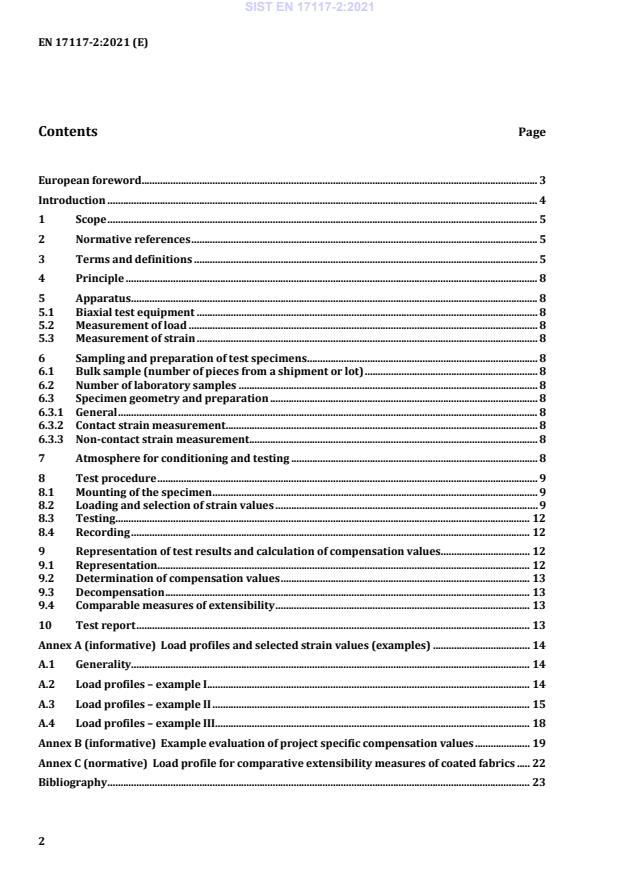
Contents Page
European foreword . 3
Introduction . 4
1 Scope . 5
2 Normative references . 5
3 Terms and definitions . 5
4 Principle . 8
5 Apparatus . 8
5.1 Biaxial test equipment . 8
5.2 Measurement of load . 8
5.3 Measurement of strain . 8
6 Sampling and preparation of test specimens . 8
6.1 Bulk sample (number of pieces from a shipment or lot) . 8
6.2 Number of laboratory samples . 8
6.3 Specimen geometry and preparation . 8
6.3.1 General . 8
6.3.2 Contact strain measurement . 8
6.3.3 Non-contact strain measurement. 8
7 Atmosphere for conditioning and testing . 8
8 Test procedure . 9
8.1 Mounting of the specimen . 9
8.2 Loading and selection of strain values . 9
8.3 Testing . 12
8.4 Recording . 12
9 Representation of test results and calculation of compensation values . 12
9.1 Representation. 12
9.2 Determination of compensation values . 13
9.3 Decompensation . 13
9.4 Comparable measures of extensibility . 13
10 Test report . 13
Annex A (informative) Load profiles and selected strain values (examples) . 14
A.1 Generality . 14
A.2 Load profiles – example I . 14
A.3 Load profiles – example II . 15
A.4 Load profiles – example III. 18
Annex B (informative) Example evaluation of project specific compensation values . 19
Annex C (normative) Load profile for comparative extensibility measures of coated fabrics . 22
Bibliography . 23
European foreword
This document (EN 17117-2:2021) has been prepared by Technical Committee CEN/TC 248 “Textiles
and textile products”, the secretariat of which is held by BSI.
This European Standard shall be given the status of a national standard, either by publication of an
identical text or by endorsement, at the latest by January 2022, and conflicting national standards shall
be withdrawn at the latest by January 2022.
Attention is drawn to the possibility that some of the elements of this document may be the subject of
patent rights. CEN shall not be held responsible for identifying any or all such patent rights
EN 17117 consists of the following parts, under the general title Rubber- or plastics-coated fabrics —
Mechanical test methods under biaxial stress states:
— Part 1: Tensile stiffness properties
— Part 2: Determination of the pattern compensation values
An additional part related to shear stiffness properties will be proposed after the publication of the
previous parts.
Any feedback and questions on this document should be directed to the users’ national standards body.
A complete listing of these bodies can be found on the CEN website.
According to the CEN-CENELEC Internal Regulations, the national standards organisations of the
following countries are bound to implement this European Standard: Austria, Belgium, Bulgaria, Croatia,
Cyprus, Czech Republic, Denmark, Estonia, Finland, France, Germany, Greece, Hungary, Iceland, Ireland,
Italy, Latvia, Lithuania, Luxembourg, Malta, Netherlands, Norway, Poland, Portugal, Republic of North
Macedonia, Romania, Serbia, Slovakia, Slovenia, Spain, Sweden, Switzerland, Turkey and the United
Kingdom.
Introduction
Compensation is the process of reducing the size of cutting patterns with the objective to introduce and
maintain the desired range of prestress specified in the structural design using coated fabrics such as
architectural tensioned envelopes. Elastic strain correspondent to the prestress and irreversible strain
of the coated fabrics induced by tensioning during installation and potential load incidents over the
lifetime of an architectural tensioned envelope, should be compensated to achieve the objective. Different
compensation values may be applied to different parts of the same architectural tensioned envelope.
Decompensation may also be applied if required.
1 Scope
This document describes methods for the determination of compensation values for orthotropic coated
fabrics (different properties along ideally perpendicular directions, such as the weft and warp yarns for
woven based coated fabrics, or along the courses and wales of knitted based coated fabrics) for
determining cutting patterns.
NOTE The final interpretation and the determination of the compensation values remains the responsibility of
the project engineer.
Annex C describes a method to determine comparable measures of extensibility along ideally
perpendicular directions of coated fabrics. The comparable measures of extensibility can be used by
design engineers to assess the extensibility of a coated fabric by comparison with other coated fabrics. In
this way, they can help to interpret results of compensation tests. Moreover, they can be used by material
suppliers to measure the consistency of extensibility along perpendicular directions of a coated fabric
from batch to batch.
2 Normative references
The following documents are referred to in the text in such a way that some or all of their content
constitutes requirements of this document. For dated references, only the edition cited applies. For
undated references, the latest edition of the referenced document (including any amendments) applies.
EN 17117-1, Rubber or plastics-coated fabrics - Mechanical test methods under biaxial stress states - Part
1: Tensile stiffness properties
3 Terms and definitions
For the purposes of this document, the following terms and definitions apply.
ISO and IEC maintain terminological databases for use in standardization at the following addresses:
— ISO Online browsing platform: available at https://www.iso.org/obp
— IEC Electropedia: available at http://www.electropedia.org/
3.1
biaxial
measurement or application along two axes simultaneously
[SOURCE: EN 17117-1:2018, 3.1]
3.2
compensation
reduction in size of a cutting pattern, so that during installation the panel elongates to achieve an initial
nominal prestress
3.3
compensation value
amount by which the dimensions of the pattern geometry is reduced by compensation
Note 1 to entry: The compensation value is expressed as a percentage of length in the direction to be
compensated.
3.4
cutting pattern
two-dimensional geometry developed from a pattern to be cut out of the individual piece of a coated
fabric
3.5
decompensation
partial or complete reduction of compensation
Note 1 to entry: Decompensation may be applied to ease the installation process, typically in the vicinity of
boundaries.
Note 2 to entry: Typical application of compensation and decompensation to a piece of a coated fabric is depicted
in Figure 1.
Key
1 final geometry when stressed with nominal prestress
2 geometry compensated, unstressed
3 geometry decompensated, unstressed
4 half of the pattern compensation measure in warp (wale, respectively)
5 half of the pattern compensation measure in fill (course, respectively)
Figure 1 — Typical application of compensation and decompensation to a piece of a coated
fabric
3.7
overstressing
stressing beyond the nominal prestress level during the installation of a panel
3.8
panel
final three-dimensional assembly of pieces of a coated fabric, cut according to the cutting pattern, ready
to be installed on site
Note 1 to entry: An architectural tensioned envelope may be made of more than one panel.
3.9
piece of a coated fabric
two-dimensional piece cut from a roll of coated fabric
3.10
nominal prestress
input data of prestress, prescribed during the form finding and structural analysis, and part of the
structural design
3.11
pattern
seam layout based subdivision of a three-dimensional surface into a piece of a coated fabric
3.12
seam layout
definition of location and direction of seams over the surface of an architectural tensioned envelope
3.13
W1,5
load applied in the warp (respectively wale) direction with a magnitude of 1,5 % of the ultimate tensile
strength (UTS) in the warp (respectively wale) direction
3.14
F1,5
load applied in the fill (respectively course) direction with a magnitude of 1,5 % of the ultimate tensile
strength (UTS) in the fill (respectively course) direction
3.15
W10
load applied in the warp (respectively wale) direction with a magnitude of 10 % of the ultimate tensile
strength (UTS) in the warp (respectively wale) direction
3.16
F10
load applied in the fill (respectively course) direction with a magnitude of 10 % of the ultimate tensile
strength (UTS) in the fill (respectively course) direction
3.17
MIN1,5
minimum of W1,5 and F1,5
3.18
MIN10
minimum of W10 and F10
4 Principle
Strains measured during the biaxial loading in warp and fill (respectively wale and course) directions of
the coated fabric are used to derive the compensation values.
5 Apparatus
5.1 Biaxial test equipment
Shall be according to EN 17117-1:2018, 5.1.
5.2 Measurement of load
Shall be according to EN 17117-1:2018, 5.2.
5.3 Measurement of strain
Shall be according to EN 17117-1:2018, 5.3.
6 Sampling and preparation of test specimens
6.1 Bulk sample (number of pieces from a shipment or lot)
Shall be according to EN 17117-1:2018, 6.1.
6.2 Number of laboratory samples
Shall be according to EN 17117-1:2018, 6.2.
6.3 Specimen geometry and preparation
6.3.1 General
Shall be according to EN 17117-1:2018, 6.3.1.
6.3.2 Contact strain measurement
Shall be according to EN 17117-1:2018, 6.3.2.
6.3.3 Non-contact strain measurement
Shall be according to EN 17117-1:2018, 6.3.3.
7 Atmosphere for conditioning and testing
Shall be according to EN 17117-1:2018, Clause 7.
8 Test procedure
8.1 Mounting of the specimen
Shall be according to EN 17117-1:2018, 8.1.
8.2 Loading and selection of strain values
In order to derive project specific compensation values from selected strain values, project specific load
profiles should be individually specified. The specimen is loaded by forces in the warp and fill
(respectively wale and course) directions with prescribed magnitudes and ratios.
Example of project specific load profiles are illustrated in Annex B.
Load ratios are used to define a load cycle with start, middle and end values.
The specification of the load profile should include consideration of:
— design nominal prestress;
— design biaxial stresses arising from characteristic external loads, for example wind, snow. Design
biaxial stresses should be representative (for example an average value) for the area over which the
compensation value is to be applied;
— type of external loads, for example wind, snow;
— design biaxial stress ratios;
— duration of design biaxial stresses;
— probability of design biaxial stresses;
— spatial representation of design biaxial stresses;
— area over which the compensation value is to be applied;
— overstressing anticipated during installation;
— installation process, for example order of prestressing of the yarn directions during installation.
Typically, two dominant load cases can be derived from the structural analysis: one with predominant
warp stress and one with predominant fill stress. The respective stresses in warp and fill direction
together with the corresponding stresses in the perpendicular direction should be used to specify the
load profile. The load profile should consist of the steps given in Table 1. In some cases, for example
pneumatic structures or plane frames, only one load case may exist. In these cases, steps 4 and 5 can be
neglected.
Table 1 — Steps for the individual specification of the load profile
Step Simulation of Remarks
o
N
Prestress/installation Nominal prestress held constant over a
specified period of time. Overstressing may be
considered. Prestress may be applied in
several cycles prior to holding it constant.
Load case with predominant warp stress Long-term nature of a load case may be
2 together with corresponding fill stress, considered by holding maximum stress
repeated several times constant over a specified period of time
3 Period of nominal prestress held constant -
Load case with predominant fill stress Long-term nature of a load case may be
4 together with corresponding warp stress, considered by holding maximum stress
repeated several times constant over a specified period of time
5 Period of nominal prestress held constant -
6 Repetition of steps 1 to 5 may be considered -
Example loading options in step 1 “Prestress/installation” are illustrated in Figure 2: Loading and
nominal prestress held constant (a), simulation of overstressing prior to prestress held constant (b),
prestress cycling prior to prestress h
...
The article discusses EN 17117-2:2021, a document that outlines mechanical test methods for rubber- or plastics-coated fabrics under biaxial stress states. It specifically focuses on determining compensation values for orthotropic coated fabrics, which have different properties along perpendicular directions. These compensation values are used in determining cutting patterns. The responsibility for interpretation and determination of compensation values lies with the project engineer. Annex C provides a method for determining comparable measures of extensibility along perpendicular directions of coated fabrics. Design engineers can use these measures to assess a coated fabric's extensibility compared to other fabrics, while material suppliers can use them to measure the consistency of extensibility across batches of coated fabric.
기사 제목: EN 17117-2:2021 - 고무 또는 플라스틱 코팅된 원단 - 이방향 응력 상태에서의 기계 시험 방법 - 제2부: 패턴 보상 값 결정 기사 내용: 이 문서는 이방성 코팅된 원단(이상적으로 수직 방향인 가로와 세로 방향 강사로 이루어진 원단)의 보상 값 결정을 위한 방법을 설명합니다. 패턴 자르기를 결정하기 위해 사용됩니다. 주의: 최종 해석 및 보상 값의 결정은 프로젝트 엔지니어의 책임입니다. 부록 C에서는 코팅된 원단의 이상적으로 수직 방향의 신축성에 대한 비교 가능한 측정치를 결정하는 방법을 제시합니다. 이 비교 가능한 신축성 측정치는 설계 엔지니어가 다른 코팅된 원단과 비교하여 코팅된 원단의 신축성을 평가하는 데에 사용될 수 있습니다. 이를 통해 보상 시험 결과를 해석하는 데 도움을 줄 수 있습니다. 또한, 물질 공급 업체는 일괄 생산된 코팅된 원단의 수직 방향에서의 신축성 일관성을 측정하기 위해 이 비교 가능한 신축성 측정치를 사용할 수 있습니다.
The article discusses EN 17117-2:2021, which focuses on mechanical test methods for rubber- or plastics-coated fabrics. Specifically, it outlines a process for determining compensation values for orthotropic coated fabrics, which have different properties in perpendicular directions. These compensation values are important for determining cutting patterns. The responsibility for interpreting and determining the compensation values lies with the project engineer. Additionally, Annex C provides a method for measuring extensibility of coated fabrics along perpendicular directions, which can be used by design engineers to compare different fabrics and assess consistency from batch to batch.
기사 제목: EN 17117-2:2021 - 고무 또는 플라스틱 코팅된 직물 - 이방성 응력 상태에서의 기계 시험 방법 - 제2부: 패턴 보상 값의 결정 기사 내용: 본 문서는 이방성 코팅된 직물(이상적으로 수직 방향, 즉 직조형 코팅된 직물의 종선과 사선로, 또는 편조형 코팅된 직물의 시외와 나들목을 따라 다른 속성을 갖는)의 보상 값을 결정하기 위한 방법을 설명합니다. 참고: 최종 해석 및 보상 값을 결정하는 것은 프로젝트 엔지니어의 책임입니다. 부록 C는 코팅된 직물의 이상적으로 수직 방향의 신축성에 대한 비교 가능한 측정치를 결정하기 위한 방법을 서술합니다. 이 비교 가능한 신축성 측정치는 디자인 엔지니어가 다른 코팅된 직물과 비교하여 코팅된 직물의 신축성을 평가하는 데 도움을 줄 수 있습니다. 이 방법을 통해 보상 시험 결과를 해석하는 데도 도움이되며, 또한 재료 공급 업체는 일괄로부터 이상적으로 수직 방향의 신축성의 일관성을 측정하는 데 사용할 수 있습니다.
記事のタイトル:EN 17117-2:2021 - ラバーまたはプラスチックコーティングされた生地 - 二軸応力状態下の機械的試験方法 - 第2部:パターン補償値の決定 記事の内容:この文書では、二軸応力状態下のラバーやプラスチックコーティングされた生地における補償値の決定方法について説明しています。特に、直交する方向で異なる特性を持つ直交異方性のコーティングされた生地に対する補償値の決定に焦点を当てています。これらの補償値は、カッティングパターンの決定に使用されます。ただし、最終的な解釈および補償値の決定はプロジェクトエンジニアの責任に帰します。 付録Cでは、コーティングされた生地の直交する方向の伸縮性の比較可能な指標を決定する方法が説明されています。これらの比較可能な指標は、設計エンジニアが他のコーティングされた生地と比較して生地の伸縮性を評価するために使用することができます。これにより、補償試験の結果を解釈するのに役立ちます。また、材料供給業者は、一貫性のある生地の伸縮性をバッチごとに測定するためにこれらの比較可能な指標を使用することができます。
記事のタイトル: EN 17117-2:2021-ゴムまたはプラスチック被覆生地-2軸応力状態下での機械的試験方法-パート2: パターン補償値の決定 記事内容: この文書では、直交方向に異なる特性を持つ直交方向の加工済み生地(織りベースのコーティング生地の場合は緯糸と縦糸、または編みベースのコーティング生地の場合はコースと編み)の補償値を決定する方法について説明しています。注意:最終的な解釈および補償値の決定はプロジェクトエンジニアの責任です。 付録Cでは、加工済み生地の直交方向の伸長性の比較可能な指標の決定方法について説明しています。比較可能な伸長性の指標は、設計エンジニアが他の加工済み生地と比較し、加工済み生地の伸長性を評価するのに役立ちます。これにより、補償試験の結果を解釈するのに役立つだけでなく、材料供給業者は一貫した伸長性をバッチごとに測定するために使用することができます。
Questions, Comments and Discussion
Ask us and Technical Secretary will try to provide an answer. You can facilitate discussion about the standard in here.
Loading comments...