

EN 18185:2026
(Main)Sustainability of construction works - Environmental product declarations - Product Category Rules for precast lightweight concrete with an open structure and precast autoclaved aerated concrete
- Abstract
This document provides product category rules (PCR) guidance for the development of Type III environmental declarations for prefabricated reinforced components of autoclaved aerated concrete or lightweight aggregate concrete with open structure according to EN 15804:2012+A2:2019.
This document defines the parameters to be reported, the EPD types (and life cycle stages) to be covered, the rules to be followed for generating life cycle inventories (LCI) and conducting life cycle impact assessments (LCIA), and the data quality to be used in the development of EPDs.
In addition to the common parts of EN 15804:2012+A2:2019, this document provides guidance for elements made as prefabricated reinforced components of autoclaved aerated concrete or lightweight aggregate concrete with open structure:
— defines the system boundaries;
— defines the modelling and assessment of material-specific characteristics;
— defines allocation procedures for multi-output processes along the production chain;
— defines allocation procedures for reuse and recycling;
— includes the rules for calculating the LCI and the LCIA underlying the EPD;
— provides guidance/specific rules for the determination of the reference service life (RSL);
— gives guidance on the establishment of default scenarios;
— gives guidance on default functional units for elements.
This document is intended to be used for cradle to gate, cradle to gate with options or cradle to grave assessments, when the intention is clearly stated in the system boundary description.
- Status
- Published
- Publication Date
- 10-Dec-2026
- Technical Committee
- CEN/TC 177 - Prefabricated reinforced components of autoclaved aerated concrete or light-weight aggregate concrete with open structure
- Drafting Committee
- CEN/TC 177/WG 1 - Prefabricated Reinforced Components of AAC
- Current Stage
- 6060 - Definitive text made available (DAV) - Publishing
- Start Date
- 22-Jul-2026
- Due Date
- 11-Dec-2026
- Completion Date
- 11-Dec-2026

EN 18185:2026 is a CEN European Standard for environmental product declarations (EPD) of precast lightweight concrete with an open structure and precast autoclaved aerated concrete. It gives product category rules for prefabricated reinforced components, building on EN 15804:2012+A2:2019. In practice, it tells EPD authors which parameters to report, how to model the life cycle, how to handle carbonation, and what data quality to use.
What does EN 18185:2026 specify?
EN 18185:2026 specifies product category rules guidance for Type III environmental declarations for prefabricated reinforced components of autoclaved aerated concrete and lightweight aggregate concrete with open structure. It sets the reporting parameters, the life cycle stages to cover, the rules for life cycle inventory (LCI) and life cycle impact assessment (LCIA), and the data quality rules used to develop EPDs.
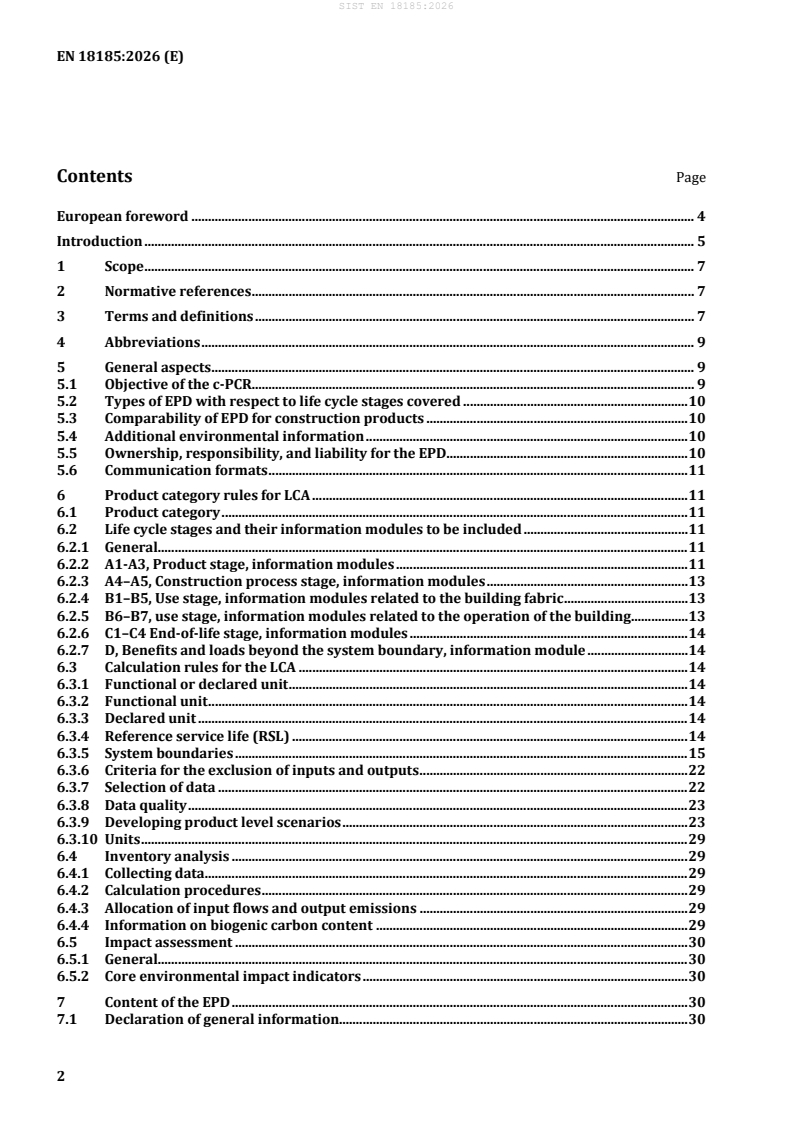
The standard is organized around the general EN 15804 framework and then adds rules specific to these elements. Its main structure covers general aspects, product category rules for LCA, EPD content, project reporting, verification and validity, plus three annexes.
| Annex | What it covers |
|---|---|
| Annex A | Product stage guidance for defining system boundaries |
| Annex B | Re-carbonation of elements |
| Annex C | Scenario guidance for elements |
What are the key requirements of EN 18185:2026?
General framework and declared scope
EN 18185:2026 is written as complementary product category rules (c-PCR) for element units and is intended to be used together with EN 15804:2012+A2:2019 and EN 15941:2024. It is aimed at transparency in EPD development and at keeping comparisons between construction products tied to their actual use in construction works.
The product category includes elements conforming to EN 1520:2026 or EN 12602:-. Clause 5 also points to the standard EPD communication and comparability rules from EN 15804, so the document is not a standalone reporting template.
Life cycle coverage and system boundaries
Clause 6.2 organizes the EPD around the usual life cycle modules A1-A3, A4-A5, B1-B7, C1-C4 and D. For elements, Clause 6.3.5.1 requires the declared EPD type to be cradle to grave with module D, so the document expects a full life cycle view including benefits and loads beyond the system boundary.
The standard requires carbonation to be considered within the system boundaries during production, storage, use and end-of-life, wherever relevant. If carbonation is not included, the EPD must say so; if it is included, the assumptions and the calculation method have to be stated. This matters because carbonation affects the reported climate impact.
Product stage, declared unit and reference service life
Clause 6.3.3 sets the declared unit separately for LAC and AAC precast reinforced components as 1 m3 of declared dry density, with other units also possible if they are clearly stated. The EPD should also state dry density, reinforcement quantity and total mass. That helps buyers and designers compare elements that differ in thickness or density.
Clause 6.3.4 ties the reference service life (RSL) to the estimated service life of the building or civil engineering work when the final use is known. If the use is unknown, the producer or manufacturer assesses the RSL, with guidance in Annex C. In practice, this means the declared service life must fit the intended application, not just the product itself.
Data, allocation and modelling rules
Clause 6.3.7 recommends data at the right geographic level, especially for cement, additions, reinforcement, transport, energy and water. It also requires the EPD to state whether a specific mix design or a generic design is used, and whether transport data are plant-specific or average. That matters because upstream assumptions can strongly change the results.
Clause 6.4 keeps the LCI rules aligned with EN 15804, including collecting data, calculation procedures, and allocation of inputs and emissions. The standard also points to allocation procedures for reuse and recycling, which is important for prefabricated components that may be recovered, crushed or reused.
Use stage, end-of-life and module D
For the use stage, EN 18185:2026 treats carbonation as a B1 issue when it occurs during use. It also says that elements generally need no maintenance, repair, replacement or refurbishment, and that B6-B7 are not relevant for elements. In practice, that reduces the amount of use-stage modelling, while keeping the environmental release and carbonation questions in scope.
For end-of-life, the standard requires scenarios for deconstruction, transport, waste processing and disposal, and it distinguishes what stays inside the system boundary from what moves to module D. Module D may cover reuse of elements, recycling of AAC or LAC, and recycling of reinforcing steel and other constituents. This matters for recyclability claims and for showing credits from secondary material use.
EPD content, reporting and verification
Clause 7 defines what the EPD must contain: general information, environmental indicators from LCA, scenarios and additional technical information, information on dangerous substances, and aggregation of information modules. Clause 8 requires a project report with the LCA-related elements and verification data. Clause 9 points back to EN 15804 for verification and validity.
What terms does EN 18185:2026 define?
- aggregate - granular material used in construction, and it may be natural, manufactured or recycled.
- lightweight aggregate - mineral aggregate with low particle density or low loose bulk density, used to make lightweight concretes.
- carbonation - the reaction of carbon dioxide with calcium- and magnesium-containing minerals to form carbonates and store CO2.
- LAC - lightweight aggregate concrete with open structure, described as concrete with an open and porous structure.
- AAC - autoclaved aerated concrete, made from binders, fine siliceous material, cell-generating material and water, then cured in autoclaves.
- element - a precast component of AAC or LAC, with or without reinforcement.
- FU - functional unit, the basis for expressing declared performance when service delivery rather than a simple quantity is being assessed.
- c-PCR - complementary product category rules, the additional rules that tailor EN 15804 to this product family.
Who uses EN 18185:2026?
EN 18185:2026 is used by manufacturers of precast AAC and LAC elements, EPD practitioners, and LCA consultants who prepare environmental declarations for these products. It is also used by engineers, specifiers, buyers and sustainability teams who need comparable EPD data for procurement or project assessment.
Quality managers and verifiers use it to check that the declared unit, service life, scenarios, carbonation treatment and module reporting are consistent. Designers and assessment specialists use it when they need product data that can feed building or civil engineering sustainability assessments under the EN 15804 framework.
Which standards are used with EN 18185:2026?
- EN 15804:2012+A2:2019 - the core PCR standard that supplies the common EPD rules, life cycle module structure and declaration format.
- EN 15941:2024 - the data quality standard named in the introduction and objective for selecting and using data in EPD work.
- EN 15942:2021 - the business-to-business communication format for EPD information.
- EN 16757:2022 - the concrete and concrete elements PCR that EN 18185 mirrors for carbonation calculation and related modelling guidance.
- EN 1520:2026 - the product standard for precast reinforced components of lightweight aggregate concrete with open structure.
- EN 12602:- - the product standard for precast reinforced components of autoclaved aerated concrete.
- EN 206-1:2026 and EN 459-1:2015 - source standards used for cement and lime definitions in Clause 3.
What does the EN 18185:2026 document contain?
EN 18185:2026 contains the full PCR structure for creating EPDs for these element types, from general rules through LCA modelling and EPD content to verification. It includes the module-based life cycle requirements, declared unit rules, data selection guidance, allocation rules, and reporting rules for carbonation and biogenic carbon.
The document also contains a system boundary figure, an end-of-life process figure, and a scenario table for typical building uses in Annex C. Annex B gives the normative carbonation and re-carbonation method, including calculation approaches and worked examples, while Annex A explains how to define product-stage boundaries for these elements.
Relations
- Effective Date
- 16-Sep-2026
- Effective Date
- 04-Nov-2026
- Effective Date
- 16-Sep-2026
Get Certified
Connect with accredited certification bodies for this standard

BSI Group
BSI (British Standards Institution) is the business standards company that helps organizations make excellence a habit.

Bureau Veritas
Bureau Veritas is a world leader in laboratory testing, inspection and certification services.

DNV
DNV is an independent assurance and risk management provider.
Sponsored listings
Frequently Asked Questions
EN 18185:2026 is a standard published by the European Committee for Standardization (CEN). Its full title is "Sustainability of construction works - Environmental product declarations - Product Category Rules for precast lightweight concrete with an open structure and precast autoclaved aerated concrete". This standard covers: This document provides product category rules (PCR) guidance for the development of Type III environmental declarations for prefabricated reinforced components of autoclaved aerated concrete or lightweight aggregate concrete with open structure according to EN 15804:2012+A2:2019. This document defines the parameters to be reported, the EPD types (and life cycle stages) to be covered, the rules to be followed for generating life cycle inventories (LCI) and conducting life cycle impact assessments (LCIA), and the data quality to be used in the development of EPDs. In addition to the common parts of EN 15804:2012+A2:2019, this document provides guidance for elements made as prefabricated reinforced components of autoclaved aerated concrete or lightweight aggregate concrete with open structure: — defines the system boundaries; — defines the modelling and assessment of material-specific characteristics; — defines allocation procedures for multi-output processes along the production chain; — defines allocation procedures for reuse and recycling; — includes the rules for calculating the LCI and the LCIA underlying the EPD; — provides guidance/specific rules for the determination of the reference service life (RSL); — gives guidance on the establishment of default scenarios; — gives guidance on default functional units for elements. This document is intended to be used for cradle to gate, cradle to gate with options or cradle to grave assessments, when the intention is clearly stated in the system boundary description.
This document provides product category rules (PCR) guidance for the development of Type III environmental declarations for prefabricated reinforced components of autoclaved aerated concrete or lightweight aggregate concrete with open structure according to EN 15804:2012+A2:2019. This document defines the parameters to be reported, the EPD types (and life cycle stages) to be covered, the rules to be followed for generating life cycle inventories (LCI) and conducting life cycle impact assessments (LCIA), and the data quality to be used in the development of EPDs. In addition to the common parts of EN 15804:2012+A2:2019, this document provides guidance for elements made as prefabricated reinforced components of autoclaved aerated concrete or lightweight aggregate concrete with open structure: — defines the system boundaries; — defines the modelling and assessment of material-specific characteristics; — defines allocation procedures for multi-output processes along the production chain; — defines allocation procedures for reuse and recycling; — includes the rules for calculating the LCI and the LCIA underlying the EPD; — provides guidance/specific rules for the determination of the reference service life (RSL); — gives guidance on the establishment of default scenarios; — gives guidance on default functional units for elements. This document is intended to be used for cradle to gate, cradle to gate with options or cradle to grave assessments, when the intention is clearly stated in the system boundary description.
EN 18185:2026 is classified under the following ICS (International Classification for Standards) categories: 13.020.50 - Ecolabelling; 91.100.30 - Concrete and concrete products. The ICS classification helps identify the subject area and facilitates finding related standards.
EN 18185:2026 has the following relationships with other standards: It is inter standard links to EN 15804:2012+A2:2019, EN 12602:2026, EN 1520:2026. Understanding these relationships helps ensure you are using the most current and applicable version of the standard.
EN 18185:2026 is associated with the following European legislation: EU Directives/Regulations: 305/2011; Standardization Mandates: M/100, M/609, M/627. When a standard is cited in the Official Journal of the European Union, products manufactured in conformity with it benefit from a presumption of conformity with the essential requirements of the corresponding EU directive or regulation.
EN 18185:2026 is available in PDF format for immediate download after purchase. The document can be added to your cart and obtained through the secure checkout process. Digital delivery ensures instant access to the complete standard document.
Standards Content (Sample)
Contents
- Introduction
- 1 Scope
- 2 Normative references
- 3 Terms and definitions
- 3.1 aggregate
- 3.2 lightweight aggregate
- 3.3 carbonation
- 3.4 LAC
- 3.5 autoclaved aerated concrete
- 3.6 element
- 3.7 cement
- 3.8 addition
- 3.9 admixture
- 3.10 lime
- 4 Abbreviations
- 5 General aspects
- 5.1 Objective of the c-PCR
- 5.2 Types of EPD with respect to life cycle stages covered
- 5.3 Comparability of EPD for construction products
- 5.4 Additional environmental information
- 5.5 Ownership, responsibility, and liability for the EPD
- 5.6 Communication formats
- 6 Product category rules for LCA
- 6.1 Product category
- 6.2 Life cycle stages and their information modules to be included
- 6.3 Calculation rules for the LCA
- 6.4 Inventory analysis
- 6.5 Impact assessment
- 7 Content of the EPD
- 7.1 Declaration of general information
- 7.2 Declaration of environmental indicators derived from LCA
- 7.3 Scenarios and additional technical information
- 7.4 Additional information on release of dangerous substances to indoor air, soil and
- 7.5 Aggregation of information modules
- 8 Project report
- 8.1 General
- 8.2 LCA-related elements of the project report
- 8.3 Documentation on additional information
- 8.4 Data availability for verification
- 9 Verification and validity of an EPD
- Annex A
- Annex B
- Annex C
- 3 Non-structural Data Potential Generally, no Repair may be In case of — — —
- 5 Elements for Data Potential Cleaning and — In case of — Energy —
- Bibliography
Introduction
This document provides rules for environmental product declarations (EPD) for prefabricated reinforced components. It complements the core product category rules for all construction products and services given in EN 15804:2012+A2:2019, Sustainability of construction works — Environmental product declarations — Core rules for the product category of construction products. This document provides additional rules for environmental product declarations (EPD) of prefabricated reinforced components. It complements the core rules for all construction products and services as established in EN 15804:2012+A2:2019.
EPD information is expressed in information modules as defined in EN 15804:2012+A2:2019, which allow easy organization and expression of data packages throughout the life cycle of concrete and concrete elements. The approach requires that the underlying data should be consistent, reproducible and comparable.
In line with EN 15804:2012+A2:2019 the EPD is expressed in a form that allows aggregation to provide complete information for buildings. This document does not deal with aggregation at the building level nor does this document describe the rules for applying EPD in a building assessment. This document refers to and mirrors relevant parts of EN 16757:2022, Sustainability of construction works — Environmental product declarations — Product Category Rules for concrete and concrete elements, drafted to cover concrete products to CEN/TC 177. In respect of the mechanism for the recarbonation of cementitious components this document references and follows the calculation methodology according to EN 16757:2022, informative Annex G ‘CO uptake by carbonation — Guidance
on calculation’, Clause G.2.
According to [5] in the bibliography, the carbonation runs linear in terms of time, and a carbonation degree of 80 % after 50 years may be assumed. Time periods lower than 50 years can be calculated according to these conditions with a linear relation. This condition can be used in all clauses where relevant.
The document deals with a limited number of quantifiable parameters as predefined in EN 15804:2012+A2:2019. Future revisions of EN 15804:2012+A2:2019 can lead to the incorporation in this document of additional predetermined parameters. This document provides the means for developing a Type III environmental declaration for prefabricated reinforced components in the context of the suite of standards that are intended to assess the sustainability of construction works. This suite of standards includes:
- EN 206-1:2026, Concrete - Specification, performance, production and conformity - Part 1:
Performance, requirements, factory production control and assessment criteria for individual values - EN 459-1:2015, Building lime - Part 1: Definitions, specifications and conformity criteria - EN 15643:2021, Sustainability of construction works — Framework for assessment of buildings and civil engineering works - EN 15978:2026, Sustainability of construction works — Assessment of environmental performance of buildings — Calculation methods - EN 15804:2012+A2:2019, Sustainability of construction works — Environmental product declaration — Core rules for the product category of construction products - EN 15941:2024, Sustainability of construction works — Environmental product declarations — Data quality for the environmental assessment of products and construction works — Selection and use of data - EN 15942:2021, Sustainability of construction works — Environmental product declarations — Communication format — Business to business
SIST EN 18185:2026 EN 18185:2026 (E) - CEN/TR 16970:2016, Sustainability of construction works — Guidance for the implementation of EN 15804 - EN 17472:2022, Sustainability of construction works —Sustainability assessment of civil engineering works — Calculation methods - EN 17672:2022, Sustainability of construction works — Environmental product declarations — Horizontal rules for business to consumer communication - EN 17680:2023, Sustainability of construction works — Evaluation of the potential for sustainable refurbishment of buildings
SIST EN 18185:2026 EN 18185:2026 (E)
1 Scope
This document provides product category rules (PCR) guidance for the development of Type III environmental declarations for prefabricated reinforced components of autoclaved aerated concrete or lightweight aggregate concrete with open structure according to EN 15804:2012+A2:2019. This document defines the parameters to be reported, the EPD types (and life cycle stages) to be covered, the rules to be followed for generating life cycle inventories (LCI) and conducting life cycle impact assessments (LCIA), and the data quality to be used in the development of EPDs. In addition to the common parts of EN 15804:2012+A2:2019, this document provides guidance for elements made as prefabricated reinforced components of autoclaved aerated concrete or lightweight aggregate concrete with open structure:
- defines the system boundaries;
- defines the modelling and assessment of material-specific characteristics;
- defines allocation procedures for multi-output processes along the production chain;
- defines allocation procedures for reuse and recycling;
- includes the rules for calculating the LCI and the LCIA underlying the EPD;
- provides guidance/specific rules for the determination of the reference service life (RSL);
- gives guidance on the establishment of default scenarios;
- gives guidance on default functional units for elements.
This document is intended to be used for cradle to gate, cradle to gate with options or cradle to grave assessments, when the intention is clearly stated in the system boundary description.
2 Normative references
The following documents are referred to in the text in such a way that some or all of their content constitutes requirements of this document. For dated references, only the edition cited applies. For undated references, the latest edition of the referenced document (including any amendments) applies.
EN 15804:2012+A2:2019, Sustainability of construction works - Environmental product declarations - Core rules for the product category of construction products
3 Terms and definitions
For the purposes of this document, the terms and definitions given in EN 15804:2012+A2:2019, Clause 3 and the following apply.
ISO and IEC maintain terminology databases for use in standardization at the following addresses:
- ISO Online browsing platform: available at https://www.iso.org/obp/
- IEC Electropedia: available at https://www.electropedia.org/
3.1 aggregate
granular material used in construction Note 1 to entry: Aggregate may be natural, manufactured, or recycled.
As impacted by EN 15804:2012+A2:2019/AC:2021.
SIST EN 18185:2026 EN 18185:2026 (E) [SOURCE: EN 12620:2002+A1:2008, 3.1 and EN 13055-1:2002]
3.2 lightweight aggregate
3 3 aggregate of mineral origin having a particle density not exceeding 2 000 kg/m (2,00 Mg/m ) or a loose 3 3 bulk density not exceeding 1 200 kg/m (1,20 Mg/m ) [SOURCE: EN 13055-1:2002, 3.2]
3.3 carbonation
carbon dioxide reaction with calcium and magnesium containing minerals to form carbonates resulting in the sequestration of CO
3.4 LAC
lightweight aggregate concrete with open structure concrete with an open and porous structure 3 3 Note 1 to entry: LAC has a dry bulk density between 400 kg/m and 2,000 kg/m and is produced with lightweight aggregates (LWA), cement, concrete additives, and admixtures.
[SOURCE: EN 1520:2026, 3.1.2, modified – open and porous structure have been added]
3.5 autoclaved aerated concrete
AAC concrete that is manufactured from binders such as cement and/or lime combined with fine siliceousbased material, cell-generating material, and water Note 1 to entry: The raw materials are mixed and cast into moulds where the mix is allowed to rise and set into cakes, and after this part of the process, the cake is cut into the required sizes of components and cured with highpressure steam in autoclaves.
[SOURCE: EN 12602:— , 3.1]
3.6 element
precast component with or without reinforcement of autoclaved aerated concrete or lightweight aggregate concrete with open structure
3.7 cement
finely ground inorganic material which, when mixed with water, forms a paste that sets and hardens by means of hydration reactions and processes and which, after hardening, retains its strength and stability even under water [SOURCE: EN 206-1:2026, 3.2.6]
Under preparation. Stage at the time of publication: FprEN 12602:2026.
SIST EN 18185:2026 EN 18185:2026 (E)
3.8 addition
finely-divided-inorganic constituent used in concrete in order to improve certain properties or to achieve special properties [SOURCE: EN 206-1:2026, 3.2.1]
3.9 admixture
constituent added during the mixing process in small quantities to modify the properties of fresh or hardened concrete [SOURCE: EN 206-1:2026, 3.2.2]
3.10 lime
calcium oxide and/or hydroxide, and calcium-magnesium oxide and/or hydroxide produced by the thermal decomposition (calcination) of naturally occurring calcium carbonate (e.g. limestone, chalk, shells) or naturally occurring calcium magnesium carbonate (e.g. dolomitic limestone, dolomite) [SOURCE : EN 459-1:2015, 3.1]
4 Abbreviations
Abbreviations given in EN 15804:2012+A2:2019, Clause 4 and the following apply. FU functional unit AAC autoclaved aerated concrete LAC lightweight aggregate concrete with open structure c-PCR complementary product category rules
5 General aspects
5.1 Objective of the c-PCR
This c-PCR aims to provide rules specific to element units for the application of EN 15804:2012+A2:2019 and EN 15941:2024. In addition to the objectives of EN 15804:2012+A2:2019, 5.1, this document aims to:
- define the parameters being declared collated, and reported;
- describe which stages of a product’s life cycle are considered in the EPD and which processes are to be included in the life cycle stages;
- to define rules for the development of scenarios;
- to communicate EPDs and environmental information about elements;
- to ensure that comparisons between construction products are only carried out in the context of their application in construction works.
This c-PCR enables transparency for the EPD development for elements.
SIST EN 18185:2026 EN 18185:2026 (E)
5.2 Types of EPD with respect to life cycle stages covered
EN 15804:2012+A2:2019, 5.2 applies (see Figure 1).
Key 1 replacement of components, parts or systems 2 only possible if the conditions to exclude the declaration of modules C1-C4 and module D are met SOURCE: EN 15804:2012+A2:2019, 5.2 Figure 1 — Types of EPD with respect to life cycle stages covered and life cycle stages and modules for the building assessment
5.3 Comparability of EPD for construction products
EN 15804:2012+A2:2019, 5.3 applies.
5.4 Additional environmental information
EN 15804:2012+A2:2019, 5.4 applies.
5.5 Ownership, responsibility, and liability for the EPD
EN 15804:2012+A2:2019, 5.5 applies.
SIST EN 18185:2026 EN 18185:2026 (E)
5.6 Communication formats
EN 15804:2012+A2:2019, 5.6 applies.
6 Product category rules for LCA
6.1 Product category
The product category referred to in this document includes elements conforming to EN 1520:2026 or
EN 12602:— .
6.2 Life cycle stages and their information modules to be included
6.2.1 General
See 5.2.
6.2.2 A1-A3, Product stage, information modules
In addition to the text of EN 15804:2012+A2:2019, 6.2.2:
When the full LCI of constituents is not available, impact indicators and aspects from the EPDs complying to EN 15804:2012+A2:2019 for the constituents, covering modules A1 to A3, can be used to assess module A1 of the element. If transport is included, then the impacts and aspects covering modules A1 to A4 can be used to assess modules A1 and A2 (see Figure 2). However, primary data for materials’ transport and sourcing (A2) shall always be preferred over A4 transport data extracted from a raw material’s EPD. Constituents’ EPDs should be assessed for consistency and compatibility for use. NOTE Carbonation of elements takes place in module B1.
Under preparation. Stage at the time of publication: FprEN 12602:2026.
SIST EN 18185:2026 EN 18185:2026 (E)
SIST EN 18185:2026 EN 18185:2026 (E)
NOTE For the use of constituents in elements, when the EPD of constituents is used, modules A1 to A3 of the constituent EPD become part of modules A1 of element EPD, and module A4 of constituent EPD becomes part of modules A2 of element EPD if relevant and following the supply chain scenario. SOURCE: EN 16757:2022, Figure 2 Figure 2 — EPD for constituents (top) and for elements (bottom)
6.2.3 A4–A5, Construction process stage, information modules
EN 15804:2012+A2:2019, 6.2.3 applies.
NOTE Carbonation of elements can take place in module A5.
6.2.4 B1–B5, Use stage, information modules related to the building fabric
EN 15804:2012+A2:2019, 6.2.4 applies.
NOTE Carbonation of elements takes place in module B1.
6.2.5 B6–B7, use stage, information modules related to the operation of the building
EN 15804:2012+A2:2019, 6.2.5 applies.
SIST EN 18185:2026 EN 18185:2026 (E)
6.2.6 C1–C4 End-of-life stage, information modules
EN 15804:2012+A2:2019, 6.2.6 applies.
NOTE Carbonation of elements can also take place in these modules.
6.2.7 D, Benefits and loads beyond the system boundary, information module
EN 15804:2012+A2:2019, 6.2.7 applies.
At the end of life of elements, there are many options for new uses.
6.3 Calculation rules for the LCA
6.3.1 Functional or declared unit
EN 15804:2012+A2:2019, 6.3.1 applies.
6.3.2 Functional unit
6.3.2.1 General
EN 15804:2012+A2:2019, 6.3.2.1 applies.
6.3.2.2 Performance in a functional unit
EN 15804:2012+A2:2019, 6.3.2.2 applies.
6.3.3 Declared unit
In addition to the text in EN 15804:2012+A2:2019, 6.3.3:
For LAC precast reinforced components 3 3 The declared unit is: 1 m LAC of a declared dry density (kg/m ).
NOTE 1 Other units (e.g. m of a declared thickness (mm) and a declared dry density) are also possible. 3 3 3 The dry density (kg/m ), reinforcement quantity (kg/m ), and total mass (kg/m ) should be specified in the EPD.
For AAC precast reinforced components 3 3 The declared unit is: 1 m AAC of a declared dry density (kg/m ).
NOTE 2 Other units (e.g. m of a declared thickness (mm) and a declared dry density) are also possible. 3 3 3 The dry density (kg/m ), reinforcement quantity (kg/m ), and total mass (kg/m ) should be specified in the EPD.
6.3.4 Reference service life (RSL)
6.3.4.1 General
In addition to the text in EN 15804:2012+A2:2019, 6.3.4.1:
When the use of the element in a defined building or civil engineering work is known, the RSL of the product shall be consistent with the Estimated Service Life (at least equal to) of the building or civil engineering work.
SIST EN 18185:2026 EN 18185:2026 (E) If the intended use of the element is unknown, the RSL of the element should be assessed by the producer or by the manufacturer for the intended use. Guidance is given in Annex C.
6.3.4.2 Scenarios for RSL and functional unit
EN 15804:2012+A2:2019, 6.3.4.2 applies.
6.3.5 System boundaries
6.3.5.1 General
In addition to the text in EN 15804:2012+A2:2019, 6.3.5.1:
For elements, the following type of EPD shall be declared: cradle to grave and module D (A, B, C, and D). Annex A provides guidance for the definition of system boundaries. The general layout of system boundaries may be found in Figure 3. For carbonization characterization factor see 6.5.1. The quantity of CO2 bound varies according to the composition determined by the recipe, the type of element, and the exposure in use.
SIST EN 18185:2026 EN 18185:2026 (E)
Key normal process/component
optional process/component
waste cycle
external transport
internal move
waste flow
SOURCE: EN 16757:2022, Figure 3 Figure 3 — General layout of system boundaries
SIST EN 18185:2026 EN 18185:2026 (E) Within the system boundaries, the impact of carbonation during the production, storage, use and the endof-life stages of the product shall be taken into account. Carbonation is a natural process that can occur during the life cycle of elements containing reactive calcium components. Carbonation is a continuous process, if the building is demolished earlier than the RSL, then carbonation should be taken into account at the end of life. The quantity of CO bound varies according to the type of element and the exposure conditions in use.
Annex B provides methods to assess carbon dioxide uptake through carbonation. Other calculation methods may be used if transparently documented.
When carbonation is not taken into account, this shall be stated on the EPD. When carbonation is taken into account assumptions made shall be specified.
6.3.5.5 clearly defines the system boundaries of the end of life stage, in order to distinguish between the benefits within and beyond the system boundaries.
6.3.5.2 Product stage
In addition to the text in EN 15804:2012+A2:2019, 6.3.5.2:
A1 Production of raw materials or constituent products.
All resources (raw materials and constituent products) entering the production process shall be declared. The main raw and auxiliary materials for the different element types are (not limited listing):
LAC components Raw materials - Cement; - Other binders; - Admixtures; - Additions; - Steel reinforcement; - Non-metallic reinforcement; - Lightweight aggregates (including source) including extraction and processing; - Fibres (if relevant); - Recycled or returned production materials; - Water (including source); - Energy (including source).
Auxiliary materials and consumables:
- Admixtures;
- Additions;
- Steel reinforcement (if relevant);
SIST EN 18185:2026 EN 18185:2026 (E) - Non-metallic reinforcement; - Mould oil; - Insulation material (if relevant); - Packaging; - Pallets; - Energy (including source).
Prefabricated reinforced components of autoclaved aerated concrete Raw materials:
- Cement;
- Quicklime;
- Hydrated lime;
- Quartz sand;
- Quartz powder;
- Rock powder;
- Fly ash;
- Steel reinforcement;
- Return slurry;
- Recycled AAC, anhydrite (natural, from industry);
- Gypsum (natural or flue gas desulphurisation);
- Aluminium-powder;
- Aluminium-paste;
- Water (including source);
- Energy (including source).
Auxiliary materials and consumables:
- Mould oil;
- Grinding balls;
- Superplasticizer;
- Hydrophobic agents;
SIST EN 18185:2026 EN 18185:2026 (E) - Steam additives; - Water conditioners (e.g. NaCl, NaOH, HCl); - Pallets; - Packaging.
A2 Transport of raw materials (incl. packaging material) to the production site. A3 Manufacturing.
All inputs and outputs used during the different stages of the production process shall be considered. The main stages for the different element types are:
LAC components - Raw material processing (if relevant); - Production of auxiliary materials; - Reinforcement manufacturing; - Mixing; - Moulding; - Curing; - Internal recycling; - Internal transport; - Any additional treatment of the product (heating, surface treatment, etc.); - Packaging; - Storing; - Treatment of packaging waste.
Prefabricated reinforced components of autoclaved aerated concrete - Raw material processing (e.g. milling); - Reinforcement manufacturing; - Mixing; - Moulding; - Curing; - Cutting; - Water processing and steam generation;
...