


prEN ISO 11092
(Main)Textiles - Physiological effects - Measurement of thermal and water-vapour resistance under steady-state conditions (sweating guarded-hotplate test) (ISO/DIS 11092:2025)
Textiles - Physiological effects - Measurement of thermal and water-vapour resistance under steady-state conditions (sweating guarded-hotplate test) (ISO/DIS 11092:2025)
ISO 11092:2014 specifies methods for the measurement of the thermal resistance and water-vapour resistance, under steady-state conditions, of e.g. fabrics, films, coatings, foams and leather, including multilayer assemblies, for use in clothing, quilts, sleeping bags, upholstery and similar textile or textile-like products.
The application of this measurement technique is restricted to a maximum thermal resistance and water-vapour resistance which depend on the dimensions and construction of the apparatus used (e.g. 2 m2·K/W and 700 m2·Pa/W respectively, for the minimum specifications of the equipment referred to in ISO 11092:2014).
Textilien - Physiologische Wirkungen - Messung des Wärme- und Wasserdampfdurchgangswiderstands unter stationären Bedingungen (sweating guarded-hotplate test) (ISO/DIS 11092:2025)
Textiles - Effets physiologiques - Mesurage de la résistance thermique et de la résistance à la vapeur d'eau en régime stationnaire (essai de la plaque chaude gardée transpirante) (ISO/DIS 11092:2025)
L'ISO 11092:2014 prescrit des méthodes pour la détermination de la résistance thermique et de la résistance à la vapeur d'eau, en régime stationnaire, de produits tels que matières textiles, films, enductions, mousses et cuir, y compris les assemblages multicouches, qui sont utilisés pour l'habillement, les couettes, les sacs de couchage, les garnitures de siège et produits similaires textiles ou apparentés aux textiles.
L'application de cette technique de mesurage est limitée à des valeurs maximales de résistance thermique et de résistance à la vapeur d'eau qui dépendent des dimensions et de la construction de l'appareil utilisé (par exemple respectivement 2 m2.K/W et 700 m2.Pa/W pour les spécifications minimales de l'équipement auquel il est fait référence dans l'ISO 11092:2014).
Tekstilije - Ugotavljanje fizioloških lastnosti - Merjenje toplotne in parne upornosti pri ustaljenih pogojih (preskus z vročo ploščo, zaščiteno pred izgubo) (ISO/DIS 11092:2025)
General Information
- Status
- Not Published
- Publication Date
- 15-Feb-2027
- Technical Committee
- CEN/TC 248 - Textiles and textile products
- Drafting Committee
- CEN/TC 248 - Textiles and textile products
- Current Stage
- 4060 - Closure of enquiry - Enquiry
- Start Date
- 14-Oct-2025
- Completion Date
- 14-Oct-2025
Relations
- Effective Date
- 18-Jan-2023
Overview - ISO/DIS 11092:2025 (prEN ISO 11092)
prEN ISO 11092 (ISO/DIS 11092:2025) specifies the sweating guarded‑hotplate (skin model) test method for measuring the steady‑state thermal resistance and water‑vapour resistance of textiles and textile‑like products. The standard covers single materials and multilayer assemblies - for example, fabrics, films, coatings, foams and leather - used in clothing, quilts, sleeping bags, upholstery and similar applications. This document is a draft international standard circulated for comments (ISO/DIS) and updates the 2014 edition.
Key topics and technical requirements
- Measurement principle: steady‑state heat and mass transfer using a sweating guarded‑hotplate that simulates skin surface conditions.
- Measured properties:
- Thermal resistance (Rct) - temperature difference divided by heat flux (m2·K/W).
- Water‑vapour resistance (Ret) - vapour pressure difference divided by evaporative heat flux (m2·Pa/W).
- Apparatus components: measuring unit with temperature and water supply control, thermal guard with temperature control, and a test enclosure.
- Specimen handling: procedures for materials ≤ 5 mm and > 5 mm thickness, including mounting and assembly (annexes cover uneven or loose fillings).
- Calibration and constants: determination of apparatus constants, reference materials, recalibration and correction terms for heating power.
- Limits: measurement applicability is constrained by apparatus design; for minimum equipment specifications the approach is limited (example figures from the document: 2 m2·K/W for thermal resistance and 700 m2·Pa/W for water‑vapour resistance).
- Quality and precision: updated repeatability and reproducibility requirements (including results from a 2025 round‑robin) and guidance on test reporting.
- Normative reference: ISO 3696:1987 for laboratory water quality (Grade 3 water used for water supply).
Practical applications and users
- Who uses it:
- Textile and apparel manufacturers for product development and quality control
- Independent textile testing laboratories and certification bodies
- R&D teams working on thermal comfort, insulation, moisture management and protective clothing
- Sleeping bag, bedding and upholstery product developers evaluating insulation and breathability
- Why it matters:
- Provides standardized, reproducible data on insulation and moisture transfer properties
- Helps compare materials and multilayer constructions for thermal comfort design
- Supports claims about breathability, insulation and physiological performance in product specifications
Related standards
- ISO 3696:1987 - Water for analytical laboratory use (referenced for water quality used in the test)
- Other ISO test methods for textile thermal and moisture properties may complement ISO 11092 when assessing transient conditions or wear‑specific scenarios.
Keywords: ISO 11092, sweating guarded‑hotplate, thermal resistance, water‑vapour resistance, textile testing, clothing comfort, steady‑state measurement.


Get Certified
Connect with accredited certification bodies for this standard

Control Union Certifications
Global certification for agriculture and sustainability.

Bureau Veritas Bangladesh
Bureau Veritas certification services in Bangladesh.

ECOCERT France
Leader in organic and sustainability certification worldwide.
Sponsored listings
Frequently Asked Questions
prEN ISO 11092 is a draft published by the European Committee for Standardization (CEN). Its full title is "Textiles - Physiological effects - Measurement of thermal and water-vapour resistance under steady-state conditions (sweating guarded-hotplate test) (ISO/DIS 11092:2025)". This standard covers: ISO 11092:2014 specifies methods for the measurement of the thermal resistance and water-vapour resistance, under steady-state conditions, of e.g. fabrics, films, coatings, foams and leather, including multilayer assemblies, for use in clothing, quilts, sleeping bags, upholstery and similar textile or textile-like products. The application of this measurement technique is restricted to a maximum thermal resistance and water-vapour resistance which depend on the dimensions and construction of the apparatus used (e.g. 2 m2·K/W and 700 m2·Pa/W respectively, for the minimum specifications of the equipment referred to in ISO 11092:2014).
ISO 11092:2014 specifies methods for the measurement of the thermal resistance and water-vapour resistance, under steady-state conditions, of e.g. fabrics, films, coatings, foams and leather, including multilayer assemblies, for use in clothing, quilts, sleeping bags, upholstery and similar textile or textile-like products. The application of this measurement technique is restricted to a maximum thermal resistance and water-vapour resistance which depend on the dimensions and construction of the apparatus used (e.g. 2 m2·K/W and 700 m2·Pa/W respectively, for the minimum specifications of the equipment referred to in ISO 11092:2014).
prEN ISO 11092 is classified under the following ICS (International Classification for Standards) categories: 59.080.01 - Textiles in general. The ICS classification helps identify the subject area and facilitates finding related standards.
prEN ISO 11092 has the following relationships with other standards: It is inter standard links to EN ISO 11092:2014. Understanding these relationships helps ensure you are using the most current and applicable version of the standard.
prEN ISO 11092 is available in PDF format for immediate download after purchase. The document can be added to your cart and obtained through the secure checkout process. Digital delivery ensures instant access to the complete standard document.
Standards Content (Sample)
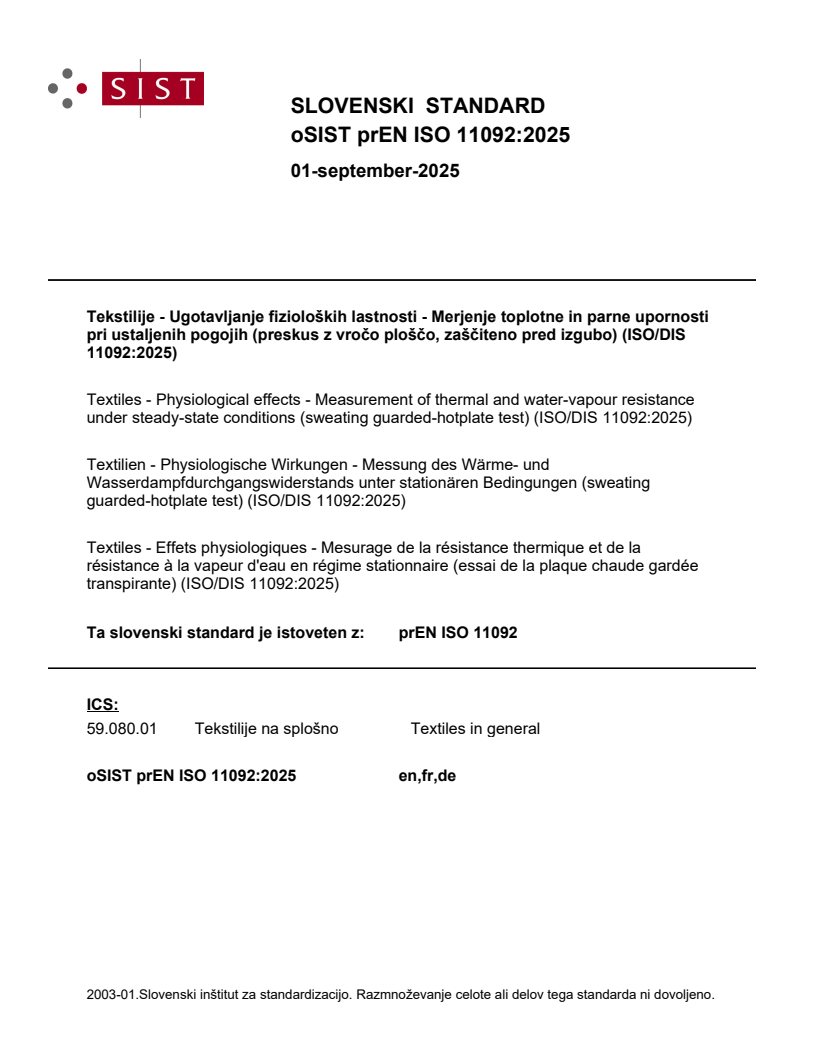
SLOVENSKI STANDARD
01-september-2025
Tekstilije - Ugotavljanje fizioloških lastnosti - Merjenje toplotne in parne upornosti
pri ustaljenih pogojih (preskus z vročo ploščo, zaščiteno pred izgubo) (ISO/DIS
11092:2025)
Textiles - Physiological effects - Measurement of thermal and water-vapour resistance
under steady-state conditions (sweating guarded-hotplate test) (ISO/DIS 11092:2025)
Textilien - Physiologische Wirkungen - Messung des Wärme- und
Wasserdampfdurchgangswiderstands unter stationären Bedingungen (sweating
guarded-hotplate test) (ISO/DIS 11092:2025)
Textiles - Effets physiologiques - Mesurage de la résistance thermique et de la
résistance à la vapeur d'eau en régime stationnaire (essai de la plaque chaude gardée
transpirante) (ISO/DIS 11092:2025)
Ta slovenski standard je istoveten z: prEN ISO 11092
ICS:
59.080.01 Tekstilije na splošno Textiles in general
2003-01.Slovenski inštitut za standardizacijo. Razmnoževanje celote ali delov tega standarda ni dovoljeno.
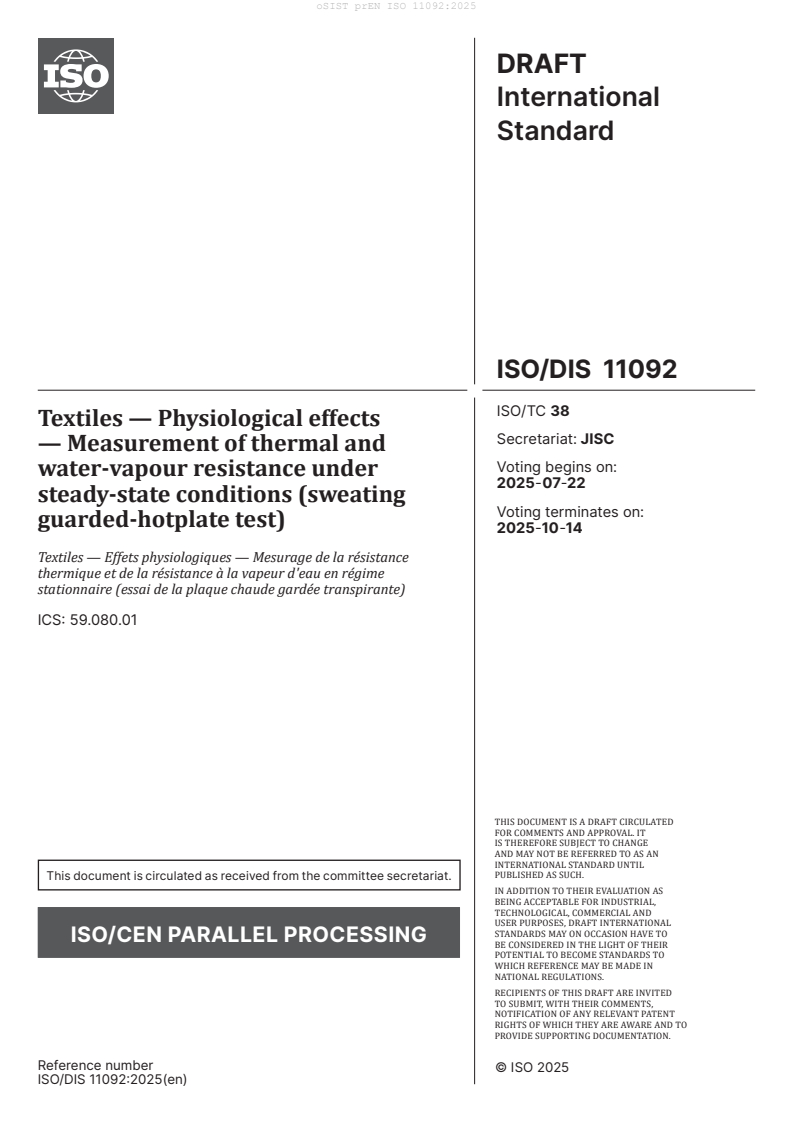
DRAFT
International
Standard
ISO/DIS 11092
ISO/TC 38
Textiles — Physiological effects
Secretariat: JISC
— Measurement of thermal and
Voting begins on:
water-vapour resistance under
2025-07-22
steady-state conditions (sweating
Voting terminates on:
guarded-hotplate test)
2025-10-14
Textiles — Effets physiologiques — Mesurage de la résistance
thermique et de la résistance à la vapeur d'eau en régime
stationnaire (essai de la plaque chaude gardée transpirante)
ICS: 59.080.01
THIS DOCUMENT IS A DRAFT CIRCULATED
FOR COMMENTS AND APPROVAL. IT
IS THEREFORE SUBJECT TO CHANGE
AND MAY NOT BE REFERRED TO AS AN
INTERNATIONAL STANDARD UNTIL
PUBLISHED AS SUCH.
This document is circulated as received from the committee secretariat.
IN ADDITION TO THEIR EVALUATION AS
BEING ACCEPTABLE FOR INDUSTRIAL,
TECHNOLOGICAL, COMMERCIAL AND
USER PURPOSES, DRAFT INTERNATIONAL
STANDARDS MAY ON OCCASION HAVE TO
ISO/CEN PARALLEL PROCESSING
BE CONSIDERED IN THE LIGHT OF THEIR
POTENTIAL TO BECOME STANDARDS TO
WHICH REFERENCE MAY BE MADE IN
NATIONAL REGULATIONS.
RECIPIENTS OF THIS DRAFT ARE INVITED
TO SUBMIT, WITH THEIR COMMENTS,
NOTIFICATION OF ANY RELEVANT PATENT
RIGHTS OF WHICH THEY ARE AWARE AND TO
PROVIDE SUPPORTING DOCUMENTATION.
Reference number
ISO/DIS 11092:2025(en)
DRAFT
ISO/DIS 11092:2025(en)
International
Standard
ISO/DIS 11092
ISO/TC 38
Textiles — Physiological effects
Secretariat: JISC
— Measurement of thermal and
Voting begins on:
water-vapour resistance under
steady-state conditions (sweating
Voting terminates on:
guarded-hotplate test)
Textiles — Effets physiologiques — Mesurage de la résistance
thermique et de la résistance à la vapeur d'eau en régime
stationnaire (essai de la plaque chaude gardée transpirante)
ICS: 59.080.01
THIS DOCUMENT IS A DRAFT CIRCULATED
FOR COMMENTS AND APPROVAL. IT
IS THEREFORE SUBJECT TO CHANGE
AND MAY NOT BE REFERRED TO AS AN
INTERNATIONAL STANDARD UNTIL
PUBLISHED AS SUCH.
This document is circulated as received from the committee secretariat.
IN ADDITION TO THEIR EVALUATION AS
BEING ACCEPTABLE FOR INDUSTRIAL,
© ISO 2025
TECHNOLOGICAL, COMMERCIAL AND
USER PURPOSES, DRAFT INTERNATIONAL
All rights reserved. Unless otherwise specified, or required in the context of its implementation, no part of this publication may
STANDARDS MAY ON OCCASION HAVE TO
ISO/CEN PARALLEL PROCESSING
be reproduced or utilized otherwise in any form or by any means, electronic or mechanical, including photocopying, or posting on
BE CONSIDERED IN THE LIGHT OF THEIR
the internet or an intranet, without prior written permission. Permission can be requested from either ISO at the address below
POTENTIAL TO BECOME STANDARDS TO
WHICH REFERENCE MAY BE MADE IN
or ISO’s member body in the country of the requester.
NATIONAL REGULATIONS.
ISO copyright office
RECIPIENTS OF THIS DRAFT ARE INVITED
CP 401 • Ch. de Blandonnet 8
TO SUBMIT, WITH THEIR COMMENTS,
CH-1214 Vernier, Geneva
NOTIFICATION OF ANY RELEVANT PATENT
Phone: +41 22 749 01 11
RIGHTS OF WHICH THEY ARE AWARE AND TO
PROVIDE SUPPORTING DOCUMENTATION.
Email: copyright@iso.org
Website: www.iso.org
Published in Switzerland Reference number
ISO/DIS 11092:2025(en)
ii
ISO/DIS 11092:2025(en)
Contents Page
Foreword .iv
Introduction .v
1 Scope . 1
2 Normative references . 1
3 Terms and definitions . 1
3.1 thermal resistance Rct .1
3.2 water-vapour resistance R .2
et
3.3 water-vapour permeability index i .2
mt
3.4 water-vapour permeability W .2
d
4 Symbols and units. 2
5 Principle . 3
6 Apparatus . 3
6.1 Measuring unit, with temperature and water supply control, .3
6.2 Thermal guard with temperature control .5
6.3 Test enclosure .5
7 Test specimens . 6
7.1 Materials ≤ 5 mm thick .6
7.2 Materials > 5 mm thick .6
8 Test procedure . 7
8.1 Determination of apparatus constants .7
8.1.1 Determination of R .8
ct0
8.1.2 Determination of R .8
et0
8.1.3 Reference material .8
8.1.4 Recalibration.8
8.2 Assembly of test specimens on the measuring unit .9
8.3 Measurement of thermal resistance R .9
ct
8.4 Measurement of water-vapour resistance R .9
et
9 Precision of results . .10
9.1 Repeatability .10
9.2 Reproducibility .10
10 Test report . 10
Annex A (normative) Mounting procedure for specimens containing loose filling materials or
having uneven thickness .12
Annex B (normative) Determination of correction terms for heating power .13
Annex C (informative) Guidance on test specimen assembly for materials prone to swelling . 14
Bibliography .16
iii
ISO/DIS 11092:2025(en)
Foreword
ISO (the International Organization for Standardization) is a worldwide federation of national standards
bodies (ISO member bodies). The work of preparing International Standards is normally carried out through
ISO technical committees. Each member body interested in a subject for which a technical committee
has been established has the right to be represented on that committee. International organizations,
governmental and non-governmental, in liaison with ISO, also take part in the work. ISO collaborates closely
with the International Electrotechnical Commission (IEC) on all matters of electrotechnical standardization.
The procedures used to develop this document and those intended for its further maintenance are described
in the ISO/IEC Directives, Part 1. In particular, the different approval criteria needed for the different types
of ISO document should be noted. This document was drafted in accordance with the editorial rules of the
ISO/IEC Directives, Part 2 (see www.iso.org/directives).
ISO draws attention to the possibility that the implementation of this document may involve the use of (a)
patent(s). ISO takes no position concerning the evidence, validity or applicability of any claimed patent
rights in respect thereof. As of the date of publication of this document, ISO had not received notice of (a)
patent(s) which may be required to implement this document. However, implementers are cautioned that
this may not represent the latest information, which may be obtained from the patent database available at
www.iso.org/patents.ISO shall not be held responsible for identifying any or all such patent rights.
Any trade name used in this document is information given for the convenience of users and does not
constitute an endorsement.
For an explanation of the voluntary nature of standards, the meaning of ISO specific terms and expressions
related to conformity assessment, as well as information about ISO's adherence to the World Trade
Organization (WTO) principles in the Technical Barriers to Trade (TBT), see www.iso.org/iso/foreword.html.
This document was prepared by Technical Committee, TC 38, Textiles.
This third edition cancels and replaces the second edition (ISO 11092:2014), which has been technically
revised.
The main changes are as follows:
— Normative references were added as Clause 2
— In 8.1.2.1, the water supplied to the measuring plate was changed to Grade 3 water in accordance with
ISO 3696:1987
— In 8.1.3, footnote 1 was deleted and replaced by a note
— In 9.1 and 9.2, the thermal resistance values have been changed to standard notation
— In 9.1, the precision is no longer only applicable to foams
— In clause 9.2, the reproducibility of the water vapour resistance values has been updated based on the
results from the round robin test in 2025
— Bibliography has been added for the informative reference in 9.2
Any feedback or questions on this document should be directed to the user’s national standards body. A
complete listing of these bodies can be found at www.iso.org/members.html.
iv
ISO/DIS 11092:2025(en)
Introduction
This document is the first of a number of standard test methods in the field of clothing comfort.
The physical properties of textile materials which contribute to physiological comfort involve a complex
combination of heat and mass transfer. Each may occur separately or simultaneously. They are time-
dependent, and may be considered in steady-state or transient conditions.
Thermal resistance is the net result of the combination of radiant, conductive and convective heat transfer,
and its value depends on the contribution of each to the total heat transfer. Although it is an intrinsic
property of the textile material, its measured value may change through the conditions of test due to the
interaction of parameters such as radiant heat transfer with the surroundings.
Several methods exist which may be used to measure heat and moisture properties of textiles, each of which
is specific to one or the other and relies on certain assumptions for its interpretation.
The sweating guarded-hotplate (often referred to as the “skin model”) described in this International
Standard is intended to simulate the heat and mass transfer processes which occur next to human skin.
Measurements involving one or both processes may be carried out either separately or simultaneously
using a variety of environmental conditions, involving combinations of temperature, relative humidity, air
speed, and in the liquid or gaseous phase. Hence transport properties measured with this apparatus can be
made to simulate different wear and environmental situations in both transient and steady-states. In this
International Standard only steady-state conditions are selected.
v
DRAFT International Standard ISO/DIS 11092:2025(en)
Textiles — Physiological effects — Measurement of thermal
and water-vapour resistance under steady-state conditions
(sweating guarded-hotplate test)
1 Scope
This document specifies methods for the measurement of the thermal resistance and water-vapour
resistance, under steady-state conditions, of e.g. fabrics, films, coatings, foams and leather, including
multilayer assemblies, for use in clothing, quilts, sleeping bags, upholstery and similar textile or textile-like
products.
The application of this measurement technique is restricted to a maximum thermal resistance and water-
vapour resistance which depend on the dimensions and construction of the apparatus used (e.g. 2 m ·K/W
and 700 m ·Pa/W respectively, for the minimum specifications of the equipment referred to in this
document).
The test conditions used in this document are not intended to represent specific comfort situations, and
performance specifications in relation to physiological comfort are not stated.
2 Normative references
The following documents are referred to in the text in such a way that some or all of their content constitutes
requirements of this document. For dated references, only the edition cited applies. For undated references,
the latest edition of the referenced document (including any amendments) applies.
ISO 3696:1987, Water for analytical laboratory use — Specification and test methods
3 Terms and definitions
For the purposes of this document, the following terms and definitions apply.
ISO and IEC maintain terminological databases for use in standardization at the following addresses:
— IEC Electropedia: available at http:// www .electropedia .org/
— ISO Online browsing platform: available at http:// www .iso .org/ obp
3.1 thermal resistance Rct
temperature difference between the two faces of a material divided by the resultant heat flux per unit area
in the direction of the gradient
NOTE 1 It is a quantity specific to textile materials or composites which determines the dry heat flux across a given
area in response to a steady applied temperature gradient. The dry heat flux may consist of one or more conductive,
convective and radiant components.
NOTE 2 Thermal resistance is expressed in square metres kelvin per watt.
ISO/DIS 11092:2025(en)
3.2 water-vapour resistance R
et
water-vapour pressure difference between the two faces of a material divided by the resultant evaporative
heat flux per unit area in the direction of the gradient.
NOTE 1 It is a quantity specific to textile materials or composites which determines the “latent” evaporative heat
flux across a given area in response to a steady applied water-vapour pressure gradient. The evaporative heat flux
may consist of both diffusive and convective components.
NOTE 2 Water-vapour resistance is expressed in square metres pascal per watt.
3.3 water-vapour permeability index i
mt
ratio of thermal and water-vapour resistances in accordance with Formula (1):
R
ct
iS=× (1)
mt
R
et
where S equals 60 Pa/K
NOTE The water-vapour permeability index is dimensionless, and has values between 0 and 1. A value of 0 implies
that the material is water-vapour impermeable, that is, it has infinite water-vapour resistance, and a material with a
value of 1 has both the thermal resistance and water-vapour resistance of an air layer of the same thickness.
3.4 water-vapour permeability W
d
characteristic of a textile material or composite depending on water-vapour resistance and temperature in
accordance with Formula (2):
W = (2)
d
RT×∅
et m
where ϕT is the latent heat of vaporization of water at the temperature T of the measuring unit, equals, for
m m
example, 0,672 W·h/g at T = 35 °C
m
NOTE Water-vapour permeability is expressed in grams per square metre hour pascal.
4 Symbols and units
Table 1
R is the thermal resistance, in square metres kelvin per watt
ct
R is the water-vapour resistance, in square metres pascal per watt
et
i is the water-vapour permeability index, dimensionless
mt
R is the apparatus constant, in square metres kelvin per watt, for the measurement of thermal
ct0
resistance R
ct
R is the apparatus constant, in square metres pascal per watt, for the measurement of water vapour
et0
resistance R
et
W is the water-vapour permeability, in grams per square meter hour pascal
d
ϕT is the latent heat of vaporization of water at the temperature T , in watt hours per gram
m m
A is the area of the measuring unit, in square metres
T is the air temperature in the test enclosure, in degrees Celsius
a
T is the temperature of the measuring unit, in degrees Celsius
m
T is the temperature of the thermal guard, in degrees Celsius
s
p is the water-vapour partial pressure, in pascals, of the air in the test enclosure at temperature T
a a
ISO/DIS 11092:2025(en)
TTabablele 1 1 ((ccoonnttiinnueuedd))
p is the saturation water-vapour partial pressure, in pascals, at the surface of the measuring unit at
m
temperature T
m
v is the speed of air above the surface of the test specimen, in metres per second
a
S is the standard deviation of air speed v, in metres per second
v
R.H. is the relative humidity, in percent
H is the heating power supplied to the measuring unit, in watts
ΔH is the correction term for heating power for the measurement of thermal resistance R
c ct
ΔH is the correction term for heating power for the measurement of water-vapour resistance R
e et
A is the slope of the correction line for the calculation of ΔH
c
B is the slope of the correction line for the calculation of ΔH
e
5 Principle
The specimen to be tested is placed on an electrically heated plate with conditioned air ducted to flow across
and parallel to its upper surface as specified in this International Standard.
For the determination of thermal resistance, the heat flux through the test specimen is measured after
steady-state conditions have been reached.
The technique described in this International Standard enables the thermal resistance R of a material to
ct
be determined by subtracting the thermal resistance of the boundary air layer above the surface of the test
apparatus from that of a test specimen plus boundary air layer, both measured under the same conditions.
For the determination of water-vapour resistance, an electrically heated porous plate is covered by a water-
vapour permeable but liquid-water impermeable membrane. Water fed to the heated plate evaporates and
passes through the membrane as vapour, so that no liquid water contacts the test specimen. With the test
specimen placed on the membrane, the heat flux required to maintain a constant temperature at the plate is
a measure of the rate of water evaporation, and from this the water-vapour resistance of the test specimen
is determined.
The technique described in this International Standard enables the water-vapour resistance R of a material
et
to be determined by subtracting the water-vapour resistance of the boundary air layer above the surf
...
Questions, Comments and Discussion
Ask us and Technical Secretary will try to provide an answer. You can facilitate discussion about the standard in here.
Loading comments...