

EN 1076:2009
(Main)Workplace exposure - Procedures for measuring gases and vapours using pumped samplers - Requirements and test methods
- Abstract
This European Standard specifies performance requirements and test methods under prescribed laboratory conditions for the evaluation of pumped samplers used in conjunction with an air sampling pump and of procedures using these samplers for the determination of gases and vapours in workplace atmospheres.
This European Standard is applicable to pumped samplers and measuring procedures using these samplers in which sampling and analysis are carried out in separate stages.
This European Standard is not applicable to:
- pumped samplers which are used for the direct determination of concentrations, for example, length-of-stain detector tubes;
- samplers which rely on sorption into a liquid, and subsequent analysis of the solution (bubblers).
- Status
- Withdrawn
- Publication Date
- 01-Dec-2009
- Withdrawal Date
- 06-Oct-2026
- Technical Committee
- CEN/TC 137 - Assessment of workplace exposure
- Drafting Committee
- CEN/TC 137/WG 2 - General requirements for measuring procedures
- Current Stage
- 9960 - Withdrawal effective - Withdrawal
- Start Date
- 03-Jul-2019
- Completion Date
- 07-Oct-2026



Relations
- Effective Date
- 08-Jun-2022
- Effective Date
- 05-Dec-2009
- Effective Date
- 10-Jul-2019
- Effective Date
- 28-Jan-2026
- Refers
EN ISO 8655-2:2022 - Piston-operated volumetric apparatus - Part 2: Pipettes (ISO 8655-2:2022) - Effective Date
- 28-Jan-2026
- Effective Date
- 28-Jan-2026
- Effective Date
- 28-Jan-2026
- Effective Date
- 28-Jan-2026
- Effective Date
- 28-Jan-2026
Get Certified
Connect with accredited certification bodies for this standard

CIS Institut d.o.o.
Personal Protective Equipment (PPE) certification body. Notified Body NB-2890 for EU Regulation 2016/425 PPE.

Kiwa BDA Testing
Building and construction product certification.
Kmetijski inštitut Slovenije
Agricultural Institute of Slovenia. Soil testing, plant health, agricultural product analysis.
Sponsored listings
Frequently Asked Questions
EN 1076:2009 is a standard published by the European Committee for Standardization (CEN). Its full title is "Workplace exposure - Procedures for measuring gases and vapours using pumped samplers - Requirements and test methods". This standard covers: This European Standard specifies performance requirements and test methods under prescribed laboratory conditions for the evaluation of pumped samplers used in conjunction with an air sampling pump and of procedures using these samplers for the determination of gases and vapours in workplace atmospheres. This European Standard is applicable to pumped samplers and measuring procedures using these samplers in which sampling and analysis are carried out in separate stages. This European Standard is not applicable to: - pumped samplers which are used for the direct determination of concentrations, for example, length-of-stain detector tubes; - samplers which rely on sorption into a liquid, and subsequent analysis of the solution (bubblers).
This European Standard specifies performance requirements and test methods under prescribed laboratory conditions for the evaluation of pumped samplers used in conjunction with an air sampling pump and of procedures using these samplers for the determination of gases and vapours in workplace atmospheres. This European Standard is applicable to pumped samplers and measuring procedures using these samplers in which sampling and analysis are carried out in separate stages. This European Standard is not applicable to: - pumped samplers which are used for the direct determination of concentrations, for example, length-of-stain detector tubes; - samplers which rely on sorption into a liquid, and subsequent analysis of the solution (bubblers).
EN 1076:2009 is classified under the following ICS (International Classification for Standards) categories: 13.040.30 - Workplace atmospheres. The ICS classification helps identify the subject area and facilitates finding related standards.
EN 1076:2009 has the following relationships with other standards: It is inter standard links to EN 1076:1997, EN 1076:1997/AC:1997, EN ISO 22065:2019, EN 1540:1998, EN ISO 8655-2:2022, EN ISO 8655-6:2022, EN 1232:1997, EN 482:2006, EN ISO 23320:2022. Understanding these relationships helps ensure you are using the most current and applicable version of the standard.
EN 1076:2009 is available in PDF format for immediate download after purchase. The document can be added to your cart and obtained through the secure checkout process. Digital delivery ensures instant access to the complete standard document.
Standards Content (Sample)
2003-01.Slovenski inštitut za standardizacijo. Razmnoževanje celote ali delov tega standarda ni dovoljeno.Exposition am Arbeitsplatz - Messung von Gasen und Dämpfen mit pumpenbetriebenen Probenahmeeinrichtungen - Anforderungen und PrüfverfahrenExposition sur les lieux de travail - Procédures pour le mesurage des gaz et vapeurs à l'aide de dispositifs de prélèvement par pompage - Exigences et méthodes d'essaiWorkplace exposure - Procedures for measuring gases and vapours using pumped samplers - Requirements and test methods13.040.30Kakovost zraka na delovnem mestuWorkplace atmospheresICS:Ta slovenski standard je istoveten z:EN 1076:2009SIST EN 1076:2010en,fr,de01-februar-2010SIST EN 1076:2010SLOVENSKI
STANDARDSIST EN 1076:1998/AC:1998SIST EN 1076:19981DGRPHãþD
EUROPEAN STANDARD NORME EUROPÉENNE EUROPÄISCHE NORM
EN 1076
December 2009 ICS 13.040.30 Supersedes EN 1076:1997English Version
Workplace exposure - Procedures for measuring gases and vapours using pumped samplers - Requirements and test methods
Exposition sur les lieux de travail - Procédures pour le mesurage des gaz et vapeurs à l'aide de dispositifs de prélèvement par pompage - Exigences et méthodes d'essai Exposition am Arbeitsplatz - Messung von Gasen und Dämpfen mit pumpenbetriebenen Probenahmeeinrichtungen - Anforderungen und Prüfverfahren This European Standard was approved by CEN on 1 November 2009.
CEN members are bound to comply with the CEN/CENELEC Internal Regulations which stipulate the conditions for giving this European Standard the status of a national standard without any alteration. Up-to-date lists and bibliographical references concerning such national standards may be obtained on application to the CEN Management Centre or to any CEN member.
This European Standard exists in three official versions (English, French, German). A version in any other language made by translation under the responsibility of a CEN member into its own language and notified to the CEN Management Centre has the same status as the official versions.
CEN members are the national standards bodies of Austria, Belgium, Bulgaria, Cyprus, Czech Republic, Denmark, Estonia, Finland, France, Germany, Greece, Hungary, Iceland, Ireland, Italy, Latvia, Lithuania, Luxembourg, Malta, Netherlands, Norway, Poland, Portugal, Romania, Slovakia, Slovenia, Spain, Sweden, Switzerland and United Kingdom.
EUROPEAN COMMITTEE FOR STANDARDIZATION
COMITÉ EUROPÉEN DE NORMALISATION EUROPÄISCHES KOMITEE FÜR NORMUNG
Management Centre:
Avenue Marnix 17,
B-1000 Brussels © 2009 CEN All rights of exploitation in any form and by any means reserved worldwide for CEN national Members. Ref. No. EN 1076:2009: ESIST EN 1076:2010
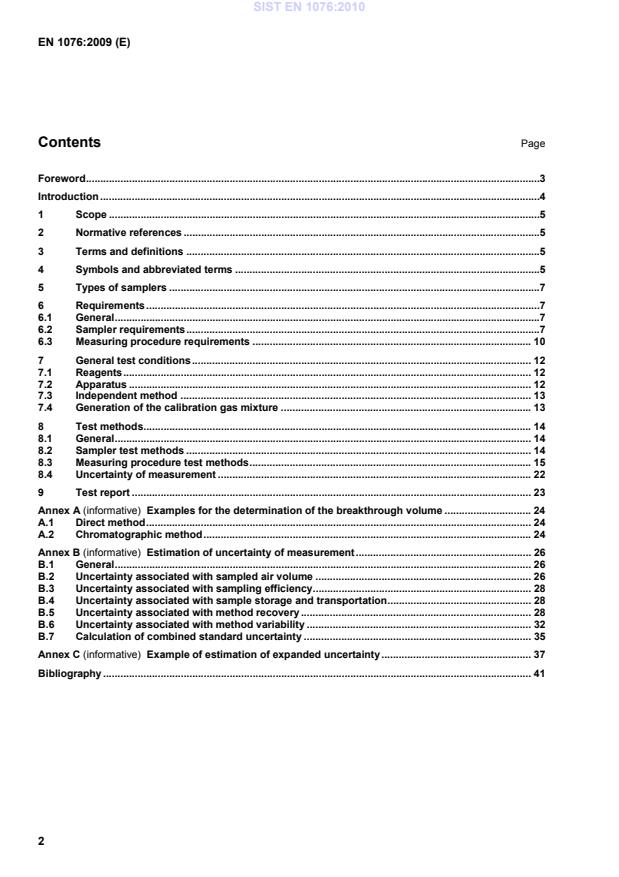
Examples for the determination of the breakthrough volume . 24A.1Direct method . 24A.2Chromatographic method . 24Annex B (informative)
Estimation of uncertainty of measurement . 26B.1General . 26B.2Uncertainty associated with sampled air volume . 26B.3Uncertainty associated with sampling efficiency . 28B.4Uncertainty associated with sample storage and transportation . 28B.5Uncertainty associated with method recovery . 28B.6Uncertainty associated with method variability . 32B.7Calculation of combined standard uncertainty . 35Annex C (informative)
Example of estimation of expanded uncertainty . 37Bibliography . 41 SIST EN 1076:2010
1) EN 1540:1998 is currently subject to revision. Until the revised EN is published the definitions given in EN 482:2006 take precedence. SIST EN 1076:2010
measurements for comparison with a long-term limit value, in milligrams (mg) ma,st maximum mass uptake of analyte in a leak test performed on a sealed sampler used for making
measurements for comparison with a short-term limit value, in milligrams (mg) 1m& mass loss from permeation tube, in micrograms per minute (µg/min) Ma molar mass of analyte, in grams per mole (g/mol) n number of replicate samples pat actual pressure of the test atmosphere sampled, in kilopascals (kPa) R recovery Ran analytical recovery RH relative humidity of the test atmosphere sampled, in percent (%) tH hold-up time of the unretained substance, in minutes (min) ts sampling time, in minutes (min) Tat temperature of the test atmosphere sampled, in Kelvins (K) V0 volume of the test atmosphere sampled, in litres (l) VH gas hold-up volume (dead volume) VR uncorrected retention volume (VR)' corrected retention volume v& flow rate into the exposure chamber, for example, in litres per minute (l/min) va volumetric air flow rate, for example, in litres per minute (l/min) βa mass concentration of the analyte in the calibration gas mixture, in milligrams per cubic metre (mg/m³) βa,R mean mass concentration of the analyte recovered from the test gas atmosphere, in milligrams per
cubic metre (mg/m³) βcg mass concentration of the calibration gas mixture, in milligrams per cubic metre (mg/m³) ϑat temperature of the test atmosphere sampled, in degrees Celsius (°C) SIST EN 1076:2010
2) The predecessor term "relative standard deviation" is deprecated. See also ISO 3534-1:2006, 2.38, Note 2. SIST EN 1076:2010
is the reference period, in minutes (min); 0,01
is the nominal minimum flow rate for type B samplers, in litres per minute (l/min); 10-3 is a factor applied to convert the nominal minimum flow rate from litres per minute (l/min) to cubic metres per minute (m³/min); 1/3
is a factor applied to calculate the maximum permitted leakage. When tested in accordance with 8.2.2, for substances with a short-term limit value the maximum leakage, i.e. the maximum mass uptake of analyte above the blank value (see 6.3.2.3), shall be less than ma,st calculated according to Equation (2), in milligrams (mg), as follows: )100,01155,0(313-sta,stLV,×××=ρm (2) where ma,st is the maximum mass uptake of analyte in a leak test performed on a sealed sampler used for making measurements for comparison with a short-term limit value; ρ LV,st is the short-term limit value of the substance given as volume concentration, in milligrams per cubic metre (mg/m³); 15
is the reference period, in minutes (min); 0,01
is the nominal minimum flow rate for type B samplers, in litres per minute (l/min); SIST EN 1076:2010
is a factor applied to convert the nominal minimum flow rate from litres per minute (l/min) to cubic metres per minute (m³/min); 1/3
is a factor applied to calculate the maximum permitted leakage. 6.2.3 Shelf life (for impregnated supports) The manufacturer shall specify the shelf life of the sampler when stored in its original package. During this period the sampler shall fulfil all requirements. 6.2.4 Sample identification (for commercially available sorbent tubes and impregnated filters) The sampler shall have a suitable area for sample identification by the user. 6.2.5 Marking Samplers shall be marked with at least the following: manufacturer’s name; product identification; indication of the direction of air flow, if necessary; batch identification; shelf life (if applicable); number of this European Standard. If required due to limited space, the marking may be placed on the packaging of the sampler. However, the manufacturer’s name, product identification and direction of air flow shall be indicated on the sampler. 6.2.6 Instructions for use The instructions for use supplied with the sampler shall be in the language(s) of the country where the sampler is to placed on the market. They shall contain at least the following information: a) designated use (general purpose for a number of gases and vapours or, specific, for a particular gas or vapour, see 6.1); b) blank value (only when used for a particular gas or vapour, see 6.1); c) directions for proper handling of the sampler, including opening and closing; d) general information on the principle of use, for example, sorbent type, reaction of the reagent impregnated solid, desorption method; e) information on storage and transport; f) information on health or environmental hazards and method of disposal. SIST EN 1076:2010
vm&&1cg=β (3) where 1m& is the mass loss from permeation tube, in micrograms per minute (µg/min); v& is the flow rate into the exposure chamber, for example, in litres per minute (l/min). NOTE The example does not give a preference for permeation systems for generating calibration gas mixtures. Determine the mean mass concentration of the test atmosphere within the exposure chamber experimentally using the results of the independent method described in 7.3. A correction may be applied for any known bias in the independent method.
Compare the determined mean mass concentration with the calculated value. If the experimentally determined value is within ± 10 % of the calculated value of the mass concentration of the delivered test atmosphere, take the calculated value as the true value of the delivered mass concentration. If this requirement is not met, then adjustments shall be made or an alternative generation method shall be used or the independent method shall be verified. If it is not possible to calculate a mass concentration of the calibration gas, for example, for reactive gases, the value determined by the independent method shall be used as the true value. SIST EN 1076:2010
2 LV; time:
4 h; relative humidity:
(50 ± 5) %; temperature:
(20 ± 2) °C. Analyze the set to determine any leakage. 8.2.3 Shelf life (for Type A impregnated supports) Store the sampler at the limits of the environmental conditions specified by the manufacturer and/or in the measuring procedure. At the end of the specified shelf-life, test the sampler under the following exposure conditions: concentration:
2 LV; time:
recommended sampling time; flow rate:
recommended flow rate; SIST EN 1076:2010
(80 ± 5) %; temperature:
(40 ± 2) °C. 8.2.4 Sample identification Perform a visual check. 8.2.5 Marking Perform a visual check. 8.2.6 Instructions for use Perform a visual check. 8.3 Measuring procedure test methods 8.3.1 Determination of the recommended sampling conditions 8.3.1.1 Selection of sampler capacity test Perform the sampler capacity verification test in 8.3.1.2 or the sampler breakthrough test in 8.3.1.3 taking into consideration whether the capacity of the sampler is likely to be high for the substance to be measured. This will depend upon the characteristics of the substance and the sampler, for example, nature and amount of the sampling substrate, and the limit value for the substance concerned. 8.3.1.2 Sampler capacity verification test Sample from a test atmosphere (generated using the apparatus in 7.2.2) with a minimum of three samplers under the following exposure conditions: a) concentration: 2 LV; b) time:
1) for long-term LV: reference period plus 1 h; 2) for short-term LV: twice the reference period; c) flow rate: recommended flow rate; d) relative humidity: (80 ± 5) %; e) temperature: (20 ± 2) ºC. For samplers without a back-up section use two samplers in series. Analyze the samplers after the test. The amount of the test substance recovered in the back-up section of sampler shall be ≤ 5 % of the total amount recovered. If the amount recovered in the back-up section of sampler is greater than 5 %, carry out the sampler breakthrough test given in 8.3.1.3. SIST EN 1076:2010
2 LV; flow rate:
according to the type of sampler (for example, 50 ml/min for Type B samplers,
200 ml/min for Type A sorbent tubes and 1 000 ml/min for impregnated filters); relative humidity:
(80 ± 5) %; temperature:
(20 ± 2) °C. Do this whilst monitoring the concentration of the test substance behind the sampler with an instrument such as gas chromatograph equipped with a flame ionisation or equivalent detector, an infrared spectrophotometer, etc. A suitable way of doing this is described in A.1. For substances with both long-term and short-term limit values, the breakthrough volume should be measured at a concentration of two times the short-term limit value especially if the ratio between the two limit values is ≥ 1,5. For two-bed Type A sorbent tubes, use only the first (primary) bed or use specially prepared single-section tubes. When it is not possible to monitor the concentration of the test substance behind the sampler using a direct reading instrument, breakthrough can be monitored using a back-up sampler that is changed and analyzed at regular intervals. 8.3.1.3.2 Chromatographic method For porous polymers and similar chromatographic sorbents, instead of the procedure described in 8.3.1.3.1, the breakthrough volume can be predicted from the chromatographic retention volume. An example is given in Annex A. NOTE 1 Breakthrough volume determined by the chromatographic method does not take into account relative humidity. Measurements by the direct method indicate that breakthrough volume at high (95 %) relative humidity is about a factor of two lower for porous polymers. NOTE 2 The chromatographic method is not suitable for reagent impregnated sorbents or activated carbon. NOTE 3 The chromatographic method is not suitable for very high mass concentrations (more than 500 mg/m3). 8.3.1.4 Determination of the maximum air flow rate (only for impregnated filters) Repeat the test described in 8.3.1.3.1 for breakthrough volume at increasing flow rates up to a maximum of 50 % above the recommended flow rate using a minimum of three samplers at each flow rate setting. The breakthrough volume determined should be constant, independent of flow rate. As the experiment to determine the breakthrough volume is repeated at increasing flow rates a point could be reached where the breakthrough volume begins to decrease. If the breakthrough volume drops by more than 5 % from its initial value the maximum air flow rate for the sampler shall be 90 % of the flow rate at which this occurs. 8.3.1.5 Determination of the minimum air flow rate (only for thermal desorption) If a sampler is to be used at a low flow rate and an inlet restrictor is not used, perform the following test to establish the flow rate above which the effect of diffusion can be disregarded. If the sampler is to be used to SIST EN 1076:2010
0,1 LV and 2 LV; time:
recommended sampling time; flow rate:
recommended flow rate; relative humidity:
(80 ± 5) %; temperature:
(20 ± 2) °C. Analyze one set within one day and the other set after two weeks storage at room temperature, or as otherwise directed by the manufacturer. Calculate the mean for each of the two sets of test results and the difference between the means, in percent. Compare with the requirement in 6.3.1.4. If the requirement in 6.3.1.4 is not met repeat the test with a shorter storage time or by using different storage conditions. NOTE An alternative approach can be to carry out a more comprehensive set of experiments determining the recovery after a range of different storage times, for example, one day, three days, seven days, ten days and two weeks. 8.3.1.6.2 Sampling media spiking method As an alternative to the procedure given in 8.3.1.6.1 sampling media may be spiked with an equivalent loading using a procedure based on one of those given in 8.3.2.2. NOTE If it is considered that the humidity of the air sampled could affect sample stability on storage, it is possible to investigate this by drawing humid air through the spiked samplers. SIST EN 1076:2010
1) for long-term LV: 0,1 LV to 2 LV; 2) for short-term LV: 0,5 LV to 2 LV; b) time:
1) for long-term LV: recommended sampling time; 2) for short-term LV: reference period; c) flow rate: recommended flow rate. The methods given in 8.3.2.2.2 to 8.3.2.2.4 can be used to determine the analytical recovery, but 8.3.2.2.2 and 8.3.2.2.3 are the preferred ones. For Type B samplers the method given in 8.3.2.2.5 can be used as well, but not the method given in 8.3.2.2.4. 8.3.2.2.2 Sampling media spiking method from the vapour phase Add a known mass of analyte corresponding to the different loadings given in 8.3.2.2.1 into a small vessel (for example, empty sampling tube, pipette reservoir), using a micropipette or syringe (see 7.2.5). The analyte can be pure or diluted in a solvent (usually the desorption solvent). Air is sampled from the vessel by pumping onto the sampling medium (recommended flow rate and sampling time shall be used, according to the type of sampling medium, type of sampler and analyte of interest). Check that all the analyte has evaporated after sampling by rinsing the vessel with desorption solvent and analyze the rinsate. Desorb and analyze all the samples. Repeat the experiment six times for each sample loading. Calculate the analytical recovery by dividing the mean mass recovered at each loading from the vapour spiked samples by the mass applied and the coefficient of variation of the replicate samples. NOTE 1 For chemical agents with low vapour pressure moderate heating could be necessary. On the other hand, for highly volatile chemical agents cooling as well as flow reduction could be necessary. NOTE 2 Heating blocks with tubes allowing pumping or purging with a gas are commercially available. SIST EN 1076:2010
...