

EN 3987:2009
(Main)Aerospace series - Test methods for metallic materials - Constant amplitude force-controlled high cycle fatigue testing
- Abstract
This document applies to constant amplitude force-controlled high cycle fatigue (HCF) testing of metallic materials governed by EN Aerospace standards. It defines the mechanical properties that may need to be determined, the equipment, test pieces, methodology of test and presentation of results.
It applies to uniaxially loaded tests carried out on plain or notched test pieces at ambient and elevated temperatures. It is not intended to cover the testing of more complex test pieces, full scale components or structures, although the methodology could well be adopted to provide for such tests.
The purpose of this document is to ensure the compatibility and reproducibility of test results. It does not cover the evaluation or interpretation of results.
- Status
- Published
- Publication Date
- 06-Oct-2009
- Withdrawal Date
- 29-Apr-2010
- Technical Committee
- ASD-STAN - Aerospace
- Drafting Committee
- ASD-STAN/D 4 - Metallic
- Current Stage
- 9093 - Decision to confirm - Review Enquiry
- Start Date
- 21-Jan-2025
- Completion Date
- 07-Oct-2026

Overview
EN 3987:2009 - Aerospace series - specifies test methods for constant amplitude force-controlled high cycle fatigue (HCF) testing of metallic materials used in aerospace applications. The standard defines which mechanical properties may be determined, required equipment, test-piece geometry, test methodology and the presentation of results. It applies to uniaxial, plain or notched specimens tested at ambient or elevated temperatures and is intended to ensure reproducibility and compatibility of HCF test data. EN 3987:2009 does not cover result interpretation or full-scale structural testing, although its methodology can be adapted for more complex tests.
Key topics and technical requirements
- Test regime: Constant-amplitude, force-controlled loading producing HCF lives typically in the range of 10^4 to 10^8 cycles.
- Loading and waveform: Uniaxial sinusoidal or equivalent waveform at a fixed frequency (commonly 10–200 Hz); waveform repeatability required so total force variation stays within 1% of the requested value.
- Force control and machine: Servo-controlled loading (hydraulic or electromechanical); machines must provide smooth start-up and no backlash through zero for tension-compression tests.
- Calibration and verification:
- Force measurement system verification at intervals ≤ 1 year (EN 10002-2:1991 method with amendments for tension/compression through zero).
- Alignment verification at intervals ≤ 1 year or 100 tests (or after fixture changes); recommended use of strain‑gauged specimens per ASTM E1012.
- Cycle counting and timing: Cycle recording resolution better than 0.1% of indicated life; calibrated timer recommended as an independent check.
- Temperature control: For elevated-temperature tests, maintain uniformity on the test section within ±4 °C; thermocouples recommended and measurement system accuracy traceable to national standards.
- Fixtures and gripping: Fixtures must ensure concentricity and parallelism to minimize bending; limits and verification methods are specified to control bending strains.
- Test pieces: Plain or notched geometries; preparation, handling and degreasing guidance provided (informative annexes).
- Reporting: Required test data and presentation format to promote comparability across laboratories.
Applications and who uses it
EN 3987:2009 is used by:
- Aerospace materials test laboratories and certification bodies
- OEMs and suppliers developing metallic aerospace components
- Metallurgists and fatigue specialists generating S–N curves and fatigue strength data
- Design and structural engineers relying on reproducible HCF data for material selection and life prediction
Practical applications include material qualification, comparison of alloys and heat treatments, and providing standardized HCF input data for component design (when coupled with appropriate interpretation methods).
Related standards
- EN 10002-2:1991 - Metallic materials - Tensile testing - Verification of force measuring systems (used for machine calibration).
- ASTM E1012 - Standard practice for verification of test frame and specimen alignment under axial force application (recommended for alignment checks).
Keywords: EN 3987:2009, high cycle fatigue (HCF), force-controlled fatigue testing, aerospace test methods, metallic materials, S–N curve, uniaxial fatigue, thermocouples, machine calibration.
Relations
- Effective Date
- 28-Jan-2026
- Effective Date
- 28-Jan-2026
- Effective Date
- 28-Jan-2026
- Effective Date
- 28-Jan-2026
- Effective Date
- 28-Jan-2026
- Effective Date
- 28-Jan-2026
- Effective Date
- 28-Jan-2026
- Effective Date
- 28-Jan-2026
- Effective Date
- 28-Jan-2026
- Effective Date
- 28-Jan-2026
- Effective Date
- 28-Jan-2026
- Effective Date
- 28-Jan-2026
- Effective Date
- 28-Jan-2026
- Effective Date
- 28-Jan-2026
- Effective Date
- 28-Jan-2026
Get Certified
Connect with accredited certification bodies for this standard

BUREAU VERITAS Certification Germany
Bureau Veritas certification in Germany.

Element Materials Technology
Materials testing and product certification.

AQMS Ltd.
AQMS provides ISO certification to SMEs across the UK.
Sponsored listings
Frequently Asked Questions
EN 3987:2009 is a standard published by the European Committee for Standardization (CEN). Its full title is "Aerospace series - Test methods for metallic materials - Constant amplitude force-controlled high cycle fatigue testing". This standard covers: This document applies to constant amplitude force-controlled high cycle fatigue (HCF) testing of metallic materials governed by EN Aerospace standards. It defines the mechanical properties that may need to be determined, the equipment, test pieces, methodology of test and presentation of results. It applies to uniaxially loaded tests carried out on plain or notched test pieces at ambient and elevated temperatures. It is not intended to cover the testing of more complex test pieces, full scale components or structures, although the methodology could well be adopted to provide for such tests. The purpose of this document is to ensure the compatibility and reproducibility of test results. It does not cover the evaluation or interpretation of results.
This document applies to constant amplitude force-controlled high cycle fatigue (HCF) testing of metallic materials governed by EN Aerospace standards. It defines the mechanical properties that may need to be determined, the equipment, test pieces, methodology of test and presentation of results. It applies to uniaxially loaded tests carried out on plain or notched test pieces at ambient and elevated temperatures. It is not intended to cover the testing of more complex test pieces, full scale components or structures, although the methodology could well be adopted to provide for such tests. The purpose of this document is to ensure the compatibility and reproducibility of test results. It does not cover the evaluation or interpretation of results.
EN 3987:2009 is classified under the following ICS (International Classification for Standards) categories: 49.025.01 - Materials for aerospace construction in general; 49.025.05 - Ferrous alloys in general. The ICS classification helps identify the subject area and facilitates finding related standards.
EN 3987:2009 has the following relationships with other standards: It is inter standard links to EN 10002-2:1991, EN 4700-002:2016, EN 4400-1:2019, EN 4800-006:2010, EN 4800-001:2010, EN 4700-002:2010, EN 4400-2:2019, EN 4700-002:2021, EN 4700-005:2010, EN 4800-002:2025, EN 4800-005:2010, EN 4800-005:2025, EN 4700-006:2010, EN 4800-002:2010, EN 4700-002:2025. Understanding these relationships helps ensure you are using the most current and applicable version of the standard.
EN 3987:2009 is available in PDF format for immediate download after purchase. The document can be added to your cart and obtained through the secure checkout process. Digital delivery ensures instant access to the complete standard document.
Standards Content (Sample)
2003-01.Slovenski inštitut za standardizacijo. Razmnoževanje celote ali delov tega standarda ni dovoljeno.Luft- und Raumfahrt - Prüfverfahren für metallische Werkstoffe - Schwerlastwechselermüdung (HCF) im kraftgesteuerten VersuchSérie aérospatiale - Méthodes d'essais applicables aux matériaux métalliques - Essais de fatigue mégacyclique en contrainte imposéeAerospace series - Test methods for metallic materials - Constant amplitude force-controlled high cycle fatigue testing49.025.01Materiali za letalsko in vesoljsko gradnjo na splošnoMaterials for aerospace construction in generalICS:Ta slovenski standard je istoveten z:EN 3987:2009SIST EN 3987:2009en,de01-december-2009SIST EN 3987:2009SLOVENSKI
STANDARD
EUROPEAN STANDARD NORME EUROPÉENNE EUROPÄISCHE NORM
EN 3987
October 2009 ICS 49.025.01; 49.025.05 English Version
Aerospace series - Test methods for metallic materials - Constant amplitude force-controlled high cycle fatigue testing
Série aérospatiale - Méthodes d'essais applicables aux matériaux métalliques - Essais de fatigue mégacyclique en contrainte imposée
Luft- und Raumfahrt - Prüfverfahren für metallische Werkstoffe - Schwerlastwechselermüdung (HCF) im kraftgesteuerten Versuch This European Standard was approved by CEN on 11 July 2008.
CEN members are bound to comply with the CEN/CENELEC Internal Regulations which stipulate the conditions for giving this European Standard the status of a national standard without any alteration. Up-to-date lists and bibliographical references concerning such national standards may be obtained on application to the CEN Management Centre or to any CEN member.
This European Standard exists in three official versions (English, French, German). A version in any other language made by translation under the responsibility of a CEN member into its own language and notified to the CEN Management Centre has the same status as the official versions.
CEN members are the national standards bodies of Austria, Belgium, Bulgaria, Cyprus, Czech Republic, Denmark, Estonia, Finland, France, Germany, Greece, Hungary, Iceland, Ireland, Italy, Latvia, Lithuania, Luxembourg, Malta, Netherlands, Norway, Poland, Portugal, Romania, Slovakia, Slovenia, Spain, Sweden, Switzerland and United Kingdom.
EUROPEAN COMMITTEE FOR STANDARDIZATION
COMITÉ EUROPÉEN DE NORMALISATION EUROPÄISCHES KOMITEE FÜR NORMUNG
Management Centre:
Avenue Marnix 17,
B-1000 Brussels © 2009 CEN All rights of exploitation in any form and by any means reserved worldwide for CEN national Members. Ref. No. EN 3987:2009: ESIST EN 3987:2009
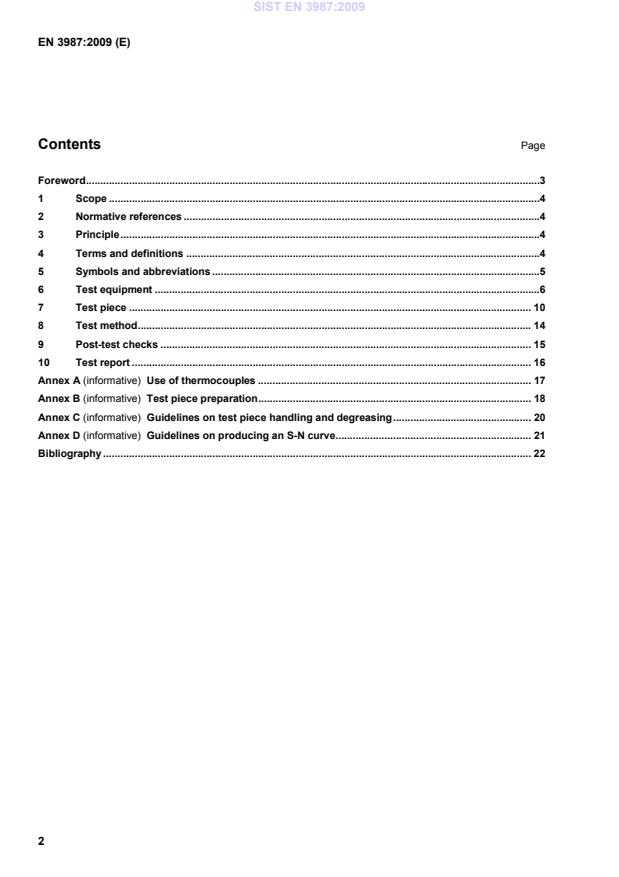
Use of thermocouples . 17Annex B (informative)
Test piece preparation . 18Annex C (informative)
Guidelines on test piece handling and degreasing . 20Annex D (informative)
Guidelines on producing an S-N curve. 21Bibliography . 22 SIST EN 3987:2009
3 Principle The uniaxially loaded force-controlled high cycle fatigue test consists of maintaining a test piece at a uniform temperature and subjecting it to a constant force-amplitude waveform. The magnitude of the applied cyclic force affects the development of microscopic plastic strain within the test section, thus determining the fatigue life. A series of such tests allows the relationship between the applied force and the number of cycles to failure to be established. The fatigue lives generated are typically in the range 104 - 108 cycles to failure and the test regime is said to be that of high cycle fatigue (HCF). 4 Terms and definitions For the purposes of this document, the following terms and definitions apply. 4.1 force-control used to describe tests in which the force acting on a known test section is controlled 4.2 test section defined as the region of the test piece between the blending fillets into the gripping section, and may be a continuous radius or a parallel sided section
1) Published by: American Society for Testing and Materials (ASTM), 1916 Race Street- Philadelphia PA 19103 USA. SIST EN 3987:2009
Force Ratio The algebraic ratio of the minimum force to the maximum force. See Figure 2 for examples of different force ratios. (F min./F max.) σ MPa Stress The force applied divided by the nominal cross-sectional area.
The nominal cross-sectional area is that calculated from measurements taken at ambient temperature, and no account is taken for the change in section as a result of elevated temperatures. The above nomenclature for force also applies to stress, with F replaced by σ. N
Number of force cycles The number of cycles applied. f Hz Frequency of cycles The number of cycles applied per second. Nf
Endurance or fatigue life The number of cycles to failure. Kt
Theoretical stress concentration factor The ratio of the notch tip stress to net section stress, calculated in accordance with defined elastic theory, to the nominal section stress. NOTE Different methods used in determining Kt may lead to variations in reported values. σN MPa Fatigue strength at N cycles The value of the stress amplitude at a stated stress ratio under which the test piece would have a life of at least N cycles with a stated probability.
Figure 1 — Fatigue force cycle
Figure 2 — Varying force ratio
NOTE 1 For ambient temperature tests (10 °C to 35 °C) it is not necessary to measure the test piece temperature. NOTE 2 The effect of compounding errors could result in the real tolerance in temperature from the specified level to be 3 °C greater. NOTE 3 The temperature rise due to plastic deformation shall be minimised (see 8.3.1) and shall be compensated for within the Table 2 tolerances.
b) Test pieces with circular cross sections shall have a blending fillet radius of at least twice the test section diameter to minimise the theoretical stress concentration, Kt, of the test piece. The test section length should be greater or equal to two times the test section diameter Concentricity and parallelism must be less than or equal to 0,03 mm. c) Test pieces with rectangular cross sections may have a reduced test cross section along one dimension, generally the width. The test section length should be greater than twice the test section width. The edges of the test piece must be longitudinally polished to prevent premature crack initiation. Errors in flatness must be less than 0,03 mm. d) Test pieces used for compression should have a test section length less than or equal to twice the test section width or diameter, to avoid buckling. e) In view of the specialised nature of notched test pieces no r
...