

prEN 1906
(Main)Building hardware - Lever handles and knob furniture - Requirements and test methods
General Information
- Abstract
This European Standard specifies test methods and requirements for spindle and fastening elements, operating torques, permissible free play and safety, free angular movement and misalignment, durability, static strength and corrosion resistance for sprung and unsprung lever handles and knobs for doors on backplates or roses.This standard is applicable only to lever handles and knobs that operate a latch or a lock.It states four categories of use according to the frequency and other conditions of use.Compliance with this European Standard ensures a margin of strength in excess of that needed for normal operation. Additional requirements are needed for special safety furniture which is suitable for use in situations where there is a high risk of falling. Since special safety furniture is not essential in every situation, this European Standard provides for additional safety requirements (see 5.13) which are only necessary when the manufacturer states that the safety furniture is claimed to conform to these requirements.This standard states five grades of security. Grade 0 according to requirements stated in the main part of this standard. Grades 1 to 4 are stated according to requirement for security lock furniture for use on burglary resistant doors (see annex A). These additional security requirements are necessary only when the manufacturer states that the products are claimed to have a high level of security, which is not essential in every situation.The suitability of lock or latch furniture for use on fire/smoke door assemblies is determined by fire performance tests conducted in addition to the performance tests required by this standard. Since suitability for use on fire/smoke door assemblies is not essential in every situation, the manufacturer has the option of stating whether the furniture is claimed to conform to these additional requirements or not. If so stated the additional requirements given in annex C are necessary.
- Status
- Not Published
- Publication Date
- 18-Aug-2009
- Technical Committee
- CEN/TC 33 - Doors, windows, shutters and building hardware
- Drafting Committee
- CEN/TC 33/WG 4 - Building hardware
- Current Stage
- 4098 - Decision to abandon - Enquiry
- Start Date
- 09-Jan-2009
- Completion Date
- 09-Jan-2009
- Directive
- 89/106/EEC - Construction products

Overview
prEN 1906 - Building hardware: Lever handles and knob furniture - Requirements and test methods is a CEN draft European Standard that defines performance requirements and test methods for lever handles, knobs, push pads and similar door furniture mounted on backplates or roses when used to operate a latch or lock. The standard covers functional, durability, safety, security and corrosion-resistance aspects and provides a coding/classification system to describe product performance for different use conditions.
Key topics and technical requirements
- Performance tests and scope
- Tests for spindle and fastening elements, operating torques, permissible free play, free angular movement and misalignment, durability, static strength and corrosion resistance.
- Test sequencing and methods are specified (see clause 6–7); marking requirements are included (clause 8).
- Classification
- Eight‑digit coding system to describe product attributes.
- Categories of use (1–4) based on frequency and likelihood of misuse (e.g., residential to very heavy public use).
- Durability grades: grade 6 = 100,000 cycles; grade 7 = 200,000 cycles.
- Security and safety
- Five security grades (Grade 0 in main standard; Grades 1–4 via Annex A) for lock furniture intended for burglary‑resistant doors.
- Special safety furniture requirements (see clause 5.13) for high‑risk situations (e.g., to resist forces that might detach handles).
- Fire/smoke door suitability
- Additional requirements and fire performance tests in Annex C; manufacturers may claim conformity for use on fire/smoke door assemblies.
- Normative and informative annexes
- Annex A (normative): enhanced security requirements.
- Annex C (normative): fire/smoke door requirements.
- Annexes B and D (informative): test apparatus illustrations and flow charts.
Practical applications and users
- Manufacturers use prEN 1906 to design, test and label lever handles and knob furniture for specified use categories and durability.
- Test laboratories apply the specified test methods and sequences; accreditation references include ISO/IEC 17025.
- Specifiers, architects and consultants rely on the classification and security/fire options to select appropriate hardware for residential, commercial, public and high‑use installations.
- Door and hardware installers, building managers and regulators use the requirements to verify compliance for safety, longevity and corrosion resistance.
- Products conforming to prEN 1906 provide a verified margin of strength beyond normal operation and can inform choices for exit routes and compatibility with standards such as EN 179.
Related standards
- EN 179 (emergency exit devices)
- EN 1670 (corrosion resistance)
- EN 1634 series / prEN 1634-2 (fire resistance – door hardware)
- EN 314-2, EN 636 (plywood references)
- ISO/IEC 17025 (testing laboratory competence)
Keywords: prEN 1906, building hardware, lever handles, knob furniture, test methods, durability, corrosion resistance, security grades, fire door hardware.
Relations
- Revises
EN 1906:2002 - Building hardware - Lever handles and knob furniture - Requirements and test methods - Effective Date
- 18-Jan-2023
Get Certified
Connect with accredited certification bodies for this standard

DIBt (Deutsches Institut für Bautechnik)
German Institute for Building Technology.
DIN CERTCO
DIN Group product certification.

Aboma Certification B.V.
Specialized in construction, metal, and transport sectors.
Sponsored listings
Frequently Asked Questions
prEN 1906 is a draft published by the European Committee for Standardization (CEN). Its full title is "Building hardware - Lever handles and knob furniture - Requirements and test methods". This standard covers: This European Standard specifies test methods and requirements for spindle and fastening elements, operating torques, permissible free play and safety, free angular movement and misalignment, durability, static strength and corrosion resistance for sprung and unsprung lever handles and knobs for doors on backplates or roses.This standard is applicable only to lever handles and knobs that operate a latch or a lock.It states four categories of use according to the frequency and other conditions of use.Compliance with this European Standard ensures a margin of strength in excess of that needed for normal operation. Additional requirements are needed for special safety furniture which is suitable for use in situations where there is a high risk of falling. Since special safety furniture is not essential in every situation, this European Standard provides for additional safety requirements (see 5.13) which are only necessary when the manufacturer states that the safety furniture is claimed to conform to these requirements.This standard states five grades of security. Grade 0 according to requirements stated in the main part of this standard. Grades 1 to 4 are stated according to requirement for security lock furniture for use on burglary resistant doors (see annex A). These additional security requirements are necessary only when the manufacturer states that the products are claimed to have a high level of security, which is not essential in every situation.The suitability of lock or latch furniture for use on fire/smoke door assemblies is determined by fire performance tests conducted in addition to the performance tests required by this standard. Since suitability for use on fire/smoke door assemblies is not essential in every situation, the manufacturer has the option of stating whether the furniture is claimed to conform to these additional requirements or not. If so stated the additional requirements given in annex C are necessary.
This European Standard specifies test methods and requirements for spindle and fastening elements, operating torques, permissible free play and safety, free angular movement and misalignment, durability, static strength and corrosion resistance for sprung and unsprung lever handles and knobs for doors on backplates or roses.This standard is applicable only to lever handles and knobs that operate a latch or a lock.It states four categories of use according to the frequency and other conditions of use.Compliance with this European Standard ensures a margin of strength in excess of that needed for normal operation. Additional requirements are needed for special safety furniture which is suitable for use in situations where there is a high risk of falling. Since special safety furniture is not essential in every situation, this European Standard provides for additional safety requirements (see 5.13) which are only necessary when the manufacturer states that the safety furniture is claimed to conform to these requirements.This standard states five grades of security. Grade 0 according to requirements stated in the main part of this standard. Grades 1 to 4 are stated according to requirement for security lock furniture for use on burglary resistant doors (see annex A). These additional security requirements are necessary only when the manufacturer states that the products are claimed to have a high level of security, which is not essential in every situation.The suitability of lock or latch furniture for use on fire/smoke door assemblies is determined by fire performance tests conducted in addition to the performance tests required by this standard. Since suitability for use on fire/smoke door assemblies is not essential in every situation, the manufacturer has the option of stating whether the furniture is claimed to conform to these additional requirements or not. If so stated the additional requirements given in annex C are necessary.
prEN 1906 is classified under the following ICS (International Classification for Standards) categories: 91.190 - Building accessories. The ICS classification helps identify the subject area and facilitates finding related standards.
prEN 1906 has the following relationships with other standards: It is inter standard links to EN 1906:2002. Understanding these relationships helps ensure you are using the most current and applicable version of the standard.
prEN 1906 is associated with the following European legislation: EU Directives/Regulations: 89/106/EEC; Standardization Mandates: M/101. When a standard is cited in the Official Journal of the European Union, products manufactured in conformity with it benefit from a presumption of conformity with the essential requirements of the corresponding EU directive or regulation.
prEN 1906 is available in PDF format for immediate download after purchase. The document can be added to your cart and obtained through the secure checkout process. Digital delivery ensures instant access to the complete standard document.
Standards Content (Sample)
SLOVENSKI STANDARD
01-marec-2008
Stavbno okovje - Kljuke in bunke - Zahteve in preskusne metode
Building hardware - Lever handles and knob furniture - Requirements and test methods
Schlösser und Baubeschläge - Türdrücker und Türknäufe - Anforderungen und
Prüfverfahren
Quincaillerie pour le bâtiment - Béquilles et boutons de porte - Exigences et méthodes
d'essai
Ta slovenski standard je istoveten z: prEN 1906
ICS:
91.190
2003-01.Slovenski inštitut za standardizacijo. Razmnoževanje celote ali delov tega standarda ni dovoljeno.
EUROPEAN STANDARD
DRAFT
NORME EUROPÉENNE
EUROPÄISCHE NORM
November 2007
ICS 91.190 Will supersede EN 1906:2002
English Version
Building hardware - Lever handles and knob furniture -
Requirements and test methods
Quincaillerie pour le bâtiment - Béquilles et boutons de Schlösser und Baubeschläge - Türdrücker und Türknäufe -
porte - Exigences et méthodes d'essai Anforderungen und Prüfverfahren
This draft European Standard is submitted to CEN members for enquiry. It has been drawn up by the Technical Committee CEN/TC 33.
If this draft becomes a European Standard, CEN members are bound to comply with the CEN/CENELEC Internal Regulations which
stipulate the conditions for giving this European Standard the status of a national standard without any alteration.
This draft European Standard was established by CEN in three official versions (English, French, German). A version in any other language
made by translation under the responsibility of a CEN member into its own language and notified to the CEN Management Centre has the
same status as the official versions.
CEN members are the national standards bodies of Austria, Belgium, Bulgaria, Cyprus, Czech Republic, Denmark, Estonia, Finland,
France, Germany, Greece, Hungary, Iceland, Ireland, Italy, Latvia, Lithuania, Luxembourg, Malta, Netherlands, Norway, Poland, Portugal,
Romania, Slovakia, Slovenia, Spain, Sweden, Switzerland and United Kingdom.
Recipients of this draft are invited to submit, with their comments, notification of any relevant patent rights of which they are aware and to
provide supporting documentation.
Warning : This document is not a European Standard. It is distributed for review and comments. It is subject to change without notice and
shall not be referred to as a European Standard.
EUROPEAN COMMITTEE FOR STANDARDIZATION
COMITÉ EUROPÉEN DE NORMALISATION
EUROPÄISCHES KOMITEE FÜR NORMUNG
Management Centre: rue de Stassart, 36 B-1050 Brussels
© 2007 CEN All rights of exploitation in any form and by any means reserved Ref. No. prEN 1906:2007: E
worldwide for CEN national Members.
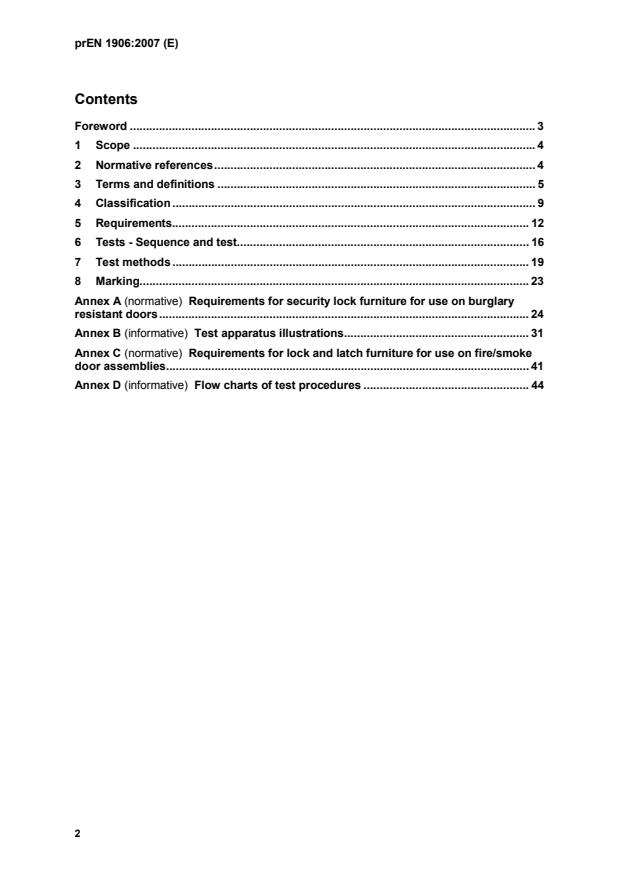
Contents
Foreword . 3
1 Scope . 4
2 Normative references. 4
3 Terms and definitions . 5
4 Classification . 9
5 Requirements. 12
6 Tests - Sequence and test. 16
7 Test methods . 19
8 Marking. 23
Annex A (normative) Requirements for security lock furniture for use on burglary
resistant doors. 24
Annex B (informative) Test apparatus illustrations. 31
Annex C (normative) Requirements for lock and latch furniture for use on fire/smoke
door assemblies. 41
Annex D (informative) Flow charts of test procedures . 44
Foreword
This document (prEN 1906:2007) has been prepared by Technical Committee CEN/TC 33 “Doors,
windows, shutters, building hardware and curtain walling”, the secretariat of which is held by AFNOR.
This document is currently submitted to the CEN Enquiry.
This document will supersede EN 1906:2002.
This document has been prepared under a mandate given to CEN by the European Commission and
the European Free Trade Association, and supports essential requirements of EC Directive(s).
For relationship with EC Directive(s), see informative Annex B and D, which is an integral part of this
document.
Contribution to the preparation of this standard has been made from the European manufacturer's
organisation "ARGE".
This European Standard is part of a series of European Standards dedicated to building hardware
products.
Compliance of a set of lock or latch furniture with this European Standard, in satisfies requirements in
normal use for safety in use and for safety in case of fire.
In this standard the Annexes A and C are normative and the Annexes B and D informative.
Normative and informative annexes to this standard are indicated in the contents.
Normative annexes give information on requirements for security lock furniture that offer enhanced
resistance to attack, requirements for lock furniture and latch furniture that offers enhanced resistance
to fire.
1 Scope
This European Standard specifies test methods and requirements for spindle and fastening elements,
operating torques, permissible free play and safety, free angular movement and misalignment,
durability, static strength and corrosion resistance for sprung and unsprung lever handles, knobs for
doors, push pads and similar in combination with backplates or roses operating latches.
This standard is applicable only to lever handles and knobs that operate a latch or a lock and other
devices.
It states four categories of use according to the frequency and other conditions of use.
Compliance with this European Standard ensures a margin of strength in excess of that needed for
normal operation. Additional requirements are needed for special safety furniture which is suitable for
use in situations where there is a high risk of falling. Since special safety furniture is not essential in
every situation, this European Standard provides for additional safety requirements (see 5.13) which
are only necessary when the manufacturer states that the safety furniture is claimed to conform to
these requirements.
This standard states five grades of security. Grade 0 according to requirements stated in the main
part of this standard. Grades 1 to 4 are stated according to requirement for security lock furniture for
use on burglary resistant doors (see annex A). These additional security requirements are necessary
only when the manufacturer states that the products are claimed to have a high level of security,
which is not essential in every situation.
The suitability of lock or latch furniture for use on fire/smoke door assemblies is determined by fire
performance tests conducted in addition to the performance tests required by this standard. Since
suitability for use on fire/smoke door assemblies is not essential in every situation, the manufacturer
has the option of stating whether the furniture is claimed to conform to these additional requirements
or not. If so stated the additional requirements given in Annex C are necessary.
Annex C refers to all kinds of lock or latch furniture for use on fire/smoke door assemblies, in the
execution as single leaf or double leaf doors.
This standard may be applied to lever handle and knob furniture used for exit doors which are used
on escape routes in residential and small office applications where EN 179 is not required. A product
meeting this standard can also be part of an exit device according to EN 179.
2 Normative references
This European Standard incorporates by dated or undated reference, provisions from other
publications. These normative references are cited at the appropriate places in the text and the
publications are listed hereafter. For dated references, subsequent amendments to, or revisions of,
any of these publications apply to this European Standard only when incorporated in it by amendment
or revision. For undated references the latest edition of the publication referred to applies (including
amendments).
EN 179 Building hardware – Emergency exit devices operated by a lever handle or push
pad – Requirements and test methods (includes Amendment A1 :2001)
EN 314-2 Plywood ; Bonding Quality ; Part 2 : Requirements
EN 636 Plywood – Specifications
EN 1634-1 Fire resistance tests for door and shutter assemblies - Part 1: Fire doors and
shutters
prEN 1634-2 Fire resistance tests for door and shutter assemblies - Part 2: Fire door hardware –
building hardware for fire resisting doorsets and openable windows
EN 1634-3 Fire resistance tests for door and shutter assemblies - Part 3: Smoke control doors
and shutters
EN 1670 Building hardware — Corrosion resistance — Requirements and test methods
ISO 10899 High-speed steel two-flute twist drills — Technical specifications
ISO/IEC 17025 General requirements for the competence of testing and calibration laboratories
3 Terms and definitions
For the purposes of this European Standard, the following terms and definitions apply.
3.1
backplate
element generally, but not essentially, approximately rectangular in plan whose purpose is, firstly,
functional to provide a bearing for the rotation of a door lever handle or knob and the means of
attachment to the door and, secondly, decorative as a trim plate to cover holes provided in the door
for the passage of spindles, keys or lock cylinders (see Figure 1a)
3.2
baseplate
component of an assembly of two parts that fit together to form a backplate or rose. This baseplate
provides the bearing and means of fixing the assembly to the door (see Figure 1b)
3.3
door furniture
combination of lever handles or knobs on backplates or roses for the purpose of operating latches or
locks
3.4
door knob
fixed or rotatable operating element, usually designed to be circular in plan, but which may be non-
circular with a maximum offset of 75 mm from its axis of rotation, which engages a spindle passing
through the door; the spindle then operating a latch mechanism when rotated, so that the latch bolt is
withdrawn in order to unlatch the door, or alternatively, is fixed against rotation and is used to pull the
door to the closed position and thereby relatch the door (see Figure 2)
3.5
door lever handle
rotatable operating element designed as a lever whose length from its axis of rotation to its free end
exceeds 75 mm and which engages a spindle passing through a door
3.6
emergency release
facility provided on the external plate that enables the door to be opened in case of emergency (see
Figure 3)
3.7
door set
any set of two lever handles or knobs with two lockplates or latchplates or, alternatively, roses and
escutcheons and complete with a spindle and fastening elements in order to operate the latch
3.8
entrance set
set with a lever handle on the one side of the door and a fixed knob or bar or no handle on the other
3.9
fire protection inlay
metal sheet inlay under the escutcheon and in the lever handle, which prevents that the fire goes
through after the melting of the cover or escutcheon (using materials with a melting point higher than
1000°C)
3.10
fireproof core
fireproof material (typically steel) core inside lever handle which allows the handle function to remain
operable after a fire.
3.11
escutcheon
surround with a shaped hole to accommodate a key or a lock cylinder, with or without a pivoted cover
plate, intended primarily to protect the door leaf from abrasion damage caused by keys (see Figure 2)
3.12
external plate
backplate or rose that is fitted on the external face of a door (see Figure 3)
3.13
fixed spindling system
system in which the spindle is fastened to both lever handles or both knobs of a lockset or latchset
often without any additional fixing of the handles or knobs to the backplates or roses, which allows the
rotation of the follower of the lock or latch to withdraw the latch bolt, permits adaptation for different
thicknesses of doors, connects the lever handle or knob to the spindle and transmits imposed axial
pulling forces to the opposite face of the door
3.14
floating spindling system
system in which the spindle is not attached to either of the lever handles or knobs of a lockset or
latchset but has additional fixing of the lever handles or knobs to the backplates or roses, which
allows the rotation of the follower of the lock or latch to withdraw the latchbolt and permits adaptation
for different thicknesses of doors
NOTE This system does not transmit imposed axial pulling forces to the opposite face of the door.
3.15
radial split spindle system
a system in which the spindle is split across radial X-section which is normal to its axis of normal
operation including door furniture spindle suitable for emergency exit-entrance door locks.
3.16
half set
single lever or knob attached to a plate or rose which allows operation of the lock or latch from one
side of the door only and usually supplied with a short length spindle fixed to the lever or knob
3.17
indicator
device that is visible from the exterior of the door to indicate whether the door is locked or unlocked
3.18
internal plate
backplate or rose that is fitted on the internal face of a door (see Figure 3)
3.19
latchplate
backplate adapted for use in conjunction with a latch and having no keyhole or cylinder aperture
3.20
lockplate – cylinder
backplate having a cylinder aperture for use in conjunction with a cylinder lock
3.21
plug protection plate
plate whose function is to protect the cylinder plug and its components against violent attack
3.22
rose
element generally circular, but which may have equi-axed or approximately equi-axed shapes such as
square or octagonal, that otherwise has the same features as a backplate (see Figure 2)
3.23
security furniture
device which provides added resistance to the lock and/or cylinder against physical attack
3.24
set of mortice latch furniture
two door lever handles or knobs with two latchplates or roses and complete with a spindle and
fastening elements
3.25
set of mortice lock furniture
two door lever handles or knobs with two lockplates or, alternatively, roses and escutcheons complete
with a spindle and fastening elements (see Figure 2)
3.26
snib
small T-handle, knob or other handle fitted to the internal plate of a set of latch furniture, lever-handle
or knob that operates a device which prevents rotation of the lever handle or knob, thereby providing
locking of the door for privacy
3.27
special safety furniture
where the strength of the fixing of the lever or knob to the backplate and/or spindle and the strength of
the fixing of the backplate to the door combine to provide a robust attachment to withstand a heavy
force in any direction of removing the lever or knob from the door
3.28
spindle
bar, usually square in cross-section, that engages with a follower
3.29
spring-assisted furniture
lever handle or knob furniture, usually exceptionally heavy in design, that incorporates a spring which
assists the return of the handle to its intended "at-rest" position but which may not necessarily have
sufficient torque to return it fully
NOTE For exceptionally heavy lever handles it is difficult to design springs that have sufficient torque to
return the handles and also have an adequate working life. For reasons relating to design of spring, the operating
angle of such lever handles is usually restricted to 40°, and they are used with latches whose bolts retract fully at
this angle of operation. When in use the combined action of the lever handle spring and the latch spring is
sufficient to return the lever handle to its intended "at-rest" position.
3.30
spring-loaded furniture
door furniture that incorporates a spring which fully returns the lever handle or knob to its intended "at-
rest" position after operating the latch
NOTE Spring-loaded furniture frequently includes an internal stop to prevent rotation beyond the intended
"at-rest" position, but this feature is not essential if the furniture is used in conjunction with a latch mechanism
incorporating its own stop.
3.31
thumb turn
small T-handle, knob or other handle fitted on the internal plate of a set of bathroom lock furniture that
operates a lock deadbolt in order to provide privacy rather than high security (see Figure 3)
3.32
trim plate
component of an assembly of two parts that fit together to form a backplate or rose which is fastened
to the baseplate as a decorative cover (see Figure 1b)
3.33
emergency exit door fittings
A door set which complies with EN 179.
Key
1 Baseplate
2 Trim plate
Figure 1a — One part backplate Figure 1b — Two part backplate
Figure 1 — Illustrations of backplates
Key Key
1 Rose 1 External plate 4 Emergency release
2 Door knob 2 Internal plate 5 Thumb turn
3 Escutcheon 3 Lever handle
Figure 2 — Set of lock furniture Figure 3 — Bathroom lockset
4 Classification
4.1 Coding system
4.1.1 General
For the purpose of this European Standard, lever handles and knobs for doors on backplates or roses
shall be classified according to the eight digit coding system described in 4.1.2 to 4.1.9.
4.1.2 Category of use (first digit)
Four grades are identified :
grade 1 : medium frequency of use by people with a high incentive to exercise care and with a
small chance of misuse, e.g. internal residential doors ;
grade 2 : medium frequency of use by people with some incentive to exercise care but where
there is some chance of misuse, e.g. internal office doors ;
grade 3 : high frequency of use by public or others with little incentive to exercise care and with a
high chance of misuse, e.g. public office doors ;
grade 4 : high frequency of use on doors which are subject to frequent violent usage, e.g. football
stadiums, offshore installations (oil rigs), barracks, public toilets, etc.
4.1.3 Durability (second digit)
Two grades of durability are identified :
grade 6 : medium frequency of use : 100 000 cycles ;
grade 7 : high frequency of use : 200 000 cycles.
4.1.4 Door mass (third digit)
No classification.
4.1.5 Fire resistance (fourth digit)
Eight grades of fire resistance are identified :
grade 0 : not approved for use on fire/smoke door assemblies ;
grade A : suitable for use on smoke door assemblies.
Grade B to F no requirements for an extra core in the handle/knob
grade B : suitable for use on smoke / fire door assemblies up to 15 min fire resistance
grade C : suitable for use on smoke / fire door assemblies up to 30 min fire resistance
grade D : suitable for use on smoke / fire door assemblies up to 60 min fire resistance
grade E : suitable for use on smoke / fire door assemblies up to 90 min fire resistance
grade F : suitable for use on smoke / fire door assemblies up to 120 min fire resistance
Grade G requirements for special core in the handle/knob
grade G : suitable for use on smoke / fire door assemblies up to 120 min fire resistance
… see annex C
4.1.6 Safety (fifth digit)
Two grades of safety are identified :
grade 0 : normal use ;
grade 1 : safety applications.
NOTE Standard furniture requires compliance with 5.1 to 5.12. Safety furniture requires compliance with
5.1 to 5.13.
4.1.7 Corrosion resistance (sixth digit)
Six grades of corrosion resistance are identified according to EN 1670.
grade 0 : no defined corrosion resistance ;
grade 1 : mild resistance ;
grade 2 : moderate resistance ;
grade 3 : high resistance ;
grade 4 : very high resistance ;
grade 5 : extremely high resistance.
Products for internal use shall comply with the minimum requirements for grade 1.
Products for external use, e.g. entrance doors, shall comply with the minimum for grade 3. Other
grades can be chosen for special purposes. e.g. grades 4 or 5 should be used for products exposed
to marine atmospheres or very polluted industrial environments.
NOTE: Products which are intended to develop a natural surface patina (e.g. bronze or brass products) or
are intended to be cleaned frequently, are not required to comply with any corrosion requirements.
4.1.8 Security (seventh digit)
Five grades of security are identified :
grade 0 : furniture not approved for use on burglary resistant doors;
grade 1 : mild burglary resistance;
grade 2 : moderate burglary resistance;
grade 3 : high burglary resistance;
grade 4 : extra high burglary resistance.
Grades 1, 2, 3 and 4 are determined according to the requirements and optional tests of annex A.
4.1.9 Type of operation (eighth digit)
Three types of operation are identified:
type A : spring-assisted furniture.
type B : spring-loaded furniture.
type U : unsprung furniture.
4.2 Example of classification
1 6 — 0 0 1 0 U
This classification example denotes furniture for use by people with a high incentive to use care in a
domestic situation, with durability grade 6 for medium frequency of use. There is no classification for
door mass, it is not approved for fire/smoke doors, nor for safety applications and has a mild
resistance to corrosion for internal use. It is not suitable for use on burglary resistant doors and is of
the unsprung type.
5 Requirements
5.1 General
Sets of lock or latch furniture shall be defined in general similar executed groups. From this group the
expected weakest assembly is subjected to the sequence of tests specified in 6.1, and listed in Table
1 using the test apparatus in accordance with 6.2 and the methods specified in clause 7 and shall
meet the requirements detailed in 5.2 to 5.14.
Results of a sequence of tests may be found applicable or found conform to sets which are tested in
another sequence of tests. If endurance tests have been carried out on sets which have equivalent
construction both sides of the door, this set can not be passed on a set of one sided movable knob or
lever handle set.
For entrance sets, endurance tests shall be undertaken on the equivalent set of lock or latch furniture
to verify that the lever handles or knobs comply with the durability requirements. All other appropriate
tests shall be carried out on the entrance set assembly. Furniture that is made available with a lever
one side and a knob on the other side shall be made known to the testing authority and endurance
tests shall be undertaken accordingly.
According to this standard, sets of furniture shall be classified in grades 1 to 4 (see 4.1.2) in regard to
the performance requirements detailed in 5.2 to 5.13.
NOTE If door furniture is to perform satisfactorily in service, it is essential that it is correctly selected for the
application for which it is to be used and fitted strictly in accordance with the manufacturer's recommendations.
Materials in products shall not release any dangerous substances in excess of the maximum levels specified in
the European material standards and any national regulations.
Table 1 — Main test parameters
Test Sub-clause Figure Description Category of use acceptance criteria
grade 1 grade 2 grade 3 grade 4
1 5.2 and 7.3.1 — Check of fastening elements and spindle yes/ no yes/ no yes/ no Yes/ no
Axial strength
+5
— Axial strength % at 50 mm ± 1 mm 300 N 500 N 800 N 1 000 N
2 5.4 and 7.3.2 B.3
15 N 15 N 15 N 15 N
— pre-load ± 1N at 50 mm ± 1 mm
— permanent deformation at 75 mm ± 2 mm ≤ 2 mm ≤ 2 mm ≤ 2 mm ≤ 2 mm
Free play "at-rest" and then at 60° ± 5 ° or maximum
of design
3 5.5 and 7.3.3 B.8 — force ± 1N at 50 mm ± 1 mm 15 N 15 N 15 N 15 N
— total movement at 75 mm ± 2 mm ≤ 10 mm ≤ 10 mm ≤ 6 mm ≤ 6 mm
Safety requirements yes yes yes Yes
Free angular movement
4 5.6 and 7.3.4 B.9 — force ± 1N at 50 mm ± 1 mm 15 N 15 N 15 N 15 N
— misalignment measured at 75 mm ± 2 mm ≤ 10 mm ≤ 10 mm ≤ 5 mm ≤ 5 mm
Operate-moment and return-moment
unsprung lever handles
— operate moment - - - -
— return-moment ≤ 0,6 Nm ≤ 0,6 Nm ≤ 1,5 Nm ≤ 1,5 Nm
5 5.7 and 7.3.5 — unsprung knobs :
— operate moment - - - -
— return-moment ≤ 0,6 Nm. ≤ 0,6 Nm ≤ 0,6 Nm ≤ 0,6 Nm
spring assisted lever handles
— operate moment
≤ 1,5 Nm ≤ 1,5 Nm ≤ 2,4 Nm ≤ 2,4 Nm
— return-moment ≤ 0,6 Nm ≤ 0,6 Nm ≤ 1,5 N.M. ≤ 1,5 Nm
— Angle of rotation
≥ 40° ≥ 40° ≥ 40° ≥ 40°
Spring-loaded lever handles
— operate moment ≤ 1,5 Nm ≤ 1,5 Nm ≤ 2,4 Nm ≤ 2,4 Nm
— return-moment - - - -
Limited deviations "at rest" for sets with spring load
± 4° ± 2° ± 1° ± 1°
Endurance test
+ 1
— number of cycles %
100 000 100 000 200 000 200 000
6 5.8 and 7.3.6 B.6 +5
— force L %
60 N 60 N 100 N 100 N
+5
— force P %
60 N 60 N 100 N 100 N
— limit deviations "at-rest" after test (except for spring ± 4 ° ± 2 ° ± 1 ° ± 1 °
assisted levers)
7 5.9 and 7.3.7 B.3 Axial strength (repetition of test 2) Same values as for test 2
8 5.10 and 7.3.8 B.8 Free play (repetition of test 3) Same values as for test 3 except for special
safety requirements
9 5.11 and 7.3.9 B.9 Free angular movement (repetition of test 4) Same values as for test 4
10 5.12 and 7.3.10 — Torque of return mechanism (repetition of test 5) Same values as for test 5
Test Sub-clause Figure Description Category of use acceptance criteria
grade 1 grade 2 grade 3 grade 4
+5
Axial strength % at 50 mm ± 1 mm optional test
11 5.13 and 7.3.11 B.3 1 500 N 1 500 N 2 500 N 2 500 N
applicable to special safety furniture only.
Rotational torque strength
12 5.3 and 7.3.12 B.1 — rotational torque ± 5 % 20 Nm 30 Nm 40 Nm 60 Nm
1 Nm 1 Nm 1 Nm 1 Nm
— pre-torque ± 0,1 Nm
— permanent deformation at 50 mm ± 2 mm ≤ 5 mm ≤ 5 mm ≤ 5 mm ≤ 5 mm
13 5.14 and 7.4 — Corrosion resistance To comply with requirements of EN 1670
5.2 Check of spindle and fastening elements
The spindle and fastening elements shall be supplied or specified by the manufacturer with every set
of lock or latch furniture. The manufacturer shall state clearly the door thickness or range of door
thicknesses for which the furniture is suitable and in the case of spring assisted and spring loaded
furniture, the angle of rotation permitted by the design (see 6.2.1.1 and 7.3.1).
5.3 Rotational torque strength
When tested in accordance with 7.3.12, lock or latch furniture shall show no failure of any component
and the lever handles or knobs shall still operate after the test. Lever handles or knobs shall not
deform permanently more than 5 mm as measured at 50 mm ± 2 mm from the axis of rotation by the
dial gauge.
5.4 Axial strength of lock furniture or latch furniture and fixing
When tested in accordance with 7.3.2, there shall be no failure of any component and lever handles
or knobs shall still operate after the test.
After test the permanent deformation for lever handles or knobs measured at the reference point
75 mm ± 2 mm from the axis of rotation shall not increase by more than 2 mm.
5.5 Free play and safety
5.5.1 Requirement for free play
The maximum total movement measured according to 7.3.3 shall not exceed 10 mm for category of
use grades 1 and 2, and 6 mm for category of use grades 3 and 4, for lock or latch furniture.
This requirement only applies to lever handles and knobs that will not be driven during the endurance
test.
5.5.2 Safety requirements
When the lock or latch furniture is fitted to the test block there shall be no sharp edges that can cause
injury.
In the area of rotation of the lever handle or knob, the head of any visible fastening element shall be
level with or below the surface of the backplate or rose after fitting, except that raised head screws
may stand proud of the furniture plate by the domed height of the screw head.
Any fastening element that secures the lever handle or knob to the spindle shall not project above the
surface by more than 1 mm after fitting.
The design of lock or latch furniture shall ensure that after fitting it is not possible for the fingers of a
user to be trapped between lever handle or knob and backplate or rose over the full range of rotation
of the lever handle or knob.
5.6 Free angular movement or misalignment
When the furniture is tested in accordance with 7.3.4, the free angular movement or misalignment
shall not exceed 10 mm for category of use grades 1 and 2, and 5 mm for category of use grades 3
and 4. This requirement applies to all furniture with either a fixed or floating spindle.
5.7 Torque of return mechanism
5.7.1 General
When the furniture is tested in accordance with 7.3.5, the lock or latch furniture shall meet the
appropriate requirements detailed in 5.7.2 to 5.7.4.
As sprung and unsprung lever handles and knobs differ in mechanical features of design different
requirements have to be applied to each.
5.7.2 Unsprung and spring-assisted lever handles
When the furniture is tested in accordance with 7.3.5.1, the torque required to return the unsprung or
spring-assisted lever handle back to its intended "at-rest" position shall be not greater than 0,6 Nm for
category of use grades 1 and 2 and not greater than 1,5 Nm for category of use grades 3 and 4.
For spring-assisted lever handles only, the torque required to rotate the lever handle to a minimum
angle of 40° from its intended "at-rest" position shall not exceed 1,5 Nm for category of use grades 1
and 2, and 2,4 Nm for category of use grades 3 and 4.
5.7.3 Unsprung knobs
When the furniture is tested in accordance with 7.3.5.2, the torque value in either direction shall be
not greater than 0,6 Nm.
5.7.4 Spring-loaded lever handles or knobs
When the furniture is tested in accordance with 7.3.5.3, the torque required to rotate the lever handles
+°5
or knobs through a maximum of 60° or through the angle of rotation permitted by the design shall
not be more than 1,5 Nm for category of use grades 1 and 2, and 2,4 Nm for category of use grades 3
and 4.
After removal of the torque, the lever handle or knob shall return to its recorded "at-rest" position
within ±4° for category of use grade 1, within ±2° for category of use grade 2, and within ±1° for
category of use grades 3 and 4.
5.8 Durability of mechanism
When the furniture is tested in accordance with 7.3.6, there shall be no failure of any component and
the lever handle or knob shall still operate after the test.
After the test, the "at-rest" position of spring-loaded door furniture when against its stops shall
conform to the "at-rest" position recorded before commencing, within ±4° for category of use grade1,
within ±2° for category of use grade 2, and within ±1° for category of use grades 3 and 4. This
requirement does not apply to spring assisted lever furniture.
5.9 Repeat test of axial strength of lock or latch furniture and methods of fixing
After completion of 7.3.6, the lock or latch furniture shall be repeat tested in accordance with 7.3.7
and shall meet the requirement of 5.4.
5.10 Repeat test of free play measurement
After completion of 7.3.7, the free play measured on the lever handle or knob not driven during the
endurance test shall be repeat tested in accordance with 7.3.8 and shall meet the requirement of
5.5.1.
5.11 Repeat test of measurement of free angular movement or misalignment
After completion of 7.3.8, the lock or latch furniture shall be repeat tested in accordance with 7.3.9
and shall meet the requirements of 5.6.
5.12 Repeat test of torque of return mechanism
After completion of 7.3.9, the lock or latch furniture shall be repeat tested in accordance with 7.3.10
and shall meet the requirements of 5.7.
5.13 Axial strength for safety furniture (optional)
After completion of 7.3.10, furniture classified as safety furniture shall be subjected to 7.3.11. There
shall be no failure of any component and the furniture shall remain fixed to the test block. The lever
handle or knob need not operate after completion of the test.
NOTE It is recommended that only furniture complying with this requirement should be used in situations
where there is a high risk of falling, such as for doors at the top of cellar steps or other staircases.
5.14 Corrosion resistance
Corrosion resistance shall comply with requirements of EN 1670.
The grade of corrosion resistance achieved shall be included in the classification coding specified
in 7.4.
The acceptance criteria defined in 5.7 of EN 1670 shall be met for all surfaces of the lever handle and
knob furniture which are visible when fitted in service.
6 Tests - Sequence and test
6.1 Test sequence
The samples received shall be examined by the test laboratory before starting the tests to ensure
completeness, compliance with the manufacturer’s packaging statements and possible damage.
After checking the spindle and fastening elements (see 5.2), a half set of lock or latch furniture shall
be fitted to a test block as defined in 6.2.1.1 and shall meet the requirements for test 7.3.2.
A set of lock or latch furniture, including the half set already submitted to 7.3.2, shall be fitted to a test
block as defined in 6.2.1.2. The half set already tested shall be submitted to tests 7.3.3 to 7.3.12, as
appropriate to the type of furniture, in the sequence specified in Table 1.
Corrosion resistance specified in 5.14 and 7.4, shall be carried out on samples that have not been
subjected to any of the preceding tests, in order to verify compliance with the requirements of
EN 1670.
6.2 Test apparatus
6.2.1 Fixing to a test block (see Figures B.1 and B.2)
6.2.1.1 After checking that the spindle and fastening elements meet the requirements of 5.2, a half-
set of lock or latch furniture shall be mounted on a test block of laminated wood (bonding type 1F 20,
quality II/II, 19 laminates, see EN 636) or similar quality as shown in Figure B.1.
The dimensions of the test block shall be 300 mm ± 5 mm × 150 mm ± 5 mm × 20 mm ± 1 mm
finished thickness. Fastening elements supplied or specified by the manufacturer shall be used.
NOTE If fastening elements are unsuitable for the 20 mm block thickness, any other suitable means can
be used.
The spindle shall be engaged with the lever handle or knob to the minimum recommended by the
manufacturer or otherwise to the minimum permitted by the design. It shall pass through a clearance
+1
hole in the test block to engage in a fixed reaction plate for a distance of 8 mm mm.
Knobs shall be fitted with a counterbalanced steel bar of length 180 mm ± 10 mm x 10 mm ± 0,5 mm
diameter whose centre line intersects the axis of rotation of the knob within a tolerance of 0,5 mm.
The vertical plane which contains the bar shall be parallel with the face of the test block ± 2°.
6.2.1.2 After testing to 7.3.2 and checking for compliance with the requirements of 5.3, a set of lock
or latch furniture that includes the half-set already tested, shall be mounted on another test block of
laminated wood (bonding type 1F 20, quality II/II, 19 laminates, see EN 636) or similar quality as
shown in Figure B.2, according to the manufacturer's instructions. Only fastening elements supplied
or specified by the manufacturer shall be used and the arrangement shall be such that the half-set
already subjected to 7.3.2 shall also be subjected to the subsequent tests.
+2
The dimensions of the test block shall be 300 mm ± 5 mm x 150 mm ± 5 mm x (40 ) mm finished
thickness, except that the thickness may be varied to comply with requirements of 5.2. The block shall
have been morticed and cross drilled in accordance with Figure B.2 to accommodate the pulley
specified in 6.2.3.1 and an appropriate pulley shall be fitted to the spindle.
6.2.1.3 A set of lock or latch furniture intended for use on a non-timber door shall be rigidly fastened
to an auxiliary fixture that matches as closely as possible the intended material and profile shape of
the door on which it is to be used. The auxiliary fixture shall have a length of 300 mm ± 5 mm and only
the fastening elements supplied or specified by the manufacturer shall be used. The auxiliary fixture
shall then be rigidly secured to the test apparatus.
The set of lock or latch furniture shall be fitted with the appropriate spindling but without a lock or
latch. A suitable pulley shall be fitted to the spindle as specified in 6.2.3.
Once 7.3.3 is commenced no retightening of the fastening elements shall be permitted until
completion of 7.3.11 or 7.3.12 as appropriate.
6.2.2 Apparatus for strength tests
For the axial strength tests 7.3.2 and 7.3.11, tensile test apparatus is preferred, but a simple test
apparatus as shown in Figure B.3 can be used as an alternative.
Figure B.1.a) illustrates convenient methods of applying the torques required for 7.3.2, 7.3.4, 7.3.5
and 7.3.6.
6.2.3 Apparatus for endurance test
6.2.3.1 Artificial latch mechanism
An artificial latch mechanism shall be used to eliminate variability inherent in commercially produced
latches, the latch action being simulated by an auxiliary spring.
The test apparatus shall incorporate a pulley made from aluminium as detailed in Figure B.4. The
pulley includes a central hub with a hole no more than 0,1 mm larger than the maximum spindle size.
The operating angle shall be 55° ± 5° from the horizontal centre line.
Additional accurate slots may be incorporated in the pulley to accommodate the fixing bolts of bolt-
through door furniture (see Figure B.5).
6.2.3.2 Test apparatus
The test apparatus shall be capable of supporting the test block and attached lock or latch furniture in
a secure manner and capable of subjecting it to the required forces. A suitable test apparatus is
illustrated in Figure B.6.
Means of rotating the driven lever handle or knob through 55° ± 5° shall be such that the lever handle
or knob can be released suddenly and allowed to return to the "at-rest" position under the action of a
spring which simulates the spring normally included in a latch. A motor driven cam, with a shape
allowing the sudden release of the lever handle or knob shall be used for this purpose.
For spring assisted lever handles with a designed operating angle of 40° the cam shall be such as to
release the lever handle at 35° ± 5°, or, in the case of spring loaded furniture, at the angle of rotation
± 5° permitted by the design.
For unsprung lever handles and for spring-assisted lever handles, the spring shall provide a return
force of 12 N ± 1 N for category of use grades 1 and 2, and 20 N ± 1 N for category of use grades 3
and 4. This force shall be measured when the lever handles have been rotated through 30°. The
return force shall act parallel to within ± 3° to the plane of the test block in an upward direction at an
+5°
angle of 30° ± 3° from vertical. When the lever handle is in the "at-rest" position or at 55° for
+5°
unsprung lever handles or at 35° for spring-assisted lever handles, the force exerted by the spring
shall not vary by more than 4 N from the force measured at the 30° position.
The spring shall be attached to the lever handle not driven by the cam at a point 50 mm ± 1 mm from
the axis of rotation.
For spring loaded lever handles, the spring shall be similar in all respects, except that it shall apply a
+5°
force of 10 N ± 0,5 N at 30° ± 3° rotation, with a variation not exceeding 2 N at 0° and 55° at the
limit of the rotation permitted by the design.
For knobs, two springs shall be attached to the driven knob at points which are, if possible,
diametrically opposite and furthest from the axis of rotation. The springs shall provide a total return
torque of 0,15 Nm ± 0,01 Nm when the knob has reached an operating angle of 30° ± 3°. When the
knob is in the "at-rest" position or at 55° ± 5°, the torque shall not vary by more than 0,03 Nm from the
torque at the 30° position. A counterbalanced bar or other suitable device may be attached to the
knob or levers, if less than 85 mm, to apply the rotary movement and trigger the return movement.
The initial point of contact of the driving peg with the lever handle or counterbalanced bar shall be
50 mm ± 1 mm from the axis of rotation of the furniture.
A rigid steel stop of 10 mm diameter attached to the frame of the test apparatus and positioned
80 mm ± 1 mm from the axis of rotation of the furniture shall be provided to arrest unsprung levers or
knobs at the "at-rest" position ± 1°.
The "at-rest" position is when the spindle hole in the lever or knob is square to the horizontal/vertical.
This position may be set by reference to the "cord" hole in the pulley (see Figure B.4).
6.2.3.3 Application of test loads
A force ‘P’ shall be applied to one of the lever handles or knobs by a cord which passes over a pulley
whose axis is 500 mm ± 10 mm from the face of the test block, the cord carrying a suitable load. The
position of the pulley shall be such that when the lever handle or knob is in its "at-rest" position, the
cord is perpendicular ± 2° to the plane of the test block (see Figure B.6).
For lever handles, the force shall be applied without shock and in a controlled manner, at a point
50 mm ± 1 mm from the axis of rotation of the spindle.
For knobs, the force shall be applied without shock and in a controlled manner coaxially with the axis
of rotation ± 1 mm.
A downward force L shall be applied to the pulley as indicated in Figure B.6.
A suitable bottom pulley is shown in Figure B.7.
Means of repeating the required test cycle for the specified numbers of operations, as required in
7.3.6, shall be provided.
7 Test methods
7.1 General
Two samples, of three sets each of lock and/or latch furniture, selected at random, shall be subjected
to the following tests:
Eleven performance tests to verify compliance with the requirements listed in 5.2 to 5.12.
A corrosion resistance test to verify compliance with the requirement given in 5.14.
Test samples shall not be subjected to both sets of tests
Performance tests, in addition to the above, are required to verify that:
safety lock and latch furniture comply with the requirement given in 5.13.
Burglary resistant lock furniture comply with the requirements given in annex A.
Fire resistant lock and latch furniture comply with the requirements given in annex C.
Flow charts of the procedure
...