


EN 16923:2022
(Main)Foodstuffs - Determination of T-2 toxin and HT-2 toxin in cereals and cereal products for infants and young children by SPE clean up and HPLC-MS/MS
Foodstuffs - Determination of T-2 toxin and HT-2 toxin in cereals and cereal products for infants and young children by SPE clean up and HPLC-MS/MS
This document describes a method for the determination of T-2 toxin and HT-2 toxin in cereals and cereal-based products, e.g. oats, intended for nutrition of infants and young children by high performance liquid chromatography (HPLC) coupled with tandem mass spectrometry (MS/MS) after cleanup by solid phase extraction (SPE) [5].
The method has been validated for HT-2 toxin in oat flour at levels of 9,3 µg/kg and 28,1 µg/kg, oat flakes at levels of 16,5 µg/kg and 21,4 µg/kg, and breakfast cereals (containing oat flakes) at a level of 8,1 µg/kg and for T-2 toxin in oat flour at levels of 4,4 µg/kg and 8,3 µg/kg, oat flakes at levels of 4,9 µg/kg and 6,6 µg/kg and breakfast cereals (containing oat flakes) at a level of 3,5 µg/kg.
Laboratory experiences [6] have shown that the method is also applicable to highly swelling materials (dry cereal-based porridges and modified starches), but these were not examined in the method validation study. Details are outlined in 7.3.
The method can also be applied to oat-by-products at higher levels of T-2- and HT-2 toxin. In this case, the dilution steps need to be considered [6].
The method can also be applied to cereals and cereal products for infants and young children based on e.g. wheat, barley and rice. In this case, the method needs to be in-house-validated for each material. At the time of the interlaboratory study, planned range was 10 µg/kg to 100 µg/kg, and it is known from the pre-study that the method works well in the whole range, although final validation was only done in the range from 3,5 µg/kg to 28,1 µg/kg.
Lebensmittel - Bestimmung von T-2-Toxin und HT-2-Toxin in Getreide und Säuglings- und Kleinkindernahrung auf Getreidebasis mit HPLC-MS/MS nach SPE-Reinigung
Dieses Dokument beschreibt ein Verfahren zur Bestimmung von T-2-Toxin und HT-2-Toxin durch Hochleistungsflüssigchromatographie (HPLC, en: high performance liquid chromatography) in Kopplung mit Tandem Massenspektrometrie (MS/MS) nach Festphasenreinigung (SPE, en: solid phase extraction) [5] in Getreide und getreidebasierten Produkten, z. B. Haferflocken, die für die Ernährung von Säuglingen und Kleinkindern vorgesehen sind.
Das Verfahren wurde für HT-2 Toxin in Hafermehl bei Konzentrationen von 9,3 µg/kg und 28,1 µg/kg, in Haferflocken bei Konzentrationen von 16,5 µg/kg und 21,4 µg/kg und bei Frühstückscerealien (die Haferflocken enthalten) bei einer Konzentration von 8,1 µg/kg sowie für T-2-Toxin in Hafermehl bei Konzentrationen von 4,4 µg/kg und 8,3 µg/kg, in Haferflocken bei Konzentrationen von 4,9 µg/kg und 6,6 µg/kg und bei Frühstückscerealien (die Haferflocken enthalten) bei einer Konzentration von 3,5 µg/kg validiert.
Laborerfahrungen [6] haben gezeigt, dass das Verfahren auch für stark aufquellende Materialien (auf trockenem Getreide basierendem Porridge und modifizierte Stärken) anwendbar ist, jedoch wurden diese in der Validierungsuntersuchung des Verfahrens nicht überprüft. Einzelheiten hierzu sind in 7.3 enthalten.
Das Verfahren kann ebenso bei Hafer-Nebenprodukten bei höheren Konzentrationen von T-2-Toxin und HT-2-Toxin angewendet werden. In diesem Fall ist es erforderlich die Verdünnungsschritte zu berücksichtigen [6].
Das Verfahren kann auch auf Getreide und Getreideerzeugnisse auf der Basis von z. B. Weizen, Gerste und Reis für Säuglinge und Kleinkinder angewendet werden. In diesem Falle ist es erforderlich, das Verfahren im Labor für jedes Material zu validieren (In house Validation). Zum Zeitpunkt des Ringversuches war ein Bereich von 10 µg/kg bis 100 µg/kg zur Validierung vorgesehen, und die Vorstudien haben gezeigt, dass das Verfahren diesen gesamten Bereich gut abdeckt, obwohl das Verfahren letztendlich nur für den Bereich von 3,5 µg/kg bis 28,1 µg/kg validiert wurde.
Produits alimentaires - Dosage des toxines T-2 et HT-2 dans les céréales et les produits céréaliers pour nourrissons et enfants en bas âge par purification par SPE et CLHP-SM/SM
Le présent document décrit une méthode de dosage des toxines T-2 et HT-2 dans les céréales et les produits céréaliers, par exemple l’avoine, destinés à l’alimentation des nourrissons et des enfants en bas âge par chromatographie liquide à haute performance (CLHP) couplée à une spectrométrie de masse en tandem (SM/SM) après purification par extraction en phase solide (SPE) [5].
La méthode a été validée pour la toxine HT-2 présente dans la farine d’avoine à des niveaux de 9,3 µg/kg et 28,1 µg/kg, dans les flocons d’avoine à des niveaux de 16,5 µg/kg et 21,4 µg/kg et dans les céréales pour petit-déjeuner (contenant des flocons d’avoine) à un niveau de 8,1 µg/kg, et pour la toxine T-2 présente dans la farine d’avoine à des niveaux de 4,4 µg/kg et 8,3 µg/kg, dans les flocons d’avoine à des niveaux de 4,9 µg/kg et 6,6 µg/kg et dans les céréales pour petit-déjeuner (contenant des flocons d’avoine) à un niveau de 3,5 µg/kg.
Les expériences menées en laboratoire [6] ont démontré que la méthode est également applicable aux matériaux qui gonflent beaucoup (bouillies à base de céréales sèches et amidons modifiés), mais ces matériaux n’ont pas été examinés lors de l’étude de validation de la méthode. Le paragraphe 7.3 fournit plus d’informations.
La méthode peut également être appliquée aux sous-produits de l’avoine à des teneurs en toxines T-2 et HT-2 plus élevées. Dans ce cas, les étapes de dilution doivent être prises en compte [6].
La méthode peut également être appliquée aux céréales et aux produits céréaliers pour nourrissons et enfants en bas âge à base par exemple de blé, d’orge et de riz. Dans ce cas, la méthode doit être validée en interne pour chaque matrice. Lors de l’étude interlaboratoires, la gamme prévue allait de 10 µg/kg à 100 µg/kg et il est connu, grâce à l’étude préalable, que la méthode fonctionne bien sur toute l’étendue de la gamme, bien que la validation finale ait seulement été faite pour la gamme de concentrations de 3,5 µg/kg à 28,1 µg/kg.
Živila - Določevanje toksinov T-2 in HT-2 v žitu in žitnih proizvodih za dojenčke in majhne otroke s HPLC-MS/MS po čiščenju s SPE
Ta dokument opisuje metodo za določanje toksinov T-2 in HT-2 v žitu in žitnih proizvodih za dojenčke oziroma majhne otroke s tekočinsko kromatografijo visoke ločljivosti (HPLC) v kombinaciji s tandemsko masno spektrometrijo (MS/MS) po čiščenju z ekstrakcijo na trdni fazi (SPE) [5].
Metoda je potrjena za toksin HT-2 v ovseni moki pri koncentracijah 9,3 μg/kg in 28,1 μg/kg, ovsenih kosmičih pri koncentracijah 16,5 μg/kg in 21,4 μg/kg ter žitih za zajtrk (ki vsebujejo ovsene kosmiče) pri koncentracijah 8,1 μg/kg, ter za toksin T-2 v ovseni moki pri koncentracijah 4,4 μg/kg in 8,3 μg/kg, ovsenih kosmičih pri koncentracijah 4,9 μg/kg in 6,6 μg/kg ter žitih za zajtrk (ki vsebujejo ovsene kosmiče) pri koncentraciji 3,5 μg/kg.
Laboratorijske izkušnje [6] kažejo, da se metoda uporablja tudi za materiale, ki močno nabreknejo (kaše iz suhih žit in modificiranih škrobov), vendar ti materiali niso bili raziskani v študiji validativnosti metode. Podrobnosti so opredeljene v točki 7.3.
Metoda se lahko uporabi tudi za stranske proizvode iz ovsa z višjimi ravnmi toksinov T-2 in HT-2. V tem primeru je treba upoštevati korake za redčenje [6].
Metodo je mogoče uporabiti tudi pri žitih in žitnih izdelkih za dojenčke oziroma majhne otroke na osnovi npr. pšenice, ječmena in riža. V tem primeru je treba metodo interno validirati za vsak izdelek. V medlaboratorijski raziskavi je bilo načrtovano območje od 10 µg/kg do 100 µg/kg, iz predhodne raziskave pa je znano, da metoda dobro deluje v celotnem območju, čeprav je bila končna validacija opravljena le v območju od 3,5 µg/kg do 28,1 µg/kg.
General Information
- Status
- Published
- Publication Date
- 15-Nov-2022
- Technical Committee
- CEN/TC 275 - Food analysis - Horizontal methods
- Drafting Committee
- CEN/TC 275/WG 5 - Biotoxins
- Current Stage
- 6060 - Definitive text made available (DAV) - Publishing
- Start Date
- 16-Nov-2022
- Due Date
- 18-Apr-2022
- Completion Date
- 16-Nov-2022
Relations
- Effective Date
- 23-Nov-2022
Overview
EN 16923:2022 is a CEN European standard describing a validated laboratory method for the determination of T-2 toxin and HT-2 toxin in cereals and cereal-based products intended for infants and young children. The method combines solid phase extraction (SPE) cleanup with high performance liquid chromatography coupled to tandem mass spectrometry (HPLC‑MS/MS) for sensitive and specific mycotoxin analysis. This edition (Nov 2022) supersedes EN 16923:2017 and includes clarified SPE elution steps and practical annexes (chromatograms, LC‑MS/MS settings, precision data).
Key topics and technical requirements
- Scope and matrix validation: Method validated for oat flour, oat flakes and breakfast cereals containing oats at low µg/kg levels (T‑2 validated down to ~3.5 µg/kg; HT‑2 validated down to ~8.1 µg/kg). Applicable to other cereal matrices (wheat, barley, rice) after in‑house validation.
- Analytical principle: Extraction with an acetonitrile–water mixture, cleanup and concentration by SPE or pass‑through columns, followed by HPLC‑MS/MS detection and quantification.
- Reagents and standards: Requires HPLC‑grade solvents, isotopically labelled internal standards ([13C]‑T‑2 and [13C]‑HT‑2), and mixed calibration standards (example range 5–100 ng/ml).
- Calibration and quantification: Use of isotopic internal standards and multi‑point calibration for accurate quantification across the validated range.
- Performance and precision: Includes repeatability and reproducibility data (annex C) from interlaboratory studies; the intended analytical range and practical limits are provided.
- Practical notes: Laboratory experience indicates applicability to highly swelling materials (e.g., dry cereal‑based porridges, modified starches) and to oat by‑products at higher toxin levels with appropriate dilution steps.
- Safety: Explicit warnings about hazardous chemicals and the toxic/carcinogenic nature of T‑2 and HT‑2 toxins - appropriate safety measures required.
Applications and users
This standard is designed for:
- Food testing and analytical laboratories performing regulatory or quality control testing of infant and young‑child foods.
- Cereal and infant food manufacturers implementing in‑house quality assurance and supplier testing for mycotoxin control.
- Regulatory authorities and public health labs monitoring compliance with mycotoxin limits in baby foods.
- Research groups validating methods for new matrices or extending the method’s range.
Practical uses include routine monitoring of oat‑based breakfast cereals and infant porridges, method transfer and in‑house validation for additional cereals, and targeted compliance testing where sensitive HPLC‑MS/MS detection is required.
Related standards
- Normative reference: EN ISO 3696 (Water for analytical laboratory use) is cited for required water quality.
- EN 16923:2022 replaces EN 16923:2017.
Keywords: EN 16923:2022, T‑2 toxin, HT‑2 toxin, HPLC‑MS/MS, SPE cleanup, mycotoxin analysis, cereals, infant food, validation, food safety.



Frequently Asked Questions
EN 16923:2022 is a standard published by the European Committee for Standardization (CEN). Its full title is "Foodstuffs - Determination of T-2 toxin and HT-2 toxin in cereals and cereal products for infants and young children by SPE clean up and HPLC-MS/MS". This standard covers: This document describes a method for the determination of T-2 toxin and HT-2 toxin in cereals and cereal-based products, e.g. oats, intended for nutrition of infants and young children by high performance liquid chromatography (HPLC) coupled with tandem mass spectrometry (MS/MS) after cleanup by solid phase extraction (SPE) [5]. The method has been validated for HT-2 toxin in oat flour at levels of 9,3 µg/kg and 28,1 µg/kg, oat flakes at levels of 16,5 µg/kg and 21,4 µg/kg, and breakfast cereals (containing oat flakes) at a level of 8,1 µg/kg and for T-2 toxin in oat flour at levels of 4,4 µg/kg and 8,3 µg/kg, oat flakes at levels of 4,9 µg/kg and 6,6 µg/kg and breakfast cereals (containing oat flakes) at a level of 3,5 µg/kg. Laboratory experiences [6] have shown that the method is also applicable to highly swelling materials (dry cereal-based porridges and modified starches), but these were not examined in the method validation study. Details are outlined in 7.3. The method can also be applied to oat-by-products at higher levels of T-2- and HT-2 toxin. In this case, the dilution steps need to be considered [6]. The method can also be applied to cereals and cereal products for infants and young children based on e.g. wheat, barley and rice. In this case, the method needs to be in-house-validated for each material. At the time of the interlaboratory study, planned range was 10 µg/kg to 100 µg/kg, and it is known from the pre-study that the method works well in the whole range, although final validation was only done in the range from 3,5 µg/kg to 28,1 µg/kg.
This document describes a method for the determination of T-2 toxin and HT-2 toxin in cereals and cereal-based products, e.g. oats, intended for nutrition of infants and young children by high performance liquid chromatography (HPLC) coupled with tandem mass spectrometry (MS/MS) after cleanup by solid phase extraction (SPE) [5]. The method has been validated for HT-2 toxin in oat flour at levels of 9,3 µg/kg and 28,1 µg/kg, oat flakes at levels of 16,5 µg/kg and 21,4 µg/kg, and breakfast cereals (containing oat flakes) at a level of 8,1 µg/kg and for T-2 toxin in oat flour at levels of 4,4 µg/kg and 8,3 µg/kg, oat flakes at levels of 4,9 µg/kg and 6,6 µg/kg and breakfast cereals (containing oat flakes) at a level of 3,5 µg/kg. Laboratory experiences [6] have shown that the method is also applicable to highly swelling materials (dry cereal-based porridges and modified starches), but these were not examined in the method validation study. Details are outlined in 7.3. The method can also be applied to oat-by-products at higher levels of T-2- and HT-2 toxin. In this case, the dilution steps need to be considered [6]. The method can also be applied to cereals and cereal products for infants and young children based on e.g. wheat, barley and rice. In this case, the method needs to be in-house-validated for each material. At the time of the interlaboratory study, planned range was 10 µg/kg to 100 µg/kg, and it is known from the pre-study that the method works well in the whole range, although final validation was only done in the range from 3,5 µg/kg to 28,1 µg/kg.
EN 16923:2022 is classified under the following ICS (International Classification for Standards) categories: 67.060 - Cereals, pulses and derived products; 67.230 - Prepackaged and prepared foods. The ICS classification helps identify the subject area and facilitates finding related standards.
EN 16923:2022 has the following relationships with other standards: It is inter standard links to EN 16923:2017. Understanding these relationships helps ensure you are using the most current and applicable version of the standard.
EN 16923:2022 is associated with the following European legislation: EU Directives/Regulations: 2017/625, 882/2004. When a standard is cited in the Official Journal of the European Union, products manufactured in conformity with it benefit from a presumption of conformity with the essential requirements of the corresponding EU directive or regulation.
You can purchase EN 16923:2022 directly from iTeh Standards. The document is available in PDF format and is delivered instantly after payment. Add the standard to your cart and complete the secure checkout process. iTeh Standards is an authorized distributor of CEN standards.
Standards Content (Sample)
SLOVENSKI STANDARD
01-februar-2023
Nadomešča:
SIST EN 16923:2017
Živila - Določevanje toksinov T-2 in HT-2 v žitu in žitnih proizvodih za dojenčke in
majhne otroke s HPLC-MS/MS po čiščenju s SPE
Foodstuffs - Determination of T-2 toxin and HT-2 toxin in cereals and cereal products for
infants and young children by SPE clean up and HPLC-MS/MS
Lebensmittel - Bestimmung von T-2-Toxin und HT-2-Toxin in Getreide und Säuglings-
und Kleinkindernahrung auf Getreidebasis mit HPLC-MS/MS nach SPE-Reinigung
Produits alimentaires - Dosage des toxines T-2 et HT-2 dans les céréales et les produits
céréaliers pour nourrissons et enfants en bas âge par SPE et CLHP-SM/SM
Ta slovenski standard je istoveten z: EN 16923:2022
ICS:
67.060 Žita, stročnice in proizvodi iz Cereals, pulses and derived
njih products
67.230 Predpakirana in pripravljena Prepackaged and prepared
hrana foods
2003-01.Slovenski inštitut za standardizacijo. Razmnoževanje celote ali delov tega standarda ni dovoljeno.
EN 16923
EUROPEAN STANDARD
NORME EUROPÉENNE
November 2022
EUROPÄISCHE NORM
ICS 67.060; 67.230 Supersedes EN 16923:2017
English Version
Foodstuffs - Determination of T-2 toxin and HT-2 toxin in
cereals and cereal products for infants and young children
by SPE clean up and HPLC-MS/MS
Produits alimentaires - Dosage des toxines T-2 et HT-2 Lebensmittel - Bestimmung von T 2 Toxin und HT 2
dans les céréales et les produits céréaliers pour Toxin in Getreide und Säuglings- und
nourrissons et enfants en bas âge par purification par Kleinkindernahrung auf Getreidebasis mit HPLC
SPE et CLHP-SM/SM MS/MS nach SPE-Reinigung
This European Standard was approved by CEN on 9 October 2022.
CEN members are bound to comply with the CEN/CENELEC Internal Regulations which stipulate the conditions for giving this
European Standard the status of a national standard without any alteration. Up-to-date lists and bibliographical references
concerning such national standards may be obtained on application to the CEN-CENELEC Management Centre or to any CEN
member.
This European Standard exists in three official versions (English, French, German). A version in any other language made by
translation under the responsibility of a CEN member into its own language and notified to the CEN-CENELEC Management
Centre has the same status as the official versions.
CEN members are the national standards bodies of Austria, Belgium, Bulgaria, Croatia, Cyprus, Czech Republic, Denmark, Estonia,
Finland, France, Germany, Greece, Hungary, Iceland, Ireland, Italy, Latvia, Lithuania, Luxembourg, Malta, Netherlands, Norway,
Poland, Portugal, Republic of North Macedonia, Romania, Serbia, Slovakia, Slovenia, Spain, Sweden, Switzerland, Türkiye and
United Kingdom.
EUROPEAN COMMITTEE FOR STANDARDIZATION
COMITÉ EUROPÉEN DE NORMALISATION
EUROPÄISCHES KOMITEE FÜR NORMUNG
CEN-CENELEC Management Centre: Rue de la Science 23, B-1040 Brussels
© 2022 CEN All rights of exploitation in any form and by any means reserved Ref. No. EN 16923:2022 E
worldwide for CEN national Members.
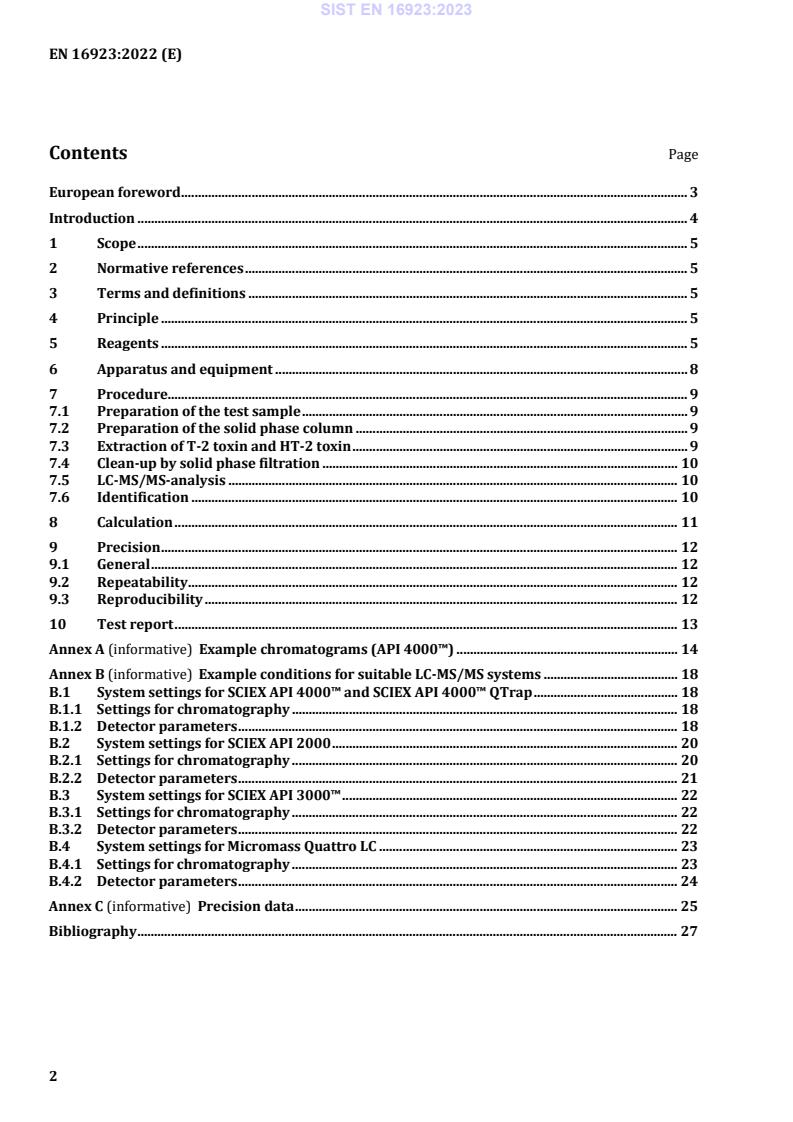
Contents Page
European foreword . 3
Introduction . 4
1 Scope . 5
2 Normative references . 5
3 Terms and definitions . 5
4 Principle . 5
5 Reagents . 5
6 Apparatus and equipment . 8
7 Procedure. 9
7.1 Preparation of the test sample . 9
7.2 Preparation of the solid phase column . 9
7.3 Extraction of T-2 toxin and HT-2 toxin . 9
7.4 Clean-up by solid phase filtration . 10
7.5 LC-MS/MS-analysis . 10
7.6 Identification . 10
8 Calculation . 11
9 Precision . 12
9.1 General . 12
9.2 Repeatability . 12
9.3 Reproducibility . 12
10 Test report . 13
Annex A (informative) Example chromatograms (API 4000™) .
Annex B (informative) Example conditions for suitable LC-MS/MS systems . 18
B.1 System settings for SCIEX API 4000™ and SCIEX API 4000™ QTrap . 18
B.1.1 Settings for chromatography . 18
B.1.2 Detector parameters . 18
B.2 System settings for SCIEX API 2000 . 20
B.2.1 Settings for chromatography . 20
B.2.2 Detector parameters . 21
B.3 System settings for SCIEX API 3000™ . 22
B.3.1 Settings for chromatography . 22
B.3.2 Detector parameters . 22
B.4 System settings for Micromass Quattro LC . 23
B.4.1 Settings for chromatography . 23
B.4.2 Detector parameters . 24
Annex C (informative) Precision data . 25
Bibliography . 27
European foreword
This document (EN 16923:2022) has been prepared by Technical Committee CEN/TC 275 “Food
analysis - Horizontal methods”, the secretariat of which is held by DIN.
This European Standard shall be given the status of a national standard, either by publication of an
identical text or by endorsement, at the latest by May 2023, and conflicting national standards shall be
withdrawn at the latest by May 2023.
Attention is drawn to the possibility that some of the elements of this document may be the subject of
patent rights. CEN shall not be held responsible for identifying any or all such patent rights.
This document supersedes EN 16923:2017.
In comparison with the previous edition, the following technical modifications have been made:
— the second elution step in the solid phase extraction in 7.4 is more clearly described.
Any feedback and questions on this document should be directed to the users’ national standards body.
A complete listing of these bodies can be found on the CEN website.
According to the CEN-CENELEC Internal Regulations, the national standards organisations of the
following countries are bound to implement this European Standard: Austria, Belgium, Bulgaria, Croatia,
Cyprus, Czech Republic, Denmark, Estonia, Finland, France, Germany, Greece, Hungary, Iceland, Ireland,
Italy, Latvia, Lithuania, Luxembourg, Malta, Netherlands, Norway, Poland, Portugal, Republic of North
Macedonia, Romania, Serbia, Slovakia, Slovenia, Spain, Sweden, Switzerland, Türkiye and the United
Kingdom.
Introduction
The mycotoxin T-2 toxin and its metabolite HT-2 toxin belong to the group of trichothecenes which are
produced by various Fusarium species. Cereals like maize, wheat, barley, oats and rye are most likely to
be affected.
WARNING 1 — Suitable precaution and protection measures need to be taken when carrying out working
steps with harmful chemicals. The latest version of the hazardous substances ordinance, Regulation (EC)
No 1907/2006 [3], should be taken into account as well as appropriate national statements, e.g. such as
in [4].
WARNING 2 — The use of this document can involve hazardous materials, operations and equipment.
This document does not purport to address all the safety problems associated with its use. It is the
responsibility of the user of this document to establish appropriate safety and health practices and
determine the applicability of regulatory limitations prior to use.
WARNING 3 — T-2 toxin and its metabolite HT-2 toxin are known to have carcinogenic effects.
1 Scope
This document describes a method for the determination of T-2 toxin and HT-2 toxin in cereals and
cereal-based products, e.g. oats, intended for nutrition of infants and young children by high performance
liquid chromatography (HPLC) coupled with tandem mass spectrometry (MS/MS) after cleanup by solid
phase extraction (SPE) [5].
The method has been validated for HT-2 toxin in oat flour at levels of 9,3 µg/kg and 28,1 µg/kg, oat flakes
at levels of 16,5 µg/kg and 21,4 µg/kg, and breakfast cereals (containing oat flakes) at a level of 8,1 µg/kg
and for T-2 toxin in oat flour at levels of 4,4 µg/kg and 8,3 µg/kg, oat flakes at levels of 4,9 µg/kg and
6,6 µg/kg and breakfast cereals (containing oat flakes) at a level of 3,5 µg/kg.
Laboratory experiences [6] have shown that the method is also applicable to highly swelling materials
(dry cereal-based porridges and modified starches), but these were not examined in the method
validation study. Details are outlined in 7.3.
The method can also be applied to oat-by-products at higher levels of T-2- and HT-2 toxin. In this case,
the dilution steps need to be considered [6].
The method can also be applied to cereals and cereal products for infants and young children based on
e.g. wheat, barley and rice. In this case, the method needs to be in-house-validated for each material. At
the time of the interlaboratory study, planned range was 10 µg/kg to 100 µg/kg, and it is known from the
pre-study that the method works well in the whole range, although final validation was only done in the
range from 3,5 µg/kg to 28,1 µg/kg.
2 Normative references
The following documents are referred to in the text in such a way that some or all of their content
constitutes requirements of this document. For dated references, only the edition cited applies. For
undated references, the latest edition of the referenced document (including any amendments) applies.
EN ISO 3696, Water for analytical laboratory use - Specification and test methods (ISO 3696)
3 Terms and definitions
No terms and definitions are listed in this document.
ISO and IEC maintain terminological databases for use in standardization at the following addresses:
— ISO Online browsing platform: available at https://www.iso.org/obp/ui
— IEC Electropedia: available at https://www.electropedia.org/
4 Principle
T-2 toxin and HT-2 toxin are extracted with acetonitrile-water mixture and by shaking manually or with
a laboratory blender. A solid phase extraction column or a pass through column is used to clean up and
concentrate the filtered and diluted extract, see also [7]. The toxins are determined by HPLC coupled with
tandem mass spectrometry.
5 Reagents
Use only reagents of recognized analytical grade and water complying with grade 1 of EN ISO 3696,
unless otherwise specified. Solvents shall be of quality for HPLC analysis, unless otherwise specified.
5.1 Acetonitrile, HPLC grade.
5.2 Methanol, HPLC grade.
5.3 Solvent mixture.
Mix 20 parts of acetonitrile (5.1) and 80 parts of water (20+80, v+v).
5.4 Extraction mixture.
Mix 84 parts of acetonitrile (5.1) and 16 parts of water (84+16, v+v).
5.5 Eluent for LC-MS/MS.
Examples of eluents suitable for LC-MS/MS systems are given in Annex B. Filter the solution through a
membrane filter (6.18).
5.6 Nitrogen, purity of at least 99,9 %.
5.7 Activated charcoal for column chromatography (particle size: 63 µm to 200 µm).
5.8 Aluminium oxide (neutral, for liquid chromatography).
5.9 Finely ground/pulverized diatomaceous earth (diatomite, kieselgur), e.g. Celite® 545 .
5.10 Siliconization reagent, e.g. Surfasil™ (optional).
5.11 Cyclohexane, analytical quality, (optional).
5.12 Preparation of the diluted siliconization reagent, (optional).
Add e.g. 50 ml of a siliconization reagent (5.10) to 950 ml cyclohexane (5.11).
5.13 Formic acid, HPLC quality.
5.14 Ammonia solution, substance concentration c(NH ) = 13,4 mol/l or mass concentration
ρ(NH ) = 250 g/l.
5.15 Ammonium acetate (CH CO NH ), LC-MS/MS quality.
3 2 4
5.16 Anti-clogging material, such as washed sea sand, glass beads, or polyethylene beads, (optional).
5.17 Stock solution of T-2 toxin, mass concentration ρ = 100 μg/ml, in acetonitrile.
T-2-toxin, e.g. crystalline or as a film, purity greater than 98 % mass fraction, or as certified standard
solution.
5.18 Stock solution of HT-2 toxin, ρ = 100 μg/ml, in acetonitrile.
Celite® 545 is a trade name of a product commercially available from various suppliers. This information is given for
the convenience of users of this document and does not constitute an endorsement by CEN of the products named.
Equivalent products may be used if they can be shown to lead to the same results.
Surfasil™ is a trade name of a product commercially available from various suppliers. This information is given for the
convenience of users of this document and does not constitute an endorsement by CEN of the products named. Equivalent
products may be used if they can be shown to lead to the same results.
HT-2 toxin, e.g. crystalline or as a film, purity greater than 98 % mass fraction, or as certified standard
solution.
5.19 Internal standard solution of [ C ]-T-2 toxin, ρ = 25 μg/ml, in acetonitrile.
Stock solution of T-2 toxin, mass concentration ρ = 25 μg/ml, in acetonitrile, taking into account the
certified purity and/or concentration.
Other suitable isotopic labelled standards of T-2 toxin than the [ C ]-T-2 toxin may be used.
5.20 Internal standard solution of [ C ]-HT-2 toxin, ρ = 25 μg/ml, in acetonitrile.
Stock solution of HT-2 toxin, ρ = 25 μg/ml, in acetonitrile, taking into account the certified purity and/or
concentration.
Other suitable isotopic labelled standards of HT-2 toxin than the [ C ]-HT-2 toxin may be used.
5.21 Mixed standard solution, ρ = 500 ng/ml.
Pipette 25 µl of each T-2 toxin and HT-2 toxin stock solution (5.17 and 5.18), respectively, into a 5 ml
volumetric flask, and dilute up to the mark with solvent mixture (5.3).
This solution can be stored at −18 °C for 12 months.
5.22 Mixed internal standard solution, ρ = 1000 ng/ml.
Dilute 200 µl of internal standard solution of [ C ]-T-2 toxin (5.19) and 200 µl of internal standard
solution of [ C ]-HT-2 toxin (5.20) with solvent mixture (5.3) in a 5 ml volumetric flask.
This solution can be stored at –18 °C for 6 months.
5.23 Calibration solutions.
For the calibration of the measuring system, prepare calibration solutions within a range from 5 ng/ml
to 100 ng/ml.
Prepare e.g. the following calibration solutions as outlined in Table 1:
Table 1 — Examples of suitable calibration solutions
Mixed
Mass Mixed
Mass internal Solvent
Calibration concentration standard
concentration standard mixture
solution per isotope solution
per analyte solution (5.3)
labelled analyte (5.21)
(5.22)
ng/ml ng/ml µl µl µl
IS-Blank 0 50 – 50 950
1 5 50 10 50 940
2 10 50 20 50 930
3 20 50 40 50 910
4 40 50 80 50 870
5 60 50 120 50 830
6 80 50 160 50 790
7 100 50 200 50 750
6 Apparatus and equipment
Usual laboratory apparatus and, in particular, the following.
6.1 Laboratory balance, accuracy of 0,01 g.
6.2 Analytical balance, accuracy of 0,1 mg.
6.3 Ultrasonic bath.
6.4 Laboratory shaker for test tubes.
6.5 Manual dispensers, microlitre syringes or microlitre pipettes for 10 µl to 5 ml.
6.6 Dispenser, suitable for 20 ml.
6.7 250 ml-Erlenmeyer flasks with stoppers, or 250 ml-centrifuge tubes.
6.8 Syringe filters (0,45 µm), or centrifugal filters (e.g. Durapore® PVDF (0,45 µm), or Millipore
Ultrafree-MC® 0,5 ml), fitting with centrifuge for reaction vessels, e.g. Eppendorf® vessels.
6.9 Folded filter, pore size 4 µm to 7 µm, diameter 100 mm.
6.10 Laboratory centrifuge.
6.11 Cartridges (6 ml), made from polypropylene (PP) and corresponding frits from polyethylene (PE),
, 6 ml, 500 mg.
or commercially available SPE columns, e.g. CHROMABOND® Carbon/Alox/Celite®
6.12 SPE vacuum/elution station.
6.13 Laboratory shaker, e.g. overhead shaker.
6.14 Laboratory blender, e.g. Ultra Turrax® .
6.15 Test tubes, suitable for a volume up to 10,0 ml.
6.16 Siliconized test tubes (optional).
After thorough cleaning of the test tubes (6.15), fill up to the top with the diluted siliconization reagent
(5.12) and allow them to stand for 1 min. Then, pouring out the reagent solution, make sure to collect it
for repeated usage. Afterwards rinse the tubes with cyclohexane (5.11) and acetonitrile (5.1) or methanol
(5.2) successively in this order. The rinsing solutions may be used again. Finally rinse the tubes twice
with double-distilled water and allow them to dry.
WARNING — Surfasil™, being a chloride silane solvent, readily reacts with water by forming hydrochloric
acid vapour. Therefore, never rinse tubes with water directly after derivatization.
Tubes that are not siliconized, such as those made from polypropylene, may be used, if formally proved
suitable.
Durapore® PVDF, Millipore Ultrafree-MC®, Ultra Turrax ®, TurboVap®LV Zymark and Surfasil™ are trade names of
products commercially available from various suppliers. Eppendorf® vessel is an example of a product commercially
available from Eppendorf, Chromabond® is the trade name of a product, commercially available from by Macherey-Nagel.
This information is given for the convenience of users of this document and does not constitute an endorsement by CEN
of the products named. Equivalent products may be used if they can be shown to lead to the same results.
6.17 Concentration evaporator workstation, e.g. TurboVap® Zymark , or similar.
6.18 Membrane filters for aqueous solutions (pore size 0,45 µm).
6.19 LC-MS/MS system with the following components:
6.19.1 HPLC pump.
6.19.2 Injection system.
6.19.3 HPLC column, e.g. octadecylsilane (ODS), that ensures base line separation to distinguish peaks
of the T-2 toxin and HT-2 toxin from all other signals, 150 mm length, 2,00 mm inner diameter, particle
size 5 µm, suitable reversed-phase pre-column.
Columns of different dimensions may also be used.
6.19.4 Column thermostat.
6.19.5 Tandem mass spectrometer (MS/MS).
6.19.6 Data evaluation system.
7 Procedure
7.1 Preparation of the test sample
Grind and homogenize the sample to particle sizes less than 1 mm before analysis.
7.2 Preparation of the solid phase column
Mix 42 g of activated charcoal (5.7) with 30 g of neutral Al O (5.8) and 18 g of Celite 545 (5.9) in a glass
2 3
vessel (500 ml) and homogenize with a shaker (6.13) for 1 h (ratio 7:5:3 activated charcoal/neutral
Al O /Celite 545; m/m/m). Place the homogenized mixture, 0,5 g respectively, in empty 6 ml cartridges
2 3
provided with three PE frits (2 frits below, and one on top for covering).
Alternatively, commercially available SPE-columns may be used. For this reason, clean up procedure shall
be checked for recovery and shall be optimized if necessary [7].
7.3 Extraction of T-2 toxin and HT-2 toxin
Weigh 25,0 g of the homogenized and finely ground sample (7.1) with an accuracy of 0,1 g into a 250 ml
beaker/Erlenmeyer flask, or into a 250 ml centrifuge tube (6.7), add 100 ml of the extraction mixture
(5.4) and close the vessel. Shake the mixture with a shaker (6.13) for approximately 1 h at room
temperature.
Alternatively, use a laboratory blender (6.14) for extraction. In this case, homogenize the mixture for
3 min at a great speed.
After extraction, pass slightly more than 10 ml extract through a folded filter (6.9) into a glass vessel.
Centrifuge this portion at 2 500 × g at room temperature for 10 min. Remove 10 ml of the upper solution
of the centrifugate.
If highly swelling food matrices a
...
기사 제목: EN 16923:2022 - Foodstuffs - Determination of T-2 toxin and HT-2 toxin in cereals and cereal products for infants and young children by SPE clean up and HPLC-MS/MS 기사 내용: 본 문서는 고체상 추출(SPE)로 정화한 뒤 고성능 액체 크로마토그래피(HPLC)와 직렬 질량 분석법(MS/MS)을 이용하여 유아 및 영아에게 영양을 제공하기 위한 귀리와 귀리 기반 제품 등 시리얼과 시리얼 제품에서 T-2 독소와 HT-2 독소를 측정하는 방법에 대해 설명한다 [5]. 이 방법은 귀리 가루에서 9.3 µg/kg 및 28.1 µg/kg 수준, 귀리 플레이크에서 16.5 µg/kg 및 21.4 µg/kg 수준, 및 귀리 플레이크 함유하는 아침 식품에서 8.1 µg/kg 수준의 HT-2 독소를 포함하여 HT-2 독소에 대해 검증되었으며, 또한 귀리 가루에서 4.4 µg/kg 및 8.3 µg/kg 수준, 귀리 플레이크에서 4.9 µg/kg 및 6.6 µg/kg 수준, 그리고 귀리 플레이크 함유하는 아침 식품에서 3.5 µg/kg 수준의 T-2 독소에 대해 검증되었다. 연구실 경험[6]에 따르면, 이 방법은 고체화 되는 고밀도 시리얼 기반 죽과 변형된 전분과 같은 재료에도 적용할 수 있으나, 이러한 재료는 방법 검증 연구에서 조사되지 않았다. 자세한 내용은 7.3에서 설명되어 있다. 또한 이 방법은 T-2 독소와 HT-2 독소의 높은 수준의 귀리 부산물에도 적용할 수 있다. 이 경우, 희석 단계를 고려해야 한다 [6]. 이 방법은 밀, 보리, 쌀 기반 등 유아 및 영아용의 시리얼과 시리얼 제품에도 적용할 수 있다. 그러나 이 경우에는 각 재료에 대해 자체적인 검증이 필요하다. 반복 실험 자료에 따르면, 계획된 범위는 10 µg/kg에서 100 µg/kg이며, 예비 연구에서는 3.5 µg/kg에서 28.1 µg/kg 범위에서의 최종 검증이 이루어졌다는 것을 알 수 있다.
The article discusses a standardized method for determining the presence of T-2 toxin and HT-2 toxin in cereals and cereal-based products, specifically those intended for infants and young children. The method involves using high-performance liquid chromatography (HPLC) coupled with tandem mass spectrometry (MS/MS) after solid phase extraction (SPE) cleanup. The method has been validated for different levels of the toxins in oat flour, oat flakes, and breakfast cereals containing oat flakes. It is also applicable to other materials such as dry cereal-based porridges and modified starches, but these were not specifically tested in the validation study. The method can also be used for cereals and cereal products made from wheat, barley, and rice, but in-house validation is required for each material. The planned range for the interlaboratory study was 10 µg/kg to 100 µg/kg, though the method was only validated for the range of 3.5 µg/kg to 28.1 µg/kg.
기사 제목: EN 16923:2022 - 식품 - SPE 정화 및 HPLC-MS/MS를 통한 유아 및 어린이용 시리얼 제품에서 T-2 독소 및 HT-2 독소의 결정 기사 내용: 이 문서에서는 고성능 액체 크로마토그래피(HPLC) 및 진단성 질량 분석법(MS/MS)을 이용한 T-2 독소와 HT-2 독소의 시리얼 및 시리얼 기반 제품, 예를 들어 귀리를 정화(SPE)한 후 측정하는 방법을 설명한다. 이 방법은 옥수수가루의 HT-2 독소 수준인 9.3 µg/kg 및 28.1 µg/kg, 귀리 플레이크의 HT-2 독소 수준인 16.5 µg/kg 및 21.4 µg/kg, 그리고 귀리 플레이크를 함유한 아침 식품의 HT-2 독소 수준인 8.1 µg/kg, 체크한 버릇이다. 귀리가루의 T-2 독소 수준인 4.4 µg/kg 및 8.3 µg/kg, 귀리 플레이크의 T-2 독소 수준인 4.9 µg/kg 및 6.6 µg/kg, 그리고 귀리 플레이크를 함유한 아침 식품의 T-2 독소 수준인 3.5 µg/kg에 대해 검증되었다. 실험실에서의 경험 [6]에 따르면이 방법은 또한 고창 자재(건조 시리얼 기반 죽과 변형 전분)에도 적용할 수 있다는 것을 보여 주었으나, 이들은 검증 연구에서 조사되지 않았다. 세부 사항은 7.3에서 설명하였다. 이 방법은 T-2 독소 및 HT-2 독소의 높은 농도를 지니는 귀리 부산물에도 적용할 수 있다. 이 경우, 희석 단계를 고려해야 한다 [6]. 이 방법은 밀, 보리 및 쌀을 기반으로 한 유아 및 어린이용 시리얼 및 시리얼 제품에도 적용할 수 있다. 이 경우, 각 재료에 대해 내부 검증이 필요하다. 연구실간 연구에서 계획된 범위는 10 µg/kg에서 100 µg/kg이지만 사전 연구에서 이 방법이 전 범위에서 잘 작동함이 알려져 있으며, 최종 검증은 3.5 µg/kg에서 28.1 µg/kg 범위에서만 수행되었다.
記事タイトル:EN 16923:2022 - 食品 - SPEクリーンアップおよびHPLC-MS/MSによる乳幼児用シリアル製品中のT-2トキシンおよびHT-2トキシンの測定 記事内容:この文書は、固相抽出(SPE)によるクリーンアップ後、高性能液体クロマトグラフィー(HPLC)とタンデム質量分析法(MS/MS)を用いて、乳幼児の栄養のためのシリアルおよびシリアルベースの製品、例えばオーツを含む製品中のT-2トキシンおよびHT-2トキシンの測定方法について説明しています。 この方法はオーツ粉のHT-2トキシンの濃度が9.3µg/kgおよび28.1µg/kg、オーツフレークのHT-2トキシンの濃度が16.5µg/kgおよび21.4µg/kg、オーツフレークを含む朝食シリアルのHT-2トキシンの濃度が8.1µg/kgで、オーツ粉のT-2トキシンの濃度が4.4µg/kgおよび8.3µg/kg、オーツフレークのT-2トキシンの濃度が4.9µg/kgおよび6.6µg/kg、オーツフレークを含む朝食シリアルのT-2トキシンの濃度が3.5µg/kgで検証されています。 実験室の経験[6]によれば、この方法はまた、乾燥シリアルベースの粥や変性デンプンなどの高膨張性材料にも適用可能であることが示されていますが、これらは試験対象外でした。詳細は7.3で説明されています。 この方法はT-2トキシンおよびHT-2トキシンの濃度が高いオーツ副産物にも適用可能ですが、この場合、希釈手順を考慮する必要があります[6]。 この方法はまた、小麦、大麦、および米などの材料を基にした乳幼児用シリアルおよびシリアル製品にも適用できますが、各材料ごとに社内での検証が必要です。インターラボラトリースタディの計画された範囲は10µg/ kgから100µg/kgでしたが、プレスタディではこの方法が全範囲でうまく機能することがわかっており、最終的な検証は3.5µg/kgから28.1µg/kgの範囲でのみ行われました。
The article discusses a method for determining the levels of T-2 toxin and HT-2 toxin in cereals and cereal products, specifically those intended for infants and young children. The method uses high performance liquid chromatography (HPLC) coupled with tandem mass spectrometry (MS/MS) after solid phase extraction (SPE) cleanup. The method has been validated for different levels of toxins in oat flour, oat flakes, and breakfast cereals containing oat flakes. It can also be applied to other materials such as dry cereal-based porridges and modified starches, as well as cereals and cereal products based on wheat, barley, and rice. However, in the latter case, additional in-house validation is required. The method has been tested within a particular range of toxin levels, but it is expected to work well in a wider range.
記事のタイトル:EN 16923:2022 - 食品 - 子供用シリアルとシリアル製品中のT-2毒素およびHT-2毒素の決定におけるSPEクリーンアップとHPLC-MS/MS 記事の内容:この文書では、固相抽出(SPE)によるクリーンアップ後、高性能液体クロマトグラフィー(HPLC)とタンデムマススペクトロメトリー(MS/MS)を用いて、幼児と幼児の栄養を目的としたオーツ麦などのシリアルおよびシリアル製品中のT-2毒素とHT-2毒素の濃度を測定する方法について説明しています[5]。 この方法は、オーツ麦粉のレベルでのHT-2毒素の検証が行われ、9.3µg/kgと28.1µg/kg、オーツ麦フレークのレベルでのHT-2毒素の検証が行われ、16.5µg/kgと21.4µg/kg、オーツ麦フレークを含む朝食シリアルのレベルでのHT-2毒素の検証が行われ、8.1µg/kgと、T-2毒素のオーツ麦粉のレベルでの検証が行われ、4.4µg/kgと8.3µg/kg、オーツ麦フレークのレベルでのT-2毒素の検証が行われ、4.9µg/kgと6.6µg/kg、朝食シリアル(オーツ麦フレークを含む)のレベルでのT-2毒素の検証が行われ、3.5µg/kgです。 研究室の経験[6]からは、この方法は高い膨張性のある材料(乾燥シリアルベースの粥や変性デンプンなど)にも適用できることが示されていますが、これらは方法の検証研究では評価されていません。詳細は7.3に記載されています。 また、この方法はT-2およびHT-2毒素の高い濃度のオーツ麦副産物にも適用できます。その場合、希釈の手順を考慮する必要があります[6]。 この方法は小麦、大麦、米などをベースにした幼児・幼児向けのシリアルおよびシリアル製品にも適用できます。ただし、この場合は各材料に対して独自の内部検証が必要です。国際試験時点では、計画された範囲は10 µg/kgから100 µg/kgであり、予備研究では最終的な検証は3.5 µg/kgから28.1 µg/kgの範囲でのみ行われたことがわかっています。
Questions, Comments and Discussion
Ask us and Technical Secretary will try to provide an answer. You can facilitate discussion about the standard in here.
Loading comments...