

prEN 81-58
(Main)Safety rules for the construction and installation of lifts - Examination and tests - Part 58: Landing doors fire resistance test
- Abstract
This document defines the fire resistance test and requirements for landing doors which are intended to provide a barrier to the spread of fire from the landing side and via the lift well in buildings for a period of time classified in this document. The fire resistance requirements are expressed in terms of integrity (E), insulation (EI) and radiation (EW).
It is applicable to landing doors installed in the lift well openings at landings and used as means of access to lift car.
It also specifies the method of testing and classification of fire resistance of landing doors. The test method is only valid for furnaces where the door is mounted in a vertical position. The test method specifies the measurement of integrity and if required the measurement of radiation and thermal insulation.
This document refers to CO2 as means of tracing the propagation of fire. The document does not cover hazards due to emission of gases.
This document is not applicable to landing doors which are installed before the date of its publication.
- Status
- Not Published
- Publication Date
- 25-Mar-2027
- Technical Committee
- CEN/TC 10 - Passenger, goods and service lifts
- Drafting Committee
- CEN/TC 10/WG 6 - Fire figting lifts
- Current Stage
- 4060 - Closure of enquiry - Enquiry
- Start Date
- 23-Apr-2026
- Due Date
- 06-Jun-2025
- Completion Date
- 23-Apr-2026

Overview
prEN 81-58:2026 is a European standard developed by CEN that specifies fire resistance requirements for lift landing doors. These landing doors are critical safety components installed at lift well openings, designed to act as a barrier to prevent the spread of fire from the landing side and through the lift well in buildings. The standard defines the necessary fire resistance levels based on integrity (E), insulation (I), and radiation (W) criteria. It also lays out the testing methods and classification criteria to verify these performance attributes. This standard updates and supersedes EN 81-58:2022, refining verifiability, marking procedures, and introducing new annexes related to testing.
Key Topics
Scope and Application
- Applicable to landing doors installed in lift well openings providing access to lift cars.
- Defines fire resistance expressed through integrity (E), insulation (I), and radiation (W).
- Testing methods require vertical furnace mounting of specimens.
- Uses CO concentration to trace fire propagation; excludes gas emission hazards.
- Not applicable to doors installed before the standard's publication.
Fire Resistance Classification
- Requirements specify classification periods for fire resistance performance.
- Designatory letters E, EI, and EW correspond to specific performance criteria:
- E (Integrity): Door’s capability to resist fire penetration.
- I (Insulation): Ability to limit heat transfer through the door.
- W (Radiation): The door's limitation on thermal radiation emission.
- Combinations of these criteria provide comprehensive safety classifications.
Testing Procedures
- Detailed test principles aligned with EN 1363-1 and EN 1634-1 standards.
- Includes definition and preparation of test specimens, their installation, and adjustment.
- Measures fire resistance by using furnace temperature, CO tracing, radiation sensors, and deformation monitoring.
- Specifies test termination criteria and assessment methods.
- Annexes offer guidance on standard supporting constructions, leakage rate measurements, and extrapolation rules for leakage rates.
Marking and Reporting
- New clause on marking landing doors provides traceability and compliance confirmation.
- Detailed instructions on compiling fire performance and classification reports for certification purposes.
Applications
prEN 81-58 serves as a crucial safety benchmark for manufacturers, installers, and building safety regulators involved in lift construction and installation. Following its provisions ensures:
Enhanced Fire Safety in Buildings
Landing doors tested and classified under this standard significantly reduce the risk of fire spreading via lift shafts-an essential feature especially in high-rise and commercial buildings.Compliance with European Regulations
This standard aligns with EU Directive 2014/33/EU related to lift safety, providing manufacturers and stakeholders a clear pathway to meet legislative requirements.Risk Reduction for Occupants and Property
By ensuring fire-resistance integrity, insulation, and radiation control, lift landing doors protect occupants from fire hazards and contribute to safer evacuation routes.Guidance for Testing Laboratories
Testing bodies can apply the detailed procedures and instrumentation requirements defined in prEN 81-58 for accurate and consistent fire resistance evaluations.
Related Standards
- prEN ISO 8100-1:2023 - Safety rules for the construction and installation of passenger and goods passenger lifts; provides broader safety requirements complementing prEN 81-58.
- EN 1363-1:2020 - General requirements for fire resistance tests; fundamental for conducting fire resistance assessments per prEN 81-58.
- EN 1634-1:2014+A1:2018 - Fire resistance and smoke control tests for doors and windows; relevant for test methods and classification.
- EN ISO 5167-1:2022 - Principles for flow measurement in ducts; supports leakage rate measurement methodologies.
- EN ISO 12100:2010 - General machinery safety principles and risk reduction relevant to lift safety system design.
- ISO 9705-1:2016 - Reaction to fire tests for wall and ceiling lining products, relevant to materials near lift landing doors.
By adhering to prEN 81-58, stakeholders ensure lift landing doors meet rigorous fire resistance requirements, enhancing overall building safety and regulatory compliance.
Relations
- Effective Date
- 23-Apr-2024
Get Certified
Connect with accredited certification bodies for this standard

DIBt (Deutsches Institut für Bautechnik)
German Institute for Building Technology.
DIN CERTCO
DIN Group product certification.

Kiwa BDA Testing
Building and construction product certification.
Sponsored listings
Frequently Asked Questions
prEN 81-58 is a draft published by the European Committee for Standardization (CEN). Its full title is "Safety rules for the construction and installation of lifts - Examination and tests - Part 58: Landing doors fire resistance test". This standard covers: This document defines the fire resistance test and requirements for landing doors which are intended to provide a barrier to the spread of fire from the landing side and via the lift well in buildings for a period of time classified in this document. The fire resistance requirements are expressed in terms of integrity (E), insulation (EI) and radiation (EW). It is applicable to landing doors installed in the lift well openings at landings and used as means of access to lift car. It also specifies the method of testing and classification of fire resistance of landing doors. The test method is only valid for furnaces where the door is mounted in a vertical position. The test method specifies the measurement of integrity and if required the measurement of radiation and thermal insulation. This document refers to CO2 as means of tracing the propagation of fire. The document does not cover hazards due to emission of gases. This document is not applicable to landing doors which are installed before the date of its publication.
This document defines the fire resistance test and requirements for landing doors which are intended to provide a barrier to the spread of fire from the landing side and via the lift well in buildings for a period of time classified in this document. The fire resistance requirements are expressed in terms of integrity (E), insulation (EI) and radiation (EW). It is applicable to landing doors installed in the lift well openings at landings and used as means of access to lift car. It also specifies the method of testing and classification of fire resistance of landing doors. The test method is only valid for furnaces where the door is mounted in a vertical position. The test method specifies the measurement of integrity and if required the measurement of radiation and thermal insulation. This document refers to CO2 as means of tracing the propagation of fire. The document does not cover hazards due to emission of gases. This document is not applicable to landing doors which are installed before the date of its publication.
prEN 81-58 is classified under the following ICS (International Classification for Standards) categories: 13.220.20 - Fire protection; 91.140.90 - Lifts. Escalators. The ICS classification helps identify the subject area and facilitates finding related standards.
prEN 81-58 has the following relationships with other standards: It is inter standard links to EN 81-58:2022. Understanding these relationships helps ensure you are using the most current and applicable version of the standard.
prEN 81-58 is associated with the following European legislation: EU Directives/Regulations: 2006/42/EC, 2014/33/EU, 2023/1230; Standardization Mandates: M/396, M/599, M/605. When a standard is cited in the Official Journal of the European Union, products manufactured in conformity with it benefit from a presumption of conformity with the essential requirements of the corresponding EU directive or regulation.
prEN 81-58 is available in PDF format for immediate download after purchase. The document can be added to your cart and obtained through the secure checkout process. Digital delivery ensures instant access to the complete standard document.
Standards Content (Sample)
SLOVENSKI STANDARD
01-februar-2026
Varnostna pravila za konstruiranje in vgradnjo dvigal (liftov) - Pregled in preskusi -
58. del: Preskus odpornosti vrat proti požaru
Safety rules for the construction and installation of lifts - Examination and tests - Part 58:
Landing doors fire resistance test
Sicherheitsregeln für die Konstruktion und den Einbau von Aufzügen - Überprüfung und
Prüfverfahren - Teil 58: Prüfung der Feuerwiderstandsfähigkeit von Fahrschachttüren
Règles de sécurité pour la construction et l'installation des élévateurs - Examens et
essais - Partie 58 : Essai de résistance au feu des portes palières
Ta slovenski standard je istoveten z: prEN 81-58
ICS:
13.220.20 Požarna zaščita Fire protection
91.140.90 Dvigala. Tekoče stopnice Lifts. Escalators
2003-01.Slovenski inštitut za standardizacijo. Razmnoževanje celote ali delov tega standarda ni dovoljeno.
DRAFT
EUROPEAN STANDARD
NORME EUROPÉENNE
EUROPÄISCHE NORM
January 2026
ICS 91.140.90; 13.220.20 Will supersede EN 81-58:2022
English Version
Safety rules for the construction and installation of lifts -
Examination and tests - Part 58: Landing doors fire
resistance test
Règles de sécurité pour la construction et l'installation Sicherheitsregeln für die Konstruktion und den Einbau
des élévateurs - Examens et essais - Partie 58 : Essai de von Aufzügen - Überprüfung und Prüfverfahren - Teil
résistance au feu des portes palières 58: Prüfung der Feuerwiderstandsfähigkeit von
Fahrschachttüren
This draft European Standard is submitted to CEN members for enquiry. It has been drawn up by the Technical Committee
CEN/TC 10.
If this draft becomes a European Standard, CEN members are bound to comply with the CEN/CENELEC Internal Regulations
which stipulate the conditions for giving this European Standard the status of a national standard without any alteration.
This draft European Standard was established by CEN in three official versions (English, French, German). A version in any other
language made by translation under the responsibility of a CEN member into its own language and notified to the CEN-CENELEC
Management Centre has the same status as the official versions.
CEN members are the national standards bodies of Austria, Belgium, Bulgaria, Croatia, Cyprus, Czech Republic, Denmark, Estonia,
Finland, France, Germany, Greece, Hungary, Iceland, Ireland, Italy, Latvia, Lithuania, Luxembourg, Malta, Netherlands, Norway,
Poland, Portugal, Republic of North Macedonia, Romania, Serbia, Slovakia, Slovenia, Spain, Sweden, Switzerland, Türkiye and
United Kingdom.
Recipients of this draft are invited to submit, with their comments, notification of any relevant patent rights of which they are
aware and to provide supporting documentation.
Warning : This document is not a European Standard. It is distributed for review and comments. It is subject to change without
notice and shall not be referred to as a European Standard.
EUROPEAN COMMITTEE FOR STANDARDIZATION
COMITÉ EUROPÉEN DE NORMALISATION
EUROPÄISCHES KOMITEE FÜR NORMUNG
CEN-CENELEC Management Centre: Rue de la Science 23, B-1040 Brussels
© 2026 CEN All rights of exploitation in any form and by any means reserved Ref. No. prEN 81-58:2026 E
worldwide for CEN national Members.
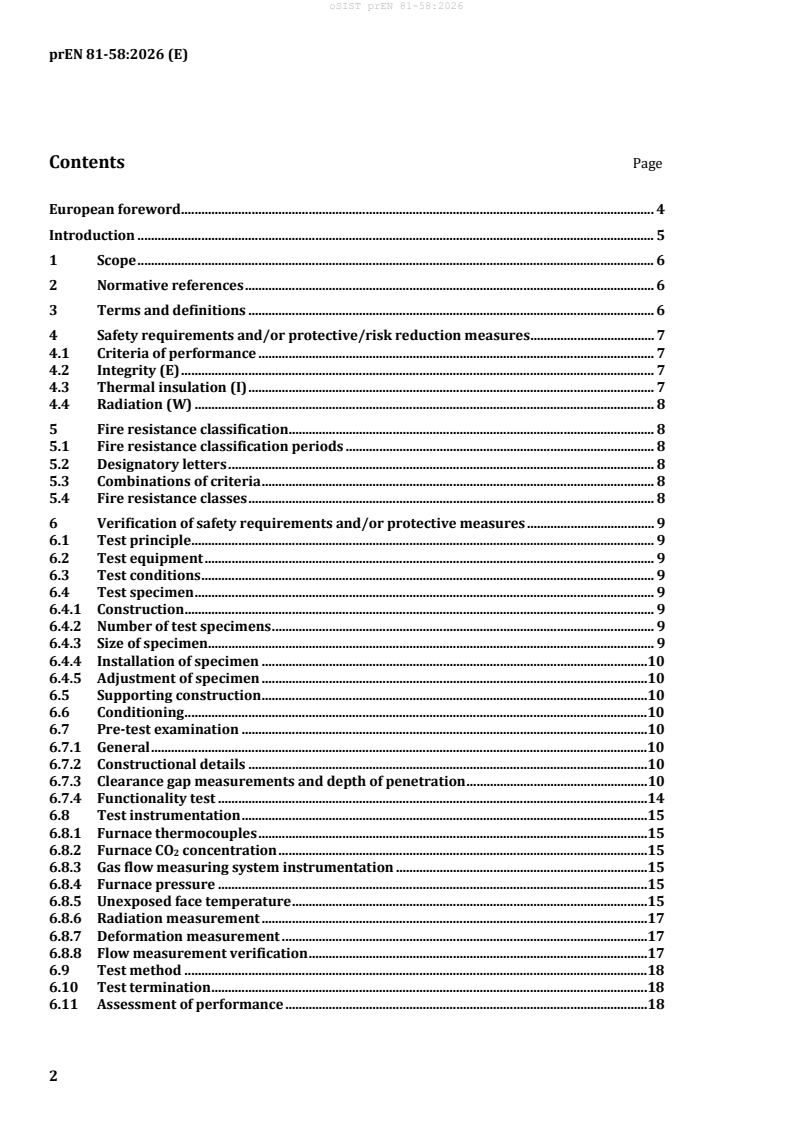
Contents Page
European foreword . 4
Introduction . 5
1 Scope . 6
2 Normative references . 6
3 Terms and definitions . 6
4 Safety requirements and/or protective/risk reduction measures . 7
4.1 Criteria of performance . 7
4.2 Integrity (E) . 7
4.3 Thermal insulation (I) . 7
4.4 Radiation (W) . 8
5 Fire resistance classification . 8
5.1 Fire resistance classification periods . 8
5.2 Designatory letters . 8
5.3 Combinations of criteria . 8
5.4 Fire resistance classes . 8
6 Verification of safety requirements and/or protective measures . 9
6.1 Test principle . 9
6.2 Test equipment . 9
6.3 Test conditions . 9
6.4 Test specimen . 9
6.4.1 Construction . 9
6.4.2 Number of test specimens . 9
6.4.3 Size of specimen . 9
6.4.4 Installation of specimen .10
6.4.5 Adjustment of specimen .10
6.5 Supporting construction .10
6.6 Conditioning .10
6.7 Pre-test examination .10
6.7.1 General .10
6.7.2 Constructional details .10
6.7.3 Clearance gap measurements and depth of penetration .10
6.7.4 Functionality test .14
6.8 Test instrumentation .15
6.8.1 Furnace thermocouples .15
6.8.2 Furnace CO concentration .15
6.8.3 Gas flow measuring system instrumentation .15
6.8.4 Furnace pressure .15
6.8.5 Unexposed face temperature .15
6.8.6 Radiation measurement .17
6.8.7 Deformation measurement .17
6.8.8 Flow measurement verification .17
6.9 Test method .18
6.10 Test termination .18
6.11 Assessment of performance .18
6.12 Field of direct application. 19
6.13 Test report . 19
7 Information for use . 19
8 Marking . 20
Annex A (normative) Description of the canopy and measuring system . 21
Annex B (normative) Standard supporting construction . 24
Annex C (informative) Landing door building interface definition . 25
Annex D (normative) Verification method for leakage rate measurement . 34
Annex E (normative) Calculation of leakage rate . 37
E.1 Calculation of leakage rate when measuring according to EN ISO 5167-1:2022 with
an orifice plate . 37
E.2 Correction based on flow measurement verification . 38
E.3 Correction based on pressure variation (pressure correction) . 38
E.4 Interpreting the leakage rate curve . 38
Annex F (normative) Extrapolation rule for the leakage rate . 39
Annex G (informative) Product fire performance report (assessment) . 41
G.1 General . 41
G.2 Content and format of fire classification report . 41
G.3 Criteria of performance . 41
G.4 Application of the test results to product variants . 41
Annex H (normative) Data label . 43
Annex ZA (informative) Relationship between this European Standard and the essential
requirements of Directive 2014/33/EU aimed to be covered . 44
Bibliography . 46
European foreword
This document (prEN 81-58:2026) has been prepared by Technical Committee CEN/TC 10 “Lifts,
escalators and moving walks”, the secretariat of which is held by AFNOR.
This document is currently submitted to the CEN Enquiry.
This document will supersede EN 81-58:2022.
In comparison with the previous edition, the following significant changes have been made:
— verifiability of the requirements improved;
— Clause 7 modified;
— new Clause 8 about marking added;
— new Annex C added;
— former Annex C to Annex G has been renumbered to Annex D to Annex H;
— Annex D (former Annex C) text editorially clarified and new Figure D.1 added;
— Annex ZA revised and new Table ZA.1.3 added.
Fire resistance classifications obtained with the previous edition of this document are not affected by the
changes introduced in this edition.
This document is intended to be used in conjunction with prEN ISO 8100-1:2023, which gives the basic
requirements for passenger and goods passenger lifts.
This document is part of the EN 81 series of standards.
This document has been prepared under a standardization request addressed to CEN by the European
Commission. The Standing Committee of the EFTA States subsequently approves these requests for its
Member States.
For the relationship with EU Legislation, see informative Annex ZA, which is an integral part of this
document.
Introduction
This document is a type-C standard as stated in EN ISO 12100:2010.
This document is of relevance, in particular, for the following stakeholder groups representing the market
players with regard to machinery safety:
— machine manufacturers (small, medium and large enterprises);
— health and safety bodies (regulators, accident prevention organizations, market surveillance, etc.).
Others can be affected by the level of machinery safety achieved with the means of the document by the
above-mentioned stakeholder groups:
— machine users/employers (small, medium and large enterprises);
— machine users/employees (e.g. trade unions, organizations for people with special needs);
— service providers, e.g. for maintenance (small, medium and large enterprises);
— consumers (in case of machinery intended for use by consumers).
The above-mentioned stakeholder groups have been given the possibility to participate in the drafting
process of this document.
The machinery concerned and the extent to which hazards, hazardous situations or hazardous events are
covered are indicated in the Scope of this document.
When requirements of this type-C standard are different from those which are stated in type-A or type-B
standards, the requirements of this type-C standard take precedence over the requirements of the other
standards for machines that have been designed and built according to the requirements of this type-C
standard.
Landing doors act as fire barriers against the transfer of a fire via the lift well. This document specifies
requirements for this purpose. It follows the general principle of EN 1363-1:2020 and where appropriate
the procedure of EN 1634-1:2014+A1:2018. Additionally, a tracer gas technique for establishing the
integrity of a landing door is used.
1 Scope
This document defines the fire resistance test and requirements for landing doors which are intended to
provide a barrier to the spread of fire from the landing side and via the lift well in buildings for a period
of time classified in this document. The fire resistance requirements are expressed in terms of integrity
(E), insulation (EI) and radiation (EW).
It is applicable to landing doors installed in the lift well openings at landings and used as means of access
to lift car.
It also specifies the method of testing and classification of fire resistance of landing doors. The test
method is only valid for furnaces where the door is mounted in a vertical position. The test method
specifies the measurement of integrity and if required the measurement of radiation and thermal
insulation.
This document refers to CO as means of tracing the propagation of fire. The document does not cover
hazards due to emission of gases.
This document is not applicable to landing doors which are installed before the date of its publication.
2 Normative references
The following documents are referred to in the text in such a way that some or all of their content
constitutes requirements of this document. For dated references, only the edition cited applies. For
undated references, the latest edition of the referenced document (including any amendments) applies.
EN 1363-1:2020, Fire resistance tests — Part 1: General requirements
EN 1363-2:1999, Fire resistance tests — Part 2: Alternative and additional procedures
EN 1634-1:2014+A1:2018, Fire resistance and smoke control tests for door and shutter assemblies,
openable windows and elements of building hardware — Part 1: Fire resistance test for door and shutter
assemblies and openable windows
prEN ISO 8100-1:2023, Lifts for the transport of persons and goods — Part 1: Safety rules for the
construction and installation of passenger and goods passenger lifts (ISO/DIS 8100-1:2023)
EN ISO 5167-1:2022, Measurement of fluid flow by means of pressure differential devices inserted in
circular cross-section conduits running full — Part 1: General principles and requirements (ISO 5167-
1:2022)
EN ISO 12100:2010, Safety of machinery — General principles for design — Risk assessment and risk
reduction (ISO 12100:2010)
ISO 9705-1:2016, Reaction to fire tests — Room corner test for wall and ceiling lining products — Part 1:
Test method for a small room configuration
3 Terms and definitions
For the purposes of this document, the terms and definitions given in prEN ISO 8100-1:2023,
EN ISO 12100:2010, EN 1363-1:2020 and the following apply.
ISO and IEC maintain terminology databases for use in standardization at the following addresses:
— ISO Online browsing platform: available at https://www.iso.org/obp
— IEC Electropedia: available at https://www.electropedia.org/
3.1
landing door
door installed in the structural opening at a landing to separate the landing from the well and used as
means of access to lift car
Note 1 to entry: In this document landing door is an assembly closing the structural opening between the landing
and the lift well including door panels, the frame and the door locking device.
3.2
door opening
width of the clear opening allowing free passage through a fully open landing door
3.3
supporting construction
construction provided in the opening of the test frame or the furnace front in order to accommodate the
test specimen
3.4
leakage rate
total flow rate of hot gases passing through gaps of the door assembly, due to overpressure on the landing
side
4 Safety requirements and/or protective/risk reduction measures
4.1 Criteria of performance
Landing doors shall comply with the safety requirements of this clause. In addition, the landing doors
shall be designed according to the principles of EN ISO 12100:2010 for relevant but not significant
hazards which are not dealt with by this document.
The criteria of integrity performance of landing doors is the ability to remain in place as a fire barrier,
ability to control the leakage of hot gases from the landing side to the lift well (E) and to satisfy any
additional criteria for insulation (I) and radiation (W) which can be specified.
Landing door shall withstand fire exposure from the landing side and prevent the entry of a fire into the
lift well for a period of time classified as per 5.1.
The fire resistance performance of the landing door shall be expressed in minutes with criteria for
integrity (E), insulation (I) and/or radiation (W) according to 4.2, 4.3 and 4.4.
4.2 Integrity (E)
The main requirement for lift door fire resistance is the integrity. The criteria is following:
— no sustained flaming in well side for more than 10 s at any time;
— the leakage rate per meter width of the door opening does not exceed 3,0 m /(min·m) after 14 min
fire.
4.3 Thermal insulation (I)
The average surface temperature rise of the lift door shall not exceed 140 K for a period of time classified
as per 5.1.
For door panel width, over panel height and/or side panel width greater than 300 mm, the maximum
temperature rise on shall not exceed 180 K for a period of time classified as per 5.1.
For over panel height and/or side panel width greater than 100 mm, but equal or less than 300 mm, the
maximum temperature rise of these members shall not exceed 360 K for a period of time classified as per
5.1.
4.4 Radiation (W)
The radiation shall not exceed the value of 15,0 kW/m for a period of time classified as per 5.1, measured
as specified in EN 1363-2:1999, Clause 8.
5 Fire resistance classification
5.1 Fire resistance classification periods
The fire resistance class is expressed as a combination of criteria's given in 4.1 and 5.3 and period of time
in minutes. Period of time shall be rounded down to the nearest fire classification period hereafter:
15 min, 20 min, 30 min, 45 min, 60 min, 90 min or 120 min. See Table 1.
5.2 Designatory letters
The following designatory letters shall be used for the fire classification of landing doors:
— E for integrity;
— I for insulation;
— W for radiation.
5.3 Combinations of criteria
The fire resistance classes shall be expressed as follows:
— E tt : tt being the fire classification period during which the criterion for integrity is
satisfied; and/or
— EI tt : tt being the fire classification period during which the criteria for integrity and
insulation are satisfied; and/or
— EW tt : tt being the fire classification period during which the criteria for integrity and
radiation are satisfied.
When criteria are combined, the time declared shall be that of the criterion having the shortest time.
EXAMPLE A landing door with E: 47 min, W: 25 min and I: 18 min is classified E 45 and/or EW 20 and/or EI 15.
5.4 Fire resistance classes
Only the fire resistance classes given in Table 1 shall be used.
Table 1 — Fire resistance classes (in minutes)
E 15 20 30 45 60 90 120
EI 15 20 30 45 60 90 120
EW 20 30 60
6 Verification of safety requirements and/or protective measures
6.1 Test principle
The test consists in exposing the landing side of a landing door to the heating conditions specified in
EN 1363-1:2020 for the period for which the door shall be assessed for its fire resistance. During the test,
positive pressure exists over the whole height of the door on the exposed side, inducing the leakage of
furnace gases to the unheated side. A canopy is provided on the unexposed side which collects the leaked
gases and a suction fan draws these through a duct provided with a system for measuring the volume
flow (see Annex A). The concentration of CO , used as a tracer gas, is measured in the furnace and at the
airflow measuring point, and by monitoring the gas flow rate and its temperature it is possible to calculate
the leakage rate of hot gases through the test door. The method gives a record of the hot gas leakage as a
function of time which is corrected for normal conditions. This provides a basis for assessing the ability
of the door to act as an effective fire barrier.
NOTE ISO 3008-2:2017 has the same test principle as EN 81-58 based on CO measurement.
6.2 Test equipment
6.2.1 The test furnace shall be as described in EN 1363-1:2020.
6.2.2 The canopy shall be as specified in Annex A.
6.2.3 The measuring system for leakage rate shall be as specified in Annex A.
6.3 Test conditions
6.3.1 The furnace shall be controlled to follow the temperature/time curve as specified in
EN 1363-1:2020.
6.3.2 The furnace shall maintain positive pressure on the exposed side over the whole height of the
specimen such that the pressure at the sill level is in the range of (2 + 8,5 × H ) ± 2 Pa where H is the
sill sill
vertical distance (in metres) between the sill level and the landing floor level.
NOTE In some applications such as service lifts or dumbwaiters, the sill level is higher than the landing floor
level.
6.4 Test specimen
6.4.1 Construction
The test specimen shall be according to the technical specification of the door assembly.
6.4.2 Number of test specimens
As information is required when the door is exposed to heating from the landing side only, one specimen
shall be tested.
6.4.3 Size of specimen
The specimen shall be full size or the maximum size that can be accommodated in the furnace. The
reference size of the front opening of the furnace is 3 m × 3 m. In order to expose a required minimum
width of 200 mm of supporting construction for a 3 m × 3 m furnace, the opening in the supporting
construction is restricted to 2,6 m × 2,8 m (width × height).
6.4.4 Installation of specimen
The specimen shall be mounted in a supporting construction having at least the fire resistance of the
target classification. The supporting construction shall be built first within the test frame leaving an
aperture of the specified size. The width of the supporting construction on the two vertical sides and the
top shall be not less than 200 mm.
The design of the connection between the door and the supporting construction, including any materials
used for the fixation and the sealing, shall be as stated in the information for use on the type of the
supporting construction used for the test. The position of the door assembly in relation to the supporting
construction shall be according to the information for use of the door.
6.4.5 Adjustment of specimen
The specimen shall be adjusted so that the clearances between door panels, or between panels and
uprights, lintels or sills at the beginning of test shall correspond to those specified in the information for
use.
6.5 Supporting construction
For the field of direct application test results (see 6.12), the landing doors shall be erected in the standard
supporting construction as described in Annex B.
6.6 Conditioning
The test specimen, as well as the supporting construction and any sealing materials used, shall be
conditioned in accordance with the requirements of EN 1363-1:2020, 8.2, and EN 1634-1:2014+A1:2018,
8.1 and Annex A. No special conditioning procedures are required where the specimen is constructed
primarily from non-hygroscopic materials.
6.7 Pre-test examination
6.7.1 General
Before the test, it shall be verified that the constructional details and clearance gap measurements and
depth of penetration conform to the specifications.
6.7.2 Constructional details
A full detailed specification of the test specimen shall be provided. The verification of the test specimen
shall be carried out in accordance with the guidance given in EN 1363-1:2020, 6.5.
6.7.3 Clearance gap measurements and depth of penetration
The clearances between the moving components and the fixed parts of the door assembly shall be
measured prior to the test. Measurements shall be made to adequately describe the nature of the gaps
and there shall be a minimum of three measurements along each side or edge. The gap sizes shall be
described to an accuracy of ±0,5 mm. Figure 1 to Figure 4 shows examples of different types of landing
doors and indicate the gaps (g) which shall be recorded. The depth of penetration and safety guides (if
any) shall be measured and recorded.
Key
g gap measurement location
d deformation measurement location
H clear height
W clear width
Figure 1 — Clearance gaps (g) and deformation measurements (d) – Single panel swing door
Key
g gap measurement location
d deformation measurement location
H clear height
W clear width
Figure 2 — Clearance gaps (g) and deformation measurements (d) – Double panel telescopic
door
Key
g gap measurement location
d deformation measurement location
H clear height
W clear width
Figure 3 — Clearance gaps (g) and deformation measurements (d) – Central opening door
Key
g gap measurement location
d deformation measurement location
H clear height
W clear width
Figure 4 — Clearance gaps (g) and deformation measurements (d) – Multi-panel sliding door
6.7.4 Functionality test
Prior to the test, the door shall be checked for functionality by opening and closing to the maximum
possible, with a minimum opening of width 150 mm.
6.8 Test instrumentation
6.8.1 Furnace thermocouples
The nature, number and the location of furnace thermocouples shall be in agreement with the
specification given in EN 1634-1:2014+A1:2018, 9.1.1, for tests on doors.
6.8.2 Furnace CO concentration
There shall be provision for continuous monitoring of CO concentration in the furnace during the test.
The instrument shall have a range of 0 % to 20 % CO concentration and the calibration shall be
established prior to the test by using a sample of known concentration. The accuracy of measurement for
, i.e. the instruments and the measurement system shall be within ±0,2 (% CO ).
CO2 2
6.8.3 Gas flow measuring system instrumentation
One or more thermocouples shall be provided close to the gas flow measuring system, within a distance
of 100 mm, to measure the temperature of the exhaust gases drawn from the canopy.
Gas sample shall be drawn from the vicinity of the measuring system to monitor continuously the CO
concentration. The instrument is expected to have a range of 0 % to 2,5 % and the accuracy of
measurement shall be within ±0,05 (% CO ), it shall be checked prior to the test by using a sample of
known concentration of CO in the range of 1 % to 2,5 %.
Provision shall be made at the gas flow measuring system to monitor the pressure differential of the flow
measuring device and the absolute pressure in relation to the ambient conditions. The range of the
instrument shall be compatible with the flow rate generated by the suction fan.
NOTE Between the sampling probes and the cooling equipment the gases are transferred through a heated line
to prevent condensation. It is advised to use a time shift when the data are measured to accommodate the response
time between the CO data and temperature and pressure data (see Annex E, E.1).
The accuracy of determination of leakage rate shall be within 10 %.
6.8.4 Furnace pressure
Furnace pressure shall be measured continuously at a minimum of two locations over the height of the
furnace to ensure that the pressure conforms to the specification in 6.3.2.
6.8.5 Unexposed face temperature
6.8.5.1 General
This clause specifies additional details for testing insulating capacity of landing doors.
Where compliance with the insulation criteria is required to be evaluated, thermocouples of the type
specified in EN 1363-1:2020 shall be attached to the unexposed face as indicated below for the purpose
of obtaining the average and maximum surface temperatures. General principles for the attachment of
thermocouples given in EN 1363-1:2020 shall apply.
The dimensions given in 6.8.5.2 and 6.8.5.3 shall be taken from landing side.
Where no evaluation against the insulation criteria is required of the door, or any part thereof, no
temperature measurements are required.
6.8.5.2 Position of the thermocouples to determine the average temperature
6.8.5.2.1 Door panel(s)
For door panel(s) width greater than 400 mm, five thermocouples shall be positioned per door panel, one
to the centre of the door panel and one to the centre of each quarter section.
For door panel(s) width greater than 300 mm but less than 400 mm, the thermocouples at the centre of
quarter sections shall be repositioned horizontally so that they are 100 mm away from the vertical edges
of the panel.
For door panel(s) width less than 300 mm, three thermocouples shall be positioned per door panel, one
to the centre of the door panel and one to the centre of upper and lower half section.
The position of the thermocouples may be adjusted from the positions defined above to a maximum
distance of 50 mm to avoid the measurement directly from top of a joint, stiffener or a through
component. In adjusting the position, the minimum distance of 100 mm from the edges of the panel shall
be maintained.
When the total area of a single part of the door assembly is equal or smaller than 0,2 m , it shall be
disregarded for the purpose of ascertaining the mean unexposed face temperature.
6.8.5.2.2 Door frame
The door frame of landing doors can include the following parts; the horizontal top member which may
include the door mechanism (on sliding and folding doors), two vertical members and an over panel. No
thermocouples shall be placed on the horizontal top member including the door mechanism.
The side panels and over panels more than 300 mm width or height shall be provided with one
thermocouple for each square meter or part thereof, subject to a minimum of two thermocouples.
These thermocouples shall not be located closer than 100 mm to any joint, stiffener or through
component, nor closer than 100 mm to the edge of the side/over panel.
If the height of the over panels or width of the side panels are equal or smaller than 300 mm no
thermocouples are required for determining the mean temperature rise.
The average insulation performance of each area shall be determined.
6.8.5.3 Position of the thermocouples to determine the maximum temperature
6.8.5.3.1 Door panel(s)
The maximum temperature shall be determined from the thermocouples fixed to determine the mean
temperature rise (as given in 6.8.5.2.1).
6.8.5.3.2 Door frame
The maximum temperature shall be determined from the thermocouples fixed to determine the mean
temperature rise (as given in 6.8.5.2.2). For side panel width and over panel height greater than 300 mm,
these shall be provided with one thermocouple for each square meter or part thereof, subject to a
minimum of two thermocouples. For side panel width and over panel height between 300 mm and
100 mm only one thermocouple shall be fixed at the centre of each member. For side panel width and
over panel height less than or equal 100 mm no temperature measurements are required.
6.8.6 Radiation measurement
If there is a requirement for the specimen door to satisfy the radiation criteria, appropriate
instrumentation, as described in EN 1363-2:1999 shall be provided to measure radiation from the
unexposed face. In order to allow the location of the radiometer at 1 m from the exposed face, as specified
in EN 1363-2:1999, an adapted aperture may need to be cut in the curtain.
6.8.7 Deformation measurement
If requested, the deformation shall be measured and recorded at specified locations, see locations “d” in
Figure 1 to Figure 4.
In the case of a swing door the deformation measurement is performed at (100 ± 5) mm from the top and
the bottom of the door and in the middle of the door height (see Figure 1).
In the case of door configurations according to Figures 2 and 3 the deformation measurements are
performed at
— in the vertical direction (100 ± 5) mm from the bottom of the door panels, and in the middle of the
door panels height, and
— in the horizontal direction at the maximum 15 mm distance from the vertical edges of the door
panels.
In the case of multi-panel sliding door according to Figure 4 the deformation measurements are
performed at
— in the vertical direction (100 ± 5) mm from the top and the bottom, and in the middle of the clear
height (H) of the door, and
— in the horizontal direction at the maximum 15 mm distance from the vertical edges of the door panels
and in the middle of the clear width (W) of the door.
Precautions shall be taken that the insulation material is not affected during the test.
The minimum distance between deformation measurement point and thermocouple measurement point
shall be 50 mm. In case the distance is less than 50 mm, the deformation measurement points shall be
moved so, that the distance is (55 ± 5) mm.
If deformation is measured by a cable through the canopy, diameter of holes in the canopy shall be no
more than 1 mm larger than diameter of the cable.
Deformation measurements (d) shall be recorded if the panel or side frame width is greater than or equal
to 300 mm.
NOTE In Figures 1 to 4, the width of the frame is less than 300 mm.
6.8.8 Flow measurement verification
The reliability and the adequacy of the leakage rate measurement system shall be established prior to the
start of the furnace test according to Annex D using the CO calibration burner shown in Figure D.1 and
Figure D.2.
Provisions shall be made during the verification test to protect the landing door against radiation or
heating by the CO calibration burner.
Action shall be taken to reduce any difference between the theoretical and measured flow rate and CO
concentration of more than 10 %. If the difference is lower than 10 % the leakage rate of the test shall be
corrected for this difference using Formula (D.1).
6.9 Test method
The test specimen shall be located in front of the furnace to provide a sealed furnace chamber. The
accuracy of the CO measuring system checked and the flow measurement verification of 6.8.8
undertaken.
On satisfactory completion of this check the exhaust fan shall remain in operation and the furnace ignited.
It shall be controlled to follow the standard heating curve of EN 1363-1:2020.
At the commencement of the test, the plate thermometers shall be 100 mm from the nearest plane of the
exposed face of the test construction.
The data from the flow measuring instrumentation and the CO concentration in the furnace shall be
recorded for analysis during the test, including the flow measurement verification (6.8.8). If the
unexposed face temperatures, radiation from this face and door deformation is being measured, these
data shall also be recorded. The time of the occurrence of flaming, and its duration shall be recorded.
Observations shall be made of the general behaviour of the door specimen during the course of the test
and notes made concerning deformation, opening of the gaps, melting or softening of materials, charring
of surface finishes, etc. If quantities of smoke are emitted from the unexposed face this shall be noted.
6.10 Test termination
The test shall be terminated according to EN 1363-1:2020, 10.5.
6.11 Assessment of performance
6.11.1 The performance of the specimen door shall be expressed in terms of integrity (E), insulation (I)
and radiation (W) given in Clause 4.
6.11.2 The leakage rate through the door shall be corrected to normal temperature and pressure
conditions and expressed as m /min, in accordance with Annex E. The limit values for acceptable leakage
rates are given in 4.2.
NOTE Transient peaks in the observed leakage rate curve can be ignored if they are due to fluctuations in the
measuring chain and do not correspond to any real increase in leakage rate as a result of increasing gaps or further
dislocations in the specimen.
The presence of combustible materials (coatings, paint) which pyrolyze at a given temperature after a
certain time may give rise to a temporary increase in the observed CO -production which does not
correspond to an increase of the leakage rate and shall therefore be disregarded for the data used for
classification.
6.11.3 The insulation of the door, where required to be established, shall be judged on the basis of either
temperature rise of the unexposed face or radiation emitted from this face. The appropriate criteria are
given in 4.3 and 4.4.
6.12 Field of direct application
Test results fulfilling with the criteria given in 6.11 in terms of Integrity (E), and Thermal Insulation (I)
shall be considered applicable to doors of sizes different from those of the test specimens, all other
constructional details being the same, within the following limitations:
1) a door with lower height than the tested specimen;
2) a door with a door opening or an opening width in the wall equal to the one tested within a range
of ±30 %;
3) a door with greater height of up to 15 %: in that case the corrected leakage rate shall be extrapolated
according to Annex F.
The limitations given above may be applied together.
If tested in a standard supporting construction, the results are valid for all constructions with a density
equal to or greater than 600 kg/m and thickness equal to or greater than 100 mm.
The results of doors tested with a supporting construction different from the standard supporting
constructions as described in Annex B are restricted to that specific supporting construction.
6.13 Test report
The test report shall provide the general information required according to the relevant provisions of
EN 1363-1:2020, 12.1 and EN 1634-1:2014+A1:2018, Clause 12 (excluding items a) and g)). In addition,
the following data shall be provided:
a) the leakage rate through the door during the course of the test;
b) the time and duration of the occurrence of flaming;
c) the deformation of the door, as a function of time, if requested (see 6.8.7);
d) radiation emission when measured, as a function of time;
e) unexposed face temperature curves when measured, as a function of time;
f) the fire classification of the door and the field of application of this fire classification (see Annex G).
7 Information for use
The following information shall be provided:
— instructions for installation of fire rated doors:
— details of the landing door positioning in relation to the supporting construction,
— details of required brackets above, below and to the sides of the landing door, as applicable,
— details of the fixing method of the brackets to the landing door and to the supporting
...