

EN 15876-1:2010+A1:2012
(Main + Amendment)Electronic fee collection - Evaluation of on-board and roadside equipment for conformity to EN 15509 - Part 1: Test suite structure and test purposes
- Abstract
This European Standard contains the Test Suite Structure (TSS) and Test Purposes (TP) to evaluate the conformity of On Board Units (OBU) and Roadside Equipment (RSE) to EN 15509.
The objective of this document is to provide a basis for conformance tests for DSRC equipment (on board units and roadside units) to enable interoperability between different equipment supplied by different manufacturers.
- Status
- Withdrawn
- Publication Date
- 17-Apr-2012
- Withdrawal Date
- 06-Oct-2026
- Technical Committee
- CEN/TC 278 - Road transport and traffic telematics
- Drafting Committee
- CEN/TC 278/WG 1 - Electronic fee collection and access control (EFC)
- Current Stage
- 9960 - Withdrawal effective - Withdrawal
- Start Date
- 26-Oct-2016
- Completion Date
- 07-Oct-2026



Relations
- Effective Date
- 15-Feb-2012
- Effective Date
- 02-Nov-2016
- Effective Date
- 28-Jan-2026
- Effective Date
- 28-Jan-2026
- Effective Date
- 28-Jan-2026
- Effective Date
- 28-Jan-2026
- Effective Date
- 28-Jan-2026
- Effective Date
- 28-Jan-2026
Get Certified
Connect with accredited certification bodies for this standard

BSI Group
BSI (British Standards Institution) is the business standards company that helps organizations make excellence a habit.

NYCE
Mexican standards and certification body.
Sponsored listings
Frequently Asked Questions
EN 15876-1:2010+A1:2012 is a standard published by the European Committee for Standardization (CEN). Its full title is "Electronic fee collection - Evaluation of on-board and roadside equipment for conformity to EN 15509 - Part 1: Test suite structure and test purposes". This standard covers: This European Standard contains the Test Suite Structure (TSS) and Test Purposes (TP) to evaluate the conformity of On Board Units (OBU) and Roadside Equipment (RSE) to EN 15509. The objective of this document is to provide a basis for conformance tests for DSRC equipment (on board units and roadside units) to enable interoperability between different equipment supplied by different manufacturers.
This European Standard contains the Test Suite Structure (TSS) and Test Purposes (TP) to evaluate the conformity of On Board Units (OBU) and Roadside Equipment (RSE) to EN 15509. The objective of this document is to provide a basis for conformance tests for DSRC equipment (on board units and roadside units) to enable interoperability between different equipment supplied by different manufacturers.
EN 15876-1:2010+A1:2012 is classified under the following ICS (International Classification for Standards) categories: 35.240.60 - IT applications in transport. The ICS classification helps identify the subject area and facilitates finding related standards.
EN 15876-1:2010+A1:2012 has the following relationships with other standards: It is inter standard links to EN 15876-1:2010, EN 15876-1:2016, EN ISO 14816:2005, EN ISO 14906:2004, CEN ISO/TS 14907-2:2006, EN ISO 3166-1:2020, EN 15509:2007, CEN ISO/TS 11133-2:2003. Understanding these relationships helps ensure you are using the most current and applicable version of the standard.
EN 15876-1:2010+A1:2012 is associated with the following European legislation: EU Directives/Regulations: 2004/54/EC; Standardization Mandates: M/338. When a standard is cited in the Official Journal of the European Union, products manufactured in conformity with it benefit from a presumption of conformity with the essential requirements of the corresponding EU directive or regulation.
EN 15876-1:2010+A1:2012 is available in PDF format for immediate download after purchase. The document can be added to your cart and obtained through the secure checkout process. Digital delivery ensures instant access to the complete standard document.
Standards Content (Sample)
2003-01.Slovenski inštitut za standardizacijo. Razmnoževanje celote ali delov tega standarda ni dovoljeno.Elektronsko pobiranje pristojbin - Ugotavljanje skladnosti opreme v vozilu in v obcestni napravi s standardom EN 15509 - 1. del: Zgradba preskuševalnega niza in namen preskušanjaElektronische Gebührenerhebung - Konformitätsprüfung von Fahrzeuggeräten und straßenseitigen Einrichtungen mit der EN 15509 - Teil 1: Prüfreihenstruktur und PrüfzweckPerception de télépéage - Évaluation de conformité de l'équipement embarqué et de l'équipement au sol à l'EN 15509 - Partie 1: Structure des suites de tests et intention des testsElectronic fee collection - Evaluation of on-board and roadside equipment for conformity to EN 15509 - Part 1: Test suite structure and test purposes35.240.60Uporabniške rešitve IT v transportu in trgoviniIT applications in transport and trade03.220.20Cestni transportRoad transportICS:Ta slovenski standard je istoveten z:EN 15876-1:2010+A1:2012SIST EN 15876-1:2010+A1:2012en,fr,de01-junij-2012SIST EN 15876-1:2010+A1:2012SLOVENSKI
STANDARD
EUROPEAN STANDARD NORME EUROPÉENNE EUROPÄISCHE NORM
EN 15876-1:2010+A1
April 2012 ICS 35.240.60 Supersedes EN 15876-1:2010English Version
Electronic fee collection - Evaluation of on-board and roadside equipment for conformity to EN 15509 - Part 1: Test suite structure and test purposes
Perception de télépéage - Évaluation de conformité de l'équipement embarqué et de l'équipement au sol à
l'EN 15509 - Partie 1: Structure des suites de tests et intention des tests
Elektronische Gebührenerhebung - Konformitätsprüfung von Fahrzeuggeräten und straßenseitigen Einrichtungen mit der EN 15509 - Teil 1: Prüfreihenstruktur und Prüfzweck This European Standard was approved by CEN on 4 March 2010 and includes Amendment 1 approved by CEN on 4 March 2012.
CEN members are bound to comply with the CEN/CENELEC Internal Regulations which stipulate the conditions for giving this European Standard the status of a national standard without any alteration. Up-to-date lists and bibliographical references concerning such national standards may be obtained on application to the CEN-CENELEC Management Centre or to any CEN member.
This European Standard exists in three official versions (English, French, German). A version in any other language made by translation under the responsibility of a CEN member into its own language and notified to the CEN-CENELEC Management Centre has the same status as the official versions.
CEN members are the national standards bodies of Austria, Belgium, Bulgaria, Croatia, Cyprus, Czech Republic, Denmark, Estonia, Finland, France, Germany, Greece, Hungary, Iceland, Ireland, Italy, Latvia, Lithuania, Luxembourg, Malta, Netherlands, Norway, Poland, Portugal, Romania, Slovakia, Slovenia, Spain, Sweden, Switzerland, Turkey and United Kingdom.
EUROPEAN COMMITTEE FOR STANDARDIZATION
COMITÉ EUROPÉEN DE NORMALISATION EUROPÄISCHES KOMITEE FÜR NORMUNG
Management Centre:
Avenue Marnix 17,
B-1000 Brussels © 2012 CEN All rights of exploitation in any form and by any means reserved worldwide for CEN national Members. Ref. No. EN 15876-1:2010+A1:2012: ESIST EN 15876-1:2010+A1:2012
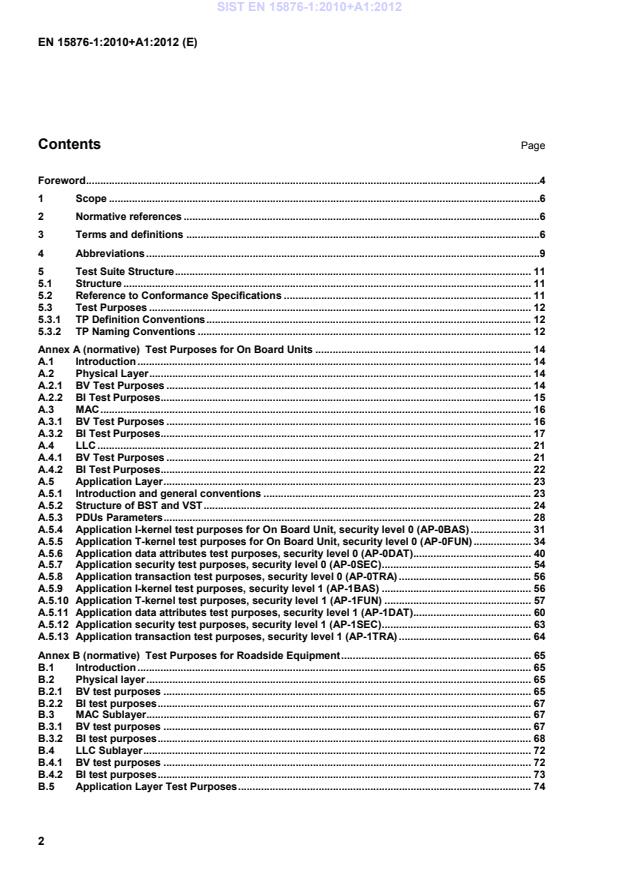
Test Purposes for On Board Units . 14A.1Introduction . 14A.2Physical Layer . 14A.2.1BV Test Purposes . 14A.2.2BI Test Purposes. 15A.3MAC . 16A.3.1BV Test Purposes . 16A.3.2BI Test Purposes. 17A.4LLC . 21A.4.1BV Test Purposes . 21A.4.2BI Test Purposes. 22A.5Application Layer . 23A.5.1Introduction and general conventions . 23A.5.2Structure of BST and VST . 24A.5.3PDUs Parameters . 28A.5.4Application I-kernel test purposes for On Board Unit, security level 0 (AP-0BAS) . 31A.5.5Application T-kernel test purposes for On Board Unit, security level 0 (AP-0FUN) . 34A.5.6Application data attributes test purposes, security level 0 (AP-0DAT). 40A.5.7Application security test purposes, security level 0 (AP-0SEC) . 54A.5.8Application transaction test purposes, security level 0 (AP-0TRA) . 56A.5.9Application I-kernel test purposes, security level 1 (AP-1BAS) . 56A.5.10Application T-kernel test purposes, security level 1 (AP-1FUN) . 57A.5.11Application data attributes test purposes, security level 1 (AP-1DAT). 60A.5.12Application security test purposes, security level 1 (AP-1SEC) . 63A.5.13Application transaction test purposes, security level 1 (AP-1TRA) . 64Annex B (normative)
Test Purposes for Roadside Equipment . 65B.1Introduction . 65B.2Physical layer . 65B.2.1BV test purposes . 65B.2.2BI test purposes . 67B.3MAC Sublayer . 67B.3.1BV test purposes . 67B.3.2BI test purposes . 68B.4LLC Sublayer . 72B.4.1BV test purposes . 72B.4.2BI test purposes . 73B.5Application Layer Test Purposes . 74SIST EN 15876-1:2010+A1:2012
PCTR Proforma for On Board Units . 95C.1Identification summary . 95C.1.1Protocol conformance test report . 95C.1.2DUT identification . 95C.1.3Testing environment . 96C.1.4Limits and reservation . 96C.1.5Comments . 96C.2DUT Conformance status . 97C.3Static conformance summary . 97C.4Dynamic conformance summary . 97C.5Static conformance review report . 98C.6Test campaign report . 99C.7Observations . 103Annex D (normative)
PCTR Proforma for Roadside Equipment . 104D.1Identification summary . 104D.1.1Protocol conformance test report . 104D.1.2DUT identification . 104D.1.3Testing environment . 105D.1.4Limits and reservation . 105D.1.5Comments . 105D.2DUT Conformance status . 106D.3Static conformance summary . 106D.4Dynamic conformance summary . 106D.5Static conformance review report . 107D.6Test campaign report . 108D.7Observations . 110Bibliography . 111
EN ISO 14906 (a "toolbox" for defining EFC-application transaction) and CEN ISO/TS 14907-2 (EFC application interface conformance tests for On Board Units). However, these standards are only of an enabling nature and do not guarantee unambiguous technical interoperability. Therefore EN 15509, Road transport and traffic telematics
Electronic fee collection
Interoperability application profile for DSRC was developed to support technical interoperability between EFC-systems. This standard defines the test suite structure and the test purposes for conformity evaluation of OBUs and RSE designed for compliance with the requirements set up in EN 15509. A test standard for evaluation of conformity of on-board and roadside equipment is a necessary element for coherent, practical and effective appraisal of products' compliance to EN 15509. This document forms Part 1 of a two-part standard: EN 15876-1, Electronic fee collection
Evaluation of on-board and roadside equipment for conformity to EN 15509
Part 1: Test suite structure and test purposes EN 15876-2, Electronic fee collection
Conformity evaluation of on-board and roadside equipment to EN 15509
Part 2: Abstract test suites Together, the two parts of EN 15876 provide the necessary foundation for implementation of the interoperability requirements as stated in EN 15509:
industry is provided with an easy-to-use toolbox for product assessment; operators can easily assess conformity to EN 15509 and reference to the standard in tendering processes; authorities and joint undertakings may reference to the test standard when stating interoperability requirements; certification organisations are given an effective tool for certification of products. SIST EN 15876-1:2010+A1:2012
The objective of this document is to provide a basis for conformance tests for DSRC equipment (on board units and roadside units) to enable interoperability between different equipment supplied by different manufacturers. 2 Normative references The following referenced documents are indispensable for the application of this document. For dated references, only the edition cited applies. For undated references, the latest edition of the referenced document (including any amendments) applies. EN 15509:2007, Road transport and traffic telematics — Electronic fee collection — Interoperability application profile for DSRC EN ISO 3166-1, Codes for the representation of names of countries and their subdivisions — Part 1: Country codes (ISO 3166-1:2006) EN ISO 14816, Road transport and traffic telematics — Automatic vehicle and equipment identification — Numbering and data structure (ISO 14816:2005) EN ISO 14906:2004, Road transport and traffic telematics — Electronic fee collection — Application interface definition for dedicated short-range communication (ISO 14906:2004) CEN ISO/TS 14907-2:2006, Road transport and traffic telematics — Electronic fee collection — Test procedures for user and fixed equipment — Part 2: Conformance test for the onboard unit application interface (ISO/TS 14907-2:2006) ETSI EN 300 674-1:2004, Electromagnetic compatibility and Radio spectrum Matters (ERM); Road Transport and Traffic Telematics (RTTT); Dedicated Short Range Communication (DSRC) transmission equipment (500 kbit/s / 250 kbit/s) operating in the 5,8 GHz Industrial, Scientific and Medical (ISM) band; Part 1: General characteristics and test methods for Road Side Units (RSU) and On-Board Units (OBU) ETSI TS 102 486-1-2:2008, Intelligent Transport Systems (ITS); Road Transport and Traffic Telematics (RTTT); Test specifications for Dedicated Short Range Communication (DSRC) transmission equipment; Part 1: DSRC data link layer: medium access and logical link control; Sub-Part 2: Test Suite Structure and Test Purposes (TSS&TP) ETSI TS 102 486-2-2:2008, Intelligent Transport Systems (ITS); Road Transport and Traffic Telematics (RTTT); Test specifications for Dedicated Short Range Communication (DSRC) transmission equipment; Part 2: DSRC application layer; Sub-Part 2: Test Suite Structure and Test Purposes (TSS&TP) 3 Terms and definitions For the purposes of this document, the following terms and definitions apply. 3.1 access credentials data that is transferred to on-board equipment (OBE), in order to establish the claimed identity of a roadside equipment (RSE) application process entity
[EN ISO 14906:2004] SIST EN 15876-1:2010+A1:2012
[EN ISO 14906:2004] 3.3 attribute application information formed by one or by a sequence of data elements, and is managed by different actions used for implementation of a transaction
[EN ISO 14906:2004] 3.4 authenticator data appended to, or a cryptographic transformation of, a data unit that allows a recipient of the data unit to prove the source and/or the integrity of the data unit and protect against forgery
[EN ISO 14906:2004] 3.5 channel information transfer path
[EN ISO 14906:2004] 3.6 component logical and physical entity composing an on-board equipment, supporting a specific functionality
[EN ISO 14906:2004] 3.7 contract expression of an agreement between two or more parties concerning the use of the road infrastructure
[EN ISO 14906:2004] 3.8 cryptography discipline which embodies principles, means, and methods for the transformation of data in order to hide its information content, prevent its undetected modification or/and prevent its unauthorised use
[EN ISO 14906:2004] 3.9 data group collection of closely related EFC data attributes which together describe a distinct part of an EFC transaction [EN ISO 14906:2004] 3.10 data integrity property that data has not been altered or destroyed in an unauthorised manner
[EN ISO 14906:2004] 3.12 implementation conformance statement statement made by the supplier of an implementation or system claimed to conform to a given specification, stating which capabilities have been implemented
[EN ISO 14906:2004] 3.13 implementation conformance statement proforma document, in the form of a questionnaire, which when completed for an implementation or system becomes an implementation conformance statement
[CEN ISO/TS 14907-2:2006] 3.14 implementation extra information for testing statement made by the supplier or an implementor of a DUT which contains or references all of the information (in addition to that given in the implementation conformance statement) related to the DUT and its testing environment, which will enable the test laboratory to run an appropriate test suite against the DUT [CEN ISO/TS 14907-2:2006] 3.15 implementation extra information for testing proforma document, in the form of a questionnaire, which when completed for a DUT becomes an implementation extra information for testing
[CEN ISO/TS 14907-2:2006] 3.16 on-board equipment equipment located within the vehicle and supporting the information exchange with the roadside equipment, and which is composed of the on-board unit and other sub-units whose presence have to be considered optional for the execution of a transaction
[EN ISO 14906:2004] 3.17 on-board unit minimum component of an on-board equipment, whose functionality always includes at least the support of the DSRC interface
[EN ISO 14906:2004] 3.18 roadside equipment equipment located at a fixed position along the road transport network, for the purpose of communication and data exchanges with the on-board equipment of passing vehicles
[EN ISO 14906:2004] SIST EN 15876-1:2010+A1:2012
[EN ISO 14906:2004] 3.20 service primitive (communication) elementary communication service provided by the Application layer protocol to the application processes
[EN ISO 14906:2004] NOTE The invocation of a service primitive by an application process implicitly calls upon and uses services offered by the lower protocol layers. 3.21 service provider (EFC) operator that accepts the user's payment means and in return provides a road-use service to the user
[EN ISO 14906:2004] 3.22 session exchange of information and interaction occurring at a specific EFC station between the roadside equipment and the user/vehicle
[EN ISO 14906:2004] 3.23 transaction whole of the exchange of information between the roadside equipment and the on-board equipment necessary for the completion of an EFC operation over the DSRC [EN ISO 14906:2004] 3.24 transaction model functional model describing the general structure of Electronic Payment Fee Collection transactions
[EN ISO 14906:2004] 3.25 tester combination of equipment and processes which is able to perform conformance tests according to this CEN standard 3.26 user entity that uses transport services provided by the Service Provider according to the terms of a contract 4 Abbreviations For the purposes of this document, the following abbreviations apply throughout the document unless otherwise specified. ADU Application Data Unit SIST EN 15876-1:2010+A1:2012
Physical layer tests are to be performed in a radio wave lab. They will not form part of the ATS. 5.2 Reference to Conformance Specifications Conformance to a profile standard implies conformance to the related base standards; hence, a number of test cases for the profile standard are exactly the same as the conformance test cases for the related base standards. Other test cases are derived from the base standards conformance test cases, by applying some restrictions or choices in e.g. the parameters values, according to what is stated in the profile standard. Finally, specific conformance test cases for the profile standard are identified for statements contained in the profile standard, which have no equivalence in the base standards. These latter cases cover for example the security algorithms and functions that are described in the profile standard. This document takes into account already defined test purposes for conformance to the base standards by referencing them, so that: a) For test purposes that are identical to those defined in the base standards conformance test cases (see e.g ETSI TS 102 486-1-2 or ETSI TS 102 486-2-2) a direct reference is reported. For reader's SIST EN 15876-1:2010+A1:2012
TP ID The TP ID is a unique identifier. It shall be specified according to the TP naming conventions defined in the sub-clause below. Title Short description of Test Purpose objective. Reference The reference should contain the references of the subject to be validated by the actual TP (specification reference, clause, paragraph). TP origin Indicates if the TP is identical to a TP defined in another test standard, derived from a TP defined in another test standard, or specific for this standard profile. Initial condition The condition defines in which initial state the DUT has to be to apply the actual TP. Stimulus and expected behaviour Definition of the events the tester performs, and the events that are expected from the DUT to conform to the base specification.
Note that the reference field normally points to the clause of the base standard [EN 15509]. As the same standard contains the Protocol Implementation Conformance Statement proforma, where appropriate a reference to the relevant table of the PICS is given either in this field or in the text introducing the group of Test Purposes. 5.3.2 TP Naming Conventions Each TP is given a unique identification. This unique identification is built up to contain the following string of information: TP///-
TP : to indicate that it is a Test Purpose; : which group among those defined in Table 1 — Test Suite Structure does the TP apply to; : type of DUT (i.e. OBU or RSE); X
: type of testing (i.e. Valid Behaviour tests – BV, or Invalid Behaviour tests – BI); SIST EN 15876-1:2010+A1:2012
PHY Physical layer
MAC MAC sublayer
LLC LLC sublayer
AP-0BAS Application layer – I Kernel support Security level 0
AP-0FUN Application layer – T Kernel support Security level 0
AP-0DAT Application layer – Data attributes support Security Level 0
AP-0SEC Application layer – Security Level 0 support
AP-0TRA Application layer – Transaction support Security level 0
AP-1BAS Application layer – I Kernel support Security level 1
AP-1FUN Application layer – T Kernel support Security level 1
AP-1DAT Application layer – Data attributes support Security Level 1
AP-1SEC Application layer – Security Level 1 support
AP-1TRA Application layer – Transaction support Security level 1
AP-0BAS Application layer – Initialisation phase support Security level 0
AP-0GET Application layer - GET-rq PDU test purposes, security level 0
AP-0SET Application layer - SET-rq PDU test purposes, security level 0
AP-0STA Application layer - GET-STAMPED-rq PDU test purposes, security level 0
AP-0MMI Application layer - SET-MMI-rq PDU test purposes security level 0
AP-0ECH Application layer - ECHO-rq PDU test purposes, security level 0
AP-0REL Application layer - EVENT-REPORT-rq PDU test purposes, security level 0
AP-1BAS Application layer - initialization phase test purposes, security level 1
AP-1GET Application layer - GET-rq PDU test purposes, security level 1
AP-1SET Application layer - SET-rq PDU test purposes, security level 1
AP-1STA Application layer - GET-STAMPED-rq PDU test purposes, security level 1
AP-1MMI Application layer - SET-MMI-rq PDU test purposes security level 1
AP-1ECH Application layer - ECHO-rq PDU test purposes, security level 1
= type of DUT OBU On Board Unit
RSE Road Side Equipment
x
= Type of testing BV Valid Behaviour Tests
BI Invalid Behaviour Tests
= sequential number (01-99) Test Purpose Number
Test Purposes for On Board Units A.1 Introduction This annex contains the Test Purposes (TP) for the conformity evaluation of OBUs to [EN 15509]. A.2 Physical Layer A.2.1 BV Test Purposes Test subgroup objective: to test the behaviour of the DUT in relation to syntactically and contextual correct behaviour of the test system. TP/PHY/OBU/BV/01 Dynamic range – sensitivity TP Origin Identical to [ETSI EN 300 674-1], Clause 10.1.1Reference [EN 15509] Clause 5.1.2 Initial condition See [ETSI EN 300 674-1], Clause 8. Stimulus and Expected Behaviour
See [ETSI EN 300 674-1], Clause 10.1.1
TP/PHY/OBU/BV/02 Dynamic range – upper power limit for communicationTP Origin Identical to [ETSI EN 300 674-1], Clause 10.1.2Reference [EN 15509] Clause 5.1.2 Initial condition See [ETSI EN 300 674-1], Clause 8. Stimulus and Expected Behaviour
See [ETSI EN 300 674-1], Clause 10.1.2
TP/PHY/OBU/BV/03 Cut-off power levelTP Origin Identical to [ETSI EN 300 674-1], Clause 10.2Reference [EN 15509] Clause 5.1.2 Initial condition See [ETSI EN 300 674-1], Clause 8. Stimulus and Expected Behaviour
See [ETSI EN 300 674-1], Clause 10.2
See [ETSI EN 300 674-1], Clause 10.3
TP/PHY/OBU/BV/05 Maximum equivalent isotropicallyradiated powerTP Origin Identical to [ETSI EN 300 674-1], Clause 10.4Reference [EN 15509] Clause 5.1.2 Initial condition See [ETSI EN 300 674-1], Clause 8. Stimulus and Expected Behaviour
See [ETSI EN 300 674-1], Clause 10.4
TP/PHY/OBU/BV/06 Frequency errorTP Origin Identical to [ETSI EN 300 674-1], Clause 10.5Reference [EN 15509] Clause 5.1.2 Initial condition See [ETSI EN 300 674-1], Clause 8. Stimulus and Expected Behaviour
See [ETSI EN 300 674-1], Clause 10.5
TP/PHY/OBU/BV/07 Transmitter spectrum maskTP Origin Identical to [ETSI EN 300 674-1], Clause 10.6Reference [EN 15509] Clause 5.1.2 Initial condition See [ETSI EN 300 674-1], Clause 8. Stimulus and Expected Behaviour
See [ETSI EN 300 674-1], Clause 10.6
TP/PHY/OBU/BV/08 Transmitter unwanted emissionsTP Origin Identical to [ETSI EN 300 674-1], Clause 10.7Reference [EN 15509] Clause 5.1.2 Initial condition See [ETSI EN 300 674-1], Clause 8. Stimulus and Expected Behaviour
See [ETSI EN 300 674-1], Clause 10.7
TP/PHY/OBU/BV/09 Receiver spurious emissionsTP Origin Identical to [ETSI EN 300 674-1], Clause 10.8Reference [EN 15509] Clause 5.1.2 Initial condition See [ETSI EN 300 674-1], Clause 8. Stimulus and Expected Behaviour
See [ETSI EN 300 674-1], Clause 10.8
A.2.2 BI Test Purposes BI test purposes group do not apply for Layer 1. SIST EN 15876-1:2010+A1:2012
See [ETSI TS 102 486-1-2] TP/MAC/OBU/BV/01
TP/MAC/OBU/BV/02 Receive downlink frames within T1TP Origin Identical to [ETSI TS 102 486-1-2] TP/MAC/OBU/BV/02 Reference [EN 15509] Clause 5.1.2 Initial condition See [ETSI TS 102 486-1-2] TP/MAC/OBU/BV/02 Stimulus and Expected Behaviour
See [ETSI TS 102 486-1-2] TP/MAC/OBU/BV/02
TP/MAC/OBU/BV/03 Timing constraints for public uplink windowsTP Origin Identical to [ETSI TS 102 486-1-2] TP/MAC/OBU/BV/03 Reference [EN 15509] Clause 5.1.2 Initial condition See [ETSI TS 102 486-1-2] TP/MAC/OBU/BV/03 Stimulus and Expected Behaviour
See [ETSI TS 102 486-1-2] TP/MAC/OBU/BV/03
TP/MAC/OBU/BV/04 Receive downlink frames within T2TP Origin Identical to [ETSI TS 102 486-1-2] TP/MAC/OBU/BV/04Reference [EN 15509] Clause 5.1.2 Initial condition See [ETSI TS 102 486-1-2] TP/MAC/OBU/BV/04 Stimulus and Expected Behaviour
See [ETSI TS 102 486-1-2] TP/MAC/OBU/BV/04
TP/MAC/OBU/BV/05 Timing constraints for private uplink windowsTP Origin Identical to [ETSI TS 102 486-1-2] TP/MAC/OBU/BV/05 Reference [EN 15509] Clause 5.1.2 Initial condition See [ETSI TS 102 486-1-2] TP/MAC/OBU/BV/05 Stimulus and Expected Behaviour
See [ETSI TS 102 486-1-2] TP/MAC/OBU/BV/05
See [ETSI TS 102 486-1-2] TP/MAC/OBU/BV/06
TP/MAC/OBU/BV/07 Manage S-bit state variableTP Origin Identical to [ETSI TS 102 486-1-2] TP/MAC/OBU/BV/07 Reference [EN 15509] Clause 5.1.2 Initial condition See [ETSI TS 102 486-1-2] TP/MAC/OBU/BV/07 Stimulus and Expected Behaviour
See [ETSI TS 102 486-1-2] TP/MAC/OBU/BV/07
TP/MAC/OBU/BV/08 Random selection of N5 public uplink windowsTP Origin Identical to [ETSI TS 102 486-1-2] TP/MAC/OBU/BV/08 Reference [EN 15509] Clause 5.1.2 Initial condition See [ETSI TS 102 486-1-2] TP/MAC/OBU/BV/08 Stimulus and Expected Behaviour
See [ETSI TS 102 486-1-2] TP/MAC/OBU/BV/08
!deleted text" A.3.2 BI Test Purposes Test subgroup objective: to check the behaviour of the DUT in response to invalid stimuli and behaviour from the test tool. TP/MAC/OBU/BI/01 Manage double-bit errors in the LID, MAC control and LPDU fields TP Origin Identical to [ETSI TS 102 486-1-2] TP/MAC/OBU/BI/01Reference [EN 15509] Clause 5.1.2 Initial condition See [ETSI TS 102 486-1-2] TP/MAC/OBU/BI/01 Stimulus and Expected Behaviour
See [ETSI TS 102 486-1-2] TP/MAC/OBU/BI/01
TP/MAC/OBU/BI/02 Detect and manage double-bit errors in the FCS field TP Origin Identical to [ETSI TS 102 486-1-2] TP/MAC/OBU/BI/02Reference [EN 15509] Clause 5.1.2 Initial condition See [ETSI TS 102 486-1-2] TP/MAC/OBU/BI/02 Stimulus and Expected Behaviour
See [ETSI TS 102 486-1-2] TP/MAC/OBU/BI/02
See [ETSI TS 102 486-1-2] TP/MAC/OBU/BI/03
TP/MAC/OBU/BI/04 Detect and manage the abort sequence in the LPDU fieldTP Origin Identical to [ETSI TS 102 486-1-2] TP/MAC/OBU/BI/04Reference [EN 15509] Clause 5.1.2 Initial condition See [ETSI TS 102 486-1-2] TP/MAC/OBU/BI/04 Stimulus and Expected Behaviour
See [ETSI TS 102 486-1-2] TP/MAC/OBU/BI/04
TP/MAC/OBU/BI/05 Detect and manage the abort sequence at the end of a downlink frame TP Origin Identical to [ETSI TS 102 486-1-2] TP/MAC/OBU/BI/05Reference [EN 15509] Clause 5.1.2 Initial condition See [ETSI TS 102 486-1-2] TP/MAC/OBU/BI/05 Stimulus and Expected Behaviour
See [ETSI TS 102 486-1-2] TP/MAC/OBU/BI/05
TP/MAC/OBU/BI/06 Detect and manage a too long downlink frame according to N2 TP Origin Identical to [ETSI TS 102 486-1-2] TP/MAC/OBU/BI/06Reference [EN 15509] Clause 5.1.2 Initial condition See [ETSI TS 102 486-1-2] TP/MAC/OBU/BI/06 Stimulus and Expected Behaviour
See [ETSI TS 102 486-1-2] TP/MAC/OBU/BI/06
TP/MAC/OBU/BI/07 Detect and manage wrong format of LIDTP Origin Identical to [ETSI TS 102 486-1-2] TP/MAC/OBU/BI/07Reference [EN 15509] Clause 5.1.2 Initial condition See [ETSI TS 102 486-1-2] TP/MAC/OBU/BI/07 Stimulus and Expected Behaviour
See [ETSI TS 102 486-1-2] TP/MAC/OBU/BI/07
TP/MAC/OBU/BI/08 Detect and manage missing MAC control fieldTP Origin Identical to [ETSI TS 102 486-1-2] TP/MAC/OBU/BI/08Reference [EN 15509] Clause 5.1.2 Initial condition See [ETSI TS 102 486-1-2] TP/MAC/OBU/BI/08 Stimulus and Expected Behaviour
See [ETSI TS 102 486-1-2] TP/MAC/OBU/BI/08
See [ETSI TS 102 486-1-2] TP/MAC/OBU/BI/09
TP/MAC/OBU/BI/10 Detect and manage wrong D-bit in MAC control field in broadcast frameTP Origin Identical to [ETSI TS 102 486-1-2] TP/MAC/OBU/BI/10Reference [EN 15509] Clause 5.1.2 Initial condition See [ETSI TS 102 486-1-2] TP/MAC/OBU/BI/10 Stimulus and Expected Behaviour
See [ETSI TS 102 486-1-2] TP/MAC/OBU/BI/10
TP/MAC/OBU/BI/11 Detect and manage wrong D-bit in MAC control field in private frameTP Origin Identical to [ETSI TS 102 486-1-2] TP/MAC/OBU/BI/11Reference [EN 15509] Clause 5.1.2 Initial condition See [ETSI TS 102 486-1-2] TP/MAC/OBU/BI/11 Stimulus and Expected Behaviour
See [ETSI TS 102 486-1-2] TP/MAC/OBU/BI/11
TP/MAC/OBU/BI/12 Detect and manage wrong L-bit in MAC control field in broadcast frameTP Origin Identical to [ETSI TS 102 486-1-2] TP/MAC/OBU/BI/12Reference [EN 15509] Clause 5.1.2 Initial condition See [ETSI TS 102 486-1-2] TP/MAC/OBU/BI/12 Stimulus and Expected Behaviour
See [ETSI TS 102 486-1-2] TP/MAC/OBU/BI/12
TP/MAC/OBU/BI/13 Detect and manage wrong L-bit in MAC control field in private frameTP Origin Identical to [ETSI TS 102 486-1-2] TP/MAC/OBU/BI/13Reference
...