

EN 12274-8:2005
(Main)Slurry surfacing - Test methods - Part 8: Visual assessment of defects
- Abstract
This European Standard specifies qualitative and quantitative test methods of the visual assessment of defects of slurry surfacing.
This European Standard is applicable to all slurry surfacing (roads, airfields and other areas).
The visual assessment reports for both methods have identical records and thus both may be used to check the specification for visual assessment of defects EN 12273-1.
Defects emanating from the substrate (existing road) should not be taken into consideration.
NOTE 1 The qualitative and quantitative tests may be used separately or sequentially. This may relate to different types of site (for example lightly trafficked roads may not be required to be quantitatively assessed).
NOTE 2 The test may be used to evaluate the durability of slurry surfacing.
- Status
- Published
- Publication Date
- 27-Sep-2005
- Technical Committee
- CEN/TC 227 - Road materials
- Drafting Committee
- CEN/TC 227 - Road materials
- Current Stage
- 9093 - Decision to confirm - Review Enquiry
- Start Date
- 11-May-2022
- Completion Date
- 07-Oct-2026

Overview
EN 12274-8:2005 is a CEN European Standard that defines visual test methods for assessing defects in slurry surfacing (including slurry seals and microsurfacing) used on roads, airfields and other paved areas. The standard specifies both qualitative (estimated) and quantitative (measured) visual assessment procedures, reporting formats and acceptance conventions. It excludes defects that originate from the underlying substrate (existing pavement).
Key topics and technical requirements
- Scope and approach
- Applies to all slurry surfacing installations; qualitative and quantitative methods may be used separately or sequentially.
- Visual assessments are carried out on 100 ± 1 m lane sections; sections must not overlap.
- Defect categories
- Bleeding / fatting up / tracking
- Delamination
- Wearing / loss of material
- Loss of coarse aggregate
- Lane joint gaps
- Rutting and slippage
- Corrugation, bumps and ridges
- Small repetitive defects or grouped small defects
- Longitudinal grooves (score marks)
- Measurement and reporting rules
- Individual area defects > 1 m² are assessed individually; smaller defects may be grouped into the smallest encompassing rectangle (groups if within 5 m).
- Quantitative measurements: lane width (W) measured at six positions to 0.1 m; defect lengths to 0.1 m and widths to 0.05 m. Area calculations for non‑rectangular shapes use a length × 0.8 × width rule.
- Defect thresholds: bumps/ridges considered defective if ≥ 20 mm above surrounding surface; corrugation considered defective if amplitude (peak-to-trough) > 5 mm with wavelength ~50–200 mm.
- Longitudinal grooves counted when length ≥ 1 m and width ≥ 1.5 × D (D = upper aggregate size).
- Results expressed as area sums (A1–A4) and percentages (P1–P4) of the assessed 100 m section; total longitudinal groove length reported as L.
- Verification
- Where bleeding/tracking is uncertain, macrotexture measurement (EN 13036-1) can be used to confirm defects (texture depth thresholds referenced in the standard).
Applications and users
- Used by highway authorities, pavement engineers, contractors and QA inspectors for acceptance testing, contract compliance, site quality control and durability evaluation of slurry surfacing works.
- Useful for airfield maintenance, pavement maintenance planning, and for preparing or checking specifications and defect reports.
- Enables consistent, auditable visual inspection records for contractual disputes and performance monitoring.
Related standards
- EN 12274 series (other slurry surfacing test methods)
- EN 12273-1 (specification for visual assessment of defects)
- EN 13036-1 (pavement macrotexture measurement)
Keywords: EN 12274-8:2005, slurry surfacing, visual assessment, test methods, pavement defects, slurry seal, microsurfacing, CEN standard, pavement inspection.
Relations
- Effective Date
- 28-Jan-2026
- Effective Date
- 28-Jan-2026
- Effective Date
- 28-Jan-2026
- Referred By
EN 1652:1997 - Copper and copper alloys - Plate, sheet, strip and circles for general purposes - Effective Date
- 28-Jan-2026
- Effective Date
- 28-Jan-2026
- Effective Date
- 28-Jan-2026
- Effective Date
- 28-Jan-2026
Get Certified
Connect with accredited certification bodies for this standard

Zavod za gradbeništvo Slovenije (ZAG) - Inšpekcija
ZAG inspection body for construction products, structures, and materials.
Sponsored listings
Frequently Asked Questions
EN 12274-8:2005 is a standard published by the European Committee for Standardization (CEN). Its full title is "Slurry surfacing - Test methods - Part 8: Visual assessment of defects". This standard covers: This European Standard specifies qualitative and quantitative test methods of the visual assessment of defects of slurry surfacing. This European Standard is applicable to all slurry surfacing (roads, airfields and other areas). The visual assessment reports for both methods have identical records and thus both may be used to check the specification for visual assessment of defects EN 12273-1. Defects emanating from the substrate (existing road) should not be taken into consideration. NOTE 1 The qualitative and quantitative tests may be used separately or sequentially. This may relate to different types of site (for example lightly trafficked roads may not be required to be quantitatively assessed). NOTE 2 The test may be used to evaluate the durability of slurry surfacing.
This European Standard specifies qualitative and quantitative test methods of the visual assessment of defects of slurry surfacing. This European Standard is applicable to all slurry surfacing (roads, airfields and other areas). The visual assessment reports for both methods have identical records and thus both may be used to check the specification for visual assessment of defects EN 12273-1. Defects emanating from the substrate (existing road) should not be taken into consideration. NOTE 1 The qualitative and quantitative tests may be used separately or sequentially. This may relate to different types of site (for example lightly trafficked roads may not be required to be quantitatively assessed). NOTE 2 The test may be used to evaluate the durability of slurry surfacing.
EN 12274-8:2005 is classified under the following ICS (International Classification for Standards) categories: 93.080.20 - Road construction materials. The ICS classification helps identify the subject area and facilitates finding related standards.
EN 12274-8:2005 has the following relationships with other standards: It is inter standard links to EN 13036-1:2010, EN 12273:2008, EN ISO 18265:2003, EN 1652:1997, EN 1654:1997, EN 1758:1997, EN 1653:1997. Understanding these relationships helps ensure you are using the most current and applicable version of the standard.
EN 12274-8:2005 is associated with the following European legislation: EU Directives/Regulations: 305/2011, 89/106/EEC; Standardization Mandates: M/124. When a standard is cited in the Official Journal of the European Union, products manufactured in conformity with it benefit from a presumption of conformity with the essential requirements of the corresponding EU directive or regulation.
EN 12274-8:2005 is available in PDF format for immediate download after purchase. The document can be added to your cart and obtained through the secure checkout process. Digital delivery ensures instant access to the complete standard document.
Standards Content (Sample)
2003-01.Slovenski inštitut za standardizacijo. Razmnoževanje celote ali delov tega standarda ni dovoljeno.Tankoplastne prevleke po hladnem postopku - Preskusne metode - 8. del: Vizualna ocena poškodbDünne Asphaltschichten in Kaltbauweise - Prüfverfahren - Teil 8: Augenscheinliche BeurteilungMatériaux bitumineux coulés a froid - Méthodes d'essai - Partie 8: Evaluation visuelle des défautsSlurry surfacing - Test methods - Part 8: Visual assessment of defects93.080.20Materiali za gradnjo cestRoad construction materialsICS:Ta slovenski standard je istoveten z:EN 12274-8:2005SIST EN 12274-8:2006en01-januar-2006SIST EN 12274-8:2006SLOVENSKI
STANDARD
EUROPEAN STANDARDNORME EUROPÉENNEEUROPÄISCHE NORMEN 12274-8September 2005ICS 93.080.20 English VersionSlurry surfacing - Test methods - Part 8: Visual assessment ofdefectsMateriaux bitumineux coulés a froid - Méthodes d' essai -Partie 8: Evaluation visuelleDünne Asphaltschichten in Kaltbauweise - Prüfverfahren -Teil 8: Augenscheinliche BeurteilungThis European Standard was approved by CEN on 4 August 2005.CEN members are bound to comply with the CEN/CENELEC Internal Regulations which stipulate the conditions for giving this EuropeanStandard the status of a national standard without any alteration. Up-to-date lists and bibliographical references concerning such nationalstandards may be obtained on application to the Central Secretariat or to any CEN member.This European Standard exists in three official versions (English, French, German). A version in any other language made by translationunder the responsibility of a CEN member into its own language and notified to the Central Secretariat has the same status as the officialversions.CEN members are the national standards bodies of Austria, Belgium, Cyprus, Czech Republic, Denmark, Estonia, Finland, France,Germany, Greece, Hungary, Iceland, Ireland, Italy, Latvia, Lithuania, Luxembourg, Malta, Netherlands, Norway, Poland, Portugal, Slovakia,Slovenia, Spain, Sweden, Switzerland and United Kingdom.EUROPEAN COMMITTEE FOR STANDARDIZATIONCOMITÉ EUROPÉEN DE NORMALISATIONEUROPÄISCHES KOMITEE FÜR NORMUNGManagement Centre: rue de Stassart, 36
B-1050 Brussels© 2005 CENAll rights of exploitation in any form and by any means reservedworldwide for CEN national Members.Ref. No. EN 12274-8:2005: ESIST EN 12274-8:2006
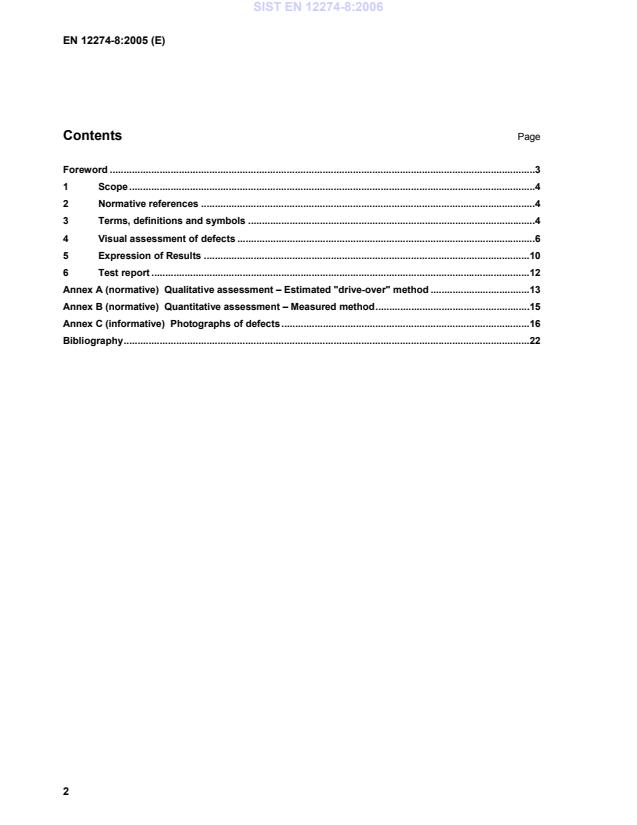
Qualitative assessment – Estimated "drive-over" method.13 Annex B (normative)
Quantitative assessment – Measured method.15 Annex C (informative)
Photographs of defects.16 Bibliography.22
3.1 Terms and definitions 3.1.1 defect state of a slurry surfacing where the material is affected by one or more of the effects defined in this European Standard (see 3.1.2 to 3.1.13). 3.1.2 bleeding, fatting up and tracking appearance of free binder at the surface NOTE This may be due to the binder migrating to the surface (bleeding) or to coarse aggregate migrating downwards (fatting up) or a combination of the two, it is often difficult to visually separate the two causes. Tracking is evident as shiny areas caused by traffic resulting in loss of macrotexture normally in the wheel tracks. 3.1.3 delamination detachment of the slurry surfacing from the underlying road or from a lower layer of a multi-layer slurry surfacing 3.1.4 wearing and loss of slurry surfacing loss of mass of material SIST EN 12274-8:2006
is the sum of the areas of bleeding fatting up and tracking in the 100 m section being considered, in square metres (m2); A2
is the sum of the areas of delamination, loss of aggregate, wearing, lane joint gaps, rutting and slippage in the 100 m section being considered, in square metres (m2); A3 is the sum of the areas of corrugation, bumps and ridges in the 100 m section being considered, in square metres (m2); A4 is the sum of the areas of the rectangle or rectangles containing small repetitive defects or group of small defects in the 100 m section being considered, in square metres (m2); D is the upper aggregate sieve size of the slurry surfacing (as in EN 13043); L
is the total length of longitudinal grooves in the 100 m section, in metres (m); P1 is the proportion of area of bleeding, fatting up and tracking in the 100 m section being considered, expressed as a percentage (%), of the area of the section; P2 is the proportion of area of delamination, loss of aggregate, wearing, lane joint gaps, rutting and slippage in the 100 m section being considered, expressed as a percentage (%), of the area of the section; P3 is the proportion of area of corrugation, bumps and ridges in the 100 m section being considered, expressed as a percentage (%), of the area of the section; P4 is the proportion of area of the rectangle or rectangles containing a group of small defects or small repetitive defects, in the 100 m section being considered, expressed as a percentage (%), of the area of the section plus the number of rectangles (see Annex A, line 14 and Annex B, line 14, area and number); S is the area of 100 m long section of slurry surfacing, in square metres (m2); W is the mean width of lane, in metres (m). 4 Visual assessment of defects 4.1 General A (100 ± 1) m section of slurry surfacing is chosen for visual assessment for each lane of the road. The section reference shall be recorded in the relevant annex. Sections may be located anywhere along the road except that they shall not overlap. The remainder of the site that is not chosen for testing or the area between sections is deemed to be without defects at the time the test is carried out. NOTE 1 The sections should be chosen in order to maximise the number of defects in each section. NOTE 2 If the defects are localised there may be only one section chosen in one lane for the entire length of road treated. SIST EN 12274-8:2006
...