

EN 12273:2008
(Main)Slurry surfacing - Requirements
- Abstract
This European Standard specifies the performance requirements and control procedures for the installation of slurry surfacing as a product for the surface treatment of roads and other trafficked areas (e.g. footways, cycleways).
This European Standard is not designed for small areas of slurry surfacing on roads that are less than 500 m2 which are not contiguous (for example minor repairs).
This European Standard does not apply to slurry surfacing designed by the purchaser.
This European Standard is not applicable to slurry surfacing carried out in tunnels in terms of reaction to fire. No such regulations have yet been identified, nor is there any method of classification of reaction to fire.
NOTE Member States can call up the technical requirements of this European Standard for use in tunnels.
This European Standard is not designed for pavements that are covered by international regulations, for example, International Civil Aviation Organisation (ICAO) regulations (airfields).
- Status
- Published
- Publication Date
- 08-Apr-2008
- Technical Committee
- CEN/TC 227 - Road materials
- Drafting Committee
- CEN/TC 227/WG 2 - Surface dressing and slurry surfacing
- Current Stage
- 9093 - Decision to confirm - Review Enquiry
- Start Date
- 11-May-2022
- Completion Date
- 07-Oct-2026
- Directive
- 305/2011 - Regulation (eu) No 305/2011 of the European Parliament and of the Council of 9 march 2011 laying down harmonised conditions for the marketing of construction products and repealing council directive 89/106/eecOJ Ref: C, C 259 OJ Date: 08-Aug-2014
89/106/EEC - Construction productsOJ Ref: C, C 321 OJ Date: 16-Dec-2008

Overview
EN 12273:2008 - Slurry surfacing - Requirements (CEN) defines performance requirements and control procedures for slurry surfacing used as a surface treatment on roads and other trafficked areas (footways, cycleways). The standard covers both slurry seal (fine aggregates) and micro‑surfacing (coarser aggregates) as in‑place mixes of aggregates, bituminous emulsion, water and additives. It excludes small, non‑contiguous repairs under 500 m², purchaser‑designed slurry systems, airfields governed by ICAO, and reaction‑to‑fire classification for tunnels (member states may adopt the technical requirements for tunnel use).
Key topics and technical requirements
- Constituent materials: Only aggregates, binders and additives with demonstrated suitability may be used (European standards, technical approvals or documented practice). Binders are bituminous emulsions (polymer modified allowed) compliant with EN 13808.
- Aggregate properties: Selection and classes are referenced to EN 13043 (PSV, resistance to abrasion, Micro‑Deval, grading).
- Grading and mix design: Producers declare grading curves and maximum nominal sizes; design recipe and method statement are required.
- Performance categories: Defined categories (0–5) for essential characteristics such as adhesion, resistance to deformation, wear and bond. Macrotexture (skid resistance) is assessed against thresholds (e.g., 0.2–1.0 mm categories using EN 13036‑1).
- Visual/perceptible assessment: Defect inspection (bleeding, delamination, rutting, corrugation, longitudinal grooves) follows EN 12274‑8 and is typically performed 11–13 months after installation to assess durability.
- Quality systems and conformity: Factory Production Control (FPC) requirements (Annex A & B) and Type Approval Installation Trial (TAIT - Annex C) verify producer capability. Annex ZA maps provisions to EU Construction Products Directive and CE marking requirements.
- Test methods: Referenced test standards include EN 12274 series, EN 13036‑1, EN ISO 13473‑1, EN 58 and EN ISO 9001.
Applications and users
Practical uses:
- Surface treatment for highways, urban streets, cycleways, footways and car parks.
- Rut and texture restoration, surface protection, skid resistance enhancement, and low-cost resurfacing.
Who should use EN 12273:
- Road authorities and highway agencies specifying maintenance works
- Pavement and surfacing contractors and producers of slurry/micro‑surfacing
- Designers, quality managers and testing laboratories validating materials and installation
- Procurement teams ensuring compliance, durability and CE marking
Related standards
- EN 13808 (bituminous emulsions)
- EN 13043 (aggregates for bituminous mixtures)
- EN 12274 series (slurry surfacing test methods)
- EN 13036‑1 (macrotexture patch test)
- EN ISO 13473‑1, EN 58, EN ISO 9001
EN 12273:2008 is the reference for specifying, producing and quality‑controlling slurry surfacing systems across Europe, ensuring predictable skid resistance, durability and workmanship when applied by competent producers under established FPC and TAIT procedures.
Relations
- Effective Date
- 28-Jan-2026
- Effective Date
- 28-Jan-2026
- Effective Date
- 28-Jan-2026
- Effective Date
- 28-Jan-2026
- Effective Date
- 28-Jan-2026
- Effective Date
- 28-Jan-2026
- Effective Date
- 28-Jan-2026
- Effective Date
- 28-Jan-2026
- Effective Date
- 28-Jan-2026
- Effective Date
- 28-Jan-2026
- Effective Date
- 28-Jan-2026
- Effective Date
- 28-Jan-2026
- Effective Date
- 28-Jan-2026
- Effective Date
- 28-Jan-2026
Get Certified
Connect with accredited certification bodies for this standard

Zavod za gradbeništvo Slovenije (ZAG) - Inšpekcija
ZAG inspection body for construction products, structures, and materials.
Sponsored listings
Frequently Asked Questions
EN 12273:2008 is a standard published by the European Committee for Standardization (CEN). Its full title is "Slurry surfacing - Requirements". This standard covers: This European Standard specifies the performance requirements and control procedures for the installation of slurry surfacing as a product for the surface treatment of roads and other trafficked areas (e.g. footways, cycleways). This European Standard is not designed for small areas of slurry surfacing on roads that are less than 500 m2 which are not contiguous (for example minor repairs). This European Standard does not apply to slurry surfacing designed by the purchaser. This European Standard is not applicable to slurry surfacing carried out in tunnels in terms of reaction to fire. No such regulations have yet been identified, nor is there any method of classification of reaction to fire. NOTE Member States can call up the technical requirements of this European Standard for use in tunnels. This European Standard is not designed for pavements that are covered by international regulations, for example, International Civil Aviation Organisation (ICAO) regulations (airfields).
This European Standard specifies the performance requirements and control procedures for the installation of slurry surfacing as a product for the surface treatment of roads and other trafficked areas (e.g. footways, cycleways). This European Standard is not designed for small areas of slurry surfacing on roads that are less than 500 m2 which are not contiguous (for example minor repairs). This European Standard does not apply to slurry surfacing designed by the purchaser. This European Standard is not applicable to slurry surfacing carried out in tunnels in terms of reaction to fire. No such regulations have yet been identified, nor is there any method of classification of reaction to fire. NOTE Member States can call up the technical requirements of this European Standard for use in tunnels. This European Standard is not designed for pavements that are covered by international regulations, for example, International Civil Aviation Organisation (ICAO) regulations (airfields).
EN 12273:2008 is classified under the following ICS (International Classification for Standards) categories: 93.080.20 - Road construction materials. The ICS classification helps identify the subject area and facilitates finding related standards.
EN 12273:2008 has the following relationships with other standards: It is inter standard links to EN 12274-8:2005, EN 13043:2013, EN 12274-2:2018, EN 58:2012, EN 1097-5:2008, EN 13043:2002, EN 13808:2013, EN ISO 13473-1:2019, EN 933-9:2022, EN 13036-1:2001, EN ISO 9001:2000, EN 933-8:2012+A1:2015, EN 12274-6:2018, EN 933-1:2012. Understanding these relationships helps ensure you are using the most current and applicable version of the standard.
EN 12273:2008 is associated with the following European legislation: EU Directives/Regulations: 305/2011, 89/106/EEC; Standardization Mandates: M/124. When a standard is cited in the Official Journal of the European Union, products manufactured in conformity with it benefit from a presumption of conformity with the essential requirements of the corresponding EU directive or regulation.
EN 12273:2008 is available in PDF format for immediate download after purchase. The document can be added to your cart and obtained through the secure checkout process. Digital delivery ensures instant access to the complete standard document.
Standards Content (Sample)
2003-01.Slovenski inštitut za standardizacijo. Razmnoževanje celote ali delov tega standarda ni dovoljeno.Tankoplastne prevleke po hladnem postopku - SpecifikacijeDünne Asphaltschichten in Kaltbauweise - AnforderungenMatériaux bitumineux coulés a froid - ExigencesSlurry surfacing - Specifications93.080.20Materiali za gradnjo cestRoad construction materialsICS:Ta slovenski standard je istoveten z:EN 12273:2008SIST EN 12273:2009en,fr,de01-januar-2009SIST EN 12273:2009SLOVENSKI
STANDARD
EUROPEAN STANDARDNORME EUROPÉENNEEUROPÄISCHE NORMEN 12273April 2008ICS 93.080.20 English VersionSlurry surfacing - RequirementsMatériaux Bitumineux coulés à froid - SpécificationsDünne Asphaltdeckschichten in Kaltbauweise -AnforderungenThis European Standard was approved by CEN on 23 February 2008.CEN members are bound to comply with the CEN/CENELEC Internal Regulations which stipulate the conditions for giving this EuropeanStandard the status of a national standard without any alteration. Up-to-date lists and bibliographical references concerning such nationalstandards may be obtained on application to the CEN Management Centre or to any CEN member.This European Standard exists in three official versions (English, French, German). A version in any other language made by translationunder the responsibility of a CEN member into its own language and notified to the CEN Management Centre has the same status as theofficial versions.CEN members are the national standards bodies of Austria, Belgium, Bulgaria, Cyprus, Czech Republic, Denmark, Estonia, Finland,France, Germany, Greece, Hungary, Iceland, Ireland, Italy, Latvia, Lithuania, Luxembourg, Malta, Netherlands, Norway, Poland, Portugal,Romania, Slovakia, Slovenia, Spain, Sweden, Switzerland and United Kingdom.EUROPEAN COMMITTEE FOR STANDARDIZATIONCOMITÉ EUROPÉEN DE NORMALISATIONEUROPÄISCHES KOMITEE FÜR NORMUNGManagement Centre: rue de Stassart, 36
B-1050 Brussels© 2008 CENAll rights of exploitation in any form and by any means reservedworldwide for CEN national Members.Ref. No. EN 12273:2008: ESIST EN 12273:2009
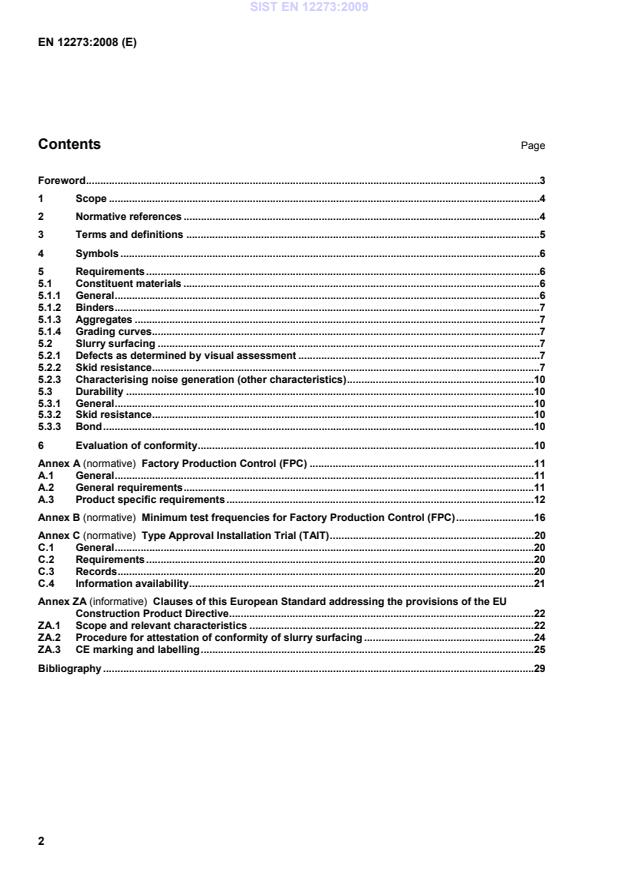
Factory Production Control (FPC).11 A.1 General.11 A.2 General requirements.11 A.3 Product specific requirements.12 Annex B (normative)
Minimum test frequencies for Factory Production Control (FPC).16 Annex C (normative)
Type Approval Installation Trial (TAIT).20 C.1 General.20 C.2 Requirements.20 C.3 Records.20 C.4 Information availability.21 Annex ZA (informative)
Clauses of this European Standard addressing the provisions of the EU Construction Product Directive.22 ZA.1 Scope and relevant characteristics.22 ZA.2 Procedure for attestation of conformity of slurry surfacing.24 ZA.3 CE marking and labelling.25 Bibliography.29
Category Technical requirement Reference Unit 0 1 2 3 4 5 Visual assessment of defects
P1 – Bleeding, fatting up and tracking EN 12274-8 % NPD ≤ 8 ≤ 2 ≤ 0,5 ≤ 0,2
P2 – Delamination, loss of aggregate, wearing, lane joint gaps, rutting or slippage EN 12274-8 % NPD ≤ 8 ≤ 2 ≤ 0,5 ≤ 0,2
P3 – Corrugation, bumps and ridges EN 12274-8 % NPD ≤ 8 ≤ 2 ≤ 0,5 ≤ 0,2
P4(n) – groups of small and repetitive defects in not more than rectangles (n) EN 12274-8 % NPD ≤ 20 (20) ≤ 5 (6) ≤ 1 (2) ≤ 0,2(1)
L – longitudinal grooves-(scoremarks) EN 12274-8 m NPD < 20 < 10 < 5 < 1
Surface characteristics
Macrotexture EN 13036-1 mm NPD ≥ 0,2 ≥ 0,4 ≥ 0,6 ≥ 0,8 ≥ 1,0 Noise generation Macrotexture EN 13036-1 mm Declared maximum value Constituent materials
Binder cohesion – bituminous emulsion EN 13808
Declare from classes in EN 13808 Aggregate – polished stone value EN 13043
Declare from the categories given in EN 13043 Aggregate – resistance to wear by micro-Deval EN 13043
Declare from the categories given in EN 13043 Aggregate – resistance to wear by abrasion by studded tyres EN 13043
Declare from the categories given in EN 13043
Type of slurry surfacing
Declared type which should include maximum aggregate size (D as defined in EN 13043) and binder type (for each layer) Other characteristics of constituents Binders – other characteristics of binders may be chosen from those given in EN 13808 Aggregates – other characteristics of aggregates may be chosen from those given in EN 13043
NOTE A category is declared for each specific technical requirement. The selection of categories for all technical requirements shall be made to avoid technically incompatible combinations e.g. high macro texture category 4 and high fatting defect category 1. SIST EN 12273:2009
EN 13036-1 (see Table 1). If the site configuration permits then EN ISO 11819-1 may be used. 5.3 Durability 5.3.1 General Slurry surfacing prepared in accordance with this European Standard is deemed to be durable for a reasonable economic working life. Durability of slurry surfacing is demonstrated by the Type Approval Installation Trial (TAIT). NOTE The effect of changes in traffic levels, climate, substrate etc., prevents exact prediction of lifetime. 5.3.2 Skid resistance 5.3.2.1 General Durability of skid resistance shall be demonstrated by means of measurement of polished stone value (PSV) in accordance with EN 13043 together with a measurement of macro-texture in accordance with EN 13036-1. 5.3.2.2 Polished stone value (PSV) Polished stone value shall be declared in accordance with EN 13043. NOTE Different categories can be used for different intended uses. 5.3.2.3 Macro-texture Macro-texture shall be declared in accordance with 5.2.2. 5.3.3 Bond Bond shall be evaluated in accordance with 5.2.1. NOTE Test methods for bond are being developed. 6 Evaluation of conformity Evaluation of conformity shall be demonstrated by: Type Approval Installation Trial (TAIT) in accordance with Annex C. Factory Production Control (FPC) in accordance with Annex A. SIST EN 12273:2009
Factory Production Control (FPC) A.1 General The producer shall establish, document and maintain a Factory Production Control (FPC) system to ensure that the slurry surfacing placed on the market conforms to the stated performance characteristics. The FPC system shall consist of procedures, regular inspections and tests and/or assessments and the use of the results to control incoming materials, equipment, the production process and the product. Alternative tests to those referred to in this document may be used for Factory Production Control if a correlation can be identified with the test used for ITT. Where the producer purchases constituent materials or has the slurry surfacing designed, or parts of the production or testing carried out by sub-contracting, the FPC of the supplier or sub-contractor may be taken into account. However, where this occurs, the producer shall retain the overall control of the slurry surfacing and ensure that he receives all the information that is necessary to fulfil the requirements according to this European Standard. The producer who sub-contracts all of his activities may in no circumstances discharge himself of his responsibilities to a sub-contractor. All the elements, requirements and provisions adopted by the producer shall be documented in a systematic manner in the form of written policies and procedures. This production control system documentation shall ensure a common understanding of conformity evaluation and enable the achievement of the required component characteristics and the effective operation of the production control system to be checked. Factory Production Control therefore brings together operational techniques and all measures allowing maintenance and control of the conformity of the slurry surfacing with its technical requirements. Its implementation may be achieved by controls and tests on measuring equipment, constituents, processes, machines and manufacturing equipment and finished components, including material properties of components, and by making use of the results thus obtained. A producer who has a Factory Production Control which complies with EN ISO 9001 and made specific to this European Standard shall be deemed to satisfy the requirements of this annex. A.2 General requirements The FPC system shall at least fulfil the requirements as described in EN ISO 9001 specified in Table A.1, where applicable: SIST EN 12273:2009
6 Resource management for FPC system including provision, human resources, infrastructure and work environment
7.1 except 7.1 a) Planning of product realization
7.2.3 c) Customer feedback
7.3 Design and development A.3.4 7.4 Purchasing (process, information and verification)
7.5 Production and service provision A.3.5 7.6 Control of monitoring and measuring devices A.3.6 8.2.4 Monitoring of processes and product A.3.7 8.3 Control of non-conforming product A.3.8 8.5.2 Corrective action A.3.9
The FPC system may be part of a Quality Management system, e.g. in accordance with EN ISO 9001. A.3 Product specific requirements The requirements set out in this clause provide product specific details. A.3.1 Records Records shall be stored and maintained in such a way they are retrievable and maintained for a minimum period of 5 years from the date of production. A.3.2 FPC system The FPC system shall: ensure consistency with the requirements of this document; ensure that the slurry surfacing placed on the market conforms with the stated performance characteristics; SIST EN 12273:2009
...