

EN 1992-1-1:2023/prA1
(Amendment)Eurocode 2 - Design of concrete structures - Part 1-1: General rules and rules for buildings, bridges and civil engineering structures
- Abstract
1.1 Scope of FprEN 1992-1-1
(1) This document gives the general basis for the design of structures in plain, reinforced and prestressed concrete made with normal weight, lightweight and heavyweight aggregates. It gives specific rules for buildings, bridges and civil engineering structures, including temporary structures; additional requirements specific to bridges are given in Annex K. The rules are valid under temperature conditions between −40 °C and +100 °C generally. This document complies with the principles and requirements for the safety, serviceability, durability and robustness of structures, the basis of their design and verification that are given in EN 1990.
(2) This document is only concerned with the requirements for resistance, serviceability, durability, robustness and fire resistance of concrete structures. Other requirements, e.g. concerning thermal or sound insulation, are not considered.
(3) This document does not cover:
- resistance to fire (see EN 1992 1 2);
- fastenings in concrete (see EN 1992 4);
- seismic design (see EN 1998 (all parts));
- particular aspects of special types of civil engineering works (such as dams, pressure vessels);
- structures made with no-fines concrete, aerated or cellular concrete, lightweight aggregate concrete with open structure components;
- structures containing steel sections considered in design (see EN 1994 (all parts)) for composite steel and concrete structures;
- structural parts made of concrete with a smallest value of the upper sieve aggregate size Dlower < 8 mm (or if known Dmax < 8 mm) unless otherwise stated in this Eurocode.
1.2 Assumptions
(1) The assumptions of EN 1990 apply to FprEN 1992-1-1.
(2) It is assumed that the requirements for execution and workmanship given in EN 13670 are complied with.
- Status
- Not Published
- Publication Date
- 06-Jan-2028
- Technical Committee
- CEN/TC 250 - Structural Eurocodes
- Current Stage
- 4060 - Closure of enquiry - Enquiry
- Start Date
- 20-Aug-2026
- Due Date
- 17-Dec-2026
- Completion Date
- 20-Aug-2026

EN 1992-1-1:2023/prA1 is a CEN draft amendment to Eurocode 2. It modifies the European rules for the design of concrete structures in buildings, bridges and civil engineering structures, including plain, reinforced, prestressed and precast concrete. It is aimed at structural designers, bridge engineers, and anyone who checks analysis, detailing, materials and verification for concrete works.
What does EN 1992-1-1:2023/prA1 specify?
EN 1992-1-1:2023/prA1 specifies changes to the general rules for designing concrete structures under the Eurocode system. Clause 1 limits the document to resistance, serviceability, durability and robustness, and it points users to other Eurocodes for fire, seismic and other excluded cases.
The document applies to structures made with normal weight, lightweight and heavyweight aggregates, under temperatures generally between −40 °C and +100 °C. It covers buildings, bridges, civil engineering structures and temporary structures, and Annex K adds bridge-specific rules.
The main text runs through Clauses 0 to 14, then Annexes A to S. The annexes provide design data, special methods and material-specific rules that support the main clauses.
| Annex | What it covers |
|---|---|
| A | Adjustment of partial factors for materials |
| B | Time dependent behaviour of materials, including strength, creep, shrinkage and relaxation |
| C | Requirements for materials |
| D | Early-age and long-term cracking due to restraint |
| E | Additional rules for fatigue verification |
| F | Safety formats for non-linear analysis |
| G | Design of membrane-, shell- and slab elements |
| H | Guidance on design of concrete structures for water-tightness |
| I | Guidance on design of concrete structures for water-tightness, with assessment-related provisions |
| J | Strengthening of existing concrete structures with CFRP |
| K | Bridges |
| L | Steel Fibre Reinforced Concrete structures |
| M | Lightweight aggregate concrete structures |
| O | Simplified approaches for second order effects |
| Q | Stainless reinforcing steel |
| R | Embedded FRP reinforcement |
| S | Minimum reinforcement for crack control and simplified control of cracking |
What are the key requirements of EN 1992-1-1:2023/prA1?
EN 1992-1-1:2023/prA1 keeps the Eurocode design framework but updates many of the rules that control safety, cracking, deformation, fatigue and detailing. In practice, the amendment matters because it changes where designers must check assumptions, which National Annex choices apply, and how several special materials and bridge details are treated.
Design basis and analysis
Clause 4 ties the design rules to EN 13670 tolerance class 1, and it requires extra allowances in design when other tolerances are permitted in the execution specification. That matters because geometry and construction tolerances affect cover, eccentricity and structural safety.
Clause 4 also clarifies prestress action for bonded and unbonded tendons. For unbonded tendons, the characteristic prestressing stress is used with the prestress partial factor, so designers must distinguish tendon type before checking the member.
Clause 7 updates the treatment of structural analysis, including initial support conditions, second order effects and examples for simplified methods in Annex O. The practical effect is that designers must be clear about when stiffness, imperfections and creep are included in the analysis model.
Resistance, shear, punching and serviceability
Clause 8 revises several ultimate limit state checks, including minimum moments for compressed members, shear reinforcement rules, torsion wording and punching shear definitions. For linear members with effective depth above 500 mm, minimum shear reinforcement may still be needed even when the shear calculation says none is required.
Clause 9 updates serviceability checks for crack width and decompression, including revised table guidance for exposure classes and a clearer treatment of minimum reinforcement on both tensioned faces. It also allows bonded tendons in the tension zone to contribute to crack control, which affects how crack-control reinforcement is calculated in practice.
Clause 10 updates fatigue rules and the stress definitions used in verification. This matters for members with repeated loading, where the compressive stress range must be defined consistently before checking fatigue resistance.
Detailing, ties and robustness
Clause 11 revises anchorage, lap length, U-bar loops, headed bars and mandrel diameter guidance. Testing can justify a reduced mandrel diameter, so detailing can be adapted when evidence supports it.
Clause 12 updates member detailing rules and the robustness provisions. It requires vertical ties in columns and walls for structures with a sufficient number of levels, and it points to Table 12.5 for tie forces. Where ductility is not required, reinforcement of ductility class A may be used.
Bridge-specific and special-material rules
Annex K adds and tightens bridge-specific applications of the general clauses. It covers concrete types, reinforcing steel, cover, structural analysis assumptions, fatigue traffic factors, ducts, anchorage, lapping and bonding rules for concrete bridges.
Annex L gives design rules for Steel Fibre Reinforced Concrete, including how to use residual tensile strengths at serviceability and ultimate limit states. Annex J updates CFRP strengthening, including long-term strength reduction, fatigue verification and anchorage checks. Annex R does the same for embedded FRP reinforcement, while Annex S gives a simplified crack-control method and allows bonded tendons to contribute near the tension face.
What terms does EN 1992-1-1:2023/prA1 define?
- ULS - Ultimate Limit States, the checks that prevent collapse-type failure and loss of resistance.
- SLS - Serviceability Limit States, the checks for cracking, deflection, stress and other in-service performance limits.
- NDP - Nationally Determined Parameters, the values or choices left to the National Annex.
- SFRC - Steel Fibre Reinforced Concrete, used in Annex L with residual tensile strength rules.
- CFRP - Carbon fibre reinforced polymer, used in Annex J for strengthening existing concrete structures.
- ABR CFRP - The CFRP strengthening system in Annex J, where long-term effects and exposure conditions are part of the verification.
Who uses EN 1992-1-1:2023/prA1?
EN 1992-1-1:2023/prA1 is used by structural engineers, bridge designers, civil engineers, checking engineers, concrete producers, precast manufacturers, and specialist strengthening contractors. Quality managers and buyers use it when they need to specify concrete type, cover, reinforcement details, materials or bridge-related requirements in a way that matches Eurocode design practice. Authorities and National Annex writers also use it because many clauses and annexes leave room for national choice.
What changed in EN 1992-1-1:2023/prA1 from the previous edition?
EN 1992-1-1:2023/prA1 is an amendment to EN 1992-1-1:2023. The update revises the title references, scope wording, normative references and many technical clauses.
The most visible changes are:
- updated references to EN 1990-1:2023+A1:2026 and EN 1991-2:2023
- revised terms, symbols and definitions
- clarified basis-of-design and structural-analysis rules
- revised ULS, SLS and fatigue provisions
- updated detailing rules for reinforcement and post-tensioning tendons
- major expansion of Annex K for bridges
- updated rules in Annexes J, L, R and S for CFRP, SFRC, embedded FRP and crack control
Which standards are used with EN 1992-1-1:2023/prA1?
- EN 1990-1:2023+A1:2026 and EN 1990 (all parts) - basis of structural and geotechnical design, including safety formats and National Annex choices.
- EN 13670 - execution and workmanship assumptions, including tolerance class 1.
- EN 1991-2:2023 - traffic actions for bridges, including bridge fatigue references.
- EN 1991-1-7:2025 - robustness and tying forces for bridges.
- EN 1992-1-2, EN 1992-4, EN 1994 (all parts) and EN 1998 (all parts) - fire design, fastenings, composite steel-concrete design and seismic design outside this part.
- EN 10138 (all parts), EN 14651, EN 197-1 and EN 206 - prestressing steel, SFRC test data, cement and concrete material basis.
- ISO 10406 (all parts) and ISO 10406-1:2015 - CFRP and ABR CFRP strengthening rules.
What does the EN 1992-1-1:2023/prA1 document contain?
The document is a clause-by-clause amendment, so its main content is revised rules, notes, tables, figures and formulas rather than a new standalone text. It updates calculations for analysis, resistance, cracking, fatigue, detailing and bridge design, and it revises several Nationally Determined Parameter tables.
It also contains annex-specific methods and tables for partial factors, time-dependent material behaviour, materials requirements, cracking due to restraint, fatigue verification, non-linear analysis, shell and slab elements, water-tightness, strengthening, SFRC, lightweight aggregate concrete, second-order effects, stainless reinforcement, embedded FRP and crack control. For users, the most important parts are the updated equations, tables and figures that control design checks and detailing choices.
Relations
- Effective Date
- 05-Nov-2025
Get Certified
Connect with accredited certification bodies for this standard

DIBt (Deutsches Institut für Bautechnik)
German Institute for Building Technology.
DIN CERTCO
DIN Group product certification.

Aboma Certification B.V.
Specialized in construction, metal, and transport sectors.
Sponsored listings
Frequently Asked Questions
EN 1992-1-1:2023/prA1 is a draft published by the European Committee for Standardization (CEN). Its full title is "Eurocode 2 - Design of concrete structures - Part 1-1: General rules and rules for buildings, bridges and civil engineering structures". This standard covers: 1.1 Scope of FprEN 1992-1-1 (1) This document gives the general basis for the design of structures in plain, reinforced and prestressed concrete made with normal weight, lightweight and heavyweight aggregates. It gives specific rules for buildings, bridges and civil engineering structures, including temporary structures; additional requirements specific to bridges are given in Annex K. The rules are valid under temperature conditions between −40 °C and +100 °C generally. This document complies with the principles and requirements for the safety, serviceability, durability and robustness of structures, the basis of their design and verification that are given in EN 1990. (2) This document is only concerned with the requirements for resistance, serviceability, durability, robustness and fire resistance of concrete structures. Other requirements, e.g. concerning thermal or sound insulation, are not considered. (3) This document does not cover: - resistance to fire (see EN 1992 1 2); - fastenings in concrete (see EN 1992 4); - seismic design (see EN 1998 (all parts)); - particular aspects of special types of civil engineering works (such as dams, pressure vessels); - structures made with no-fines concrete, aerated or cellular concrete, lightweight aggregate concrete with open structure components; - structures containing steel sections considered in design (see EN 1994 (all parts)) for composite steel and concrete structures; - structural parts made of concrete with a smallest value of the upper sieve aggregate size Dlower < 8 mm (or if known Dmax < 8 mm) unless otherwise stated in this Eurocode. 1.2 Assumptions (1) The assumptions of EN 1990 apply to FprEN 1992-1-1. (2) It is assumed that the requirements for execution and workmanship given in EN 13670 are complied with.
1.1 Scope of FprEN 1992-1-1 (1) This document gives the general basis for the design of structures in plain, reinforced and prestressed concrete made with normal weight, lightweight and heavyweight aggregates. It gives specific rules for buildings, bridges and civil engineering structures, including temporary structures; additional requirements specific to bridges are given in Annex K. The rules are valid under temperature conditions between −40 °C and +100 °C generally. This document complies with the principles and requirements for the safety, serviceability, durability and robustness of structures, the basis of their design and verification that are given in EN 1990. (2) This document is only concerned with the requirements for resistance, serviceability, durability, robustness and fire resistance of concrete structures. Other requirements, e.g. concerning thermal or sound insulation, are not considered. (3) This document does not cover: - resistance to fire (see EN 1992 1 2); - fastenings in concrete (see EN 1992 4); - seismic design (see EN 1998 (all parts)); - particular aspects of special types of civil engineering works (such as dams, pressure vessels); - structures made with no-fines concrete, aerated or cellular concrete, lightweight aggregate concrete with open structure components; - structures containing steel sections considered in design (see EN 1994 (all parts)) for composite steel and concrete structures; - structural parts made of concrete with a smallest value of the upper sieve aggregate size Dlower < 8 mm (or if known Dmax < 8 mm) unless otherwise stated in this Eurocode. 1.2 Assumptions (1) The assumptions of EN 1990 apply to FprEN 1992-1-1. (2) It is assumed that the requirements for execution and workmanship given in EN 13670 are complied with.
EN 1992-1-1:2023/prA1 is classified under the following ICS (International Classification for Standards) categories: 91.080.40 - Concrete structures. The ICS classification helps identify the subject area and facilitates finding related standards.
EN 1992-1-1:2023/prA1 has the following relationships with other standards: It is inter standard links to EN 1992-1-1:2023. Understanding these relationships helps ensure you are using the most current and applicable version of the standard.
EN 1992-1-1:2023/prA1 is available in PDF format for immediate download after purchase. The document can be added to your cart and obtained through the secure checkout process. Digital delivery ensures instant access to the complete standard document.
Standards Content (Sample)
SLOVENSKI STANDARD
01-julij-2026
Evrokod 2 - Projektiranje betonskih konstrukcij - 1-1. del: Splošna pravila in
pravila za stavbe, mostove in gradbene konstrukcije
Eurocode 2 - Design of concrete structures - Part 1-1: General rules and rules for
buildings, bridges and civil engineering structures
Eurocode 2: Bemessung und Konstruktion von Stahlbeton- und Spannbetontragwerken -
Teil 1 1: Allgemeine Regeln und Regeln für Hochbauten, Brücken und
Ingenieurbauwerke
Eurocode 2 : Calcul des structures en béton - Partie 1-1 : Règles générales et règles
pour les bâtiments, les ponts et les ouvrages de génie civil
Ta slovenski standard je istoveten z: EN 1992-1-1:2023/prA1
ICS:
91.010.30 Tehnični vidiki Technical aspects
91.080.40 Betonske konstrukcije Concrete structures
2003-01.Slovenski inštitut za standardizacijo. Razmnoževanje celote ali delov tega standarda ni dovoljeno.
DRAFT
EUROPEAN STANDARD
EN 1992-1-1:2023
NORME EUROPÉENNE
EUROPÄISCHE NORM
prA1
May 2026
ICS 91.080.40
English Version
Eurocode 2 - Design of concrete structures - Part 1-1:
General rules and rules for buildings, bridges and civil
engineering structures
Eurocode 2 : Calcul des structures en béton - Partie 1-1 Eurocode 2: Bemessung und Konstruktion von
: Règles générales et règles pour les bâtiments, les Stahlbeton- und Spannbetontragwerken - Teil 1 1:
ponts et les ouvrages de génie civil Allgemeine Regeln und Regeln für Hochbauten,
Brücken und Ingenieurbauwerke
This draft amendment is submitted to CEN members for enquiry. It has been drawn up by the Technical Committee CEN/TC 250.
This draft amendment A1, if approved, will modify the European Standard EN 1992-1-1:2023. If this draft becomes an
amendment, CEN members are bound to comply with the CEN/CENELEC Internal Regulations which stipulate the conditions for
inclusion of this amendment into the relevant national standard without any alteration.
This draft amendment was established by CEN in three official versions (English, French, German). A version in any other
language made by translation under the responsibility of a CEN member into its own language and notified to the CEN-CENELEC
Management Centre has the same status as the official versions.
CEN members are the national standards bodies of Austria, Belgium, Bulgaria, Croatia, Cyprus, Czech Republic, Denmark, Estonia,
Finland, France, Germany, Greece, Hungary, Iceland, Ireland, Italy, Latvia, Lithuania, Luxembourg, Malta, Netherlands, Norway,
Poland, Portugal, Republic of North Macedonia, Romania, Serbia, Slovakia, Slovenia, Spain, Sweden, Switzerland, Türkiye and
United Kingdom.
Recipients of this draft are invited to submit, with their comments, notification of any relevant patent rights of which they are
aware and to provide supporting documentation.
Warning : This document is not a European Standard. It is distributed for review and comments. It is subject to change without
notice and shall not be referred to as a European Standard.
EUROPEAN COMMITTEE FOR STANDARDIZATION
COMITÉ EUROPÉEN DE NORMALISATION
EUROPÄISCHES KOMITEE FÜR NORMUNG
CEN-CENELEC Management Centre: Rue de la Science 23, B-1040 Brussels
© 2026 CEN All rights of exploitation in any form and by any means reserved Ref. No. EN 1992-1-1:2023/prA1:2026 E
worldwide for CEN national Members.
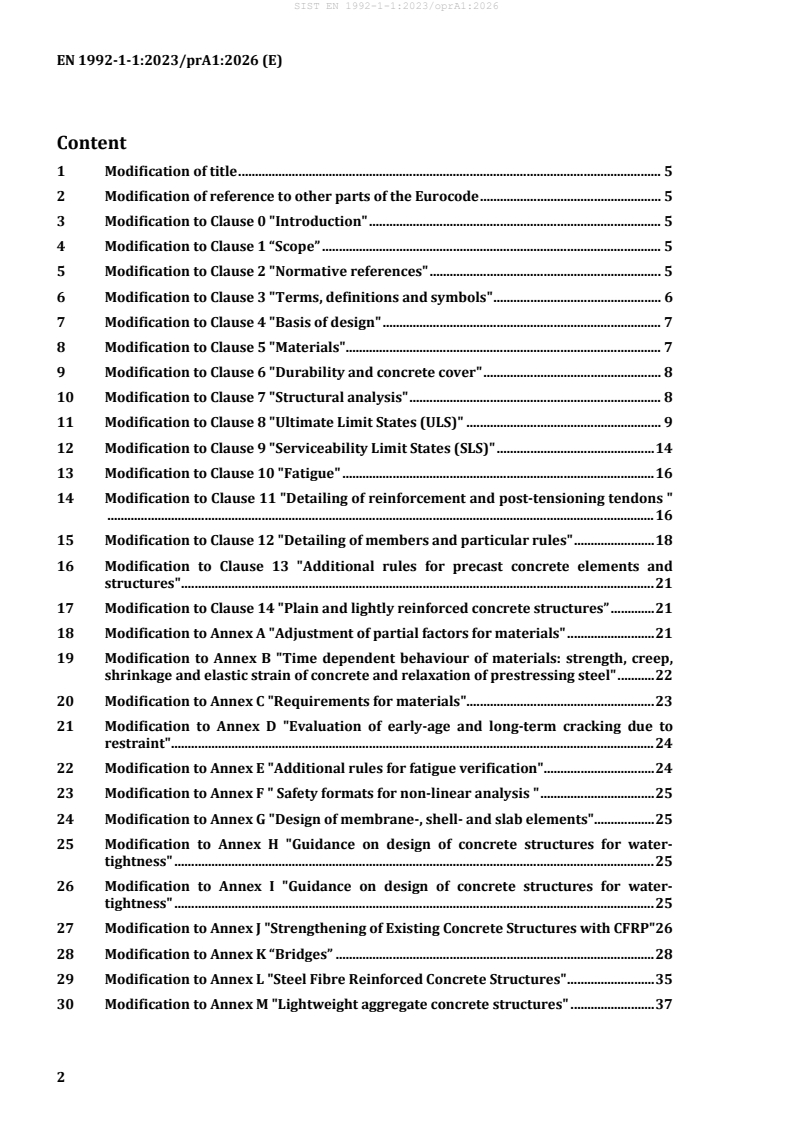
Content
1 Modification of title . 5
2 Modification of reference to other parts of the Eurocode . 5
3 Modification to Clause 0 "Introduction" . 5
4 Modification to Clause 1 “Scope” . 5
5 Modification to Clause 2 "Normative references" . 5
6 Modification to Clause 3 "Terms, definitions and symbols" . 6
7 Modification to Clause 4 "Basis of design" . 7
8 Modification to Clause 5 "Materials" . 7
9 Modification to Clause 6 "Durability and concrete cover" . 8
10 Modification to Clause 7 "Structural analysis" . 8
11 Modification to Clause 8 "Ultimate Limit States (ULS)" . 9
12 Modification to Clause 9 "Serviceability Limit States (SLS)" . 14
13 Modification to Clause 10 "Fatigue" . 16
14 Modification to Clause 11 "Detailing of reinforcement and post-tensioning tendons "
................................................................................................................................................................... 16
15 Modification to Clause 12 "Detailing of members and particular rules" . 18
16 Modification to Clause 13 "Additional rules for precast concrete elements and
structures" . 21
17 Modification to Clause 14 "Plain and lightly reinforced concrete structures” . 21
18 Modification to Annex A "Adjustment of partial factors for materials" . 21
19 Modification to Annex B "Time dependent behaviour of materials: strength, creep,
shrinkage and elastic strain of concrete and relaxation of prestressing steel" . 22
20 Modification to Annex C "Requirements for materials". 23
21 Modification to Annex D "Evaluation of early-age and long-term cracking due to
restraint" . 24
22 Modification to Annex E "Additional rules for fatigue verification" . 24
23 Modification to Annex F " Safety formats for non-linear analysis " . 25
24 Modification to Annex G "Design of membrane-, shell- and slab elements" . 25
25 Modification to Annex H "Guidance on design of concrete structures for water-
tightness" . 25
26 Modification to Annex I "Guidance on design of concrete structures for water-
tightness" . 25
27 Modification to Annex J "Strengthening of Existing Concrete Structures with CFRP" 26
28 Modification to Annex K “Bridges” . 28
29 Modification to Annex L "Steel Fibre Reinforced Concrete Structures" . 35
30 Modification to Annex M "Lightweight aggregate concrete structures" . 37
31 Modification to Annex O "Simplified approaches for second order effects" . 37
32 Modification to Annex Q "Stainless reinforcing steel" . 37
33 Modification to Annex R "Embedded FRP reinforcement" . 38
34 Modification to Annex S "Minimum reinforcement for crack control and simplified
control of cracking". 38
European foreword
This document (EN 1992-1-1:2023/prA1:2026) has been prepared by Technical Committee CEN/TC 250
“Structural Eurocodes”, the secretariat of which is held by BSI.
This document is currently submitted to the CEN Enquiry.
This document is an amendment to EN 1992-1-1:2023.
NOTE Some modifications are purely editorial corrections to improve the quality of the document and
these will not be tagged in the consolidated publication, as noted after the modification.
The first generation of EN Eurocodes was published between 2002 and 2007. This document forms part
of the second generation of the Eurocodes, which have been prepared under Mandate M/515 issued to
CEN by the European Commission and the European Free Trade Association.
The Eurocodes have been drafted to be used in conjunction with relevant execution, material, product
and test standards, and to identify requirements for execution, materials, products and testing that are
relied upon by the Eurocodes.
The Eurocodes recognise the responsibility of each Member State and have safeguarded their right to
determine values related to regulatory safety matters at national level through the use of National
Annexes.
1 Modification of title
Replace “Stahlbeton- und Spannbetontragwerken“ by “Betontragwerken“ in German title.
2 Modification of reference to other parts of the Eurocode
Replace in 0.3(3) and 0.5 “FprEN 1992-1-1” by “EN 1992-1-1”.
Replace in 1.1(1), 1.2(1), Clause 2, 4.1.1(1), 4.2.1.1(1), 6.1(1), 7.3.4(2), 9.3.4(1), 10.2(1), F.3(2), F.6(2), F.7(6),
I.1(1) NOTE 2, I.4.1.1(1), J.9(1) “EN 1990” (dated or undated) by “EN 1990 (all parts)”.
Replace in 3.1, 4.1.1(2) (three occasions), 4.1.2(1), 4.1.3(1), 4.2.1.4(2), 9.3.1(2) (three occasions), 9.4(2),
10.2(1) NOTE, 10.4(1) NOTE, 12.5.2(1), A.3(3) NOTE, A.12.4, Table A.4 NOTE, Table E.1(NDP), E.3(1), F.3(5),
F.4(1), F.5(1), F.6(1), I.4.2.1(2) NOTE 3, I.9.1(2), K.12.4(1), L.15(5) “EN 1990” by “EN 1990-1”. References to
the publication date, clauses, tables, annexes, if any, remain unchanged.
Replace in K.9(5) NOTE “EN 1991-2:2021“ by “EN 1991-2:2023“. References to table and annex remain
unchanged.
Replace in 5.3.1(3) NOTE 2 “EN 10138” by „EN 10138 (all parts)“.
3 Modification to Clause 0 "Introduction"
0.1 Replace “:” with “—” in Eurocode titles
0.1 Replace “— New parts are under development, e.g. Eurocode for design of structural glass” with “—
EN 19100 Eurocode 10 — Design of glass structures”
0.1 Add the following new list item: “— New parts are under development, e.g. Eurocode for design of
fibre-polymer composite structures and Eurocode for design of tensioned membrane structures”
Replace in 0.2(1) the first sentence by:
“EN 1992 applies to the design of buildings, bridges and civil engineering structures in plain, reinforced
and prestressed and precast concrete.”
Add a note at the end of 0.2(3):
“NOTE EN 1992-2:2005 and EN 1992-3:2006 are withdrawn.”
Replace in 0.3(3) “FprEN 1992-1-1” by “EN 1992-1-1”.
0.5 Add “clauses” to the end of “National choice is allowed in EN 1992-1-1 through notes to the following:”
Add in 0.5 the following references to the list of NDPs:
“K.4(2), K.3(3), K.5(3), K.5(4), K.5(5), K.5(6), K.7(4), K.7(6), K.7(7), K.7(8), K.7(9), K.7(10), K.7(11), K.8(7), K.8(8),
K.8(9), K.8(10), K.8(11), K.8(12), K.9(2), K.9(3), K.9(4), K.10.2(3), K.12.1(2), K.13(3), K.13(5)”
4 Modification to Clause 1 “Scope”
In 1.1(2) replace first sentence by the following new sentence:
“This document is only concerned with the requirements for resistance, serviceability, durability and
robustness of concrete.”
5 Modification to Clause 2 "Normative references"
Replace “EN 1990:2023, Eurocode — Basis of structural and geotechnical design” with “by “EN 1990-
1:2023+A1:2026, Eurocode — Basis of structural and geotechnical design — Part 1: New structures”
Delete space “ EN 1993 -1-9,” with “EN 1993-1-9,”
6 Modification to Clause 3 "Terms, definitions and symbols"
In 3.1.36 change “a reinforcement” to “an ordinary reinforcement bar”.
In 3.1.37 change “closed reinforcement” to “closed ordinary reinforcement bar”.
In 3.1.38 change “reinforcing steel” to “reinforcement”.
In 3.1.46 change the first entry of “reinforcement” to “ordinary reinforcement bar”.
In 3.1.48 change the term from “loop” to “U-bar loop” and in the definition “U-shaped reinforcement” to
“U-shaped ordinary reinforcement bar”.
In 3.1.66 replace “made of strands” by “consisting of strands”.
In 3.1.70 replace “reinforcing bars” by “reinforcement”.
In 3.1.80 change in definition from “continuously wound reinforcement” to “continuously wound
reinforcement bar”.
Replace definition of stainless steel in 3.1.82 by "corrosion-resistant alloy reinforcing steel”.
In 3.1.83 change “reinforcement bent” to “reinforcement bar bent”.
In 3.1.101 delete “used as NSM reinforcement”
In 3.1.114 the second sentence of the definitions is changed to “Note 1 to entry” to read:
“Note 1 to entry: This class defines the strength of the SFRC concrete without additional reinforcing bars
or prestressing”
In 3.2.1:
change “A ” to “A ”
cc c,conf
For A change definition to “Area of minimum reinforcement to be placed at the most tensioned face
s,min,w1
of the section part under consideration to avoid yielding when cracking occurs”
For A change definition to “Area of minimum reinforcement to be placed at the least tensioned face
s,min,w2
of the section part under consideration to avoid yielding when cracking occurs”
Add “E Internal force or stress in case of the initial support conditions”
in
For N change definition to “Number of lorries per year according to EN 1991-2:2023, Table 6.7”
obs
In 3.2.2:
In definition of k replace “design crack” by “calculated crack”.
w
Add a comma between k and k .
1/r 1/r,simpl
Delete symbol w and w with definitions.
k,cal,1 k,cal,2
In 3.2.3:
Change in definition for α the symbol “E ” to “E ”.
e c cm
Replace “Θ ” and “Θ ” by “θ ” and “θ ” (same font as above)
Rd Ed Rd Ed
Replace σ ’ by ”σ’ ”
sd sd
Change the definition of 𝜏𝜏 to “Design value of the average acting shear stress over a cross-section”.
Ed
Start definitions of τ , τ , τ , τ , τ , τ , τ , τ , τ , τ , τ and τ with “Design
Rd Rd,c Rd,cs Rd,i Rdm Rd,sy Rdc,min Rd,max t,Rd t,Rd,sw t,Rd,sl t,Rd,max
value of…”; change capital letter of “Shear, Minimum, Maximum, Torsional” to small letters.
Delete “φ or Φ” from the definition of φ.
fat
Add definition “w Mechanical ratio for the amount of confinement reinforcement”.
c
Add definition “w Mechanical ratio for the amount of transverse reinforcement”.
t
In 3.5.2:
Replace “stress” by “strength” in definition of f .
bsm
Replace “short-term” by “long-term” in definition of f .
fud
In 3.6.2:
Add “and volume effects” at the end of definition of f .
Fts,ef
Replace “to be used in the constitutive law for bi-linear stress distribution” by “and volume effects” in
definition of f .
Ft1,ef
Delete “for crack widths” and “accounting for fibre orientation” from definition of f .
Ftsd
Replace definition of f by the following new: “Design residual tensile strength for crack width = 0,5 mm
Ft1d
accounting for fibre orientation and volume effects to be used for bi-linear stress distribution”.
Replace “to be used in the constitutive law for bi-linear stress analysis” by “and volume effects” in
definition of f .
Ft3,ef
Replace definition of f by the following new: “Design residual tensile strength at the ultimate limit state”.
Ftud
Replace definition of f by the following new: “Effective residual tensile strength for crack widths at the
Ftu,ef
ultimate limit state accounting for fibre orientation and volume effects”
In the definition of fFt3d add “and volume effects” between “orientation” and “to be used”.
Add “in slabs” at the end of the definition of k .
AS
In 3.6.3 add definition “τ Design value of the punching shear resistance of SFRC with shear
Rd,csF
reinforcement”
In 3.6.3 delete in definition of 𝜀𝜀 the references “according to 5.1.7 and 8.1.5”
Ftud
In 3.7.2 change “f “ to “f “
bd100a bd,100a
7 Modification to Clause 4 "Basis of design"
In 4.2.1.5(2) add “of bonded tendons” between “design prestress action” and “at ultimate limit” and add a
new second sentence at the end:
“For unbonded tendons, the characteristic value of the prestressing stress should be used and multiplied
by the partial factor for prestress.”
In 4.2.2(1) divide first sentence into two sentences to read:
“The design rules in this standard are consistent with EN 13670 Tolerance Class 1. Where other
tolerances are permitted, they shall be specified in the execution specification and suitable allowances
shall be made in the design.”
8 Modification to Clause 5 "Materials"
In 5.1.1, Note 2, replace “informative Annex M” with “Normative Annex M”
In 5.2.1(2) replace “reinforcement” by “reinforcing steel” (for ribbed and indented).
In Table 5.6 change footnote a to “In all strength classes, a characteristic strain at maximum force ε = 3,5
uk
% applies.”
Replace Figure 5.3 with the following new figure:
9 Modification to Clause 6 "Durability and concrete cover"
In 6.1(3), NOTE 2 replace “pitting depth” by “loss of section due to pitting”.
In 6.4(1), NOTE 2 change the beginning of note from “An informative Annex P…” to “Informative Annex
P…”
In 6.5.2.2(9), NOTE change “a National Annex” to “the National Annex”.
In Table 6.6 change “Table 12.2” to “Table 12.2(NDP)”
10 Modification to Clause 7 "Structural analysis"
Align Formula (7.6) left, as in Formula (7.7).
th
In 7.2.2(4), 4 bullet point, add “or 1/10 of” between “ribs,” and “smallest horizontal void”.
In 7.3.1(2) delete “, and for structures designed for earthquake resistance,”
Replace in 7.3.1(6) in Formula (7.14) and in definition below the formula "𝐸𝐸 " by “𝐸𝐸 ".
𝑡𝑡=0 le
Replace in Formula (7.15) "𝐸𝐸 " by “𝐸𝐸 " and add to definition instead of "𝐸𝐸 and 𝐸𝐸 see (6) ":
𝑡𝑡=0 in 𝑡𝑡 𝑡𝑡=0
“E see (6);
t
E is the internal force or stress in case of the initial support conditions;”
in
Replace in 7.4.2(2) in definition of δ under Formula (7.27) “φ ” by “φ ”.
Ed eff,b eff,s
Replace NOTE in 7.4.3.1(1) by new NOTE:
„NOTE Examples are given for:
— nominal curvature method, in O.7;
— reduced stiffness value method, in O.8.1; and
— moment magnification factor method in O.8.2.”
In 7.4.3.2(1), last sentence, replace “estimates” by “assumptions”.
Replace in title of Figure 7.4 “equivalent” by “effective”
Add in 7.6.3.2(1), NOTE 1 “the” before “post-tensioning system”.
nd
In 7.6.5(1), replace 2 sentence by the following new sentence:
“In the first case for verification of the ultimate limit state, the origin of the design stress-strain
relationship in 5.3 (Figure 5.3) should be shifted to a stress equal to 𝜎𝜎 and a strain equal to 𝜎𝜎 /E .”
pd pd p
Replace 7.6.5(2) by the following new paragraph (2):
“(2) When verifying the application of prestress to members, the design value of the prestressing stress
as external action should be determined as σ (x,t) = γ σ (x,t). When verifying the capacity of members
pd P pm
with unbonded tendons, the design value of the prestressing stress should be taken as σ (x,t) = γ r
pd P inf
σ (x,t) + ∆σ .”
pm pd
11 Modification to Clause 8 "Ultimate Limit States (ULS)"
Replace first sentence in 8.1.1(5) by:
“Unless second order effects and effects of geometric imperfections and of imposed deformations have
been accounted for in the analysis, cross-sections loaded by an axial compression NEd should be designed
for a minimum moment of at least”
Add in 8.1.1(6) sub-headings a) and b) to Figure 8.1 to read:
Figure 8.1 (not included, no changes)
a) Section b) Strain distribution
Delete “permanently” in 8.1.1(7).
Change in 8.1.1(8) last sentence of definition of N to read:
Rd,0
“where if benefit is taken from confinement reinforcement in design, f should be replaced by f
cd cd,c
according to Formula (8.15).”
Replace in 8.1.3(2) “G.4(1)-(2)” by “G.4(1) and (2)”.
Replace in 8.1.4(3) the second paragraph below the definitions of Formula (8.14) by:
“For confining reinforcements not in the x, or y-axes, the corresponding components should be
considered (in the instance of Figure 8.3 d), the component of the inner confinement reinforcement
effective in x and y may be taken as √2 times the area of one leg).”
Replace in 8.1.4(3) Figure (8.3)e) by new Figure (8.3)e):
“
”
𝑠𝑠
In Table 8.1, rows a), b) and c), last column, add a blank (more space) between the minus-sign “-“ and “ ”,
2𝑏𝑏
cs
𝑠𝑠 𝑠𝑠
“ " and " ".
2𝑏𝑏 2𝑏𝑏
csx csy
In Table 8.1, row c), second column, second indent, delete the reference to Figure 8.3 c).
In Table 8.1, row c), third column, replace the text under the formular with the following new text:
“b is the straight length of a segment between bends (defined by the intersections of centrelines) and
i
anchorages
2 2 2
(Σb = 4b + 2b in the example of Figure 8.3c);
i 1 2
2 2
Σb = 8b in the example of Figure 8.3d);
i 1
and Σb = 0 in the example of Figure 8.3e))”
i
In Table 8.1, row d), last column, replace the text under the formular with the following new text:
“where
𝑥𝑥 ≤ 𝑏𝑏 ⁄2, and
cs csx
𝑠𝑠
1 − ≥ 0; and
4𝑥𝑥
cs
𝑠𝑠
1 − ≥ 0”
4𝑏𝑏
csy
In 8.2.1 b) delete “and 8.4.3“ and in c) delete "and 8.4.4”.
Replace 8.2.1(2) by the following new paragraph (2):
“(2) When, on the basis of the design shear calculation, no shear reinforcement is required, minimum
shear reinforcement may nevertheless be necessary for linear members, according to Clause 12. For
linear members with d > 500 mm, minimum shear reinforcement fulfilling the provisions of Clause 12
shall be provided.
NOTE In exceptions where this were not possible, the verification methods according to I.8.3.1(3), which
define an additional size effect for d> 500 mm can be used.”
Replace in Formula (8.20) “11” by “8,8”.
Delete in definition of d below Formula (8.28) “dnom” and add the following new note below the definition:
“NOTE For d refer to NOTE in 8.2.1(3).”
In 8.2.2(3) replace “a shorter than 4 d” with “a < 4 d”.
cs cs
Add in 8.2.2(5) “due to prestressing” after “compressive normal forces”.
Replace in 8.2.2(5) the NOTE by the following new note:
“NOTE The factor k can be calculated according to Formula (8.34), and 𝜏𝜏 according to Formula
Rdc,max
(8.35), unless the National Annex gives another value.”
Delete in 8.2.2(5) from the definition of e , 1st sentence, “or of the external load that produces the
p
compressive axial force”.
Replace in 8.2.2(5) the definition of a and the paragraph below with the following new text:
cs,0
“a is determined according to Formula (8.30) without considering in M the effect of prestressing.
cs,0 Ed
For the given factor k according to Formula (8.34), the effective depth d in Formula (8.33) may be
replaced by a where a is determined according to Formulae (8.29) and (8.30) replacing a by a .”
v v cs cs,0
In 8.2.2(7) replace “with different reinforcement ratios in both directions” by “with reinforcement in both
directions” and replace the reference to “8.2.1(5)” by “Formula (8.26)”.
In 8.2.2(9) add “, with a value of ν defined in 8.2.3(6) or 8.2.3(7).” to the last sentence.
In 8.2.3(10) replace the text before Formula (8.54) with the following new sentence:
“Where the web contains ducts of diameters such that Σφ > b /8, the strength reduction factor ν in
duct w
Formula (8.44) and in both Formulae in the Note of 8.2.3(5) shall be multiplied with the ratio b /b
w,nom w
where:”
In 8.2.6(4) replace “A1, A2 or A3” by “A , A or A ”.
1 2 3
In Figure 8.15b) delete “Shear reinforcement: 45° ≤ α ≤ 90°” and “Interface reinforcement: 35° ≤ α ≤
w
135°”
Replace Figure 8.15c) by the following new figure:
“ ”
Change title of 8.3.2 to “Internal forces due to torsion in solid or closed sections”.
Replace in 8.3.6(1) the definition of “S ; S ” by the following wording:
Ed Rd
“are the individual design action and, respectively, the corresponding individual design resistance of the
cross-section (e.g. design torsional moment and pure design torsional resistance (refer to 8.3.4), design
bending moment and pure design bending moment resistance and design shear force and shear
resistance).”
In 8.4.2(1) replace NOTE 1 by the following new wording:
“NOTE 1 d and d apply unless the National Annex permits alternative use of d and d
vxd vyd dx dy
(see 8.2.1(3)).”
Replace Figure 8.19d) by the new following new figure:
In 8.4.2(6), 4th hyphen, change „corner columns is not larger” to “corner columns taken to be not larger”.
Replace Figure 8.21 (changes in figure b)) by the following new figure:
st
In 8.4.3(2) replace the 1 sentence by:
“For distances a according to Formula (8.98) smaller than 8d in the considered load combination, the
p v
value of d in Formula (8.94) may be replaced by:”
v
In 8.4.3(2) replace the definition of a , a by:
p,x p,y
“in general, are the maximum distances from the centroid of the support area to the two points (on the
x- and on the y-axis, respectively) where the bending moments m , respectively m , are zero. The
Ed,x Ed,y
local coordinate system (x,y) has its origin at the centre of the supporting area.
For elongated columns or similar cases a and a may be taken as the maximum distances from the
px py
centroid of the control perimeter (which may be simplified according to Figure 8.21a)) to the two
points (on the x- and on the y-axis, respectively) where the bending moments m , respectively m ,
Ed,x Ed,y
are zero. The local coordinate system (x,y) has its origin at the centroid of the control perimeter.
The distances a and a may be calculated according to (3) or using a linear elastic (uncracked) model.
px py
The local coordinate system (x,y) coincides with the reinforcement (principal directions in case of
layers which are not orthogonal).
In 8.4.3(3), last sentence, replace “largest span length” by “larger span length”.
In 8.4.4(4), 3rd hyphen, delete „ratio”, change „according Formula (8.95)” to “according to Formula (8.95)”
and change “and calculated using” to “and the reinforcement ratio calculated using”.
Replace Figure 8.23 with the following new figure:
“ ”
Change subtitles of Figures 8.23b) to e) as follows:
“b) Bent bar
c) Bent bar with bar of at least equal size in the bend
d) Headed bar
e) Inclined bar”
Add to 8.4.4(7) at the end of the second paragraph (ending with reference to Figure 8.24b)) a new sentence:
“At the end of walls, b is limited by a line drawn at 60° to the wall face starting 0,5d and 1,5d from
0.5,out v v
the corner (see Figure 8.24 c)).”
Replace Figure 8.24 (changes are in figure c)) with the following new figure:
“
”
Replace Figure 8.27a) with thew following new figure:
“ ”
Replace Figure 8.27b) with thew following new figure:
“ ”
nd
In 8.5.4.3(2). 2 hyphen, change “loops (11.4.6)“ to “U-bar loops (11.4.6)”.
nd
In 8.5.4.4(2) 2 hyphen, change “in case the tie is” to “in case the ties are”.
In Figure 8.31 move the titles for a) and b) directly below the respective figure.
Replace in 8.6(2) the sentence above Figure 8.32 by
“The minimum height of the load introduction block should be h ≥ a – a .”
1 0
Replace Figure 8.33b) with thew following new figure:
“ ”
12 Modification to Clause 9 "Serviceability Limit States (SLS)"
Add in 9.1(4) a new sentence before the existing sentence below Formula (9.1):
“For a more accurate calculation 1,05 E can be replaced by E according to Formula (B.21).”
cm c
st rd
In Table 9.1,1 column, 3 row, change “or stress” to “and stress”.
Modify Table 9.2 as follows:
— Split cell under frequent combination of actions with “Decompression” applicable to XD1, XD2, XD3
XS1, XS2, XS3 only. Add in lower part of cell “ ― “.
— Change sequence to “XF1, XF2 XF3, XF4”.
— Remove 2nd full stop in NOTE 1.
— Place formula in NOTE 2 on same one line.
Table 9.2 (only parts with changes shown for illustration):
wlim,cal=
X0, XC1 – –
0,2 mm ⋅ ksurf
– –
Decompression wlim,cal =
XC2, XC3, XC4
b
0,2 mm ⋅ ksurf
w =
lim,cal
0,3 mm ⋅ k
surf
XD1, XD2, XD3
b
Decompression
XS1, XS2, XS3
a,c a,c
σc ≤ 0,6fck – σc ≤ 0,6fck
XF1, XF2, XF3,
–
–
XF4
NOTE 1 Crack widths are verified at the member surface unless the National Annex gives a different location.
NOTE 2 The factor ksurf considers the difference between an increased crack width at the member surface and the required
mean crack width according to durability performance of the minimum cover:
1,0 ≤ ksurf = cact/(10 mm + cmin,dur) ≤ 1,5.
c is a specified actual cover ≥ c due to detailing or execution reasons.
act nom
In 9.2.2(2), (iii), below Formula (9.4) change A and A as follows:
s,min,w1 s,min,w2
“A is the area of minimum reinforcing steel to be placed at the most tensioned face of the section
s,min,w1
part under consideration to avoid yielding when cracking occurs;
As,min,w2 is the area of minimum reinforcing steel to be placed at the least tensioned face of the section part
under consideration to avoid yielding when cracking occurs;”
st
Replace in 9.2.2(3) the 1 sentence by the following new sentence:
“Bonded tendons in the tension zone may be assumed to avoid yielding”.
Delete in Formula (9.5) the horizontal line:
≤ 0,8
“𝑘𝑘 = 0,8 − 0,6(min{𝑏𝑏; ℎ}−0,3) � "
h
≥ 0,5
Move in 9.2.2(3) the sentence “If only prestressing steel is used to control cracking, ξ = ξ;” up to definition
of ξ and place after “…according to Formula (9.6):”. Change colon to full stop.
Replace Figure 9.3d) to f) by the following new figure:
“ ”
Change in 9.2.3(3), definitions below Formula (9.12) the following bullet points as shown:
“c) long term loading and crack formation stage or;”
and
“e) long term loading and stabilised cracking stage or;”
In 9.2.3(6) delete “clear” from the definition of c under Formular (9.19).
Change in 9.3.1(3), first hyphen to:
“— in buildings, indirectly, by limiting the span-to-depth ratio, see 9.3.2;”
In Table 9.3, footnote a) change the formular as follows:
“ω =(A /b ∙d)∙(f /f ) is the required…”
r s,req w yd cd
Replace in 9.3.2(3) „cubic root“ by „cube root”.
Delete in 9.3.3(1) below Formula 9.26) the word “zeta” from the definition of 𝜁𝜁.
Replace in Formula (9.27) “𝜌𝜌 ” by “𝜌𝜌” (two locations)
l
13 Modification to Clause 10 "Fatigue"
Change in 10.1(1) the font size for bullet points a) to c) from 11 to 10 (add them to the NOTE).
Replace in 10.5(1), Formular (10.4), the definition of σ :
cd,min
“σ is the minimum compressive stress at the same fibre where σ occurs, if 𝜎𝜎 is a tensile stress
cd,min cd,max cd,min
then 𝜎𝜎 should be taken as 0;”
cd,min
14 Modification to Clause 11 "Detailing of reinforcement and post-tensioning tendons "
Add in 11.3(2), below the list of diameters the following sentence:
“In case it is justified by testing, the mandrel diameter may be reduced”.
Change the title of Figure 11.2d) to “d) Anchorage of headed bars in tension 11.4.7”.
Replace Figure 11.3a) by the following new figure:
Replace Figure 11.3b) by the following new figure:
Replace in 11.4.2(3), Formula for c by “c = min{0,5c ; c ; c ; 3,0ϕ}”.
d d s x y
Replace in 11.4.2(4) b) in the first row of the sentence ”which are” by “whose axes are”.
Add to the end of the title of Figure 11.5 b) “; n = 2, n =1”
c b
Replace in 11.4.2(5), in Formula (11.4) “3,75 ϕ ” by “3,0 ϕ ”.
th
Change in Table 11.3, 4 row the wording from “loops (tension only)” to “U-bar loops (tension only)”.
rd
Change in 11.5.2(8) the reference in the 3 row from 11.12 c) to “11.12 d)” and the reference at the end of
the sentence from 11.12d) to “11.12e)”.
Change in 11.5.2(9) the references at the end of the sentence from Figure 11.12b) and 11.12d) to “see
Figure 11.12c) or 11.12f)”.
Change in 11.5.2(10) the reference at the end of the sentence from Figure 11.12 to “Figure 11.12b) or
11.12e)”
Change in 11.5.4(2) in the definition of k the symbol from “𝜔𝜔” to “𝜔𝜔 ” and in Formula (11.15) (four
st c
locations). In addition, delete colon at the end of Formula (11.15).
Change in 11.5.5(4) in the definition of k the symbol from “𝜔𝜔” to “𝜔𝜔 ” and in Formula (11.20) (four
st t
locations).
Replace in 11.4.7(3), Formula (11.11) the factor “1,1” by “2,6”.
Replace Figure 11.10a) and b) by the new figure below, and add “2 continuous bar” to the key.
“ “ and “ ”
Add in Table11.3, row “headed bars”, column “Design lap length” the following new provision:
“l ≥ max(8 𝜙𝜙; 125 mm)”
sd
Replace Figure 11.12 and the sub-titles of figures a) to f) by the following:
“
b) tension laps with transverse c) compression laps with
a) transverse reinforcement,
reinforcement in the outer transverse reinforcement in the
tension laps
section outer section
e) tension laps with f) compression laps with
d) confinement reinforcement,
concentrated reinforcement in concentrated reinforcement in
tension laps
the outer section the outer section
„
Add to 11.5.4(1) at the end of the paragraph the following new sentence:
“The U-bar loops should be detailed so that the distance between T and T is not larger than l – 𝜙𝜙”.
1 2 sd
Replace Figure 11.15 by the following new figure:
“ ”
15 Modification to Clause 12 "Detailing of members and particular rules"
Change in 12.2(4) the definition of A to “is the area of minimum shear or torsion reinforcement within
sw,min
the spacing s;”
In 12.3.2(1), first row, change N to “N ”.
vd Vd
Replace in 12.3.2(1), in the sentence above Formula (12.6) “it may be assumed” by:
“according to 8.2.2(10) for the design of the longitudinal reinforcement, the moment curve should be
shifted in horizontal direction over a distance a according to:”
l
Replace Figure 12.1 by the following new figure:
“ ”
Change in 12.3.3(6) the beginning of the sentence to “Such laps…”.
Replace Figure 12.3 (changes in b)) by the following new figure:
“ ”
Replace in Figure 12.3 the subheading of figure d) by:
“d) U-stirrups closed by laps in the web of beams with l to be designed for 1,2f ”
sd yd
Delete in 12.4.2(5) “or of shear reinforcement assemblies” and “(of bent up bars or shear reinforcement
assemblies)”
Add to 12.5.1(2), NOTE, „See also 8.4.4(1).”
Change in 12.5.2(2) the reference to Formula (12.11) to “Formula (12.10)”.
Replace Figure 12.7a) by the following new figure:
“
“
Replace Figure 12.7b) by the following new figure:
“ ”
Replace Figure 12.7c) by the following new figure:
“ ”a
Replace in 12.6(1) at the start of the sentence ”hoop” by “transverse”.
Replace in Table 12.4, row 5, last column, the reference “see 12.7(3)” by “see 12.6”.
Replace in 12.9.1(1) the second sentence, starting with “Structures with normal consequences…” by the
following new sentence and new note:
“An adequate level of robustness is described EN 1990:2023, 4.4.
NOTE EN 1990:2023+A1:2026, Annex E (informative) provides alternative methods to enhance
robustness.”
Add in 12.9.1(4) the following new sentence at the end of the paragraph:
“Where ductility is not required reinforcement of ductility class A may be used.”
nd
Replace in 12.9.2.3(2), 2 sentence, “shall” by “should”.
Replace 12.9.2.4(1) by the following new paragraph (1) and a new paragraph (2):
“(1) Vertical ties should be provided in each column and wall in structures with ≥ n levels.
vt
NOTE The value is n = 5 unless the National Annex gives a different value.
vt
(2) Ties should be capable of resisting a design value of tensile force according to Table 12.5 (NDP).
Continuous vertical ties should be provided from the lowest to the highest level.”
rd
Delete heading of 12.9.3 and rename former 12.9.3(1) to “(3)” (3 paragraph of 12.9.2.4).
Replace Table 12.5 (NDP) by the following new table:
“
Description Symbol Requirement
1 Peripheral ties T EN 1991-1-7:2025, A.3
p
2 Internal ties T EN 1991-1-7:2025, A.3
i
3 Horizontal ties to columns T EN 1991-1-7:2025, A.3
col
4 Horizontal ties to walls t EN 1991-1-7:2025, A.3
fac
5 Vertical ties T EN 1991-1-7:2025, A.4
v
“
Change in 12.10(5), first sentence, “a ” to “a”.
16 Modification to Clause 13 "Additional rules for precast concrete elements and
structures"
Delete in 13.3.2(1), second row, “of Formula (B.14)”.
nd
Replace in 13.4.1(1), at the end of the 2 hyphen “strength” by “capacity”.
Replace Figure 13.6b) by the following new figure:
17 Modification to Clause 14 "Plain and lightly reinforced concrete structures”
Delete in 14.2(2) the reference “(see 8.1.1)”.
18 Modification to Annex A "Adjustment of partial factors for materials"
Replace in Table A.1, rows a), b), c) and h) the reference to Table A.4 by “Table A.4 (NDP)” (four locations).
Remove in Table A.2, 1st column, the parentheses before i), j), i. e. replace “(i)” by “i)” and add a horizontal
nd rd
line in the 2 and 3 column above 𝛾𝛾, as shown below:
“
persistent and
transient design accidental design
Condition for adjusting material factors
situations situations
for precast members
γ γ γ γ γ γ
S C V S C V
”
Replace in Table A.4 (NDP) the note by the following new note:
“NOTE The β values refer to CC2. For others Consequence Classes, refer to EN 1990-1.”
tgt
Replace in A.3(6), the definition of ∆d below Formular (A.8) with the following new wording:
“
Δd is the deviation value of the effective depth:
Δd = 15 mm for reinforcing steel and post-tensioning tendons;
Δd = 5 mm for pre-tensioning tendons.
“
Replace in A.3(7), below Formula (A.12) the first sentence below “where” by:
“V , V , μ and μ are taken from Table A.3 or updated considering the cases b), c), f), or h) defined in
Ac θc Ac θc
Table A.1 (NDP);”
Replace in A.3(8), below Formula (A.16) the first sentence below “where” by:
“Vd, Vθs, µd and µθs are taken from Table A.3 or updated considering the cases b), c), f), or h) defined in
Table A.1 (NDP);”
19 Modification to Annex B "Time dependent behaviour of materials: strength, creep,
shrinkage and elastic strain of concrete and relaxation of prestressing steel"
Replace in B.3, NOTE 3, the last sentence of the note by:
“It can be taken into account using specialist methods if considered to have an influence on the design of
a member.”
Replace Table B.1 (NDP) by the following new table:
“
Composition and properties of the cement or the binder of the concrete
Concrete containing only Concrete containing binder composition
cement
Class
Cement
Type of Composition of the binder
b
strength class ,
a c d
cement (Portland cement clinker cement and SCM )
e.g.
Portland cement clinker and more than 65 mass-percentage
CS CEM III
32,5 N; 42,5 N of ground granulated blast furnace slag (ggbs) or more than
CEM II/B
35 mass-percentage of fly ash (fa)
Portland cement clinker and more than 35 mass-percentage
CN CEM II/A
but less than 65 mass-percentage of ground granulated blast
CEM I
32,5 R; 42,5 N
furnace slag (ggbs) or more than 20 mass-percentage but
less than 35 mass-percentage of fly ash (fa)
Portland cement clinker and less than 35 mass-percentage
CR CEM II/A
42,5 R; 52,5 N;
of ground granulated blast furnace slag (ggbs) or less than
CEM I
52,5 R
20 mass-percentage of SCM other than ggbs
a
CEM IV, CEM V and special cements may be classed considering Portland cement clinker
content and strength class
b
According to EN 197-1.
c
Observe that the content of Portland cement clinker in CEM I may be 95 mass-percentage.
d
Considered as binder for the water-binder-ratio according to EN 206.
“
Replace in B.6(3) in the definition of RH below Formula (B.33) “(relevant for high performance concrete)”
eq
by “ (relevant for high strength concrete)”.
Replace in B.7(3) the first sentence by:
“The following standards should be used to conduct relevant tests:”
Move in B.8(2), Formula (B.42) dτ at the end of the formula and replace “τ ” by “τ”:
i
“
𝑡𝑡
( )
∂σ τ
c
𝜀𝜀 (𝑡𝑡,𝜎𝜎 ) = 𝜎𝜎 (𝑡𝑡 ) ⋅ 𝐽𝐽(𝑡𝑡,𝑡𝑡 ) + � ∙ 𝐽𝐽(𝑡𝑡,𝜏𝜏) ∙ 𝑑𝑑𝜏𝜏
cσ c c 0 0
(B.42)
∂τ
𝑡𝑡
“
20 Modification to Annex C "Requirements for materials"
Place in C.4.1(2) the NOTE below Table C.2 into this table.
Replace in Tables C.5, C.6 and C.7, row “Ductility” the characteristic value of stress ratio “≥ 1,10” by
“≥ 1,08”.
Replace C.6(3) by the following text:
“(3) The permanent slip value measured for a simple coupler, consisting of no more than two load-
transmitting components, should not exceed 0,10 mm, after loading to 0,65 R .
e,nom
For couplers consisting of more than two load-transmitting components:
a) the permanent slip value should not exceed 0,10 mm, after loading to 0,65 R ; or
e,nom
b) the strain measured across the splice at a load equivalent to 0,65 R should not exceed 0,16 % or
e,nom
the actual value measured on the reference bar, whichever is the greater.”
Replace in C.7(2) “strength” by “capacity” (two locations).
Divide in Table C.9 the header of the first column, change “11.0” to “11,0” and replace “na” by “n.a.”, see
below:
“
Required minimum mean bond strength as a function of
Bond efficiency Bond efficiency
concrete strength fck (MPa)
class factor k
b,pi
12 16 20 30 40 50
CPI-1,0 1,0 7,7 8,9 10,0 12,2 14,1 15,8
CPI-0,9 0,9 n.a. 8,0 9,0 11,0 12,7 14,2
CPI-0,8 0,8 n.a. n.a. 8,0 9,8 11,3 12,6
CPI-0,7 0,7 n.a. n.a. n.a. 8,6 9,9 11,1
n.a. = not allowed
NOTE 1 Values for intermediate concrete strength may be interpolated linearly.
NOTE 2 Post-installed reinforcing bars with a mean bond strength fbm,rqd < 7,7 MPa are not covered by this Eurocode.
“
21 Modification to Annex D "Evaluation of early-age and long-term cracking due to
restraint"
Replace
...