


EN 13985:2003
(Main)Machine tools - Safety - Guillotine shears
Machine tools - Safety - Guillotine shears
1.1 This standard specifies technical safety requirements and measures to be adopted by persons undertaking the design as defined in 3.11 of EN 292-1:1991, manufacture and supply of guillotine shears which are intended to work cold metal or material partly of cold metal.
1.2 This standard also covers guillotine shears whose primary intended use is to work cold metal, which are to be used in the same way to work other sheet materials (e.g. cardboard, plastic, rubber, leather). 1.3 The requirements in this standard take account of intended use, as defined in 3.12 of EN 292-1:1991. This standard presumes access to the guillotine shear from all directions, deals with the hazards described in clause 4, and specifies the safety requirements and/or protective measures for both the operator and other exposed persons. 1.4 This standard also applies to ancillary devices which are an integral part of the guillotine shear. For the safeguarding of integrated manufacturing systems using guillotine shears see also prEN 1921 (ISO 11161:1994 modified). 1.5 This standard includes guillotine shears in which energy is imparted to the blade by a number of means. e.g.: a) mechanically driven from a motor through a friction clutch; b) through a direct drive motor and brake; c) through hydraulic pressure; d) through pneumatic pressure. 1.6 This standard does not cover machines whose principal designed purpose is: a) cutting in other than a straight line (e.g. at nibbling machines);
b) cutting by continuous action at crocodile shears (see 3.4). 1.7 This standard is applicable to machines built after its date of issue.
Werkzeugmaschinen - Sicherheit - Tafelscheren
1.1 Diese Norm legt technische Sicherheitsanforderungen und Schutzmaßnahmen für Tafelscheren fest. Die Anforderungen sind von Konstrukteuren (siehe Definition in 3.11 von EN 292-1:1991), Herstellern und Lieferern zu beachten. Die Tafelscheren sind vorgesehen für die Kaltbearbeitung von Metall oder teilweise aus Metall (siehe Definition in 3.1.7) bestehenden Werkstoffen. Im Folgenden werden die Tafelscheren Maschinen genannt.
1.2 Diese Norm gilt auch für Tafelscheren, deren hauptsächlicher Verwendungszweck die Kaltbearbeitung von Metall ist und die in gleicher Weise für die Bearbeitung von anderem Tafelmaterial (z.B. Pappe, Kunststoff, Gummi, Leder) eingesetzt werden sollen.
1.3 Die in dieser Norm enthaltenen Anforderungen beziehen die bestimmungsgemäße Verwendung mit ein, wie in 3.12 von EN 292-1:1991 definiert. Diese Norm unterstellt den Zugang zur Tafelschere von allen Seiten, behandelt die in Abschnitt 4 beschriebenen Gefährdungen und legt die Sicherheitsanforderungen und/oder Schutz-maßnahmen für den Bediener und andere exponierte Personen fest.
1.4 Diese Norm gilt auch für Zusatzeinrichtungen, die fester Bestandteil der Tafelschere sind. Diese Norm gilt auch für Maschinen die in Fertigungssystemen ingegriert sind, wenn die auftretenden Gefahren und Risiken vergleichbar mit denen einer separat betriebenen Maschine sind.
1.5 Diese Norm bezieht Tafelscheren mit ein, bei denen Energie durch verschiedene Mittel auf das Messer übertragen wird, z. B.:
a) mechanischer Antrieb durch einen Motor mit Hilfe einer Reibungskupplung;
b) durch direkt angetriebenen Motor und direkt angetriebene Bremse;
c) durch hydraulischen Druck;
d) durch pneumatischen Druck.
1.6 Diese Norm gilt nicht für Maschinen, deren Hauptzweck ist:
a) Schneiden in einer anderen als der geraden Linie (z. B. bei Knabberscheren);
b) kontinuierliches Schneiden in Krokodilscheren (siehe 3.4).
Machines-outils - Sécurité - Cisailles guillotines
1.1 La présente Norme européenne spécifie les prescriptions techniques de sécurité et les mesures de protection que doivent respecter les personnes chargées de la conception, comme défini en 3.11 de l'EN 292 1:1991, de la construction et de la fourniture des cisailles guillotines conçues pour le travail à froid des métaux ou des matériaux partiellement constitués de métal telles que définies en 3.1.7 et ci-après désignées par le terme machine.
1.2 La présente norme s'applique également aux cisailles guillotines pour lesquelles l'utilisation normale première est le travail à froid des métaux et qui sont utilisées de la même manière pour le travail d'autres matériaux en feuilles (tels que le carton, le plastique, le caoutchouc ou le cuir).
1.3 Les prescriptions de la présente norme tiennent compte de l'utilisation normale telle que définie en 3.12 de l'EN 292-1:1991. La présente norme suppose un accès possible à la cisaille guillotine de tous les côtés, traite des phénomènes dangereux décrits à l'Article 4 et spécifie les prescriptions de sécurité et/ou les mesures de protection à la fois pour l'opérateur et les autres personnes exposées.
1.4 La présente norme est applicable également aux dispositifs auxiliaires faisant partie intégrante de la cisaille guillotine. La présente norme s'applique aussi aux machines intégrées dans une ligne de production pour autant que les phénomènes dangereux et les risques soient comparables à ceux des machines isolées.
1.5 La présente norme inclue les cisailles guillotines dont l'énergie est transmise à la lame par différents moyens, par exemple :
a) par entraînement mécanique à partir d'un moteur et d'un embrayage à friction ;
b) par entraînement direct d'un moteur et d'un frein ;
c) par pression hydraulique ;
d) par pression pneumatique ;
1.6 La présente norme ne traite pas des machines conçues principalement pour :
a) la coupe en ligne non droite (par exemple les machines de poinçonnage) ;
b) la coupe en continu des cisa
Obdelovalni stroji - Varnost - Škarje
General Information
- Status
- Withdrawn
- Publication Date
- 07-Jan-2003
- Withdrawal Date
- 10-Feb-2009
- Technical Committee
- CEN/TC 143 - Machine tools - Safety
- Drafting Committee
- CEN/TC 143/WG 1 - Metal forming machine tools - Safety
- Current Stage
- 9960 - Withdrawal effective - Withdrawal
- Start Date
- 11-Feb-2009
- Completion Date
- 11-Feb-2009
- Directive
- 98/37/EC - Machinery
Relations
- Effective Date
- 22-Dec-2008

Get Certified
Connect with accredited certification bodies for this standard

National Aerospace and Defense Contractors Accreditation Program (NADCAP)
Global cooperative program for special process quality in aerospace.
CARES (UK Certification Authority for Reinforcing Steels)
UK certification for reinforcing steels and construction.
DVS-ZERT GmbH
German welding certification society.
Sponsored listings
Frequently Asked Questions
EN 13985:2003 is a standard published by the European Committee for Standardization (CEN). Its full title is "Machine tools - Safety - Guillotine shears". This standard covers: 1.1 This standard specifies technical safety requirements and measures to be adopted by persons undertaking the design as defined in 3.11 of EN 292-1:1991, manufacture and supply of guillotine shears which are intended to work cold metal or material partly of cold metal. 1.2 This standard also covers guillotine shears whose primary intended use is to work cold metal, which are to be used in the same way to work other sheet materials (e.g. cardboard, plastic, rubber, leather). 1.3 The requirements in this standard take account of intended use, as defined in 3.12 of EN 292-1:1991. This standard presumes access to the guillotine shear from all directions, deals with the hazards described in clause 4, and specifies the safety requirements and/or protective measures for both the operator and other exposed persons. 1.4 This standard also applies to ancillary devices which are an integral part of the guillotine shear. For the safeguarding of integrated manufacturing systems using guillotine shears see also prEN 1921 (ISO 11161:1994 modified). 1.5 This standard includes guillotine shears in which energy is imparted to the blade by a number of means. e.g.: a) mechanically driven from a motor through a friction clutch; b) through a direct drive motor and brake; c) through hydraulic pressure; d) through pneumatic pressure. 1.6 This standard does not cover machines whose principal designed purpose is: a) cutting in other than a straight line (e.g. at nibbling machines); b) cutting by continuous action at crocodile shears (see 3.4). 1.7 This standard is applicable to machines built after its date of issue.
1.1 This standard specifies technical safety requirements and measures to be adopted by persons undertaking the design as defined in 3.11 of EN 292-1:1991, manufacture and supply of guillotine shears which are intended to work cold metal or material partly of cold metal. 1.2 This standard also covers guillotine shears whose primary intended use is to work cold metal, which are to be used in the same way to work other sheet materials (e.g. cardboard, plastic, rubber, leather). 1.3 The requirements in this standard take account of intended use, as defined in 3.12 of EN 292-1:1991. This standard presumes access to the guillotine shear from all directions, deals with the hazards described in clause 4, and specifies the safety requirements and/or protective measures for both the operator and other exposed persons. 1.4 This standard also applies to ancillary devices which are an integral part of the guillotine shear. For the safeguarding of integrated manufacturing systems using guillotine shears see also prEN 1921 (ISO 11161:1994 modified). 1.5 This standard includes guillotine shears in which energy is imparted to the blade by a number of means. e.g.: a) mechanically driven from a motor through a friction clutch; b) through a direct drive motor and brake; c) through hydraulic pressure; d) through pneumatic pressure. 1.6 This standard does not cover machines whose principal designed purpose is: a) cutting in other than a straight line (e.g. at nibbling machines); b) cutting by continuous action at crocodile shears (see 3.4). 1.7 This standard is applicable to machines built after its date of issue.
EN 13985:2003 is classified under the following ICS (International Classification for Standards) categories: 25.120.10 - Forging equipment. Presses. Shears. The ICS classification helps identify the subject area and facilitates finding related standards.
EN 13985:2003 has the following relationships with other standards: It is inter standard links to EN 13985:2003+A1:2009. Understanding these relationships helps ensure you are using the most current and applicable version of the standard.
EN 13985:2003 is associated with the following European legislation: EU Directives/Regulations: 98/37/EC; Standardization Mandates: M/BC/CEN/88/13. When a standard is cited in the Official Journal of the European Union, products manufactured in conformity with it benefit from a presumption of conformity with the essential requirements of the corresponding EU directive or regulation.
EN 13985:2003 is available in PDF format for immediate download after purchase. The document can be added to your cart and obtained through the secure checkout process. Digital delivery ensures instant access to the complete standard document.
Standards Content (Sample)
SLOVENSKI STANDARD
01-november-2003
Obdelovalni stroji - Varnost - Škarje
Machine tools - Safety - Guillotine shears
Werkzeugmaschinen - Sicherheit - Tafelscheren
Machines-outils - Sécurité - Cisailles guillotines
Ta slovenski standard je istoveten z: EN 13985:2003
ICS:
25.120.10 Kovaški stroji. Stiskalnice. Forging equipment. Presses.
Škarje Shears
2003-01.Slovenski inštitut za standardizacijo. Razmnoževanje celote ali delov tega standarda ni dovoljeno.
EUROPEAN STANDARD
EN 13985
NORME EUROPÉENNE
EUROPÄISCHE NORM
January 2003
ICS 25.120.10
English version
Machine tools - Safety - Guillotine shears
Machines-outils - Sécurité - Cisailles guillotines Werkzeugmaschinen - Sicherheit - Tafelscheren
This European Standard was approved by CEN on 14 November 2002.
CEN members are bound to comply with the CEN/CENELEC Internal Regulations which stipulate the conditions for giving this European
Standard the status of a national standard without any alteration. Up-to-date lists and bibliographical references concerning such national
standards may be obtained on application to the Management Centre or to any CEN member.
This European Standard exists in three official versions (English, French, German). A version in any other language made by translation
under the responsibility of a CEN member into its own language and notified to the Management Centre has the same status as the official
versions.
CEN members are the national standards bodies of Austria, Belgium, Czech Republic, Denmark, Finland, France, Germany, Greece,
Hungary, Iceland, Ireland, Italy, Luxembourg, Malta, Netherlands, Norway, Portugal, Slovakia, Spain, Sweden, Switzerland and United
Kingdom.
EUROPEAN COMMITTEE FOR STANDARDIZATION
COMITÉ EUROPÉEN DE NORMALISATION
EUROPÄISCHES KOMITEE FÜR NORMUNG
Management Centre: rue de Stassart, 36 B-1050 Brussels
© 2003 CEN All rights of exploitation in any form and by any means reserved Ref. No. EN 13985:2003 E
worldwide for CEN national Members.
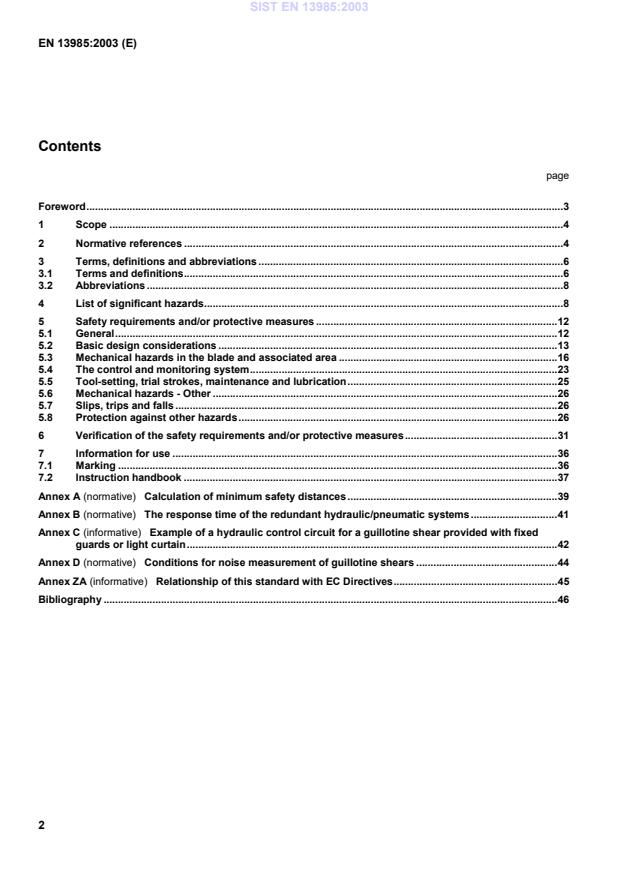
Contents
page
Foreword.3
1 Scope .4
2 Normative references .4
3 Terms, definitions and abbreviations .6
3.1 Terms and definitions.6
3.2 Abbreviations .8
4 List of significant hazards.8
5 Safety requirements and/or protective measures .12
5.1 General.12
5.2 Basic design considerations .13
5.3 Mechanical hazards in the blade and associated area .16
5.4 The control and monitoring system.23
5.5 Tool-setting, trial strokes, maintenance and lubrication.25
5.6 Mechanical hazards - Other .26
5.7 Slips, trips and falls .26
5.8 Protection against other hazards.26
6 Verification of the safety requirements and/or protective measures.31
7 Information for use .36
7.1 Marking .36
7.2 Instruction handbook .37
Annex A (normative) Calculation of minimum safety distances .39
Annex B (normative) The response time of the redundant hydraulic/pneumatic systems.41
Annex C (informative) Example of a hydraulic control circuit for a guillotine shear provided with fixed
guards or light curtain.42
Annex D (normative) Conditions for noise measurement of guillotine shears .44
Annex ZA (informative) Relationship of this standard with EC Directives.45
Bibliography .46
Foreword
This document (EN 13985:2003) has been prepared by Technical Committee CEN/TC 143 ”Machine tools -
Safety“, the secretariat of which is held by SNV.
This European Standard shall be given the status of a national standard, either by publication of an identical text or
by endorsement, at the latest by July 2003, and conflicting national standards shall be withdrawn at the latest by
July 2003.
This document has been prepared under a mandate given to CEN by the European Commission and the European
Free Trade Association, and supports essential requirements of EC Directive(s).
For relationship with EC directive(s), see informative Annex ZA, which is an integral part of this document.
Organisation contributing to the preparation of this European Standard include the European Manufacturer
Association CECIMO.
NOTE The safety requirements related to the use of PES or PPS will be dealt with at its next revision.
The European Standards produced by CEN/TC 143 are particular to machine tools and complement the relevant A
and B standards on the subject of general safety (see introduction of EN 292-1:1991 for a description of A, B and C
standards).
Annexes A, B and D are normative. Annex C is informative.
According to the CEN/CENELEC Internal Regulations, the national standards organizations of the following
countries are bound to implement this European Standard: Austria, Belgium, Czech Republic, Denmark, Finland,
France, Germany, Greece, Hungary, Iceland, Ireland, Italy, Luxembourg, Malta, Netherlands, Norway, Portugal,
Slovakia, Spain, Sweden, Switzerland and the United Kingdom.
0 Introduction
This European Standard has been prepared to be a harmonised standard to provide one means of conforming to
the essential safety requirements of the “Machinery“ Directive and associated EFTA Regulations. It is a C-type
standard as described in EN 1070:1998.
The machinery concerned and the extent to which hazards, hazardous situations and events are covered are
indicated in the scope of this standard. When provisions of this C type standard are different from those which are
stated in A or B standards, the provision of this C type standard take precedence over the provisions of the other
standards for machines that have been designed and built according to the provisions of this C type standard.
Complementary guidance is given in the A and B standards to which reference is made in the text (see clause 2).
The figures are intended to be examples only and not to give the only interpretation of the text.
The requirements of this European Standard concern designers, manufacturers, suppliers and importers of
machines described in the scope.
This standard also includes information to be provided by the manufacturer to the user.
1 Scope
1.1 This European Standard specifies technical safety requirements and measures to be adopted by persons
undertaking the design as defined in 3.11 of EN 292-1:1991, manufacture and supply of guillotine shears which are
intended to work cold metal or material partly of cold metal as defined in 3.1.7 and hereafter referred as machines.
1.2 This standard also covers guillotine shears whose primary intended use is to work cold metal, which are to
be used in the same way to work other sheet materials (e.g. cardboard, plastic, rubber, leather).
1.3 The requirements in this standard take account of intended use, as defined in 3.12 of EN 292-1:1991. This
standard presumes access to the guillotine shear from all directions, deals with the hazards described in clause 4,
and specifies the safety requirements and/or protective measures for both the operator and other exposed persons.
1.4 This standard also applies to ancillary devices which are an integral part of the guillotine shear. This
standard also applies to machines which are integrated into an automatic production line where the hazards and
risk arising are comparable to those of machines working separately.
1.5 This standard includes guillotine shears in which energy is imparted to the blade by a number of means. e.g.:
a) mechanically driven from a motor through a friction clutch;
b) through a direct drive motor and brake;
c) through hydraulic pressure;
d) through pneumatic pressure.
1.6 This standard does not cover machines whose principal designed purpose is:
a) cutting in other than a straight line (e.g. at nibbling machines);
b) cutting by continuous action at crocodile shears (see 3.4).
1.7 This standard does not cover the safety requirements related to the use of PES or PPS. They will be dealt with
at its next revision.
1.8 This standard is not applicable to machines which are manufactured before the date of publication of this
document by CEN.
2 Normative references
This European Standard incorporates by dated or undated reference, provisions from other publications. These
normative references are cited at the appropriate places in the text, and the publications are listed hereafter. For
dated references, subsequent amendments to or revisions of any of these publications apply to this European
Standard only when incorporated in it by amendment or revision. For undated references, the latest edition of the
publication referred to applies (including amendments).
EN 292-1:1991, Safety of machinery – Basic concepts, general principles for design – Part 1: Basic terminology,
methodology.
EN 292-2:1991, Safety of machinery – Basic concepts, general principles for design – Part 2: Technical principles
and specifications.
EN 294:1992, Safety of machinery – Safety distance to prevent danger zones being reached by the upper limbs.
EN 418:1992, Safety of machinery – Emergency stop equipment, functional aspects – Principles for design.
EN 563, Safety of machinery – Temperatures of touchable surfaces – Ergonomics data to establish temperature
limit values for hot surfaces.
EN 614-1, Safety of machinery – Ergonomic design principles – Part 1: Terminology and general principles.
EN 894-2:1997, Safety of machinery – Ergonomic requirements for the design of displays and control actuators –
Part 2: Displays.
EN 894-3:2000, Safety of machinery – Ergonomic requirements for the design of displays and control actuators –
Part 3: Control actuators.
EN 953:1997, Safety of machinery – Guards – General requirements for the design and construction of fixed and
movable guards.
EN 954-1:1996, Safety of machinery – Safety related parts of control systems – Part 1: General principles for
design.
EN 982:1996, Safety of machinery – Safety requirements for fluid power systems and their components –
Hydraulics.
EN 983:1996, Safety of machinery – Safety requirements for fluid power systems and their components –
Pneumatics.
EN 999:1998, Safety of machinery – The positioning of protective equipment in respect to approach speeds of
parts of the human body.
prEN 1005-2, Safety of machinery – Human physical performance – Part 2: Manual handling of machinery and
component parts of machinery.
EN 1037:1995, Safety of machinery – Prevention of unexpected started up.
EN 1050:1996, Safety of machinery – Principles for risk assessment.
EN 1070:1998, Safety of machinery –Terminology.
EN 1088:1995, Safety of machinery – Interlocking devices associated with guards – Principles for design and
selection.
EN 1837:1999, Safety of machinery – Integral lighting of machines.
EN ISO 3746:1995, Acoustics – Determination of sound power levels of noise sources using sound pressure –
Survey method using an enveloping measurement surface over a reflecting plane (ISO 3746:1995).
EN ISO 4871:1996, Acoustics – Declaration and verification of noise emission values of machinery and equipment
(ISO 4871:1996).
EN ISO 11202:1995, Acoustics – Noise emitted by machinery and equipment – Measurement of emissions of
sound pressure levels at the work station and other specified positions – Survey method in situ (ISO 11202:1995).
EN ISO 11688-1:1998, Acoustics – Recommended practice for the design of low-noise machinery and equipment –
Part 1: Planning (ISO/TR 11688-1:1995).
EN ISO 11688-2:2000, Acoustics – Recommended practice for the design of low-noise machinery and equipment –
Part 2: Introduction to the physics of low-noise design (ISO/TR 11688-2:1998).
EN ISO 14122-1, Safety of machinery – Permanent means of access to machinery – Part 1: Choice of fixed means
of access between two levels (ISO 14122-1:2001).
EN ISO 14122-2, Safety of machinery – Permanent means of access to machinery – Part 2: Working platforms and
walkways (ISO 14122-2:2001).
EN ISO 14122-3, Safety of machinery – Permanent means of access to machinery – Part 3: Stairs, stepladders
and guard-rails (ISO 14122-3:2001).
prEN ISO 14122-4, Safety of machinery – Permanent means of access to machines and industrial plants - Part 4:
Fixed ladders (ISO/FDIS 14122-4:1999).
EN 60204-1:1997, Safety of machinery – Electrical equipment of machines – Part 1: General requirements
(IEC 60204-1:1997).
EN 60529, Degrees of protection provided by enclosures (IP code) (IEC 60529:1989).
EN 60825-1, Safety of laser products – Part 1: Equipment classification, requirements and user's guide (IEC
60825-1:1993).
EN 61310-2:1995, Safety of machinery – Indication, marking and actuation – Part 2: Requirements for marking
(IEC 61310-2:1995).
EN 61496-1:1997, Safety of machinery – Electro-sensitive protective equipment – Part 1: General requirements
and tests (IEC 61496-1:1997).
prEN 61496-2:1997, Safety of machinery – Electrosensitive protective equipment – Part 2: Particular requirements
for equipment using active optoelectronic protective devices (IEC 61469-2).
3 Terms, definitions and abbreviations
3.1 Terms and definitions
For the purposes of this European Standard, the terms and definitions given in EN 1070:1998 and the following
definitions apply. Further definitions are provided in relevant A and B standards and in annex A of EN 292-
2:1991/A1:1995.
3.1.1
ancillary device
device intended for use with the guillotine shear and integrated with it (e.g. devices for lubrication, feed, ejection)
3.1.2
beam
main reciprocating guillotine shear member holding the top blade. The top blade can be guided either by direct
slide (vertically up and down) or swinging beam
3.1.3
clamp
part of the machine which holds the sheet material in position on the work table during the cutting stroke. Also
called hold-down or jack
3.1.4
crocodile shears
shears having a shearing action like that of scissors. Power is applied in an angular direction around the pivot and
the action of the blades is guided only by the pivot
3.1.5
cycle (operating cycle)
movement completed by the moving parts from the cycle start position (normally the top dead centre) to the bottom
dead centre and back to the cycle stop position (normally the top dead centre). The operating cycle includes all
operations carried out during this movement
3.1.6
dead centres
points at which the moving blade, during its travel, is
a) either at the end of the chosen closing stroke, known as the bottom dead centre (BDC),
b) or at the end of the chosen opening stroke, known as the top dead centre (TDC)
3.1.7
guillotine shears
machine, sometimes known simply as a guillotine or shears, consisting of side frames bridged by a work table to
which is fixed a bottom blade and a movable upper beam to which is fixed a top blade(s). The blades may also be
of fixed or variable angle (i.e. the angular relationship between the top and bottom blades)
Figure 1 — Guillotine shear
3.1.8
inching device; limited movement control device
control device, the actuation of which permits only a limited amount of travel of a machine element, thus minimising
risk as much as possible; further movement is precluded until there is subsequent and separate actuation of the
control (see 3.23.8 of EN 292-1:1991)
3.1.9
monitoring
safety function which ensures that a protective measure is initiated if the ability of a component or an element to
perform its function is diminished, or if the process conditions are changed in such a way that hazards are
generated (see 3.7.6 of EN 292-2:1991)
3.1.10
muting
temporary automatic suspension of a safety function(s) by safety related parts of the control system (see 3.7 of
EN 954-1:1996)
3.1.11
overall system stopping performance; overall response time
time occurring from actuating the protective device to the cessation of hazardous motion, or to the machine
assuming a safe condition
3.1.12
redundancy
application of more than one device or system, or part of a device or a system, with the objective of ensuring that,
in the event of one failing to perform its function, another is available to perform that function (see 3.44 of
EN 60204-1:1997 and 3.7.5 of EN 292-2:1991)
3.2 Abbreviations
3.2.1 M Monitoring (see 3.1.9)
3.2.2 R Redundancy (see 3.1.12)
3.2.3 S Single channel
3.2.4 BDC Bottom dead centre (see 3.1.6)
3.2.5 TDC Top dead centre (see 3.1.6)
3.2.6 PES Programmable electronic systems
3.2.7 PPS Programmable pneumatic systems
3.2.8 AOPD Active opto-electronic protective devices
3.2.9 ESPE Electro-sensitive protective equipment
4 List of significant hazards
4.1 The list of hazards contained in Table 1 is the result of a hazard identification, their associated danger zones
and reference to protective measures for guillotine shears covered by the scope of this standard. The safety
requirements and/or protective measures and information for use contained in clauses 5 and 7 are based on a risk
assessment and deal with the identified hazards by either eliminating them or reducing the effects of the risks they
generate.
4.2 The risk assessment assumes foreseeable access from all directions, as well as unexpected and unintended
strokes or gravity falls. Risks to both the operators and other persons who can have access to the danger zones
are identified, taking into account hazards which can occur under various conditions of intended use (e.g.
commissioning, setting, production, maintenance, repair, decommissioning, dismantling - see also 3.11 of
EN 292-1:1991) during the life of the machine. The assessment includes an analysis of the effect of failure in the
control system.
4.3 The user of this standard (i.e. the designer, manufacturer, supplier) shall check that the list of significant
hazards in Table 1 is complete for the machine under consideration. If the user determines that there are additional
hazards then he shall analyse and evaluate the risks associated with these hazards in accordance with EN 1050
with particular attention to the intended use of the machine (e.g. commissioning, setting, production, maintenance,
repair, decommissioning, dismantling - see also 3.11 of EN 292-1:1991), and its reasonably foreseeable misuse.
Table 1 — Significant hazards, danger zones, protective measures
No. Hazards Danger zone Relevant Relevant Protective
clauses in clauses in measures:
EN 292- EN 292- relevant
2/A1:1995 1:1991 clauses in this
standard
1.0 Mechanical hazards 1.3 4.2
Generated by machine parts (except 1.3.6)
or work-pieces Blades and associated area:
Generated by accumulation of – between the moving blade 1.5.3, 1.6.1, 4.2
energy inside the machinery and the work-piece 1.6.3
caused, for example, by: – between the moving blade
– elastic elements (springs) and the fixed blade 5.2.6
– liquids and gases under – between moving and fixed 5.5.2
pressure parts of guillotine shear 5.3
– between the table and work- 5.5
piece
– between the clamps and
work-piece or table
– between fixtures/positioning
devices and work-piece
– at power operated gauges
– moving work-pieces,
1.1 Crushing hazard – ejection or falling of work- 1.3
pieces at the rear of guillotine (except 1.3.6)
shear,
1.2 Shearing hazard – rear moving sheet supports, 1.4 (except 4.2.1
– rear sheet conveyor, 1.4.2.3),
– sheet stacking unit 1.5.14
1.3 Cutting of severing hazard From the hazardous event of
falling objects
1.4 Entanglement hazard
1.5 Drawing-in or trapping hazard
1.6 Impact hazard Moving parts of electrical, 1.3 4.2.1 5.6
hydraulic and pneumatic
equipment
Motor and drive machinery
– moving flywheels, belts,
pulleys and other motor driven
parts
Mechanical handling device
1.9 High pressure fluid injection Hydraulic systems 1.3.2 4.2.1 5.8.3
or ejection hazard
(continued)
Table 1 (continued)
No. Hazards Danger zone Relevant Relevant Protective
clauses in clauses in measures:
EN 292- EN 292- relevant
2/A1:1995 1:1991 clauses in this
standard
2 Electrical hazards due to
2.1 Contact of persons with live Electrical equipment 1.5.1, 1.6.3 4.3 5.8.3
parts (direct contact)
2.2 Contact of persons with parts Electrical equipment 1.5.1 4.3
which have become live
under faulty conditions
(indirect contact)
3 Thermal hazards
3.1 Thermal hazards resulting in Parts of the hydraulic system 1.5.5, 1.5.6, 4.4 5.2.1.5, 5.8.2
burns and scalds, by a 1.5.7
possible contact of persons
4 Hazards generated by noise
4.1 Other physiological disorders Falling of work-pieces at the 1.5.8 4.5 5.8.5, 7.2.2 g)
(e.g. loss of balance, loss of rear of guillotine shear
awareness) hearing losses
(deafness)
6 Hazards generated by
radiation
6.5 Lasers Any area at the guillotine shear 1.5.12 4.7 5.8.6
where there is a risk due to
laser beam.
7.0 Hazards generated by 5.8.7
materials and substances
processed or used by
machinery, for example:
7.1 Hazards from contact with or Toxic materials used in the 1.1.3, 1.5.13, 4.8 5.8.7.1
inhalation of harmful fluids, construction and intended use 1.6.5 5.8.7.2
gases, mists, fumes and of the guillotine shear 5.8.7.3
dusts
8.0 Hazards generated by
neglecting ergonomic
principles in machinery
design, as e.g. from:
8.1 Unhealthy postures or 1.1.2 d), 1.1.5, 4.9 5.8.8
excessive effort 1.6.2, 1.6.4
8.2 Inadequate consideration of 1.1.2 d), 2.2
hand-arm or foot-leg anatomy
8.4 Inadequate local lighting 1.1.4 5.8.8.3, 7.2.2d)
(continued)
Table 1 (continued)
No. Hazards Danger zone Relevant Relevant Protective
clauses in clauses in measures:
EN 292- EN 292- relevant
2/A1:1995 1:1991 clauses in this
standard
8.6 Human error, human 1.1.2 d), 1.2.2, 4.9 5.4.5.1, 5.4.3,
behaviour 1.2.5, 1.2.8, 5.4.6
1.5.4, 1.7
8.7 Inadequate design, location 1.2.2 5.4.3, 5.4.4,
or identification of manual 5.4.5, 5.8.8.2
controls
8.8 Inadequate design or location 1.7.1 5.8.8.2
of visual display units
10 Unexpected start-up,
unexpected overrun/ over
speed
10.1 Failure/disorder of the control 1.2.7, 1.6.3 5.2.1, 5.2.1.4,
system Blades and associated area: 5.2.1.7, 5.2.2,
5.4.1
10.2 Restoration of the energy – between the moving blade 1.2.6 5.4, 7.2.2 o)
supply after an interruption and the work-piece
– between the moving blade
and the fixed blade
– between the table and work-
piece
– between the clamps and
work-piece or table
– between fixtures/positioning
devices and work-piece
– safeguarding
– at power operated gauges
(continued)
Table 1 (concluded)
No. Hazards Danger zone Relevant Relevant Protective
clauses in clauses in measures:
EN 292- EN 292- relevant
2/A1:1995 1:1991 clauses in this
standard
10.3 External influences on – ejection or falling of work- 1.2.1, 1.5.11 5.4
electrical equipment pieces at the rear of guillotine
shear
– rear moving sheet supports,
10.4 Other external influences – rear sheet conveyor, 1.2.1
(gravity, wind etc.) – sheet stacking unit
10.5 Errors in the software 1.2.1 5.4.2
10.6 Errors made by the operator 1.1.2 d), 1.2.2, 4.9 7.2.2
(due to mismatch of machin- 1.2.5, 1.2.8,
ery with human character- 1.5.4, 1.7
istics and abilities, see 8.6)
13 Failure of the power supply see 10 1.2.6 5.2.1.12
14 Failure of the control circuit 1.2.1, 1.2.3, 5.2.1.4
1.2.4, 1.2.5,
1.2.7, 1.6.3
15 Errors of fitting
Blades 1.5.4 4.9 5.5.1, 5.5.4
16 Break-up during operation Mechanical, electrical, hydrau- 1.3.2 4.2.2 5.2.1, 5.2.2
lic, and pneumatic equipment
17 Falling or ejected objects or
Machine components 1.3.3 4.2.2 5.2.6, 5.3.13,
fluids Work-pieces and blades 5.6.4, 5.8.3
18 Loss of stability/ Floor area around the guillotine 1.3.1 4.2.2 5.8.4
overturning of machinery shear
19 Slip, trip and fall of persons All access and/or work at 1.5.15 4.2.3 5.7
(related to machinery)
heights
Floor area around the guillotine
shear
5 Safety requirements and/or protective measures
5.1 General
The guillotine shears covered by this standard range in size from small to large machines with a single operator or
several operators.
The methods or measures to be implemented to eliminate the significant hazards or reduce their associated risks
are detailed in this clause in the following manner:
basic design considerations for major guillotine components or systems (see 5.2);
safeguarding against mechanical hazards in the blade area under different modes of production (see 5.3);
protection against hazards due to control system or control component failures (see 5.4);
safeguarding against hazards which can occur during setting, trial strokes, maintenance and lubrication (see
5.5);
safeguarding against other hazards (see 5.6 to 5.8).
In addition, the machine shall be designed according to the principles of EN 292 for hazards relevant but not
significant which are not dealt with by this standard.
5.2 Basic design considerations
5.2.1 Brakes and friction clutches
5.2.1.1 Fluid or air pressure shall not be used to apply a brake unless means are provided to ensure that, in
the event of loss of fluid or air pressure, the integrity of the brake is maintained and the clutch is disengaged.
Diaphragms shall not be used to apply a brake.
5.2.1.2 The designer shall ensure that:
a) the springs used for applying the brake or disengaging the clutch are of compression type and well tried
components;
b) multiple assemblies are used;
c) all the springs are closely uniform in dimension, quality and rating;
d) the means of loading the springs are such that, when adjusted, the spring anchorages can be locked to
prevent slackening back;
e) the arrangements for spring housing and guiding, and of guide pins, are such as to minimize binding;
f) the brake can function even if 50 % of the spring assembly has failed.
5.2.1.3 The arrangement provided for engagement and disengagement of the clutch and brake shall not affect
their safe function.
NOTE Combined clutch and brake units are recommended so as to reduce the possibility of the overlapping of their
engagement.
5.2.1.4 The clutch and brake shall be designed so that failure of components e.g. for power transmission or
screws shall not prevent the clutch to be disengaged and the brake to be applied.
5.2.1.5 Any heat generated which can cause a hazardous situation shall be dissipated.
5.2.1.6 Effective arrangements shall be made to prevent reduction of braking performance due to penetration
of lubricants to the brake friction surfaces.
5.2.1.7 The clutch and brake shall be designed in such a way that the accumulation of dust, fluid or debris is
minimised in areas likely to give rise to inefficient brake or clutch performance and any moisture, dust or lubricating
oil, which breaks or corrodes packaging material (e.g. gaskets and seals), cannot influence the required function
adversely (e.g. by obstructing an air channel or otherwise affecting their efficiency).
5.2.1.8 Band brakes shall not be used on guillotine shears for the purpose of stopping the beam.
5.2.1.9 Clutches shall be of a capacity capable of engaging and disengaging the intended stroke, without
excessive temperature rise, under conditions of maximum use of the guillotine shears.
5.2.1.10 Sufficient working clearances shall be provided so as to ensure that, under the severest conditions of
operation and temperature, no undesired movement of the driven members shall take place.
5.2.1.11 Arrangements shall be made to prevent the accumulation of debris evolved from frictional surfaces in
places where it might give rise to inefficient clutch performance, and for its effective dispersal.
5.2.1.12 The clutch and brake and their control system shall be designed so that, in the event of failure of
pneumatic, hydraulic or electrical supply, the clutch is disengaged and the brake is immediately applied.
5.2.1.13 If diaphragms are used in a clutch system, measures shall be taken to avoid damage by the cutting
effect of sharp edges or wearing by rough surfaces. Evacuation of air shall not be prevented due to slackening of
the diaphragm, e.g. due to material fatigue.
5.2.2 Hydraulic and pneumatic systems - Common features
5.2.2.1 The general requirements in EN 982 and EN 983 shall be applied in designing hydraulic and
pneumatic systems. These systems shall also comply with the particular requirements in 5.2.2, 5.2.3 and 5.2.4.
5.2.2.2 Filters and pressure regulators shall be provided.
5.2.2.3 Devices shall be provided to ensure that the permitted range of working pressure is maintained.
5.2.2.4 Pressurised transparent bowls (e.g. glass, plastic) shall be protected to prevent injury from flying
particles without affecting visibility.
5.2.2.5 All piping, pipe fittings, passages, surge or storage tanks and cored or drilled holes, shall be free from
burrs or foreign matter which might cause damage e.g. to valves or clutch and brake operating parts (see 5.3.4.2.3
of EN 982:1996 and 5.3.4.2.3 of EN 983:1996).
5.2.2.6 Each run of piping shall, where practicable, be continuous from one piece of apparatus to another.
Precautions shall be taken to prevent damage by thermal expansion. Rigid piping shall be securely supported at
frequent intervals to avoid vibration or movement.
Care shall be taken to avoid kinking of flexible pipes used to carry fluids. Such kinking can cause traps which
prevent the fluid exhausting. This applies particularly to piping feeding the running joint of the clutch and brake.
5.2.2.7 Where a drop in pressure could lead to unintended dangerous motion of the beam, pipes and pipe
connections shall be chosen to prevent such a loss of pressure. Such pipe connections shall be flanged or welded.
5.2.2.8 The support of operating valves shall not depend only on the connected piping. This is to avoid
undesirable effects from vibration which might affect both valves and piping.
5.2.2.9 Operating valves for clutch and brake shall be so designed as to ensure that, when in the non-
operating position, leakage past the inlet valve will escape sufficiently freely to prevent build-up of pressure in the
clutch-operating cylinder.
5.2.2.10 Operating valves for clutch and brake shall be so designed that it is not possible for both the inlet port
and the exhaust ports to remain closed at the same time.
5.2.2.11 Exhaust ports and piping between clutch operating cylinders and valves shall be selected to ensure
prompt release of fluid from clutch operating cylinders. Precautions shall be taken to ensure that the exhaust ports
of operating valves prevent residual pressure in the cylinder. The valve shall be selected so that the pressure ratio
between clutch and brake is such that the residual pressure in the cylinder will not become excessive in the event
of a valve fault.
NOTE Normally, a ratio of at least 3.5 to 1 between spring pressure in the brake and residual pressure in the cylinder is
satisfactory.
5.2.2.12 Control valves and other control components (e.g. regulators, pressure gauges) shall be mounted in
positions which provide accessibility and protection against damage.
5.2.2.13 Where valves are manually or mechanically (as distinct from electrically) operated, the arrangements
for restoring the valves shall be positive (i.e. when the actuator of the valve is released, the valve shall
automatically move to the safe position). See also 5.4.6.
Any unintended movement due dissipation shall be avoided of stored energy according to EN 1037.
NOTE The safety position can be the open or closed position of a valve, depending upon the well-tried principles in the
hydraulic or pneumatic circuit.
5.2.3 Pneumatic systems
5.2.3.1 Where valves or other movable parts of the guillotine shear control system require lubrication, visible
automatic means of lubrication shall be provided to introduce the oil into the air line in suitable form. The presence
of oil shall be visible.
5.2.3.2 Where silencing systems are fitted, they shall be provided and installed in accordance with the valve
manufacturer´s instructions for use in safety systems and their effect on braking performance shall be taken into
account. Only non-clogging direct to atmosphere silencers are permissible to brake/clutch manufacturers´
specifications.
5.2.3.3 Water separators shall be provided.
5.2.4 Hydraulic systems
5.2.4.1 The circuit shall be protected by a pressure limiting valve(s). These valves shall not be capable of
alteration without the use of a tool; also they shall be set at a pressure which is no more than 10 % higher than the
maximum operating pressure.
5.2.4.2 In order to prevent unexpected start up of dangerous movement (see EN 1037), hydraulic systems
which include accumulators shall allow the fluid pressure to fall when the pressure generating unit is stopped. If this
is impossible, the parts of the circuit which are maintained under pressure shall be supplied with a manual
discharge valve in addition to the other devices required by standards or rules concerning accumulators (e.g. relief
valves, pneumatic gauges) and bear a clear indication (by means of a descriptive plate) of the hazard (see 5.3.4.5
of EN 982:1996).
5.2.4.3 A pressure relief valve(s) shall be provided to protect from damage due to over pressure the annular
part of cylinder and other relevant components. The pressure relief valve(s) shall operate at 10 % above the design
maximum operating pressure. The pressure relief valve(s) shall be directly operated and its setting sealed. The
components it protects shall be designed to sustain the pressure at which the valve is set. The relief valve shall be
constructed so that, if a single break in the spring occurs, the space between the windings remains less than one
wire thickness. The spring shall be guided.
5.2.5 Electrical systems
The electrical equipment of the machine shall comply with EN 60204-1, together with the following:
5.2.5.1 The designer of a guillotine shear shall consider whether the limits of the power supply, the physical
environment as well as the operating conditions of some components are different than 4.3 and 4.4 of
EN 60204-1:1997. In this case, the choice of relevant components has to be made in this respect.
5.2.5.2 The emergency stop shall function as a category 0 stop (see 9.2.5.4 of EN 60204-1:1997 and 5.4.5.2)
and shall stop all hazardous movements. The emergency stop shall stop all hazardous movements (e.g. beam,
back gauges, supports, integral handling devices). A category 1 emergency stop function complying to 9.2.2 and
9.2.5.4.2 of EN 60204-1:1997 may be used for electronic controlled drives for example on machines equipped with
automatic feed and/or removal systems or electrical drive of the stroke.
5.2.5.3 The minimum degree of protection for operator interface and press-mounted control devices shall be of
at least IP 54 according to EN 60529.
5.2.5.4 Enclosures of control-gear shall provide a degree of protection of at least IP 54 (see
EN 60529).
5.2.5.5 Arrangements shall be made to ensure that a short-circuit in the wiring outside the control cabinet (e.g.
wiring to a foot pedal) shall not result in an unexpected start-up (see EN 1037).
5.2.6 Prevention of unintended gravity fall of the blade during maintenance or repair
5.2.6.1 Where there is a risk of injury from a gravity fall exists, a mechanical restraint device, e.g. a scotch
shall be provided to be inserted in the guillotine shear for use during repair or any necessary intervention between
the tools other than normal manual feeding.
5.2.6.2 Where the device is not capable of absorbing the entire guillotine shear force, it shall be interlocked to
the guillotine shear control so that a closing stroke cannot be performed while the device is in position, and the
beam is retained in the upper position (see EN 1037).
5.3 Mechanical hazards in the blade and associated area
5.3.1 The major danger zone at guillotine shears is the blade and associated area and protective measures need
to be taken to deal with the relevant hazards. This sub-clause indicates how the hazards in the blade and
associated area shall be safeguarded. No safeguarding is required where the gap between the closing surfaces
cannot exceed 6 mm.
Key
1 Crushing hazard
2 Shear hazard
3 Moving blade
4 Moving clamp
5 Fixed guard
NOTE See Table 2 for values of A and B.
Figure 2 — Feed opening in a fixed guard at the front side of a guillotine shear
Table 2 — Height of feed openings and minimum related safety distances
A – Height of feed opening B – Minimum related safety
(mm) distance (mm)
A £ 6 0
6 < A £ 7 15
7 < A £ 8 20
8 < A £ 10 40
10 < A £ 12 65
12 < A £ 16 90
16 < A £ 20 120
20 < A £ 22 165
22 < A£ 32 190
32 < A £ 35 230
35 < A £ 38 320
38 < A £ 48 400
48 < A £ 55 450
55 < A £ 120 850
NOTE See Figure 2 for understanding of A and B.
For guillotine shears with height of feed opening A exceeding 38 mm safeguarding by interlocking guards or ESPE
using AOPD is recommended.
3a - Example of safeguarding using fixed guards
Key
1 Machine 3 Detection zone
2 Light curtain 4 Table
3b - Example of safeguarding using light curtain
Figure 3 — Guards fitted to guillotine shears to prevent front and side access
5.3.2 Guards and devices described in EN 292, EN 953,and 5.3.3.1, 5.3.5, 5.3.6.1 which are appropriate to the
protection of any exposed person at the cutting area are listed below. Designers, manufacturers and suppliers shall
provide wherever possible fixed guards to prevent access of exposed persons to the moving parts. Where fixed
guarding is not practicable, designers, manufacturers, and suppliers shall select safeguarding methods which
reduce the risks as far as possible, considering the principal hazards and the mode of production:
a) interlocking guards (see EN 292, EN 953, EN 1088, 5.3.3.2, 5.3.3.3, 5.3.6.2);
b) electro-sensitive protective devices (see EN 61496–1, pr EN 61496–2, 5.3.3.4, 5.3.6.3).
5.3.3 Access from the front
5.3.3.1 General
The selected combination of safeguarding methods shall protect all exposed persons, (i.e. those who can gain
access to the danger zone during operation, setting, maintenance, cleaning and inspection activities), as described
in 4.2.
The provided guards and protective devices shall be at least interfaced with the control system of the guillotine
shear in the same category as required for these guards and devices.
The machine front table extension shall exceed the front safeguarded area.
The relationship between the dimension of the feed opening and the distance to the nearest danger point (plate
clamps/cutting line) shall follow Table 2 (see also Figure 2.).
5.3.3.2 Fixed guards
Where a fixed guard is used it shall prevent access from the front of the guillotine shears to the danger zone
(nearest danger point) created by the moving blade and plate clamps. Fixed guards shall comply with EN 292,
EN 953 and 5.3.2, 5.3.5, 5.3.6.1. They shall be firmly secured to the machine. The openings giving access to
danger zones and related safety distances of the fixed guard shall comply with Table 4 of EN 294:1992.
The design of the fixed guard shall allow good visibility of the cutting line.
Access shall be prevented to the danger zone via slots or grooves cut in the surface of the work table (see also
Table 2).
5.3.3.3 Interlocking guards without guard locking
Interlocking guards without guard locking shall comply with EN 953 and prevent, in conjunction with fixed guards,
access to the danger zone (clamps, cutting line) during any hazardous movement. Initiation of the stroke shall be
prevented until the guard gate is closed. The associated interlocking devices shall conform to EN 1088 and be
designed and constructed in accordance with 6.2.2 of EN 1088:1995. The associated control system of the
guillotine shear shall conform to category 4 of EN 954-1:1996. Interlocking guards without guard locking shall be
placed in such a position that the operator does not have time to reach the danger zone before any hazardous
movement in the tools area has ceased. Calculation of the safety distance shall be based on the overall response
time of the guillotine shear coming to a stop and on the speed of movement of the operator. See EN 999 and
annex A.
5.3.3.4 ESPE using AOPDs in the form light curtains
ESPE using AOPDs in the form of light curtains shall comply with the following:
a) light curtains and light beams shall conform to type 4 in accordance with 4.2.2.5 of EN 61496-1:1997, and be
designed and constructed according to pr EN 61496-2:1997. The associated part of the control system of the
guillotine shear shall conform to category 4 of EN 954-1:1996;
b) access to the danger zone shall only be possible through the detection zone of the light curtain. Additional
safeguarding shall prevent access to the danger zone from any o
...
Questions, Comments and Discussion
Ask us and Technical Secretary will try to provide an answer. You can facilitate discussion about the standard in here.
Loading comments...