

EN 13890:2009
(Main)Workplace exposure - Procedures for measuring metals and metalloids in airborne particles - Requirements and test methods
- Abstract
This European Standard specifies performance requirements and test methods for the evaluation of procedures for measuring metals and metalloids in airborne particles sampled onto a suitable collection substrate, e.g. a filter.
This European Standard specifies a method for estimating the uncertainties associated with random and systematic errors and combining them to calculate the expanded uncertainty of the measuring procedure as a whole, as prescribed in EN 482.
This European Standard is applicable to measuring procedures in which sampling and analysis is carried out in separate stages, but it does not specify performance requirements for collection, transport and storage of samples, since these are dealt with in EN 13205 and ISO 15767.
This European Standard is not applicable to procedures for measuring metals or metalloids present as inorganic gases or vapours, e.g. mercury, arsenic (see EN 838 and EN 1076), or to procedures for measuring metals and metalloids in compounds that could be present as a particle/vapour mixture, e.g. arsenic trioxide.
- Status
- Withdrawn
- Publication Date
- 15-Sep-2009
- Withdrawal Date
- 06-Oct-2026
- Technical Committee
- CEN/TC 137 - Assessment of workplace exposure
- Drafting Committee
- CEN/TC 137/WG 2 - General requirements for measuring procedures
- Current Stage
- 9960 - Withdrawal effective - Withdrawal
- Start Date
- 08-Apr-2020
- Completion Date
- 07-Oct-2026



Relations
- Effective Date
- 19-Sep-2009
- Effective Date
- 08-Jun-2022
- Effective Date
- 28-Jan-2026
- Effective Date
- 28-Jan-2026
- Effective Date
- 28-Jan-2026
- Effective Date
- 28-Jan-2026
- Effective Date
- 28-Jan-2026
- Effective Date
- 28-Jan-2026
- Effective Date
- 28-Jan-2026
- Effective Date
- 28-Jan-2026
- Effective Date
- 28-Jan-2026
- Effective Date
- 28-Jan-2026
- Effective Date
- 28-Jan-2026
- Effective Date
- 28-Jan-2026
- Effective Date
- 28-Jan-2026
Get Certified
Connect with accredited certification bodies for this standard

CIS Institut d.o.o.
Personal Protective Equipment (PPE) certification body. Notified Body NB-2890 for EU Regulation 2016/425 PPE.

Kiwa BDA Testing
Building and construction product certification.
Kmetijski inštitut Slovenije
Agricultural Institute of Slovenia. Soil testing, plant health, agricultural product analysis.
Sponsored listings
Frequently Asked Questions
EN 13890:2009 is a standard published by the European Committee for Standardization (CEN). Its full title is "Workplace exposure - Procedures for measuring metals and metalloids in airborne particles - Requirements and test methods". This standard covers: This European Standard specifies performance requirements and test methods for the evaluation of procedures for measuring metals and metalloids in airborne particles sampled onto a suitable collection substrate, e.g. a filter. This European Standard specifies a method for estimating the uncertainties associated with random and systematic errors and combining them to calculate the expanded uncertainty of the measuring procedure as a whole, as prescribed in EN 482. This European Standard is applicable to measuring procedures in which sampling and analysis is carried out in separate stages, but it does not specify performance requirements for collection, transport and storage of samples, since these are dealt with in EN 13205 and ISO 15767. This European Standard is not applicable to procedures for measuring metals or metalloids present as inorganic gases or vapours, e.g. mercury, arsenic (see EN 838 and EN 1076), or to procedures for measuring metals and metalloids in compounds that could be present as a particle/vapour mixture, e.g. arsenic trioxide.
This European Standard specifies performance requirements and test methods for the evaluation of procedures for measuring metals and metalloids in airborne particles sampled onto a suitable collection substrate, e.g. a filter. This European Standard specifies a method for estimating the uncertainties associated with random and systematic errors and combining them to calculate the expanded uncertainty of the measuring procedure as a whole, as prescribed in EN 482. This European Standard is applicable to measuring procedures in which sampling and analysis is carried out in separate stages, but it does not specify performance requirements for collection, transport and storage of samples, since these are dealt with in EN 13205 and ISO 15767. This European Standard is not applicable to procedures for measuring metals or metalloids present as inorganic gases or vapours, e.g. mercury, arsenic (see EN 838 and EN 1076), or to procedures for measuring metals and metalloids in compounds that could be present as a particle/vapour mixture, e.g. arsenic trioxide.
EN 13890:2009 is classified under the following ICS (International Classification for Standards) categories: 13.040.30 - Workplace atmospheres. The ICS classification helps identify the subject area and facilitates finding related standards.
EN 13890:2009 has the following relationships with other standards: It is inter standard links to EN 13890:2002, EN ISO 21832:2020, EN ISO 13137:2022, EN 13205-4:2014, EN 13205-5:2014, EN 1540:1998, EN 13205-1:2014, EN 13205-6:2014, CEN/TR 13205-3:2014, EN 13205-2:2014, EN 482:2006, EN ISO 3696:1995, EN 1232:1997, EN 481:1993, EN ISO 19108:2005. Understanding these relationships helps ensure you are using the most current and applicable version of the standard.
EN 13890:2009 is available in PDF format for immediate download after purchase. The document can be added to your cart and obtained through the secure checkout process. Digital delivery ensures instant access to the complete standard document.
Standards Content (Sample)
2003-01.Slovenski inštitut za standardizacijo. Razmnoževanje celote ali delov tega standarda ni dovoljeno.Exposition am Arbeitsplatz - Messung von Metallen und Metalloiden in luftgetragenen Partikeln - Anforderungen und PrüfverfahrenExposition sur les lieux de travail - Procédures pour le mesurage des métaux et métalloïdes dans les particules en suspension dans l'air - Exigences et méthodes d'essaiWorkplace exposure - Procedures for measuring metals and metalloids in airborne particles - Requirements and test methods13.040.30Kakovost zraka na delovnem mestuWorkplace atmospheresICS:Ta slovenski standard je istoveten z:EN 13890:2009SIST EN 13890:2009en,fr,de01-november-2009SIST EN 13890:2009SLOVENSKI
STANDARDSIST EN 13890:20031DGRPHãþD
EUROPEAN STANDARDNORME EUROPÉENNEEUROPÄISCHE NORMEN 13890September 2009ICS 13.040.30Supersedes EN 13890:2002
English VersionWorkplace exposure - Procedures for measuring metals andmetalloids in airborne particles - Requirements and test methodsExposition sur les lieux de travail - Procédures pour lemesurage des métaux et métalloïdes dans les particules ensuspension dans l'air - Exigences et méthodes d'essaiExposition am Arbeitsplatz - Messung von Metallen undMetalloiden in luftgetragenen Partikeln - Anforderungen undPrüfverfahrenThis European Standard was approved by CEN on 8 August 2009.CEN members are bound to comply with the CEN/CENELEC Internal Regulations which stipulate the conditions for giving this EuropeanStandard the status of a national standard without any alteration. Up-to-date lists and bibliographical references concerning such nationalstandards may be obtained on application to the CEN Management Centre or to any CEN member.This European Standard exists in three official versions (English, French, German). A version in any other language made by translationunder the responsibility of a CEN member into its own language and notified to the CEN Management Centre has the same status as theofficial versions.CEN members are the national standards bodies of Austria, Belgium, Bulgaria, Cyprus, Czech Republic, Denmark, Estonia, Finland,France, Germany, Greece, Hungary, Iceland, Ireland, Italy, Latvia, Lithuania, Luxembourg, Malta, Netherlands, Norway, Poland, Portugal,Romania, Slovakia, Slovenia, Spain, Sweden, Switzerland and United Kingdom.EUROPEAN COMMITTEE FOR STANDARDIZATIONCOMITÉ EUROPÉEN DE NORMALISATIONEUROPÄISCHES KOMITEE FÜR NORMUNGManagement Centre:
Avenue Marnix 17,
B-1000 Brussels© 2009 CENAll rights of exploitation in any form and by any means reservedworldwide for CEN national Members.Ref. No. EN 13890:2009: ESIST EN 13890:2009
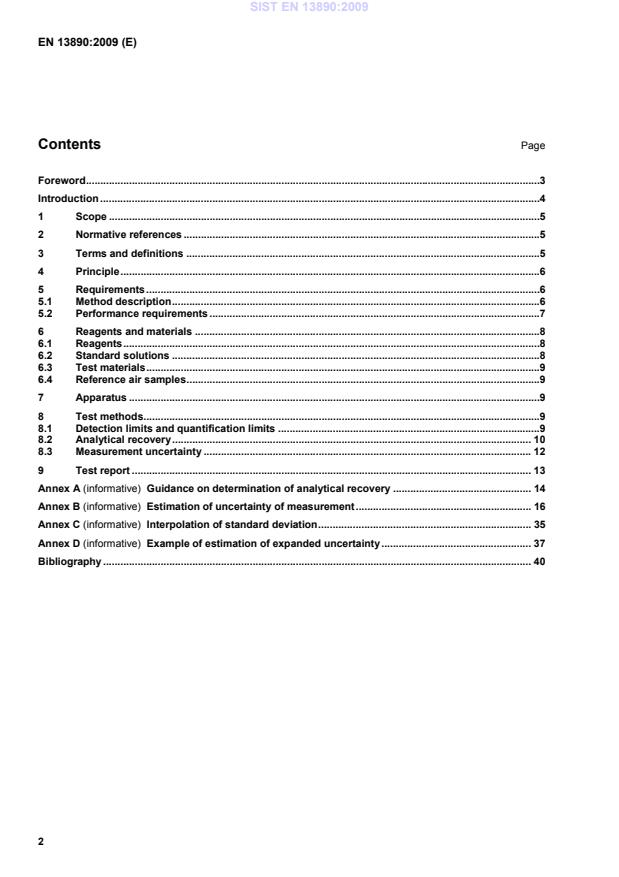
Guidance on determination of analytical recovery . 14Annex B (informative)
Estimation of uncertainty of measurement . 16Annex C (informative)
Interpolation of standard deviation . 35Annex D (informative)
Example of estimation of expanded uncertainty . 37Bibliography . 40 SIST EN 13890:2009
1) All references to EN 13205 in this European Standard refer to the ongoing revision of EN 13205:2001. 2) EN 1540:1998 is currently subject to revision. Until the revised EN is published the definitions given in EN 482:2006 take precedence. SIST EN 13890:2009
The scope of the measuring procedure shall give at least information about the following: the metals and metalloids covered by the measuring procedure; the analytical technique(s) used in the measuring procedure; the range of concentrations of metals and metalloids in air for which the measuring procedure has been shown to meet the acceptance criteria for expanded uncertainty prescribed in EN 482, together with the associated range of sampled air volumes (e.g. 0,01 mg ⋅ m-3 to 0,5 mg ⋅ m-3 for sampled air volumes in the range 240 l to 960 l); any form of the metals and metalloids for which the sample preparation method described has been shown to be or is known to be ineffective; and
any known interferences. NOTE If there is no procedure for measuring a particular metal or metalloid that meets the requirements of this European Standard, a measuring procedure whose performance is nearest to the specified requirements should be used. SIST EN 13890:2009
(1) SIST EN 13890:2009
is the lower limit of the required analytical range of the metal or metalloid, in micrograms;
is the limit value for the metal or metalloid, in milligrams per cubic metre;
is the design flow rate of the sampler to be used, in litres per minute; and
is the minimum sampling time that will be used, in minutes. For procedures that involve sample dissolution, calculate the lower limit of the required working range for each metal and metalloid, in micrograms per millilitre, by dividing the lower limit of the required working range, in micrograms, by the volume of the test solution, in millilitres. When tested in accordance with 8.1.2.1, the determined quantification limits shall be lower than the resulting values. For procedures that do not involve sample dissolution, when tested in accordance with 8.1.2.2, the determined quantification limits for each metal and metalloid shall be lower than the lower limit of the required working range in micrograms. 5.2.2 Analytical recovery When tested in accordance with one of the procedures prescribed in 8.2, the mean analytical recovery shall be at least 90 % for all material types included within the scope of the measuring procedure and the coefficient of variation3) of the analytical recovery shall be less than 5 %. 5.2.3 Expanded uncertainty The expanded uncertainty of the measuring procedure shall comply with the requirements specified in EN 482. 6 Reagents and materials 6.1 Reagents During the analysis, use only reagents of analytical grade, and only water complying with the requirements for EN ISO 3696 grade 2 water (electrical conductivity less than 0,1 mS ⋅ m-1, i.e. resistivity greater than 0,01 MΩ ⋅ m, at 25 °C). It is recommended that the water used be obtained from a water purification system that delivers ultrapure water having a resistivity greater than 0,18 MΩ ⋅ m (usually expressed by manufacturers of water purification systems as 18 MΩ ⋅ cm water). 6.2 Standard solutions Standard solutions with concentrations of the metals and metalloids of interest that are traceable to national and/or international standards. If commercial standard solutions are used observe the manufacturer's expiry date or recommended shelf life.
3) The predecessor term "relative standard deviation" is deprecated. See also ISO 3534-1:2006, 2.38, Note 2. SIST EN 13890:2009
an instrument or instruments for analysing the metals and metalloids of interest. 8 Test methods 8.1 Detection limits and quantification limits 8.1.1 Instrumental detection limit 8.1.1.1 For measuring procedures that involve sample dissolution, analyse the calibration blank solution at least ten times under repeatability conditions. If there is no measurable response from the analytical instrument, prepare a test solution with concentrations of the metals or metalloids of interest near their anticipated instrumental detection limits by diluting the standard solutions (6.2) by an appropriate factor. Analyse the test solution at least ten times under repeatability conditions. NOTE For measuring procedures that involve analysis of the sample on the collection substrate, an instrumental detection limit is not a meaningful concept and, as such, cannot be determined. SIST EN 13890:2009
Guidance on determination of analytical recovery A.1 Procedures for soluble compounds of metals and metalloids A.1.1 In general, procedures for the determination of soluble compounds of metals and metalloids in workplace air incorporate a design-based sample dissolution method, i.e. soluble compounds of metals and metalloids are defined as such by the specific leach solution and leach conditions prescribed or envisaged for sample dissolution when the corresponding limit values were set 4). This is because, except for compounds that have a very high or very low solubility in water, solubility is dependent upon the nature of the leach solution and other factors such as particle size, solute/solvent ratio, temperature etc. Consequently, by definition, the analytical method gives 100 % recovery and the analytical bias is zero. A.1.2 However, there are circumstances in which procedures for the determination of soluble compounds of metals and metalloids in workplace air can give incorrect results. In particular, this can occur if a soluble compound reacts with the collection substrate, or a contaminant on it, to produce an insoluble compound. For example, a low recovery will be obtained for soluble silver compounds if the filter used is contaminated with chloride (see reference [6]). Consideration should therefore be given to chemical compatibility when selecting collection substrates for soluble compounds of metals and metalloids (see ISO 15202-1). If it is believed that there could be a chemical compatibility problem, tests should be performed to confirm that analytical recovery is satisfactory. A.2 Procedures that involve sample dissolution A.2.1 Most procedures for measuring metals and metalloids in airborne particles involve sample dissolution, e.g. procedures in which the analysis is carried out by atomic absorption spectrometry (AAS), inductively coupled plasma – atomic emission spectrometry (ICP – AES) and inductively coupled plasma - mass spectrometry (ICP-MS). The major source of analytical bias for this type of procedure is usually incomplete dissolution of the metals or metalloids of interest. The analytical bias can therefore be estimated by testing the effectiveness of the sample dissolution method on a range of suitable, well-characterised bulk materials (e.g. pure compounds of the metal or metalloid of interest, certified reference materials). A.2.2 The analytical method should normally not exhibit a bias. If there are clearly identifiable sample types for which the measuring procedure as a whole is not suitable because the sample dissolution method gives poor recoveries, these should be excluded from the scope of the procedure. A.2.3 In some instances, the use of results obtained from the analysis of certified reference materials (CRMs) and/or pure compounds can lead to an over-estimate of the analytical bias because air samples containing a much smaller amount of material of much smaller particle size are much more readily taken into solution. If this could be the case, it might be possible to obtain a more relevant estimate of analytical bias by repeating the sample dissolution experiments on test filters prepared by generating a homogenous dust cloud from the test material and collecting replicate samples using a multiport sampling device.
4) For soluble metal and metalloid compounds that have a limit value that does not have an associated prescribed measuring procedure, it is recommended that the sample dissolution procedure prescribed in ISO 15202-2 is used. SIST EN 13890:2009
Estimation of uncertainty of measurement B.1 General Methods for measurement of chemical agents in airborne particles involve two major steps: sampling and analysis. The following is a typical, but non-exclusive, list of random and non-random uncertainty components: a) sampling 1) uncertainty associated with sampled air volume (see B.2); 2) uncertainty associated with sampling efficiency (see B.3); and 3) uncertainty associated with sample storage and transportation, if any (see B.4). b) analysis 1) uncertainty associated with analytical recovery (see B.5); 2) uncertainty associated with analytical precision (see B.6.3.1 or B.6.4.1); 3) uncertainty associated with the calibration (see B.6.3.2 and B.6.3.3 or B.6.4.2 and B.6.4.3); 4) uncertainty associated with dilution of sample solutions, if applicable (see B.6.3.4 or B.6.4.4); 5) uncertainty associated with instrument response drift (see B.6.3.5 or B.6.4.5); and 6) uncertainty associated with blank subtraction (see B.6.5). B.2 Uncertainty associated with sampled air volume B.2.1 Sources of uncertainty For pumped sampling, the sampled air volume has the following sources of uncertainty: flow rate measurement (see B.2.2), pump flow stability (see B.2.3); and sampling time (see B.2.4). B.2.2 Flow rate measurement Flow rate measurements can be carried out using a range of different devices, e.g. rotameters, mass flow meters, bubble flow meters or dry piston flow meters. Flow rate measurement error arises from three sources: the calibration of the flow meter (non-random), the reading of the flow meter (random) and, where appropriate, correction of the flow rate reading to ambient pressure and temperature. SIST EN 13890:2009
% Uncertainty of
flow rate calibrationa % Uncertainty of
flow rate readingb % rotameter, 30 cm lengthc 100 1,6 0,23 50 2,0 0,45 10 5,2 2,3 Flow meter type Flow meter measuring range l ⋅ min-1 Measured flow rate
l ⋅ min-1 Uncertainty of
flow rate calibrationa
% Uncertainty of
flow rate readingb
% mass flow meter 0,1 to 15 2,0 0,61 2,0 Flow meter type Flow cell measuring range l ⋅ min-1 Measured flow rate
l ⋅ min-1 Uncertainty of
flow rate calibrationa
% Uncertainty of
flow rate readingb
% bubble flow meter 0 to 0,25 0,12 0,4 0,35 0,2 to 6
2,0 0,12 0,1 2 to 30 3,0 0,06 0,22 dry piston flow meter 0,5 to 5 2,0 0,59 0,26 0,5 to 25 3,0 0,41 0,07 a Flow rate calibration uncertainties calculated assuming a rectangular probability distribution A/√3, where A is the distribution value from the flow meter calibration certificate. b Flow rate reading uncertainties based on ten measurements. c The uncertainty of the flow rate reading of an analogue flow meter depends upon the resolution of the scale of the instrument. If the flow rate is measured several times, the uncertainty of the flow rate reading is reduced by a factor of 1/√n, where n is the number of measurements of the flow rate. If a generally applicable estimate of uncertainty is to be made for a method that does not specify the use of a particular type of flow meter, the uncertainty components for a mass flow meter given in Table B.1 should be used, as this constitutes a worst-case scenario if the use of an inappropriate rotameter is disregarded. B.2.3 Pump flow stability Pumps for personal air sampling are usually self-regulating and maintain the set flow rate independent of variation in back pressure. EN 1232 and EN 12919 require that the flow rate is maintained to within ± 5 % of the set value throughout the sampling period. Assuming a rectangular probability distribution, the maximum acceptable value of a non-random uncertainty component of the pump flow stability is 5/√3 %. Actual values for the pump flow stability can be less than 5 %. It can be estimated from the value given by manufacturer or from the results of the test in EN 1232:1997, 6.6. Assuming a rectangular probability SIST EN 13890:2009
is the difference between the mean reading of the flow rate at minimum and maximum back pressure, in percent. B.2.4 Sampling time Sampling time can be measured very exactly with a radio controlled clock, a quartz clock or stopwatch. The major source of uncertainty in measurement of sampling time is the accuracy with which the reading is taken, i.e. to the nearest minute or second.
If the reading is taken to the nearest second, the non-random uncertainty component is very small for both long-term and short-term measurements and can be negligible. If the reading is taken to the nearest minute, the non-random component is very small for long-term measurements (e.g. > 2 h) and can be disregarded, but for short-term measurements it needs to be taken into account. For example, if time is recorded to the nearest minute, the coefficient of variation is 2,7 % for a sampling time of 15 min (summing the maximum 0,5 min biases at the start and end of the sampling period and dividing by the sampling time and √6, assuming a triangular probability distribution). If the pump is supplied with an internal timer, EN 1232 require that after 8 h the indicated time shall not deviate more than 5 min from a reference timer. The maximum tolerance for the sampling time is 1 %. Assuming a rectangular probability distribution, the maximum acceptable value of a non-random uncertainty component is 1/√3 = 0,58 %. B.3 Uncertainty associated with sampling efficiency B.3.1 General Aerosol samplers have to follow one or more of the sampling conventions defined in EN 481. Aerosol sampling methods have random and non-random uncertainty components that arise from how closely the samplers u
...