

EN 1705:2025
(Main)Plastics piping systems - Thermoplastics valves - Test method for the integrity of a valve after an external blow
- Abstract
This document specifies a test method for determining the leak tightness and the ease of operation and stop resistance of a valve made of thermoplastic material following an impact applied to the operating device.
- Status
- Published
- Publication Date
- 20-May-2025
- Technical Committee
- CEN/TC 155 - Plastics piping systems and ducting systems
- Drafting Committee
- CEN/TC 155/WG 32 - Valves
- Current Stage
- 6060 - Definitive text made available (DAV) - Publishing
- Start Date
- 21-May-2025
- Due Date
- 26-Nov-2025
- Completion Date
- 21-May-2025

Overview
EN 1705:2025 - Plastics piping systems - Thermoplastics valves - Test method for the integrity of a valve after an external blow (CEN) specifies a standardized impact test and follow‑up assessments to verify the integrity of thermoplastic valves after an external strike to the operating device. The standard defines how to check external leak tightness, operating torque, and stop‑mechanism resistance after impact, including required conditioning temperatures and test sequence. EN 1705:2025 replaces EN 1705:1996 and includes clarifications for thermoplastic materials and high‑risk impact positions.
Key topics and technical requirements
- Scope and purpose: Determines leak tightness and ease of operation of valves made of thermoplastic material following an external blow.
- Impact principle: A falling weight (striker) is applied once to the most critical position of the valve operating device (axial or perpendicular impacts as illustrated). Impact parameters (mass, striker geometry, drop height) are set by the referring product standard or agreed between parties.
- Test temperatures: Unless specified otherwise, tests are performed at −20 °C and +40 °C with specified conditioning times.
- Performance checks after impact:
- Measure opening and closing torques per EN ISO 8233 before and after impact.
- Apply stop resistance torque for 15 s with the obturator in open and closed positions and record damage/malfunction.
- Assess external leak tightness after conditioning in a water bath (20 ± 2 °C for ≥12 h) and pneumatic pressurization: first 25 mbar over hydrostatic head, then 1.5 × MOP (or 1.5 × PN) held for ≥30 s.
- Apparatus: Clamping fixture to rigidly support the valve, falling weight machine conforming to EN ISO 3127, torque‑measuring device, temperature‑controlled environments, and pneumatic pressurizing/measurement equipment.
- Test pieces & sampling: Valve in as‑manufactured condition unless the referring product standard specifies otherwise; minimum one test piece per impact position unless otherwise required.
- Test report: Must reference EN 1705:2025 and include product identification, test temperatures, obturator/valve positions at impact, measured torques, visual damage and leak test results.
Practical applications and who uses this standard
- Manufacturers of thermoplastic valves: design validation and quality control.
- Testing laboratories: standardized procedure for impact integrity testing and certification.
- Product standards writers and conformity assessors: referencing EN 1705:2025 when defining product acceptance criteria.
- Specifiers and procurement teams in plastics piping systems for fluid conveyance (e.g., distribution networks) who require documented resistance to external blows.
- R&D and failure analysis teams investigating impact‑related valve performance.
Related standards
- EN ISO 3127 (resistance to external blows)
- EN ISO 8233 (valve torque test)
- EN ISO 1167-1 (resistance to internal pressure)
- Referring product standards (e.g., EN 12201, EN 1555) set specific impact parameters and sampling.
Keywords: EN 1705:2025, thermoplastics valves, test method, external blow, leak tightness, operating torque, stop resistance, plastics piping systems, CEN.
Relations
- Effective Date
- 11-Oct-2023
- Effective Date
- 28-Jan-2026
- Effective Date
- 28-Jan-2026
- Effective Date
- 28-Jan-2026
- Effective Date
- 28-Jan-2026
- Effective Date
- 28-Jan-2026
- Effective Date
- 28-Jan-2026
- Effective Date
- 28-Jan-2026
- Effective Date
- 28-Jan-2026
- Effective Date
- 28-Jan-2026
- Effective Date
- 28-Jan-2026
Get Certified
Connect with accredited certification bodies for this standard

Institut za varilstvo d.o.o. (Welding Institute)
Slovenia's leading welding institute since 1952. ISO 3834, EN 1090, pressure equipment certification, NDT personnel, welder qualification. Only IIW Au
Sponsored listings
Frequently Asked Questions
EN 1705:2025 is a standard published by the European Committee for Standardization (CEN). Its full title is "Plastics piping systems - Thermoplastics valves - Test method for the integrity of a valve after an external blow". This standard covers: This document specifies a test method for determining the leak tightness and the ease of operation and stop resistance of a valve made of thermoplastic material following an impact applied to the operating device.
This document specifies a test method for determining the leak tightness and the ease of operation and stop resistance of a valve made of thermoplastic material following an impact applied to the operating device.
EN 1705:2025 is classified under the following ICS (International Classification for Standards) categories: 23.060.01 - Valves in general. The ICS classification helps identify the subject area and facilitates finding related standards.
EN 1705:2025 has the following relationships with other standards: It is inter standard links to EN 1705:1996, EN ISO 3127:2017, EN ISO 1167-1:2006, EN ISO 8233:2024, EN 1555-4:2021, EN ISO 16486-4:2025, EN ISO 16486-4:2022, EN 12201-4:2012, EN 1555-4:2011, EN 1555-4:2025, EN 12201-4:2024. Understanding these relationships helps ensure you are using the most current and applicable version of the standard.
EN 1705:2025 is associated with the following European legislation: EU Directives/Regulations: 305/2011. When a standard is cited in the Official Journal of the European Union, products manufactured in conformity with it benefit from a presumption of conformity with the essential requirements of the corresponding EU directive or regulation.
EN 1705:2025 is available in PDF format for immediate download after purchase. The document can be added to your cart and obtained through the secure checkout process. Digital delivery ensures instant access to the complete standard document.
Standards Content (Sample)
SLOVENSKI STANDARD
01-julij-2025
Cevni sistemi iz polimernih materialov - Plastomerni ventili - Metoda za preskus
neoporečnosti ventila po zunanjem udarcu
Plastics piping systems - Thermoplastics valves - Test method for the integrity of a valve
after an external blow
Kunststoff-Rohrleitungssysteme - Thermoplast-Armaturen - Prüfverfahren der
Unversehrtheit einer Armatur nach äußerer Schlagbelastung
Systèmes de canalisations en plastique - Robinets en thermoplastiques - Méthode
d'essai pour la vérification d'un robinet après un choc externe
Ta slovenski standard je istoveten z: EN 1705:2025
ICS:
23.060.01 Ventili na splošno Valves in general
83.140.40 Gumene cevi Hoses
2003-01.Slovenski inštitut za standardizacijo. Razmnoževanje celote ali delov tega standarda ni dovoljeno.
EN 1705
EUROPEAN STANDARD
NORME EUROPÉENNE
May 2025
EUROPÄISCHE NORM
ICS 23.060.01 Supersedes EN 1705:1996
English Version
Plastics piping systems - Thermoplastics valves - Test
method for the integrity of a valve after an external blow
Systèmes de canalisations en plastique - Robinets en Kunststoff-Rohrleitungssysteme - Thermoplast-
thermoplastiques - Méthode d'essai pour la vérification Armaturen - Prüfverfahren der Unversehrtheit einer
d'un robinet après un choc externe Armatur nach äußerer Schlagbelastung
This European Standard was approved by CEN on 14 April 2025.
CEN members are bound to comply with the CEN/CENELEC Internal Regulations which stipulate the conditions for giving this
European Standard the status of a national standard without any alteration. Up-to-date lists and bibliographical references
concerning such national standards may be obtained on application to the CEN-CENELEC Management Centre or to any CEN
member.
This European Standard exists in three official versions (English, French, German). A version in any other language made by
translation under the responsibility of a CEN member into its own language and notified to the CEN-CENELEC Management
Centre has the same status as the official versions.
CEN members are the national standards bodies of Austria, Belgium, Bulgaria, Croatia, Cyprus, Czech Republic, Denmark, Estonia,
Finland, France, Germany, Greece, Hungary, Iceland, Ireland, Italy, Latvia, Lithuania, Luxembourg, Malta, Netherlands, Norway,
Poland, Portugal, Republic of North Macedonia, Romania, Serbia, Slovakia, Slovenia, Spain, Sweden, Switzerland, Türkiye and
United Kingdom.
EUROPEAN COMMITTEE FOR STANDARDIZATION
COMITÉ EUROPÉEN DE NORMALISATION
EUROPÄISCHES KOMITEE FÜR NORMUNG
CEN-CENELEC Management Centre: Rue de la Science 23, B-1040 Brussels
© 2025 CEN All rights of exploitation in any form and by any means reserved Ref. No. EN 1705:2025 E
worldwide for CEN national Members.
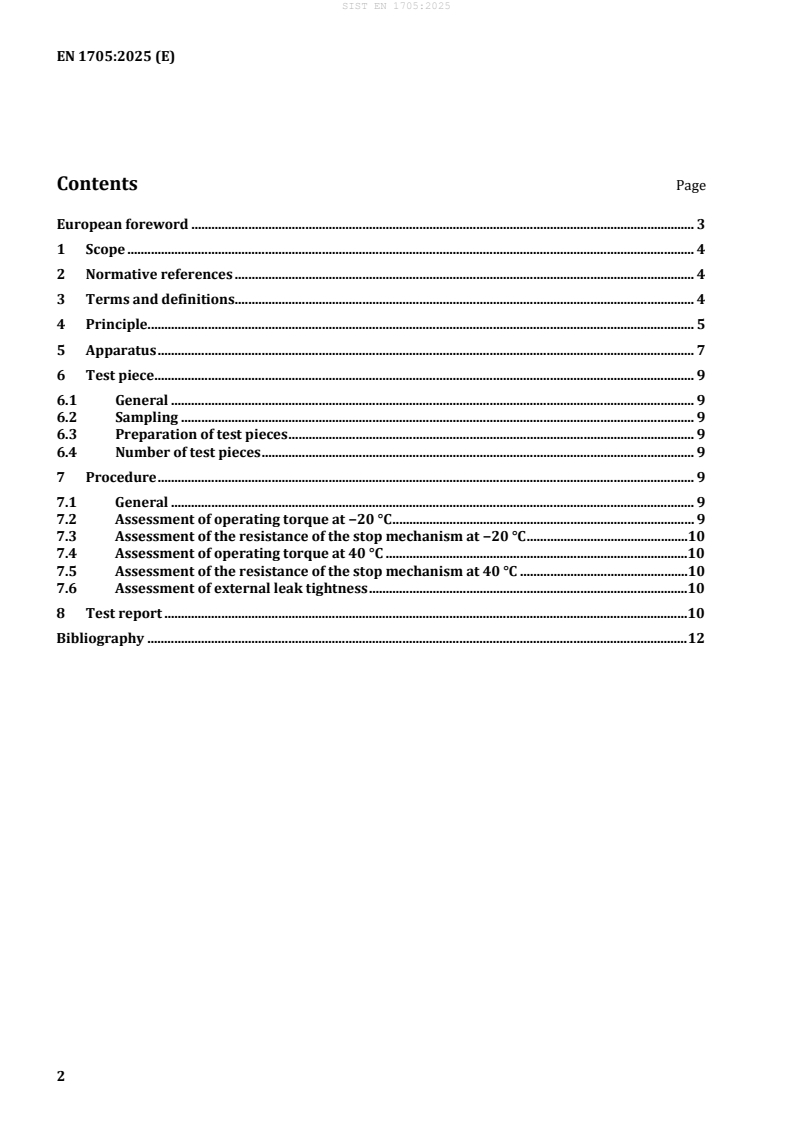
Contents Page
European foreword . 3
1 Scope . 4
2 Normative references . 4
3 Terms and definitions . 4
4 Principle. 5
5 Apparatus . 7
6 Test piece . 9
6.1 General . 9
6.2 Sampling . 9
6.3 Preparation of test pieces . 9
6.4 Number of test pieces . 9
7 Procedure . 9
7.1 General . 9
7.2 Assessment of operating torque at −20 °C . 9
7.3 Assessment of the resistance of the stop mechanism at −20 °C .10
7.4 Assessment of operating torque at 40 °C .10
7.5 Assessment of the resistance of the stop mechanism at 40 °C .10
7.6 Assessment of external leak tightness .10
8 Test report .10
Bibliography .12
European foreword
This document (EN 1705:2025) has been prepared by Technical Committee CEN/TC 155 “Plastics piping
systems and ducting systems”, the secretariat of which is held by NEN.
This European Standard shall be given the status of a national standard, either by publication of an
identical text or by endorsement, at the latest by November 2025, and conflicting national standards shall
be withdrawn at the latest by November 2025.
Attention is drawn to the possibility that some of the elements of this document may be the subject of
patent rights. CEN shall not be held responsible for identifying any or all such patent rights.
This document supersedes EN 1705:1996.
— added in the scope the reference to thermoplastic materials
— added the Clause 3 Terms and definitions
— clarifications were introduced for Clause 4 Principle by adding the high-risk impact positions
— subclauses on “Sampling”, “Preparation of test pieces”, “Number of test pieces” were added under
Clause 6 “Test piece”
— Clause 7 “Procedure” was revised and operations to be carried out in the tests have been specified
Any feedback and questions on this document should be directed to the users’ national standards body.
A complete listing of these bodies can be found on the CEN website.
According to the CEN-CENELEC Internal Regulations, the national standards organisations of the
following countries are bound to implement this European Standard: Austria, Belgium, Bulgaria, Croatia,
Cyprus, Czech Republic, Denmark, Estonia, Finland, France, Germany, Greece, Hungary, Iceland, Ireland,
Italy, Latvia, Lithuania, Luxembourg, Malta, Netherlands, Norway, Poland, Portugal, Republic of North
Macedonia, Romania, Serbia, Slovakia, Slovenia, Spain, Sweden, Switzerland, Türkiye and the United
Kingdom.
1 Scope
This document specifies a test method for determining the leak tightness and the ease of operation and
stop resistance of a valve made of thermoplastic material following an impact applied to the operating
device.
2 Normative references
The following documents are referred to in the text in such a way that some or all of their content
constitutes requirements of this document. For dated references, only the edition cited applies. For
undated references, the latest edition of the referenced document (including any amendments) applies.
EN ISO 3127, Thermoplastics pipes - Determination of resistance to external blows - Round-the-clock
method (ISO 3127)
EN ISO 1167-1:2006, Thermoplastics pipes, fittings and assemblies for the conveyance of fluids -
Determination of the resistance to internal pressure - Part 1: General method (ISO 1167-1:2006)
EN ISO 8233, Thermoplastics valves - Torque - Test method (ISO 8233)
3 Terms and definitions
For the purposes of this document, the following terms and definitions apply.
ISO and IEC maintain terminology databases for use in standardization at the following addresses:
— ISO Online browsing platform: available at https://www.iso.org/obp
— IEC Electropedia: available at https://www.electropedia.org
3.1
operating device
part of a valve for connection with the operating key which allows the opening and the closing of the valve
[SOURCE: EN 1555-4:2021, 3.1.5]
3.2
obturator
movable component of the valve whose position in the fluid flow path permits, restricts or obstructs the
fluid flow
[SOURCE: EN 736-2:2016, 3.2.1, modified – Note 1 to entry deleted]
3.3
body
main component of the valve which provides the fluid flow passageways
[SOURCE: EN 736-2:2016, 3.1.1, modified – deleted “and the body ends”]
3.4
valve end
part of the valve provided with the means of connection to the piping component
3.5
external leak tightness
leak tightness of the body enveloping the space containing the fluid, with respect to the atmosphere
[SOURCE: EN 12201-4:2024, 3.1.1 [3] modified (fluid instead of water)]
4 Pr
...