

FprEN 15767-3:2026
(Main)Portable equipment for projecting extinguishing agents and firefighting support operations - Portable monitors - Part 3: Foam devices
- Abstract
In addition to the requirements given in EN 15767-1, this document is applicable to devices designed for aspirating air and projecting low expansion foam and, in some cases, inducting foam concentrate. It specifies requirements for safety, performance, classification and designation, as well as test methods, instructions for use and maintenance and marking.
This document is not applicable to foam devices that are manufactured before its date of publication.
- Status
- Not Published
- Publication Date
- 19-Jul-2026
- Technical Committee
- CEN/TC 192 - Fire service equipment
- Drafting Committee
- CEN/TC 192/WG 8 - Hand-held branchpipes for fire service use
- Current Stage
- 6055 - CEN Ratification completed (DOR) - Publishing
- Start Date
- 22-Jun-2026
- Due Date
- 15-Dec-2026
- Completion Date
- 22-Jun-2026

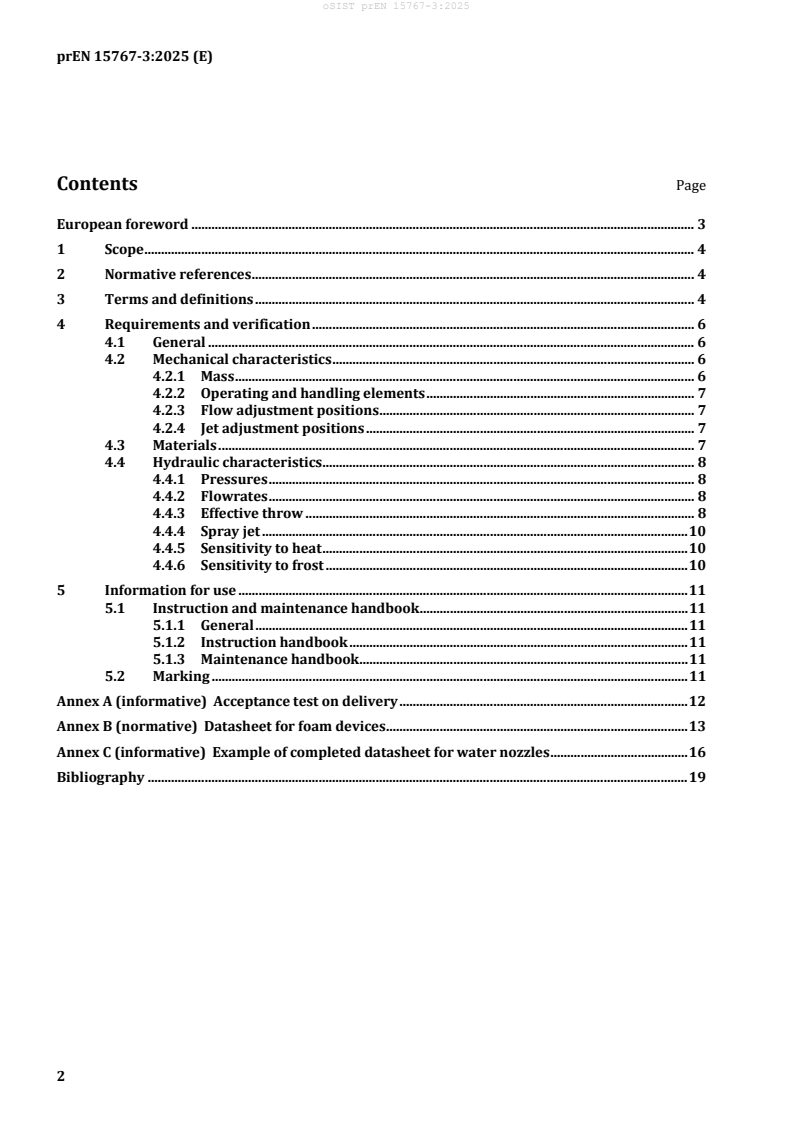
FprEN 15767-3:2026 is a draft European Standard from the European Committee for Standardization (CEN) for portable equipment for projecting extinguishing agents and firefighting support operations. It covers portable monitors with foam devices that aspirate air and project low expansion foam, and in some cases induct foam concentrate. The standard specifies safety, performance, classification and designation, test methods, instructions for use and maintenance, and marking for people who design, test, buy and use this equipment.
What does FprEN 15767-3:2026 specify?
FprEN 15767-3:2026 applies to foam devices used with portable monitors, in addition to the general requirements in EN 15767-1. It is for devices designed to aspirate air and project low expansion foam, with some devices also able to induct foam concentrate.
The document is organized into five clauses and three annexes:
- Scope
- Normative references
- Terms and definitions
- Requirements and verification
- Information for use
| Annex | What it covers | Status |
|---|---|---|
| A | Acceptance test on delivery | Informative |
| B | Datasheet for foam devices | Normative |
| C | Example of completed datasheet for water nozzles | Informative |
The scope excludes foam devices manufactured before the date of publication. In practice, this means the standard is meant for current product design, testing, documentation and marking, not retrospective evaluation of older equipment.
What are the key requirements of FprEN 15767-3:2026?
General test approach and user information
FprEN 15767-3:2026 treats all tests in Clause 4 as type tests. It also says that performance comparisons are made with water, but water results are only a guide because the foam concentrate affects throw, expansion and metering.
This matters because a product cannot be judged from water tests alone. Buyers and test laboratories need the foam-concentrate data as well, especially for self-inducting nozzles.
The document also links the test sequence to the reference pressure p and, unless otherwise stated, uses the same order for the different foam device types. The instruction handbook for self-inducting nozzles must state the conditions of use for the EN 1568-1:2018 characteristics and give at least the maximum viscosity of the foam concentrate. Foam nozzles must also be ergonomically designed for use with firefighter's gloves complying with EN 659.
Mechanical and handling requirements
FprEN 15767-3:2026 sets a maximum mass by flowrate range, with a separate note for seawater-resistant foam devices. It also limits the torque needed to move levers, valve handles and rotating operating elements, and it checks the force for detented rotating parts before and after cycling.
In practice, these requirements are about safe handling at the fireground. A device must be light enough to move, and its controls must remain usable with gloves and after repeated operation.
Flow settings must be clearly identifiable by visual means, and adjustable jet positions must be clearly marked. That helps operators select the right setting quickly under stress and reduces the risk of using the wrong spray or flow position.
Hydraulic performance and environmental resistance
FprEN 15767-3:2026 defines the pressures used to measure hydraulic characteristics at the device inlet, including the reference pressure p and the nominal pressure pN. It also limits how far the measured flowrate may vary from the selected flow setting.
The document requires a minimum effective throw for each flowrate position above 500 l/min, measured under a defined test setup. It also requires self-inducting nozzles to produce a spray jet with a spray angle of at least 100°. The maximum effective throw has to be stated in the instruction handbook.
The materials used must allow the device to meet all Clause 4 requirements, including heat and frost resistance. For the heat test, the device must still work after 24 h at 55 °C. For the frost test, after operation, draining and storage at -15 °C for 30 min, the operating elements must still move manually.
What terms does FprEN 15767-3:2026 define?
- Foam concentrate - the liquid mixed with water to make foam solution.
- Foam solution - the mixture of foam concentrate and water used to create foam.
- Foam device - a device that aspirates air and projects foam, and may also induct foam concentrate.
- Foam tube - a device that turns foam solution pressure into velocity and mixes in air to make a coherent foam stream in a tube.
- Self-inducting nozzle - a water nozzle fitted with its own self-inducting system.
- Induction rate - the ratio of foam concentrate to foam solution.
- Low expansion foam - foam with an expansion ratio below 20.
Who uses FprEN 15767-3:2026?
Manufacturers and designers use FprEN 15767-3:2026 to design foam devices, choose materials, set flow positions and prepare the handbook and marking. Test laboratories and certification bodies use it for type tests, delivery checks and verification of mass, forces, throw and resistance to heat and frost.
It is also used by fire service equipment buyers, quality managers and maintenance teams. For them, the document helps when comparing products, checking documentation, and confirming that the device can be operated safely with firefighter gloves and maintained with the right spare parts information.
What changed in FprEN 15767-3:2026 from the previous edition?
FprEN 15767-3:2026 supersedes EN 15767-3:2010. The foreword lists these significant changes:
- the title was amended;
- the definition of foam nozzle was added;
- foam cannon was replaced with foam tube;
- the maximum flow Qmax was deleted;
- notes with "should" and "may" were turned into normative text;
- general requirements were moved into a new 4.1;
- the foam concentrate viscosity requirement was added to the handbook information;
- verifications were placed under the related requirements in Clause 4;
- the ergonomic requirement for foam nozzles was strengthened for use with EN 659 gloves;
- missing requirements were added for heat and frost resistance;
- missing verifications were added for mass, operating elements, flow positions, jet positions and materials;
- Table 1 on maximum mass was amended;
- the informative Annex A on effects of foam concentrate on performance was deleted;
- wording and editorial changes were made.
Which standards are used with FprEN 15767-3:2026?
| Standard | How it is used |
|---|---|
| EN 15767-1 | The general requirements part that this document builds on. |
| EN 15767-2 | The companion part for water nozzles, used in notes and cross-references. |
| EN 1568-1:2018 | Source of the definitions for foam concentrate, foam solution, expansion and low expansion foam. |
| EN 659 | The firefighter glove standard used in the ergonomics requirement. |
| ISO 228-1 | Pipe thread dimensions and designation, cited in the bibliography and example datasheet. |
| ISO 228-2 | Verification of pipe threads by limit gauges, cited in the bibliography. |
What does the FprEN 15767-3:2026 document contain?
Clause 4 combines the practical test methods with the requirements they verify. It covers mass, operating and handling elements, flow and jet adjustment positions, materials, flowrates, effective throw, spray jet, heat resistance and frost resistance.
The document includes two figures for throw measurement and flow charts, and two tables for key measured values such as mass limits and operating forces. Annex B provides the required datasheet structure, including general data, a flow-pressure chart, operational device details, requirement results and optional extra data.
Annex C shows how the datasheet can be completed in practice, which is useful for product files, technical documentation and comparison of test results. Annex A gives guidance for acceptance testing on delivery, so customers or third parties can check conformity when the product is received.
Relations
- Effective Date
- 02-Oct-2024
Get Certified
Connect with accredited certification bodies for this standard

CIS Institut d.o.o.
Personal Protective Equipment (PPE) certification body. Notified Body NB-2890 for EU Regulation 2016/425 PPE.

Kiwa BDA Testing
Building and construction product certification.
Kmetijski inštitut Slovenije
Agricultural Institute of Slovenia. Soil testing, plant health, agricultural product analysis.
Sponsored listings
Frequently Asked Questions
FprEN 15767-3:2026 is a draft published by the European Committee for Standardization (CEN). Its full title is "Portable equipment for projecting extinguishing agents and firefighting support operations - Portable monitors - Part 3: Foam devices". This standard covers: In addition to the requirements given in EN 15767-1, this document is applicable to devices designed for aspirating air and projecting low expansion foam and, in some cases, inducting foam concentrate. It specifies requirements for safety, performance, classification and designation, as well as test methods, instructions for use and maintenance and marking. This document is not applicable to foam devices that are manufactured before its date of publication.
In addition to the requirements given in EN 15767-1, this document is applicable to devices designed for aspirating air and projecting low expansion foam and, in some cases, inducting foam concentrate. It specifies requirements for safety, performance, classification and designation, as well as test methods, instructions for use and maintenance and marking. This document is not applicable to foam devices that are manufactured before its date of publication.
FprEN 15767-3:2026 is classified under the following ICS (International Classification for Standards) categories: 13.220.10 - Fire-fighting. The ICS classification helps identify the subject area and facilitates finding related standards.
FprEN 15767-3:2026 has the following relationships with other standards: It is inter standard links to EN 15767-3:2010. Understanding these relationships helps ensure you are using the most current and applicable version of the standard.
FprEN 15767-3:2026 is associated with the following European legislation: EU Directives/Regulations: 2023/1230; Standardization Mandates: M/605. When a standard is cited in the Official Journal of the European Union, products manufactured in conformity with it benefit from a presumption of conformity with the essential requirements of the corresponding EU directive or regulation.
FprEN 15767-3:2026 is available in PDF format for immediate download after purchase. The document can be added to your cart and obtained through the secure checkout process. Digital delivery ensures instant access to the complete standard document.
Standards Content (Sample)
SLOVENSKI STANDARD
oSIST prEN 15767-3:2025
01-september-2025
Prenosna oprema za črpanje in uporabo gasilnega sredstva in podporne gasilske
operacije - Prenosni monitorji - 3. del: Gasilno sredstvo - pena
Portable equipment for projecting extinguishing agents and firefighting support
operations - Portable monitors - Part 3: Foam devices
Tragbare Geräte zum Ausbringen von Löschmitteln und zur Unterstützung der
Brandbekämpfung - Tragbare Wasserwerfer - Teil 3: Schaumdüsen
Equipement portable pour la projection d'agents d'extinction et les opérations de soutien
à la lutte contre les incendies - Lances-canon portables - Partie 3: Dispositifs pour la
mousse
Ta slovenski standard je istoveten z: prEN 15767-3
ICS:
13.220.10 Gašenje požara Fire-fighting
oSIST prEN 15767-3:2025 en,fr,de
2003-01.Slovenski inštitut za standardizacijo. Razmnoževanje celote ali delov tega standarda ni dovoljeno.
oSIST prEN 15767-3:2025
oSIST prEN 15767-3:2025
DRAFT
EUROPEAN STANDARD
prEN 15767-3
NORME EUROPÉENNE
EUROPÄISCHE NORM
June 2025
ICS 13.220.10 Will supersede EN 15767-3:2010
English Version
Portable equipment for projecting extinguishing agents
and firefighting support operations - Portable monitors -
Part 3: Foam devices
Equipement portable pour la projection d'agents Tragbare Geräte zum Ausbringen von Löschmitteln
d'extinction et les opérations de soutien à la lutte und zur Unterstützung der Brandbekämpfung -
contre les incendies - Lances--canon portables - Partie Tragbare Wasserwerfer - Teil 3: Schaumdüsen
3: Dispositifs pour la mousse
This draft European Standard is submitted to CEN members for enquiry. It has been drawn up by the Technical Committee
CEN/TC 192.
If this draft becomes a European Standard, CEN members are bound to comply with the CEN/CENELEC Internal Regulations
which stipulate the conditions for giving this European Standard the status of a national standard without any alteration.
This draft European Standard was established by CEN in three official versions (English, French, German). A version in any other
language made by translation under the responsibility of a CEN member into its own language and notified to the CEN-CENELEC
Management Centre has the same status as the official versions.
CEN members are the national standards bodies of Austria, Belgium, Bulgaria, Croatia, Cyprus, Czech Republic, Denmark, Estonia,
Finland, France, Germany, Greece, Hungary, Iceland, Ireland, Italy, Latvia, Lithuania, Luxembourg, Malta, Netherlands, Norway,
Poland, Portugal, Republic of North Macedonia, Romania, Serbia, Slovakia, Slovenia, Spain, Sweden, Switzerland, Türkiye and
United Kingdom.
Recipients of this draft are invited to submit, with their comments, notification of any relevant patent rights of which they are
aware and to provide supporting documentation.
Warning : This document is not a European Standard. It is distributed for review and comments. It is subject to change without
notice and shall not be referred to as a European Standard.
EUROPEAN COMMITTEE FOR STANDARDIZATION
COMITÉ EUROPÉEN DE NORMALISATION
EUROPÄISCHES KOMITEE FÜR NORMUNG
CEN-CENELEC Management Centre: Rue de la Science 23, B-1040 Brussels
© 2025 CEN All rights of exploitation in any form and by any means reserved Ref. No. prEN 15767-3:2025 E
worldwide for CEN national Members.
oSIST prEN 15767-3:2025
prEN 15767-3:2025 (E)
Contents Page
European foreword . 3
1 Scope . 4
2 Normative references . 4
3 Terms and definitions . 4
4 Requirements and verification . 6
4.1 General . 6
4.2 Mechanical characteristics . 6
4.2.1 Mass . 6
4.2.2 Operating and handling elements . 7
4.2.3 Flow adjustment positions . 7
4.2.4 Jet adjustment positions . 7
4.3 Materials . 7
4.4 Hydraulic characteristics . 8
4.4.1 Pressures . 8
4.4.2 Flowrates . 8
4.4.3 Effective throw . 8
4.4.4 Spray jet . 10
4.4.5 Sensitivity to heat . 10
4.4.6 Sensitivity to frost . 10
5 Information for use . 11
5.1 Instruction and maintenance handbook . 11
5.1.1 General . 11
5.1.2 Instruction handbook . 11
5.1.3 Maintenance handbook . 11
5.2 Marking . 11
Annex A (informative) Acceptance test on delivery . 12
Annex B (normative) Datasheet for foam devices . 13
Annex C (informative) Example of completed datasheet for water nozzles . 16
Bibliography . 19
oSIST prEN 15767-3:2025
prEN 16767-3:2025 (E)
European foreword
This document (prEN 15767-3:2025) has been prepared by Technical Committee CEN/TC 192 “Fire
service equipment”, the secretariat of which is held by BSI.
This document is currently submitted to the CEN Enquiry.
This document will supersede EN 15767-3:2010.
prEN 15767-3:2024 includes the following significant changes with respect to EN 15767-3:2010:
— the title has been amended;
— definition of “foam nozzle” has been added (see 3.3.1);
— “foam cannon” has been replaced with “foam tube” (see 3.3.2);
— maximum flow Q , has been deleted;
max
— according to current rules for drafting standard, notes containing the words “should” and “may” have
been transformed into normative text;
— all general requirements have been placed in a new 4.1 “General”;
— information about the viscosity of the foam concentrate shall be given (see 4.1 and 5.1.2);
— each verification has been placed under the corresponding requirement (see Clause 4);
— water nozzles shall be ergonomically designed (see 4.1 – should replaced by shall);
— missing requirements have been added in 4.4.5 and 4.4.6;
— missing verification have been added in 4.2.1, 4.2.2, 4.2.3, 4.2.4 and 4.3;
— Table 1 “Maximum mass” has been amended;
— informative Annex A on “Effects of the foam concentrate on the performance of the foam devices” has
been deleted;
— improvement of the wording/editorial changes.
oSIST prEN 15767-3:2025
prEN 15767-3:2025 (E)
1 Scope
In addition to the requirements given in EN 15767-1, this document applies to devices designed for
aspirating air and projecting low expansion foam and, in some cases, inducting foam concentrate. It
specifies requirements for safety, performance, classification and designation, as well as test methods,
instructions for use and maintenance and marking.
This document is not applicable to water nozzles that are manufactured before its date of publication.
2 Normative references
The following documents are referred to in the text in such a way that some or all of their content
constitutes requirements of this document. For dated references, only the edition cited applies. For
undated references, the latest edition of the referenced document (including any amendments) applies.
1 )
EN 15767-1, , Portable equipment for projecting extinguishing agents and firefighting support
operations — Portable monitors — Part 1: General requirements for portable monitor assemblies
3 Terms and definitions
For the purposes of this document, the definitions given in EN 15767-1 and the following apply.
ISO and IEC maintain terminology databases for use in standardization at the following addresses:
— ISO Online browsing platform: available at https://www.iso.org/obp/
— IEC Electropedia: available at https://www.electropedia.org/
3.1
foam concentrate
liquid which is diluted with water to produce foam solution
[EN 1568-1:2018, 3.7 without the note]
3.2
foam solution
solution of foam concentrate in water
[EN 1568-1:2018, 3.8]
3.3
foam device
device designed for aspirating air and projecting foam and, in some cases, inducting foam concentrate
Note 1 to entry: Several types of foam devices are described from 3.3.1 to 3.3.3.
3.3.1
foam nozzle
water nozzle with or without inducing system that transforms the foam solution pressure into velocity
to produce a coherent stream of firefighting foam
Note 1 to entry: Water nozzle is defined in EN 15767-2.
Under revision.
oSIST prEN 15767-3:2025
prEN 16767-3:2025 (E)
3.3.2
foam tube
device that transforms the foam solution pressure into velocity and mixes air with the foam solution to
produce a coherent stream of firefighting foam in a tube
3.3.3
self-inducting nozzle
water nozzle equipped with a self-inducting system
Note 1 to entry: Water nozzle is defined in EN 15767-2.
3.3.4
foam attachment
device fitted to a water nozzle or a self-inducting nozzle that mixes air with the foam solution to produce
firefighting foam
3.4
pick-up tube
non collapsible tube for transferring the foam concentrate to the inducting system
3.5
inducting system
device for mixing foam concentrate with water at a set rate
3.6
self-inducting system
inducting system integrated into a foam device
3.7
spreader
device to modify the shape of the foam stream into a flat spray
3.8
induction rate
ratio of foam concentrate to the foam solution
3.9
metering device
device controlling the induction rate
3.10
expansion
expansion value
expansion ratio
ratio of the volume of foam to the volume of the foam solution from which it was made
[SOURCE: EN 1568-1:2018, 3.2]
3.11
low expansion foam
foam which has an expansion ratio less than 20
[SOURCE: EN 1568-1:2018, 3.3]
oSIST prEN 15767-3:2025
pr
...