EN 13123-2:2004
(Main)Windows, doors, and shutters - Explosion resistance - Requirements and classification - Part 2: Range test
Windows, doors, and shutters - Explosion resistance - Requirements and classification - Part 2: Range test
This European Standard specifies the criteria which windows, doors and shutters shall satisfy to achieve a classification when submitted to the test method described in EN 13124-2.
This European Standard concerns a test method against blast waves in open air resulting from high explosives that can be carried by hand and placed a few metres from a target. At such close distances blast values vary across an attack face. Controlled measurement of the actual blast on the face of the test specimen being difficult, costly and subject to inaccuracy, consistency of the blast forces is therefore controlled in this European Standard by the characteristics of the explosive charge and its location.
This European Standard covers only the behaviour of the complete unit including infill, frame and fixings as tested. It gives no information on the ability of the surrounding wall or building structure to resist the direct or transmitted forces.
If the windows, doors and shutters are intended for specific conditions of climate, specific test conditions can be required (see clause 4).
This European Standard gives no information on the explosion resistance capacity of the wall or other surrounding structure.
Fenster, Türen und Abschlüsse - Sprengwirkungshemmung - Anforderungen und Klassifizierung - Teil 2: Freilandversuch
Diese Europäische Norm legt die Kriterien fest, die Fenster, Türen und Abschlüsse erfüllen müssen, um eine Klassifizierung zu erreichen, wenn diese nach dem in EN 13124-2 beschriebenen Prüfverfahren geprüft werden.
Diese Europäische Norm behandelt ein Verfahren zur Prüfung gegen Druckwellen im Freien, die von hochexplosiven Sprengmitteln, die von Hand getragen werden können und wenige Meter vor dem Ziel abgelegt werden, erzeugt werden. Bei solchen kleinen Abständen schwanken die Druckwerte über einer Angriffsfläche. Die kontrollierte Messung der tatsächlichen Druckwellen auf der Fläche des Prüfkörpers ist schwierig, kostenaufwändig und ungenau, die Gleichmäßigkeit der Druckkräfte wird in dieser Europäischen Norm durch die Kenngrößen der Sprengladung und deren Anordnung geregelt.
Diese Europäische Norm behandelt nur das Verhalten der Gesamtkonstruktion, einschließlich deren Füllung, Rahmen und Befestigungen, entsprechend der Prüfung. Diese Norm gibt keinen Aufschluss über die Möglichkeiten der umgebenden Wand oder Gebäudekonstruktion, den direkten oder übertragenen Kräften standzuhalten.
Falls die Fenster, Türen und Abschlüsse zum Einsatz unter besonderen klimatischen Bedingungen vorgesehen sind, können besondere Prüfbedingungen erforderlich sein (siehe Abschnitt 4).
Diese Europäische Norm gibt keinen Aufschluss über die Sprengwirkungshemmung der umgebenden Wand oder Gebäudekonstruktion.
Portes, fenêtres et fermetures - Résistance à l'explosion - Exigences et classification - Partie 2: Essai en plein air
La présente norme européenne définit les critères de classification des portes, fenêtres et fermetures selon la méthode d'essai décrite dans l'EN 13124-2.
La présente norme européenne traite d'une méthode d'essai de résistance aux ondes de choc produites à l'air libre par des explosifs puissants, qui peuvent être transportés manuellement et placés à quelques mètres d'une cible. Lorsque la distance est aussi faible, les valeurs d'onde diffèrent selon les endroits de la surface attaquée. La mesure des paramètres de l'onde de choc sur la face considérée du corps d'épreuve est une opération difficile et coûteuse, et qui comporte en outre des risques d'inexactitude ; par conséquent, la valeur des efforts de l'onde de choc dans la présente norme européenne est fonction des caractéristiques de la charge explosive et de son emplacement.
La présente norme européenne traite seulement du comportement de l'unité complète soumise à l'essai (y compris remplissage, châssis et fixations). Elle ne donne aucune information sur la capacité du mur adjacent ou de la structure du bâtiment à résister aux forces appliquées directement ou transmises.
Si les fenêtres, portes et fermetures sont destinées à être exposées à des conditions climatiques particulières, il peut être nécessaire de recourir à des conditions d'essai particulières (voir article 4).
La présente norme européenne ne donne aucune information sur la capacité de résistance à l'explosion du mur ou du reste de la structure du bâtiment.
Okna, vrata in polkna – Odpornost proti eksplozijam – Zahteve in razvrstitev – 2. del: Preskus na prostem
General Information
Relations
Standards Content (Sample)
2003-01.Slovenski inštitut za standardizacijo. Razmnoževanje celote ali delov tega standarda ni dovoljeno.Okna, vrata in polkna – Odpornost proti eksplozijam – Zahteve in razvrstitev – 2. del: Preskus na prostemFenster, Türen und Abschlüsse - Sprengwirkungshemmung - Anforderungen und Klassifizierung - Teil 2: FreilandversuchPortes, fenetres et fermetures - Résistance a l'explosion - Exigences et classification - Partie 2: Essai en plein airWindows, doors, and shutters - Explosion resistance - Requirements and classification - Part 2: Range test91.060.50Vrata in oknaDoors and windows13.230Varstvo pred eksplozijoExplosion protectionICS:Ta slovenski standard je istoveten z:EN 13123-2:2004SIST EN 13123-2:2004en01-oktober-2004SIST EN 13123-2:2004SLOVENSKI
STANDARD
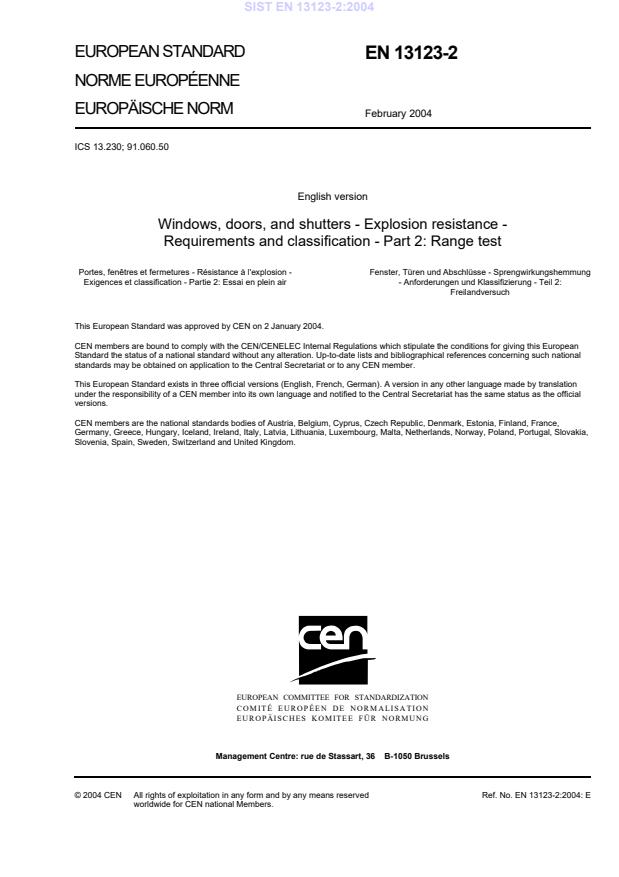
EUROPEAN STANDARDNORME EUROPÉENNEEUROPÄISCHE NORMEN 13123-2February 2004ICS 13.230; 91.060.50English versionWindows, doors, and shutters - Explosion resistance -Requirements and classification - Part 2: Range testPortes, fenêtres et fermetures - Résistance à l'explosion -Exigences et classification - Partie 2: Essai en plein airFenster, Türen und Abschlüsse - Sprengwirkungshemmung- Anforderungen und Klassifizierung - Teil 2:FreilandversuchThis European Standard was approved by CEN on 2 January 2004.CEN members are bound to comply with the CEN/CENELEC Internal Regulations which stipulate the conditions for giving this EuropeanStandard the status of a national standard without any alteration. Up-to-date lists and bibliographical references concerning such nationalstandards may be obtained on application to the Central Secretariat or to any CEN member.This European Standard exists in three official versions (English, French, German). A version in any other language made by translationunder the responsibility of a CEN member into its own language and notified to the Central Secretariat has the same status as the officialversions.CEN members are the national standards bodies of Austria, Belgium, Cyprus, Czech Republic, Denmark, Estonia, Finland, France,Germany, Greece, Hungary, Iceland, Ireland, Italy, Latvia, Lithuania, Luxembourg, Malta, Netherlands, Norway, Poland, Portugal, Slovakia,Slovenia, Spain, Sweden, Switzerland and United Kingdom.EUROPEAN COMMITTEE FOR STANDARDIZATIONCOMITÉ EUROPÉEN DE NORMALISATIONEUROPÄISCHES KOMITEE FÜR NORMUNGManagement Centre: rue de Stassart, 36
B-1050 Brussels© 2004 CENAll rights of exploitation in any form and by any means reservedworldwide for CEN national Members.Ref. No. EN 13123-2:2004: ESIST EN 13123-2:2004
...
Frequently Asked Questions
EN 13123-2:2004 is a standard published by the European Committee for Standardization (CEN). Its full title is "Windows, doors, and shutters - Explosion resistance - Requirements and classification - Part 2: Range test". This standard covers: This European Standard specifies the criteria which windows, doors and shutters shall satisfy to achieve a classification when submitted to the test method described in EN 13124-2. This European Standard concerns a test method against blast waves in open air resulting from high explosives that can be carried by hand and placed a few metres from a target. At such close distances blast values vary across an attack face. Controlled measurement of the actual blast on the face of the test specimen being difficult, costly and subject to inaccuracy, consistency of the blast forces is therefore controlled in this European Standard by the characteristics of the explosive charge and its location. This European Standard covers only the behaviour of the complete unit including infill, frame and fixings as tested. It gives no information on the ability of the surrounding wall or building structure to resist the direct or transmitted forces. If the windows, doors and shutters are intended for specific conditions of climate, specific test conditions can be required (see clause 4). This European Standard gives no information on the explosion resistance capacity of the wall or other surrounding structure.
This European Standard specifies the criteria which windows, doors and shutters shall satisfy to achieve a classification when submitted to the test method described in EN 13124-2. This European Standard concerns a test method against blast waves in open air resulting from high explosives that can be carried by hand and placed a few metres from a target. At such close distances blast values vary across an attack face. Controlled measurement of the actual blast on the face of the test specimen being difficult, costly and subject to inaccuracy, consistency of the blast forces is therefore controlled in this European Standard by the characteristics of the explosive charge and its location. This European Standard covers only the behaviour of the complete unit including infill, frame and fixings as tested. It gives no information on the ability of the surrounding wall or building structure to resist the direct or transmitted forces. If the windows, doors and shutters are intended for specific conditions of climate, specific test conditions can be required (see clause 4). This European Standard gives no information on the explosion resistance capacity of the wall or other surrounding structure.
EN 13123-2:2004 is classified under the following ICS (International Classification for Standards) categories: 13.230 - Explosion protection; 91.060.50 - Doors and windows. The ICS classification helps identify the subject area and facilitates finding related standards.
EN 13123-2:2004 has the following relationships with other standards: It is inter standard links to EN 13123-2:2025. Understanding these relationships helps ensure you are using the most current and applicable version of the standard.
EN 13123-2:2004 is associated with the following European legislation: EU Directives/Regulations: 305/2011, 89/106/EEC. When a standard is cited in the Official Journal of the European Union, products manufactured in conformity with it benefit from a presumption of conformity with the essential requirements of the corresponding EU directive or regulation.
You can purchase EN 13123-2:2004 directly from iTeh Standards. The document is available in PDF format and is delivered instantly after payment. Add the standard to your cart and complete the secure checkout process. iTeh Standards is an authorized distributor of CEN standards.
Die SIST EN 13123-2:2004 stellt einen entscheidenden Standard für Fenster, Türen und Rollläden dar, die sich mit der Explosionssicherheit befassen. Der Umfang dieser Norm ist klar definiert und konzentriert sich auf die Anforderungen und Klassifizierung von Bauelementen, die explosionsbedingten Belastungen ausgesetzt sind. Dieser Standard legt die Kriterien fest, die erfüllt werden müssen, um bei den Tests, die in der EN 13124-2 beschrieben sind, klassifiziert zu werden. Ein wichtiger Stärke dieser Norm ist die spezifizierte Testmethode, die explosionsartige Druckwellen berücksichtigt, die von tragbaren Sprengstoffen erzeugt werden. Diese Nähe zur Angriffsfläche und die damit verbundenen Herausforderungen in Bezug auf Variation und Konsistenz der Druckwerte werden durch präzise Vorgaben zur Ausführung der Tests adressiert. Die Norm beschreibt, wie die Eigenschaften der Sprengladung und deren Platzierung kontrolliert werden, um die Testbedingungen zu standardisieren und reproduzierbar zu machen. Dies erhöht die Zuverlässigkeit der Testergebnisse erheblich und sorgt dafür, dass die Leistungsfähigkeit der getesteten Elemente objektiv bewertet werden kann. Des Weiteren bezieht sich der Standard ausschließlich auf das Verhalten des vollständigen Bauelements – einschließlich des Füllmaterials, des Rahmens und der Befestigungen – während der Tests, was die Relevanz für Hersteller und Planer von sicherheitsrelevanten Produkten unterstreicht. Es ist jedoch wichtig zu beachten, dass keine Angaben zur Widerstandsfähigkeit der umgebenden Wand oder der Gebäudehülle gemacht werden. Diese Einschränkung ist für Fachleute von Bedeutung, da die gesamte Sicherheitsbewertung eines Gebäudes auch die strukturelle Integrität der Wände berücksichtigen muss. Zusätzlich weist die Norm darauf hin, dass für spezielle klimatische Bedingungen gegebenenfalls angepasste Testkriterien erforderlich sind, was die Flexibilität und Anpassungsfähigkeit des Standards an unterschiedliche Anforderungen unterstreicht. Insgesamt bietet die SIST EN 13123-2:2004 eine umfassende und praxisorientierte Grundlage für die Bewertung der Explosionssicherheit von Fenstern, Türen und Rollläden und stellt sicher, dass diese Produkte bestimmten Sicherheitsanforderungen genügen.
SIST EN 13123-2:2004 표준은 창문, 문 및 셔터의 폭발 저항성에 대한 요구 사항과 분류를 다루고 있으며, 특히 폭발 파동에 대한 테스트 방법을 명시하고 있습니다. 이 표준은 고폭발물에 의해 발생하는 외부의 폭발 파동에 대한 테스트를 수행하는 데 필요한 기준을 설정하고 있습니다. 이 표준의 주요 강점 중 하나는 폭발 시험이 수행되는 시나리오에 대한 세심한 고려입니다. 시험은 대상에 몇 미터 내에 위치한 고폭발물에 의해 발생한 폭발에 대한 것입니다. 이와 같은 조건에서 실제 폭발 하중의 측정은 어려운 점을 반영하여, 폭발 하중의 일관성을 보장하기 위해 폭발물의 특성과 배치 위치에 의해 조절됩니다. 또한, SIST EN 13123-2:2004 표준은 창문, 문 및 셔터의 통합 유닛의 성능을 평가하는 데 집중하고 있으며, 전체 유닛의 행동을 테스트하여 자재의 내구성과 안정성을 평가합니다. 하지만 이 표준은 주변 벽이나 건물 구조의 힘에 대한 저항력에 대한 정보를 제공하지 않으므로, 이는 사용자가 추가적으로 고려해야 할 요소입니다. 표준의 범위는 매우 명확하여 창문, 문 및 셔터가 특정 기후 조건을 충족할 필요가 있을 경우에는 추가적인 테스트 조건이 요구될 수 있음을 명시하고 있습니다. 이러한 유연한 접근은 다양한 환경에서 제품의 안전성을 보장하는 데 중요한 역할을 합니다. 종합적으로, SIST EN 13123-2:2004 표준은 폭발 저항성 요구 사항을 체계적으로 규정하여, 창문, 문 및 셔터의 설계 및 제조에 있어 필수적인 내용으로, 폭발 안전성을 강화하는 데 기여합니다. 이는 현재와 미래의 다양한 시장 요구에 부응할 수 있는 중요한 기준으로 자리 잡고 있습니다.
La norme EN 13123-2:2004 constitue un cadre essentiel pour l'évaluation de la résistance à l'explosion des fenêtres, des portes et des volets. Son périmètre se concentre sur la définition des critères que ces éléments doivent respecter afin d'obtenir une classification lors des tests conformes à la méthode décrite dans la norme EN 13124-2. Cela permet d’assurer un standard de sécurité crucial dans des environnements où le risque d'explosion est présent. L'un des points forts de cette norme est la spécificité de sa méthode d'essai, qui prend en compte les vagues de choc générées par des explosifs placés à courte distance du cadre testé. En stipulant des caractéristiques précises de la charge explosive et de son emplacement, elle garantit une évaluation juste et cohérente des forces d'explosion, un aspect souvent complexe, coûteux et imprécis dans d'autres méthodes d'évaluation. Il est également important de noter que la norme aborde le comportement de l'unité testée dans son ensemble, y compris le cadre, les fixations et les panneaux de remplissage. Cela offre une vision complète de la performance de l'ensemble du produit par rapport aux forces d'explosion, bien qu'elle ne traite pas de la résistance de la structure environnante ni des murs adjacents face à ces forces. Ainsi, cela permet aux concepteurs et aux fabricants de se concentrer sur l'optimisation des caractéristiques des fenêtres, portes et volets eux-mêmes. La norme s'avère aussi pertinente face aux exigences climatiques et aux conditions spécifiques, soulignant que des tests auxiliaires pourraient être nécessaires pour des installations dans des environnements particuliers. En somme, la norme EN 13123-2:2004, avec ses exigences claires et son approche méthodique, se positionne comme un outil indispensable pour garantir la sécurité et la fiabilité des fenêtres, portes et volets en cas d'explosion.
EN 13123-2:2004は、ウィンドウ、ドア、およびシャッターの爆発耐性に関する非常に重要なヨーロッパの標準であり、特に高爆発物によって生成される爆風に対する試験方法を定義しています。この標準は、試験対象となるウィンドウ、ドア、シャッターが達成すべき分類基準を詳述しています。 本標準の強みの一つは、爆風が対象物に対して異なる力を及ぼすことを考慮し、爆発物の特性や配置によって爆風の一貫性を確保している点です。このアプローチにより、試験の信頼性が向上し、製品の実際の使用状況に基づく評価が可能となります。そのため、機密性や安全性の観点から、ウィンドウ、ドア、シャッターの設計者にとって非常に価値のある標準です。 さらに、この標準は、試験されたユニット全体の挙動をカバーしており、フレームやフィクシングを含むインフィルの特性も考慮されています。この包括的な評価は製品の耐久性を示すため、製造業者やユーザーにとって極めて有益です。しかし、周囲の壁や建物構造の直接的な耐力についての情報は提供されていないため、これらの要素に関しては別個に考慮する必要があります。 加えて、特定の気候条件に対応したウィンドウやドア、シャッターに関しては特別な試験条件が必要になる場合があることも明記されています。これは、さまざまな環境要因に対応するための十分な配慮を示しています。 総じて、EN 13123-2:2004は、ウィンドウ、ドア、シャッターにおける爆発耐性を測るための効果的で包括的な基準であり、安全性を高めるための非常に有用なツールとなっています。製品の設計や評価において、この標準の活用はますます重要なものとなるでしょう。
The European Standard EN 13123-2:2004 provides a comprehensive framework for assessing the explosion resistance of windows, doors, and shutters through a structured range test methodology. Its primary scope is to detail the necessary criteria that must be met for these components to achieve a specified classification based on their performance against blast waves generated by high explosives. One of the strengths of this standard is its focus on realistic testing conditions that mimic the impact of blast waves in open air. By defining the characteristics of the explosive charge and where it is located relative to the test specimen, EN 13123-2:2004 ensures that the measurements reflect the forces likely encountered in a genuine explosive scenario. This meticulous attention to controlled measurements addresses potential inconsistencies that could arise, thereby enhancing the reliability of the resulting classifications. Furthermore, the standard emphasizes the need for evaluating not just the individual components (like windows, doors, and shutters) but the complete unit, including the infill, frame, and fixings. This holistic approach is pivotal for ensuring that the entire construct can withstand explosive forces, which is crucial for safety and security applications where lives and property may be at risk. Another relevant aspect of the EN 13123-2:2004 is its flexibility. It acknowledges that specific conditions may demand tailored test criteria, which broadens the standard's applicability to various climatic and operational environments. However, it is important to note that the standard does not address the explosion resistance capacity of surrounding walls or structures, highlighting a gap that may need consideration for comprehensive risk assessments. In summary, the EN 13123-2:2004 standard is a foundational document for manufacturers and regulatory bodies focused on the explosion resistance of architectural features. Its defined criteria and systematic testing methodology provide a robust basis for evaluating safety in contexts where blast risks are a concern.


Questions, Comments and Discussion
Ask us and Technical Secretary will try to provide an answer. You can facilitate discussion about the standard in here.
Loading comments...