

EN 15165:2014
(Main)Food processing machinery - Forming machines - Safety and hygiene requirements
- Abstract
1.1 General
This European Standard applies to forming machines, used for forming food products with a mould into portions, as defined in 1.2.
This document applies to both machines standing on the floor and table top machines, and also to machines integrated in a processing line (i.e. interfaces, when the machine is combined with other machines).
This document covers the following auxiliary devices and interchangeable equipment:
a) auxiliary devices:
1) paper interleavers;
2) croquette attachment;
3) meat ball rollers;
4) stick inserters;
5) specific material/product conveyors;
6) specific lifting and tilting devices.
b) interchangeable equipment:
1) croquette attachment;
2) meat ball rollers;
3) stick inserters;
4) specific material/product conveyors;
5) specific lifting and tilting devices.
This document deals with all significant hazards, hazardous situations and events relevant to forming machines, when they are used as intended and under conditions of misuse which are reasonable foreseeable by the manufacturer (see Clause 4).
This document deals with the significant hazards, hazardous situations and events arising during the whole lifetime of the machine, including the phases of transport, assembly and installation, commissioning, maintenance, dismantling, disabling and scrapping and use as defined in EN ISO 12100:2010, 5.4.
This document is not applicable to forming machines which are manufactured before the date of publication of this document by CEN.
1.2 Machine description
This European Standard specifies requirements for the design, manufacture and operating of forming machines, e.g. for rissoles, hamburgers, in the following only referred to as machines.
It specifies safety and hygiene requirements for design and manufacture of forming machines, which are used for forming food products into portions with a mould. The mould may have a sliding or rotary movement and is filled with product in one position and emptied in another.
These machines have a feed provision, which is in the most cases a feed intake hopper (see Figures 1 and 2). Moulds may be filled by the action of rotating worm, rotating paddles or reciprocating hydraulic arms. Machines produce single or multiple lines of products.
Forming machines are intended for use on ground or minced meat, meat products, fish, vegetables or similar products. Use includes manufacture of product, setting, treating or process changeover, cleaning, fault finding and maintenance.
(...)
1.3 Combinations of forming machines and auxiliary devices and/or interchangeable equipment
1.3.1 Definition
A combination of a forming machine with auxiliary devices and/or interchangeable equipment becomes a new machine, when the following requirements are fulfilled / met:
- the (combined) device/equipment works together as an entity, meaning from production related view they form an entity (i.e. the coaction will be focused on a shared aim) and
- they are controlled as an entity, via a shared or linked control system and
- they work - regarding safety - together as an entity and also form a unit in this aspect.
According to this definition a new machine is not existent when in a total complex single autonomous functional machines are connected in relation to function and control, but do not form a unit in relation to safety. This is given e.g. when:
- on the single interfaces / interconnection points none ore only minor hazards between the separate machines occur, due to their combination;
- the emergency stop of one machine is connected / looped through to the next machine since the operator’s position is only at the next machine.
In such mechanical equipment each single machine can still be regarded autonomous in relation to safety.
1.3.2 Example for combinations
(...)
- Status
- Published
- Publication Date
- 28-Oct-2014
- Withdrawal Date
- 29-Apr-2015
- Technical Committee
- CEN/TC 153 - Food processing machinery - Safety and hygiene specifications
- Drafting Committee
- CEN/TC 153/WG 2 - Meat processing machinery
- Current Stage
- 6060 - Definitive text made available (DAV) - Publishing
- Start Date
- 29-Oct-2014
- Due Date
- 09-Nov-2014
- Completion Date
- 29-Oct-2014

Overview - EN 15165:2014 (Food processing machinery - Forming machines)
EN 15165:2014 is the CEN standard that sets safety and hygiene requirements for forming machines used in food processing - machines that form products (e.g., rissoles, hamburgers, meatballs) into portions using a mould. It applies to floor-standing and tabletop machines and to machines integrated into processing lines, as well as specified auxiliary devices and interchangeable equipment (paper interleavers, croquette attachments, meat ball rollers, stick inserters, specific conveyors, lift/tilt devices). The standard addresses hazards throughout the machine lifetime (transport, installation, operation, maintenance, dismantling) and supports conformity with EU machinery legislation.
Key topics and technical requirements
- Scope and machine description - definition of forming machines, mould operation (sliding/rotary), typical feed systems (hoppers, worms, paddles, hydraulic arms) and single/multiple product lines.
- Hazard identification - list of significant hazards relevant to forming machines (mechanical, electrical, hydraulic/pneumatic, stability, noise, ergonomics, hygiene).
- Mechanical safety - guarding, interlocks, prevention of cutting, crushing and entrapment points; safety measures for infeed hoppers and mould areas; requirements for drives, ejectors and conveyors.
- Integration and combinations - rules to determine when combinations of machines and auxiliary equipment form a new machine (shared control, shared safety entity).
- Electrical, hydraulic and pneumatic safety - protection, emergency stops, ingress protection and controls.
- Hygiene and cleanability - materials, design principles and areas to ensure safe cleaning and prevent contamination (Annex B provides design guidance).
- Noise - measurement and declaration procedures for noise emission (normative Annex A).
- Verification and information for use - safety verification checklists, instruction handbooks and marking requirements for safe operation and maintenance.
Applications and who uses this standard
- Machine manufacturers - design and manufacture of compliant forming machines and attachments.
- System integrators - safe integration of forming machines into processing lines.
- Safety and compliance engineers - risk assessments, CE marking, conformity with EU Directive 2006/42/EC and EN ISO 12100:2010.
- QA / Hygiene managers and food processors - selecting equipment that meets hygiene and cleanability expectations.
- Maintenance and training teams - guidance for safe servicing, lock-out/tag-out and user information.
Related standards
- EN ISO 12100:2010 - general principles for risk assessment and machine design.
- EU Directive 2006/42/EC - Machinery Directive (essential requirements supported by EN 15165).
- Other CEN/TC 153 standards for food machinery may apply depending on equipment and processes.
EN 15165:2014 is essential for anyone specifying, building or integrating forming machines to ensure both operator safety and hygienic design in food production environments.
Relations
- Effective Date
- 25-Aug-2026
- Effective Date
- 09-Feb-2026
- Effective Date
- 09-Feb-2026
- Effective Date
- 28-Jan-2026
- Refers
EN 1672-2:2005+A1:2009 - Food processing machinery - Basic concepts - Part 2: Hygiene requirements - Effective Date
- 28-Jan-2026
- Effective Date
- 28-Jan-2026
- Effective Date
- 28-Jan-2026
- Effective Date
- 28-Jan-2026
- Effective Date
- 28-Jan-2026
- Effective Date
- 28-Jan-2026
- Effective Date
- 28-Jan-2026
- Effective Date
- 28-Jan-2026
- Effective Date
- 28-Jan-2026
- Effective Date
- 28-Jan-2026
- Effective Date
- 28-Jan-2026
Get Certified
Connect with accredited certification bodies for this standard

BSI Group
BSI (British Standards Institution) is the business standards company that helps organizations make excellence a habit.

Bureau Veritas
Bureau Veritas is a world leader in laboratory testing, inspection and certification services.

DNV
DNV is an independent assurance and risk management provider.
Sponsored listings
Frequently Asked Questions
EN 15165:2014 is a standard published by the European Committee for Standardization (CEN). Its full title is "Food processing machinery - Forming machines - Safety and hygiene requirements". This standard covers: 1.1 General This European Standard applies to forming machines, used for forming food products with a mould into portions, as defined in 1.2. This document applies to both machines standing on the floor and table top machines, and also to machines integrated in a processing line (i.e. interfaces, when the machine is combined with other machines). This document covers the following auxiliary devices and interchangeable equipment: a) auxiliary devices: 1) paper interleavers; 2) croquette attachment; 3) meat ball rollers; 4) stick inserters; 5) specific material/product conveyors; 6) specific lifting and tilting devices. b) interchangeable equipment: 1) croquette attachment; 2) meat ball rollers; 3) stick inserters; 4) specific material/product conveyors; 5) specific lifting and tilting devices. This document deals with all significant hazards, hazardous situations and events relevant to forming machines, when they are used as intended and under conditions of misuse which are reasonable foreseeable by the manufacturer (see Clause 4). This document deals with the significant hazards, hazardous situations and events arising during the whole lifetime of the machine, including the phases of transport, assembly and installation, commissioning, maintenance, dismantling, disabling and scrapping and use as defined in EN ISO 12100:2010, 5.4. This document is not applicable to forming machines which are manufactured before the date of publication of this document by CEN. 1.2 Machine description This European Standard specifies requirements for the design, manufacture and operating of forming machines, e.g. for rissoles, hamburgers, in the following only referred to as machines. It specifies safety and hygiene requirements for design and manufacture of forming machines, which are used for forming food products into portions with a mould. The mould may have a sliding or rotary movement and is filled with product in one position and emptied in another. These machines have a feed provision, which is in the most cases a feed intake hopper (see Figures 1 and 2). Moulds may be filled by the action of rotating worm, rotating paddles or reciprocating hydraulic arms. Machines produce single or multiple lines of products. Forming machines are intended for use on ground or minced meat, meat products, fish, vegetables or similar products. Use includes manufacture of product, setting, treating or process changeover, cleaning, fault finding and maintenance. (...) 1.3 Combinations of forming machines and auxiliary devices and/or interchangeable equipment 1.3.1 Definition A combination of a forming machine with auxiliary devices and/or interchangeable equipment becomes a new machine, when the following requirements are fulfilled / met: - the (combined) device/equipment works together as an entity, meaning from production related view they form an entity (i.e. the coaction will be focused on a shared aim) and - they are controlled as an entity, via a shared or linked control system and - they work - regarding safety - together as an entity and also form a unit in this aspect. According to this definition a new machine is not existent when in a total complex single autonomous functional machines are connected in relation to function and control, but do not form a unit in relation to safety. This is given e.g. when: - on the single interfaces / interconnection points none ore only minor hazards between the separate machines occur, due to their combination; - the emergency stop of one machine is connected / looped through to the next machine since the operator’s position is only at the next machine. In such mechanical equipment each single machine can still be regarded autonomous in relation to safety. 1.3.2 Example for combinations (...)
1.1 General This European Standard applies to forming machines, used for forming food products with a mould into portions, as defined in 1.2. This document applies to both machines standing on the floor and table top machines, and also to machines integrated in a processing line (i.e. interfaces, when the machine is combined with other machines). This document covers the following auxiliary devices and interchangeable equipment: a) auxiliary devices: 1) paper interleavers; 2) croquette attachment; 3) meat ball rollers; 4) stick inserters; 5) specific material/product conveyors; 6) specific lifting and tilting devices. b) interchangeable equipment: 1) croquette attachment; 2) meat ball rollers; 3) stick inserters; 4) specific material/product conveyors; 5) specific lifting and tilting devices. This document deals with all significant hazards, hazardous situations and events relevant to forming machines, when they are used as intended and under conditions of misuse which are reasonable foreseeable by the manufacturer (see Clause 4). This document deals with the significant hazards, hazardous situations and events arising during the whole lifetime of the machine, including the phases of transport, assembly and installation, commissioning, maintenance, dismantling, disabling and scrapping and use as defined in EN ISO 12100:2010, 5.4. This document is not applicable to forming machines which are manufactured before the date of publication of this document by CEN. 1.2 Machine description This European Standard specifies requirements for the design, manufacture and operating of forming machines, e.g. for rissoles, hamburgers, in the following only referred to as machines. It specifies safety and hygiene requirements for design and manufacture of forming machines, which are used for forming food products into portions with a mould. The mould may have a sliding or rotary movement and is filled with product in one position and emptied in another. These machines have a feed provision, which is in the most cases a feed intake hopper (see Figures 1 and 2). Moulds may be filled by the action of rotating worm, rotating paddles or reciprocating hydraulic arms. Machines produce single or multiple lines of products. Forming machines are intended for use on ground or minced meat, meat products, fish, vegetables or similar products. Use includes manufacture of product, setting, treating or process changeover, cleaning, fault finding and maintenance. (...) 1.3 Combinations of forming machines and auxiliary devices and/or interchangeable equipment 1.3.1 Definition A combination of a forming machine with auxiliary devices and/or interchangeable equipment becomes a new machine, when the following requirements are fulfilled / met: - the (combined) device/equipment works together as an entity, meaning from production related view they form an entity (i.e. the coaction will be focused on a shared aim) and - they are controlled as an entity, via a shared or linked control system and - they work - regarding safety - together as an entity and also form a unit in this aspect. According to this definition a new machine is not existent when in a total complex single autonomous functional machines are connected in relation to function and control, but do not form a unit in relation to safety. This is given e.g. when: - on the single interfaces / interconnection points none ore only minor hazards between the separate machines occur, due to their combination; - the emergency stop of one machine is connected / looped through to the next machine since the operator’s position is only at the next machine. In such mechanical equipment each single machine can still be regarded autonomous in relation to safety. 1.3.2 Example for combinations (...)
EN 15165:2014 is classified under the following ICS (International Classification for Standards) categories: 67.260 - Plants and equipment for the food industry. The ICS classification helps identify the subject area and facilitates finding related standards.
EN 15165:2014 has the following relationships with other standards: It is inter standard links to ISO 8598:1996, EN 60529:1991, EN IEC 61496-1:2020, EN ISO 4414:2010, EN 1672-2:2005+A1:2009, EN ISO 3744:2010, EN ISO 13857:2008, EN ISO 13849-1:2023, EN ISO 13854:2019, EN 953:1997+A1:2009, EN 2286:1989, EN ISO 14122-3:2016, EN 13288:2025, EN ISO 14119:2013, EN 1005-2:2003+A1:2008. Understanding these relationships helps ensure you are using the most current and applicable version of the standard.
EN 15165:2014 is associated with the following European legislation: EU Directives/Regulations: 2006/42/EC; Standardization Mandates: M/396. When a standard is cited in the Official Journal of the European Union, products manufactured in conformity with it benefit from a presumption of conformity with the essential requirements of the corresponding EU directive or regulation.
EN 15165:2014 is available in PDF format for immediate download after purchase. The document can be added to your cart and obtained through the secure checkout process. Digital delivery ensures instant access to the complete standard document.
Standards Content (Sample)
2003-01.Slovenski inštitut za standardizacijo. Razmnoževanje celote ali delov tega standarda ni dovoljeno.Stroji za predelavo hrane - Stroji za oblikovanje - Varnostne in higienske zahteveNahrungsmittelmaschinen - Formmaschinen - Sicherheits- und HygieneanforderungenMachines pour les produits alimentaires - Formeuses - Prescriptions relatives à la sécurité et à l'hygièneFood processing machinery - Forming machines - Safety and hygiene requirements67.260Tovarne in oprema za živilsko industrijoPlants and equipment for the food industryICS:Ta slovenski standard je istoveten z:EN 15165:2014SIST EN 15165:2015en,fr,de01-januar-2015SIST EN 15165:2015SLOVENSKI
STANDARD
EUROPEAN STANDARD NORME EUROPÉENNE EUROPÄISCHE NORM
EN 15165
October 2014 ICS 67.260 English Version
Food processing machinery - Forming machines - Safety and hygiene requirements
Machines pour les produits alimentaires - Formeuses pour viandes hachées - Prescriptions relatives à la sécurité et l'hygiène
Nahrungsmittelmaschinen - Formmaschinen - Sicherheits- und Hygieneanforderungen This European Standard was approved by CEN on 6 September 2014.
CEN members are bound to comply with the CEN/CENELEC Internal Regulations which stipulate the conditions for giving this European Standard the status of a national standard without any alteration. Up-to-date lists and bibliographical references concerning such national standards may be obtained on application to the CEN-CENELEC Management Centre or to any CEN member.
This European Standard exists in three official versions (English, French, German). A version in any other language made by translation under the responsibility of a CEN member into its own language and notified to the CEN-CENELEC Management Centre has the same status as the official versions.
CEN members are the national standards bodies of Austria, Belgium, Bulgaria, Croatia, Cyprus, Czech Republic, Denmark, Estonia, Finland, Former Yugoslav Republic of Macedonia, France, Germany, Greece, Hungary, Iceland, Ireland, Italy, Latvia, Lithuania, Luxembourg, Malta, Netherlands, Norway, Poland, Portugal, Romania, Slovakia, Slovenia, Spain, Sweden, Switzerland, Turkey and United Kingdom.
EUROPEAN COMMITTEE FOR STANDARDIZATION
COMITÉ EUROPÉEN DE NORMALISATION EUROPÄISCHES KOMITEE FÜR NORMUNG
CEN-CENELEC Management Centre:
Avenue Marnix 17,
B-1000 Brussels © 2014 CEN All rights of exploitation in any form and by any means reserved worldwide for CEN national Members. Ref. No. EN 15165:2014 ESIST EN 15165:2015
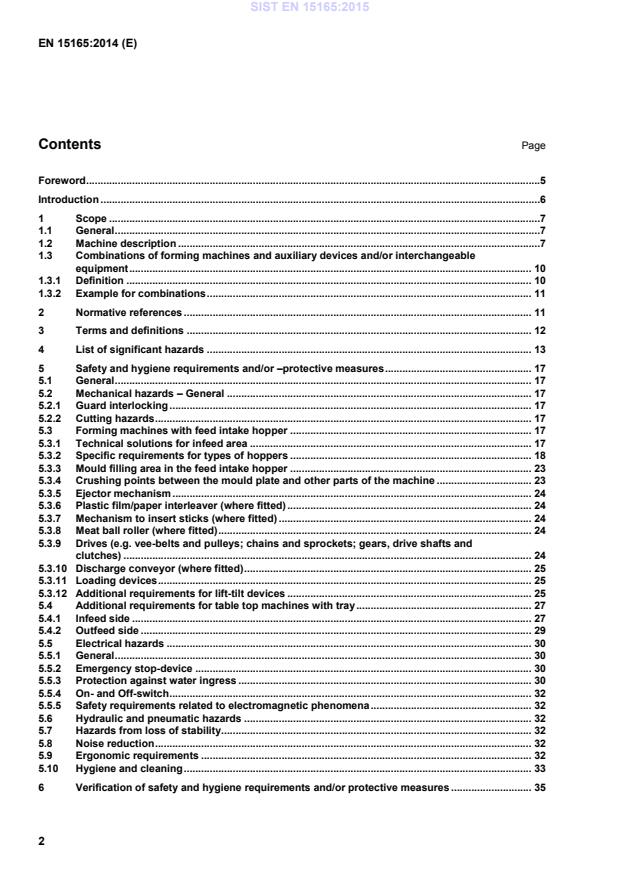
Noise test code for forming machines (grade 2) . 40 A.1 Sound measurements . 40 A.2 Installation and mounting conditions . 42 A.3 Operating conditions . 42 A.4 Measurement . 42 A.5 Information to be recorded . 42 A.6 Information to be reported. 42 A.7 Declaration and verification of noise emission values . 43 Annex B (normative)
Design principles to ensure the cleanability of forming machines . 44 B.1 Terms and definitions . 44 B.2 Materials of construction . 45 B.3 Design . 45 Bibliography . 51
Figures Figure 1 — Floor machines . 9 Figure 2 — Table top machine with tray . 10 Figure 3 — Example of combination . 11 Figure 4 — Danger zones . 16 Figure 5 — Forming machine with feed intake hopper and switch bar/light barrier – safety distances . 20 Figure 6 — Forming machines with divided hopper – safety distances . 21 Figure 7 — Forming machine with feed intake hopper — Example: ladder – safety distances . 22 Figure 8 — Forming machine with feed intake hopper — Example: step, two-hand control . 22 Figure 9 — Plough in feed intake hopper . 23 Figure 10 — Safety device for container position . 27 Figure 11 — Infeed and outfeed side of table top machines . 29 Figure 12 — Outfeed side of table top machines . 30 Figure 13 — On/Off switch with hood . 31 Figure 14 — Hygiene areas of forming machines . 34 Figure 15 — Hygiene areas of forming machines . 35 Figure A.1 — Position of measuring point . 41 Figure B.1 — Joined surfaces – food area . 44 Figure B.2 — Corners and radii in food area . 45 Figure B.3 — Angles in the food area . 46 Figure B.4 — Intersecting surfaces in the food area . 47 Figure B.5 — Acceptable joining elements – head profiles . 48 Figure B.6 — Castors – dimensions examples . 49 SIST EN 15165:2015
Tables Table 1 — List of significant hazards . 14 Table 2 — Verification list . 36
Key 1 hopper 2 hopper insert 3 feed spiral 4 mould plate drive
5 feed drive 6 knock out unit 7 mould plate 8 conveyor Key 1 trough 2 feed spiral 3 mould plate drive 4 feed drive 5 knock out unit
6 mould plate 7 conveyor 8 press block 9 stairs and cleaning platform a) Floor machine with hopper b) Floor machine with trough SIST EN 15165:2015
Key 1 hopper 2 hopper insert
3 feed spiral 4 mould plate drive
5 knock out unit 6 mould plate
7 conveyor 8 press plungers c) Floor machine with hopper Figure 1 — Floor machines
Key 1 hopper 2 paddles 3 interleaver 4 drum (mould plate) Figure 2 — Table top machine with tray 1.3 Combinations of forming machines and auxiliary devices and/or interchangeable equipment 1.3.1 Definition A combination of a forming machine with auxiliary devices and/or interchangeable equipment becomes a new machine, when the following requirements are fulfilled / met: — the (combined) device/equipment works together as an entity, meaning from production related view they form an entity (i.e. the coaction will be focused on a shared aim) and — they are controlled as an entity, via a shared or linked control system and — they work – regarding safety – together as an entity and also form a unit in this aspect. According to this definition a new machine is not existent when in a total complex single autonomous functional machines are connected in relation to function and control, but do not form a unit in relation to safety. This is given e.g. when: — on the single interfaces / interconnection points none ore only minor hazards between the separate machines occur, due to their combination; — the emergency stop of one machine is connected / looped through to the next machine since the operator’s position is only at the next machine. In such mechanical equipment each single machine can still be regarded autonomous in relation to safety. SIST EN 15165:2015
Key A forming machine B auxiliary device (optional; e.g. paper interleaver) C interchangeable equipment (optional; e.g. croquette attachment) D auxiliary device (optional; e.g. product conveyor) Figure 3 — Example of combination 2 Normative references The following documents, in whole or in part, are normatively referenced in this document and are indispensable for its application. For dated references, only the edition cited applies. For undated references, the latest edition of the referenced document (including any amendments) applies. EN 349, Safety of machinery — Minimum gaps to avoid crushing of parts of the human body EN 574, Safety of machinery — Two-hand control devices — Functional aspects — Principles for design EN 614-1, Safety of machinery — Ergonomic design principles — Part 1: Terminology and general principles EN 953:1997+A1:2009, Safety of machinery - Guards — General requirements for the design and construction of fixed and movable guards EN 1005-1, Safety of machinery — Human physical performance — Part 1: Terms and definitions EN 1005-2, Safety of machinery — Human physical performance — Part 2: Manual handling of machinery and component parts of machinery EN 1005-3, Safety of machinery — Human physical performance — Part 3: Recommended force limits for machinery operation EN 1672-2:2005+A1:2009, Food processing machinery — Basic concepts — Part 2: Hygiene requirements EN 13288, Food processing machinery — Bowl lifting and tilting machines — Safety and hygiene requirements EN 60204-1:2006, Safety of machinery — Electrical equipment of machines — Part 1: General requirements (IEC 60204-1:2005, modified) EN 60529, Degrees of protection provided by enclosures (IP Code) (IEC 60529) EN 61496-1, Safety of machinery — Electro-sensitive protective equipment — Part 1: General requirements and tests (IEC 61496-1) SIST EN 15165:2015
Key 1 Zone 1 2 Zone 2 3 Zone 3 4 Zone 4 5 Zone 5 6 Zone 6 a) Floor machine with trough SIST EN 15165:2015
Key 1 Zone 1 2 Zone 2 3 Zone 3 4 Zone 4 7 Zone 7 8 Zone 8 9 Zone 9 10 Zone 10 b) Floor machine with hopper Figure 4 — Danger zones SIST EN 15165:2015
Key A
≥ 1 600 mm S
= A + E ≥ 2 250 mm B
≤ 50 mm Figure 5 — Forming machine with feed intake hopper and switch bar/light barrier – safety distances 5.3.2.6 Forming machines with light barrier at feed intake hopper At these forming machines, a light barrier shall be provided on the complete circumference of the hopper edge of the feed intake hopper. When the forming machine is running with or without product, the feeding mechanism shall come to a standstill within 1 s after the light barrier has been activated (see Figure 5). The design of the light barrier shall be in accordance with ESPE Type 2 of EN 61496-1. For requirements relating to the safety distances see Figure 5. 5.3.2.7 Forming machines with divided hopper 5.3.2.7.1 On these forming machines the upper part of the feed intake hopper shall be movable. The upper part of the hopper shall be interlocked. If the machine is running with or without product, the feeder shall come to standstill within 1 s, after the gap C between lower and upper part of the hopper has been opened > 50 mm (see Figure 6). For requirements relating to the interlocking of the upper part of the hopper, see 5.2.2. The design dimension S, being the sum of distance A measured from the floor/standing area to the upper edge of the feed intake hopper and the distance E measured from the hopper edge to the danger point at the feeder in the feed intake hopper shall be S = A + E ≥ 2450 mm. The distance A from the floor/standing area to the hopper edge of the feed intake hopper shall be ≥ 1 600 mm (see Figure 6). 5.3.2.7.2 On these forming machines without loading device, the distance B from the floor/standing area to the separation point of the feed intake hopper shall be ≤ 1 400 mm (see Figure 6). SIST EN 15165:2015
Key A
≥ 1 600 mm B
≤ 1 400 mm C
≤ 50 mm S
= A + E ≥ 2 450 mm Figure 6 — Forming machines with divided hopper – safety distances 5.3.2.8 Additional requirements in case of interlocked steps and ladders 5.3.2.8.1 Steps and ladders If danger points in the feed intake hopper of forming machines can be reached from the standing area of a step or ladder (falling below the safety dimension of 2 250 mm, see 5.3.2.5, or 2 450 mm, see 5.3.2.6 and 5.3.2.7.), the steps or ladders shall be interlocked (see Figure 7). When the forming machine is running with or without product, the feeder shall come to a standstill within 1 s after the interlocking system has been actuated when the step or ladder has been moved into its working position. For requirements relating to the interlocking system of the step or ladder, see 5.2.2. The distance A1 from the standing area of a step to the hopper edge shall be > 1 100 mm (see Figure 7). On feed intake hoppers with a diameter of the feed intake hopper mouth < 1 100 mm, a distance A1 from the standing area to the hopper edge ≥ 700 mm is sufficient (see Figure 7). The standing area of steps shall have a width ≥ 500 mm, a length ≥ 400 mm and a toe rail of a height of 15 mm. If the standing area is < 500 mm above ground, an area of a width ≥ 400 mm and a length ≥ 350 mm is sufficient. The standing area shall be of the non-slip type. Standing areas of steps which are located > 1 200 mm above ground shall also be limited with handrail that shall fulfil the requirements of EN ISO 14122-3. The standing area of the intermediate step shall have a width of ≥ 300 mm and a length of ≥ 200 mm. Treads of ladders shall have a width of ≥ 500 mm and a depth of ≥ 80 mm. The ladder shall be arranged at an angle of < 70° to the horizontal (see Figure 7) and equipped with a handrail commencing from a measurement higher than 1 200 mm. The outside walls shall be designed (e.g. vertical and smooth) to prevent the operator climbing on the machine. This also applies to interlocked steps in their folded position. The intermediate step should not be interlocked if the distance to danger zone is big enough. SIST EN 15165:2015
S = A + E ≥ 2 250 mm or ≥ 2 450 mm A1 ≥ 1 100 mm, if D ≥ 1 100 mm A1 ≥ 700 mm, if D < 1 100 mm . ≤ 70°
Key 1 feeder 2 step/ladder, interlocked Key 1 two-hand control 2 step, interlocked Figure 7 — Forming machine with feed intake hopper — Example: ladder – safety distances Figure 8 — Forming machine with feed intake hopper — Example: step, two-hand control
5.3.2.9 Forming machines with plough in the feed intake hopper The access to the danger point at the plough/counter auger and the infeed auger in the feed intake hopper shall be prevented or restricted. This can be achieved by the observance of one of the following measures: 5.3.2.9.1 The distance between plough/counter auger (fixed) and the infeed auger (rotating) in the feed intake hopper shall be ≤ 6 mm and have an angle of pitch > 90° (see Figure 9). 5.3.2.9.2 The relative position of plough/counter auger (fixed) and infeed auger (rotating) in the feed intake hopper results in a safety situation, if there is a distance > 30 mm between plough/counter auger and infeed auger. SIST EN 15165:2015
Key 1 infeed auger 2 hopper wall 3 plough/counter auger 4 . = angle of pitch 5 danger point at the plough/counter auger Figure 9 — Plough in feed intake hopper 5.3.2.10 View into feed intake hopper With a feed intake hopper height > 1 600 mm above the standing surface, a view into the feed intake hopper (e.g. by means of a mirror, fill level indication) shall be ensured. 5.3.3 Mould filling area in the feed intake hopper Zone 3 Access to the danger zone shall be prevented when the rams/knock out bar are in normal operation. This can be achieved by means of the safeguards described under 5.3.1 above. 5.3.4 Crushing points between the mould plate and other parts of the machine Zone 3 If hazards cannot be eliminated by design, e.g. by use of distances according to EN ISO 13857 and EN 349, the access to any remaining crushing point between the moving mould plate and other parts of the machine shall be prevented. This can be achieved by a combination of fixed and interlocking guards. The safety related parts of the control system implementing the interlocking function shall be at least performance level “c” in accordance with EN ISO 13849-1. Apart from the actual discharge opening all openings shall comply with EN ISO 13857:2008, Table 4. SIST EN 15165:2015
...