


EN 12717:2001
(Main)Safety of machine tools - Drilling machines
Safety of machine tools - Drilling machines
This standard specifies the technical safety requirements and measures to be adopted by persons undertaking the design, construction and supply (including and dismantling, with arrangements for transport and maintenance) of stationary drilling machines.
Sicherheit von Werkzeugmaschinen - Bohrmaschinen
1.1
Diese Norm legt die technischen Sicherheitsanforderungen und Schutzmaßnahmen fest, die von
Personen zu beachten sind, die mit der Konstruktion, dem Bau und der Lieferung (einschließlich Installation
und Demontage, mit orkehrungen für Transport, Wartung und Instandhaltung) von ortsfesten Bohrmaschinen
befasst sind (siehe 3. ).
Diese Norm behandelt sowohl manuelle als auch automatische Bohrmaschinen. Diese umfassen, sind aber
nicht beschränkt auf
- Tischbohrmaschinen (siehe Bild A. );
- Radialbohrmaschinen (siehe Bild A.2);
- Koordinatenbohrmaschinen mit fester Tischhöhe (siehe Bild A.3);
- Waagerecht-Bohrmaschinen (siehe Bild A.4);
- Mehrspindelbohrmaschinen (siehe Bild A.5);
- Revolverbohrmaschinen mit manueller Revolverschaltung.
1.2
Diese Norm berücksichtigt die bestimmungsgemäße erwendung einschließlich des vernünftigerweise
vorhersehbaren Missbrauches, der Wartung, des Reinigens und der Einrichtvorgänge. Sie setzt den Zugang
zur Maschine von allen Seiten voraus. Sie beschreibt Maßnahmen zur Risikominderung sowohl für Bediener
als auch für andere gefährdete Personen.
1.3
Diese Norm gilt auch für Werkstückzuführeinrichtungen, wenn diese einen integralen Bestandteil der
Maschine bilden.
1.4
Diese Norm behandelt signifikante Gefährdungen an Bohrmaschinen bei bestimmungsgemäßer
erwendung und unter Bedingungen, die für den Hersteller vorhersehbar sind (siehe Abschnitt 4).
1.5
Gefährdungen, die aus anderen Bearbeitungsverfahren herrühren (z. B. Fräsen, Schleifen, Drehen,
Umformen, Elektroerodieren (EDM), Laser-Bearbeitung), werden durch andere Normen abgedeckt (siehe
Literaturhinweise).
1.6
Diese Norm gilt nicht für automatische Bohrmaschinen mit automatischem Werkzeugwechsel (siehe
prEN 24 7: 996).
1.7
Diese Norm gilt nicht für Bohrmaschinen, die vor dem Datum der eröffentlichung dieser Norm durch
CEN hergestellt wurden.
Sécurité des machines-outils - Perceuses
1 Domaine d'application
1.1 La présente norme précise les prescriptions techniques et les mesures de sécurité qui doivent être prises par les personnes réalisant la conception, la construction et la fourniture (y compris l'installation et le démontage, ainsi que les dispositions pour le transport et l'entretien) des perceuses fixes (voir 3.1).
Les machines manuelles et automatiques couvertes par la présente norme sont les suivantes, mais cette liste n'est pas limitative :
¾ perceuses sur pied (voir Figure A.1);
¾ perceuses à bras radial (voir Figure A.2);
¾ perceuses à table à coordonnées (voir Figure A.3);
¾ perceuses à broche horizontale (voir Figure A.4);
¾ perceuses multibroches (voir Figure A.5);
¾ perceuses à tourelle à commande manuelle de l'indexage de tourelle.
1.2 La présente norme tient compte de l'utilisation normale, y compris du mauvais usage raisonnablement prévisible, des opérations d'entretien, de nettoyage et de réglage. Elle présume de la possibilité d'accéder à la machine dans toutes les directions. Elle décrit les moyens permettant de réduire les risques auxquels les opérateurs et aux autres personnes sont exposées.
1.3 La présente norme est applicable également aux dispositifs mécanisés de transfert de pièce, lorsque ceux-ci font partie intégrante de la machine.
1.4 La présente norme traite des phénomènes dangereux présentés par les perceuses lorsqu'elles sont utilisées comme prévu et dans les conditions prévues par les constructeurs (voir article 4).
1.5 Les risques provoqués par les autres procédés d'usinage du métal (tels que le fraisage, la rectification, le tournage, le formage, l'usinage par électroérosion ou l'usinage par laser) sont traités dans d'autres normes (voir la- Bibliographie).
1.6 Les perceuses automatiques disposant de mécanismes de changement automatique d'outils ne sont pas couvertes par la présente norme (voir le prEN 12417:1996).
Safety of machine tools - Drilling machines
General Information
- Status
- Withdrawn
- Publication Date
- 24-Apr-2001
- Withdrawal Date
- 10-Feb-2009
- Technical Committee
- CEN/TC 143 - Machine tools - Safety
- Drafting Committee
- CEN/TC 143/WG 4 - Machining centres, etc. - Safety
- Current Stage
- 9960 - Withdrawal effective - Withdrawal
- Start Date
- 11-Feb-2009
- Completion Date
- 11-Feb-2009
- Directive
- 98/37/EC - Machinery
Relations
- Effective Date
- 19-Jan-2023

Get Certified
Connect with accredited certification bodies for this standard

National Aerospace and Defense Contractors Accreditation Program (NADCAP)
Global cooperative program for special process quality in aerospace.
CARES (UK Certification Authority for Reinforcing Steels)
UK certification for reinforcing steels and construction.
DVS-ZERT GmbH
German welding certification society.
Sponsored listings
Frequently Asked Questions
EN 12717:2001 is a standard published by the European Committee for Standardization (CEN). Its full title is "Safety of machine tools - Drilling machines". This standard covers: This standard specifies the technical safety requirements and measures to be adopted by persons undertaking the design, construction and supply (including and dismantling, with arrangements for transport and maintenance) of stationary drilling machines.
This standard specifies the technical safety requirements and measures to be adopted by persons undertaking the design, construction and supply (including and dismantling, with arrangements for transport and maintenance) of stationary drilling machines.
EN 12717:2001 is classified under the following ICS (International Classification for Standards) categories: 25.080.40 - Drilling machines. The ICS classification helps identify the subject area and facilitates finding related standards.
EN 12717:2001 has the following relationships with other standards: It is inter standard links to EN 12717:2001+A1:2009. Understanding these relationships helps ensure you are using the most current and applicable version of the standard.
EN 12717:2001 is associated with the following European legislation: EU Directives/Regulations: 98/37/EC; Standardization Mandates: M/079. When a standard is cited in the Official Journal of the European Union, products manufactured in conformity with it benefit from a presumption of conformity with the essential requirements of the corresponding EU directive or regulation.
EN 12717:2001 is available in PDF format for immediate download after purchase. The document can be added to your cart and obtained through the secure checkout process. Digital delivery ensures instant access to the complete standard document.
Standards Content (Sample)
SLOVENSKI STANDARD
01-januar-2002
Safety of machine tools - Drilling machines
Safety of machine tools - Drilling machines
Sicherheit von Werkzeugmaschinen - Bohrmaschinen
Sécurité des machines-outils - Perceuses
Ta slovenski standard je istoveten z: EN 12717:2001
ICS:
25.080.40 Vrtalniki Drilling machines
2003-01.Slovenski inštitut za standardizacijo. Razmnoževanje celote ali delov tega standarda ni dovoljeno.
EUROPEAN STANDARD
EN 12717
NORME EUROPÉENNE
EUROPÄISCHE NORM
April 2001
ICS 25.080.40
English version
Safety of machine tools - Drilling machines
Sécurité des machines-outils - Perceuses Sicherheit von Werkzeugmaschinen - Bohrmaschinen
This European Standard was approved by CEN on 7 March 2001.
CEN members are bound to comply with the CEN/CENELEC Internal Regulations which stipulate the conditions for giving this European
Standard the status of a national standard without any alteration. Up-to-date lists and bibliographical references concerning such national
standards may be obtained on application to the Management Centre or to any CEN member.
This European Standard exists in three official versions (English, French, German). A version in any other language made by translation
under the responsibility of a CEN member into its own language and notified to the Management Centre has the same status as the official
versions.
CEN members are the national standards bodies of Austria, Belgium, Czech Republic, Denmark, Finland, France, Germany, Greece,
Iceland, Ireland, Italy, Luxembourg, Netherlands, Norway, Portugal, Spain, Sweden, Switzerland and United Kingdom.
EUROPEAN COMMITTEE FOR STANDARDIZATION
COMITÉ EUROPÉEN DE NORMALISATION
EUROPÄISCHES KOMITEE FÜR NORMUNG
Management Centre: rue de Stassart, 36 B-1050 Brussels
© 2001 CEN All rights of exploitation in any form and by any means reserved Ref. No. EN 12717:2001 E
worldwide for CEN national Members.
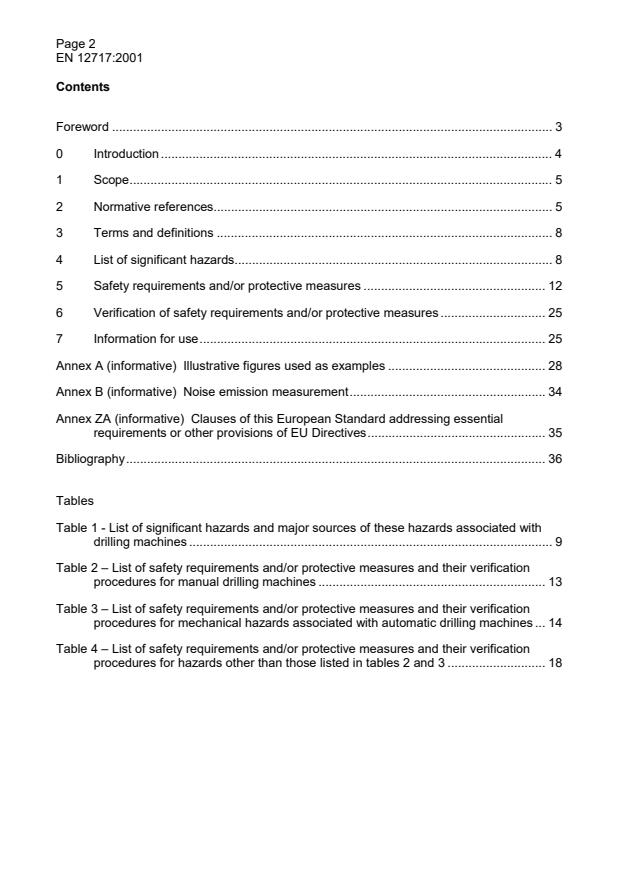
Page 2
Contents
Foreword . 3
0 Introduction . 4
1 Scope. 5
2 Normative references. 5
3 Terms and definitions . 8
4 List of significant hazards. 8
5 Safety requirements and/or protective measures . 12
6 Verification of safety requirements and/or protective measures . 25
7 Information for use. 25
Annex A (informative) Illustrative figures used as examples . 28
Annex B (informative) Noise emission measurement. 34
Annex ZA (informative) Clauses of this European Standard addressing essential
requirements or other provisions of EU Directives. 35
Bibliography. 36
Tables
Table 1 - List of significant hazards and major sources of these hazards associated with
drilling machines . 9
Table 2 – List of safety requirements and/or protective measures and their verification
procedures for manual drilling machines . 13
Table 3 – List of safety requirements and/or protective measures and their verification
procedures for mechanical hazards associated with automatic drilling machines . 14
Table 4 – List of safety requirements and/or protective measures and their verification
procedures for hazards other than those listed in tables 2 and 3 . 18
Page 3
Foreword
This European Standard has been prepared by Technical Committee CEN/TC 143
"Machine tools - Safety", the secretariat of which is held by SNV.
This European Standard shall be given the status of a national standard, either by
publication of an identical text or by endorsement, at the latest by October 2001, and
conflicting national standards shall be withdrawn at the latest by October 2001.
This European Standard has been prepared under a mandate given to CEN by the
European Commission and the European Free Trade Association, and supports essential
requirements of EC Directive(s).
This standard has been prepared to provide one means of conforming with the essential
requirements of the Machinery Directive and associated EFTA regulations.
Annexes A, B and ZA are informative. This European Standard also contains a
Bibliography.
For relationship with EC Directive(s), see informative Annex ZA, which is an integral part of
this standard.
According to the CEN/CENELEC Internal Regulations, the national standards organizations
of the following countries are bound to implement this European Standard: Austria,
Belgium, Czech Republic, Denmark, Finland, France, Germany, Greece, Iceland, Ireland,
Italy, Luxembourg, Netherlands, Norway, Portugal, Spain, Sweden, Switzerland and the
United Kingdom.
Page 4
0 Introduction
This European standard is a type C standard as stated in EN 292–1.
When provisions of this type C standard are different from those which are stated in type A
or B standards, the provisions of this type C standard take precedence.
Drilling machines present a wide range of hazards, not least from their wide application as
rotating tool, 'stationary' workpiece machine tools, for general purpose cutting of cold metal
work material.
Protection of operators and other persons from contact with moving cutting tools, especially
when being rapidly rotated in the spindle or from contact with fast–moving workpieces, is of
great importance.
When power–operated mechanisms are provided for workpiece transfer, they can also
create hazardous situations during loading/unloading and workpiece alignment or clamping.
On automatic drilling machines, total enclosure of the work zone using guards during
cutting is the preferred method of safeguarding. Where this is not practicable (e.g. due to
size of the workpiece, its geometry, or its special characteristics), operators may be
safeguarded by other means (e.g. perimeter fencing, protective devices at the operating
position). Operators may also benefit from pendant controls, which enable them to move
about the machine.
The significant hazards covered by this standard are those listed in clause 4. The safety
requirements and/or protective measures to prevent or minimize those hazards identified in
table 1 and procedures for verification of these requirements or measures are found in
clause 5.
The figures in annex A are examples only and are not intended to illustrate the only
interpretation of the text.
Page 5
1 Scope
1.1 This standard specifies the technical safety requirements and measures to be adopted
by persons undertaking the design, construction and supply (including installation and
dismantling, with arrangements for transport and maintenance) of stationary drilling
machines (see 3.1).
This standard covers both manual and automatic drilling machines. These include but are
not limited to:
– pedestal drilling machines (see figure A.1);
– radial arm drilling machines (see figure A.2);
– coordinate table drilling machines (see figure A.3);
– horizontal spindle drilling machines (see figure A.4);
– multi–spindle drilling machines (see figure A.5)
– turret type drilling machines with manual control of turret index.
1.2 This standard takes account of intended use including reasonably foreseeable misuse,
maintenance, cleaning, and setting operations. It presumes access to the machine from all
directions. It describes means to reduce risks to operators and other exposed persons.
1.3 This standard also applies to workpiece transfer devices when they form an integral part
of the machine.
1.4 This standard deals with significant hazards relevant to drilling machines when they are
used as intended and under the conditions foreseen by the manufacturer (see clause 4).
1.5 Hazards arising from other metal working processes (e.g. milling, grinding, turning,
forming, EDM, laser processing) are covered by other standards (see Bibliography).
1.6 Automatic drilling machines with automatic tool changing capabilities are not covered
by this standard (see prEN 12417:1996).
1.7 This standard is not applicable to drilling machines, which were manufactured before
the date of publication by CEN of this standard.
2 Normative references
This European Standard incorporates, by dated or undated reference, provisions from
other publications. These normative references are cited at the appropriate places in the
text and the publications are listed hereafter. For dated references, subsequent
amendments to or revisions of any of these publications apply to this European Standard
only when incorporated in it by amendment or revision. For undated references the latest
edition of the publication referred to applies (including amendments).
EN 292-1: 1991 and EN 292-2/A1:1995 Safety of machinery - Basic concepts, general
principles for design - Part 1: Basic terminology, methodology
EN 292-2: 1991 Safety of machinery - Basic concepts, general principles for design -
Part 2: Technical principles and specifications
EN 294: 1992 Safety of machinery – Safety distances to prevent danger zones
being reached by the upper limbs
Page 6
EN 349 Safety of machinery – Minimum gaps to avoid crushing of parts of
the human body
EN 457 Safety of machinery - Auditory danger signals - General
requirements, design and testing (ISO 7731:1986 modified)
EN 574 Safety of machinery - Two hand control devices – Functional
aspects – Principles for design
EN 614 Safety of machinery - Ergonomic design principles –
Part 1: Terminology and general principles
Part 2: Interaction between machinery design and work tasks
EN 626 Safety of machinery – Reduction of risks to health from hazardous
substances emitted by machinery
EN 894:1997 Safety of machinery –Ergonomics requirements and data for the design
of displays and control actuators-
Part 1: Human interactions
Part 2: Displays
EN 894:2000 Part 3: Control actuators
EN 953:1997 Safety of machinery – Guards – General requirements for the design
and construction of fixed and movable guards
EN 954-1 Safety of machinery - Safety-related parts of control systems - Part l:
General principles for design
EN 982:1996 Safety of machinery - Safety requirements for fluid power systems and
their components - Hydraulics
EN 983:1996 Safety of machinery - Safety requirements for fluid power systems and
their components - Pneumatics
EN 999 Safety of machinery – The positioning of protective equipment in
respect of approach speeds of parts of the human body
prEN 1005:1998 Safety of machinery – Human physical performance –
Part 1: Terms and definitions
Part 2: Manual handling of heavy weights associated with machinery
Part 3: Recommended force limits for machinery operation
EN 1037:1995 Safety of machinery – Prevention of unexpected start-up
EN 1050:1996 Safety of machinery - Principles for risk assessment
EN 1088:1995 Safety of machinery - Interlocking devices associated with guards –
Principles for design and selection
EN 1127–1:1997 Explosive atmospheres - Explosion prevention and protection –
Part 1: Basic concepts and methodology
EN 1760–1:1997 Safety of machinery - Pressure sensitive protective devices – Part 1:
General principles for the design and testing of pressure sensitive
mats and pressure sensitive floors
EN 1837 Safety of machinery – Integral lighting of machines
Page 7
EN ISO 3744:1995 Acoustics – Determination of sound power level of noise sources
using sound pressure – Engineering method in an essentially free
field over a reflecting plane
EN ISO 3746:1995 Acoustics – Determination of sound power level of noise
sources using sound pressure – Survey method using an
enveloping measurement surface over a reflecting plane
EN ISO 4871 Acoustics – Declaration and verification of noise emission
values of machinery and equipment
EN ISO 9614-1:1995 Acoustics – Determination of sound power level of noise
sources using sound intensity – Part 1: Measurement at discrete
points
EN ISO 11202:1995 Acoustics – Noise emitted by machinery and equipment –
Measurement method of emission sound power levels at the
work station and at other specified positions – Survey method in
situ
EN ISO 11204:1995 Acoustics - Noise emitted by machinery and equipment –
Method requiring environmental corrections
EN ISO 14122 Permanent means of access to machines and industrial plants
Part 2: Working platforms and gangways
Part 3: Stairways, stepladders and guard-rails
prEN 13478:1999 Safety of machinery - Fire prevention and protection
EN ISO 11688-1 Acoustics – Recommended practice for the design of low–noise
machinery and equipment - Part 1:Planning
ISO/TR 11688-2:1998 Acoustics – Recommended practice for the design of low–noise
machinery and equipment - Part 2: Introduction to the physics of
low-noise design
EN 60204-1:1997 Safety of machinery - Electrical equipment of machines - Part 1:
General requirements
EN 60529:1991 Degrees of protection provided by enclosures (IP Code)
EN 61496-1:1997 Safety of machinery - Electrosensitive protective equipment -
Part 1 - General requirements and tests
IEC 61496-2 Safety of machinery – Electro-sensitive protective equipment –
Part 2: Particular requirements for equipment using active opto-
electronic protective devices (AOPDs)
EN 50081-2 Electromagnetic compatibility - Generic emission standard –
Part 2: Industrial environment
EN 61000-6-2 Electromagnetic compatibility (EMC) – Part 6-2: Generic
standards - Immunity for industrial environments
(IEC 61000-6-2:1999)
Page 8
3 Terms and definitions
For the purposes of this standard, the following terms and definitions apply. For other terms
and definitions, see EN 292–1, EN 292–2/A1.
3.1
drilling machine
a machine designed to produce holes in cold metal by the use of a rotating cutting tool.
3.1.1
manual drilling machine
a machine where the axial motion of the cutting tool is controlled through the actuation of a
handwheel or lever (may include powered axial feed or powered unprogrammed positioning
of spindle or workpiece).
3.1.2
automatic drilling machine
a machine with the capability to perform programmed multiple position drilling operations.
3.2
workpiece transfer device
a mechanism integrated with the machine as a means of supplying a previously loaded
workpiece to a machine in exchange for a finished workpiece (e.g. pallet changing device).
3.3
work zone
the space where the metal cutting process can take place.
3.4
electronic handwheel
a manually operated control device which initiates and maintains an axis movement by
pulse generation input to the numerical control during its rotation.
4 List of significant hazards
4.1 The list of hazards contained in table 1 is the result of a hazard identification and
risk assessment carried out as described by EN 1050, for the wide range of drilling
machines covered by the scope of this standard. The safety requirements and/or measures
and information for use contained in clauses 5 and 7 are based on the risk assessment and
deal with the identified hazards by either eliminating them or reducing the effects of the
risks they generate.
4.2 The risk assessment assumes foreseeable access from all directions, as well as
unexpected start–up. Risks to both the operators and other persons who can have access
to the hazard zones are identified, taking into account hazards which can occur under
various conditions (e.g. commissioning, set–up, production, maintenance, repair,
decommissioning) during the life of the machine. The assessment includes an analysis of
the effect of failure in the control system.
4.3 In addition, the user of this standard (i.e. the designer, manufacturer, supplier) shall
validate that the risk assessment is complete for the machine under consideration with
particular attention to:
Page 9
– the intended use of the machine including maintenance, setting and cleaning, and its
reasonably foreseeable misuse;
– the identification of the significant hazards associated with the machine.
Table 1 - List of significant hazards and major sources of these hazards associated
with drilling machines
Description Example(s) of related Associated activity Related danger zone Clause 5
*
hazardous situation(s) Reference
1 Mechanical hazards
1.1 Crushing moving axes, tool setting, manual tool between fixed and Tables 2, 3
clamping exchange, moving elements of and 4
maintenance the machine (1.1.1–1.4.3)
1.2 Shearing moving axes manual operation between tool/ spindle
and table/ workpiece
1.3 Cutting or severing tool running drilling with hand held work zone
workpiece
1.4 Entanglement rotating spindle or tool workpiece load/ at spindle or tool
unload, positional
adjustment, manual
swarf/chip removal,
cutting fluid
application
other rotating parts (e.g. setting, cleaning, swarf/chip collection
conveyors, transmission maintenance and discharge zones,
elements) transmission
elements
1.5 Drawing–in or trapping rapid travel of table or power–operated envelope of Tables 2, 3
spindle head motion of workpiece movement of and 4
on table or tool in workpiece on table (1.1.1–1.4.3)
spindle axes; envelope of
movement of tool in
spindle head
rotating power maintenance in or around machine
transmission
mechanisms
1.6 Impact unintended movement during drilling with work zone
(rotation) of workpiece inadequate workpiece
clamping
rapid movement of during powered at machine
workpiece or spindle traverse
head,
automatic workpiece power-operated envelope of motion of
transfer workpiece transfer workpiece and
workpiece transfer
mechanisms
1.7 Stabbing or puncture handling tools during manual tool at sharp cutter faces (see clause
change 7)
handling swarf/chips during loading/ at workpiece, table, (see clause
unloading and and swarf /chip 7)
cleaning collecting and
discharge zones
2 Electrical hazards
2.1 Contact of persons contact with live parts or during electrical cabinet, 2.1
with live parts (direct connections commissioning, terminal boxes,
contact) maintenance, trouble control panels at
shooting machine
2.2 Contact of persons contact with live parts or during operation, at machine or faulty 2.2
with parts which have connections inspection and part
become live under maintenance of
faulty conditions machine
(indirect contact)
Page 10
Description Example(s) of related Associated activity Related danger zone Clause 5
*
hazardous situation(s) Reference
Hazards generated by noise
4.1 Hearing loss motion of power during operating cycle near machine 4.1
(deafness), other transmission elements, of machine
physiological cutting processes and
disorders (e.g. loss of fluid power systems
balance, loss of
awareness)
4.2 Interference with air blast used for during operating cycle near machine 4.2
speech cleaning of tool or of machine
communication, workpiece locations
acoustical signals
7 Hazards generated by materials and substances
7.1 Hazards from contact conditions near during operating cycle at or near machine 7.1
with or inhalation of machine caused by of the machine
harmful fluids, gases, ejection of particles of
mists, fumes, and work material, fluid
dusts droplets or mist from
metal working fluids
7.2 Fire or explosion flammable work during operating cycle at or near machine 7.2
material, flammable (low of the machine
flash point) metal
working fluids
7.3 Biological or micro– contact with hydraulic or during operation, at or near machine 7.3
biological (viral or metal working fluid as process control, and
bacterial) hazards liquid or mist containing maintenance
detritus and bacteria
8 Hazards generated by neglecting ergonomic principles in the design process
8.1 Unhealthy postures or lifting and reaching while during loading/ at load/unload and 8.1
excessive effort handling workpiece, unloading, process tool mounting
(repetitive strain) tools, and machine parts control, and positions,
maintenance maintenance action
points
8.2 Inadequate inappropriate location of during loading/ at load/unload and 8.2
consideration of hand- controls unloading, process tool mounting
arm or foot-leg control, and positions,
anatomy maintenance maintenance action
points
8.4 Inadequate local judgment and accuracy during loading at load/unload, tool 8.4
lighting of manual actions /unloading, process mounting positions
impaired during control, tool handling
handling/ positioning of
work materials and
cutters
8.6 Human errors, human reasonably foreseeable during loading/ at load/unload, tool 8.6
behaviour misuse, inadvertent unloading, process mounting positions
operation of controls, control, tool handling
incorrect work material
and cutter handling and
setting
8.7 Inadequate design, inadvertent operation of during setting, at or near machine 8.7
location or controls operating cycle
identification of
manual controls
8.8 Inadequate design or misinterpretation of during setting, at or near machine 8.8
location of visual displayed information operating cycle
display units
Page 11
Description Example(s) of related Associated activity Related danger zone Clause 5
*
hazardous situation(s) Reference
10 Unexpected start-up, unexpected overrun/ overspeed
10.1 Failure/disorder of the mechanical hazards during setting, at machine 10.1
control system associated with selected cleaning
machine movement
10.2 Restoration of energy unexpected movements during setting, at or near machine 10.2
supply after an of machine cleaning or
interruption maintenance
10.3 External influences on unpredictable behaviour during setting or at or near machine 10.3
the electrical of electronic controls operating cycle of
equipment due to electromagnetic the machine
interference
13 Failure of the power malfunctions of the during operation, at machine – machine 13
supply control with consequent process control, elements retained in a
misapplication of stored maintenance safe condition by the
energy or power. Power application of power
workholding fails, motor or fluid pressure.
overspeed. Part
breakage causes
machine elements to
move under residual
forces (inertia, gravity,
spring/ energy storage
means) causing external
elements to move
unexpectedly
14 Failure of the control Unexpected movement During setting, At or near machine 14
of machine cleaning or
circuit
maintenance
15 machine elements fail or 15
Errors of fitting
swing unexpectedly
17 Falling or ejected ejection of machine during machine at or near machine 17
parts, workpiece or tools operation
objects or fluids
caused by clamping
device, control system
failures or collision due
to data errors
18 unrestrained machine or during loading/ at machine 18
Loss of stability,
machine part unloading and
overturning of
(maintained in position process control, at
machinery
by gravity), falls or heavy/unwielding
overturns workpieces during
maintenance
(disassembly/
relocation)
19 Slip , trip, and fall of ejection or spillage of during workpiece machine table, floor 19
metal working fluids and load/unload, setting, area around machine
persons
lubricants (also hydraulic process control and and workpiece
fluid if used); work at maintenance permanent means of
heights work at heights access to the machine
work to replenish
fluids (e.g. lubricants)
* This list is derived from annex A of EN 1050: 1996.
Page 12
5 Safety requirements and/or protective measures
5.1 General requirements
Drilling machines shall comply with the safety requirements and/or protective measures of
this clause.
In addition, the drilling machine shall be designed according to the principles of EN 292 for
hazards relevant but not significant which are not dealt with by this standard.
5.2 Specific requirements
The specific safety requirements and/or protective measures for manual drilling machines
are detailed in table 2.
The specific safety requirements and/or protective measures for automatic drilling
machines are detailed in table 3.
The specific safety requirements and/or protective measures common to both manual and
automatic drilling machines are detailed in table 4.
Page 13
Table 2 – List of safety requirements and/or protective measures and their
verification procedures for manual drilling machines
Hazard Safety requirement and/or protective Verification
measure
1 Mechanical 1.1 Work zones
visual inspection
Access to mechanical hazards arising from rotating spindle/tools
of manual drilling machines shall be prevented by fixed or
adjustable guards or interlocked movable guards (Interlocking
devices shall be in accordance with EN 1088:1995). Where
guards are not practicable, these may be substituted by
protective devices.
1.1.1 Guards
visual inspection
Guard(s) shall enclose the spindle nose, chuck/toolholder, and
cutting tool to prevent access from at least the front and both
sides when the spindle/quill is at its normal rest position (see
figure A.6).
1.1.2 Protective devices
by visual inspection,
For some machine types (e.g. radial arm drilling machine) where
practical test
reasonably foreseeable applications can preclude the use of
guards, protective devices shall be provided (e.g. telescopic trip
device associated with a braking system).
Such protective devices shall be located no more than 150 mm
from the outside diameter of each spindle of the machine and in
the first quadrant of spindle rotation from the operator’s normal
position (see figure A.7).
1.1.3 Spindle braking
Stopping performance of spindle braking systems associated measurement
with a trip device shall have a minimum capability as follows:
spindle RPM (n) max. revolutions to stop
n 1
250 < n 2
1000 < n 3
n > 1500 4
1.2 Workpiece holding
For all manual drilling machines, the manufacturer shall visual inspection
incorporate facilities to securely affix the workpiece to the work
table (e.g. through holes, T slots, mounting holes – see figure
A.8).
NOTE Crushing hazards are not normally considered significant for manual drilling machines.
Page 14
Table 3 – List of safety requirements and/or protective measures and their
verification procedures for mechanical hazards associated with automatic drilling
machines
Hazards Safety requirement and/or protective measure Verification
1 Mechanical 1.1 Work zone
1.1.1 Primary safeguards
Visual inspection
The work zones of automatic drilling machines shall be safeguarded.
The guarding arrangements shall be designed to prevent access to
hazardous situations.
NOTE General guidance for the design selection of safeguards, where
the hazards from moving parts cannot be avoided by design is given in
4.1, 4.2 and table 1 of EN 292-2: 1991.
For the purposes of this clause,
1) all protective equipment shall be in accordance with the following:
in accordance with EN 61496-1:1997 (ESPE), in accordance with
IEC 61496-2:1997, category 4 (AOPD), in accordance with
EN 61496-1:1997 (PSPD).
2) Guards shall be in accordance with EN 953:1997,
1.1.2 Guarding strategies
1.1.2.1 General
The work zone shall be enclosed where possible by fixed and/or Visual inspection,
interlocked movable guards during machining operations. Where assessment
enclosure is not reasonably practicable (e.g. due to the size of the
workpiece, its geometry, other special characteristics of the machine or
its application), operators and other exposed persons shall be
safeguarded by a combination of other means (e.g. protected operator
position (cabin), perimeter guarding, other protective devices).
1.1.2.2 Enclosure
Visual inspection,
Where reasonably practicable, work zone guarding shall be fixed to the
examination of
structure of the machine (see 3.2.1 of EN 953: 1997) (see also guard
characteristics below and figures A.3, A.4). drawings
1.1.2.3 Alternatives to enclosures
Visual inspection
Access to the work zone, by the operator, from the normal (fixed)
operating position shall be prevented by local guarding (typically
forming a cabin). Access to the cabin shall not require entry into the
hazard zone enclosed by perimeter fencing or other protective devices.
Where this is not possible because of the machine configuration or
other operating constraints, the access route to the operating position
shall not require approach to hazardous situations.
Where the machine operator requires access to the work zone from the Visual inspection
protected (fixed) operating position (cabin) e.g. for setting purposes or
process control, the cabin shall be designed so that access is via an
interlocked movable guard from within the cabin. Alternatively the
movement of a pendant control from the cabin position shall have the
same effect as the interlocked guard above. Operation of the machine
in mode 1 (automatic cycle) shall only be possible when the pendant
control (above) is relocated in the cabin. Any other powered movement
of machine elements shall only be achieved by selection of the
appropriate operating mode (see operating modes below).
Page 15
Hazards Safety requirement and/or protective measure Verification
Access to the work zone by persons other than the machine operator Visual inspection,
1 Mechanical
shall be prevented by perimeter fencing and/or other means (e.g. conformance to
(continued)
electrosensitive protective equipment (ESPE), active-opto electronic drawings/
protective devices (AOPDs), pressure sensitive protective devices specifications
(PSPDs). Where access points (e.g. gates), are provided they shall be
interlocked. Where interlocking is not possible because of the particular
machine configuration and application, any non interlocked access
points shall be within the visual held of the operator(s) from the normal
working position. Where it is foreseen that the machine will be operated
unattended, for some or all of the operating cycle, other means of
access control (e.g. key pad operated locks), shall be provided to
prevent unauthorised access.
Visual inspection,
1.1.3 Multiple work zones
functional test to
ensure compliance,
Where more than one work zone is provided on a single machine,
conformance to
safeguards (e.g. fixed or interlocked movable guards, AOPD, ESPE)
drawings/
shall protect the operator(s) from adjacent active work zone hazards
specifications
(e.g. when loading or unloading workpieces in a non-active work zone,
cleaning).
Unauthorised movement of the machine into an adjacent non-active
work zone shall be prevented using a limiting device (eg mechanical
stops, range limit switches, light beams, AOPDs)
1.1.4 Guard characteristics
1.1.4.1 Height and position
Measurements to
Where guards are floor mounted (e.g. perimeter fencing), they shall be
ensure compliance
securely fixed and have a minimum height of 1,4 m at a distance in
with EN 294
accordance with table 2 of EN 294: 1992 from the hazard zone. Any
opening between the bottom of the guard and the floor shall not exceed
300 mm.
1.1.4.2 Containment
Guards shall be designed to contain and/or prevent exposure to Practical check
swarf/chips, fluids and parts that can be discharged or ejected (see also
7.1.4, 17.1, 17.2 and 19.2 of table 4).
1.1.4.3 Observation
Where routine observation of the machine operation is required, means Visual inspection
(e.g. windows) shall be provided so that this can be achieved without
the need to open, remove or suspend any work zone guard or other
protective device(s) (see also 8.4 lighting, of table 4).
1.1.5 Interlocking
1.1.5.1 All movable guards through which frequent access to the work Visual inspection,
zone is required (i.e. more than once per shift) shall be interlocked. practical check
Opening of a guard or actuation of a protective device in mode 1
(automatic cycle - see below) shall cause hazardous movements to
stop and further movement to be inhibited (see EN 1037). Measures to
minimise the possible defeat of interlocking device(s) shall be taken
(see clauses 5 and 7 of EN 1088: 1995).
Practical check
1.1.5.2 If opening of an interlocked movable guard exposes operators to
hazards listed from 1.1 to 1.7 of table 1, guard locking shall be provided
(see EN 1088 and also 7.2.m) of clause 7).
Page 16
Hazards Safety requirement and/or protective measure Verification
1 Mechanical 1.1.6 Modes of operation
(continued)
1.1.6.1 General
Each machine shall have at least two modes of operation (i.e. modes 1 Visual inspection,
and 2) with the option of a third mode (i.e. mode 3). The selection of a practical check
mode of operation shall be either by key switch, access code or equally
secure means and shall only be permitted from outside the work zone.
Selection of a mode shall not initiate hazardous situations. (See also
9.2.3 of EN 60204–1: 1997)
1.1.6.2 Mode 1 - Automatic cycle [automatic production]
The guards shall be closed and/or the protective devices be active to Practical check
permit execution of programmed sequential machine operation under
numerical control.
1.1.6.3 Mode 2 – Setting
Setting mode is a mode of operation in which adjustments for the
subsequent machining process are performed by the operator.
NOTE Assessment of tool or workpiece position, e.g. by touching the
workpiece with a probe or tool, and programme sequence checking,
belong to the setting mode.
When any interlocked movable guard is open or a protective device is
suspended, powered machine movements shall only be permitted
under the following conditions:
a) Axis movements at a maximum rate of 2 m/min or a maximum Measurement
increment of 10 mm.
These movements shall be selected one axis at a time and may be Practical check
initiated and maintained by one of the following means:
– a hold-to-run control device;
– an electronic handwheel;
– manual data input (MDI) followed by cycle start together with an
enabling device.
b) Spindle speed shall be limited by its stopping performance which Measurement
shall not exceed 2 revolutions.
Spindle rotation shall only be initiated and maintained by one of the Practical check
following means:
– a hold-to-run control device
– a spindle start control device together with an enabling device.
Release of an enabling device shall initiate a category 1 stop in
accordance with 9.2.2 of EN 60204-1:1997.
c) The limits of speed or incremental distance [defined in a) and b) Examination of
above] shall be monitored and if exceeded, the power to the drives shall circuit diagrams,
be removed by a controlled stop (Category 1 - see 9.2.2 of practical check
EN 60204–1: 1997).
d) Means shall be provided to prevent hazardous movement of vertical Practical check
or slant axes under gravity.
e) Automatic workpiece changing mechanisms shall remain inhibited. Practical check
Initiation of their automatic movement shall only be possible by
reselection of mode 1.
Exception: For maintenance in mode 2 only, the provisions contained in Practical check
1.1 of table 4 shall be permitted.
f) Unguarded swarf/chip conveyor movements shall only be initiated and Visual inspection,
maintained by a hold-to-run control device. examination of
circuit diagrams
Page 17
Hazards Safety requirement and/or protective measure Verification
g) Where multiple hold-to-run control device locations are provided (e.g. Practical check
1 Mechanical
main control station, hand-held pendant), only one shall be functional at
(continued)
a time.
1.1.6.4 Mode 3 - Optional mode for manual intervention under
restricted operating conditions
When provided, this mode permits use of the machine under manual or
numerical control with work zone guards open and/or protective devices
suspended under the following conditions:
a) This mode shall only be provided when details of the intended Visual inspection (of
application are known and the required skill level of operators shall be instruction
defined in the instruction handbook (see 7.2 g) of clause 7). handbook)
b) Single axis and multiple axis vector speeds shall be limited to Measurement
5m/min.
c) Spindle speed shall be limited by its stopping performance which Measurement
shall not exceed 5 revolutions.
NOTE 1 In order to achieve this stopping requirement it may be
necessary to provide tool diameter identification or measurement
systems to limit the permitted speed of the spindle for each tool used.
NOTE 2 Alternative solutions to this clause have been considered
during the development of this standard but no firm conclusions have
been reached. This particular problem will be re-visited in a future
revision of this standard.
d) Program execution shall be initiated by cycle start control device in Practical check
conjunction with an enabling device;
e) Non-programmed movements shall be achieved as follows:
1) Spindle rotation shall be initiated and maintained by a spindle start Examination of
control device together with an enabling device. circuit diagrams,
practical test
Release of an enabling device shall initiate a category 1 stop in
accordance with 9.2.2 of EN 60204-1:1997.
2) Axis movements may be initiated and maintained by one of the Practical check
following means:
– a hold-to-run control device
– an electronic handwheel
– manual data input (MDI) followed by cycle start together with an
enabling device.
f) The limits of speed or incremental distance [defined in b) and c) Practical check
above] shall be monitored and if exceeded, the power to the drives shall
be removed by a controlled stop (category 1, see 9.2.2 of EN 60204-1:
1997).
g) The requirements d), e), f) and g) of mode 2 in 1.1.6.3 also apply. See1.1.6.3d), e), f),
g)
Page 18
Hazards Safety requirement and/or protective measure Verification
Visual inspection,
1 Mechanical 1.1.7 Release of trapped persons
verification against
(concluded)
circuit diagrams,
Means shall be provided for the movement of machine axes for
practical check
emergency purposes (e.g release of trapped persons). These means
are for example:
a) With power off:
– manually operated relief valves to depressurise systems
under pressure;
– manual release of power-actuated brakes provided that
weight-balancing exists;
b) With power on:
– manual control facilities of power-piloted valves/drives;
– control facilities to start counter motions.
(see also 7.2.m) of clause 7).
Table 4 – List of safety requirements and/or protective measures and their
verification procedures for hazards other than those listed in tables 2 and 3
NOTE The numbering of various provisions in this table is in accordance with Table 1 and hence missing
numbers correspond to hazards which are not significant
Hazards Safety requirement and/or protective measure Verification
1 Mechanical 1.1 Workpiece transfer devices (e.g. pallet changing devices,
automatic workpiece changing devices)
Visual inspection
1.1.1 Load/unload positions for operators at workpiece transfer devices
shall be located outside the work zone and away from other hazardous
mechanisms.
1.1.2 Access to hazardous movements shall be prevented by means of Visual inspection,
fixed and/or interlocked movable guards or hazardous movement(s) practical check
shall be either stopped or inhibited by the actuation of protective
devices (e,g, ESPE, AOPD).
1.1.3 Where access is required with the guards open or the protective Examination of
devices suspended, powered motion shall only be initiated under the circuit diagrams,
control of an enabling device together with a hold-to-run device to measurement,
permit step-by-step movement. When continuous movement is practical check
required, a two-hand control device shall be provided. This device shall
be in accordance with 9.2.5.7 Type 3 of EN 60204-1:1997. Such
movement shall be at a safe distance from the hazardous situation, see
EN 574 and EN 999. No hazardous movement shall arise from the
actuation of any sensor or feedback device (see 10.1.4 of EN 60204-1,
1997 and 7.2 f of clause 7 in this standard).
1.2 Swarf /chip collection and removal
Visual inspection,
1.2.1 Access to hazardous moving parts of swarf/chip collection and
practical check
removal systems shall be prevented by means of fixed guards. Where
operators have a need to access more frequently than once per shift,
interlocked movable guards shall be provided. Guards shall be in
accordance with EN 953.
1.2.2 Opening an interlocked movable guard, which provides access to Examination of
circuit diagrams,
the hazardous moving parts of a swarf/chip system shall cause the
practical check
movement to cease and remain inhibited (see also 1.1.5 of table 3 and
14.1.1 of this table).
1.2.3 If movement of a swarf/chip system with an interlocked guard Examination of
open is essential (e.g. for cleaning purposes) the movement shall only circuit diagrams,
be permitted under the control of a hold-to-run device with an adjacent practical check
emergency stop device. A warning sign shall indicate the hazardous
area of the swarf/chip system discharge (see also 7.2 f) of clause 7).
Page 19
Hazards Safety requirement and/or protective measure Verification
1 Mechanical 1.3 Power transmission mechanisms
(e.g. driveshafts, belts, pulleys,
(concluded) gears)
Visual inspection
1.3.1 Access to hazardous power transmission parts (e g belts, chains,
gears. pulleys, shafts) shall be prevented by means of fixed guards but
interlocked movable guards shall be provided where operators have a
need to access more frequently than once per shift. Guard shall be in
accordance with EN 953.
Visual inspection
1.3.2 Opening an interlocked movable guard, which exposes moving
power transmission parts, shall cause their movement to cease and
remain inhibited. Interlocking provisions shall conform to EN 1088:1995
and as a minimum to category 1 (see 6.2.2 of EN 954–1: 1996).
1.3.3 Where the hazardous moving parts can be reached before they Visual inspection
come to rest. guard locking shall be applied to prevent opening of the
guard until the hazardous movement has ceased. Delayed unlocking
shall be achieved by means of a motion detector or timer control. (see
7.2 and 7.3 of EN 1088: 1995 and EN 999).
1.4 Pits
Visual inspection
1.4.1 Pits in or around a machine shall be covered (e.g. floor grids) or
secured against persons falling into them by e.g.
– railings;
– cables with roll up device;
– chains (red/white, black/yellow) with a warning sign 1 m in front
of the fall down position.
1.4.2 Where access to pits is necessary for observation, maintenance, Visual inspection
or adjustment purposes, entry into the pit shall be via interlocked
access gates which prevent machine movement in mode 1. Where
powered machine movements are necessary, machine elements may
be moved under the conditions set out in 1.1.6.3 of table 3 and 1.1 and
1.2 of this table .
1.4.3 Safety distances between moving machine elements and pit walls Measurement of
or other fixed parts shall be in accordance with EN 349. Where these distance, visual
safety distances cannot be achieved, additional protective measures inspection, practical
check
shall be provided to minimise the risk of crushing or trapping.
2 Electrical 2.1 Direct contact
To minimise the haza
...
Questions, Comments and Discussion
Ask us and Technical Secretary will try to provide an answer. You can facilitate discussion about the standard in here.
Loading comments...