


EN 16602-70-56:2015
(Main)Space product assurance - Vapour Phase Bioburden Reduction for Flight Hardware
Space product assurance - Vapour Phase Bioburden Reduction for Flight Hardware
This standard specifies procedures for the reduction of microbiological contamination of flight hardware using hydrogen peroxide vapour.
The procedures specified in this standard cover:
• Reduction of microbiological contamination on exposed surfaces.
• Reduction of microbiological contamination in controlled ambient and vacuum environments.
This standard also specifies requirements for the conditioning of the flight hardware, bioburden reduction cycle development, and equipment to be used for applying a bioburden reduction procedure.
This standard may be tailored for the specific characteristics and constraints of a space project in conformance with ECSS-S-ST-00C.
Raumfahrtproduktsicherung - Reduktion der Gesamtkeimzahl bei Dampfphase für Flughardware
Assurance produit des projets spatiaux - Réduction en phase gazeuse de la charge microbienne des matériels de vol
Zagotavljanje varnih proizvodov v vesoljski tehniki - Zmanjšanje biološke obremenitve v parni fazi za letalsko strojno opremo
Ta standard določa postopke za zmanjšanje mikrobiološke onesnaženosti letalske strojne opreme s hlapi vodikovega peroksida. Postopki, določeni v tem standardu, vključujejo: • zmanjšanje mikrobiološke onesnaženosti izpostavljenih površin; • zmanjšanje mikrobiološke onesnaženosti v nadzorovanih zunanjih in vakuumskih okoljih. Ta standard določa tudi zahteve za staranje letalske strojne opreme, razvoj cikla zmanjševanja biološke obremenitve in opremo za izvajanje postopka zmanjšanja biološke obremenitve. Ta standard se lahko prilagodi posameznim lastnostim in omejitvam vesoljskega projekta v skladu s standardom ECSS-S-ST-00C.
General Information
- Status
- Published
- Publication Date
- 22-Sep-2015
- Withdrawal Date
- 30-Mar-2016
- Technical Committee
- CEN/CLC/TC 5 - Space
- Drafting Committee
- CEN/CLC/TC 5 - Space
- Current Stage
- 9093 - Decision to confirm - Review Enquiry
- Start Date
- 15-Sep-2021
- Completion Date
- 11-Feb-2026
Relations
- Effective Date
- 28-Jan-2026
Overview
EN 16602-70-56:2015 - "Space product assurance - Vapour Phase Bioburden Reduction for Flight Hardware" - is a CEN European Standard that specifies procedures for reducing microbiological contamination of flight hardware using hydrogen peroxide vapour (HPV). The standard covers reduction of contamination on exposed surfaces and within controlled ambient and vacuum environments, and sets requirements for hardware conditioning, cycle development, process equipment, monitoring and reporting. It supports planetary protection objectives and is intended for tailoring to specific space projects in conformance with ECSS policy.
Key topics and technical requirements
- Process agent: Hydrogen peroxide vapour is the mandated bioburden reduction agent.
- Process steps: Typical cycle sequence includes preconditioning, a Ct-value (time-integrated HPV concentration) treatment step, and venting; each step requires defined control and monitoring parameters.
- Environments: Procedures apply in controlled ambient (1000 hPa; 25–45 °C; 3–50% RH measured at 35 °C) and controlled vacuum (25–45 °C; 1.3–13.3 hPa) conditions.
- Product compatibility & conditioning: Material compatibility must be evaluated (see ECSS-Q-ST-70-53). Products shall meet particulate/molecular cleanliness of ≥ 300A per IEST-STD-CC1246D before HPV treatment.
- Biological indicators (BIs): Process monitoring requires viable BIs - specified as spores of Bacillus stearothermophilus (DSM 5934 or ATCC 7953) - with positive controls to verify BI viability and culture media quality. Hydrogen peroxide processes are not eligible for parametric release; BI no-growth results are required for product release.
- Packaging: Packaging present during treatment must be compatible with HPV and pressure changes, maintain cleanliness and preserve bioburden level until use.
- Documentation & DRDs: The standard defines DRD templates (Annex A/B/C) for specification, supplier proposal, and reporting of bioburden reduction activities.
- Special concepts: Definitions included for “exposed surfaces,” “overkill” (12 log reduction equivalent), and required colony forming unit levels on BIs tied to targeted reduction.
Practical applications and users
- Space agencies and prime contractors specifying planetary protection and contamination control for missions.
- Flight-hardware suppliers and test laboratories performing HPV sterilization campaigns.
- Contamination control engineers, cleanroom operators, QA teams, and planetary protection officers who must develop, validate and document bioburden reduction cycles.
- Integration into mission processes where microbiological contamination limits are mandated for scientific integrity (e.g., astrobiology-sensitive missions).
Related standards (applicable)
- ECSS-Q-ST-70-53 (material compatibility tests for sterilization)
- ECSS-Q-ST-70-55 (microbial examination of hardware and cleanrooms)
- ECSS-Q-ST-70-58 (bioburden control of cleanrooms)
- IEST-STD-CC1246D (product cleanliness levels)
- ECSS-S-ST-00-01 (glossary and system references)
Keywords: EN 16602-70-56:2015, vapour phase bioburden reduction, hydrogen peroxide vapour, space product assurance, flight hardware sterilization, planetary protection, biological indicators, cleanroom bioburden control.


Get Certified
Connect with accredited certification bodies for this standard

DEKRA North America
DEKRA certification services in North America.

Eagle Registrations Inc.
American certification body for aerospace and defense.

Element Materials Technology
Materials testing and product certification.
Sponsored listings
Frequently Asked Questions
EN 16602-70-56:2015 is a standard published by the European Committee for Standardization (CEN). Its full title is "Space product assurance - Vapour Phase Bioburden Reduction for Flight Hardware". This standard covers: This standard specifies procedures for the reduction of microbiological contamination of flight hardware using hydrogen peroxide vapour. The procedures specified in this standard cover: • Reduction of microbiological contamination on exposed surfaces. • Reduction of microbiological contamination in controlled ambient and vacuum environments. This standard also specifies requirements for the conditioning of the flight hardware, bioburden reduction cycle development, and equipment to be used for applying a bioburden reduction procedure. This standard may be tailored for the specific characteristics and constraints of a space project in conformance with ECSS-S-ST-00C.
This standard specifies procedures for the reduction of microbiological contamination of flight hardware using hydrogen peroxide vapour. The procedures specified in this standard cover: • Reduction of microbiological contamination on exposed surfaces. • Reduction of microbiological contamination in controlled ambient and vacuum environments. This standard also specifies requirements for the conditioning of the flight hardware, bioburden reduction cycle development, and equipment to be used for applying a bioburden reduction procedure. This standard may be tailored for the specific characteristics and constraints of a space project in conformance with ECSS-S-ST-00C.
EN 16602-70-56:2015 is classified under the following ICS (International Classification for Standards) categories: 49.140 - Space systems and operations. The ICS classification helps identify the subject area and facilitates finding related standards.
EN 16602-70-56:2015 has the following relationships with other standards: It is inter standard links to EN ISO 22523:2006. Understanding these relationships helps ensure you are using the most current and applicable version of the standard.
EN 16602-70-56:2015 is associated with the following European legislation: Standardization Mandates: M/496. When a standard is cited in the Official Journal of the European Union, products manufactured in conformity with it benefit from a presumption of conformity with the essential requirements of the corresponding EU directive or regulation.
EN 16602-70-56:2015 is available in PDF format for immediate download after purchase. The document can be added to your cart and obtained through the secure checkout process. Digital delivery ensures instant access to the complete standard document.
Standards Content (Sample)
2003-01.Slovenski inštitut za standardizacijo. Razmnoževanje celote ali delov tega standarda ni dovoljeno.Zagotavljanje varnih proizvodov v vesoljski tehniki - Zmanjšanje biološke obremenitve v parni fazi za letalsko strojno opremoRaumfahrtproduktsicherung - Reduktion der Gesamtkeimzahl bei Dampfphase für FlughardwareAssurance produit des projets spatiaux - Réduction en phase gazeuse de la charge microbienne des matériels de volSpace product assurance - Vapour Phase Bioburden Reduction for Flight Hardware49.140Vesoljski sistemi in operacijeSpace systems and operationsICS:Ta slovenski standard je istoveten z:EN 16602-70-56:2015SIST EN 16602-70-56:2015en,fr,de01-november-2015SIST EN 16602-70-56:2015SLOVENSKI
STANDARD
EUROPEAN STANDARD NORME EUROPÉENNE EUROPÄISCHE NORM
EN 16602-70-56
September 2015 ICS 49.140
English version
Space product assurance - Vapour Phase Bioburden Reduction for Flight Hardware
Assurance produit des projets spatiaux - Réduction en phase gazeuse de la charge microbienne des matériels de vol
Raumfahrtproduktsicherung - Reduktion der Gesamtkeimzahl bei Dampfphase für Flughardware This European Standard was approved by CEN on 16 November 2014.
CEN and CENELEC members are bound to comply with the CEN/CENELEC Internal Regulations which stipulate the conditions for giving this European Standard the status of a national standard without any alteration. Up-to-date lists and bibliographical references concerning such national standards may be obtained on application to the CEN-CENELEC Management Centre or to any CEN and CENELEC member.
This European Standard exists in three official versions (English, French, German). A version in any other language made by translation under the responsibility of a CEN and CENELEC member into its own language and notified to the CEN-CENELEC Management Centre has the same status as the official versions.
CEN and CENELEC members are the national standards bodies and national electrotechnical committees of Austria, Belgium, Bulgaria, Croatia, Cyprus, Czech Republic, Denmark, Estonia, Finland, Former Yugoslav Republic of Macedonia, France, Germany, Greece, Hungary, Iceland, Ireland, Italy, Latvia, Lithuania, Luxembourg, Malta, Netherlands, Norway, Poland, Portugal, Romania, Slovakia, Slovenia, Spain, Sweden, Switzerland, Turkey and United Kingdom.
CEN-CENELEC Management Centre: Avenue Marnix 17, B-1000 Brussels © 2015 CEN/CENELEC All rights of exploitation in any form and by any means reserved worldwide for CEN national Members and for CENELEC Members. Ref. No. EN 16602-70-56:2015 E SIST EN 16602-70-56:2015
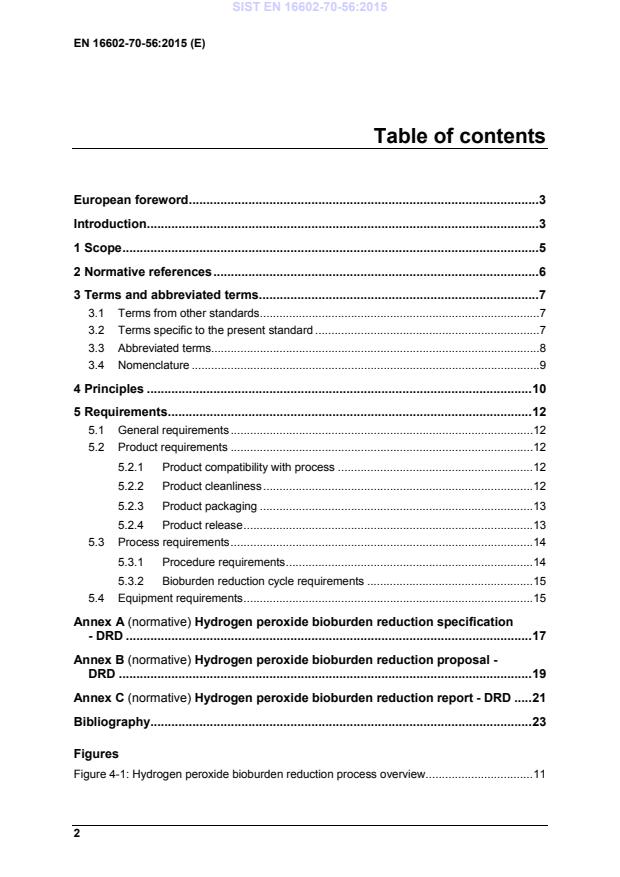
Figures Figure 4-1: Hydrogen peroxide bioburden reduction process overview . 11
“States parties shall pursue studies of outer space, including the Moon and other celestial bodies, and conduct exploration of them so as to avoid their harmful contamination and also adverse changes in the environment of the Earth resulting from the introduction of extraterrestrial matter and, when necessary, adopt appropriate measures for this purpose.”
Harmful contamination in that sense is defined as biological contamination, including organic-constituents, to protect the environment in order to allow future exobiology research. The Committee On Space Research (COSPAR) has established some planetary protection guidelines, based on the Outer Space Treaty. These guidelines impose requirements on spaceflight missions according to target body/mission type combinations.
The objective of this Standard is to ensure that proper procedures for reducing the microbiological contamination on flight hardware are in place to meet the planetary protection constraints. SIST EN 16602-70-56:2015
EN reference Reference in text Title EN 16601-00-01 ECSS-S-ST-00-01 ECSS system - Glossary of terms EN 16601-40 ECSS-M-ST-40 Space project management - Configuration and information management EN 16602-10-09 ECSS-Q-ST-10-09 Space product assurance - Nonconformance control system EN 16602-70-53 ECSS-Q-ST-70-53 Space product assurance - Materials and hardware compatibility tests for sterilization processes EN 16602-70-55 ECSS-Q-ST-70-55 Space product assurance - Microbial examination of flight hardware and cleanrooms EN 16602-70-58 ECSS-Q-ST-70-58 Space product assurance - Bioburden control of cleanrooms
IEST-STD-CC1246D Institute of environmental science and technology - product cleanliness levels and contamination control program
The process is a hydrogen peroxide bioburden reduction. 3.2.2 controlled ambient conditions 1000 hPa pressure, temperature from 25 °C to 45 °C and relative humidity from 3 % to 50 %, as measured at 35 °C 3.2.3 controlled vacuum conditions temperature from 25 °C to 45 °C and pressure from 1,3 hPa to 13,3 hPa 3.2.4 cycle sequence of individual steps
NOTE
For the purpose of this standard, the individual steps are preconditioning, bioburden reduction Ct-value and venting. Each step has associated control and monitoring parameters like time and hydrogen peroxide vapour concentration. SIST EN 16602-70-56:2015
Examples: Free for gas exchange are e.g., exterior surfaces, interior surfaces of boxes with venting holes, surfaces of honeycomb cells, surfaces of the outer and inner plies of multi-layer insulation, open cell foam. 3.2.6 overkill equivalent to a 12 order of magnitude bioburden reduction 3.2.7 parametric release declaration that a product is at a certain bioburden level, based on records demonstrating that the process parameters were delivered within specified tolerances NOTE
Parametric release can be used for achieving bioburden reduction with heat (temperature and time record sufficient, no need for biological test) but is not acceptable for bioburden reduction using chemicals (biological test for process monitoring is mandatory). 3.2.8 positive control testing the viability of biological indicators and the quality of the culture medium 3.3 Abbreviated terms For the purpose of this Standard, the abbreviated terms from ECSS-S-ST-00-01 and the following apply: Abbreviation Meaning BIs biological indicators cfu colony forming unit COSPAR Committee on Space Research Ct time integrated (hydrogen peroxide) concentration ESD electrostatic discharge L litre (volume in controlled environment) mg
milligram (hydrogen peroxide) NCR nonconformance report sec seconds
It is expected that, during tailoring, all the recommendations in this document are either converted into requirements or tailored out. c. The words “may” and “need not” are used in this standard to express positive and negative permissions respectively. All the positive permissions are expressed with the word “may”. All the negative permissions are expressed with the words “need not”. d. The word “can” is used in this standard to express capabilities or possibilities, and therefore, if not accompanied by one of the previous words, it implies descriptive text. NOTE
In ECSS “may” and “can” have a complete different meaning: “may” is normative (permission) and “can” is descriptive. e. The present and past tense are used in this standard to express statement of fact, and therefore they imply descriptive text.
For example: for all ESA projects, those requirements are specified in ESSB-ST-U-001.
The following series of ECSS standards describe the processes and procedures to respond to those bioburden requirements: • ECSS-Q-ST-70-57 together with the present standard describe the currently approved bioburden reduction processes, i.e. dry heat and vapour hydrogen peroxide, respectively. • ECSS-Q-ST-70-58 describes how to operate a bioburden controlled environment, like a cleanroom, for the assembly and testing of bioburden controlled flight hardware.
• ECSS-Q-ST-70-55 describes how to measure the biological contamination on flight hardware and in bioburden controlled environments. • ECSS-Q-ST-70-53 describes how to evaluate the material compatibility with different bioburden reduction processes.
The activities related to hydrogen peroxide bioburden reduction are shown in Figure 4-1. The related requirements are captured in clause 5. The process can be summarized as follows: • The customer issues a “bioburden reduction specification” used as an input for the supplier “work proposal for bioburden reduction”. • Subject for customer approval the supplier prepares and performs the process taking as inputs the hardware requiring bioburden reduction, the quality requirements and the work proposal (output of the previous activity). • Then the supplier will record and produce a report by comparing the results against the work proposal for bioburden reduction.
Background information for using biological indicators can be found in ISO 11138. SIST EN 166
...
Questions, Comments and Discussion
Ask us and Technical Secretary will try to provide an answer. You can facilitate discussion about the standard in here.
Loading comments...