

EN 12079-1:2006
(Main)Offshore containers and associated lifting sets - Part 1: Offshore container - Design, manufacture and marking
- Abstract
This part of EN 12079 specifies requirements for the design, manufacture and marking of offshore freight and service containers with maximum gross mass not exceeding 25000 kg, intended for repeated use to, from and between offshore installations and ships.
This part of EN 12079 specifies only transport related requirements.
Other parts of the standard are:
EN 12079-2, Offshore containers and associated lifting sets - Part 2: Lifting sets - Design, manufacture and marking
EN 12079-3, Offshore containers and associated lifting sets - Part 3: Periodic inspection, examination and testing
- Status
- Withdrawn
- Publication Date
- 25-Apr-2006
- Withdrawal Date
- 06-Oct-2026
- Technical Committee
- CEN/TC 280 - Offshore containers
- Drafting Committee
- CEN/TC 280 - Offshore containers
- Current Stage
- 9960 - Withdrawal effective - Withdrawal
- Start Date
- 11-Jul-2018
- Completion Date
- 07-Oct-2026

Relations
- Effective Date
- 22-Dec-2008
- Effective Date
- 20-Jul-2016
- Effective Date
- 03-Jun-2026
- Effective Date
- 03-Jun-2026
- Effective Date
- 03-Jun-2026
- Effective Date
- 03-Jun-2026
- Effective Date
- 03-Jun-2026
- Effective Date
- 28-Jan-2026
- Effective Date
- 28-Jan-2026
- Effective Date
- 28-Jan-2026
- Effective Date
- 28-Jan-2026
- Effective Date
- 28-Jan-2026
- Effective Date
- 28-Jan-2026
- Effective Date
- 28-Jan-2026
- Effective Date
- 28-Jan-2026
Get Certified
Connect with accredited certification bodies for this standard

BRCGS (Brand Reputation Compliance Global Standards)
Global food safety and quality standards owner.
Sponsored listings
Frequently Asked Questions
EN 12079-1:2006 is a standard published by the European Committee for Standardization (CEN). Its full title is "Offshore containers and associated lifting sets - Part 1: Offshore container - Design, manufacture and marking". This standard covers: This part of EN 12079 specifies requirements for the design, manufacture and marking of offshore freight and service containers with maximum gross mass not exceeding 25000 kg, intended for repeated use to, from and between offshore installations and ships. This part of EN 12079 specifies only transport related requirements. Other parts of the standard are: EN 12079-2, Offshore containers and associated lifting sets - Part 2: Lifting sets - Design, manufacture and marking EN 12079-3, Offshore containers and associated lifting sets - Part 3: Periodic inspection, examination and testing
This part of EN 12079 specifies requirements for the design, manufacture and marking of offshore freight and service containers with maximum gross mass not exceeding 25000 kg, intended for repeated use to, from and between offshore installations and ships. This part of EN 12079 specifies only transport related requirements. Other parts of the standard are: EN 12079-2, Offshore containers and associated lifting sets - Part 2: Lifting sets - Design, manufacture and marking EN 12079-3, Offshore containers and associated lifting sets - Part 3: Periodic inspection, examination and testing
EN 12079-1:2006 is classified under the following ICS (International Classification for Standards) categories: 55.180.10 - General purpose containers. The ICS classification helps identify the subject area and facilitates finding related standards.
EN 12079-1:2006 has the following relationships with other standards: It is inter standard links to EN 12079:1999, EN ISO 10855-1:2018, ISO 1496-1:1990, ISO 1496-4:1991, ISO 1496-3:1995, ISO 1161:1984, ISO 209-1:1989, EN 1744-1:1998, EN 10025-4:2019+A1:2022, EN 10250-3:2022, EN ISO 7500-1:2018, EN ISO 6892-1:2019, EN 673:1997, EN ISO 23277:2015, EN ISO 17637:2016. Understanding these relationships helps ensure you are using the most current and applicable version of the standard.
EN 12079-1:2006 is available in PDF format for immediate download after purchase. The document can be added to your cart and obtained through the secure checkout process. Digital delivery ensures instant access to the complete standard document.
Standards Content (Sample)
2003-01.Slovenski inštitut za standardizacijo. Razmnoževanje celote ali delov tega standarda ni dovoljeno.Offshore containers and associated lifting sets - Part 1: Offshore container - Design, manufacture and markingConteneurs pour manutention en mer et dispositifs de levage associés - Partie 1: Conteneurs pour manutention en mer - Conception, construction et marquageOffshore-Container und zugehörige Anschlaggarnituren - Teil 1: Offshore-Container - Auslegung, Herstellung und KennzeichnungTa slovenski standard je istoveten z:EN 12079-1:2006SIST EN 12079-1:2007en55.180.10General purpose containersICS:SIST EN 12079:20001DGRPHãþDSLOVENSKI
STANDARDSIST EN 12079-1:200701-januar-2007
EUROPEAN STANDARDNORME EUROPÉENNEEUROPÄISCHE NORMEN 12079-1April 2006ICS 55.180.10Supersedes EN 12079:1999
English VersionOffshore containers and associated lifting sets - Part 1: Offshorecontainer - Design, manufacture and markingConteneurs pour utilisation en mer et dispositifs de levageassociés - Partie 1: Conception, construction et marquageOffshore-Container und zugehörige Anschlaggarnituren -Teil 1: Offshore-Container - Auslegung, Herstellung undKennzeichnungThis European Standard was approved by CEN on 9 March 2006.CEN members are bound to comply with the CEN/CENELEC Internal Regulations which stipulate the conditions for giving this EuropeanStandard the status of a national standard without any alteration. Up-to-date lists and bibliographical references concerning such nationalstandards may be obtained on application to the Central Secretariat or to any CEN member.This European Standard exists in three official versions (English, French, German). A version in any other language made by translationunder the responsibility of a CEN member into its own language and notified to the Central Secretariat has the same status as the officialversions.CEN members are the national standards bodies of Austria, Belgium, Cyprus, Czech Republic, Denmark, Estonia, Finland, France,Germany, Greece, Hungary, Iceland, Ireland, Italy, Latvia, Lithuania, Luxembourg, Malta, Netherlands, Norway, Poland, Portugal, Romania,Slovakia, Slovenia, Spain, Sweden, Switzerland and United Kingdom.EUROPEAN COMMITTEE FOR STANDARDIZATIONCOMITÉ EUROPÉEN DE NORMALISATIONEUROPÄISCHES KOMITEE FÜR NORMUNGManagement Centre: rue de Stassart, 36
B-1050 Brussels© 2006 CENAll rights of exploitation in any form and by any means reservedworldwide for CEN national Members.Ref. No. EN 12079-1:2006: E
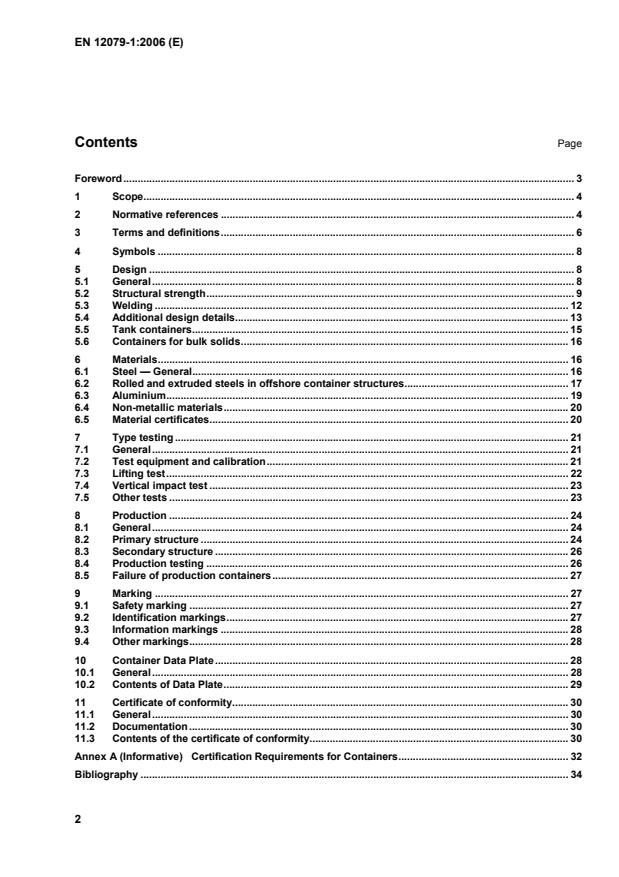
Certification Requirements for Containers.32 Bibliography.34
1 Scope This part of EN 12079 specifies requirements for the design, manufacture and marking of offshore freight and service containers with maximum gross mass not exceeding 25000 kg, intended for repeated use to, from and between offshore installations and ships.
This part of EN 12079 specifies only transport related requirements. Other parts of the standard are: EN 12079-2, Offshore containers and associated lifting sets - Part 2: Lifting sets – Design, manufacture and marking EN 12079-3, Offshore containers and associated lifting sets - Part 3: Periodic inspection, examination and testing 2 Normative references The following referenced documents are indispensable for the application of this European Standard. For dated references, only the edition cited applies. For undated references, the latest edition of the referenced document (including any amendments) applies. EN 287-1, Qualification test of welders — Fusion welding — Part 1: Steels EN 473, Non destructive testing - Qualification and certification of NDT personnel - General principles EN 571-1, Non destructive testing - Penetrant testing - Part 1: General principles EN 970, Non-destructive examination of fusion welds — Visual examination EN 1289, Non-destructive examination of welds - Penetrant testing of welds - Acceptance levels EN 1290, Non-destructive examination of welds - Magnetic particle examination of welds EN 1291, Non-destructive examination of welds - Magnetic particle testing of welds - Acceptance levels EN 1435, Non-destructive examination of welds - Radiographic examination of welded joints EN 1712, Non-destructive examination of welds - Ultrasonic examination of welded joints - Acceptance levels EN 1714, Non-destructive examination of welds - Ultrasonic examination of welded joints EN 10002-1, Metallic materials — Tensile testing — Part 1: Method of test at ambient temperature EN 10025-1, Hot rolled products of structural steels - Part 1: General technical delivery conditions EN 10025-2, Hot rolled products of structural steels - Part 2: Technical delivery conditions for non-alloy structural steels EN 10025-3, Hot rolled products of structural steels - Part 3: Technical delivery conditions for normalized/normalized rolled weldable fine grain structural steels
3 Terms and definitions For the purposes of this European Standard, the following terms and definitions apply. 3.1 offshore container portable unit for repeated use in the transport of goods or equipment handled in open seas to, from and between fixed and/or floating installations and ships. NOTE The unit incorporates permanently installed equipment for lifting and handling and may include equipment for filling, emptying, cooling, heating, etc. Offshore containers are subdivided into 3 categories: 3.1.1 offshore freight container offshore container built for the transport of goods NOTE Examples of offshore freight containers are: general cargo container: A closed container with doors; cargo basket: An open top container for general or special cargo; tank container: A container for the transport of dangerous or non-dangerous fluids; bulk container: A container for the transport of solids in bulk; special container: A container for the transport of special cargo e.g. garbage containers, equipment; boxes, gas cylinder racks. 3.1.2 offshore service container offshore container built and equipped for a special service task, usually as a temporary installation e.g. laboratories, workshops, stores, power plants, control stations 3.1.3 offshore waste skip open or closed offshore container used for the storage and removal of waste NOTE Normally constructed from flat steel plate forming the load bearing sections of the container, with bracing in the form of steel profiles e.g. channel or hollow section, being fitted horizontally and/or vertically around sides and ends. In addition to the pad eyes for the lifting set, these containers may have side mounted lugs suitable for use with the lifting equipment mounted on a skip lift vehicle.
examination in accordance with EN 970 4 Symbols R
rating i.e. the maximum gross mass of the container including permanent equipment and
its cargo, in kg; but excluding the lifting set; T tare mass i.e. the mass of an empty container including any permanent equipment but excluding cargo and lifting set, in kg; P payload i.e. the maximum permissible mass of cargo which may be safely transported by the container, in kg; S mass of the lifting set in kg NOTE 1 P = R - T NOTE 2 R, T and P are, by definition in units of mass, kilograms (kg). Where design requirements are based on the gravitational forces derived from these values, those forces are indicated thus: Rg, Tg and Pg the units of which are in newtons or multiples thereof. TD design air temperature, i.e. a minimum reference temperature used for the selection of steel grades used in offshore containers and equipment expressed in degrees centigrade; eσ von Mises equivalent stress, expressed in MPa or N/mm2; Re
specified minimum yield stress, expressed in MPa or N/mm2. 5 Design 5.1 General 5.1.1 An offshore container shall have sufficient strength to allow loading and unloading from supply vessels offshore operating in a sea state with significant wave heights of 6 m and to withstand impact from heavy seas. NOTE Local impacts, e.g. from hitting other deck cargo or rigid parts of the ship structure, may cause extreme loads in such conditions. 5.1.2 To prevent the containers from overturning (tipping) on a moving deck, they shall be designed to withstand tilting at 30 ° in any direction, without overturning when loaded at its maximum gross
where: for steel: eRC= for aluminium: Base material 0.2CR=
Heat affected zone 0,7mCRβ= where:
is 0,8 for ISO AlMg4,5Mn-HAR/AA5083-H32
is 0,7 for all other aluminium alloys and tempers (see Table 4) 5.2.2.2 Lifting with lifting set The design force on the primary structure shall be calculated as 2,5 Rg. g is the acceleration due to gravity (in m/s2 i.e. 9,80665). The internal load shall be taken as (2,5 R - T)g evenly distributed over the container floor. For tank containers, the actual distribution of the tare mass shall be used for the calculations. Pad eyes shall be designed for a total vertical force of 3 Rg. The force shall be considered to be evenly distributed between (n - 1) pad eyes where n is the actual number of pad eyes. To determine the resulting sling force on the pad eyes, the sling angle shall be taken into account, so that the resulting sling force on each pad eye is calculated as follows: ()31cosgRFnv=− where: F is the resulting sling force, in newtons; n is the actual number of pad eyes (for calculation purposes n shall not exceed 4 and shall be not less than 2); v is the angle between a sling leg and the vertical, in degrees and shall be assumed to be 45 ° unless otherwise specified. For containers with only one pad eye, that pad eye shall be designed for a total vertical force of 5 Rg. NOTE Containers without a roof may have insufficient strength and stiffness to pass the 2 point lifting test (7.3.3). In order to avoid building prototypes that will not pass the test, the ability of an open top container to withstand the load occurring in the 2-point lifting test should be checked by a suitable calculation method. In these calculations, the nominal yield stress of the material should not be exceeded. These calculations do not replace the prototype testing. 5.2.2.3 Lifting with forklift truck The weight of the lifting set shall be taken into account when calculating the strength of the fork pockets. The design force on the primary structure shall be calculated as 1,6 (R+S)g. The internal load shall be taken as (1,6 (R+S)-T)g evenly distributed over the container floor. Where fork pockets are intended only for handling of the empty container, the design load shall be taken as 1,6 (T+S)g.
- 0,25 Rg For other frame members of the side structure, including the top rails:
- 0,15 Rg Maximum calculated deflections at these loadings shall not exceed: For corner posts and bottom side rails 1250n where: 1n is the total length of the rail or post in mm. For other frame members 1250n where: 1n is the length of the shortest edge of the wall being considered. NOTE 1n is a (nominal) reference length and will often be different from the actual span of a beam. For horizontal impact on tank containers for dangerous cargoes see 5.5.4.
where: 1n is the total length of the rail. NOTE Maximum vertical impact forces are likely to occur when a container is lowered onto the deck of a heaving supply vessel. If the deck is at an angle, the first impact will be on a corner. Such impact forces cannot be readily simulated by static forces. As dynamic calculations would be very complex, it is usually sufficient to verify the strength by a vertical impact test as described in 7.4. 5.2.4 Internal forces on container walls Each container wall, including the doors, shall be designed to withstand an internal force of 0,6 Pg evenly distributed over the whole surface, without suffering any permanent deformation. 5.2.5 Minimum material thickness
The following minimum material thickness (t) requirements shall apply. a) for external parts of corner posts and bottom rails i.e. parts forming the outside of the container: for R≥
1000 kg, t = 6 mm; for R < 1000 kg, t = 4 mm. b) for all other parts of the primary structure: t = 4 mm; c) for secondary structure made from metallic materials: t = 2 mm; d) for waste skips of monocoque design (see 5.1) within an area of up to 100 mm from the side edges : t = 6 mm; for the remaining parts of the side structure: t = 4 mm. NOTE The thicknesses may have to be increased beyond these values to take account of special considerations such as rating, design, corrosion allowances, the need for impact tests of the material, etc. 5.3 Welding Essential and non-redundant primary structural members shall be welded with full penetration welds. For other primary structure, the use of fillet welds shall be justified by design appraisal (including calculations and consideration of failure modes).
NOTE 2 It is recommended that pad-eyes be slotted into the primary structure NOTE 3 Where ISO-corner fittings are mounted in conjunction with pad eyes, the corner fittings are not intended for lifting with slings offshore. NOTE 4 Attention is drawn to the need for designers to be aware of the restrictions in permissible shackle types introduced in EN 12079-2 and particularly to the preference for bow shackles with bolt type pin with hexagon head, hexagon nut and split cotter pin. As a result it is necessary that the designer ensure sufficient clearance surrounding the pad eye to enable the fitting and removal of this preferred type.
NOTE The IMDG Code has restrictions for loaded handling of tanks over a certain length, by forklift. Reference should be made to Chapters 4.2 and 6.7 of the IMDG Code.
Table 1 — Charpy impact test temperature - Structural steel for primary structural members Material thickness (t) in mm Impact test temperature in °C t ≤ 12 TD + 10 12 < t ≤ 25 TD t > 25 TD - 20
The average energy absorption for base material specimens with their axis parallel to the final rolling direction shall not be less than given in Figure 1. For specimens with their axis transverse to the final rolling direction the valve shall be two thirds of that for longitudinally orientated specimens.
Key X inpact energy, J Y specified minimum yield stress (RE), N/mm² Figure 1 — Charpy V - notch, values for steel 6.2 Rolled and extruded steels in offshore container structures 6.2.1 General requirements Where required, steels for welding shall be made by open hearth, electric furnace or the basic oxygen steel process. Steels in the primary structure shall be killed and fine grain treated. Only materials with non-ageing properties shall be used. 6.2.2 Groups of steels Structural steels for the primary structure shall be carbon steel, carbon-manganese steel, carbon-manganese micro-alloyed steel or low-alloyed steel.
Table 2 — Chemical composition (ladle analysis) a Chemical Composition % C max Mn Si max P max S max Cr max Ni max Cu max Mo max Alsol b
min Cr+Ni+Cu+ Mo max 0,20 0,90 to 1,50 0,50 0,035 0,035 0,25 0,300,20 0,08 0,015 0,70 a The carbon equivalent shall not exceed 0,45% b Aluminium may be replaced partly or totally by other fine graining elements as stated in the approved specifications
Table 3 — Mechanical properties Mechanical properties Yield strength Tensile strength Elongation Reduction of area Impact Energy RoH Rm A5 Z KV a
[N/mm2] [N/mm2] [%]
(Joule) min
min [%] min min at -20°C 220 430 to 600 25 40 27 a Average value on 3 ISO-V notch impact specimens acc. to EN 10045-1. One individual value may be below the average value but shall not be lower than 70 % of the average.
6.3 Aluminium The chemical composition, heat treatment, weldability and mechanical properties shall be suitable for the purpose. When materials of different galvanic potential are joined together, the design shall be such that galvanic corrosion is avoided. Aluminium alloys used in offshore containers shall be made by rolling or extruding. Aluminium alloys and tempers specified in Table 4 and 5 may be used. Use of other alloys or tempers shall be subject to special consideration. Table 4 — Aluminium alloys and tempers for rolled products Alloy Temper ISO 209 – 1 AA ISO / AA AlMg 2,5 5052 0 / 0
HAR / H32
HBR / H34
HCR / H36 AlMg 3 5754 0 / 0
HAR / H32
HBR / H34 AlMg 3,5 5154 0 / 0
HAR / H32
HBR / H34 AlMg 4 5086 0 / 0
HAR / H32
HBR / H34 AlMg 3 Mn 5454 0 / 0
HAR / H32
HBR / H34
HAR / H32
HBR / H34 AlSiMgMn 6082 0 / 0
TB / T4
TE / T5
TF / T6 NOTE AA = American Aluminium Association. These references are included for information as users may encounter these references in practice.
Table 5 — Aluminium alloys and tempers for extruded products Alloy Temper ISO 209 - 1 AA ISO / AA AlSi 0,5 Mg 6063 TB / T4
TF / T6 AlSiMgMn 6082 TF / T6 NOTE AA = American Aluminium Association. These references are included for information as users may encounter these references in practice.
6.4 Non-metallic ma
...