

EN 12183:2006
(Main)Manual wheelchairs - Requirements and test methods
- Abstract
This European Standard specifies requirements and test methods for manual wheelchairs intended to carry one person.
It also specifies requirements and test methods for manual wheelchairs with electrically powered ancillary equipment.
This European Standard does not apply in total to
wheelchairs intended for special purposes, such as sports, showering, toileting,
custom-made wheelchairs,
stand-up wheelchairs and
add-on power kits for the propulsion of manual wheelchairs.
NOTE Requirements for electrically powered wheelchairs are specified in EN 12184.
- Status
- Withdrawn
- Publication Date
- 12-Sep-2006
- Withdrawal Date
- 22-Feb-2007
- Technical Committee
- CEN/TC 293 - Technical aids for disabled persons
- Drafting Committee
- CEN/TC 293/WG 9 - Wheelchairs - Revision of EN 12183 and EN 12184
- Current Stage
- 9960 - Withdrawal effective - Withdrawal
- Start Date
- 23-Feb-2007
- Completion Date
- 23-Feb-2007


Relations
- Effective Date
- 22-Dec-2008
- Effective Date
- 22-Dec-2008
- Effective Date
- 28-Jan-2026
- Effective Date
- 28-Jan-2026
- Effective Date
- 28-Jan-2026
Get Certified
Connect with accredited certification bodies for this standard

BSI Group
BSI (British Standards Institution) is the business standards company that helps organizations make excellence a habit.

TÜV Rheinland
TÜV Rheinland is a leading international provider of technical services.

TÜV SÜD
TÜV SÜD is a trusted partner of choice for safety, security and sustainability solutions.
Sponsored listings
Frequently Asked Questions
EN 12183:2006 is a standard published by the European Committee for Standardization (CEN). Its full title is "Manual wheelchairs - Requirements and test methods". This standard covers: This European Standard specifies requirements and test methods for manual wheelchairs intended to carry one person. It also specifies requirements and test methods for manual wheelchairs with electrically powered ancillary equipment. This European Standard does not apply in total to wheelchairs intended for special purposes, such as sports, showering, toileting, custom-made wheelchairs, stand-up wheelchairs and add-on power kits for the propulsion of manual wheelchairs. NOTE Requirements for electrically powered wheelchairs are specified in EN 12184.
This European Standard specifies requirements and test methods for manual wheelchairs intended to carry one person. It also specifies requirements and test methods for manual wheelchairs with electrically powered ancillary equipment. This European Standard does not apply in total to wheelchairs intended for special purposes, such as sports, showering, toileting, custom-made wheelchairs, stand-up wheelchairs and add-on power kits for the propulsion of manual wheelchairs. NOTE Requirements for electrically powered wheelchairs are specified in EN 12184.
EN 12183:2006 is classified under the following ICS (International Classification for Standards) categories: 11.180.10 - Aids and adaptation for moving. The ICS classification helps identify the subject area and facilitates finding related standards.
EN 12183:2006 has the following relationships with other standards: It is inter standard links to EN 12183:1999, EN 12183:2009, EN ISO 11151-2:2000, EN ISO 11151-1:2000, EN 379:2003+A1:2009. Understanding these relationships helps ensure you are using the most current and applicable version of the standard.
EN 12183:2006 is associated with the following European legislation: EU Directives/Regulations: 2001/16/EC, 93/42/EEC; Standardization Mandates: M/023, M/334. When a standard is cited in the Official Journal of the European Union, products manufactured in conformity with it benefit from a presumption of conformity with the essential requirements of the corresponding EU directive or regulation.
EN 12183:2006 is available in PDF format for immediate download after purchase. The document can be added to your cart and obtained through the secure checkout process. Digital delivery ensures instant access to the complete standard document.
Standards Content (Sample)
2003-01.Slovenski inštitut za standardizacijo. Razmnoževanje celote ali delov tega standarda ni dovoljeno.Manual wheelchairs - Requirements and test methodsHWRGHFauteuils roulants manuels - Exigences et méthodes d'essaiRollstühle mit Muskelkraftantrieb - Anforderungen und PrüfverfahrenTa slovenski standard je istoveten z:EN 12183:2006SIST EN 12183:2006en,fr,de11.180.10JLEDQMHAids and adaptation for movingICS:SIST EN 12183:20001DGRPHãþDSLOVENSKI
STANDARDSIST EN 12183:200601-december-2006
EUROPEAN STANDARDNORME EUROPÉENNEEUROPÄISCHE NORMEN 12183September 2006ICS 11.180.10Supersedes EN 12183:1999
English VersionManual wheelchairs - Requirements and test methodsFauteuils roulants manuels - Exigences et méthodesd'essaiRollstühle mit Muskelkraftantrieb - Anforderungen undPrüfverfahrenThis European Standard was approved by CEN on 1 August 2006.CEN members are bound to comply with the CEN/CENELEC Internal Regulations which stipulate the conditions for giving this EuropeanStandard the status of a national standard without any alteration. Up-to-date lists and bibliographical references concerning such nationalstandards may be obtained on application to the Central Secretariat or to any CEN member.This European Standard exists in three official versions (English, French, German). A version in any other language made by translationunder the responsibility of a CEN member into its own language and notified to the Central Secretariat has the same status as the officialversions.CEN members are the national standards bodies of Austria, Belgium, Cyprus, Czech Republic, Denmark, Estonia, Finland, France,Germany, Greece, Hungary, Iceland, Ireland, Italy, Latvia, Lithuania, Luxembourg, Malta, Netherlands, Norway, Poland, Portugal, Romania,Slovakia, Slovenia, Spain, Sweden, Switzerland and United Kingdom.EUROPEAN COMMITTEE FOR STANDARDIZATIONCOMITÉ EUROPÉEN DE NORMALISATIONEUROPÄISCHES KOMITEE FÜR NORMUNGManagement Centre: rue de Stassart, 36
B-1050 Brussels© 2006 CENAll rights of exploitation in any form and by any means reservedworldwide for CEN national Members.Ref. No. EN 12183:2006: E
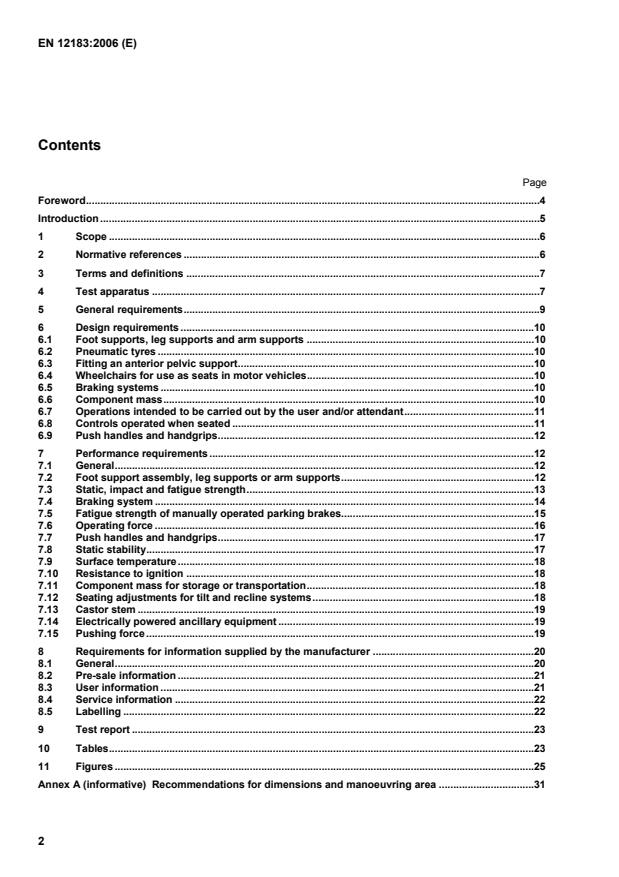
Recommendations for dimensions and manoeuvring area.31
Recommended design features.34 B.1 Introduction.34 B.2 General recommendations.34 B.2.1 Fittings and tools.34 B.2.2 Tyres.34 B.2.3 Means to inflate tyres.34 B.2.4 Surface temperature.34 B.2.5 Recommendations related to the user transferring into or out of the wheelchair.34 B.2.6 Resistance to contamination from urine incontinence.35 B.2.7 Head support.35 B.2.8 Accidental operation of parking brakes.35 B.2.9 Tipping device.35 B.2.10 Anti-tip devices.35 Annex C (informative)
Recommended seating design.36 Annex D (informative)
Manoeuvring forces.37 D.1 Recommendations.37 D.1.1 Push handle force.37 D.1.2 Handrim force.37 D.2 Manoeuvring test for handrim activated power assisted wheelchairs.37 Annex E (informative)
Technical changes from EN 12183:1999.38 Annex ZA (informative)
Relationship between this European Standard and the Essential Requirements of Council Directive 93/42/EEC of 14 June 1993 concerning medical devices.40 Bibliography.43
1 Scope This European Standard specifies requirements and test methods for manual wheelchairs intended to carry one person. It also specifies requirements and test methods for manual wheelchairs with electrically powered ancillary equipment. This European Standard does not apply in total to wheelchairs intended for special purposes, such as sports, showering, toileting, custom-made wheelchairs, stand-up wheelchairs and add-on power kits for the propulsion of manual wheelchairs. NOTE Requirements for electrically powered wheelchairs are specified in EN 12184. 2 Normative references The following referenced documents are indispensable for the application of this document. For dated references, only the edition cited applies. For undated references, the latest edition of the referenced document (including any amendments) applies. EN 1021-1, Furniture — Assessment of ignitability of upholstered furniture — Part 1: Ignition source smouldering cigarette EN 1021-2, Furniture — Assessment of ignitability of upholstered furniture — Part 2: Ignition source match flame equivalent EN 12182:1999, Technical aids for disabled persons — General requirements and test methods EN 12184, Electrically powered wheelchairs, scooters and their chargers — Requirements and test methods EN ISO 14971, Medical devices — Application of risk management to medical devices (ISO 14971:2000 ISO 7176-1:1999, Wheelchairs — Part 1: Determination of static stability ISO 7176-3:2003, Wheelchairs — Part 3: Determination of effectiveness of brakes ISO 7176-8:1998, Wheelchairs — Part 8: Requirements and test methods for static, impact and fatigue strengths ISO 7176-11:1992, Wheelchairs — Part 11: Test dummies ISO 7176-13:1989, Wheelchairs — Part 13: Determination of coefficient of friction of test surfaces ISO 7176-15:1996, Wheelchairs — Part 15: Requirements for information disclosure, documentation and labelling ISO 7176-19:2001, Wheelchairs — Part 19: Wheeled mobility devices for use in motor vehicles
1 000 mm of extension in any direction and 25 mm apart per 6 000 mm of extension in any direction. 4.2 Horizontal test plane, a flat, rigid plane, with a coefficient of friction as defined in ISO 7176-13, of sufficient size to accommodate the wheelchair under test, and such that the whole surface lies between two imaginary horizontal planes 5 mm apart per 1 000 mm of extension in any direction and 25 mm apart per 6 000 mm of extension in any direction.
10 Nm. 4.8 Test dummy
4.8.1 General Select a test dummy (ISO 7176-11) of mass equal to or, if there is no dummy of equal mass, the next size greater than the maximum user mass recommended by the manufacturer.
If the maximum user mass specified by the manufacturer is greater than 100 kg use an augmentation to the 100 kg test dummy from ISO 7176-11 as specified below. The mass is added to the upper legs/seat section and trunk/back section in the ratio of 1:6. The following will provide the required mass and position to augment a 100 kg dummy. M is the total mass of the required dummy. 4.8.1.1
The additional trunk/back section mass is obtained from the following: 7,85857,0−M 4.8.1.2
The point on the Y axis for the centre of mass for the complete new trunk/back section is obtained from the following: point on Y (comp) axis measured from the pivot point of the dummy =28,8275322,1−+MM- 4,8 cm ± 0,1 cm. 4.8.1.3
The point on the Y axis of the centre of mass of the additional trunk/back section mass is obtained from the following: ()[]()()additionalcomp1007629,8611007661YMYM=−×−×−+in cm 4.8.1.4
The point on the X axis of the centre of mass for the additional trunk/back section mass measured from the front face of the trunk/back section is obtained from the following: ()()[]()()additional25,1cm1007636,618,336,6100761,320,17XMMM=−−−+−+in cm 4.8.1.5
When constructing the new mass dummy using the above calculations the additional mass shall be positioned within Y additional ± 0.1 cm and X additional ± 0.1 cm.
The additional mass of the upper legs is obtained from the following: 3,14143,0−=M 4.8.1.7
The additional mass for the upper leg/seat section is evenly distributed so as not to change the centre of mass for this segment. NOTE This may be achieved by wrapping the leg/seat section in a sheet material e.g. lead of appropriate mass. 4.8.1.8 The mass of the lower legs/feet does not increase from the 100 kg dummy. 4.9 Means to measure speed in the range 0,5 m/s to 1,5 m/s with an accuracy of ± 0,05 m/s. 4.10 Means to move the brake lever smoothly for 60 000 cycles at a frequency of not more than 0,5 Hz. 4.11
Means to measure elapsed time in seconds in the range 0 to 30 s with an accuracy of +1 s 5 General requirements The wheelchair shall conform to the requirements as specified in EN 12182:1999 for the following: intended performance and technical documentation (4.2); aids that can be dismantled (4.4); single use fasteners (4.5); biocompatibility and toxicity (5.2); contaminants and residues (5.3); infection and microbiological contamination (5.4); overflow, spillage, leakage and ingress of liquids (Clause 9); safety of moving parts (Clause 12); prevention of traps for parts of human body (Clause 13); folding and adjusting mechanisms (Clause 14); surfaces, corners and edges (Clause 18); A risk analysis shall also be carried out in accordance with EN ISO 14971
6.1 Foot supports, leg supports and arm supports The wheelchair shall be fitted with foot supports that have a means of positioning the user’s feet at the required height, and prevent the user’s feet from sliding backwards and shall meet the performance requirements specified in 7.2. Where fitted leg supports and arm supports shall meet the performance requirements specified in 7.2. 6.2 Pneumatic tyres If the wheelchair is fitted with pneumatic tyres, they shall have the same type of valve connection on all tyres. The tyres or the rims shall be marked with the maximum pressure in kPa or bar. 6.3 Fitting an anterior pelvic support The wheelchair shall have provision for an anterior pelvic support to be fitted. The manufacturer of the wheelchair shall have available as an option an anterior pelvic support which can be used with that provision. 6.4 Wheelchairs for use as seats in motor vehicles If the manufacturer specifies that the intended use of the wheelchair includes use by an adult as a seat in a motor vehicle, the wheelchair shall conform to the performance requirements of ISO 7176-19. If the manufacturer specifies that the intended use of the wheelchair includes use as a seat in a motor vehicle by a child of mass greater than 22 kg, the wheelchair shall conform to the performance requirements of
ISO 7176-19 with the exception of the horizontal excursion limits and the selection of the Anthropomorphic Test Device (ATD). The horizontal excursion limits specified in Table 1 of ISO 10542-5:2005 and the ATD selection specified in Table A.1 of ISO 10542-5:2005 shall apply. 6.5 Braking systems The wheelchair shall be fitted with a braking system that meets the performance requirements specified in 7.4. If one or more brake levers are fitted to a wheelchair in the form used on bicycles and mopeds, the hand-grip width of such brake levers, measured 15 mm from the end of the brake lever, shall not be greater than 75 mm before a force is applied. See Figure 2. 6.6 Component mass If the wheelchair is intended to be dismantled for storage or transportation, any component that requires moving or handling and has a mass greater than 10 kg shall be provided with suitable handling devices (e.g. handles). The manufacturer shall provide information indicating the points where it can be lifted and describe how it shall be handled during disassembling, lifting, carrying, and assembling to reduce risks to the person or persons moving or handling the equipment.
) N to the centroid of each foot support normal to the plane of the unloaded foot support. In cases where the foot support has no identifiable plane, apply the force within 5° of vertical. The force F is calculated from the following equation: F = 0,125 x m x g where F
is the force in Newtons applied to each foot support; m
is the maximum user mass in kilograms specified by the manufacturer. b) Apply the force for 5 s to 10 s. c) While the force is being applied measure the shortest distance between the foot supports. d) Record if the foot supports met the requirements. 7.3 Static, impact and fatigue strength 7.3.1 Requirements When the maximum user mass specified by the manufacturer does not exceed 100 kg, the wheelchair shall conform to the static loading requirements of ISO 7176-8. Where the manufacturer specifies a maximum user mass greater than 100 kg the appropriate dummy specified in 4.8 and the forces specified in Table 2 shall apply. 7.3.2 Test Test the wheelchair in accordance with ISO 7176-8 if the maximum user mass specified by the manufacturer does not exceed 100 kg. Arm supports and back supports shall conform to the static loading requirements of ISO 7176-8 in all intended incremental operating positions with the exception of the upward force on a push handle which shall be 880 N, or NOTE The upward force is a correction of the value for upward force on push handles stated in Table 8 of
ISO 7176-8:1998. if the user mass specified by the manufacturer exceeds 100 kg, use the appropriate dummy as specified in 4.8 and the forces shown in Table 2 to replace the forces specified in ISO 7176-8.
)° from the horizontal or at the safe slope claimed by the manufacturer if greater. c) Repeat facing downhill. d) Determine if the parking brakes hold the loaded wheelchair stationary on the slope
Figure 6; two planes not less than 350 mm apart equidistant from a vertical plane parallel to the forward direction of travel that bisects the wheelchair; horizontal test plane. When the wheelchair is fitted with steering and/or manoeuvring handgrips for attendant use, the handgrips shall be at least 75 mm in length and between 20 mm and 50 mm in diameter. When manoeuvring handgrips are fitted with controls that are intended to be used by being gripped by one hand, the handgrip width needed to grip them shall be no greater than 75 mm (see Figure 2). 7.7.2 Test a) Place the wheelchair on the horizontal test plane. b) Project the planes specified in 7.7.1 and determine whether any part of the wheelchair lies within the enclosed space. c) Measure the dimensions of the steering and/or manoeuvring handgrips. d) Where applicable, measure the grip width of the controls fitted to the push handles that are intended to be used by being gripped by one hand. e) Record whether the wheelchair meets the requirements. 7.8 Static stability 7.8.1 Requirements The wheelchair shall have provision for anti-tip devices if the static stability is less than 10°. 7.8.2 Test Test the loaded wheelchair as specified in ISO 7176-1 using a dummy equal to the maximum user mass as specified by the manufacturer to determine the static stability. Record the angles from Table 4 of
ISO 7176-1:1999. The results shall be used to establish the need for anti-tip devices to meet the requirement.
EN 1021-1 and EN 1021-2. Progressive smouldering ignition and flaming ignition as defined in these European Standards shall not occur. 7.10.3 Other parts For single membrane seats and back supports, posture belts and harnesses, foot supports and footboards and skirt guards/clothing guards the material of each item shall be tested with the source applied centrally to the material face that contacts the user by the methods specified in EN 1021-1 and EN 1021-2. Progressive smouldering ignition and flaming ignition as defined in these European Standards shall not occur. NOTE It is not necessary to test components that are inherently resistant to ignition e.g. steel frame tube. 7.11 Component mass for storage or transportation If the wheelchair is intended to be dismantled for carrying, any component that has a mass greater than 10 kg shall be provided with suitable handling devices (e.g. handles) or the manufacturer shall provide information indicating the points where it can be lifted and describe how it should be handled during disassembling, lifting, carrying and assembling to reduce risks to the person or persons moving or handling the equipment. 7.12 Seating adjustments for tilt and recline systems 7.12.1 Requirements If the manufacturer specifies that the seating can be adjusted by an attendant or the user or both while the user is seated, uncontrolled movement of the seating shall not exceed ± 5 mm, the attendant or user or both as specified by the manufacturer shall not have to lift a mass (e.g. the combined mass of the user and the seating) which presents a moving and handling safety hazard to an attendant and/or user. Controls for seating adjustments intended to be operated by the user shall be accessible to the user from all seating positions. NOTE The shaded area of Figure 3 shows the maximum reach space for the user in relation to the actual wheelchair back support reference plane.
)° and the difference between left and right castor stem angle shall not exceed 1°. The lateral castor stem angle shall be 90° ± 1° and the asymmetry between left and right castor stem angle s
...