

EN 379:2003+A1:2009
(Main + Amendment)Personal eye-protection - Automatic welding filters
- Abstract
This European standard specifies requirements for automatic welding filters which switch their luminous transmittance to a lower predetermined value when a welding arc is ignited (referred to as welding filters with switchable scale numbers). It also specifies requirements for automatic welding filters which switch their luminous transmittance to a lower value, where the lower value of luminous transmittance is set automatically in dependence on the illuminance generated by the welding arc (referred to as welding filters with automatic scale number setting).
The requirements of this standard apply if such a filter is to be used for continuous viewing of the welding process, (including gas welding and cutting), and if it is to be used only during the period when the arc is being ignited.
These filters are used in welders' eye protectors or are fixed to equipment.
If they are to be used in welders’ eye protectors, other applicable requirements for these types of filters are given in EN 166. The requirements for the frames/mountings to which they are intended to be fitted are given in EN 175.
Guidance on the selection and use of these filters is given in annex A.
The specifications for welding filters without switchable luminous transmittance are given in EN 169.
- Status
- Withdrawn
- Publication Date
- 31-Mar-2009
- Withdrawal Date
- 06-Oct-2026
- Technical Committee
- CEN/TC 85 - Eye-protective equipment
- Drafting Committee
- CEN/TC 85/WG 4 - Welding, ultraviolet and infrared filters
- Current Stage
- 9960 - Withdrawal effective - Withdrawal
- Start Date
- 27-Apr-2022
- Completion Date
- 07-Oct-2026
- Directive
- 2016/425 - Regulation (EU) 2016/425 of the European Parliament and of the Council of 9 March 2016 on personal protective equipment and repealing Council Directive 89/686/EECOJ Ref: C, C 113 OJ Date: 27-Mar-2018
89/686/EEC - Personal protective equipment (PPE)OJ Ref: C, C 205 OJ Date: 09-Jul-2011

Relations
- Effective Date
- 04-Feb-2009
- Effective Date
- 19-Nov-2025
- Effective Date
- 19-Feb-2025
- Effective Date
- 13-Apr-2022
- Refers
ISO 9211-2:1994 - Optics and optical instruments — Optical coatings — Part 2: Optical properties - Effective Date
- 03-Jun-2026
- Effective Date
- 28-Jan-2026
- Effective Date
- 28-Jan-2026
- Effective Date
- 28-Jan-2026
- Effective Date
- 28-Jan-2026
- Effective Date
- 28-Jan-2026
Get Certified
Connect with accredited certification bodies for this standard

CIS Institut d.o.o.
Personal Protective Equipment (PPE) certification body. Notified Body NB-2890 for EU Regulation 2016/425 PPE.

Kiwa BDA Testing
Building and construction product certification.
Kmetijski inštitut Slovenije
Agricultural Institute of Slovenia. Soil testing, plant health, agricultural product analysis.
Sponsored listings
Frequently Asked Questions
EN 379:2003+A1:2009 is a standard published by the European Committee for Standardization (CEN). Its full title is "Personal eye-protection - Automatic welding filters". This standard covers: This European standard specifies requirements for automatic welding filters which switch their luminous transmittance to a lower predetermined value when a welding arc is ignited (referred to as welding filters with switchable scale numbers). It also specifies requirements for automatic welding filters which switch their luminous transmittance to a lower value, where the lower value of luminous transmittance is set automatically in dependence on the illuminance generated by the welding arc (referred to as welding filters with automatic scale number setting). The requirements of this standard apply if such a filter is to be used for continuous viewing of the welding process, (including gas welding and cutting), and if it is to be used only during the period when the arc is being ignited. These filters are used in welders' eye protectors or are fixed to equipment. If they are to be used in welders’ eye protectors, other applicable requirements for these types of filters are given in EN 166. The requirements for the frames/mountings to which they are intended to be fitted are given in EN 175. Guidance on the selection and use of these filters is given in annex A. The specifications for welding filters without switchable luminous transmittance are given in EN 169.
This European standard specifies requirements for automatic welding filters which switch their luminous transmittance to a lower predetermined value when a welding arc is ignited (referred to as welding filters with switchable scale numbers). It also specifies requirements for automatic welding filters which switch their luminous transmittance to a lower value, where the lower value of luminous transmittance is set automatically in dependence on the illuminance generated by the welding arc (referred to as welding filters with automatic scale number setting). The requirements of this standard apply if such a filter is to be used for continuous viewing of the welding process, (including gas welding and cutting), and if it is to be used only during the period when the arc is being ignited. These filters are used in welders' eye protectors or are fixed to equipment. If they are to be used in welders’ eye protectors, other applicable requirements for these types of filters are given in EN 166. The requirements for the frames/mountings to which they are intended to be fitted are given in EN 175. Guidance on the selection and use of these filters is given in annex A. The specifications for welding filters without switchable luminous transmittance are given in EN 169.
EN 379:2003+A1:2009 is classified under the following ICS (International Classification for Standards) categories: 13.340.20 - Head protective equipment. The ICS classification helps identify the subject area and facilitates finding related standards.
EN 379:2003+A1:2009 has the following relationships with other standards: It is inter standard links to EN 379:2003, EN ISO 16321-2:2021, EN ISO 18526-2:2020, EN ISO 16321-1:2022, ISO 9211-2:1994, EN 12183:2006, EN 167:2001, EN 165:2005, EN 166:2001, EN 169:2002. Understanding these relationships helps ensure you are using the most current and applicable version of the standard.
EN 379:2003+A1:2009 is associated with the following European legislation: EU Directives/Regulations: 2016/425, 89/686/EEC. When a standard is cited in the Official Journal of the European Union, products manufactured in conformity with it benefit from a presumption of conformity with the essential requirements of the corresponding EU directive or regulation.
EN 379:2003+A1:2009 is available in PDF format for immediate download after purchase. The document can be added to your cart and obtained through the secure checkout process. Digital delivery ensures instant access to the complete standard document.
Standards Content (Sample)
2003-01.Slovenski inštitut za standardizacijo. Razmnoževanje celote ali delov tega standarda ni dovoljeno.Persönlicher Augenschutz - Automatische SchweißerschutzfilterProtection individuelle de l'oeil - Filtres de soudage automatiquePersonal eye-protection - Automatic welding filters25.160.01Varjenje, trdo in mehko spajkanje na splošnoWelding, brazing and soldering in general13.340.20Varovalna oprema za glavoHead protective equipmentICS:Ta slovenski standard je istoveten z:EN 379:2003+A1:2009SIST EN 379:2003+A1:2009en,de01-julij-2009SIST EN 379:2003+A1:2009SLOVENSKI
STANDARD
EUROPEAN STANDARD NORME EUROPÉENNE EUROPÄISCHE NORM
EN 379:2003+A1
April 2009 ICS 13.340.20 Supersedes EN 379:2003English Version
Personal eye-protection - Automatic welding filters
Protection individuelle de l'oeil - Filtres de soudage automatique
Persönlicher Augenschutz - Automatische Schweißerschutzfilter This European Standard was approved by CEN on 1 August 2003 and includes Amendment 1 approved by CEN on 24 February 2009.
CEN members are bound to comply with the CEN/CENELEC Internal Regulations which stipulate the conditions for giving this European Standard the status of a national standard without any alteration. Up-to-date lists and bibliographical references concerning such national standards may be obtained on application to the CEN Management Centre or to any CEN member.
This European Standard exists in three official versions (English, French, German). A version in any other language made by translation under the responsibility of a CEN member into its own language and notified to the CEN Management Centre has the same status as the official versions.
CEN members are the national standards bodies of Austria, Belgium, Bulgaria, Cyprus, Czech Republic, Denmark, Estonia, Finland, France, Germany, Greece, Hungary, Iceland, Ireland, Italy, Latvia, Lithuania, Luxembourg, Malta, Netherlands, Norway, Poland, Portugal, Romania, Slovakia, Slovenia, Spain, Sweden, Switzerland and United Kingdom.
EUROPEAN COMMITTEE FOR STANDARDIZATION
COMITÉ EUROPÉEN DE NORMALISATION EUROPÄISCHES KOMITEE FÜR NORMUNG
Management Centre:
Avenue Marnix 17,
B-1000 Brussels © 2009 CEN All rights of exploitation in any form and by any means reserved worldwide for CEN national Members. Ref. No. EN 379:2003+A1:2009: ESIST EN 379:2003+A1:2009
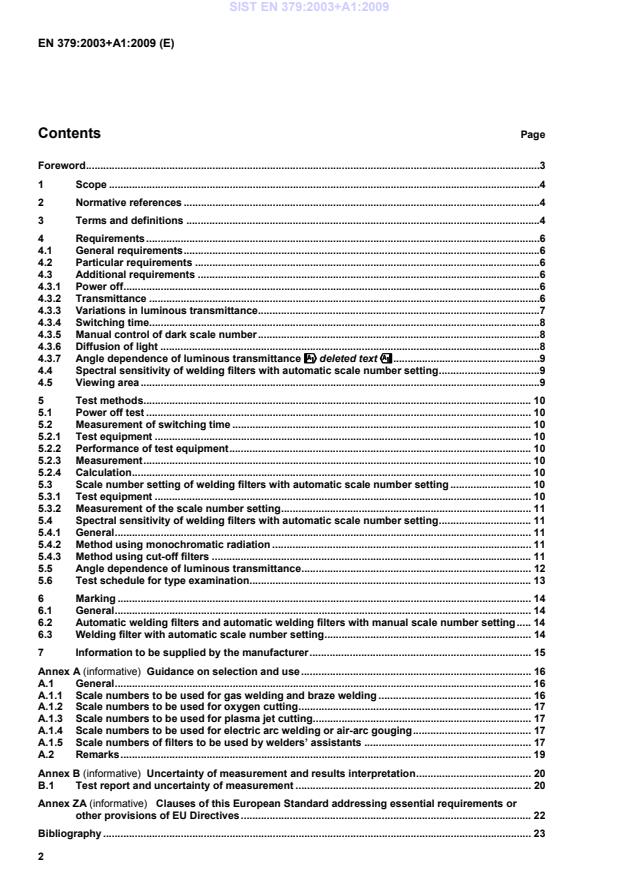
Guidance on selection and use . 16A.1General . 16A.1.1Scale numbers to be used for gas welding and braze welding . 16A.1.2Scale numbers to be used for oxygen cutting . 17A.1.3Scale numbers to be used for plasma jet cutting . 17A.1.4Scale numbers to be used for electric arc welding or air-arc gouging . 17A.1.5Scale numbers of filters to be used by welders’ assistants . 17A.2Remarks . 19Annex B (informative)
Uncertainty of measurement and results interpretation . 20B.1Test report and uncertainty of measurement . 20Annex ZA (informative)
Clauses of this European Standard addressing essential requirements or other provisions of EU Directives . 22Bibliography . 23SIST EN 379:2003+A1:2009
Foreword This document (EN 379:2003+A1:2009) has been prepared by Technical Committee CEN/TC 85 “Eye-protective equipment”, the secretariat of which is held by AFNOR. This European Standard shall be given the status of a national standard, either by publication of an identical text or by endorsement, at the latest by October 2009, and conflicting national standards shall be withdrawn at the latest by October 2009. This document includes Amendment 1, approved by CEN on 2009-02-24. This document supersedes !EN 379:2003". The start and finish of text introduced or altered by amendment is indicated in the text by tags ! ". This document has been prepared under a mandate given to CEN by the European Commission and the European Free Trade Association, and supports essential requirements of EU Directive. For relationship with EU Directive, see informative Annex ZA, which is an integral part of this document. Annexes A and B are informative. In the revision of this European standard, and that of EN 169, which was performed concurrently, it was decided to remove from EN 379 welding filters with dual scale numbers and include them within EN 169. According to the CEN/CENELEC Internal Regulations, the national standards organizations of the following countries are bound to implement this European Standard: Austria, Belgium, Bulgaria, Cyprus, Czech Republic, Denmark, Estonia, Finland, France, Germany, Greece, Hungary, Iceland, Ireland, Italy, Latvia, Lithuania, Luxembourg, Malta, Netherlands, Norway, Poland, Portugal, Romania, Slovakia, Slovenia, Spain, Sweden, Switzerland and United Kingdom. SIST EN 379:2003+A1:2009
Guidance on the selection and use of these filters is given in annex A. The specifications for welding filters without switchable luminous transmittance are given in EN 169. 2 Normative references !The following referenced documents are indispensable for the application of this document. For dated references, only the edition cited applies. For undated references, the latest edition of the referenced document (including any amendments) applies." !EN 165:2005", Personal eye-protection – Vocabulary EN 166:2001, Personal eye-protection – Specifications EN 167:2001, Personal eye-protection – Optical test methods !deleted text" EN 169:2002 !deleted text", Personal eye-protection – Filters for welding and related techniques – Transmittance requirements and recommended use ISO 9211-2:1994, Optics and optical instruments – Optical coatings – Part 2: Optical properties !ISO 11664-2:2007, Colorimetry – Part 2: CIE standard illuminants" 3 Terms and definitions For the purposes of this European Standard, the terms and definitions given in !EN 165:2005" and the following apply. 3.1 automatic welding filter
a protective filter which automatically switches its scale number from a lower value (light state scale number) to a higher value (dark state scale number) when the welding arc is ignited 3.1.1 automatic welding filter with manual scale number setting a protective filter which automatically switches its scale number from a lower value (light state scale number) to a higher value (dark state scale number) selected by the user when the welding arc is ignited SIST EN 379:2003+A1:2009
3.1.2 automatic welding filter with automatic scale number setting a welding filter with switchable scale number, in which the dark state scale number depends upon the illuminance generated by the welding arc. 3.2 light state scale number the scale number corresponding to the maximum value of luminous transmittance τ 1(see Figure 1)
τ1
--------------------------- τd -------------------------------
τ2
Light state Lightest dark state Intermediate dark state Darkest state
scale number scale number scale number Figure 1 - Example showing the meaning of the terms in the case of an automatic welding filter with a light state scale number of 5 and dark state scale numbers between 10 and 14 3.3 dark state scale number
the scale number corresponding to the value of the luminous transmittance τd reached after the ignition of the welding arc by an automatic welding filter (see Figure 1) 3.4 darkest state scale number the highest scale number corresponding to the minimum value of luminous transmittance τ2 of an automatic welding filter claimed by the manufacturer (see Figure 1) 3.5 switching time the switching time ts of an automatic welding filter is defined by the following integral: ∫====)3)((01s2d)(1ττττttttttt where t = 0
is the time at which the arc ignites; τ (t)
is luminous transmittance at a time t after the ignition of the welding arc; t = t (τ (t)=3·τ2) is the time at which the luminous transmittance falls to 3 times the luminous transmittance in the darkest state. NOTE In the case of short term exposure to light, the glare is approximately proportional to the product of the illuminance at the eye and time. The time relationship of the darkening process can be very different depending on the construction of the welding filter with switchable scale number. It is therefore appropriate to define the switching time as an integral of the luminous transmittance over time and not merely by the initial and final luminous transmittances. SIST EN 379:2003+A1:2009
3.6 cut-off filter a filter with a range of low spectral transmittance (cut-off band) followed by a range with high spectral transmittance (pass-band) or vice versa, with properties described according to ISO 9211-2:1994. !!!!3.7 viewing area area not opaque used by the wearer to view the task and meets the requirements of the stated filter scale number" 4 Requirements 4.1 General requirements Automatic welding filters shall comply with requirements given in Table 1. These requirements shall be met for the highest possible scale number as may be set under either automatic setting (including manual offset) or manual setting. Table 1 - General requirements Property Requirement Spherical, astigmatic and prismatic refractive powers EN 166:2001, 7.1.2.1.2 Luminous transmittance EN 169:2002, Table 1 Variations in luminous transmittance 4.3.3 Spectral transmittance EN 169:2002, Table 1 Diffusion of light 4.3.6 Quality of material and surface EN 166:2001, 7.1.3 Robustness of construction EN 166:2001, 7.1.4 Resistance to ultraviolet radiation EN 166:2001, 7.1.5.2, but replacing 7.1.5.2 b) by 4.3.6 of this European standard Resistance to ignition EN 166:2001, 7.1.7
4.2 Particular requirements Where a manufacturer wishes to claim compliance with particular requirements, these requirements shall be as specified in EN 166:2001, 7.2.2 to 7.2.8 and 7.3. 4.3 Additional requirements
4.3.1 Power off When tested according to 5.1, automatic welding filters shall be no more than nine scale numbers lighter than the darkest state scale number. 4.3.2 Transmittance 4.3.2.1 The requirements of 4.3.2.2, 4.3.2.3 and 4.3.2.4 shall be satisfied when the transmittances are measured as described in EN 167:2001, 6, using standard illuminant A. 4.3.2.2 The minimum luminous transmittance in the light state shall be 0,16% when measured at both
(-5 ± 2)oC and (55 ± 2)oC. SIST EN 379:2003+A1:2009
4.3.2.3 The luminous transmittance requirements given in EN 169:2002, Table 1, shall apply to both light and dark states (τ 1, τd and τ 2). The measurements shall be taken at both (- 5 ± 2)oC and (55 ± 2)oC. 4.3.2.4 The spectral transmittance in the ultraviolet and the mean transmittance in the infrared, as given in EN 169:2002, Table 1, and the additional requirements (a) to (d) of EN 169:2002, 5.2, required for the darkest state scale number, shall also apply to all other states. The measurements shall be taken at a temperature of (23 ± 5)oC. 4.3.2.5 In the case of welding filters with automatic scale number setting, this setting of the dark state scale number shall meet the following requirements: a) The dark state scale number N(Ev) shall depend on the illuminance Ev as follows: )lx/log(25,293,2)(vvEEN+= Some values calculated from this formula are given as examples in Table 2, for scale numbers between
8 and 14: Table 2 - Dark state scale number
Dark state scale number Scale number N 8 9 10 11 12 13 14 Illuminance / lx 180 500 1 400 3 900 10 700 30 000 83 000
b) The scale number set in dependence on the illuminance at the filter front shall not deviate by more than ±1 scale number from the scale number given by the formula in (a). c) The range of the luminous transmittance of the welding filter shall be limited by design not to exceed the manufacturer’s claimed darkest state scale number.
d) A manual offset may be provided, which allows the automatically set scale number to be changed by ±1 scale number. This shall be tested at both minimum and maximum settings. e) When tested using double the illuminance given by the formula in (a) for the darkest state scale number, the luminous transmittance shall correspond to the darkest state scale number claimed by the manufacturer. 4.3.3 Variations in luminous transmittance When measured in accordance with clauses 7.1 and 7.2 of EN 167:2001 at a temperature of (23 ± 5)oC the values of P1, P2 and P3 of welding filters with switchable scale number shall not exceed the values in Table 3 for the assigned class. The requirement shall apply to both light and dark states (τ 1, τd and τ 2). Table 3 - Classification of oculars according to the maximum value of P1, P2 or P3 as specified in 4.3.3 Luminous transmittance % Maximum value of P1 or P2 % Maximum value of P3
% max. min. Class 1 Class 2 Class 3 Class 1 Class 2 Class 3 100 17,9 5 10 15 20 20 20 17,9 0,44 10 15 20 20 20 20 0,44 0,023 15 20 30 20 20 30 0,023 0,0012 20 30 40 20 30 40 0,0012 0,000023 30 40 60 30 40 60
(55 ± 2) °C. The switching time given in Table 4 shall not be exceeded at either of these temperatures. 4.3.4.3 The switching time shall be measured as described in clause 5.2 at temperatures of (10 ± 2) °C and (55 ± 2) °C. The switching time given in Table 4 shall not be exceeded at either of these temperatures. Table 4 - Maximum switching times Dark state scale number Light state scale number 1,7 2 2,5 3 4 5 6 Switching time ms 7 300 400 500 700 1000 No requirement No requirement 8 100 150 200 300 500 1000 No requirement 9 40 50 70 100 200 400 700 10 20 20 30 40 70 100 300 11 6 7 10 15 30 50 100 12 2 3 4 5 10 20 40 13 0,8 1 1,5 2 4 7 10 14 0,3 0,4 0,5 0,7 1 3 5 15 0,10 0,15 0,2 0,3 0,5 1 2 16 0,04 0,05 0,07 0,1 0,2 0,4 0,7 NOTE
The values given in Table 4 are based on a 0,5 s duration of glare when the welding arc is ignited. (see: E. Buhr, E. Sutter: Dynamic Filters for Protective Devices, in: G. J. Müller, D. H. Sliney (Hrsg.): Dosimetry of Laser Radiation in Medicine and Biology, SPIE IS 5, 175-195, Washington 1989)
4.3.5 Manual control of dark scale number When a manual control of the dark scale number is provided, the means of control shall meet the following requirements: a) There shall be a digital indication of the scale number for each position of the manual control; b) With an illuminance of (104 ± 103) lx on the filter, the scale number in the dark states (τd and τ2) shall not deviate by more than ±1 from the set scale number; c) If the range of control is more than five scale numbers, it shall be divided into two sub-ranges with separate manual controls. Each manual control shall control a sub-range of no more than five scale numbers. In the case of automatic welding filters with manual control according to 4.3.2.5 e), the total scale number range shall not exceed seven scale numbers, (including the tolerance of 4.3.5 (b) and the provision of 4.3.2.5 e)). 4.3.6 Diffusion of light The diffusion of light shall be measured in accordance with one of the reference methods described in EN 167:2001, 4. The maximum value of the reduced luminance factor in the light or dark state shall determine the diffusion of light class of the welding filter as shown in Table 5. SIST EN 379:2003+A1:2009
Table 5 - Assignment of diffusion of light class Diffusion of light class Maximum value of reduced luminance factor (cd/m2)/lx 1 1,0 2 2,0 3 3,0
4.3.7 Angle dependence of luminous transmittance !!!!deleted text"""" The luminous transmittance is measured at normal to the filter and at angles of incidence up to ±15° to the normal in order to establish the maximum and minimum transmittance. Then the ratios of the luminous transmittance values measured at any angle of incidence up to ±15° to the normal to the filter and the value of the luminous transmittance measured at normal incidence are c
...