

EN 14597:2012
(Main)Temperature control devices and temperature limiters for heat generating systems
- Abstract
1.1 This European Standard applies to electrical or non electrical temperature control devices which are used to control temperatures within heat generating systems by controlling the supply of energy. It also applies to limiting devices which ensure that the temperature in heat generating systems will not exceed a predefined limit.
This European Standard specifies operating values, operating times, and operational sequences associated with the safety of the heat generating system.
This European Standard also applies to controls using NTCs or PTCs thermistors, additional requirements for which are contained in Annex J of EN 60730-2-9:2010.
This European Standard applies to controls with a rated voltage not exceeding 690 V and with a rated current not exceeding 63 A.
This European Standard also applies to manual controls if, electrically and/or mechanically, they form an integral part of automatic controls.
NOTE Requirements for manually operated switches not forming part of an automatic control are contained in EN 61058 1.
This European Standard does not apply to room thermostats.
1.2 This European Standard does not take into account the response value of an automatic action of the control, if such a response value is dependent upon the method of mounting the control in the heat generating system or equipment, in which case the control should be tested together with the heat generator. Where a response value is of significance for the protection of the user or surroundings, the value defined in the appropriate household equipment standard or as determined by the manufacturer applies.
1.3 This European Standard applies also to controls incorporating electronic devices, requirements for which are contained in Annex DX.
- Status
- Published
- Publication Date
- 26-Jun-2012
- Withdrawal Date
- 30-Dec-2012
- Technical Committee
- CEN/TC 58 - Safety and control devices for burners and appliances burning gaseous or liquid fuels
- Drafting Committee
- CEN/TC 58/WG 12 - Electronics
- Current Stage
- 9092 - Decision on results of review/2YR ENQ - revise - Review Enquiry
- Start Date
- 06-Nov-2024
- Completion Date
- 07-Oct-2026



Overview
EN 14597:2012 is a CEN European Standard for temperature control devices and temperature limiters for heat generating systems. It defines functional and safety requirements, test methods, and operational sequences for electrical and non‑electrical controls used to regulate the supply of energy to heat generators. The standard covers sensors, control units, actuators and combinations thereof - including electronic devices and thermistor‑based controls - up to a rated voltage of 690 V and rated current of 63 A. Room thermostats and standalone manual switches not part of an automatic control are excluded.
Key Topics
- Scope and device types: Applies to operating controls and protective (safety) limiters used in air, water, oil and flue‑gas systems; manual controls only when integral to automatic devices.
- Functional requirements: Specifies operating values, operating times, and operational sequences related to safe operation of heat generating systems.
- Safety and tests: Normative requirements and test procedures for electrical safety, mechanical strength, moisture/dust resistance, insulation, heating, endurance and abnormal operation.
- Electronic and sensor requirements: Covers controls incorporating electronics (Annex DX) and thermistors (NTC/PTC) with additional requirements referenced to EN 60730‑2‑9:2010 Annex J. Annex EX provides sensor characteristics and fault modes.
- Installation and response: Notes that control response may depend on mounting; where mounting affects response, the control should be tested with the heat generator.
- Device coding and actions: Uses device codes and annexes (AX, BX, CX, DX, EX) to define required protective actions, information and permissible time factors.
Applications
Who uses EN 14597 and why:
- Manufacturers of boilers, burners, water heaters, heat exchangers and associated control devices - to design and test controls for compliance.
- Product committees and standards writers - to reference appropriate control requirements when specifying safety for specific appliances.
- HVAC and controls engineers - for selecting suitable operating or protective controls and understanding test/installation implications.
- Test laboratories and conformity assessors - for type testing and verification against the normative annexes.
- Safety and risk engineers - to perform risk analyses (FMEA) and select device codes appropriate to the application.
Practical notes:
- Use EN 14597 together with the EN 60730 series for electrical/EMC and low‑voltage requirements.
- When protection depends on mounting, test the control assembled with the heat generator.
- Product standards should specify particular values from Annex BX where needed.
Related Standards
- EN 60730 series (automatic electrical controls) - for construction, electrical safety and EMC
- EN 60730‑2‑9 (thermistors / Annex J) - additional thermistor requirements
- EN 61058‑1 - manually operated switches (when not part of automatic control)
- Relevant appliance standards listed in EN 14597 (boilers, water heaters, burners, etc.)
Keywords: EN 14597, temperature control devices, temperature limiters, heat generating systems, CEN standard, thermistors, safety requirements, electronic controls, HVAC controls.
Relations
- Replaces
EN 14597:2005 - Temperature control devices and temperature limiters for heat generating systems - Effective Date
- 14-Nov-2009
- Effective Date
- 09-Feb-2026
- Effective Date
- 09-Feb-2026
- Effective Date
- 09-Feb-2026
- Effective Date
- 09-Feb-2026
- Effective Date
- 09-Feb-2026
- Effective Date
- 09-Feb-2026
- Effective Date
- 09-Feb-2026
- Effective Date
- 09-Feb-2026
- Effective Date
- 28-Jan-2026
- Effective Date
- 28-Jan-2026
- Effective Date
- 28-Jan-2026
- Effective Date
- 28-Jan-2026
- Effective Date
- 28-Jan-2026
- Effective Date
- 28-Jan-2026
Get Certified
Connect with accredited certification bodies for this standard

BSMI (Bureau of Standards, Metrology and Inspection)
Taiwan's standards and inspection authority.
Sponsored listings
Frequently Asked Questions
EN 14597:2012 is a standard published by the European Committee for Standardization (CEN). Its full title is "Temperature control devices and temperature limiters for heat generating systems". This standard covers: 1.1 This European Standard applies to electrical or non electrical temperature control devices which are used to control temperatures within heat generating systems by controlling the supply of energy. It also applies to limiting devices which ensure that the temperature in heat generating systems will not exceed a predefined limit. This European Standard specifies operating values, operating times, and operational sequences associated with the safety of the heat generating system. This European Standard also applies to controls using NTCs or PTCs thermistors, additional requirements for which are contained in Annex J of EN 60730-2-9:2010. This European Standard applies to controls with a rated voltage not exceeding 690 V and with a rated current not exceeding 63 A. This European Standard also applies to manual controls if, electrically and/or mechanically, they form an integral part of automatic controls. NOTE Requirements for manually operated switches not forming part of an automatic control are contained in EN 61058 1. This European Standard does not apply to room thermostats. 1.2 This European Standard does not take into account the response value of an automatic action of the control, if such a response value is dependent upon the method of mounting the control in the heat generating system or equipment, in which case the control should be tested together with the heat generator. Where a response value is of significance for the protection of the user or surroundings, the value defined in the appropriate household equipment standard or as determined by the manufacturer applies. 1.3 This European Standard applies also to controls incorporating electronic devices, requirements for which are contained in Annex DX.
1.1 This European Standard applies to electrical or non electrical temperature control devices which are used to control temperatures within heat generating systems by controlling the supply of energy. It also applies to limiting devices which ensure that the temperature in heat generating systems will not exceed a predefined limit. This European Standard specifies operating values, operating times, and operational sequences associated with the safety of the heat generating system. This European Standard also applies to controls using NTCs or PTCs thermistors, additional requirements for which are contained in Annex J of EN 60730-2-9:2010. This European Standard applies to controls with a rated voltage not exceeding 690 V and with a rated current not exceeding 63 A. This European Standard also applies to manual controls if, electrically and/or mechanically, they form an integral part of automatic controls. NOTE Requirements for manually operated switches not forming part of an automatic control are contained in EN 61058 1. This European Standard does not apply to room thermostats. 1.2 This European Standard does not take into account the response value of an automatic action of the control, if such a response value is dependent upon the method of mounting the control in the heat generating system or equipment, in which case the control should be tested together with the heat generator. Where a response value is of significance for the protection of the user or surroundings, the value defined in the appropriate household equipment standard or as determined by the manufacturer applies. 1.3 This European Standard applies also to controls incorporating electronic devices, requirements for which are contained in Annex DX.
EN 14597:2012 is classified under the following ICS (International Classification for Standards) categories: 17.200.20 - Temperature-measuring instruments; 97.120 - Automatic controls for household use. The ICS classification helps identify the subject area and facilitates finding related standards.
EN 14597:2012 has the following relationships with other standards: It is inter standard links to EN 14597:2005, EN 60730-2-8:2002, EN 60730-2-14:1997/A11:2005, EN 60730-1:2011, EN 60730-2-14:1997/A1:2001, EN 60730-2-14:1997/A2:2008, EN 60730-2-8:2002/A1:2003, EN 60730-2-14:1997, EN 60730-2-9:2010, EN 17059:2018, EN 16510-2-5:2025, EN 16510-1:2022, EN 16510-1:2018, EN 17175:2019, EN 303-5:2021. Understanding these relationships helps ensure you are using the most current and applicable version of the standard.
EN 14597:2012 is available in PDF format for immediate download after purchase. The document can be added to your cart and obtained through the secure checkout process. Digital delivery ensures instant access to the complete standard document.
Standards Content (Sample)
2003-01.Slovenski inštitut za standardizacijo. Razmnoževanje celote ali delov tega standarda ni dovoljeno.Naprave za regulacijo in omejevanje temperature za sisteme generiranja toploteTemperaturregeleinrichtungen und Temperaturbegrenzer für wärmeerzeugende AnlagenDispositifs de régulation et de limitation de température pour les systèmes générateurs de chaleurTemperature control devices and temperature limiters for heat generating systems97.120Avtomatske krmilne naprave za domAutomatic controls for household use91.140.10Sistemi centralnega ogrevanjaCentral heating systemsICS:Ta slovenski standard je istoveten z:EN 14597:2012SIST EN 14597:2012en,fr,de01-november-2012SIST EN 14597:2012SLOVENSKI
STANDARDSIST EN 14597:20061DGRPHãþD
EUROPEAN STANDARD NORME EUROPÉENNE EUROPÄISCHE NORM
EN 14597
June 2012 ICS 17.200.20; 97.120 Supersedes EN 14597:2005English Version
Temperature control devices and temperature limiters for heat generating systems
Dispositifs de régulation et de limitation de température pour les systèmes générateurs de chaleur
Temperaturregeleinrichtungen und Temperaturbegrenzer für wärmeerzeugende Anlagen This European Standard was approved by CEN on 10 May 2012.
CEN members are bound to comply with the CEN/CENELEC Internal Regulations which stipulate the conditions for giving this European Standard the status of a national standard without any alteration. Up-to-date lists and bibliographical references concerning such national standards may be obtained on application to the CEN-CENELEC Management Centre or to any CEN member.
This European Standard exists in three official versions (English, French, German). A version in any other language made by translation under the responsibility of a CEN member into its own language and notified to the CEN-CENELEC Management Centre has the same status as the official versions.
CEN members are the national standards bodies of Austria, Belgium, Bulgaria, Croatia, Cyprus, Czech Republic, Denmark, Estonia, Finland, France, Germany, Greece, Hungary, Iceland, Ireland, Italy, Latvia, Lithuania, Luxembourg, Malta, Netherlands, Norway, Poland, Portugal, Romania, Slovakia, Slovenia, Spain, Sweden, Switzerland, Turkey and United Kingdom.
EUROPEAN COMMITTEE FOR STANDARDIZATION
COMITÉ EUROPÉEN DE NORMALISATION EUROPÄISCHES KOMITEE FÜR NORMUNG
Management Centre:
Avenue Marnix 17,
B-1000 Brussels © 2012 CEN All rights of exploitation in any form and by any means reserved worldwide for CEN national Members. Ref. No. EN 14597:2012: ESIST EN 14597:2012
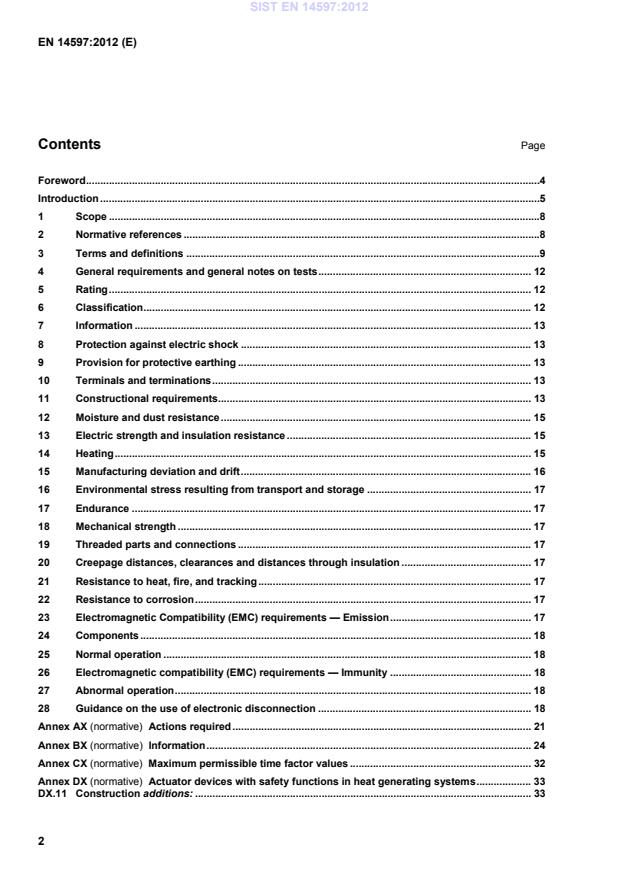
Actions required . 21Annex BX (normative)
Information . 24Annex CX (normative)
Maximum permissible time factor values . 32Annex DX (normative)
Actuator devices with safety functions in heat generating systems . 33DX.11 Construction additions: . 33SIST EN 14597:2012
Characteristics of typical temperature sensors and their fault modes . 35Bibliography . 36 Tables Table 1 — List of standards (non-exhaustive) for equipment using temperature control devices within the scope of this document . 6Table 14.201 — Test parameters for temperature sensing controls used in specific applications . 16Table AX.1a — Actions required for operating and protective controls for HGS according to their device codes . 21Table AX.1b — Actions required for actuators for HGS according to their device code . 23Table BX.1 — Information according to temperature sensing controls for HGS . 24Table CX.1 — Maximum permissible time factor values according to the application . 32Table EX.1 — Characteristics of typical temperature sensors . 35 SIST EN 14597:2012
e) Expansion of footnote 205 for requirement 27; also the new footnote 208 for the requirement 27 in Table BX.1. The test specification in requirement 27 was clarified. According to the CEN/CENELEC Internal Regulations, the national standards organizations of the following countries are bound to implement this European Standard: Austria, Belgium, Bulgaria, Croatia, Cyprus, Czech Republic, Denmark, Estonia, Finland, France, Germany, Greece, Hungary, Iceland, Ireland, Italy, Latvia, Lithuania, Luxembourg, Malta, Netherlands, Norway, Poland, Portugal, Romania, Slovakia, Slovenia, Spain, Sweden, Switzerland, Turkey and the United Kingdom.
EN 656
EN 303-3 Heating boilers — Part 3: Gas-fired central heating boilers — Assembly comprising a boiler body and a forced draught burner TC 109 EN 625 Gas-fired central heating boilers — Specific requirements for the domestic hot water operation of combination boilers of nominal heat input not exceeding 70 kW TC 109 EN 677 Gas-fired central heating boilers — Specific requirements for condensing boilers with a nominal heat input not exceeding 70 kW TC 109 EN 676 Automatic forced draught burners for gaseous fuels TC 131 Gas burners using fans SIST EN 14597:2012
EN 1020 Non-domestic forced convection gas-fired air heaters for space heating not exceeding a net heat input of 300 kW incorporating a fan to assist transportation of combustion air or combustion products
EN 778 Domestic gas-fired forced convection air heaters for space heating not exceeding a net heat input of 70 kW, without a fan to assist transportation of combustion air and/or combustion products TC 180 EN 1319 Domestic gas-fired forced convection air heaters for space heating, with fan-assisted burners not exceeding a net heat input of 70 kW
EN 1196 Domestic and non-domestic gas-fired air heaters — Supplementary requirements for condensing air heaters TC 180 EN 12669 Direct gas-fired hot air blowers for use in greenhouses and supplementary non-domestic space heating TC 180
EN 12828 Heating systems in buildings — Design for water-based heating systems TC 228
EN 416-1 Single burner gas-fired overhead radiant tube heaters for non-domestic use — Part 1: Safety TC 180 Non-domestic gas-fired overhead radiant heaters EN 416-2 Single burner gas-fired overhead radiant tube heaters for non-domestic use — Part 2: Rational use of energy
EN 419-1 Non-domestic gas-fired overhead luminous radiant heaters — Part 1: Safety
EN 419-2 Single burner gas-fired overhead radiant tube heaters for non-domestic use — Part 2: Rational use of energy
EN 12952-8 Water-tube boilers and auxiliary installations — Part 8: Requirements for firing systems for liquid and gaseous fuels for the boiler TC 269 Shell and water-tube boilers EN 12953-7 Shell boilers — Part 7: Requirements for firing systems for liquid and gaseous fuels for the boilers TC 269 SIST EN 14597:2012
60730-2-9 and modifies and replaces requirements of that standard as appropriate for the purpose of this document. If not stated otherwise, all references refer to Clauses of EN 60730-2-9, which is applied in combination with EN 60730-1. Actuator devices are covered by EN 60730-2-14, if applicable. NOTE Additional requirements or tests are numbered, starting with a number higher than X.200 and X being the particular Clause number. This is done in order to distinguish additional requirements from the requirements and tests of EN 60730-1 and the corresponding Parts 2, where numbering starts above X.100. All other Clause numbers refer to Clauses of EN 60730-2-9 and EN 60730-1. 1 Scope 1.1 This European Standard applies to electrical or non-electrical temperature control devices which are used to control temperatures within heat generating systems by controlling the supply of energy. It also applies to limiting devices which ensure that the temperature in heat generating systems will not exceed a predefined limit. This European Standard specifies operating values, operating times, and operational sequences associated with the safety of the heat generating system. This European Standard also applies to controls using NTCs or PTCs thermistors, additional requirements for which are contained in Annex J of EN 60730-2-9:2010. This European Standard applies to controls with a rated voltage not exceeding 690 V and with a rated current not exceeding 63 A. This European Standard also applies to manual controls if, electrically and/or mechanically, they form an integral part of automatic controls. NOTE Requirements for manually operated switches not forming part of an automatic control are contained in EN 61058-1. This European Standard does not apply to room thermostats. 1.2 This European Standard does not take into account the response value of an automatic action of the control, if such a response value is dependent upon the method of mounting the control in the heat generating system or equipment, in which case the control should be tested together with the heat generator. Where a response value is of significance for the protection of the user or surroundings, the value defined in the appropriate household equipment standard or as determined by the manufacturer applies. 1.3 This European Standard applies also to controls incorporating electronic devices, requirements for which are contained in Annex DX. 2 Normative references The following documents, in whole or in part, are normatively referenced in this document and are indispensable for its application. For dated references, only the edition cited applies. For undated references, the latest edition of the referenced document (including any amendments) applies. SIST EN 14597:2012
Note 1 to entry: The control provides either an automatic reset after a minimum time delay of 10 min or type 2H and type 2V actions. Note 2 to entry: The flue gas flow control is used for monitoring the flue gas passages of gas-fired equipment with natural draught burners. Note 3 to entry: Elsewhere in this document, this device is designated by the device code ASW. SIST EN 14597:2012
3.213.1 control with auxiliary energy control that requires electrical, pneumatic or hydraulic energy for transferring the temperature measured by its sensing element(s) to an electrical or mechanical output or actuator
3.213.2 control without auxiliary energy control that uses a sensing element acting directly on a contact output or an actuator
3.214 lockout shutdown after which a restart can only be accomplished by a manual reset and by no other means Note 1 to entry: "Reset with tool" is considered to be covered by "manual reset". Note 2 to entry: This is essentially the same as EN 60730-2-5:2002+A1:2004+A11:2005, 2.3.112.1, non volatile lockout: the condition of a burner control system following safety shut down such that a restart can only be accomplished by a manual reset of the burner control system and by no other means [5]. 3.215 manual reset reset actuated manually which can be made directly on the control or remotely via data transfer initiated by human action Note 1 to entry: Regardless of the technical solution, the safety level of the manual reset will not be reduced. SIST EN 14597:2012
Note 1 to entry: The electric actuator moves the valve, damper or similar device to defined positions; it might also incorporate other functions, such as electric interlock switches and/or feedback. [SOURCE: EN 60730-2-14:1997, 2.2.101] 3.219 actuator element element that is actuated either by an actuator (electrical, pneumatic or hydraulic) or directly by a sensing element 3.220 closing time period of time from the moment the actuator closing signal is delivered to the moment the actuator element reaches the fully closed position 3.221 shut off pressure declared maximum pressure between valve inlet and valve outlet against which the actuator device shuts off in cases of emergency 3.222 kvs value flow through a fully opened valve, measured in m3/h at a differential pressure of 1 bar and using water of 20 °C ± 10 K 4 General requirements and general notes on tests EN 60730-2-9:2010, Clause 3 is applicable. EN 60730-2-9:2010, Clause 4 is applicable. 5 Rating EN 60730-2-9:2010, Clause 5 is applicable. 6 Classification EN 60730-2-9:2010, Clause 6 is applicable, with the following addition: SIST EN 14597:2012
VR –15 % to VR +15 % for DC powered controls;
for pneumatic or hydraulic auxiliary energy within the range of ±10 %, in relation to the rated supply pressure. SIST EN 14597:2012
a) If the factory-set switching point is set for an ambient temperature exceeding 20 °C, the switching point may increase by a maximum of 5 K if the ambient temperature drops from that level to 20 °C.
c) This property shall be declared by the manufacturer (see Table BX.1, requirement 206). 14.204 Sensing elements of temperature sensing controls for heat generating systems of type 1 action or type 2 action shall be capable of withstanding for one hour temperatures 15 % or 25 K above the maximum setting temperature, whichever is the highest value, unless the manufacturer declares a different value in Table 7.2, requirement 218 of EN 60730-2-9:2010. In this case, the declared value applies. After the test, the temperature sensing elements shall continue to operate in the intended manner. For controls of type TB, STW, ATW, Th, STB, ASW, and ASTB which are intended to keep the temperature below a certain limit, the operating temperature shall not have changed by more than ±2 K after the test. Furthermore, no change of the operating point above the rated operating temperature as declared under requirement 48 of Table 7.2 of EN 60730-1:2011 shall occur. The tests shall be carried out at the highest setting (if applicable). The following values in Table 14.201 reflect the experiences made so far or the preferred values, respectively. Table 14.201 — Test parameters for temperature sensing controls used in specific applications Application Upper setting temperature Temperature rise Maximum temperature at the sensing element Criterion of
compliance Controls for air heaters – – 200 °C <0 K Controls for solid fuel boilers – – 400 °C <0 K Thermal bypass protection – – 125 °C <0 K ASW Highest setpoint (HEW) +50 K HEW + 50 K, but at least 130 °C ±2 K ASTB Highest setpoint (HEW) +50 K HEW + 50 K, but at least 130 °C -2 K
14.210 See Annex DX. 15 Manufacturing deviation and drift EN 60730-2-9:2010, Clause 15 is applicable with the following modification: 15.1, 15.5.3.102, 15.5.3.103, 15.5.3.109, and 15.5.6 are not applicable. Additional sub-clauses: 15.201 The absolute value of the manufacturing deviation from the declared set point or, for adjustable devices, the highest temperature of the set point range for TR, FR and TW, shall not exceed the maximum of 5 % or 2 K, whichever gives the wider range. The manufacturing deviation from the set point or, for adjustable devices, the highest temperature of the set point range for TB, STW, ATW, Th, ASW, STB and ASTB shall not exceed 0 % to –10 % [°C] or 0 K to –4 K, whichever gives the wider range. All percentage values refer to the highest adjustable temperature. NOTE "Gives the wider range" is equivalent to "gives the lower temperature". SIST EN 14597:2012
...