

EN 1396:2023
(Main)Aluminium and aluminium alloys - Coil coated sheet and strip for general applications - Specifications
- Abstract
This document specifies the particular requirements for wrought aluminium and wrought aluminium alloys in the form of coil coated sheet and strip for general applications. This product is generally supplied in thicknesses up to 3,0 mm.
It is applicable to cold-rolled aluminium and aluminium alloy strip coated by the coil coating process both with liquid as well as with powder paints, either in the final width or slit afterwards, and to sheet obtained from such strip.
It does not apply to coil coated sheet and strip used for special applications such as cans, closures and lids which are dealt with in separate EN 541.
- Status
- Published
- Publication Date
- 06-Jun-2023
- Technical Committee
- CEN/TC 132 - Aluminium and aluminium alloys
- Drafting Committee
- WG 36 - Rolled products
- Current Stage
- 6060 - Definitive text made available (DAV) - Publishing
- Start Date
- 07-Jun-2023
- Due Date
- 29-May-2023
- Completion Date
- 07-Jun-2023

Overview - EN 1396:2023 (CEN)
EN 1396:2023 is the CEN European standard that specifies requirements for coil coated sheet and strip made from aluminium and aluminium alloys for general applications. It applies to cold‑rolled strip coated by the coil coating process (liquid or powder paints, or laminated films), supplied either in final width or slit afterwards, and to sheet produced from such strip. Typical product thickness is up to 3.0 mm. The standard supersedes EN 1396:2015 and is intended for decorative and corrosion‑resistant flat products rather than special uses (e.g., cans and closures covered by EN 541).
Key topics and technical requirements
EN 1396:2023 covers practical and testable requirements, including:
- Ordering information and documentation requirements to ensure clear specification between supplier and purchaser.
- Production and manufacturing processes for coil coating, including pre‑treatment and curing or lamination.
- Quality control and acceptance criteria, including freedom from visible defects.
- Chemical composition and mechanical properties referencing relevant wrought aluminium alloy designations.
- Tolerances on shape and dimensions, including thickness limits (generally up to 3.0 mm).
- Organic coating properties: film thickness, gloss, colour tolerances, adhesion, flexibility and durability requirements.
- Test procedures and sampling for chemical, tensile and coating tests (links to EN 13523 series and EN ISO 6892-1 methods).
- Inspection documents, marking, packing and arbitration tests for dispute resolution.
- Informative annexes with examples of coating systems (Annex B), guidelines for organic coatings (Annex C) and storage/processing guidance (Annex D).
Practical applications and users
EN 1396:2023 is directly relevant for:
- Manufacturers of coil coated aluminium strip and sheet (coil coaters, laminators).
- Specifiers and purchasers in construction, building facades, roofing, cladding and architectural panels.
- OEMs in automotive, caravans, appliances, HVAC and fabricating industries.
- Fabricators, paint formulators and coating suppliers who need to meet or test coating performance.
- Quality and compliance teams and testing laboratories verifying conformity to European coil coating specifications.
Practical benefits include standardized criteria for durability, appearance and formability - reducing procurement risk and ensuring consistent performance in decorative and protective applications.
Related standards
- EN 485-1, EN 485-4 (sheet/strip technical conditions and tolerances)
- EN 515, EN 573-3 (wrought product temper and chemical composition)
- EN 12258-1 (terms and definitions)
- EN 13523 series (coil coated materials test methods)
- EN ISO 6892-1 (tensile testing)
Keywords: EN 1396:2023, coil coated aluminium, coil coated sheet, aluminium alloys, coil coating, organic coating, CEN standard, specifications.
Relations
- Effective Date
- 17-Mar-2021
- Effective Date
- 25-Mar-2026
- Effective Date
- 28-Jan-2026
- Effective Date
- 28-Jan-2026
- Effective Date
- 28-Jan-2026
- Effective Date
- 28-Jan-2026
- Effective Date
- 28-Jan-2026
- Effective Date
- 28-Jan-2026
- Effective Date
- 28-Jan-2026
- Effective Date
- 28-Jan-2026
- Refers
EN 12258-1:2012 - Aluminium and aluminium alloys - Terms and definitions - Part 1: General terms - Effective Date
- 28-Jan-2026
- Effective Date
- 28-Jan-2026
- Effective Date
- 28-Jan-2026
- Effective Date
- 28-Jan-2026
- Effective Date
- 28-Jan-2026
Get Certified
Connect with accredited certification bodies for this standard

Element Materials Technology
Materials testing and product certification.

Inštitut za kovinske materiale in tehnologije
Institute of Metals and Technology. Materials testing, metallurgical analysis, NDT.
Sponsored listings
Frequently Asked Questions
EN 1396:2023 is a standard published by the European Committee for Standardization (CEN). Its full title is "Aluminium and aluminium alloys - Coil coated sheet and strip for general applications - Specifications". This standard covers: This document specifies the particular requirements for wrought aluminium and wrought aluminium alloys in the form of coil coated sheet and strip for general applications. This product is generally supplied in thicknesses up to 3,0 mm. It is applicable to cold-rolled aluminium and aluminium alloy strip coated by the coil coating process both with liquid as well as with powder paints, either in the final width or slit afterwards, and to sheet obtained from such strip. It does not apply to coil coated sheet and strip used for special applications such as cans, closures and lids which are dealt with in separate EN 541.
This document specifies the particular requirements for wrought aluminium and wrought aluminium alloys in the form of coil coated sheet and strip for general applications. This product is generally supplied in thicknesses up to 3,0 mm. It is applicable to cold-rolled aluminium and aluminium alloy strip coated by the coil coating process both with liquid as well as with powder paints, either in the final width or slit afterwards, and to sheet obtained from such strip. It does not apply to coil coated sheet and strip used for special applications such as cans, closures and lids which are dealt with in separate EN 541.
EN 1396:2023 is classified under the following ICS (International Classification for Standards) categories: 77.150.10 - Aluminium products. The ICS classification helps identify the subject area and facilitates finding related standards.
EN 1396:2023 has the following relationships with other standards: It is inter standard links to EN 1396:2015, EN 573-3:2026, EN 13523-22:2024, EN 13523-1:2024, EN 13523-3:2024, EN 573-3:2019+A2:2023, EN ISO 6892-1:2019, EN 515:2017, EN 485-4:1993, EN 13523-2:2021, EN 12258-1:2012, EN ISO 1514:2024, EN 485-1:2016, CEN/TR 16239:2011, EN 17235:2024. Understanding these relationships helps ensure you are using the most current and applicable version of the standard.
EN 1396:2023 is available in PDF format for immediate download after purchase. The document can be added to your cart and obtained through the secure checkout process. Digital delivery ensures instant access to the complete standard document.
Standards Content (Sample)
SLOVENSKI STANDARD
01-september-2023
Aluminij in aluminijeve zlitine - Prevlečena ali premazana pločevina in trakovi za
splošno uporabo - Specifikacije
Aluminium and aluminium alloys - Coil coated sheet and strip for general applications -
Specifications
Aluminium und Aluminiumlegierungen - Bandbeschichtete Bleche und Bänder für
allgemeine Anwendungen - Spezifikationen
Aluminium et alliages d’aluminium - Tôles et bandes revêtues en continu pour
applications générales - Spécifications
Ta slovenski standard je istoveten z: EN 1396:2023
ICS:
77.150.10 Aluminijski izdelki Aluminium products
2003-01.Slovenski inštitut za standardizacijo. Razmnoževanje celote ali delov tega standarda ni dovoljeno.
EN 1396
EUROPEAN STANDARD
NORME EUROPÉENNE
June 2023
EUROPÄISCHE NORM
ICS 77.150.10 Supersedes EN 1396:2015
English Version
Aluminium and aluminium alloys - Coil coated sheet and
strip for general applications - Specifications
Aluminium et alliages d'aluminium - Tôles et bandes Aluminium und Aluminiumlegierungen -
revêtues en continu pour applications générales - Bandbeschichtete Bleche und Bänder für allgemeine
Spécifications Anwendungen - Spezifikationen
This European Standard was approved by CEN on 7 May 2023.
CEN members are bound to comply with the CEN/CENELEC Internal Regulations which stipulate the conditions for giving this
European Standard the status of a national standard without any alteration. Up-to-date lists and bibliographical references
concerning such national standards may be obtained on application to the CEN-CENELEC Management Centre or to any CEN
member.
This European Standard exists in three official versions (English, French, German). A version in any other language made by
translation under the responsibility of a CEN member into its own language and notified to the CEN-CENELEC Management
Centre has the same status as the official versions.
CEN members are the national standards bodies of Austria, Belgium, Bulgaria, Croatia, Cyprus, Czech Republic, Denmark, Estonia,
Finland, France, Germany, Greece, Hungary, Iceland, Ireland, Italy, Latvia, Lithuania, Luxembourg, Malta, Netherlands, Norway,
Poland, Portugal, Republic of North Macedonia, Romania, Serbia, Slovakia, Slovenia, Spain, Sweden, Switzerland, Türkiye and
United Kingdom.
EUROPEAN COMMITTEE FOR STANDARDIZATION
COMITÉ EUROPÉEN DE NORMALISATION
EUROPÄISCHES KOMITEE FÜR NORMUNG
CEN-CENELEC Management Centre: Rue de la Science 23, B-1040 Brussels
© 2023 CEN All rights of exploitation in any form and by any means reserved Ref. No. EN 1396:2023 E
worldwide for CEN national Members.
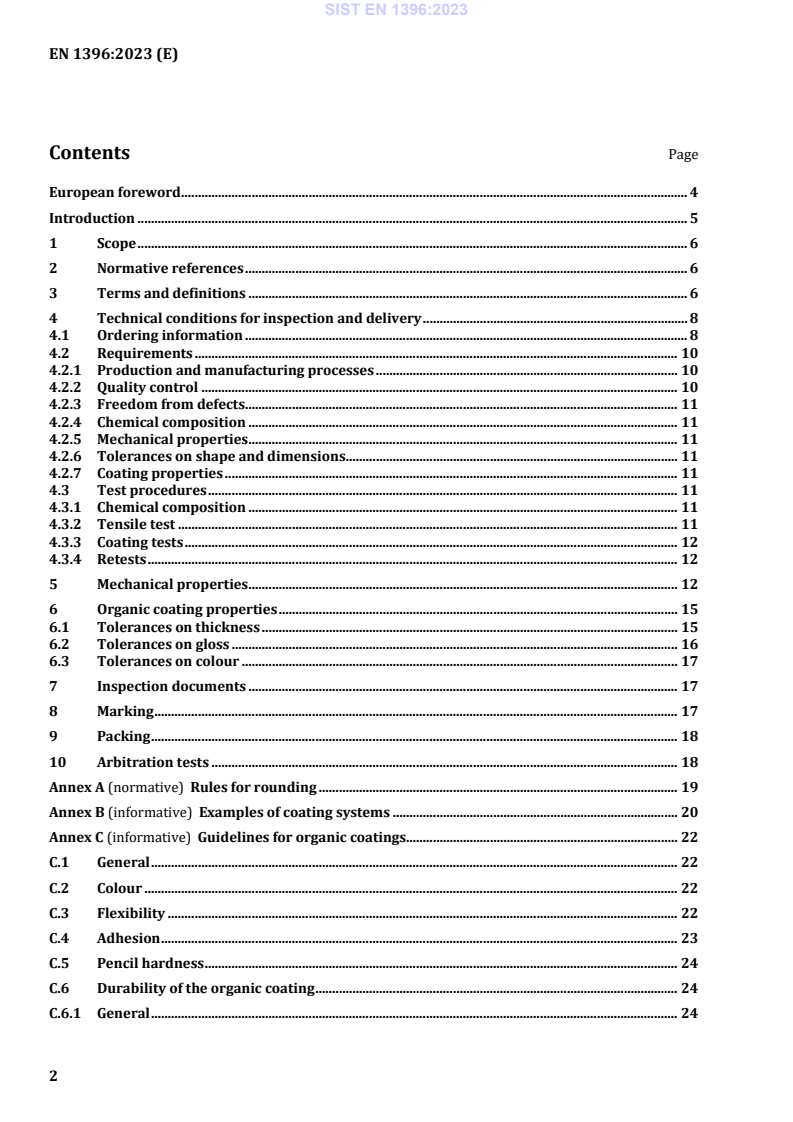
Contents Page
European foreword . 4
Introduction . 5
1 Scope . 6
2 Normative references . 6
3 Terms and definitions . 6
4 Technical conditions for inspection and delivery . 8
4.1 Ordering information . 8
4.2 Requirements . 10
4.2.1 Production and manufacturing processes . 10
4.2.2 Quality control . 10
4.2.3 Freedom from defects. 11
4.2.4 Chemical composition . 11
4.2.5 Mechanical properties . 11
4.2.6 Tolerances on shape and dimensions . 11
4.2.7 Coating properties . 11
4.3 Test procedures . 11
4.3.1 Chemical composition . 11
4.3.2 Tensile test . 11
4.3.3 Coating tests . 12
4.3.4 Retests . 12
5 Mechanical properties . 12
6 Organic coating properties . 15
6.1 Tolerances on thickness . 15
6.2 Tolerances on gloss . 16
6.3 Tolerances on colour . 17
7 Inspection documents . 17
8 Marking . 17
9 Packing . 18
10 Arbitration tests . 18
Annex A (normative) Rules for rounding . 19
Annex B (informative) Examples of coating systems . 20
Annex C (informative) Guidelines for organic coatings. 22
C.1 General . 22
C.2 Colour . 22
C.3 Flexibility . 22
C.4 Adhesion . 23
C.5 Pencil hardness . 24
C.6 Durability of the organic coating . 24
C.6.1 General . 24
C.6.2 Corrosion resistance (outdoor exposure) . 26
C.6.3 UV resistance . 27
C.6.4 Humidity and water immersion resistance (accelerated tests) . 29
C.6.5 Acetic acid salt spray fog resistance (accelerated corrosion test) . 29
C.6.6 Filiform corrosion test, FFC (accelerated corrosion test) . 30
Annex D (informative) Guidelines for storage and subsequent processing . 31
D.1 Storage . 31
D.2 General instructions for processing . 31
D.3 Forming . 31
D.4 Cutting . 31
D.5 Joining . 32
D.6 Cleaning . 32
D.7 Temporary protective films . 32
Bibliography . 33
European foreword
This document (EN 1396:2023) has been prepared by Technical Committee CEN/TC 132 “Aluminium
and aluminium alloys”, the secretariat of which is held by AFNOR.
This European Standard shall be given the status of a national standard, either by publication of an
identical text or by endorsement, at the latest by December 2023, and conflicting national standards shall
be withdrawn at the latest by December 2023.
Attention is drawn to the possibility that some of the elements of this document may be the subject of
patent rights. CEN shall not be held responsible for identifying any or all such patent rights.
This document supersedes EN 1396:2015.
Any feedback and questions on this document should be directed to the users’ national standards body.
A complete listing of these bodies can be found on the CEN website.
According to the CEN-CENELEC Internal Regulations, the national standards organisations of the
following countries are bound to implement this European Standard: Austria, Belgium, Bulgaria, Croatia,
Cyprus, Czech Republic, Denmark, Estonia, Finland, France, Germany, Greece, Hungary, Iceland, Ireland,
Italy, Latvia, Lithuania, Luxembourg, Malta, Netherlands, Norway, Poland, Portugal, Republic of North
Macedonia, Romania, Serbia, Slovakia, Slovenia, Spain, Sweden, Switzerland, Türkiye and the United
Kingdom.
Introduction
Organic coated aluminium and aluminium alloy strip and sheet products can be used to advantage in
cases where corrosion resistance and decorative appearance are of primary importance. They have
applications throughout the flat products processing industry e.g. in the building, automotive, caravans,
appliances, fabricating and packaging industries.
Organic coated aluminium and aluminium alloy flat products can be delivered in numerous types and
grades, depending on the base material used (various grades of aluminium), on the coating material and
types of coating and on the requirements for the surface appearance and the formability.
The properties of the products can vary within greater or smaller limits depending on the choice and
combination of properties required. It is therefore not practicable to specify in detail minimum
requirements for all properties for all types of products.
As a general rule, material specifications are agreed between manufacturer and user/purchaser using,
when appropriate, the guidelines from Annex C.
Guidelines for proper storage and subsequent processing of organic coated aluminium and aluminium
alloy flat products are given in Annex D.
1 Scope
This document specifies the particular requirements for wrought aluminium and wrought aluminium
alloys in the form of coil coated sheet and strip for general applications. This product is generally supplied
in thicknesses up to 3,0 mm.
It is applicable to cold-rolled aluminium and aluminium alloy strip coated by the coil coating process both
with liquid as well as with powder paints, either in the final width or slit afterwards, and to sheet obtained
from such strip.
It does not apply to coil coated sheet and strip used for special applications such as cans, closures and
lids which are dealt with in separate EN 541.
2 Normative references
The following documents are referred to in the text in such a way that some or all of their content
constitutes requirements of this document. For dated references, only the edition cited applies. For
undated references, the latest edition of the referenced document (including any amendments) applies.
EN 485-1, Aluminium and aluminium alloys - Sheet, strip and plate - Part 1: Technical conditions for
inspection and delivery
EN 485-4, Aluminium and aluminium alloys - Sheet, strip and plate - Part 4: Tolerances on shape and
dimensions for cold-rolled products
EN 515, Aluminium and aluminium alloys - Wrought products - Temper designations
EN 573-3, Aluminium and aluminium alloys - Chemical composition and form of wrought products - Part 3:
Chemical composition and form of products
EN 12258-1, Aluminium and aluminium alloys - Terms and definitions - Part 1: General terms
EN 13523-1, Coil coated metals - Test methods - Part 1: Film thickness
EN 13523-2, Coil coated metals - Test methods - Part 2: Gloss
EN 13523-3, Coil coated metals - Test methods - Part 3: Colour difference and metamerism - Instrumental
comparison
EN 13523-22, Coil coated metals - Test methods - Part 22: Colour difference - Visual comparison
EN ISO 6892-1, Metallic materials - Tensile testing - Part 1: Method of test at room temperature
(ISO 6892-1)
3 Terms and definitions
For the purposes of this document, the terms and definitions given in EN 12258-1 and the following apply.
ISO and IEC maintain terminology databases for use in standardization at the following addresses:
— ISO Online browsing platform: available at https://www.iso.org/obp
— IEC Electropedia: available at https://www.electropedia.org/
3.1
aluminium
unalloyed aluminium or aluminium alloy
Note 1 to entry: In the USA the term “Aluminum” is used.
3.2
aluminium alloy
aluminium which contains alloying elements, where aluminium predominates by mass over each of the
other elements and where the aluminium content is not greater than 99,00 %
3.3
metal substrate
base material from cold rolled aluminium or aluminium alloy strip
3.4
coating material
material comprising organic polymers e.g. synthetic resins or plastics, to which pigments, additives and
sol- vents (if required) have generally been added, suitable for coil coating
Note 1 to entry: These can be paints (liquid or powder) or plastic films.
3.5
coil coating
method in which a coating material is applied in a continuous process on a cold rolled metal strip
Note 1 to entry: This process includes cleaning and chemical pre-treatment of the surface and either:
— one-side or two-side, single or multiple application of liquid or powder coating materials which are
subsequently cured; or
— laminating with plastic films.
3.6
organic coating
paint or lacquer film on a coated product produced from wet paint or from powder coating, or the
laminated organic film
3.7
top side
side of the strip with the highest decorative demand and which, in normal production, is uppermost
Note 1 to entry: For strip supplied in coil form, the top side is normally the outside of the coil. For sheet supplied
in stacks or bundles the top side is normally uppermost.
3.8
reverse side
underside of the strip, generally coated with a backing coat (see 3.12), but possibly pre-treated only or
coated with one of the other systems described in 3.10, 3.11 and 3.13, to fulfil special requirements such
as foam or glue adhesion, specially specified friction, etc.
3.9
coating system
combination of coatings either on the top side or on the reverse side of the metal substrate
Note 1 to entry: The name of the coating system derives from the topcoat coating material (see examples in
Annex B).
3.10
single layer coating
single coating either with requirements on appearance, formability, corrosion protection, subsequent
painting etc., or as a primer with special properties regarding adhesion and corrosion protection for post-
painting applications
3.11
multilayer coating
system comprising a primer or a base coat, possibly intermediate coat(s), and a top coat with particular
requirements on appearance, formability, corrosion protection, etc.
3.12
backing coat
single coating of any type with no particular requirements for appearance, formability, corrosion
protection etc., usually on the reverse side of the coated product
3.13
film coating
organic film applied to a substrate to which an adhesive and, if appropriate, a primer has been applied
before- hand
3.14
master coil
parent coil
coil from which products (coil or sheet) are obtained
3.15
order document
document or set of documents agreed between supplier and purchaser at the time of ordering
Note 1 to entry: An order document can be an order of the purchaser confirmed by the supplier or a quotation of
the supplier confirmed by the purchaser.
4 Technical conditions for inspection and delivery
4.1 Ordering information
The order document shall specify the product required and shall contain the following information:
a) the form and type of product:
1) the form of the product (organic coated coil, sheet or strip);
2) the designation of the aluminium or aluminium alloy, in accordance with EN 573-3;
b) the temper of the material for delivery (degree of hardness or heat treatment condition) in
accordance with EN 515 and EN ISO 6892-1;
c) the dimensions and shape of the product:
1) thickness (of the metal substrate);
2) width;
3) length of sheet (in the rolling direction);
4) internal and external diameters of the coil;
5) core size and type.
NOTE Unless otherwise agreed, the length is the largest dimension.
d) the quantity:
1) mass or number of pieces;
e) the coating system (see examples in Annex B):
1) for the top side:
i. colour designation (international and/or company code);
ii. nominal gloss value;
iii. protective strippable film when required;
If the surface is likely to be damaged during transportation, storage, processing or erection,
the coil coated material may, on agreement, be supplied with the additional protection of a
temporary strippable film. Type, thickness, adhesion properties, formability, tear strength
and light fastness should be taken into consideration when choosing protective films. Only
certain protective films can be exposed to outdoor weathering, and these only for a limited
period.
2) for the reverse side:
i. whether it is a backing coat or not;
ii. colour designation (international and/or company code);
iii. nominal gloss value;
f) the type and the design of embossing, when required;
g) any requirements for inspection documents;
h) any special requirements for packing:
1) mass per coil and per packing unit;
2) number of sheets per stack;
3) position of coil axis (vertical or horizontal);
4) design of pallet;
5) direction of winding;
Optional information to be mentioned in the order:
i) the form and type of product:
1) the purchaser application;
j) the number of this document, i.e. EN 1396, or a specification number, or, where none exists, the
properties agreed between manufacturer and purchaser;
k) the quantity:
1) quantity tolerances if required;
l) the coating system:
1) for the top side:
i. special requirements when required such as coat system (single, multiple); type of organic
coating (see Table B.1); coating thickness in micrometers, if different from normal (see
Table B.1); coating system code; etc.;
2) for the reverse side:
i. special requirements when required such as coat system (single, multiple); type of organic
coating (see Table B.1); coating thickness in micrometers, if different from normal (see
Table B.1); surface finish if not coated (degreased only, pre-treated etc.); printing of
markings; foam adhesion; adhesive bonding, etc.;
m) any special requirements agreed between manufacturer and purchaser:
1) marking of products;
2) flagging of defects;
3) instruction on the position of the top side if other than the normal one (see 3.7);
4) other characteristics of the products (see Annex B).
4.2 Requirements
4.2.1 Production and manufacturing processes
Unless otherwise specified in the order, the production and manufacturing processes shall be left to the
discretion of the manufacturer. Unless it is explicitly stated in the order no obligation shall be placed on
the manufacturer to use the same processes for subsequent and similar orders.
4.2.2 Quality control
The manufacturer shall be responsible for the performance of all inspection and tests required by the
relevant European Standard and/or the particular specification, prior to shipment of the product.
If the purchaser wishes to inspect the product at the manufacturer's works, he shall notify the
manufacturer at the time of placing the order.
4.2.3 Freedom from defects
The product shall be free from defects prejudicial to its suitable and proper use. Its surface shall be of a
uniform appearance, colour and texture and be essentially free of blemishes such as flow lines, streaks,
blisters or other imperfections.
Tolerance on surface defects is normally greater for products supplied as coils (as compared to sheets)
due to the impossibility of removing defects within coils and this should be taken into account by the
purchaser when assessing the product. Limiting samples may be agreed.
Uniformity and aesthetic faults shall be noted when visible. Visible examination shall be done at following
distances:
— building façade applications: 5 m for external and 3 m for internal use;
— all other applications: 3 m for external and 2 m for internal use.
4.2.4 Chemical composition
The chemical composition shall comply with the requirements as specified in EN 573-3.
4.2.5 Mechanical properties
The mechanical properties shall be in conformity with those specified in Clause 5 or those agreed upon
between the supplier and the purchaser and stated on the order.
4.2.6 Tolerances on shape and dimensions
The tolerances on shape and dimensions specified in EN 485-4 shall apply.
Tolerances on thickness shall only apply to the uncoated (bare) metal substrate. For the tolerances on
the organic coating thicknesses see 6.1.
Unless otherwise agreed, the purchaser may reject only those products having dimensions not complying
with the specified tolerances.
4.2.7 Coating properties
Property requirements relating to the organic coating are specified in Clause 6. Other requirements shall
be agreed by the supplier and the purchaser and stated on the order. Annex C gives some guidelines for
such requirements.
4.3 Test procedures
4.3.1 Chemical composition
For chemical composition testing see EN 485-1.
4.3.2 Tensile test
For the selection and preparation of samples and test-pieces see EN 485-1.
Testing shall be carried out according to EN ISO 6892-1, and the following additional requirements:
— the test-piece shall be taken with its length transverse to the rolling direction. For narrow widths
(less than 300 mm) testing in the rolling direction is permitted. In this case, testing direction shall be
reported and specified;
— the test-piece shall have a reduced section 12,5 mm wide;
— unless otherwise agreed testing shall be carried out on the coated material. The thickness of the metal
substrate shall be used for the calculation of the cross-section;
— the elongation shall be measured using an original gauge length of 50 mm.
Testing shall be carried out on at least one test-piece taken from each inspection lot. Furthermore, testing
shall be carried out on:
— one test piece taken from each master coil of more than 1 000 kg;
— one test piece taken from every 10 master coils of 500 kg up to 1 000 kg;
— one test piece taken from every 25 master coils of less than 500 kg.
4.3.3 Coating tests
The coating tests shall be carried out either as agreed upon by the manufacturer and the purchaser or in
accordance with the following standards:
— coating thickness (when required): EN 13523-1;
— specular gloss: EN 13523-2;
— colour difference: EN 13523-3 and EN 13523-22.
NOTE Instrumental comparison for colour difference (EN 13523-3) does not give reliable values in the case of
embossed or textured coatings, metallic or pearlescent pigmented coatings.
The frequency of testing shall be as for the tensile test.
Other tests may be specified. The methods of testing, if other than the ones in the normative references
(see Clause 2), the acceptance criteria and the frequency of testing shall be agreed between supplier and
purchaser. Guidelines for such specification are set out in Annex C.
4.3.4 Retests
Retests shall be carried out in conformance with EN 485-1.
5 Mechanical properties
Properties shall be in conformance with those specified in Table 1, using the rounding rules set out in
Annex A. Properties for alloys and/or tempers not covered in Table 1 shall be agreed between
manufacturer and purchaser.
Table 1 — Mechanical properties after coating
A mm
R
R
m p0,2 %
MPa MPa specified thickness t (mm)
Alloy designation Temper
min.
min. max. min. t ≤ 0,5 0,5 < t ≤ 1,5 t > 1,5
EN AW-1050A [Al 99,5] O 65 95 20 20 22 26
H42 85 125 65 4 5 6
H44 100 145 80 3 4 5
H46 120 160 90 2 3 4
H48 140 — 120 2 2 3
EN AW-1200 [Al 99,0] O 75 105 30 19 21 24
H42 90 135 70 4 5 6
H44 110 155 90 3 4 5
H46 130 170 100 2 3 4
H48 150 — 130 2 2 3
EN AW-3003 [Al Mn1Cu] 0 95 135 35 15 17 17
H43 130 170 100 4 5 5
H44 140 185 110 4 4 5
H45 150 205 130 3 4 4
H46 165 210 140 2 3 3
H48 180 220 165 2 2 3
H49 195 — 190 2 2 2
EN AW-3103 [Al Mn1] H44 140 180 110 4 4 5
H46 160 200 140 2 3 3
H48 180 — 160 2 2 3
EN AW-3004 [Al Mn1Mg1] H42 185 240 130 4 5 6
H43 195 235 160 3 4 5
H44 210 265 180 3 4 4
H46 230 285 200 3 3 3
H48 260 — 220 2 3 3
EN AW-3005 [Al Mn1Mg0,5] O 115 165 45 12 14 16
H41 130 180 80 7 8 9
H42 140 195 95 5 5 6
H44 165 215 135 3 3 4
H46 185 240 160 2 2 3
A mm
R R
%
m p0,2
MPa MPa specified thickness t (mm)
Alloy designation Temper
min.
min. max. min. t ≤ 0,5 0,5 < t ≤ 1,5 t > 1,5
H48 210 — 180 1 2 2
EN AW-3104 [Al Mn1Mg1Cu] H48 240 280 210 3 4 4
H49 280 — 250 2 2 2
EN AW-3105 [Al Mn0,5Mg0,5] O 100 155 40 14 15 17
H42 130 180 105 6 6 7
H44 150 200 120 3 3 4
H46 175 225 150 2 2 3
H48 195 — 170 2 2 2
EN AW-4017 [Al SiMnMgCu] H42 145 200 120 2 2 2
EN AW-5005 [Al Mg1(B)] O 100 145 35 15 19 20
H42 125 165 80 4 5 6
H44 145 185 110 3 4 5
H46 165 205 135 2 3 4
H48 185 — 160 1 2 3
EN AW-5006 [Al Mg1Mn0,5] H41 140 190 105 7 7 8
H48 200 250 180 3 3 3
H49 200 — 190 2 2 2
EN AW-5010 [Al Mg0,5Mn] H42 110 150 90 5 5 6
H44 130 170 100 3 3 4
H45 140 180 110 2 2 3
H46 150 190 120 2 2 3
H48 170 210 140 1 1 2
EN AW-5050 [Al Mg1,5(C)] H44 170 215 130 3 4 5
H46 190 235 160 2 3 4
H48 210 250 180 1 2 3
H49 240 — 220 1 1 2
EN AW-5251 [Al Mg2] O 160 200 60 13 14 16
H44 190 230 120 3 5 6
H46 210 270 165 3 4 5
H48 250 — 215 2 3 3
A mm
R R
%
m p0,2
MPa MPa specified thickness t (mm)
Alloy designation Temper
min.
min. max. min. t ≤ 0,5 0,5 < t ≤ 1,5 t > 1,5
EN AW-5052 [Al Mg2,5] H42 205 260 130 5 6 7
H44 230 280 150 4 5 6
H46 250 300 180 3 4 5
H48 270 — 210 3 3 4
EN AW-5754 [Al Mg3] O 190 240 80 12 14 16
H41 205 245 125 8 9 10
H42 220 270 130 7 8 9
H44 230 280 160 5 5 6
H46 260 310 190 4 4 5
H48 280 — 220 3 3 4
EN AW-5182 [Al Mg4,5Mn0,4] H48 330 — 300 1 1 2
EN AW-6011 [Al Mg0,9Si0,9Cu] T8 340 — 320 2 2 2
EN AW-6025 [Al Mg2,5SiMnCu] O 160 220 60 8 10 10
H41 170 220 100 4 5 5
H42 180 230 135 2 3 4
H46 220 260 185 2 3 4
EN AW-8006 [Al Fe1,5Mn] O 70 — 45 18 18 20
H42 85 125 75 5 5 6
H44 90 130 75 2 2 3
EN AW-8011A [Al FeSi(A)] O 80 120 30 19 21 24
H44 125 165 100 3 4 5
EN AW-8111 O 75 120 30 20 21 22
H42 110 155 85 4 4 5
6 Organic coating properties
6.1 Tolerances on thickness
When specified in the order document, the thickness of the organic coating shall meet the tolerances
given in Table 2.
These tolerances on the specified coating thickness shall apply to the total organic coating thickness on
each relevant side, but not including the strippable film thickness (where applicable).
The measurements shall be carried out on a representative specimen according to EN 13523-1.
The measurements should be carried out on flat samples only (i.e.: not embossed).
For structured surfaces only negative deviation on the average of ten measurements shall be applied.
For powder coatings, maximum allowable deviation from the specified thickness shall be 10 for an
average of five measurements and 15 for an individual measurement for all film thicknesses.
Other tolerances as well as the measuring method to be used can be agreed between manufacturer and
purchaser; in this case, both pieces of information shall be reported and specified.
Table 2 — Tolerances on total thickness of the organic coating
Dimensions in micrometres
Specified thickness range 3 < t 5 < t ≤ 10 < t 20 < t 25 < t 35 < t 60 < t 100 < t t > 20
≤ 5 10 ≤ 20 ≤ 25 ≤ 35 ≤ 60 ≤ 100 ≤ 200 0
Maximum allowable negative 2 2 2 3 3 5 10 15 20
deviation from the specified thickness:
for an average of five measurements
Maximum allowable negative 2 3 4 5 6 8 15 25 40
deviation from the specified thickness:
for an individual measurement
NOTE 1 Both tolerances are only intended for smooth surfaces. Tolerance for individual measurements does not
apply.
NOTE 2 There are no requirements for backing coat.
NOTE 3 There are no requirements for the positive deviation.
6.2 Tolerances on gloss
The test method for measuring specular gloss shall be as specified in EN 13523-2.
NOTE The method does not give reliable values in the case of embossed or textured coatings, metallic or
pearlescent pigmented coatings.
The tolerances on gloss measured using a 60° head are specified in Table 3.
These tolerances apply to measurements carried out in accordance with EN 13523-2 using a 60° head,
unless otherwise agreed. For gloss values below 10, a 85° head is recommended, where other tolerances
may apply.
The measurements should be carried out on flat samples (i.e.: not embossed).
Other values may be agreed between supplier and purchaser.
Test method and gloss tolerances for textured finishes should be agreed between supplier and purchaser.
Table 3 — Tolerances on gloss
Values in gloss units
Gloss unit range Tolerances on nominal Maximum variation within one Gloss type
gloss supply
≤ 10 ±2 ±1 matt
> 10 ≤ 20 ±4 ±2 low gloss
> 20 ≤ 40 ±5 ±3 satin
> 40 ≤ 60 ±7 ±5 semi-gloss
> 60 ≤ 80 ±8 ±7 gloss
> 80 Minimum gloss 80 high gloss
6.3 Tolerances on colour
The colour shall match visually the colour specified. If necessary, appropriate colour tolerances should
be agreed in advance. Recommendations for the evaluation are specified in Annex C.
7 Inspection documents
Inspection documents shall be issued in accordance with EN 485-1.
8 Marking
Unless otherwise agreed at the time of ordering, the following minimum marking requirements shall
apply:
— name or mark of the manufacturer;
— alloy and temper designation for the substrate;
— information on the coating on each surface;
— order number;
— ordered dimensions;
— production batch number and mass.
Each of these items shall be given on a label, which is to be attached to every coil or pack.
9 Packing
The packing requirements shall be agreed between manufacturer and purchaser at the time of ordering.
For coils packed eye to the sky — when observed from the top — the direction of winding is specified as
clock- wise or anti-clockwise according to the following sketch (Figure 1):
a) Clockwise b) Anti-clockwise
Figure 1 — Direction of winding
10 Arbitration tests
In cases of dispute concerning conformity with the requirements of this document or specification cited
on the order, before rejecting the products, testing and examination shall be carried out by an arbitrator
chosen by mutual agreement between manufacturer and purchaser.
The arbitrator's decision shall be final.
Annex A
(normative)
Rules for rounding
In recording test results, the number representing the result of a test to determine a given property shall
be expressed to the same number of decimal places as the corresponding number in this document.
The following rounding rules shall be used for determination of compliance with this document:
a) when the figure immediately after the last figure to be retained is less than 5, the last figure to be
retained remains unchanged;
b) when the figure immediately after the last figure to be retained is greater than 5, or equal to 5 and
followed by at least one figure other than zero, the last figure to be retained is increased by one;
c) when the figure immediately after the last figure to be retained is equal to 5 and followed by zeros
only, the last figure to be retained remains unchanged if even and is increased by one if odd.
The results of determinations of dimensions (length, width, thickness etc.) and shape (squaring,
cambering, straightness, flatness etc.) shall not be rounded. These shall comply with the specification in
the relevant European standard, taking into account permissible tolerances also given in that European
standard.
Annex B
(informative)
Examples of coating systems
EXAMPLE 1 Topside: Two coat system, PVDF, colour xxxx, gloss xxx units, coating thickness xxx µm, with
protective strippable film.
Reverse side: Single coat system requiring PU foam adhesion, coating thickness approx. xxx µm.
EXAMPLE 2 Topside: Two coat system, Polyester (PT), colour xxxx, gloss xxx units, coating thickness xxx µm,
with protective strippable film.
Reverse side: Two coat system, Polyester (PT), colour xxxx, gloss xxx units, coating thickness xxx µm.
EXAMPLE 3 Topside: Single coat system, Epoxy (EP), colour xxxx, gloss xxx units, coating thickness xxx µm.
Reverse side: Pre-treated only.
EXAMPLE 4 Topside: Laminated with PVC-film, colour xxxx, gloss xxx units, film thickness xxx µm.
Reverse side: Backing coat, approx. xxx µm.
EXAMPLE 5 Topside: Two coat system, Polyester (PT), with stripes, stripe code n° xxxx (drawing N.), colour of
base coat xxxx, colour of stripe 1 xxxx, colour of stripe 2 xxxx, gloss xxx units, coating thickness (base coat) xxx µm,
coating thickness (stripes) xxx µm.
Reverse side: Backing coat, approx. xxx µm.
Table B.1 — Symbol and typical thickness or thickness ranges of the more common coating
materials (for information only)
Dimensions in micrometres
a
Coating material Typical thickness or
Symbol
b
thickness ranges
Liquid coatings
Acrylic AY 20
Alkyd AK 15
Epoxy EP 5
Fluoropolymer FEVE 10 to 40
Polyamide (PA) modified systems PUR-PA and PT-PA 20 to 30
Polyesters PE 10 to 20
Polyurethane PUR 20
Polyurethane adhesives PUR(A) 6
Polyvinylidene fluoride PVDF 20 to 40
Silicone modified polyester PT-SI 20
Powder coatings
Polyester SP 50 to 80
Epoxy EP 50 to 80
c
Laminated films
Polyvinyl chloride PVC(F) > 100
Polyvinyl fluoride PVF(F) 38
Polyester PET < 150
a
The symbols correspond broadly to those in EN ISO 1043-1 or were chosen by analogy.
b
The typical thickness values relate to the individual coats (excluding primer and adhesive coatings).
c
Excluding adhesive coating thickness of approximately 10 µm.
Annex C
(informative)
Guidelines for organic coatings
C.1 General
Coil coated products should comply with the relevant requirements of this annex when agreed between
supplier and purchaser and stated on the order.
C.2 to C.5 can be used for lot acceptance if so agreed.
C.6.2 to C.6.5 are only intended for surveillance purpose. The frequency of the relevant test is left to the
discretion of the manufacturer, who should maintain records of the lots so tested and make them
available for examination at the manufacturer's facility.
C.2 Colour
The colour should be measured according to EN 13523-3 and should not differ from the agreed standard
by:
White and pastel colours ΔE ≤ 1 (where white and pastel colours are specified as L* > 80 and
C*(a,b) < 10).
Other colours ΔE ≤ 2
Illuminants and geometry should be declared. For specific colours, other tolerances can be agreed at the
time of inquiry and order.
Within one supply the colour difference between extremes should not exceed ΔE 0,7 CIELAB unit.
These figures are for guidance only and are not appropriate for all colours. Therefore, specific numerical
values should be set when necessary.
The measurements should be executed on a mutually agreed colour measurement device. This does not
apply to metallic paint finishes, textured coatings and embossed surfaces.
The colour should be evaluated visually according to EN 13523-22.
C.3 Flexibility
Flexibility of the organic coating is assessed by subjecting the material to a bend test. The test should be
carried out on a material at ambient temperature.
The bend test should be carried out according to EN 13523-7 in the rolling direction. If the transverse
direction is used it should be specified in the report.
As an alternative to the devices covered in EN 13523-7 the following method may be used to carry out
the bending (see also Figure C.1):
— the test piece (at least 250 mm × 30 mm) is bent (at 1 cm from one extremity) over an angle of
approximately 100° by hand or by any other convenient means;
— the bent test-piece is then pressed, using a vice or a hydraulic press, until the two faces come into
contact. This constitutes the “0T” bend;
— if the bent area shows cracks with apparent underlying metal, a second bend is carried out by folding
the test-piece over the first bend and then pressing it using the vice or press. This constitutes the
“0,5T” bend;
— this procedure is continued until a crack free bend is obtained;
— in case of dispute the test should be carried out at a temperature of 23 °C ± 2 °C and at a relative
humidity of 50 % ± 5 %.
Figure C.1 — Bending values
The frequency of testing should be as for the tensile test.
Bending values should not exceed 3T, unless otherwise specified or agreed between supplier and
purchaser.
Measured bend radii are governed by the choice of metal substrate, temper, thickness and coating
material. Therefore, when limit values are required, these should be agreed between supplier and
purchaser and stated on the order in accordance with the shape and folds of the finished product.
C.4 Adhesion
C.4.1 Adhesion of the organic coating is assessed by evaluating the coating surface, after deformation,
in specified conditions, of a specimen previously cross-hatched with a cutting tool. Cross-hatching should
be carried out according to EN 13523-6. The specimen should then be deformed using one of the
following methods as appropriate:
— method 1: liquid coating from which the film thickness is up to 50 µm may be reverse impact tested
in accordance with either EN 13523-5, ISO 6272-1 or ISO 6272-2, using the maximum indentation
energy that will not rupture the substrate. Tested with tape, there should be no loss of adhesion of
the organic coating. Cracking of the paint film should not be considered as a cause for rejection.
— method 2: coatings should be tested in accordance with EN 13523-6 followed by EN ISO 1520, noting
the following:
— cross-hatching should comprise two parallel cuts made 5 mm apart, together with two additional
similar cuts made at right angles to form a central 5 mm × 5 mm central square. The cuts should
just reach the metal, and each cut should measure at least 50 mm in length;
— for coatings greater than or equal to 60 μm thickness. After indentation, an attempt is made
to pull the strips away from the substrate in each of the four directions, starting from the central
square. The ends of the strips are lifted with a knife, then pulled with pincers. The peeling is
observed and expressed in percentage of the distance between the top and the base of the dome.
If ageing is carried out, express the adhesion as a percentage of peeling for the ageing period;
— for coating less than 60 μm
...