

prEN 17237
(Main)Thermal insulation products for buildings - External thermal insulation composite systems with renders (ETICS) - Specification
General Information
- Abstract
This document specifies the characteristics and performance for design External Thermal Insulation Composite Systems (design ETICS) with rendering systems on thermal insulation products, delivered as a kit by a system holder, and used as thermal insulation for buildings.
This document covers design ETICS kits on walls which are made of masonry (bricks, blocks, stones, etc.) or concrete (cast on site or as prefabricated panels) with or without rendering systems. This document covers ETICS with thermal insulation products made of cellular glass, expanded polystyrene, expanded cork, mineral wool, phenolic foam, rigid polyurethane foam, extruded polystyrene foam or wood fibre as far as they comply with Annex B.
A design ETICS kit comprises a prefabricated insulation product bonded onto the wall, or mechanically fixed using anchors, profiles, etc., or a combination of adhesive and mechanical fixings. The insulation product is faced with a rendering system consisting of one or more layers (site applied), one of which contains reinforcement. The rendering system is applied directly to the insulating panels, without an air gap or disconnecting layer.
This document is not applicable for:
a) Mechanically fixed kits with supplementary adhesive with the mass per unit area of the rendering system of > 40 kg/m2 in end use conditions intended by the system holder and/or mechanical fixed kits with the mass per unit area of the rendering system plus thermal insulation product of > 65 kg/m2 intended by the system holder.
b) Mechanically fixed kits without supplementary adhesive with the mass per unit area of the rendering system of > 30 kg/m2 in end use conditions intended by the system holder and/or mechanical fixed kits with the mass per unit area of the rendering system plus thermal insulation product of > 60 kg/m2 intended by the system holder and/or with a thickness of the thermal insulation product intended by the system holder of > 200 mm. For thermal insulations products with thicknesses ≤ 200 mm fixed with anchors without supplementary adhesive, the bending deformation of the mechanically fixing devices is assumed as negligible.
c) Purely bonded kits with or without supplementary mechanically fixing devices with bonded area (coverage) less than 40 %, intended by the system holder.
d) Mechanically fixed kits with supplementary adhesive with bonded area (coverage) less than 40 %, intended by the system holder.
e) Kits incorporating a thermal insulation product providing a declared thermal resistance of less than 1 m2K/W.
External insulation and finishing systems (EIFS) according to ISO 17738 are not covered by this standard.
- Status
- Not Published
- Publication Date
- 01-Dec-2019
- Technical Committee
- CEN/TC 88 - Thermal insulating materials and products
- Drafting Committee
- CEN/TC 88/WG 18 - External thermal insulation composite systems
- Current Stage
- 3098 - Decision to reject - Consensus building
- Start Date
- 08-Apr-2019
- Completion Date
- 30-Sep-2026

Overview
prEN 17237 - a CEN draft standard - defines characteristics and performance requirements for design External Thermal Insulation Composite Systems (design ETICS) delivered as kits with a site‑applied rendering system. It applies to ETIC kits for walls of masonry or concrete (cast in‑situ or precast) using a range of thermal insulation products. The standard sets out required properties, testing methods, assessment and verification of constancy of performance (AVCP) for system holders, manufacturers and testing laboratories.
Key topics and technical requirements
- Scope of systems covered
- Design ETICS kits comprising prefabricated insulation panels bonded and/or mechanically fixed to the substrate, with a layered rendering system applied directly to the insulation (no air gap).
- Insulation materials explicitly covered: cellular glass, expanded polystyrene (EPS), extruded polystyrene (XPS), expanded cork, mineral wool, phenolic foam, rigid polyurethane foam (PUR/PIR), wood fibre (subject to Annex B compliance).
- Important exclusions
- Mechanically fixed kits with rendering mass per unit area or combined mass exceeding specified kg/m² limits (see standard for exact thresholds).
- Kits with bonded (coverage) area < 40 % in end‑use conditions.
- Kits with declared thermal resistance < 1 m²K/W.
- External Insulation and Finishing Systems (EIFS) per ISO 17738 are not covered.
- Performance characteristics and tests
- Reaction to fire, water absorption and water tightness, impact resistance, water vapour permeability.
- Bond strength (adhesive to insulation; tensile strength perpendicular to surface; base coat adhesion; rendering system adhesion).
- Fixing strength: pull‑through, pull‑off tensile and shear, plate anchor characteristics, collar anchor and rail fixing strength.
- Thermal resistance (including point thermal transmittance of anchors and correction factors for profiles), airborne sound insulation (dynamic stiffness, airflow resistance), and mass/weight of rendering.
- Assessment & conformity
- Testing, sampling and reporting procedures, plus AVCP including factory production control (FPC) and initial/continuous inspection regimes.
- Annexes provide parameters, acceptance criteria, calculation methods (Annex B) and characteristic values.
Applications
- Use prEN 17237 when specifying, designing or certifying external insulation composite kits for building façades.
- Practical applications include energy‑efficiency upgrades, new façade systems, retrofit projects and compliance testing for thermal, fire and mechanical performance.
- Helps architects, façade engineers, system manufacturers, installers and product test laboratories demonstrate system performance and support regulatory compliance.
Who should use this standard
- System holders and manufacturers preparing ETIC kits for market
- Specifiers, architects and façade designers selecting external insulation solutions
- Test houses and accredited laboratories conducting performance verification
- Building authorities and certification bodies assessing compliance
Related standards
- ISO 17738 (EIFS) - explicitly not covered by prEN 17237; consult ISO 17738 for EIFS-specific requirements.
- prEN 17237 is published under CEN procedures - consult national CEN bodies for adoption status and national transpositions.
Relations
- Effective Date
- 28-Jan-2026
- Effective Date
- 28-Jan-2026
- Effective Date
- 28-Jan-2026
- Effective Date
- 28-Jan-2026
- Effective Date
- 19-Jan-2023
- Effective Date
- 18-Jan-2023
- Effective Date
- 14-Nov-2012
Get Certified
Connect with accredited certification bodies for this standard

DIBt (Deutsches Institut für Bautechnik)
German Institute for Building Technology.
DIN CERTCO
DIN Group product certification.

Aboma Certification B.V.
Specialized in construction, metal, and transport sectors.
Sponsored listings
Frequently Asked Questions
prEN 17237 is a draft published by the European Committee for Standardization (CEN). Its full title is "Thermal insulation products for buildings - External thermal insulation composite systems with renders (ETICS) - Specification". This standard covers: This document specifies the characteristics and performance for design External Thermal Insulation Composite Systems (design ETICS) with rendering systems on thermal insulation products, delivered as a kit by a system holder, and used as thermal insulation for buildings. This document covers design ETICS kits on walls which are made of masonry (bricks, blocks, stones, etc.) or concrete (cast on site or as prefabricated panels) with or without rendering systems. This document covers ETICS with thermal insulation products made of cellular glass, expanded polystyrene, expanded cork, mineral wool, phenolic foam, rigid polyurethane foam, extruded polystyrene foam or wood fibre as far as they comply with Annex B. A design ETICS kit comprises a prefabricated insulation product bonded onto the wall, or mechanically fixed using anchors, profiles, etc., or a combination of adhesive and mechanical fixings. The insulation product is faced with a rendering system consisting of one or more layers (site applied), one of which contains reinforcement. The rendering system is applied directly to the insulating panels, without an air gap or disconnecting layer. This document is not applicable for: a) Mechanically fixed kits with supplementary adhesive with the mass per unit area of the rendering system of > 40 kg/m2 in end use conditions intended by the system holder and/or mechanical fixed kits with the mass per unit area of the rendering system plus thermal insulation product of > 65 kg/m2 intended by the system holder. b) Mechanically fixed kits without supplementary adhesive with the mass per unit area of the rendering system of > 30 kg/m2 in end use conditions intended by the system holder and/or mechanical fixed kits with the mass per unit area of the rendering system plus thermal insulation product of > 60 kg/m2 intended by the system holder and/or with a thickness of the thermal insulation product intended by the system holder of > 200 mm. For thermal insulations products with thicknesses ≤ 200 mm fixed with anchors without supplementary adhesive, the bending deformation of the mechanically fixing devices is assumed as negligible. c) Purely bonded kits with or without supplementary mechanically fixing devices with bonded area (coverage) less than 40 %, intended by the system holder. d) Mechanically fixed kits with supplementary adhesive with bonded area (coverage) less than 40 %, intended by the system holder. e) Kits incorporating a thermal insulation product providing a declared thermal resistance of less than 1 m2K/W. External insulation and finishing systems (EIFS) according to ISO 17738 are not covered by this standard.
This document specifies the characteristics and performance for design External Thermal Insulation Composite Systems (design ETICS) with rendering systems on thermal insulation products, delivered as a kit by a system holder, and used as thermal insulation for buildings. This document covers design ETICS kits on walls which are made of masonry (bricks, blocks, stones, etc.) or concrete (cast on site or as prefabricated panels) with or without rendering systems. This document covers ETICS with thermal insulation products made of cellular glass, expanded polystyrene, expanded cork, mineral wool, phenolic foam, rigid polyurethane foam, extruded polystyrene foam or wood fibre as far as they comply with Annex B. A design ETICS kit comprises a prefabricated insulation product bonded onto the wall, or mechanically fixed using anchors, profiles, etc., or a combination of adhesive and mechanical fixings. The insulation product is faced with a rendering system consisting of one or more layers (site applied), one of which contains reinforcement. The rendering system is applied directly to the insulating panels, without an air gap or disconnecting layer. This document is not applicable for: a) Mechanically fixed kits with supplementary adhesive with the mass per unit area of the rendering system of > 40 kg/m2 in end use conditions intended by the system holder and/or mechanical fixed kits with the mass per unit area of the rendering system plus thermal insulation product of > 65 kg/m2 intended by the system holder. b) Mechanically fixed kits without supplementary adhesive with the mass per unit area of the rendering system of > 30 kg/m2 in end use conditions intended by the system holder and/or mechanical fixed kits with the mass per unit area of the rendering system plus thermal insulation product of > 60 kg/m2 intended by the system holder and/or with a thickness of the thermal insulation product intended by the system holder of > 200 mm. For thermal insulations products with thicknesses ≤ 200 mm fixed with anchors without supplementary adhesive, the bending deformation of the mechanically fixing devices is assumed as negligible. c) Purely bonded kits with or without supplementary mechanically fixing devices with bonded area (coverage) less than 40 %, intended by the system holder. d) Mechanically fixed kits with supplementary adhesive with bonded area (coverage) less than 40 %, intended by the system holder. e) Kits incorporating a thermal insulation product providing a declared thermal resistance of less than 1 m2K/W. External insulation and finishing systems (EIFS) according to ISO 17738 are not covered by this standard.
prEN 17237 is classified under the following ICS (International Classification for Standards) categories: 91.100.60 - Thermal and sound insulating materials. The ICS classification helps identify the subject area and facilitates finding related standards.
prEN 17237 has the following relationships with other standards: It is inter standard links to EN 13495:2019, EN 13497:2018+A1:2021, EN 13494:2019, EN 13497:2018, EN 13498:2002, EN 13499:2003, EN 13500:2003. Understanding these relationships helps ensure you are using the most current and applicable version of the standard.
prEN 17237 is associated with the following European legislation: EU Directives/Regulations: 305/2011, 89/106/EEC; Standardization Mandates: M/489. When a standard is cited in the Official Journal of the European Union, products manufactured in conformity with it benefit from a presumption of conformity with the essential requirements of the corresponding EU directive or regulation.
prEN 17237 is available in PDF format for immediate download after purchase. The document can be added to your cart and obtained through the secure checkout process. Digital delivery ensures instant access to the complete standard document.
Standards Content (Sample)
SLOVENSKI STANDARD
01-marec-2022
Toplotnoizolacijski proizvodi za stavbe - Kontaktni fasadni toplotnoizolacijski
sistemi z ometi (ETICS) - Značilnosti
Thermal insulation products for buildings - External thermal insulation composite kits with
a rendering system (ETIC kits) - Characteristics
Wärmedämmstoffe für Gebäude - Außenseitige Wärmedämmverbundsysteme mit
Putzoberfläche (WDVS) - Spezifikation
Produits isolants thermiques pour bâtiments - Kits d’isolation thermique extérieure par
enduit sur isolant (kits ETIC) - Caractéristiques
Ta slovenski standard je istoveten z: prEN 17237
ICS:
91.100.60 Materiali za toplotno in Thermal and sound insulating
zvočno izolacijo materials
2003-01.Slovenski inštitut za standardizacijo. Razmnoževanje celote ali delov tega standarda ni dovoljeno.
DRAFT
EUROPEAN STANDARD
NORME EUROPÉENNE
EUROPÄISCHE NORM
January 2022
ICS 91.100.60
English Version
Thermal insulation products for buildings - External
thermal insulation composite kits with a rendering system
(ETIC kits) - Characteristics
Produits isolants thermiques pour bâtiments - Kits Wärmedämmstoffe für Gebäude - Außenseitige
d'isolation thermique extérieure par enduit sur isolant Wärmedämmverbundsysteme mit Putzoberfläche
(kits ETIC) - Caractéristiques (WDVS) - Spezifikation
This draft European Standard is submitted to CEN members for enquiry. It has been drawn up by the Technical Committee
CEN/TC 88.
If this draft becomes a European Standard, CEN members are bound to comply with the CEN/CENELEC Internal Regulations
which stipulate the conditions for giving this European Standard the status of a national standard without any alteration.
This draft European Standard was established by CEN in three official versions (English, French, German). A version in any other
language made by translation under the responsibility of a CEN member into its own language and notified to the CEN-CENELEC
Management Centre has the same status as the official versions.
CEN members are the national standards bodies of Austria, Belgium, Bulgaria, Croatia, Cyprus, Czech Republic, Denmark, Estonia,
Finland, France, Germany, Greece, Hungary, Iceland, Ireland, Italy, Latvia, Lithuania, Luxembourg, Malta, Netherlands, Norway,
Poland, Portugal, Republic of North Macedonia, Romania, Serbia, Slovakia, Slovenia, Spain, Sweden, Switzerland, Turkey and
United Kingdom.
Recipients of this draft are invited to submit, with their comments, notification of any relevant patent rights of which they are
aware and to provide supporting documentation.
Warning : This document is not a European Standard. It is distributed for review and comments. It is subject to change without
notice and shall not be referred to as a European Standard.
EUROPEAN COMMITTEE FOR STANDARDIZATION
COMITÉ EUROPÉEN DE NORMALISATION
EUROPÄISCHES KOMITEE FÜR NORMUNG
CEN-CENELEC Management Centre: Rue de la Science 23, B-1040 Brussels
© 2022 CEN All rights of exploitation in any form and by any means reserved Ref. No. prEN 17237:2022 E
worldwide for CEN national Members.
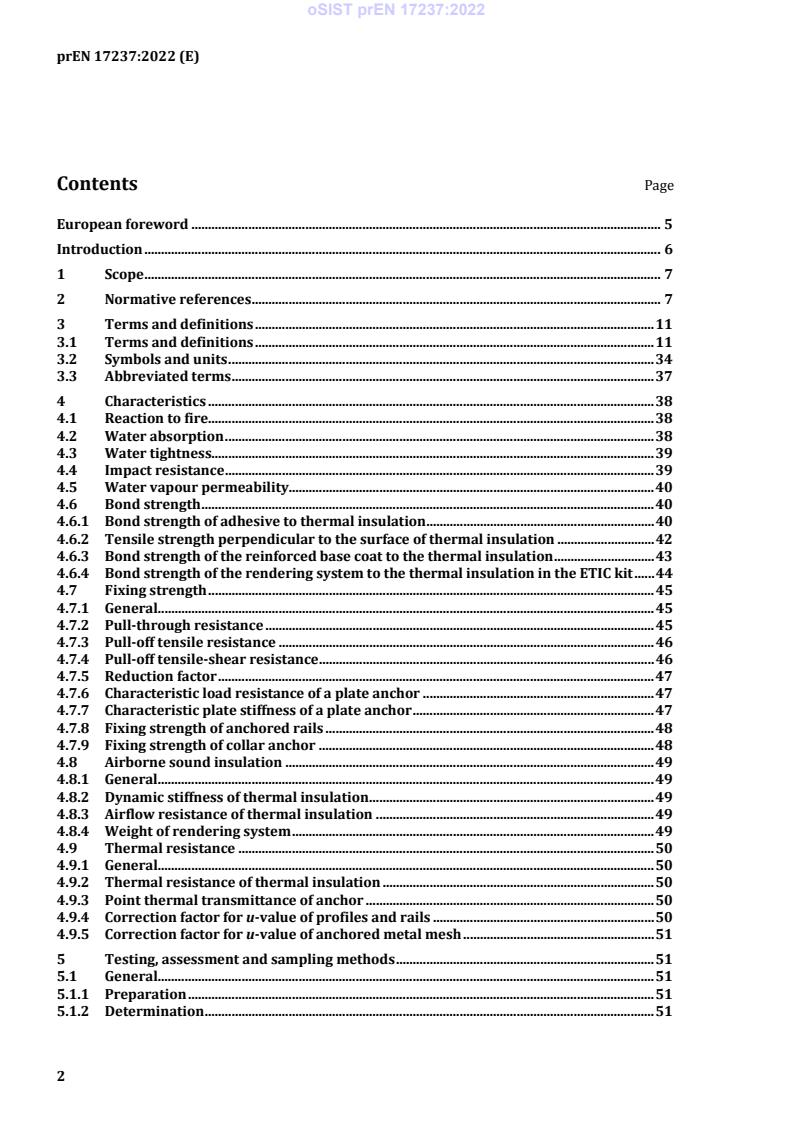
Contents Page
European foreword . 5
Introduction . 6
1 Scope . 7
2 Normative references . 7
3 Terms and definitions . 11
3.1 Terms and definitions . 11
3.2 Symbols and units . 34
3.3 Abbreviated terms . 37
4 Characteristics . 38
4.1 Reaction to fire. 38
4.2 Water absorption . 38
4.3 Water tightness. 39
4.4 Impact resistance . 39
4.5 Water vapour permeability. 40
4.6 Bond strength . 40
4.6.1 Bond strength of adhesive to thermal insulation . 40
4.6.2 Tensile strength perpendicular to the surface of thermal insulation . 42
4.6.3 Bond strength of the reinforced base coat to the thermal insulation . 43
4.6.4 Bond strength of the rendering system to the thermal insulation in the ETIC kit . 44
4.7 Fixing strength . 45
4.7.1 General. 45
4.7.2 Pull-through resistance . 45
4.7.3 Pull-off tensile resistance . 46
4.7.4 Pull-off tensile-shear resistance . 46
4.7.5 Reduction factor . 47
4.7.6 Characteristic load resistance of a plate anchor . 47
4.7.7 Characteristic plate stiffness of a plate anchor . 47
4.7.8 Fixing strength of anchored rails . 48
4.7.9 Fixing strength of collar anchor . 48
4.8 Airborne sound insulation . 49
4.8.1 General. 49
4.8.2 Dynamic stiffness of thermal insulation . 49
4.8.3 Airflow resistance of thermal insulation . 49
4.8.4 Weight of rendering system . 49
4.9 Thermal resistance . 50
4.9.1 General. 50
4.9.2 Thermal resistance of thermal insulation . 50
4.9.3 Point thermal transmittance of anchor . 50
4.9.4 Correction factor for u-value of profiles and rails . 50
4.9.5 Correction factor for u-value of anchored metal mesh . 51
5 Testing, assessment and sampling methods . 51
5.1 General. 51
5.1.1 Preparation . 51
5.1.2 Determination . 51
5.1.3 Reporting . 52
5.2 Reaction to fire . 52
5.2.1 Determination for the product . 52
5.2.2 Determination for the components . 60
5.3 Water absorption . 64
5.3.1 Preparation . 64
5.3.2 Determination . 64
5.3.3 Reporting . 66
5.3.4 DiAp . 66
5.4 Water tightness . 67
5.4.1 Preparation . 67
5.4.2 Determination . 67
5.4.3 Reporting . 68
5.4.4 DiAp . 68
5.5 Impact resistance . 72
5.5.1 Preparation . 72
5.5.2 Determination . 72
5.5.3 Reporting . 72
5.5.4 DiAp . 73
5.6 Water vapour permeability . 73
5.6.1 Determination for the components . 73
5.7 Bond strength. 76
5.7.1 Bond strength of adhesive to thermal insulation . 76
5.7.2 Tensile strength perpendicular to the surface of thermal insulation . 77
5.7.3 Bond strength of the reinforced base coat to the thermal insulation . 79
5.7.4 Bond strength of the rendering system to the thermal insulation in the ETIC kit . 80
5.8 Fixing strength . 81
5.8.1 Pull-through resistance . 81
5.8.2 Pull-off tensile resistance . 85
5.8.3 Pull-off tensile-shear resistance . 88
5.8.4 Reduction factor . 91
5.8.5 Characteristic load resistance of a plate anchor . 92
5.8.6 Characteristic plate stiffness of a plate anchor F . 92
5.8.7 Fixing strength of anchored rails . 93
5.8.8 Fixing strength of collar anchor . 94
5.9 Airborne sound insulation . 95
5.9.1 Dynamic stiffness of thermal insulation . 95
5.9.2 Airflow resistance of thermal insulation . 95
5.9.3 Weight of rendering system . 95
5.10 Thermal resistance . 96
5.10.1 Thermal resistance of thermal insulation . 96
5.10.2 Point thermal transmittance of anchor . 97
5.10.3 Correction factor for u-value of profiles and rails . 97
5.10.4 Correction factor for u-value of anchored metal mesh . 97
6 Assessment and verification of constancy of performance – AVCP . 98
6.1 General . 98
6.2 Assessment of performance . 98
6.2.1 General . 98
6.2.2 Test samples, testing and assessment criteria. 99
6.3 Verification of constancy of performance. 99
6.3.1 Factory production control (FPC) . 99
6.3.2 Initial inspection of factory and of FPC . 101
6.3.3 Continuous surveillance of FPC . 102
Annex A (normative) Parameters related to the basic components and to the fixing
methods of the ETIC kits with the methods of their verification and acceptance
criteria . 103
A.1 Adhesives . 103
A.2 Thermal insulation . 104
A.3 Mechanical fixing device . 106
A.4 Base coat . 108
A.5 Reinforcement . 108
A.6 Key coat . 109
A.7 Finishing coat . 109
A.8 Decorative coat . 109
A.9 Fixing method. 110
Annex B (normative) Calculation of PCS (formulae and example) . 115
ETIC kit
B.1 General. 115
B.2 Example . 115
Annex C (normative) Characteristic load resistance and characteristic plate stiffness of
plate anchors in the ETIC kit . 116
C.1 General. 116
C.2 Sampling, test specimen, conditioning and testing . 116
C.3 Calculation . 117
Annex D (normative) Point thermal transmittance of mechanical fixing devices in the ETIC
kit . 120
D.1 General. 120
D.2 Assessment of the point thermal transmittance . 120
D.3 Calculation . 121
Annex E (normative) Test plan and conformity tables. 124
Annex F (normative) Table for particle distribution . 148
Annex G (normative) Calculations for pull-off resistance . 150
G.1 General. 150
G.2 Test specimen showing plate anchors in middle area position only . 150
G.3 Test specimen showing plate anchors in different anchor setting positions . 151
G.4 Test specimen showing profiles and rails . 155
G.5 Test specimen showing anchored metal mesh . 155
Annex H (normative) Comparison of FPC results with reference values . 156
H.1 General. 156
Annex ZA (informative) Relationship of this European Standard with Regulation (EU)
No. 305/2011 . 166
Bibliography . 169
European foreword
This document (prEN 17237:2022) has been prepared by Technical Committee CEN/TC 88 “Thermal
insulating materials and products”, the secretariat of which is held by DIN.
This document is currently submitted to the CEN Enquiry.
This document has been prepared under a Standardization Request given to CEN by the European
Commission and the European Free Trade Association, and supports essential requirements of
EU Directive(s) / Regulation(s).
For relationship with EU Directive(s) / Regulation(s), see informative Annex ZA, which is an integral part
of this document.
The assessment methods take into account a working life of the ETIC kit for the intended use of 50 years,
if installed and maintained properly in the works.
Introduction
This document has been created by CEN/TC88/WG18, supported by many experts from across Europe.
As different stakeholders were involved, in particular regulators, testing institutes, manufacturers (=
system holders) and component suppliers, the current enquiry version considers many aspects of later
use. However, the communication and discussion between all stakeholders should go on during enquiry.
For that reason, the European Association for External Thermal Insulation Composite Systems (EAE)
volunteered to constantly support the dialogue. Currently an FAQ list, online trainings and discussions
are intended to support the enquiry. For latest information see https://www.ea-etics.eu.
1 Scope
This document specifies the characteristics for external thermal insulation composite kits with a
rendering system (ETIC kits) for external walls and/or external finishes of walls (including cladding).
In this document, ETIC kits are used on external walls, which are made either of masonry (bricks, blocks,
stones, etc.) or concrete (cast on site or as prefabricated panels).
With regard to the components, this document covers ETIC kits with:
a) adhesives, which are ready to use mortars, dry mixed mortars or PU adhesive foams, all specified in
A.1;
b) thermal insulations, which are made of one of the following materials: mineral wool (MW), expanded
polystyrene (EPS), extruded polystyrene foam (XPS), rigid polyurethane foam (PU), phenolic foam
(PF), cellular glass (CG), expanded cork (ICB) or wood fibre (WF), all specified in A.2;
c) mechanical fixing devices, which are plate anchors, spiral anchors, profiles and rails with collar
anchors or anchors for an anchored metal mesh, all specified in A.3;
d) base coats, which are ready to use or dry mixed, all specified in A.4;
e) reinforcements, which are glass fibre meshes or metal meshes, all specified in A.5;
f) key coats, all specified in A.6;
g) finishing coats, which are ready to use or dry mixed, all specified in A.7;
h) decorative coats, all specified in A.8.
This document covers ETIC kits, which are fixed to the substrate either with adhesive or mechanical fixing
devices or combination of both, clustered as the fixing methods (I to VIII), all defined in 3.1.3.1 to 3.1.3.8
and further specified in A.9.
This document specifies procedures for assessment and verification of constancy of performance (AVCP)
of the ETIC kit characteristics.
This document does not cover:
— ETIC kits with the components and the fixing methods a) other those indicated above and b) not
complying with the criteria for their parameters, further specified in Annex A;
— ETIC kits with other finishing layers than rendering systems, e.g. ceramic tiles, glass tiles, sand-lime-
bricks, ceramic brick slips, natural and artificial stones;
— External insulation and finishing systems (EIFS), according to ISO 17738.
2 Normative references
The following documents are referred to in the text in such a way that some or all of their content
constitutes requirements of this document. For dated references, only the edition cited applies. For
undated references, the latest edition of the referenced document (including any amendments) applies.
EN 755-2:2016, Aluminium and aluminium alloys - Extruded rod/bar, tube and profiles - Part 2: Mechanical
properties
EN 822:2013, Thermal insulating products for building applications - Determination of length and width
EN 823:2013, Thermal insulating products for building applications - Determination of thickness
EN 824:2013, Thermal insulating products for building applications - Determination of squareness
EN 825:2013, Thermal insulating products for building applications - Determination of flatness
EN 826:2013, Thermal insulating products for building applications - Determination of compression
behaviour
EN 998-1:2016, Specification for mortar for masonry - Part 1: Rendering and plastering mortar
EN 1015-1:1998 , Methods of test for mortar for masonry - Part 1: Determination of particle size
distribution (by sieve analysis)
EN 1015-6:1998 , Methods of test for mortar for masonry - Part 6: Determination of bulk density of fresh
mortar
EN 1015-18:2002, Methods of test for mortar for masonry - Part 18: Determination of water absorption
coefficient due to capillary action of hardened mortar
EN 1015-19:1998 , Methods of test for mortar for masonry - Part 19: Determination of water vapour
permeability of hardened rendering and plastering mortars
EN 1062-1:2004, Paints and varnishes - Coating materials and coating systems for exterior masonry and
concrete - Part 1: Classification
EN 1062-3:2008, Paints and varnishes - Coating materials and coating systems for exterior masonry and
concrete - Part 3: Determination of liquid water permeability
EN 1542:1999, Products and systems for the protection and repair of concrete structures - Test methods -
Measurement of bond strength by pull-off
EN 1602:2013, Thermal insulating products for building applications - Determination of the apparent
density
EN 1604:2013, Thermal insulating products for building applications - Determination of dimensional
stability under specified temperature and humidity conditions
EN 1607:2013, Thermal insulating products for building applications - Determination of tensile strength
perpendicular to faces
EN 10088-2:2014, Stainless steels - Part 2: Technical delivery conditions for sheet/plate and strip of
corrosion resisting steels for general purposes
EN 10204:2004, Metallic products - Types of inspection documents
EN 10244-1:2009, Steel wire and wire products - Non-ferrous metallic coatings on steel wire - Part 1:
General principles
EN 12090:2013, Thermal insulating products for building applications - Determination of shear behaviour
As impacted by EN 1015-1:1998/A1:2006.
As impacted by EN 1015-6:1998/A1:2006.
As impacted by EN 1015-19:1998/A1:2004.
EN 12127:1997, Textiles - Fabrics - Determination of mass per unit area using small samples
EN 12667:2001, Thermal performance of building materials and products - Determination of thermal
resistance by means of guarded hot plate and heat flow meter methods - Products of high and medium
thermal resistance
EN 12939:2000, Thermal performance of building materials and products - Determination of thermal
resistance by means of guarded hot plate and heat flow meter methods - Thick products of high and medium
thermal resistance
EN 13162:2012+A1:2015, Thermal insulation products for buildings - Factory made mineral wool (MW)
products - Specification
EN 13163:2012+A2:2016, Thermal insulation products for buildings - Factory made expanded polystyrene
(EPS) products - Specification
EN 13164:2012+A1:2015, Thermal insulation products for buildings - Factory made extruded polystyrene
foam (XPS) products - Specification
EN 13165:2012+A2:2016, Thermal insulation products for buildings - Factory made rigid polyurethane
foam (PU) products - Specification
EN 13166:2012+A2:2016, Thermal insulation products for buildings - Factory made phenolic foam (PF)
products - Specification
EN 13167:2012+A1:2015, Thermal insulation products for buildings - Factory made cellular glass (CG)
products - Specification
EN 13170:2012+A1:2015, Thermal insulation products for buildings - Factory made products of expanded
cork (ICB) - Specification
EN 13171:2012+A1:2015, Thermal insulation products for buildings - Factory made wood fibre (WF)
products - Specification
EN 13238:2010, Reaction to fire tests for building products - Conditioning procedures and general rules for
selection of substrates
EN 13494:2019, Thermal insulation products for building applications - Determination of the tensile bond
strength of the adhesive and of the base coat to the thermal insulation material
EN 13495:2019, Thermal insulation products for building applications - Determination of the pull-off
resistance of external thermal insulation composite systems (ETICS) (foam block test)
EN 13496:2013, Thermal insulation products for building applications - Determination of the mechanical
properties of glass fibre meshes as reinforcement for External Thermal Insulation Composite Systems with
renders (ETICS)
EN 13497:2018+A1:2021, Thermal insulation products for building applications - Determination of the
resistance to impact of external thermal insulation composite systems (ETICS)
EN 13501-1:2018, Fire classification of construction products and building elements - Part 1: Classification
using data from reaction to fire tests
EN 13820:2003, Thermal insulating materials for building applications - Determination of organic content
EN 13823:2020, Reaction to fire tests for building products - Building products excluding floorings exposed
to the thermal attack by a single burning item
EN 15715:2009, Thermal insulation products - Instructions for mounting and fixing for reaction to fire
testing - Factory made products
EN 15824:2017, Specifications for external renders and internal plasters based on organic binders
EN 16382:2016, Thermal insulation products for building applications - Determination of the pull-through
resistance of plate anchors through thermal insulation products
EN 16383:2016, Thermal insulation products for building applications - Determination of the hygrothermal
behaviour of external thermal insulation composite systems with renders (ETICS)
EN 16733:2016, Reaction to fire tests for building products - Determination of a building product's
propensity to undergo continuous smouldering
EN 17101:2018, Thermal insulation products for buildings - Methods of identification and test methods for
one-component PU adhesive foam for External Thermal Insulation Composite Systems (ETICS)
EN 29052-1:1992, Acoustics - Determination of dynamic stiffness - Part 1: Materials used under floating
floors in dwellings
EN ISO 180:2019, Plastics - Determination of Izod impact strength (ISO 180:2019)
EN ISO 307:2019, Plastics - Polyamides - Determination of viscosity number (ISO 307:2019)
EN ISO 898-1:2013, Mechanical properties of fasteners made of carbon steel and alloy steel - Part 1: Bolts,
screws and studs with specified property classes - Coarse thread and fine pitch thread (ISO 898-1:2013)
EN ISO 1133-1:2011, Plastics - Determination of the melt mass-flow rate (MFR) and melt volume-flow rate
(MVR) of thermoplastics - Part 1: Standard method (ISO 1133-1:2011)
EN ISO 1133-2:2011, Plastics - Determination of the melt mass-flow rate (MFR) and melt volume-flow rate
(MVR) of thermoplastics - Part 2: Method for materials sensitive to time-temperature history and/or
moisture (ISO 1133-2:2011)
EN ISO 21306-1:2019, Plastics - Unplasticized poly(vinyl chloride) (PVC-U) moulding and extrusion
materials - Part 1: Designation system and basis for specifications (ISO 21306-1:2019)
EN ISO 1182:2020, Reaction to fire tests for products - Non-combustibility test (ISO 1182:2020)
EN ISO 1183-1:2019, Plastics - Methods for determining the density of non-cellular plastics - Part 1:
Immersion method, liquid pycnometer method and titration method (ISO 1183-1:2019, Corrected version
2019-05)
EN ISO 1716:2018, Reaction to fire tests for products - Determination of the gross heat of combustion
(calorific value) (ISO 1716:2018)
EN ISO 2811-1:2016, Paints and varnishes - Determination of density - Part 1: Pycnometer method (ISO
2811-1:2016)
EN ISO 3251:2019, Paints, varnishes and plastics - Determination of non-volatile-matter content (ISO
3251:2019)
EN ISO 3451-1:2019, Plastics - Determination of ash - Part 1: General methods (ISO 3451-1:2019)
EN ISO 6946:2017, Building components and building elements - Thermal resistance and thermal
transmittance - Calculation methods (ISO 6946:2017)
EN ISO 7783:2018, Paints and varnishes - Determination of water-vapour transmission properties - Cup
method (ISO 7783:2018)
EN ISO 9053-1:2018, Acoustics - Determination of airflow resistance - Part 1: Static airflow method (ISO
9053-1:2018)
EN ISO 9229:2020, Thermal insulation - Vocabulary (ISO 9229:2020)
EN ISO 10211:2017, Thermal bridges in building construction - Heat flows and surface temperatures -
Detailed calculations (ISO 10211:2017)
EN ISO 10456:2007 , Building materials and products - Hygrothermal properties -Tabulated design values
and procedures for determining declared and design thermal values (ISO 10456:2007)
EN ISO 11357-3:2018, Plastics - Differential scanning calorimetry (DSC) - Part 3: Determination of
temperature and enthalpy of melting and crystallization (ISO 11357-3:2018)
EN ISO 11357-6:2018, Plastics - Differential scanning calorimetry (DSC) - Part 6: Determination of
oxidation induction time (isothermal OIT) and oxidation induction temperature (dynamic OIT) (ISO 11357-
6:2018)
EN ISO 11925-2:2020, Reaction to fire tests - Ignitability of products subjected to direct impingement of
flame - Part 2: Single-flame source test (ISO 11925-2:2020)
EN ISO 12572:2016, Hygrothermal performance of building materials and products - Determination of
water vapour transmission properties - Cup method (ISO 12572:2016)
EN ISO 16535:2019, Thermal insulating products for building applications - Determination of long-term
water absorption by immersion (ISO 16535:2019)
EN ISO 29767:2019, Thermal insulating products for building applications - Determination of short-term
water absorption by partial immersion (ISO 29767:2019)
ISO 527-1:2019, Plastics - Determination of tensile properties - Part 1: General principles
ISO 1887:2014, Textile glass - Determination of combustible-matter content
ISO 12491:1997, Statistical methods for quality control of building materials and components
3 Terms and definitions
3.1 Terms and definitions
For the purposes of this document, the terms and definitions given in EN ISO 9229:2020 and the following
apply.
As impacted by EN ISO 10456:2007/AC:2009.
ISO and IEC maintain terminological databases for use in standardization at the following addresses:
— IEC Electropedia: available at https://www.electropedia.org/
— ISO Online browsing platform: available at https://www.iso.org/obp
3.1.1 General
3.1.1.1
design External Thermal Insulation Composite System (design ETICS)
set of ETIC kits comprising the same base coat and thermal insulation of the same material
Note 1 to entry: A design ETICS is defined by the description of every ETIC kit comprised and usually marketed
under one trade name.
Note 2 to entry: Figure 1 shows an example and the relationship between an assembled ETIC kit and construction
works. Box 1 contains all components used for the whole set of ETIC kits of a design ETICS. The ETIC kit components
of one of these ETIC kits are outlined in grey. This specific ETIC kit is mechanically fixed on adhesive bed with plate
anchors, also illustrated in Figure 4. It comprises eight components. Box 2 indicates construction works, box 3 the
assembled ETIC kit with the use of additional ancillary products, box 4 the ETIC kit components, box 5 the
components of the rendering system of the ETIC kit, box 6 the components of the reinforced basecoat of the ETIC
kit and box 7 the components of the finishing layer of the ETIC kit.
Key
1 design ETICS (Box 1) A adhesives
2 construction works (Box 2) B thermal insulation of the same material
3 assembled ETIC kit with the use of additional C mechanical fixing devices
ancillary products (Box 3)
4 ETIC kit components, outlined in grey D base coat
5 rendering system of ETIC kit (Box 5) E reinforcements
6 reinforced base coat of ETIC kit (Box 6) G key coats
7 finishing layer of ETIC kit (Box 7) H finishing coats
I decorative coats
J ancillary products
K other construction products
Same characters indicate components of the same group. Different shades mean different components of
the same group.
Figure 1 — Relationship between an assembled ETIC kit and construction works
3.1.1.2
rendering system
reinforced base coat with finishing layer
3.1.1.3
reinforced base coat
base coat with embedded reinforcement
3.1.1.4
finishing layer
finishing coat with a key coat (optional) and/or a decorative coat (optional)
3.1.1.5
External Thermal Insulation Composite kit (ETIC kit)
product specified by the comprising components together with the following information:
— bonded area;
— adhesive coverage;
— thermal insulation thickness;
— anchor setting positions;
— anchor plate position perpendicular to substrate;
— anchor number per unit area;
— profiles and rails distances;
— number of fixing points per rail length;
— base coat coverage;
— key coat coverage;
— finishing coat coverage;
— decorative coat coverage;
— fixing method
Note 1 to entry: An ETIC kit is fixed to the substrate using adhesive, mechanical fixing or their combination so that
there is no air ventilation between the substrate and the thermal insulation layer. The continuous thermal insulation
layer is faced with a rendering system consisting of two or more layers, one of which contains a reinforcement. The
rendering system is applied directly to the thermal insulation boards, without any air gap or a disconnecting layer.
3.1.1.6
bonded area
percentage of the area of the substrate and thermal insulation simultaneously covered by the adhesive
3.1.1.7
coverage
consumption of a ready to use or wet dry mix component per unit area
3.1.1.8
anchor setting position
position of an anchor related to the borders of an insulation board
Key
1 middle area position examples
2 edge/corner position examples
3 joint position examples
4 panel borders
light grey joint area
r distance defining the middle area
min
c distance c determined according to EN 16382:2016
dark grey middle area
grey edge/corner area
NOTE The solid line circles represent plate or spiral anchors.
Figure 2— Anchor setting positions
3.1.1.8.1
middle area position
position of an anchor in the middle area of a thermal insulation board, defined by the distance of the
centre of an anchor sleeve to the closest edge of the insulation board ≥ than the minimum distance to the
border r
min
Note 1 to entry: See Figure 2.
3.1.1.8.2
edge/corner position
position of an anchor in the edge/corner area of a thermal insulation board, keeping a distance ≥ c and <
r to the border
min
Note 1 to entry: See Figure 2.
3.1.1.8.3
joint position
position of an anchor in the joint area of a thermal insulation board, keeping a distance < c to the border
or set in joints
Note 1 to entry: See Figure 2.
3.1.1.9
Superposition of anchors
arrangement of anchors below the minimum distance between anchor sleeves d , explained in Figure 3,
min
influencing the type of assessment of fixing strength
Key
1 minimum distance between anchor sleeves dmin not met, creates superposition
2 minimum distance between anchor sleeves d just met, creates no superposition
min
3 minimum distance between anchor sleeves d exceeded, creates no superposition
min
Figure 3 — Superposition of anchors
3.1.1.10
anchor plate position perpendicular to substrate
position of an anchor plate in the thickness direction of a thermal insulation board, in particular “above
the reinforcement”, “flush” or “countersunk”
Note 1 to entry: See Figure 4 to Figure 6.
3.1.1.10.1
plate anchor above reinforcement
plate anchors above reinforcement are set within the base coat, in the part just above reinforcement
Note 1 to entry: See Figure 4.
Key
1 substrate
2 adhesive
3 thermal insulation
4 plate anchor
5 base coat
6 reinforcement
7 finishing layer
Figure 4 — plate anchor above reinforcement
3.1.1.10.2
plate anchor flush
Plate anc
...