


EN 14035-5:2006
(Main)Fireworks - Part 5: Batteries and combinations - Specification and test methods
Fireworks - Part 5: Batteries and combinations - Specification and test methods
This European Standard specifies requirements for the construction, performance, primary packaging and labelling of batteries and combinations and the corresponding test methods. It is applicable to fireworks which are classified as batteries and combinations in categories 2 and 3 according to EN 14035-2.
It is applicable to category 2 batteries and combinations containing elements, each corresponding to a type of fireworks listed in EN 14035-2 and which conform to the relevant requirements of categories 1 and 2.
It is applicable to category 3 batteries and combinations containing elements, each corresponding to a type fireworks listed in EN 14035-2 and which conform to the relevant requirements of categories 1, 2 and 3.
It is not applicable to banger batteries and flash banger batteries, which are specified in EN 14035-4 and
EN 14035-12 respectively.
NOTE 1 The elements (types of firework) that can be included in a battery or combination are specified in Clause 4.
It is not applicable to batteries and combinations containing pyrotechnic composition that includes any of the following substances:
- arsenic or arsenic compounds;
- mixtures containing a mass fraction of chlorates greater than 80 %;
- mixtures of chlorates with metals;
- mixtures of chlorates with red phosphorus;
- mixtures of chlorates with potassium hexacyanoferrate(II);
- mixtures of chlorates with sulfur;
- mixtures of chlorates with sulfides;
- lead or lead compounds;
- mercury compounds;
- white phosphorus;
- picrates or picric acid;
- potassium chlorate with a mass fraction of bromates greater than 0,15 %;
- sulfur with an acidity, expressed as mass fraction of sulfuric acid, greater than 0,002 %;
- zirconium with a particle size of less than 40 mm.
NOTE 2 In EN 14035-2, batteries and combinations are classified as follows:
- brief description:
- battery: assembly including several elements, each of the same type and corresponding to one of the types of firework listed in
Feuerwerkskörper - Teil 5: Batterien und Kombinationen - Anforderungen und Prüfverfahren
Diese Europäische Norm legt Anforderungen an die Konstruktion, Funktion, kleinste Verpackungseinheit und Beschriftung von Batterien und Kombinationen und die entsprechenden Prüfverfahren fest. Sie gilt für Feuerwerkskörper, die als Batterie und Kombination in die Kategorien 2 und 3 in der EN 14035-2 eingruppiert sind.
Sie gilt für Batterien und Kombinationen der Kategorie 2 die Feuerwerkskörper der Typen enthalten die in
EN 14035-2 aufgeführt sind und die Bedingungen der Kategorien 1 und 2 erfüllen.
Sie gilt für Batterien und Kombinationen der Kategorie 3 die Feuerwerkskörper der Typen enthalten die in
EN 14035-2 aufgeführt sind und die Bedingungen der Kategorien 1, 2 und 3 erfüllen.
Sie gilt nicht für Knallkörperbatterien und Blitzknallkörperbatterien, die in EN 14035-4 beziehungsweise
EN 14035-12 aufgeführt sind.
ANMERKUNG Die Bauteile (Typen von Feuerwerkskörper) die in eine Batterie oder Kombination enthalten sein können, sind in Abschnitt 4 aufgeführt.
Sie gilt nicht für Batterien und Kombinationen, die pyrotechnischen Satz enthalten, in dem eine der nachfolgend aufgeführten Substanzen enthalten ist:
- Arsen und Arsenverbindungen,
- Blei und Bleiverbindungen,
- Kaliumchlorat mit einem Massenanteil an Bromaten von mehr als 0,15 %,
- Mischungen mit einem Massenanteil an Chloraten von mehr als 80 %,
- Mischungen von Chloraten mit Metallen,
- Mischungen von Chloraten mit rotem Phosphor,
- Mischungen von Chloraten mit Kaliumhexacyanoferrat(II),
- Mischungen von Chloraten mit Schwefel,
- Mischungen von Chloraten mit Sulfiden,
- Pikrate und Pikrinsäure,
- Quecksilberverbindungen,
- weißer Phosphor,
- Schwefel mit einem Massenanteil an freier Säure (angegeben als H2SO4) von mehr als 0,002 %,
- Zirkon mit einer Korngröße von weniger als 40 µm.
ANMERKUNG In EN 14035-2 sind Batterien und Kombinationen wie folgt klassifiziert:
- Kurzbeschreibung:
Artifices de divertissement - Partie 5: Batteries et combinaisons - Spécifications et méthodes d'essai
La présente Norme européenne spécifie les exigences de construction, performances, emballage primaire et étiquetage des batteries et combinaisons, ainsi que les méthodes d'essai correspondantes. Elle s’applique aux artifices de divertissement classés sous le nom de batteries et combinaisons de catégories 2 et 3 dans l'EN 14035-2.
Elle s’applique aux batteries et combinaisons de catégorie 2 comportant plusieurs produits, chacun correspondant à un type d’artifice de divertissement cité dans l'EN 14035-2 et satisfaisant aux exigences applicables relatives aux catégories 1 et 2.
Elle s’applique aux batteries et combinaisons de catégorie 3 comportant plusieurs produits, chacun correspondant à un type d’artifice de divertissement cité dans l'EN 14035-2 et satisfaisant aux exigences applicables relatives aux catégories 1, 2 et 3.
Elle ne s’applique pas aux pétards à mèche en batterie ni aux pétards à composition flash en batterie, qui sont respectivement spécifiés dans l’EN 14035-4 et l’EN 14035-12.
NOTE 1 Les produits (types d’artifices de divertissement) pouvant être inclus dans une batterie ou une combinaison sont spécifiés à l’Article 4.
Elle ne s’applique pas aux batteries et combinaisons dont la composition pyrotechnique comprend l’une des substances suivantes :
- arsenic ou composés d'arsenic ;
- mélanges contenant une fraction en masse de chlorates supérieure à 80 % ;
- mélanges de chlorates et de métaux ;
- mélanges de chlorates et de phosphore rouge ;
- mélanges de chlorates et d'hexacyanoferrate (II) de potassium ;
- mélanges de chlorates et de soufre ;
- mélanges de chlorates et de sulfures ;
- plomb ou composés de plomb ;
- composés de mercure ;
- phosphore blanc ;
- picrates ou acide picrique ;
- chlorate de potassium contenant une fraction en masse de bromates supérieure à 0,15 % ;
- soufre présentant une acidité, exprimée en fraction de masse d’acide sulfurique, supérieure à 0,002 % ;
- zirconium ayant une taille de particule inférieure
Ognjemet - 5. del: Baterije in sestave - Specifikacija in preskusne metode
General Information
- Status
- Withdrawn
- Publication Date
- 21-Feb-2006
- Withdrawal Date
- 28-Sep-2010
- Technical Committee
- CEN/TC 212 - Fireworks
- Drafting Committee
- CEN/TC 212 - Fireworks
- Current Stage
- 9960 - Withdrawal effective - Withdrawal
- Start Date
- 29-Sep-2010
- Completion Date
- 29-Sep-2010
Relations
- Replaced By
EN 15947-4:2010 - Pyrotechnic articles - Fireworks, Categories 1, 2 and 3 - Part 4: Test methods - Effective Date
- 08-Jun-2022
- Effective Date
- 08-Jun-2022
- Effective Date
- 08-Jun-2022

Get Certified
Connect with accredited certification bodies for this standard

Eurofins Food Testing Global
Global leader in food, environment, and pharmaceutical product testing.

Intertek Bangladesh
Intertek certification and testing services in Bangladesh.
Intertek Textile Testing
Global textile testing and certification.
Sponsored listings
Frequently Asked Questions
EN 14035-5:2006 is a standard published by the European Committee for Standardization (CEN). Its full title is "Fireworks - Part 5: Batteries and combinations - Specification and test methods". This standard covers: This European Standard specifies requirements for the construction, performance, primary packaging and labelling of batteries and combinations and the corresponding test methods. It is applicable to fireworks which are classified as batteries and combinations in categories 2 and 3 according to EN 14035-2. It is applicable to category 2 batteries and combinations containing elements, each corresponding to a type of fireworks listed in EN 14035-2 and which conform to the relevant requirements of categories 1 and 2. It is applicable to category 3 batteries and combinations containing elements, each corresponding to a type fireworks listed in EN 14035-2 and which conform to the relevant requirements of categories 1, 2 and 3. It is not applicable to banger batteries and flash banger batteries, which are specified in EN 14035-4 and EN 14035-12 respectively. NOTE 1 The elements (types of firework) that can be included in a battery or combination are specified in Clause 4. It is not applicable to batteries and combinations containing pyrotechnic composition that includes any of the following substances: - arsenic or arsenic compounds; - mixtures containing a mass fraction of chlorates greater than 80 %; - mixtures of chlorates with metals; - mixtures of chlorates with red phosphorus; - mixtures of chlorates with potassium hexacyanoferrate(II); - mixtures of chlorates with sulfur; - mixtures of chlorates with sulfides; - lead or lead compounds; - mercury compounds; - white phosphorus; - picrates or picric acid; - potassium chlorate with a mass fraction of bromates greater than 0,15 %; - sulfur with an acidity, expressed as mass fraction of sulfuric acid, greater than 0,002 %; - zirconium with a particle size of less than 40 mm. NOTE 2 In EN 14035-2, batteries and combinations are classified as follows: - brief description: - battery: assembly including several elements, each of the same type and corresponding to one of the types of firework listed in
This European Standard specifies requirements for the construction, performance, primary packaging and labelling of batteries and combinations and the corresponding test methods. It is applicable to fireworks which are classified as batteries and combinations in categories 2 and 3 according to EN 14035-2. It is applicable to category 2 batteries and combinations containing elements, each corresponding to a type of fireworks listed in EN 14035-2 and which conform to the relevant requirements of categories 1 and 2. It is applicable to category 3 batteries and combinations containing elements, each corresponding to a type fireworks listed in EN 14035-2 and which conform to the relevant requirements of categories 1, 2 and 3. It is not applicable to banger batteries and flash banger batteries, which are specified in EN 14035-4 and EN 14035-12 respectively. NOTE 1 The elements (types of firework) that can be included in a battery or combination are specified in Clause 4. It is not applicable to batteries and combinations containing pyrotechnic composition that includes any of the following substances: - arsenic or arsenic compounds; - mixtures containing a mass fraction of chlorates greater than 80 %; - mixtures of chlorates with metals; - mixtures of chlorates with red phosphorus; - mixtures of chlorates with potassium hexacyanoferrate(II); - mixtures of chlorates with sulfur; - mixtures of chlorates with sulfides; - lead or lead compounds; - mercury compounds; - white phosphorus; - picrates or picric acid; - potassium chlorate with a mass fraction of bromates greater than 0,15 %; - sulfur with an acidity, expressed as mass fraction of sulfuric acid, greater than 0,002 %; - zirconium with a particle size of less than 40 mm. NOTE 2 In EN 14035-2, batteries and combinations are classified as follows: - brief description: - battery: assembly including several elements, each of the same type and corresponding to one of the types of firework listed in
EN 14035-5:2006 is classified under the following ICS (International Classification for Standards) categories: 71.100.30 - Explosives. Pyrotechnics and fireworks. The ICS classification helps identify the subject area and facilitates finding related standards.
EN 14035-5:2006 has the following relationships with other standards: It is inter standard links to EN 15947-4:2010, EN 15947-5:2010, EN 15947-3:2010. Understanding these relationships helps ensure you are using the most current and applicable version of the standard.
EN 14035-5:2006 is available in PDF format for immediate download after purchase. The document can be added to your cart and obtained through the secure checkout process. Digital delivery ensures instant access to the complete standard document.
Standards Content (Sample)
2003-01.Slovenski inštitut za standardizacijo. Razmnoževanje celote ali delov tega standarda ni dovoljeno.Fireworks - Part 5: Batteries and combinations - Specification and test methodsOgnjemet - 5. del: Baterije in sestave - Specifikacija in preskusne metodeArtifices de divertissement - Partie 5: Batteries et combinaisons - Spécifications et méthodes d'essaiFeuerwerkskörper - Teil 5: Batterien und Kombinationen - Anforderungen und PrüfverfahrenTa slovenski standard je istoveten z:EN 14035-5:2006SIST EN 14035-5:2006en,fr,de71.100.30ICS:SLOVENSKI
STANDARDSIST EN 14035-5:200601-maj-2006
EUROPEAN STANDARDNORME EUROPÉENNEEUROPÄISCHE NORMEN 14035-5February 2006ICS 71.100.30 English VersionFireworks - Part 5: Batteries and combinations - Specificationand test methodsArtifices de divertissement - Partie 5: Batteries etcombinaisons - Spécifications et méthodes d'essaiFeuerwerkskörper - Teil 5: Batterien und Kombinationen -Anforderungen und PrüfverfahrenThis European Standard was approved by CEN on 30 December 2005.CEN members are bound to comply with the CEN/CENELEC Internal Regulations which stipulate the conditions for giving this EuropeanStandard the status of a national standard without any alteration. Up-to-date lists and bibliographical references concerning such nationalstandards may be obtained on application to the Central Secretariat or to any CEN member.This European Standard exists in three official versions (English, French, German). A version in any other language made by translationunder the responsibility of a CEN member into its own language and notified to the Central Secretariat has the same status as the officialversions.CEN members are the national standards bodies of Austria, Belgium, Cyprus, Czech Republic, Denmark, Estonia, Finland, France,Germany, Greece, Hungary, Iceland, Ireland, Italy, Latvia, Lithuania, Luxembourg, Malta, Netherlands, Norway, Poland, Portugal, Romania,Slovakia, Slovenia, Spain, Sweden, Switzerland and United Kingdom.EUROPEAN COMMITTEE FOR STANDARDIZATIONCOMITÉ EUROPÉEN DE NORMALISATIONEUROPÄISCHES KOMITEE FÜR NORMUNGManagement Centre: rue de Stassart, 36
B-1050 Brussels© 2006 CENAll rights of exploitation in any form and by any means reservedworldwide for CEN national Members.Ref. No. EN 14035-5:2006: E
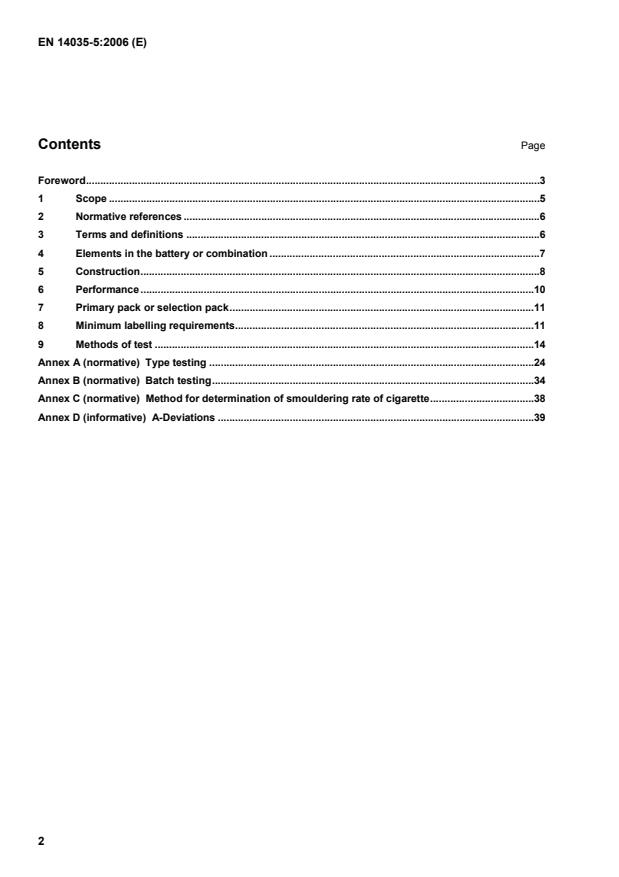
Type testing.24 Annex B (normative)
Batch testing.34 Annex C (normative)
Method for determination of smouldering rate of cigarette.38 Annex D (informative)
A-Deviations.39
EN 14035-12 respectively. NOTE 1 The elements (types of firework) that can be included in a battery or combination are specified in Clause 4. It is not applicable to batteries and combinations containing pyrotechnic composition that includes any of the following substances: — arsenic or arsenic compounds; — mixtures containing a mass fraction of chlorates greater than 80 %; — mixtures of chlorates with metals; — mixtures of chlorates with red phosphorus; — mixtures of chlorates with potassium hexacyanoferrate(II); — mixtures of chlorates with sulfur; — mixtures of chlorates with sulfides; — lead or lead compounds; — mercury compounds; — white phosphorus; — picrates or picric acid; — potassium chlorate with a mass fraction of bromates greater than 0,15 %; — sulfur with an acidity, expressed as mass fraction of sulfuric acid, greater than 0,002 %; — zirconium with a particle size of less than 40 µm.
NOTE 2 In EN 14035-2, batteries and combinations are classified as follows: — brief description: — battery: assembly including several elements, each of the same type and corresponding to one of the types of firework listed in EN 14035-2, with one point of ignition; — combination: assembly including several elements, not all of the same type, each corresponding to one of the types of firework listed in EN 14035-2, with one point of ignition; — principal effects: as for the individual elements. Schemes for type testing of batteries and combinations and batch testing of batteries and combinations are specified in Annex A and Annex B respectively. 2 Normative references The following referenced documents are indispensable for the application of this European Standard. For dated references, only the edition cited applies. For undated references, the latest edition of the referenced document (including any amendments) applies. EN 14035-1:2003, Fireworks — Part 1: Terminology EN 14035-2, Fireworks — Part 2: Categorisation EN 61672-1, Electroacoustics — Sound level meters — Part 1: Specifications (IEC 61672-1:2002) EN 61672-2, Electroacoustics — Sound level meters — Part 2: Pattern evaluation tests (IEC 61672-2:2003) EN ISO 845, Cellular plastics and rubbers — Determination of apparent (bulk) density (ISO 845:1988) EN ISO 868, Plastics and ebonite — Determination of indentation hardness by means of a durometer (Shore hardness) (ISO 868:2003) EN ISO 2439, Flexible cellular polymeric materials — Determination of hardness (indentation technique) (ISO 2439:1997 including Technical Corrigendum 1:1998) ISO 2859-1, Sampling procedures for inspection by attributes — Part 1: Sampling schemes indexed by acceptance quality limit (AQL) for lot-by-lot inspection 3 Terms and definitions For the purposes of this European Standard, the terms and definitions given in EN 14035-1:2003 apply.
EN 14035-2): — Bengal flames; — crackling granules; — fountains; — ground spinners; — mines; — rockets, assembled in a launcher; — Roman candles; — spinners; — shell-in-mortars; — shot tubes; — wheels. Conformity to this requirement shall be verified by visual examination. 4.2 Combination A combination shall comprise elements corresponding to two or more of the following types of firework (as classified in EN 14035-2): — bangers; — Bengal flames; — fountains; — mines; — Roman candles; — shell-in-mortars; —shot tubes; — wheels. Conformity to this requirement shall be verified by visual examination.
EN 14035. Conformity to these requirements shall be verified by visual examination. 5.1.4.2 Pyrotechnic units The materials of the pyrotechnic units shall conform to the requirements, if any, given in the relevant parts of EN 14035. Conformity to these requirements shall be verified by visual examination.
A-weighted impulse sound pressure level (LAImax) of not higher than 120 dB(AI) at a horizontal distance of
8,0 m from the testing point and at a height of 1,0 m above the ground. When tested in accordance with 9.3, a category 3 battery or combination shall produce a maximum
A-weighted impulse sound pressure level (LAImax) of not higher than 120 dB(AI) at a horizontal distance of
15,0 m from the testing point and at a height of 1,0 m above the ground.
1) If applicable.
— ‘For outdoor use only‘; — 'Avoid overhead obstructions’; — ‘Remove orange fuse cover‘1); Specific placing instructions for different types of battery or combination, inserted as appropriate (see 8.3.4); — ‘Standing sideways, light fuse at its outermost end and retire immediately‘; — ‘Spectators must be at least 25 m away‘; — 'Operator must retire at least 15 m’. 8.3.4 Placing instructions For batteries and combinations to be placed on flat ground: — ‘Place battery on flat ground‘2); or — ‘Place combination on flat ground‘2). For batteries and combinations to be buried into soft ground or material: — ‘Insert battery upright in soft ground or other non-flammable material, e.g. sand‘2); or — ‘Insert combination upright in soft ground or other non-flammable material, e.g. sand‘2). For batteries and combinations to be fixed to a post: — ‘Fix battery firmly and upright to a solid post‘; — ‘Ensure top of battery clears post‘2); or — ‘Fix combination firmly and upright to a solid post‘2); — ‘Ensure top of combination clears post‘2). 8.4 Name, address and telephone number of manufacturer or distributor or importer Labelling shall include: — name or trade mark, the address and the telephone number of the manufacturer; or — abbreviation or code allowing the identification of the manufacturer, and the name or trade mark, the address and the telephone number: — of his authorized distributor, or — if the manufacturer is not established in a CEN member country, of the importer in a CEN member country.
2) Whichever is appropriate.
— an additional code or abbreviation for the manufacturer shall be marked. 8.5 Reference to this European Standard A battery or combination shall be marked with 'EN 14035-5'. A primary pack shall be marked with the words 'Contents conform to EN 14035-5'. 8.6 Printing 8.6.1 Labelling Labelling shall be clearly visible, easily legible, indelible and on a single-colour background. NOTE Printing errors which are not misleading should not be classified as faults. 8.6.2 Type size When measured in accordance with 9.6, the type sizes shall be such that the height of the character ‘X’ (in upper case) is at least 2,8 mm for the information specified in 8.2, 8.3 and 8.7 and at least 2,1 mm for the other information. 8.7 Additional information on the primary pack (if applicable) If the battery or the combination is not labelled completely with the information specified in 8.2 to 8.5, or if the primary pack acts as protection of the initial fuses according to 5.1.3.3, the battery or the combination shall only be sold in a primary pack. The primary pack shall be marked with the statement 'Must be sold as packaged'. This statement shall appear adjacent to the type name or category. For the printing 8.6 applies. 9 Methods of test NOTE Verification of conformity to the requirements in Clause 4, 5.1.1, 5.1.3.2 or 5.1.3.3, 5.1.4, 5.1.5, Clause 7, 8.1 to 8.5, 8.6.1 and 8.7 is by visual examination. 9.1 Attachment of protruding fuse (type test and batch test) 9.1.1 Apparatus 9.1.1.1 Means of clamping the battery or combination.
Where y is the distance, in m, from the viewing point to the testing point (see Figure 2).
Key 1 acrylic glass 2 black tape, 10 mm to 20 mm wide 3 solid base 4 stand Figure 1 – Viewing screen
Key 1 top of battery or combination 2 sighting device 3 position of observer Figure 2 – Use of a viewing screen to monitor a height of 20 m 9.3.3.6 Means for monitoring the height of fallout, capable of indicating vertical heights of 5 m and 10 m. NOTE A vertical height of 5 m can be indicated by 5 m poles around the edge of the test area and the 10 m height can be estimated using the same poles. 9.3.3.7 Measuring device, capable of measuring a height of 1,0 m to the nearest 10 mm. 9.3.3.8 Laboratory balance, capable of weighing to the nearest 0,1 g. 9.3.4 Procedure 9.3.4.1 Measure and record the wind speed (see 9.3.2.3). 9.3.4.2 If making sound pressure level measurements (see 9.3.1), set up the microphone of the sound level meter (9.3.3.4) in the test area (9.3.2.1 or 9.3.2.2), at a height of 1,0 m above the ground, determined by the measuring device (9.3.3.7), and at a horizontal distance from the testing point of 8,0 m for category 2 batteries or combinations or 15,0 m for category 3 batteries and combinations. Direct the microphone horizontally towards the testing point and, if necessary, connect it to the sound level meter. 9.3.4.3 Place the battery or combination, in accordance with the instructions on the label with the initial fuse in the centre of the test area and, if appropriate, the battery or combination fully extended across the centre of the test area. Remove the orange fuse cover, if any, and straighten the initial fuse, if necessary. Apply the ignition source (9.3.3.3) and at the same instant, start the timing device (9.3.3.1). Observe the intermediate time at the moment the initial fuse ignites. If the initial fuse fails to ignite within 10 s do not proceed with further testing of that battery or combination. Otherwise, stop the timing device when the battery or combination starts to produce its first principal effect. Record whether the initial fuse ignited within 10 s and whether the ignition of the initial fuse was visible.
Key 1 test specimen 2 cigarette 3 wire support 4 non-flammable surface a) Test assembly
Dimensions in millimetres
b) Dimensions Figure 3 — Side ignition test
Figure 4 — Type sizes of print
Type testing A.1 General For the purposes of type testing each of the batteries or combinations tested, except those used for the determination of net explosive content, shall meet one of the following sets of requirements. a) If the battery or combination has an initial fuse which is not designed to resist side ignition, it shall conform to Clause 4, 5.1.1, 5.1.2, 5.1.3.2 or 5.1.3.3, 5.1.4, 5.1.5, 5.1.6 and Clauses 6 and 8. b) If the battery or combination has an initial fuse designed to resist side ignition, it shall conform to Clause 4, 5.1.1, 5.1.2, 5.1.3.4, 5.1.4, 5.1.5, 5.1.6 and Clauses 6 and 8. The batteries or combinations used for the determination of net explosive content shall each conform to 5.1.6 and, if the initial fuse is designed to resist side ignition, it shall conform to 5.1.3.4. The batteries or combinations subjected to mechanical conditioning in accordance with A.5 shall, additionally, conform to A.3. For batteries or combinations which are supplied in primary packs, in order to protect the initial fuses of the batteries or combinations (see 5.1.3.3), each of the packs examined shall conform to Clauses 7 and 8 and 9.6. A.2 Number of batteries or combinations to be tested A total of 33 batteries or combinations shall be tested, in accordance with Table A.1. If the batteries or combinations are supplied in primary packs they shall be selected at random from at least 5 packs.
30 mm, which are welded to the underside and run from the centre to each of the four corners and to the middle of each edge; b) a 20 mm thick plate of fibreboard, firmly attached to the platform by screws; c) a cylindrical steel boss, diameter 125 mm and height 35 mm, located under the centre of the platform; d) a 284 mm long shaft, with diameter of 20 mm, fixed to the centre of the boss; e) a restraining peg, to prevent the platform from rotating; the mass of the platform assembly (items a) to e)) shall be (23 ± 1) kg; f) an annular, elastomeric pressure spring, with a Shore A hardness, when determined in accordance with
EN ISO 868, of 68, outside diameter 125 mm, inside diameter 27 mm and height 32 mm, on which the cylindrical boss will rest; g) a shallow steel cylinder, inside diameter 126 mm, wall thickness 5 mm, outside height 30 mm, with a base 8 mm thick which has a 25 mm diameter hole drilled through the centre, to contain the elastomeric spring; h) a supporting steel cylinder, outside diameter 80 mm, inside diameter 60,1 mm and height 92,4 mm, to which the shallow cylinder is screwed; i) a PVC liner, outside diameter 60 mm, inside diameter 20,2 mm and height 92,4 mm, located inside the supporting cylinder and attached by a screw; j) a steel mounting plate, thickness 12 mm, with a 25 mm hole drilled through the centre, to which the supporting steel cylinder is screwed; k) a steel base plate, thickness 12 mm; l) four supporting pillars, height 260 mm and diameter 32 mm, screwed to the mounting plate and to the base plate; m) a framework to support the base plate so that the complete assembly is at a convenient working height; n) an attachment to the shaft, allowing adjustment to the overall length, fitted with a cam wheel, outside diameter 30,0 mm, with a contact surface 8,0 mm wide; o) a cylindrical cam, outside diameter 120 mm, inside diameter 100 mm, wall thickness 10 mm, with a 'vertical drop' of 50,0 mm between the high point and the low point; p) a collar, outside diameter 50 mm, height 4,0 mm; q) an electric motor and suitable gearing, to rotate the cam at a rotational frequency of 1 r/s.
Key 1 restraining peg 2 platform 3 boss 4 pressure spring 5 cup 6 supporting cylinder 7 PVC liner 8 mounting plate 9 shaft 10 supporting pillar Figure A.1 — Detail of top section of mechanical shock apparatus
Key 1 mounting plate 2 supporting pillar 3 base plate Figure A.2 — General assembly of mechanical shock apparatus
Key 1 cam 2 collar 3 cam wheel Figure A.3 — Detail of shaft attachment and cam assembly of mechanical shock apparatus
...
Questions, Comments and Discussion
Ask us and Technical Secretary will try to provide an answer. You can facilitate discussion about the standard in here.
Loading comments...