

EN 15434:2006
(Main)Glass in building - Product standard for structural and/or ultra-violet resistant sealant (for use with structural sealant glazing and/or insulating glass units with exposed seals)
- Abstract
This European Standard covers the evaluation of conformity and the factory production control of sealant for the intrinsic capabilities when intended to apply for:
¾ insulating glass units to assemble there where ultra-violet resistance and/or mechanical resistance (structural use) of the insulating glass edge seal is required:
¾ required level of resistance to UV exposure will depend on the degree of exposure to UV radiation with or without protection;
¾ when the outer seal of the insulating glass has a structural function and/or is exposed to the UV radiation without any protection, only silicone based sealants are permitted;
¾ when the outer seal of the insulating glass has no structural function and is protected from direct exposure to UV radiation, organic and silicone based sealants are permitted;
¾ manufacturing of factory made structural sealant glazing elements when referred to by the relevant European Standards and ETAGs.
Only silicone based sealants are permitted;
¾ assembling of glass products into or onto supports, where also ultra-violet resistance and/or mechanical resistance (structural use) of the seal is required under controlled environmental conditions as described in Clause 5 of EN 13022–2:2006.
Only silicone based sealants are permitted.
This European Standard also specifies requirements concerning seals and bonds of sealant in conformity with this European Standard.
¾ When bonding of sealant to a non-glass substrate is tested, the substrate, which means the material, its treatment and its preparations for bonding, as applied or to be applied on the work is used in testing (coating of coated glass is considered as a non-glass substrate).
This European Standard contains other aspects of importance of trade.
- Status
- Withdrawn
- Publication Date
- 09-May-2006
- Withdrawal Date
- 23-Mar-2010
- Technical Committee
- CEN/TC 129 - Glass in building
- Drafting Committee
- CEN/TC 129/WG 16 - Structural glazing
- Current Stage
- 9960 - Withdrawal effective - Withdrawal
- Start Date
- 24-Mar-2010
- Completion Date
- 24-Mar-2010

Relations
- Effective Date
- 18-Jan-2023
- Referred By
EN 13022-2:2006+A1:2010 - Glass in building - Structural sealant glazing - Part 2: Assembly rules - Effective Date
- 28-Jan-2026
- Effective Date
- 28-Jan-2026
- Effective Date
- 11-Jul-2009
Frequently Asked Questions
EN 15434:2006 is a standard published by the European Committee for Standardization (CEN). Its full title is "Glass in building - Product standard for structural and/or ultra-violet resistant sealant (for use with structural sealant glazing and/or insulating glass units with exposed seals)". This standard covers: This European Standard covers the evaluation of conformity and the factory production control of sealant for the intrinsic capabilities when intended to apply for: ¾ insulating glass units to assemble there where ultra-violet resistance and/or mechanical resistance (structural use) of the insulating glass edge seal is required: ¾ required level of resistance to UV exposure will depend on the degree of exposure to UV radiation with or without protection; ¾ when the outer seal of the insulating glass has a structural function and/or is exposed to the UV radiation without any protection, only silicone based sealants are permitted; ¾ when the outer seal of the insulating glass has no structural function and is protected from direct exposure to UV radiation, organic and silicone based sealants are permitted; ¾ manufacturing of factory made structural sealant glazing elements when referred to by the relevant European Standards and ETAGs. Only silicone based sealants are permitted; ¾ assembling of glass products into or onto supports, where also ultra-violet resistance and/or mechanical resistance (structural use) of the seal is required under controlled environmental conditions as described in Clause 5 of EN 13022–2:2006. Only silicone based sealants are permitted. This European Standard also specifies requirements concerning seals and bonds of sealant in conformity with this European Standard. ¾ When bonding of sealant to a non-glass substrate is tested, the substrate, which means the material, its treatment and its preparations for bonding, as applied or to be applied on the work is used in testing (coating of coated glass is considered as a non-glass substrate). This European Standard contains other aspects of importance of trade.
This European Standard covers the evaluation of conformity and the factory production control of sealant for the intrinsic capabilities when intended to apply for: ¾ insulating glass units to assemble there where ultra-violet resistance and/or mechanical resistance (structural use) of the insulating glass edge seal is required: ¾ required level of resistance to UV exposure will depend on the degree of exposure to UV radiation with or without protection; ¾ when the outer seal of the insulating glass has a structural function and/or is exposed to the UV radiation without any protection, only silicone based sealants are permitted; ¾ when the outer seal of the insulating glass has no structural function and is protected from direct exposure to UV radiation, organic and silicone based sealants are permitted; ¾ manufacturing of factory made structural sealant glazing elements when referred to by the relevant European Standards and ETAGs. Only silicone based sealants are permitted; ¾ assembling of glass products into or onto supports, where also ultra-violet resistance and/or mechanical resistance (structural use) of the seal is required under controlled environmental conditions as described in Clause 5 of EN 13022–2:2006. Only silicone based sealants are permitted. This European Standard also specifies requirements concerning seals and bonds of sealant in conformity with this European Standard. ¾ When bonding of sealant to a non-glass substrate is tested, the substrate, which means the material, its treatment and its preparations for bonding, as applied or to be applied on the work is used in testing (coating of coated glass is considered as a non-glass substrate). This European Standard contains other aspects of importance of trade.
EN 15434:2006 is classified under the following ICS (International Classification for Standards) categories: 81.040.20 - Glass in building. The ICS classification helps identify the subject area and facilitates finding related standards.
EN 15434:2006 has the following relationships with other standards: It is inter standard links to EN 15434:2006+A1:2010, EN 13022-2:2006+A1:2010, EN 13022-1:2006+A1:2010, EN 15434:2006/FprA1. Understanding these relationships helps ensure you are using the most current and applicable version of the standard.
EN 15434:2006 is associated with the following European legislation: EU Directives/Regulations: 305/2011, 89/106/EEC. When a standard is cited in the Official Journal of the European Union, products manufactured in conformity with it benefit from a presumption of conformity with the essential requirements of the corresponding EU directive or regulation.
EN 15434:2006 is available in PDF format for immediate download after purchase. The document can be added to your cart and obtained through the secure checkout process. Digital delivery ensures instant access to the complete standard document.
Standards Content (Sample)
2003-01.Slovenski inštitut za standardizacijo. Razmnoževanje celote ali delov tega standarda ni dovoljeno.Glass in building - Product standard for structural and/or ultra-violet resistant sealant (for use with structural sealant glazing and/or insulating glass units with exposed seals)Steklo v gradbeništvu – Produktni standard za strukturna in/ali UV-odporna tesnila (za uporabo v strukturnih zasteklitvah in/ali v izolacijskih steklih z nezavarovanim robnim tesnjenjem)Verre dans la construction - Norme de produits pour produit de collage et de scellement structurel et/ou résistants aux rayonnements ultraviolets (utilisé pour les vitrages extérieurs collés et/ou pour les vitrages isolants a bords exposés)Glas im Bauwesen - Produktnorm für lastübertragende und/oder UV-beständige Dichtstoffe (für geklebte Verglasungen und/oder Isolierverglasungen mit exponierten Dichtungen)Ta slovenski standard je istoveten z:EN 15434:2006SIST EN 15434:2006en81.040.20Steklo v gradbeništvuGlass in buildingICS:SLOVENSKI
STANDARDSIST EN 15434:200601-oktober-2006
EUROPEAN STANDARDNORME EUROPÉENNEEUROPÄISCHE NORMEN 15434May 2006ICS 81.040.20 English VersionGlass in building - Product standard for structural and/or ultra-violet resistant sealant (for use with structural sealant glazingand/or insulating glass units with exposed seals)Verre dans la construction - Norme de produits pour produitde collage et de scellement structurel et/ou résistants auxrayonnements ultraviolets (utilisé pour les vitragesextérieurs collés et/ou pour les vitrages isolants à bordsexposés)Glas im Bauwesen - Produktnorm für lastübertragendeund/oder UV-beständige Dichtstoffe (für geklebteVerglasungen und/oder Isolierverglasungen mit exponiertenDichtungen)This European Standard was approved by CEN on 3 April 2006.CEN members are bound to comply with the CEN/CENELEC Internal Regulations which stipulate the conditions for giving this EuropeanStandard the status of a national standard without any alteration. Up-to-date lists and bibliographical references concerning such nationalstandards may be obtained on application to the Central Secretariat or to any CEN member.This European Standard exists in three official versions (English, French, German). A version in any other language made by translationunder the responsibility of a CEN member into its own language and notified to the Central Secretariat has the same status as the officialversions.CEN members are the national standards bodies of Austria, Belgium, Cyprus, Czech Republic, Denmark, Estonia, Finland, France,Germany, Greece, Hungary, Iceland, Ireland, Italy, Latvia, Lithuania, Luxembourg, Malta, Netherlands, Norway, Poland, Portugal, Romania,Slovakia, Slovenia, Spain, Sweden, Switzerland and United Kingdom.EUROPEAN COMMITTEE FOR STANDARDIZATIONCOMITÉ EUROPÉEN DE NORMALISATIONEUROPÄISCHES KOMITEE FÜR NORMUNGManagement Centre: rue de Stassart, 36
B-1050 Brussels© 2006 CENAll rights of exploitation in any form and by any means reservedworldwide for CEN national Members.Ref. No. EN 15434:2006: E
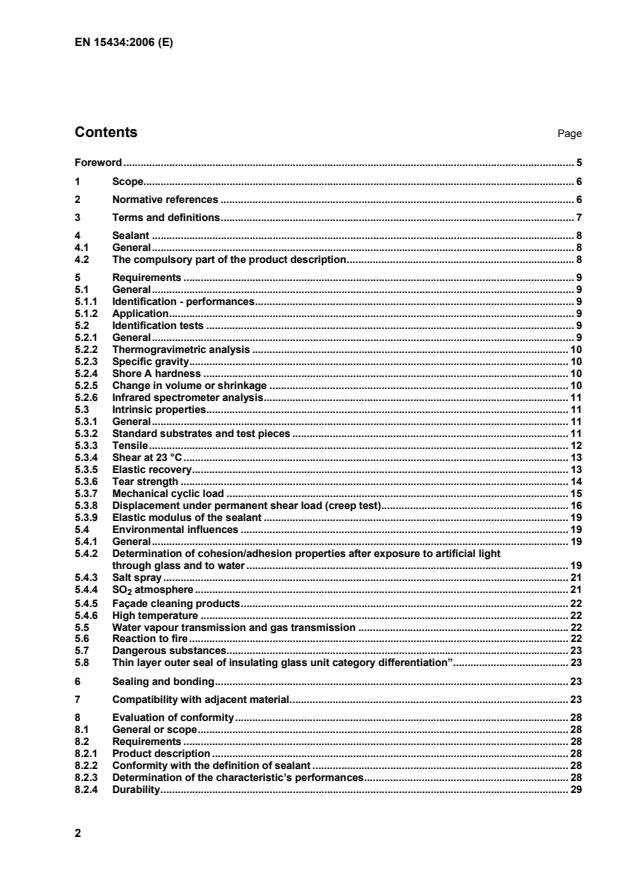
Evaluation of tests results.36 A.1 Evaluation of the characteristic values Ru,5.36 A.2 Evaluation of the rigidity modulus at the origin.37 A.3 Secant modulus, tangent modulus and shear modulus.37 A.4 Stiffness.39 Annex B (normative)
Shear at 23 °C: Test method.43 Annex C (normative)
Factory production control.45 C.1 Factory Production Control requirements.45 C.1.1 General.45 C.1.2 Organisation.45 C.1.3 Control system.45 C.2 Marking.46 C.3 Inspection and testing tables of Sealants production.46 C.3.1 Information on Tables C.1.46 C.3.2 Use of proxy testing.47 Annex D (normative)
Thin layer outer seal of insulating glass category differentiation.50 D.1 General.50 D.2 Test specimens and test samples.50 D.2.1 Test specimen description (see Figure D.1).50 D.2.2 Number of test specimen.51 D.2.3 Conditioning.51 D.3 Dynamic shear testing.52 D.4 Record.52 D.5 Specifications and category differentiation.52 Annex E (normative)
Formation of bubbles.54 E.1 Purpose of the test.54 E.2 Test specimen description and conditioning.54 E.3 Record and evaluation.54 Annex F (informative)
Sealing, structural bonding and UV resistance schematic illustrations.56 Annex G (normative)
Initial testing of bonding of sealant to non- glass substrates.59 G.1 Bonding to coated surfaces of coated glass.59 G.2 Metals.59 G.3 Test specimens.59 G.4 Description of the material.59 G.5 Mechanical strength and adhesion: initial testing.59 G.6 Test report.60 G.7 Initial testing of specific projects.60
Provisions for voluntary involvement of third party(ies).61 V.1 General.61 V.2 Voluntary tasks for third parties.61 V.3 Marking and labelling.61 Bibliography.62
Only silicone based sealants are permitted; assembling of glass products into or onto supports, where also ultra-violet resistance and/or mechanical resistance (structural use) of the seal is required under controlled environmental conditions as described in Clause 5 of EN 13022–2:2006.
Only silicone based sealants are permitted. This European Standard also specifies requirements concerning seals and bonds of sealant in conformity with this European Standard. When bonding of sealant to a non-glass substrate is tested, the substrate, which means the material, its treatment and its preparations for bonding, as applied or to be applied on the work is used in testing (coating of coated glass is considered as a non-glass substrate). This European Standard contains other aspects of importance of trade. 2 Normative references The following referenced documents are indispensable for the application of this European Standard. For dated references, only the edition cited applies. For undated references, the latest edition of the referenced document (including any amendments) applies. EN 572-1, Glass in building — Basic soda lime silicate glass products — Part 1: Definitions and general physical and mechanical properties EN 572-2, Glass in building — Basic soda lime silicate glass products — Part 2: Float glass EN 1279-4:2002, Glass in building — Insulating glass units — Methods of test for the physical attributes of edge seals EN 13022-1:2006, Glass in Building — Structural sealant glazing — Glass products for structural sealant glazing systems for supported and unsupported monolithic and multiple glazing EN 13022-2:2006, Glass in building — Structural sealant glazing — Assembly rules
3 Terms and definitions For the purposes of this European Standard, the terms and definitions given in EN 13022-1:2006,
EN 13022-2:2006, EN 1279-4:2002 and the following apply. 3.1 initial cure stage in the curing where sealant has appropriate cohesive strength to resist to different levels of action 3.2 creep factor shear design stress under dynamic load 3.3 initial type testing determination of the performance of a product (characteristic, durability), on the basis of either actual tests or other procedures (such as conventional, standardised, tabulated or general accepted values, standardised or recognised calculation methods, test reports when made available), in accordance with this European Standard that demonstrates compliance with this European Standard
number of tests prescribe "Rupture ≥ 90 % cohesive", i.e. the rupture of the samples need to be located at least 90 % within the sealant and a maximum 10 % at the interface between the sealant and the glass 4 Sealant 4.1 General For conformity purposes, the sealant manufacturer shall describe the product in a product description, which will be part of the factory production control documentation, or of the quality insurance system, whichever is applied. Disclosure of the product description is entirely at the discretion of the sealant manufacturer or his agent. The product description shall contain at least a normative part, and may contain an informative part when the manufacturer foresees further development of the product. The product description shall be prepared under the responsibility of the sealant manufacturer or his agent. 4.2 The compulsory part of the product description The compulsory part of the description consists of three sub parts: 1) component description: name and/or type of the sealant, together if it concerns a mono or a multiple component sealant and in the case of a multiple component sealant, the mixing ratio and the tolerances of the mixing ratio within which the performances of the characteristics and properties does not change significantly; 2) initial cure information: relevant data (or figure or values) depending on the temperature and the relative humidity, the chemistry of the curing system, number of components, mixing ratio and tolerances, section of the sealant to be applied, the nature of the adhesion surfaces …; 3) cured sealant description:
2.1 Reaction to fire 5.6 3 Hygiene, health and the environment::
3.1 Release of dangerous substances 5.7 4 Safety in use:
4.1 Resistance against wind, snow, permanent load and/or imposed loads of the glass unit 5.3 and 5.4 5 Protection against noise (when intended for use in insulating glass seal): 5.3, 5.4, 5.5 and 5.8 6 Energy economy and heat retention (when intended for use in insulating glass seal): 5.3, 5.4, 5.5 and 5.8
5.2 Identification tests 5.2.1 General All tests of 5.2 except 5.2.5 "Change in volume" are carried out on cured products. When no curing time has explicitly been stated by the sealant manufacturer, a curing time of at least 28 days at
(23 ± 2) °C and (50 ± 5) % relative humidity shall be maintained. The identification test performances are independent of the production equipment used, provided that a factory production control in accordance with Annex C is in use.
2,4 µm to 50 µm, preferably by use of a KRS 5 crystal. Test specimen: a tongue shaped amount of cured sealant which shall be conditioned for at least
48 h at (23 ± 2) °C, subsequently subjected to pyrolysis. Evaluation: the measured spectrum high lighting the relevant characteristic wavelengths of absorption. 5.3 Intrinsic properties 5.3.1 General For determining these properties, the tests are to be carried out on test pieces according to 5.3.2. The rigidity modulus and strength Ru,5 are defined in Annex A. The intrinsic properties are independent of the production equipment used, provided that a factory production control in accordance with Annex C is in use. 5.3.2 Standard substrates and test pieces Flat float glass, in accordance with EN 572 Parts 1 and 2, is to be used as a standard glass substrate. Unless otherwise indicated in the various clauses, test pieces are to be used with the dimensions given in Figure 1. Substrate dimension may be different from those given in Figure 1. The dimensions of the sealant joint, however, shall always be 12 mm x 12 mm x 50 mm.
Key 1 float glass 2 float glass 3 sealant Figure 1 — Standard test piece Unless otherwise specified in this European Standard the test pieces shall be conditioned for 28 days at (23 ± 2) °C and (50 ± 5) % R.H., or in conformity with the specification of the sealant’s manufacturer. The stresses are given in MPa by the ratio of the breaking force in N and the initial cross section area in mm². 5.3.3 Tensile Tests are carried out in conformity with EN ISO 8339, Conditioning A. After conditioning for 24 ± 4 hours, pulling of the test pieces at the following temperatures: for the class T1: -20 °C, +23 °C, +80 °C; for the class T2: -40 °C, +23 °C, +80 °C (for Nordic countries). Number of test specimen: 10 for each temperature. Evaluation: a) general:
visual examination: rupture shall be at least of 90 % cohesive; b) sealant for structural purposes.
Criteria Class T1:
80 °C ∆x mean ≥ 75 % 23 °C Ru5 ≥ 0,5 MPa -20 °C ∆x mean
≥ 75 %
Class T2:
80 °C ∆x mean
≥ 75 % 23 °C Ru5 ≥ 0,5 MPa -40 °C ∆x mean
≥ 75 %
With ∆x mean = X mean °C /
X mean 23°C X mean is defined in A.1. From the stress-at-elongation graph recorded, the following shall be noted: type of failure - whether cohesive or adhesive; stress at elongations of 5 %, 10 %, 15 %, 20 % and 25 %; stress and elongation at rupture, only for test specimens conditioned at + 23 °C. c) sealant for use for non structural insulating glass unit seals: strength and elongation criteria according to EN 1279-4. 5.3.4 Shear at 23 °C Tests are carried out in conformity with Annex B. Direction of force: longitudinal. Number of test specimen: 10. Pulling of the test pieces at the following temperatures: -20 °C, +23 °C, +80 °C. Evaluation: Shear displacement. Criteria identical to 5.3.3. Rupture shall be at least of 90 % cohesive. 5.3.5 Elastic recovery The purpose of the test is to evaluate the elastic recovery behaviour and consequently the relaxation behaviour after long term loading. The test shall be carried out in accordance with EN ISO 7389, Conditioning A with a load to give 25 % elongation (= 125 % of original length).
initial stress and elongation; final stress and elongation; elongation after unloading the test pieces. Number of test specimen: 3. Evaluation: -
sealant for structural purposes: the average of the elastic recovery shall be at least 95 %. 5.3.6 Tear strength The aim of this test is to establish the mode of propagation of a cut in the structural sealant. Five test pieces are prepared as specified in 5.3.2. After curing, the test pieces are cut at the ends of the sealant as shown on Figure 2. The samples are tested to destruction in accordance with 5.3.3 and
EN ISO 8339 at the temperature: 23 °C ± 2 °C. Number of test pieces: 5. Evaluation: The average tear breaking strength value shall be: when insert in the structural seal (e.g. mechanical self-weight support, safety devices, other elements as relevant):
at least 0,75 times the average value as measured by 5.3.2 at 23 °C: ∆Xmean > 0,75; without insert in the structural seal: at least 0, 50 times the average value as measured by 5.3.2 at 23 °C: ∆Xmean ≥ 0,50. Rupture shall be at least of 90 % cohesive. Where ∆Xmean = X mean tear / X mean 23°C
Key 1 float glass 2 float glass 3 sealant with 5 mm deep incisions at the extremes
Figure 2 — Test specimen for the tear strength test 5.3.7 Mechanical cyclic load The purpose of this test is to evaluate the effect of fatigue stresses on the residual mechanical strength of the sealant bond. Test specimens are subjected to repetitive tensile loads with a cycle time of 8 s (see Figure 3): 100 times from 0,1 σdes to the design stress σdes; 250 times from 0,1 σdes to 0,8 x the design stress σdes; 5 000 times from 0,1 σdes to 0,6 x the design stress σdes; where 6R5,udes=σ (1) After 24 h conditioning at (23 ± 2) °C and (50 ± 5) % relative humidity and after visual inspection of the sealing, the test specimen shall be subjected to tensile test. Number of test specimen: 10.
Key t1 duration of the peak load ≥ 2 s t2 rest time ≥ 2 s t3 cycle period time ≤ 8 s Figure 3 — Stress cycle for fatigue test Evaluation: a) sealant for structural purposes: - rigidity modulus: average shall not deviate more than 25 % from the rigidity modulus as measured by 5.3.3 at 23 °C; - strength: Ru,5 shall not be less than 75 % of the mean value of the tensile test according to 5.3.3, at 23 °C (∆Xmean ≥ 0,75). - rupture shall be at least of 90 % cohesive; b) outer seal of insulating glass unit without structural function. - strength and elongation criteria according to EN 1279-4. 5.3.8 Displacement under permanent shear load (creep test) 5.3.8.1 Purpose of the test This test is applicable for sealant intended for structural purposes and under permanent shear load. 5.3.8.2 Creep factor: definition and requirement Factor γc by which the shear design stress under dynamic load Γdes shall be divided to obtain a permanent shear design stress Γ∞ for which no creep is measurable following the criteria of the test described below: cdesγΓ=Γ∞ with
γc
≥ 10 (2) The value of Γ∞ declared by the manufacturer.
Key 1 spacer to maintain the extension 2 structural sealant height h to be declared by sealant manufacturer Glass thickness: 8 mm Glass size: 20 mm x 20 mm Figure 4 — Creep test specimens for structural purposes 5.3.8.4 Test procedure Manufacture enough test specimens, three required for the test and a few spares, and store them
28 days at a temperature of (23 ± 2) °C. Install three test specimens in the creep installation and place it in a climatic chamber with a temperature of (23 ± 2) °C. and a relative humidity RH of (50 ± 5) %.
Figure 5 — Load arrangement for creep measurement The creep installation subjects simultaneously the test specimens for 91 days to (see Figure 5): tensile loading of: i,ti,tP2400F=
where Pt,i = 0,3x σdes for 91 days; and 6R5;udes=σ (4) Ru,5 is determined for structural purposes in accordance with 5.3.4 at 23 °C; permanent shear loading of: ∞Γ=2400Fs.
(5) With Γ∞, stress given by the manufacturer, taking into account a minimum creep factor of 10. Evaluation: creep evolution at 1 day, 3 days, 7 days, 10 days then each 7 days after loading; deformation after 91 days before unloading; residual deformation 24 h after unloading. The sealant shall be “Displacement under permanent shear load” (creep) graded in accordance with Table 3. The grade C 1 is applicable for the value of the height of the seal declared for the test and for inferior values of this declared height.
All not grade C1 sealant
5.3.9 Elastic modulus of the sealant The aim of this test is to determine the calculation of the modulus E0. The test shall be carried out in conformity with EN ISO 527-3 with all the test pieces having a thickness of (2,2 ± 0,2) mm. The manufacturer shall give the modulus type to be introduced in the calculation, either tangent or secant to the origin. In the latter case, the boundaries of the curve (deformation, stress (ε1, σ1),
(ε2, σ2)) between which the calculation modulus. Number of test pieces: 5. Speed of the traction: 5 mm/min. The maximum relative elongation allowed in the calculation shall correspond to the upper boundary used to determine the calculation modulus. The test report shall contain the graphs (deformation, stress) for each sample tested. 5.4 Environmental influences 5.4.1 General The performances as function of the environmental influences are independent of the production equipment used, provided that a factory production control in accordance with Annex C is in use. The test pieces shall be prepared as described in 5.3.2. 5.4.2 Determination of cohesion/adhesion properties after exposure to artificial light through glass and to water Purpose and principle of the test The purpose of this test is to evaluate the sensitivity of the structural sealant to artificial ageing, combining the effect of the ultraviolet radiation and the exposure to water, by measuring the residual mechanical strength of the structural sealant. Test specimens are prepared in which the sealant to be tested adheres to two parallel glass surfaces. After submitting the test specimens to a permanent artificial light at elevated temperature and to water, the test specimens are extended at rupture.
(24 ± 2) h, followed by destructive tensile testing. Tensile testing The 20 test pieces are submitted to a destructive tensile testing at a speed of (5,5 ± 0,5) mm/min. Record stress at breaking point elongation at breaking point type of rupture
1)
Ultra-Vitalux ® is the trade-name of a product supplied by OSRAM in Mercurius straat 28, B-1930 Nossegem or in Steinerne Furt 62, D-86167 Augsburg. This information is given for the convenience of users of this European Standard and does not constitute an endorsement by CEN of the product named. Equivalent products may be used if they can be shown to lead to the same results.
∆Xmean ≥ 0, 75; secant stiffness (or rigidity modulus) shall be as follows: 0,5 ≤ Kx,c/Kx ≤ 1,10
(with 0 ≤ x % ≤ 12,5 of the deformation/stress curve) See A.4: Stiffness; rupture shall be at least of 90 % cohesive. b) sealant for use for non structural insulating glass unit seals (if relevant):
strength and elongation criteria according to the requirement of EN 1279-4. 5.4.3 Salt spray This test is applicable for sealant intended for structural purposes. Conditioning: - conditioning of the test pieces shall be carried out in accordance with prEN ISO 9227. - atmosphere NSS shall be maintained for 480 h for uncoated glass, glass coated on face 4 (and other substrates), and for 240 h for glass coated on faces 2 and 3. Number of test specimen: 5. Evaluation: sealant for structural purposes: Stress at the breaking point as measur
...