

EN 12896-6:2019
(Main)Public transport - Reference data model - Part 6: Passenger information
- Abstract
1.1 General Scope of the Standard
The main objective of the present standard is to present the Reference Data Model for Public Transport, based on:
- the Reference Data Model, EN 12896, known as Transmodel V5.1;
- EN 28701:2012, Intelligent transport systems -) Public transport - Identification of Fixed Objects in Public Transport (IFOPT), although note that this particular standard has been withdrawn as it is now included within Parts 1 and 2 of this standard (EN 12896-1:2016 and EN 12896-2:2016) following their successful publication,
incorporating the requirements of:
- EN 15531-1 to -3 and CEN/TS 15531-4 and -5: Public transport – Service interface for real-time information relating to public transport operations (SIRI);
- CEN/TS 16614-1 and -2: Public transport - Network and Timetable Exchange (NeTEx), in particular the specific needs for long distance train operation.
Particular attention is drawn to the data model structure and methodology:
- the data model is described in a modular form in order to facilitate the understanding and the use of the model;
- the data model is entirely described in UML.
The following functional domains are considered:
- Network Description: routes, lines, journey patterns, timing patterns, service patterns, scheduled stop points and stop places;
- Timing Information and Vehicle Scheduling (runtimes, vehicle journeys, day type-related vehicle schedules);
- Passenger Information (planned and real-time);
- Fare Management (fare structure, sales, validation, control);
Operations Monitoring and Control: operating day-related data, vehicle follow-up, control actions;
- Driver Management:
- Driver Scheduling (day-type related driver schedules),
- Rostering (ordering of driver duties into sequences according to some chosen methods),
- Driving Personnel Disposition (assignment of logical drivers to physical drivers and recording of driver performance);
- Management Information and Statistics (including data dedicated to service performance indicators).
The data modules dedicated to cover most functions of the above domains will be specified.
Several concepts are shared by the different functional domains. This data domain is called "Common Concepts".
1.2 Functional Domain Description
The different functional domains (enumerated above) taken into account in the present standard, and of which the data have been represented as the reference model, are described in EN 12896-1:2016, Public transport - Reference data model - Part 1: Common concepts.
1.3 Particular Scope of this Document
The present document entitled Public transport - Reference data model - Part 6: Passenger information, incorporates the following main data packages:
- Trip Description;
- Passenger Queries.
This document itself is composed of the following parts:
- Main document (normative) representing the data model for the concepts shared by the different fare domains covered by Transmodel;
- Annex A (normative), containing the data dictionary, i.e. the list of all the concepts and attribute tables present in the main document together with the definitions;
- Annex B (normative), providing a complement to EN 12896-1:2016, particularly useful for parts 4 to 8 of the Public Transport Reference Data Model;
- Annex C (informative), indicating the data model evolutions;
- Annex D (informative), indicating the high-level equivalences of the example passenger information functional requests to the capabilities of other standards;
- Annex E (informative), providing an example set of commonly found passenger information functional requests and data dictionary for the elements used in the examples.
- Status
- Withdrawn
- Publication Date
- 10-Sep-2019
- Withdrawal Date
- 13-Oct-2026
- Technical Committee
- CEN/TC 278 - Road transport and traffic telematics
- Drafting Committee
- CEN/TC 278/WG 3 - Public transport (PT)
- Current Stage
- 9960 - Withdrawal effective - Withdrawal
- Start Date
- 01-Jul-2026
- Completion Date
- 14-Oct-2026



Overview
EN 12896-6:2019 - Public transport: Reference data model - Part 6: Passenger information defines a modular, UML-described reference data model for passenger information within the Transmodel family. Part 6 focuses on the data structures and functional requirements needed to describe and deliver both planned and real‑time passenger information. It builds on Transmodel V5.1 (EN 12896) and incorporates relevant concepts from IFOPT, SIRI (EN 15531 series) and NeTEx (CEN/TS 16614) to support interoperable data exchange across public transport systems - including special needs for long‑distance train operations.
Key technical topics and requirements
- Modular UML data model: The model is presented in modular packages to simplify understanding and reuse; all concepts are formally described in UML.
- Primary data packages: Trip Description and Passenger Queries are the central packages for passenger-facing functionality.
- Types of passenger information: Planned timetable data, real‑time updates, trip planning results, trip duration estimations and fare-related information.
- Use cases and actors: Includes defined use cases and business contexts for passenger information services (query types, delivery methods, filters and policies).
- Normative Annexes:
- Annex A - data dictionary listing concepts and attributes (e.g., LEG, MONITORED LEG, PT_TRIP, PI_REQUEST).
- Annex B - extensions and methodological conventions complementing EN 12896-1.
- Annexes C–E - model evolution, equivalence mappings to other standards, and example passenger information requests.
- Interoperability focus: Aligns with SIRI and NeTEx to enable standardized service interfaces and data exchange for journey planners, real‑time feeds and timetable distribution.
Practical applications and who uses this standard
EN 12896-6:2019 is intended for organizations and projects needing a standard, interoperable model for passenger information:
- Public transport authorities designing central journey planners and open data feeds.
- ITS system integrators and software vendors implementing timetable, real‑time information and trip‑planning APIs.
- Mobile app developers and passenger information display providers requiring standardized message models and attributes.
- Rail and long‑distance operators needing harmonized data models for cross‑network timetable and passenger information exchange.
- Data exchange initiatives (NeTEx/SIRI implementations) seeking conformity with Transmodel-based semantics.
Related standards
- EN 12896 (Transmodel V5.1) - Reference Data Model (foundation)
- EN 12896-1:2016 / EN 12896-2:2016 - Common concepts and related parts
- EN 15531 series (SIRI) - Real‑time service interface
- CEN/TS 16614 (NeTEx) - Network & Timetable Exchange
- EN 28701 (IFOPT) - Identification of fixed objects (now integrated into EN 12896 parts)
EN 12896-6:2019 is a practical reference for building interoperable passenger information services, supporting consistent implementation, data sharing and integration across transport networks.
Relations
- Replaced By
EN 12896-6:2026 - Public transport - Reference data model - Part 6: Passenger information - Effective Date
- 19-Jun-2024
- Effective Date
- 28-Jan-2026
- Effective Date
- 28-Jan-2026
- Effective Date
- 28-Jan-2026
- Effective Date
- 28-Jan-2026
- Effective Date
- 28-Jan-2026
- Effective Date
- 28-Jan-2026
- Effective Date
- 28-Jan-2026
- Effective Date
- 28-Jan-2026
- Effective Date
- 28-Jan-2026
- Effective Date
- 28-Jan-2026
- Effective Date
- 28-Jan-2026
- Effective Date
- 28-Jan-2026
- Effective Date
- 28-Jan-2026
- Effective Date
- 28-Jan-2026
Get Certified
Connect with accredited certification bodies for this standard

BSI Group
BSI (British Standards Institution) is the business standards company that helps organizations make excellence a habit.

NYCE
Mexican standards and certification body.
Sponsored listings
Frequently Asked Questions
EN 12896-6:2019 is a standard published by the European Committee for Standardization (CEN). Its full title is "Public transport - Reference data model - Part 6: Passenger information". This standard covers: 1.1 General Scope of the Standard The main objective of the present standard is to present the Reference Data Model for Public Transport, based on: - the Reference Data Model, EN 12896, known as Transmodel V5.1; - EN 28701:2012, Intelligent transport systems -) Public transport - Identification of Fixed Objects in Public Transport (IFOPT), although note that this particular standard has been withdrawn as it is now included within Parts 1 and 2 of this standard (EN 12896-1:2016 and EN 12896-2:2016) following their successful publication, incorporating the requirements of: - EN 15531-1 to -3 and CEN/TS 15531-4 and -5: Public transport – Service interface for real-time information relating to public transport operations (SIRI); - CEN/TS 16614-1 and -2: Public transport - Network and Timetable Exchange (NeTEx), in particular the specific needs for long distance train operation. Particular attention is drawn to the data model structure and methodology: - the data model is described in a modular form in order to facilitate the understanding and the use of the model; - the data model is entirely described in UML. The following functional domains are considered: - Network Description: routes, lines, journey patterns, timing patterns, service patterns, scheduled stop points and stop places; - Timing Information and Vehicle Scheduling (runtimes, vehicle journeys, day type-related vehicle schedules); - Passenger Information (planned and real-time); - Fare Management (fare structure, sales, validation, control); Operations Monitoring and Control: operating day-related data, vehicle follow-up, control actions; - Driver Management: - Driver Scheduling (day-type related driver schedules), - Rostering (ordering of driver duties into sequences according to some chosen methods), - Driving Personnel Disposition (assignment of logical drivers to physical drivers and recording of driver performance); - Management Information and Statistics (including data dedicated to service performance indicators). The data modules dedicated to cover most functions of the above domains will be specified. Several concepts are shared by the different functional domains. This data domain is called "Common Concepts". 1.2 Functional Domain Description The different functional domains (enumerated above) taken into account in the present standard, and of which the data have been represented as the reference model, are described in EN 12896-1:2016, Public transport - Reference data model - Part 1: Common concepts. 1.3 Particular Scope of this Document The present document entitled Public transport - Reference data model - Part 6: Passenger information, incorporates the following main data packages: - Trip Description; - Passenger Queries. This document itself is composed of the following parts: - Main document (normative) representing the data model for the concepts shared by the different fare domains covered by Transmodel; - Annex A (normative), containing the data dictionary, i.e. the list of all the concepts and attribute tables present in the main document together with the definitions; - Annex B (normative), providing a complement to EN 12896-1:2016, particularly useful for parts 4 to 8 of the Public Transport Reference Data Model; - Annex C (informative), indicating the data model evolutions; - Annex D (informative), indicating the high-level equivalences of the example passenger information functional requests to the capabilities of other standards; - Annex E (informative), providing an example set of commonly found passenger information functional requests and data dictionary for the elements used in the examples.
1.1 General Scope of the Standard The main objective of the present standard is to present the Reference Data Model for Public Transport, based on: - the Reference Data Model, EN 12896, known as Transmodel V5.1; - EN 28701:2012, Intelligent transport systems -) Public transport - Identification of Fixed Objects in Public Transport (IFOPT), although note that this particular standard has been withdrawn as it is now included within Parts 1 and 2 of this standard (EN 12896-1:2016 and EN 12896-2:2016) following their successful publication, incorporating the requirements of: - EN 15531-1 to -3 and CEN/TS 15531-4 and -5: Public transport – Service interface for real-time information relating to public transport operations (SIRI); - CEN/TS 16614-1 and -2: Public transport - Network and Timetable Exchange (NeTEx), in particular the specific needs for long distance train operation. Particular attention is drawn to the data model structure and methodology: - the data model is described in a modular form in order to facilitate the understanding and the use of the model; - the data model is entirely described in UML. The following functional domains are considered: - Network Description: routes, lines, journey patterns, timing patterns, service patterns, scheduled stop points and stop places; - Timing Information and Vehicle Scheduling (runtimes, vehicle journeys, day type-related vehicle schedules); - Passenger Information (planned and real-time); - Fare Management (fare structure, sales, validation, control); Operations Monitoring and Control: operating day-related data, vehicle follow-up, control actions; - Driver Management: - Driver Scheduling (day-type related driver schedules), - Rostering (ordering of driver duties into sequences according to some chosen methods), - Driving Personnel Disposition (assignment of logical drivers to physical drivers and recording of driver performance); - Management Information and Statistics (including data dedicated to service performance indicators). The data modules dedicated to cover most functions of the above domains will be specified. Several concepts are shared by the different functional domains. This data domain is called "Common Concepts". 1.2 Functional Domain Description The different functional domains (enumerated above) taken into account in the present standard, and of which the data have been represented as the reference model, are described in EN 12896-1:2016, Public transport - Reference data model - Part 1: Common concepts. 1.3 Particular Scope of this Document The present document entitled Public transport - Reference data model - Part 6: Passenger information, incorporates the following main data packages: - Trip Description; - Passenger Queries. This document itself is composed of the following parts: - Main document (normative) representing the data model for the concepts shared by the different fare domains covered by Transmodel; - Annex A (normative), containing the data dictionary, i.e. the list of all the concepts and attribute tables present in the main document together with the definitions; - Annex B (normative), providing a complement to EN 12896-1:2016, particularly useful for parts 4 to 8 of the Public Transport Reference Data Model; - Annex C (informative), indicating the data model evolutions; - Annex D (informative), indicating the high-level equivalences of the example passenger information functional requests to the capabilities of other standards; - Annex E (informative), providing an example set of commonly found passenger information functional requests and data dictionary for the elements used in the examples.
EN 12896-6:2019 is classified under the following ICS (International Classification for Standards) categories: 35.240.60 - IT applications in transport. The ICS classification helps identify the subject area and facilitates finding related standards.
EN 12896-6:2019 has the following relationships with other standards: It is inter standard links to EN 12896-6:2026, EN 15531-3:2022, EN 15531-1:2022, CEN/TS 15531-4:2021, EN 12896-2:2016, CEN/TS 17118:2024, EN 12896-3:2016, CEN/TS 15531-5:2022, EN 12896-8:2019, EN 12896-1:2016, EN 15531-2:2022, EN 12896-5:2019, CEN/TS 16614-1:2020, CEN/TS 16614-4:2020, CEN/TS 17402:2020. Understanding these relationships helps ensure you are using the most current and applicable version of the standard.
EN 12896-6:2019 is associated with the following European legislation: EU Directives/Regulations: 2010/40/EU, 2016/797/EU, 2016/797/EU, 2016/797/EU, 2016/797/EU, 2016/797/EU, 2016/797/EU, 2016/797/EU, 2016/797/EU, 2016/797/EU, 2016/797/EU, 2016/797/EU, 2016/797/EU, 2016/797/EU. When a standard is cited in the Official Journal of the European Union, products manufactured in conformity with it benefit from a presumption of conformity with the essential requirements of the corresponding EU directive or regulation.
EN 12896-6:2019 is available in PDF format for immediate download after purchase. The document can be added to your cart and obtained through the secure checkout process. Digital delivery ensures instant access to the complete standard document.
Standards Content (Sample)
SLOVENSKI STANDARD
01-november-2019
Javni prevoz - Referenčni podatkovni model - 6. del: Informiranje potnikov
Public transport - Reference data model - Part 6: Passenger information
Öffentlicher Verkehr - Referenzdatenmodell - Teil 6: Information an Reisende
Transports publics - Modèle de données de référence - Partie 6 : Information des
usagers
Ta slovenski standard je istoveten z: EN 12896-6:2019
ICS:
35.240.60 Uporabniške rešitve IT v IT applications in transport
prometu
2003-01.Slovenski inštitut za standardizacijo. Razmnoževanje celote ali delov tega standarda ni dovoljeno.
EN 12896-6
EUROPEAN STANDARD
NORME EUROPÉENNE
September 2019
EUROPÄISCHE NORM
ICS 35.240.60
English Version
Public transport - Reference data model - Part 6:
Passenger information
Transports publics - Modèle de données de référence - Öffentlicher Verkehr - Referenzdatenmodell - Teil 6:
Partie 6 : Information des usagers Information an Reisende
This European Standard was approved by CEN on 19 April 2019.
CEN members are bound to comply with the CEN/CENELEC Internal Regulations which stipulate the conditions for giving this
European Standard the status of a national standard without any alteration. Up-to-date lists and bibliographical references
concerning such national standards may be obtained on application to the CEN-CENELEC Management Centre or to any CEN
member.
This European Standard exists in three official versions (English, French, German). A version in any other language made by
translation under the responsibility of a CEN member into its own language and notified to the CEN-CENELEC Management
Centre has the same status as the official versions.
CEN members are the national standards bodies of Austria, Belgium, Bulgaria, Croatia, Cyprus, Czech Republic, Denmark, Estonia,
Finland, France, Germany, Greece, Hungary, Iceland, Ireland, Italy, Latvia, Lithuania, Luxembourg, Malta, Netherlands, Norway,
Poland, Portugal, Republic of North Macedonia, Romania, Serbia, Slovakia, Slovenia, Spain, Sweden, Switzerland, Turkey and
United Kingdom.
EUROPEAN COMMITTEE FOR STANDARDIZATION
COMITÉ EUROPÉEN DE NORMALISATION
EUROPÄISCHES KOMITEE FÜR NORMUNG
CEN-CENELEC Management Centre: Rue de la Science 23, B-1040 Brussels
© 2019 CEN All rights of exploitation in any form and by any means reserved Ref. No. EN 12896-6:2019 E
worldwide for CEN national Members.
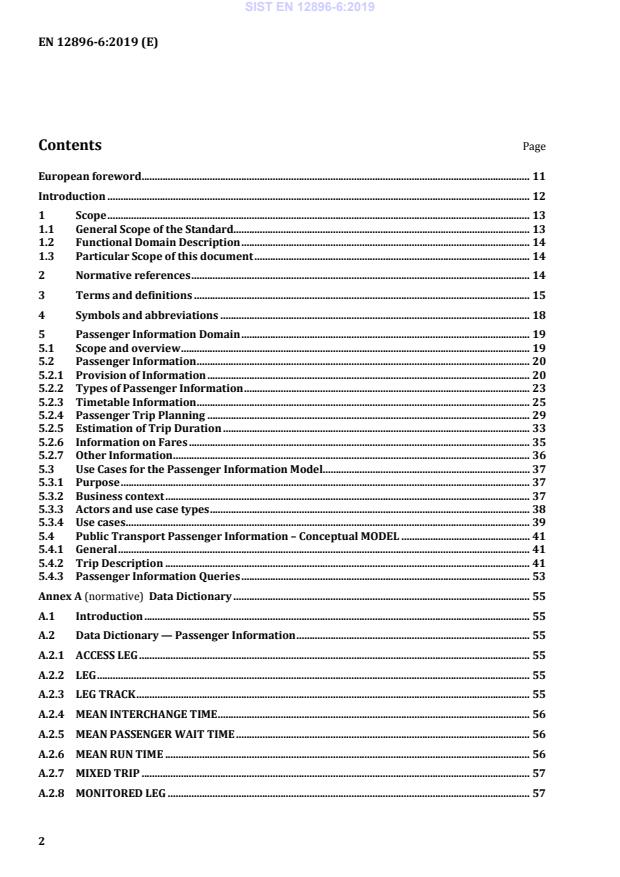
Contents Page
European foreword . 11
Introduction . 12
1 Scope . 13
1.1 General Scope of the Standard. 13
1.2 Functional Domain Description . 14
1.3 Particular Scope of this document . 14
2 Normative references . 14
3 Terms and definitions . 15
4 Symbols and abbreviations . 18
5 Passenger Information Domain . 19
5.1 Scope and overview . 19
5.2 Passenger Information . 20
5.2.1 Provision of Information . 20
5.2.2 Types of Passenger Information . 23
5.2.3 Timetable Information . 25
5.2.4 Passenger Trip Planning . 29
5.2.5 Estimation of Trip Duration . 33
5.2.6 Information on Fares . 35
5.2.7 Other Information . 36
5.3 Use Cases for the Passenger Information Model. 37
5.3.1 Purpose . 37
5.3.2 Business context . 37
5.3.3 Actors and use case types . 38
5.3.4 Use cases . 39
5.4 Public Transport Passenger Information – Conceptual MODEL . 41
5.4.1 General . 41
5.4.2 Trip Description . 41
5.4.3 Passenger Information Queries . 53
Annex A (normative) Data Dictionary . 55
A.1 Introduction . 55
A.2 Data Dictionary — Passenger Information . 55
A.2.1 ACCESS LEG . 55
A.2.2 LEG . 55
A.2.3 LEG TRACK . 55
A.2.4 MEAN INTERCHANGE TIME . 56
A.2.5 MEAN PASSENGER WAIT TIME . 56
A.2.6 MEAN RUN TIME . 56
A.2.7 MIXED TRIP . 57
A.2.8 MONITORED LEG . 57
A.2.9 MONITORED LEG ARRIVAL . 57
A.2.10 MONITORED LEG CALL . 58
A.2.11 MONITORED LEG CALL PART . 58
A.2.12 MONITORED LEG DEPARTURE . 58
A.2.13 MONITORED LEG PROGRESS . 59
A.2.14 MONITORED TRIP . 59
A.2.15 MONITORED TRIP PATTERN . 59
A.2.16 NON-PT TRIP . 60
A.2.17 OTHER LEG . 60
A.2.18 PARTICIPANT SYSTEM . 60
A.2.19 PATH GUIDANCE. 61
A.2.20 PI DELIVERY . 61
A.2.21 PI REQUEST . 61
A.2.22 PI REQUEST FILTER. 62
A.2.23 PI REQUEST POLICY . 62
A.2.24 PT CONNECTION LEG . 62
A.2.25 PT FARE OFFER . 63
A.2.26 PT RIDE LEG . 63
A.2.27 PT TRIP . 63
A.2.28 TRAVEL . 64
A.2.29 TRAVEL FLOW . 64
A.2.30 TRAVELLING ENTITY . 64
A.2.31 TRIP . 64
A.2.32 TRIP PATTERN . 65
A.2.33 TRIP PATTERN MONITORING . 65
A.2.34 TRIP REASON . 65
A.2.35 TYPE OF GUARANTEE . 66
A.2.36 TYPE OF PASSENGER . 66
A.2.37 TYPE OF TRAVELLING ENTITY . 66
A.2.38 TYPE OF REQUEST . 67
Annex B (normative) Additional Common Concepts — Extension to EN 12896-1:2016, Public
transport – Reference data model – Part 1: Common concepts . 68
B.1 Methodology and Conventions . 68
B.1.1 Methodology for conceptual modelling . 68
B.1.1.1 General . 68
B.1.1.2 Packages . 68
B.1.1.3 Package Prefixes and Package order . 69
B.1.1.4 Part Prefixes and diagram names . 70
B.1.1.5 Class diagrams . 70
B.1.1.6 Class Diagram Presentations . 71
B.1.1.7 Use of Colour . 71
B.1.2 MODEL Class Diagrams . 72
B.1.2.1 General . 72
B.1.2.2 Classes and attributes . 73
B.1.2.2.1 General . 73
B.1.2.2.2 Attribute visibility . 74
B.1.2.2.3 Attribute names . 74
B.1.2.2.4 Attribute types . 74
B.1.2.2.5 Multiplicity of Attributes . 74
B.1.2.2.6 Common attributes . 74
B.1.2.2.7 Simple Diagram Example . 74
B.1.2.3 Relationships . 76
B.1.2.3.1 General . 76
B.1.2.3.2 Association relationships . 76
B.1.2.3.3 Reflexive associations . 76
B.1.2.3.4 Aggregation relationship . 77
B.1.2.3.5 Generalization relationship . 78
B.1.2.3.6 Multiplicity (Cardinality) of Relationships . 79
B.1.2.3.7 Presence of Relationships on a given diagram. 79
B.1.2.3.8 Relationships and navigability . 80
B.1.2.3.9 Positional semantics for laying out classes and relationships . 81
B.1.2.3.10 Explicit Frames . 81
B.1.3 Summary of Rules for Transmodel Presentation . 82
B.1.3.1 Presentation of Class Structure diagrams . 82
B.1.3.2 Rules for naming and presenting classes . 82
B.1.3.3 Rules for use of role names . 83
B.1.3.4 Rules for use of multiplicity . 84
B.1.3.5 Rules for relationship qualifiers . 84
B.1.3.6 Rules for presenting relationships . 85
B.1.3.7 Rules for Placing Role names . 86
B.2 Extensions to the Common Concept MODEL . 86
B.2.1 General . 86
B.2.2 Additional Common Concepts — Additional Generalizations . 86
B.2.2.1 Generic Type of Value – Conceptual MODEL . 86
B.2.2.2 Generic Assignment – Conceptual MODEL . 88
B.2.2.3 Generic Section – Conceptual MODEL . 88
B.2.3 Extensions to the Generic Framework . 89
B.2.3.1 General . 89
B.2.3.2 Alternative Text – Conceptual MODEL . 89
B.2.3.3 Generic View – Conceptual MODEL . 90
B.2.3.4 Generic Loggable Object – Conceptual MODEL. 91
B.2.3.5 Event Model – Conceptual MODEL . 91
B.2.4 Extensions to the Reusable Components . 92
B.2.4.1 Employee Model – Conceptual MODEL . 92
B.2.4.2 Message Model – Conceptual MODEL. 93
B.2.4.2.1 Messages . 93
B.2.4.2.2 Publication Scope . 94
B.2.4.3 Role Model – Conceptual MODEL . 95
B.2.4.3.1 Generic Roles . 95
B.2.4.3.2 Service Organization Roles . 96
B.2.4.3.3 Employee Roles . 97
B.2.4.3.4 Administrative Organization Roles . 97
B.2.4.3.5 Technology Organization Roles . 98
B.2.4.3.6 Messaging Roles . 99
B.2.4.3.7 Transport Customer Roles . 100
B.2.4.4 Security List – Conceptual MODEL . 100
B.2.4.5 Transfer Time – Conceptual MODEL . 101
B.2.5 Data Dictionary . 101
B.2.5.1 General . 101
B.2.5.2 ADMINISTRATIVE ORGANIZATION ROLE . 102
B.2.5.3 ALTERNATIVE TEXT. 102
B.2.5.4 ASSIGNMENT. 102
B.2.5.5 BLACKLIST . 102
B.2.5.6 CLASS ATTRIBUTE . 103
B.2.5.7 CONDUCTOR ROLE . 103
B.2.5.8 CUSTOMER SERVICE PROVIDER ROLE . 103
B.2.5.9 CUSTOMER SERVICE ROLE . 104
B.2.5.10 DATA COLLECTOR ROLE . 104
B.2.5.11 DRIVER ROLE . 104
B.2.5.12 EMPLOYEE . 104
B.2.5.13 EMPLOYEE ROLE . 105
B.2.5.14 EVENT . 105
B.2.5.15 GENERAL EVENT . 105
B.2.5.16 GENERAL OBSERVER ROLE . 106
B.2.5.17 GENERAL SECTION . 106
B.2.5.18 LOG . 106
B.2.5.19 LOG ENTRY . 106
B.2.5.20 LOGGABLE OBJECT . 107
B.2.5.21 MESSAGE . 107
B.2.5.22 MESSAGE PART . 107
B.2.5.23 MESSAGE PRIORITY . 107
B.2.5.24 ORGANIZATION ROLE . 108
B.2.5.25 PT SCOPE . 108
B.2.5.26 PUBLICATION APPROVER ROLE . 108
B.2.5.27 PUBLICATION DECISION . 109
B.2.5.28 PUBLICATION SCOPE . 109
B.2.5.29 PUBLICATION WINDOW . 109
B.2.5.30 PUBLISHING ACTION . 109
B.2.5.31 PUBLISHING CHANNEL . 110
B.2.5.32 QUALIFICATION . 110
B.2.5.33 REGISTRAR ROLE . 110
B.2.5.34 SECTION . 110
B.2.5.35 SECTION IN LINK SEQUENCE . 111
B.2.5.36 SECURITY LIST . 111
B.2.5.37 SECURITY LISTABLE . 111
B.2.5.38 SECURITY LISTING . 111
B.2.5.39 SECURITY MANAGER ROLE . 111
B.2.5.40 SERVICE OPERATOR ROLE . 112
B.2.5.41 SITUATION AUTHOR ROLE . 112
B.2.5.42 SPECIFIC OBSERVER ROLE . 112
B.2.5.43 STATION EMPLOYEE ROLE . 113
B.2.5.44 TECHNOLOGY ORGANIZATION ROLE . 113
B.2.5.45 TRAFFIC INFORMATION OFFICER ROLE . 113
B.2.5.46 TRANSFER TIME . 114
B.2.5.47 TRANSPORT USER ROLE . 114
B.2.5.48 TRAVEL DOCUMENT CONTROLLER ROLE . 114
B.2.5.49 TRAVEL DOCUMENT CONTROLLING ORGANIZATION ROLE . 114
B.2.5.50 TRAVEL ORGANIZATION ROLE . 115
B.2.5.51 TYPE OF AUDIENCE . 115
B.2.5.52 TYPE OF EVENT . 115
B.2.5.53 TYPE OF MESSAGE . 116
B.2.5.54 TYPE OF MESSAGE PART CONTENT . 116
B.2.5.55 TYPE OF QUALIFICATION . 116
B.2.5.56 TYPE OF SECURITY LIST . 116
B.2.5.57 TYPE OF VALUE . 117
B.2.5.58 View . 117
B.2.5.59 WHITELIST . 117
Annex C (informative) Data Model Evolution . 118
C.1 Change Requests . 118
C.2 Source of Text . 128
C.3 Diagram Status. 130
Annex D (informative) Mapping to OADJP and to SIRI . 131
D.1 Table of equivalent SIRI Services . 131
D.2 Table of equivalent OADJP Services . 131
Annex E (informative) Passenger Information Functional Requests . 133
E.1 Introduction. 133
E.2 Overview of Passenger Information Functional Requests. 133
E.2.1 General . 133
E.2.2 Further types of PI Query . 135
E.3 System Provisioning Queries — Exchange Point Query . 135
E.3.1 Exchange Point Request . 135
E.3.2 Exchange Point Delivery . 135
E.3.2.1 General . 135
E.3.2.2 Exchange Point example . 136
E.4 Travel Related Queries . 137
E.4.1 Location Query. 137
E.4.1.1 Location Request. 137
E.4.1.2 Location Delivery . 138
E.4.2 Stop Event Query . 139
E.4.2.1 Stop Event Request . 139
E.4.2.2 Stop Event Delivery . 140
E.4.3 Schedule Query . 141
E.4.3.1 Schedule Request . 141
E.4.3.2 Schedule Delivery . 142
E.4.4 Situation Query . 143
E.4.4.1 Situation Request . 143
E.4.4.2 Situation Delivery . 144
E.4.5 Trip Query . 145
E.4.5.1 Trip Request . 145
E.4.5.2 Trip Delivery . 146
E.4.6 Service Journey Query . 147
E.4.6.1 Service Journey Request . 147
E.4.6.2 Service Journey Delivery . 148
E.5 Fare Related Queries . 149
E.5.1 Stop Fare Query . 149
E.5.1.1 Stop Fare Request . 149
E.5.1.2 Stop Fare Delivery . 150
E.5.2 Trip Fare Queries . 151
E.5.2.1 General . 151
E.5.2.2 Common Trip Fare Query Model . 151
E.5.2.3 Single Trip Fare Query . 152
E.5.2.3.1 Single Trip Fare Request . 152
E.5.2.3.2 Single Trip Fare Delivery . 153
E.5.2.4 Repeated Trip Fare Query . 154
E.5.2.4.1 Repeated Trip Fare Request . 154
E.5.2.4.2 Repeated Trip Fare Delivery . 155
E.5.3 Fare Product Query . 156
E.5.3.1 Fare Product Request . 156
E.5.3.2 Fare Product Delivery. 157
E.6 Data Dictionary — Passenger Information Requests . 158
E.6.1 EXCHANGE POINTS DELIVERY . 158
E.6.2 EXCHANGE POINTS REQUEST . 158
E.6.3 EXCHANGE POINTS REQUEST FILTER . 159
E.6.4 EXCHANGE POINTS REQUEST POLICY . 159
E.6.5 FARE PRODUCT DELIVERY . 159
E.6.6 FARE PRODUCT REQUEST . 160
E.6.7 FARE PRODUCT REQUEST POLICY . 160
E.6.8 LOCATION DELIVERY . 161
E.6.9 LOCATION GEOMETRY RESTRICTION. 161
E.6.10 LOCATION PLACE FILTER . 161
E.6.11 LOCATION REQUEST . 161
E.6.12 LOCATION REQUEST POLICY . 162
E.6.13 PLACE RESULT . 162
E.6.14 PROFILE REQUIREMENTS . 162
E.6.15 REPEATED TRIP FARE REQUEST . 163
E.6.16 REPEATED TRIP FARE REQUIREMENTS . 163
E.6.17 SCHEDULE DELIVERY .
...