

EN 12896-8:2019
(Main)Public transport - Reference data model - Part 8: Management information & statistics
General Information
- Abstract
1.1 General Scope of the Standard
The main objective of the present standard is to present the Reference Data Model for Public Transport, based on:
- the Reference Data Model, EN 12896, known as Transmodel V5.1;
- EN 28701:2012, Intelligent transport systems - Public transport - Identification of Fixed Objects in Public Transport (IFOPT), although note that this particular standard has been withdrawn as it is now included within Parts 1 and 2 of this standard (EN 12896 1:2016 and EN 12896 2:2016) following their successful publication;
incorporating the requirements of:
- EN 15531-1 to −3 and CEN/TS 15531-4 and −5: Public transport - Service interface for real-time information relating to public transport operations (SIRI);
- CEN/TS 16614-1 and -2: Network and Timetable Exchange (NeTEx), in particular the specific needs for long distance train operation.
Particular attention is drawn to the data model structure and methodology:
- the data model is described in a modular form in order to facilitate the understanding and the use of the model;
- the data model is entirely described in UML.
The following functional domains are considered:
- Network Description: routes, lines, journey patterns, timing patterns, service patterns, scheduled stop points and stop places;
- Timing Information and Vehicle Scheduling (runtimes, vehicle journeys, day type-related vehicle schedules);
- Passenger Information (planned and real-time);
- Fare Management (fare structure, sales, validation, control);
- Operations Monitoring and Control: operating day-related data, vehicle follow-up, control actions;
- Driver Management:
- Driver Scheduling (day-type related driver schedules),
- Rostering (ordering of driver duties into sequences according to some chosen methods),
- Driving Personnel Disposition (assignment of logical drivers to physical drivers and recording of driver performance);
- Management Information and Statistics (including data dedicated to service performance indicators).
The data modules dedicated to cover most functions of the above domains will be specified.
Several concepts are shared by the different functional domains. This data domain is called "Common Concepts".
1.2 Functional Domain Description
The different functional domains (enumerated above) taken into account in the present document, and of which the data have been represented as the reference model, are described in EN 12896-1:2016, Public transport - Reference data model - Part 1: Common Concepts.
1.3 Particular Scope of this Document
The present document entitled Public transport - Reference data model - Part 8: Management information & statistics describes how to structure data which refers to the planning stages (e.g. timetables, run times, driver rosters, etc.) and/or to the daily actual production, and which is registered for different purposes, in particular to build service performance indicators. The data model is based on a generic design pattern, Generic Loggable Objects Model (provided in the Additional Common Concepts part - Annex B), and incorporates the following data packages:
- Logging Time and Place, providing additions to the Generic Loggable Objects Model,
- Recorded Objects,
- Recorded Use of Services,
- Service Journey Performance.
The last three packages show how the recorded data contributes to the implementation of indicators.
This document itself is composed of the following parts:
- Main document (normative),
- Annex A (normative), containing the data dictionary, i.e. the list of all the concepts and attribute tables present in the main document together with the definitions,
- Annex B (normative), providing a complement to EN 12896-1:2016, particularly useful for Parts 4 to 8 of the Public Transport Reference Data Model;
- Annex C (informative), indicating the data model evolution from the previous version.
- Status
- Published
- Publication Date
- 10-Sep-2019
- Withdrawal Date
- 30-Mar-2020
- Technical Committee
- CEN/TC 278 - Road transport and traffic telematics
- Drafting Committee
- CEN/TC 278/WG 3 - Public transport (PT)
- Current Stage
- 9092 - Decision on results of review/2YR ENQ - revise - Review Enquiry
- Start Date
- 01-May-2025
- Completion Date
- 30-Sep-2026



Overview
EN 12896-8:2019 - Public transport - Reference data model - Part 8: Management information & statistics - describes a standardized data model for collecting, structuring and logging planning and operational data used to produce management information and statistical indicators in public transport. Part 8 extends the Transmodel family (EN 12896 / Transmodel V5.1) and integrates concepts from SIRI and NeTEx to support consistent reporting of service performance, passenger counts, recorded trips and other operational measures. The model is modular and fully expressed in UML, using a generic design pattern called the Generic Loggable Objects Model.
Key technical topics and requirements
- Scope and coverage
- Planning-stage and daily production data used for service performance indicators (timetables, runtimes, driver rosters, etc.).
- Data packages defined include Logging Time and Place, Recorded Objects, Recorded Use of Services, and Service Journey Performance.
- Modular UML data model
- Model described in modular UML diagrams to facilitate reuse and implementation.
- Emphasis on Common Concepts shared across functional domains (network, scheduling, fares, operations, driver management).
- Generic Loggable Objects Model
- Provides the pattern for logging events and associating time/place/context to recorded data.
- Supports traceability and aggregation needed to compute KPIs.
- Normative deliverables
- Main normative model, Annex A (data dictionary), Annex B (additional common concepts), and Annex C (model evolution notes).
- Interoperability considerations
- Aligns with EN 15531 (SIRI) and CEN/TS 16614 (NeTEx) requirements, particularly for long-distance train needs and real-time interfaces.
Practical applications and who uses it
- Transit authorities and operators use the model to:
- Build management information systems (MIS) and dashboards for punctuality, reliability and ridership KPIs.
- Structure automatic passenger counting, ticketing-derived counts, and onboard device records.
- Support operations monitoring, vehicle/driver rostering and performance reporting.
- IT vendors, system integrators and data modelers use the standard to:
- Design interoperable data stores, APIs and reporting pipelines consistent with Transmodel and NeTEx/SIRI ecosystems.
- Implement standardized UML-based data schemas and data dictionaries for cross-vendor integration.
- Planners, analysts and regulators rely on it for consistent metrics and comparability across services and regions.
Related standards
- EN 12896 series (Transmodel)
- EN 28701 / IFOPT (now integrated into EN 12896 Parts 1 & 2)
- EN 15531 (SIRI) - real-time service interface
- CEN/TS 16614 (NeTEx) - network & timetable exchange
Keywords: EN 12896-8:2019, Public transport reference data model, Management information & statistics, Transmodel, UML, service performance indicators, SIRI, NeTEx, Generic Loggable Objects Model.
Relations
- Effective Date
- 25-Aug-2026
- Effective Date
- 09-Feb-2026
- Effective Date
- 28-Jan-2026
- Effective Date
- 28-Jan-2026
- Effective Date
- 28-Jan-2026
- Effective Date
- 28-Jan-2026
- Effective Date
- 28-Jan-2026
- Effective Date
- 28-Jan-2026
- Effective Date
- 28-Jan-2026
- Referred By
EN 12896-6:2019 - Public transport - Reference data model - Part 6: Passenger information - Effective Date
- 28-Jan-2026
- Effective Date
- 28-Jan-2026
- Effective Date
- 30-Apr-2025
Get Certified
Connect with accredited certification bodies for this standard

BSI Group
BSI (British Standards Institution) is the business standards company that helps organizations make excellence a habit.

NYCE
Mexican standards and certification body.
Sponsored listings
Frequently Asked Questions
EN 12896-8:2019 is a standard published by the European Committee for Standardization (CEN). Its full title is "Public transport - Reference data model - Part 8: Management information & statistics". This standard covers: 1.1 General Scope of the Standard The main objective of the present standard is to present the Reference Data Model for Public Transport, based on: - the Reference Data Model, EN 12896, known as Transmodel V5.1; - EN 28701:2012, Intelligent transport systems - Public transport - Identification of Fixed Objects in Public Transport (IFOPT), although note that this particular standard has been withdrawn as it is now included within Parts 1 and 2 of this standard (EN 12896 1:2016 and EN 12896 2:2016) following their successful publication; incorporating the requirements of: - EN 15531-1 to −3 and CEN/TS 15531-4 and −5: Public transport - Service interface for real-time information relating to public transport operations (SIRI); - CEN/TS 16614-1 and -2: Network and Timetable Exchange (NeTEx), in particular the specific needs for long distance train operation. Particular attention is drawn to the data model structure and methodology: - the data model is described in a modular form in order to facilitate the understanding and the use of the model; - the data model is entirely described in UML. The following functional domains are considered: - Network Description: routes, lines, journey patterns, timing patterns, service patterns, scheduled stop points and stop places; - Timing Information and Vehicle Scheduling (runtimes, vehicle journeys, day type-related vehicle schedules); - Passenger Information (planned and real-time); - Fare Management (fare structure, sales, validation, control); - Operations Monitoring and Control: operating day-related data, vehicle follow-up, control actions; - Driver Management: - Driver Scheduling (day-type related driver schedules), - Rostering (ordering of driver duties into sequences according to some chosen methods), - Driving Personnel Disposition (assignment of logical drivers to physical drivers and recording of driver performance); - Management Information and Statistics (including data dedicated to service performance indicators). The data modules dedicated to cover most functions of the above domains will be specified. Several concepts are shared by the different functional domains. This data domain is called "Common Concepts". 1.2 Functional Domain Description The different functional domains (enumerated above) taken into account in the present document, and of which the data have been represented as the reference model, are described in EN 12896-1:2016, Public transport - Reference data model - Part 1: Common Concepts. 1.3 Particular Scope of this Document The present document entitled Public transport - Reference data model - Part 8: Management information & statistics describes how to structure data which refers to the planning stages (e.g. timetables, run times, driver rosters, etc.) and/or to the daily actual production, and which is registered for different purposes, in particular to build service performance indicators. The data model is based on a generic design pattern, Generic Loggable Objects Model (provided in the Additional Common Concepts part - Annex B), and incorporates the following data packages: - Logging Time and Place, providing additions to the Generic Loggable Objects Model, - Recorded Objects, - Recorded Use of Services, - Service Journey Performance. The last three packages show how the recorded data contributes to the implementation of indicators. This document itself is composed of the following parts: - Main document (normative), - Annex A (normative), containing the data dictionary, i.e. the list of all the concepts and attribute tables present in the main document together with the definitions, - Annex B (normative), providing a complement to EN 12896-1:2016, particularly useful for Parts 4 to 8 of the Public Transport Reference Data Model; - Annex C (informative), indicating the data model evolution from the previous version.
1.1 General Scope of the Standard The main objective of the present standard is to present the Reference Data Model for Public Transport, based on: - the Reference Data Model, EN 12896, known as Transmodel V5.1; - EN 28701:2012, Intelligent transport systems - Public transport - Identification of Fixed Objects in Public Transport (IFOPT), although note that this particular standard has been withdrawn as it is now included within Parts 1 and 2 of this standard (EN 12896 1:2016 and EN 12896 2:2016) following their successful publication; incorporating the requirements of: - EN 15531-1 to −3 and CEN/TS 15531-4 and −5: Public transport - Service interface for real-time information relating to public transport operations (SIRI); - CEN/TS 16614-1 and -2: Network and Timetable Exchange (NeTEx), in particular the specific needs for long distance train operation. Particular attention is drawn to the data model structure and methodology: - the data model is described in a modular form in order to facilitate the understanding and the use of the model; - the data model is entirely described in UML. The following functional domains are considered: - Network Description: routes, lines, journey patterns, timing patterns, service patterns, scheduled stop points and stop places; - Timing Information and Vehicle Scheduling (runtimes, vehicle journeys, day type-related vehicle schedules); - Passenger Information (planned and real-time); - Fare Management (fare structure, sales, validation, control); - Operations Monitoring and Control: operating day-related data, vehicle follow-up, control actions; - Driver Management: - Driver Scheduling (day-type related driver schedules), - Rostering (ordering of driver duties into sequences according to some chosen methods), - Driving Personnel Disposition (assignment of logical drivers to physical drivers and recording of driver performance); - Management Information and Statistics (including data dedicated to service performance indicators). The data modules dedicated to cover most functions of the above domains will be specified. Several concepts are shared by the different functional domains. This data domain is called "Common Concepts". 1.2 Functional Domain Description The different functional domains (enumerated above) taken into account in the present document, and of which the data have been represented as the reference model, are described in EN 12896-1:2016, Public transport - Reference data model - Part 1: Common Concepts. 1.3 Particular Scope of this Document The present document entitled Public transport - Reference data model - Part 8: Management information & statistics describes how to structure data which refers to the planning stages (e.g. timetables, run times, driver rosters, etc.) and/or to the daily actual production, and which is registered for different purposes, in particular to build service performance indicators. The data model is based on a generic design pattern, Generic Loggable Objects Model (provided in the Additional Common Concepts part - Annex B), and incorporates the following data packages: - Logging Time and Place, providing additions to the Generic Loggable Objects Model, - Recorded Objects, - Recorded Use of Services, - Service Journey Performance. The last three packages show how the recorded data contributes to the implementation of indicators. This document itself is composed of the following parts: - Main document (normative), - Annex A (normative), containing the data dictionary, i.e. the list of all the concepts and attribute tables present in the main document together with the definitions, - Annex B (normative), providing a complement to EN 12896-1:2016, particularly useful for Parts 4 to 8 of the Public Transport Reference Data Model; - Annex C (informative), indicating the data model evolution from the previous version.
EN 12896-8:2019 is classified under the following ICS (International Classification for Standards) categories: 35.240.60 - IT applications in transport. The ICS classification helps identify the subject area and facilitates finding related standards.
EN 12896-8:2019 has the following relationships with other standards: It is inter standard links to ISO 80000-1:2009, ISO 4217:2015, EN 12896-1:2016, EN 12896-2:2016, EN 12896-3:2016, CEN/TR 17370:2019, CEN/TS 16614-4:2020, CEN/TS 17402:2020, CEN/TS 16614-1:2020, EN 12896-6:2019, CEN/TS 16614-6:2024, EN 12896-8:2026. Understanding these relationships helps ensure you are using the most current and applicable version of the standard.
EN 12896-8:2019 is associated with the following European legislation: EU Directives/Regulations: 2010/40/EU, 2016/797/EU, 2016/797/EU, 2016/797/EU, 2016/797/EU, 2016/797/EU, 2016/797/EU, 2016/797/EU, 2016/797/EU, 2016/797/EU, 2016/797/EU, 2016/797/EU, 2016/797/EU, 2016/797/EU. When a standard is cited in the Official Journal of the European Union, products manufactured in conformity with it benefit from a presumption of conformity with the essential requirements of the corresponding EU directive or regulation.
EN 12896-8:2019 is available in PDF format for immediate download after purchase. The document can be added to your cart and obtained through the secure checkout process. Digital delivery ensures instant access to the complete standard document.
Standards Content (Sample)
SLOVENSKI STANDARD
01-november-2019
Javni prevoz - Referenčni podatkovni model - 8. del: Informacije o upravljanju in
statistika
Public transport - Reference data model - Part 8 : Management information & statistics
Öffentlicher Verkehr - Referenzdatenmodell - Teil 8: Managementinformationen und
Statistiken
Transports publics - Modèle de données de référence - Partie 8 : tableaux de bord et
statistiques
Ta slovenski standard je istoveten z: EN 12896-8:2019
ICS:
35.240.60 Uporabniške rešitve IT v IT applications in transport
prometu
2003-01.Slovenski inštitut za standardizacijo. Razmnoževanje celote ali delov tega standarda ni dovoljeno.
EN 12896-8
EUROPEAN STANDARD
NORME EUROPÉENNE
September 2019
EUROPÄISCHE NORM
ICS 35.240.60
English Version
Public transport - Reference data model - Part 8 :
Management information & statistics
Transports publics - Modèle de données de référence - Öffentlicher Verkehr - Referenzdatenmodell - Teil 8:
Partie 8 : tableaux de bord et statistiques Managementinformationen und Statistiken
This European Standard was approved by CEN on 19 April 2019.
CEN members are bound to comply with the CEN/CENELEC Internal Regulations which stipulate the conditions for giving this
European Standard the status of a national standard without any alteration. Up-to-date lists and bibliographical references
concerning such national standards may be obtained on application to the CEN-CENELEC Management Centre or to any CEN
member.
This European Standard exists in three official versions (English, French, German). A version in any other language made by
translation under the responsibility of a CEN member into its own language and notified to the CEN-CENELEC Management
Centre has the same status as the official versions.
CEN members are the national standards bodies of Austria, Belgium, Bulgaria, Croatia, Cyprus, Czech Republic, Denmark, Estonia,
Finland, France, Germany, Greece, Hungary, Iceland, Ireland, Italy, Latvia, Lithuania, Luxembourg, Malta, Netherlands, Norway,
Poland, Portugal, Republic of North Macedonia, Romania, Serbia, Slovakia, Slovenia, Spain, Sweden, Switzerland, Turkey and
United Kingdom.
EUROPEAN COMMITTEE FOR STANDARDIZATION
COMITÉ EUROPÉEN DE NORMALISATION
EUROPÄISCHES KOMITEE FÜR NORMUNG
CEN-CENELEC Management Centre: Rue de la Science 23, B-1040 Brussels
© 2019 CEN All rights of exploitation in any form and by any means reserved Ref. No. EN 12896-8:2019 E
worldwide for CEN national Members.
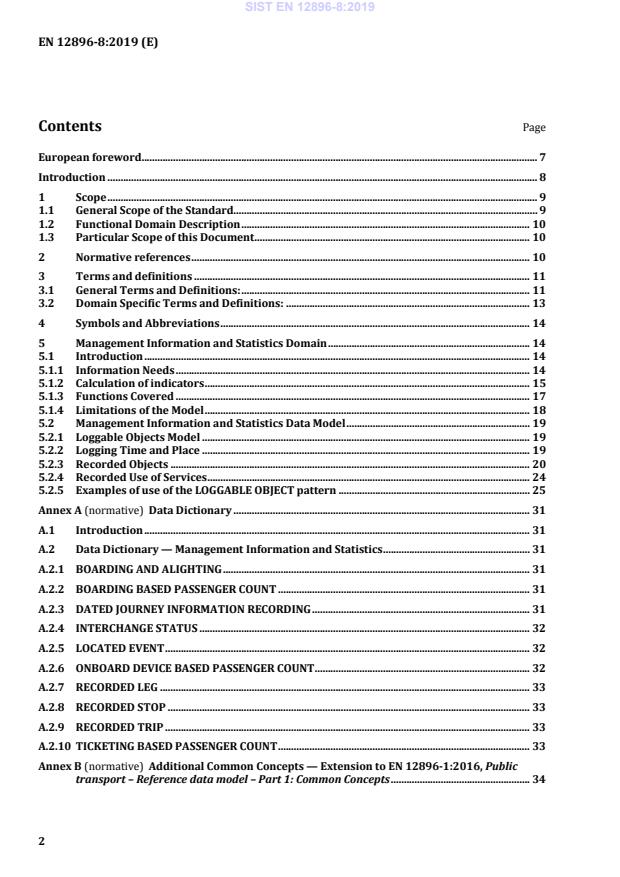
Contents Page
European foreword . 7
Introduction . 8
1 Scope . 9
1.1 General Scope of the Standard. 9
1.2 Functional Domain Description . 10
1.3 Particular Scope of this Document . 10
2 Normative references . 10
3 Terms and definitions . 11
3.1 General Terms and Definitions: . 11
3.2 Domain Specific Terms and Definitions: . 13
4 Symbols and Abbreviations . 14
5 Management Information and Statistics Domain . 14
5.1 Introduction . 14
5.1.1 Information Needs . 14
5.1.2 Calculation of indicators . 15
5.1.3 Functions Covered . 17
5.1.4 Limitations of the Model . 18
5.2 Management Information and Statistics Data Model . 19
5.2.1 Loggable Objects Model . 19
5.2.2 Logging Time and Place . 19
5.2.3 Recorded Objects . 20
5.2.4 Recorded Use of Services . 24
5.2.5 Examples of use of the LOGGABLE OBJECT pattern . 25
Annex A (normative) Data Dictionary . 31
A.1 Introduction . 31
A.2 Data Dictionary — Management Information and Statistics . 31
A.2.1 BOARDING AND ALIGHTING . 31
A.2.2 BOARDING BASED PASSENGER COUNT . 31
A.2.3 DATED JOURNEY INFORMATION RECORDING . 31
A.2.4 INTERCHANGE STATUS . 32
A.2.5 LOCATED EVENT . 32
A.2.6 ONBOARD DEVICE BASED PASSENGER COUNT . 32
A.2.7 RECORDED LEG . 33
A.2.8 RECORDED STOP . 33
A.2.9 RECORDED TRIP . 33
A.2.10 TICKETING BASED PASSENGER COUNT . 33
Annex B (normative) Additional Common Concepts — Extension to EN 12896-1:2016, Public
transport – Reference data model – Part 1: Common Concepts . 34
B.1 Methodology and Conventions . 34
B.1.1 Methodology for conceptual modelling . 34
B.1.1.1 General . 34
B.1.1.2 Packages . 34
B.1.1.3 Package Prefixes and Package order . 35
B.1.1.4 Part Prefixes and diagram names . 36
B.1.1.5 Class diagrams . 36
B.1.1.6 Class Diagram Presentations . 37
B.1.1.7 Use of Colour . 37
B.1.2 MODEL Class Diagrams . 38
B.1.2.1 General . 38
B.1.2.2 Classes and attributes . 39
B.1.2.2.1 General . 39
B.1.2.2.2 Attribute visibility . 39
B.1.2.2.3 Attribute names . 40
B.1.2.2.4 Attribute types . 40
B.1.2.2.5 Multiplicity of Attributes . 40
B.1.2.2.6 Common attributes . 40
B.1.2.2.7 Simple Diagram Example . 40
B.1.2.3 Relationships . 42
B.1.2.3.1 General . 42
B.1.2.3.2 Association relationships . 42
B.1.2.3.3 Reflexive associations . 42
B.1.2.3.4 Aggregation relationship . 43
B.1.2.3.5 Generalization relationship . 44
B.1.2.3.6 Multiplicity (Cardinality) of Relationships . 45
B.1.2.3.7 Presence of Relationships on a given diagram . 45
B.1.2.3.8 Relationships and navigability . 46
B.1.2.3.9 Positional semantics for laying out classes and relationships . 47
B.1.2.3.10 Explicit Frames . 47
B.1.3 Summary of Rules for Transmodel Presentation . 48
B.1.3.1 Presentation of Class Structure diagrams . 48
B.1.3.2 Rules for naming and presenting classes . 48
B.1.3.3 Rules for use of role names . 49
B.1.3.4 Rules for use of multiplicity . 50
B.1.3.5 Rules for relationship qualifiers . 50
B.1.3.6 Rules for presenting relationships . 51
B.1.3.7 Rules for Placing Role names . 51
B.2 Extensions to the Common Concept MODEL . 52
B.2.1 General . 52
B.2.2 Additional Common Concepts . 52
B.2.2.1 Additional Generalizations . 52
B.2.2.1.1 Generic Type of Value – Conceptual MODEL . 52
B.2.2.1.2 Generic Assignment – Conceptual MODEL . 53
B.2.2.1.3 Generic Section – Conceptual MODEL . 54
B.2.3 Extensions to the Generic Framework . 55
B.2.3.1 General . 55
B.2.3.2 Alternative Text – Conceptual MODEL . 55
B.2.3.3 Generic View – Conceptual MODEL . 56
B.2.3.4 Generic Loggable Object – Conceptual MODEL . 57
B.2.3.5 Event Model – Conceptual MODEL. 57
B.2.4 Extensions to the Reusable Components . 58
B.2.4.1 Employee Model – Conceptual MODEL . 58
B.2.4.2 Message Model – Conceptual MODEL . 59
B.2.4.2.1 Messages . 59
B.2.4.2.2 Publication Scope . 60
B.2.4.3 Role Model – Conceptual MODEL . 61
B.2.4.3.1 Generic Roles . 61
B.2.4.3.2 Service Organization Roles . 62
B.2.4.3.3 Employee Roles . 62
B.2.4.3.4 Administrative Organization Roles . 63
B.2.4.3.5 Technology Organization Roles . 64
B.2.4.3.6 Messaging Roles . 65
B.2.4.3.7 Transport Customer Roles . 66
B.2.4.4 Security List – Conceptual MODEL . 66
B.2.4.5 Transfer Time – Conceptual MODEL . 67
B.2.5 Data Dictionary . 67
B.2.5.1 General . 67
B.2.5.2 ADMINISTRATIVE ORGANIZATION ROLE . 68
B.2.5.3 ALTERNATIVE TEXT . 68
B.2.5.4 ASSIGNMENT . 68
B.2.5.5 BLACKLIST . 68
B.2.5.6 CLASS ATTRIBUTE . 69
B.2.5.7 CONDUCTOR ROLE . 69
B.2.5.8 CUSTOMER SERVICE PROVIDER ROLE . 69
B.2.5.9 CUSTOMER SERVICE ROLE . 69
B.2.5.10 DATA COLLECTOR ROLE . 70
B.2.5.11 DRIVER ROLE . 70
B.2.5.12 EMPLOYEE. 70
B.2.5.13 EMPLOYEE ROLE . 70
B.2.5.14 EVENT . 71
B.2.5.15 GENERAL EVENT . 71
B.2.5.16 GENERAL OBSERVER ROLE . 71
B.2.5.17 GENERAL SECTION . 71
B.2.5.18 LOG . 72
B.2.5.19 LOG ENTRY . 72
B.2.5.20 LOGGABLE OBJECT . 72
B.2.5.21 MESSAGE . 72
B.2.5.22 MESSAGE PART . 73
B.2.5.23 MESSAGE PRIORITY . 73
B.2.5.24 ORGANIZATION ROLE . 73
B.2.5.25 PT SCOPE . 73
B.2.5.26 PUBLICATION APPROVER ROLE . 73
B.2.5.27 PUBLICATION DECISION . 74
B.2.5.28 PUBLICATION SCOPE. 74
B.2.5.29 PUBLICATION WINDOW . 74
B.2.5.30 PUBLISHING ACTION . 74
B.2.5.31 PUBLISHING CHANNEL . 75
B.2.5.32 QUALIFICATION . 75
B.2.5.33 REGISTRAR ROLE . 75
B.2.5.34 SECTION . 75
B.2.5.35 SECTION IN LINK SEQUENCE . 76
B.2.5.36 SECURITY LIST. 76
B.2.5.37 SECURITY LISTABLE . 76
B.2.5.38 SECURITY LISTING . 76
B.2.5.39 SECURITY MANAGER ROLE . 76
B.2.5.40 SERVICE OPERATOR ROLE . 77
B.2.5.41 SITUATION AUTHOR ROLE . 77
B.2.5.42 SPECIFIC OBSERVER ROLE . 77
B.2.5.43 STATION EMPLOYEE ROLE . 77
B.2.5.44 TECHNOLOGY ORGANIZATION ROLE . 78
B.2.5.45 TRAFFIC INFORMATION OFFICER ROLE . 78
B.2.5.46 TRANSFER TIME . 78
B.2.5.47 TRANSPORT USER ROLE. 78
B.2.5.48 TRAVEL DOCUMENT CONTROLLER ROLE . 79
B.2.5.49 TRAVEL DOCUMENT CONTROLLING ORGANIZATION ROLE . 79
B.2.5.50 TRAVEL ORGANIZATION ROLE . 79
B.2.5.51 TYPE OF AUDIENCE . 79
B.2.5.52 TYPE OF EVENT . 80
B.2.5.53 TYPE OF MESSAGE . 80
B.2.5.54 TYPE OF MESSAGE PART CONTENT . 80
B.2.5.55 TYPE OF QUALIFICATION . 80
B.2.5.56 TYPE OF SECURITY LIST . 81
B.2.5.57 TYPE OF VALUE. 81
B.2.5.58 View . 81
B.2.5.59 WHITELIST . 81
Annex C (informative) Data Model Evolutions. 83
C.1 Change Requests . 83
C.2 Source of Text . 83
C.3 Diagram Status . 83
Bibliography . 85
European foreword
This document (EN 12896-8:2019) has been prepared by Technical Committee CEN/TC 278 “Intelligent
transport systems”, the secretariat of which is held by NEN.
This European Standard shall be given the status of a national standard, either by publication of an
identical text or by endorsement, at the latest by March 2020, and conflicting national standards shall
be withdrawn at the latest by March 2020.
Attention is drawn to the possibility that some of the elements of this document may be the subject of
patent rights. CEN shall not be held responsible for identifying any or all such patent rights.
The series is composed of the following documents:
— Public transport – Reference data model – Part 1: Common concepts;
— Public transport – Reference data model – Part 2: Public transport network;
— Public transport – Reference data model – Part 3: Timing information and vehicle scheduling;
— Public transport – Reference data model – Part 4: Operations monitoring and control;
— Public transport – Reference data model – Part 5: Fare management;
— Public transport – Reference data model – Part 6: Passenger information;
— Public transport – Reference data model – Part 7: Driver management;
— Public transport – Reference data model – Part 8: Management information & statistics; and
— Public transport – Reference data model – Part 9: Informative documentation [CEN/TR].
Together these create version 6 of the European Standard EN 12896, known as “Transmodel”, and thus
replace EN 12896:2006, known as “Transmodel v5.1”.
In comparison with EN 12896:2006, the technical modifications made are presented in
CEN/TR 12896-9, Public transport – Reference data model – Part 9: Informative Documentation.
According to the CEN-CENELEC Internal Regulations, the national standards organisations of the
following countries are bound to implement this European Standard: Austria, Belgium, Bulgaria,
Croatia, Cyprus, Czech Republic, Denmark, Estonia, Finland, France, Germany, Greece, Hungary, Iceland,
Ireland, Italy, Latvia, Lithuania, Luxembourg, Malta, Netherlands, Norway, Poland, Portugal, Republic of
North Macedonia, Romania, Serbia, Slovakia, Slovenia, Spain, Sweden, Switzerland, Turkey and the
United Kingdom.
Introduction
Part 1 of this European Standard presents the following items:
— Rationale for the Transmodel Standard;
— Use of the Transmodel Standard;
— Applicability of the Transmodel Standard;
— Conformance Statement;
— Transmodel Origins;
— Reference to the Previous Version and Other Documents.
The data structures represented in Part 1 are generic patterns that are referenced by different other
parts.
Part 2 of this European Standard presents space-related data structures.
Part 3 presents time-related data structures and replaces the sections of EN 12896:2006 referring to
the time-related Tactical Planning Components and to Vehicle Scheduling.
Part 4 presents data referring to daily operations (i.e. to operational days), different from those planned
for day types (space-related data structures and tactical planning components) and including
operational raw data referring to operations follow-up.
Part 5 presents fares structures including sales, validation and control.
Part 6 presents Passenger Information (planned and real-time).
Part 7 presents Driver Management including Driver Scheduling (day-type related driver schedules),
Rostering (ordering of driver duties into sequences according to some chosen methods) and Driving
Personnel Disposition (assignment of logical drivers to physical drivers and recording of driver
performance).
Part 8 (this part) presents Management Information and Statistics.
1 Scope
1.1 General Scope of the Standard
The main objective of the present standard is to present the Reference Data Model for Public Transport,
based on:
— the Reference Data Model, EN 12896, known as Transmodel V5.1;
— EN 28701:2012, Intelligent transport systems – Public transport – Identification of Fixed Objects in
Public Transport (IFOPT), although note that this particular standard has been withdrawn as it is
now included within Parts 1 and 2 of this standard (EN 12896-1:2016 and EN 12896-2:2016)
following their successful publication;
incorporating the requirements of:
— EN 15531-1 to −3 and CEN/TS 15531-4 and −5: Public transport – Service interface for real-time
information relating to public transport operations (SIRI);
— CEN/TS 16614-1 and -2: Network and Timetable Exchange (NeTEx), in particular the specific needs
for long distance train operation.
Particular attention is drawn to the data model structure and methodology:
— the data model is described in a modular form in order to facilitate the understanding and the use
of the model;
— the data model is entirely described in UML.
The following functional domains are considered:
— Network Description: routes, lines, journey patterns, timing patterns, service patterns, scheduled
stop points and stop places;
— Timing Information and Vehicle Scheduling (runtimes, vehicle journeys, day type-related vehicle
schedules);
— Passenger Information (planned and real-time);
— Fare Management (fare structure, sales, validation, control);
— Operations Monitoring and Control: operating day-related data, vehicle follow-up, control actions;
— Driver Management:
— Driver Scheduling (day-type related driver schedules),
— Rostering (ordering of driver duties into sequences according to some chosen methods),
— Driving Personnel Disposition (assignment of logical drivers to physical drivers and recording
of driver performance);
— Management Information and Statistics (including data dedicated to service performance
indicators).
The data modules dedicated to cover most functions of the above domains will be specified.
Several concepts are shared by the different functional domains. This data domain is called “Common
Concepts”.
1.2 Functional Domain Description
The different functional domains (enumerated above) taken into account in the present document, and
of which the data have been represented as the reference model, are described in EN 12896-1:2016,
Public transport – Reference data model – Part 1: Common Concepts.
1.3 Particular Scope of this Document
The present document entitled Public transport – Reference data model – Part 8: Management
information & statistics describes how to structure data which refers to the planning stages
(e.g. timetables, run times, driver rosters, etc.) and/or to the daily actual production, and which is
registered for different purposes, in particular to build service performance indicators. The data model
is based on a generic design pattern, Generic Loggable Objects Model (provided in the Additional
Common Concepts part – Annex B), and incorporates the following data packages:
— Logging Time and Place, providing additions to the Generic Loggable Objects Model,
— Recorded Objects,
— Recorded Use of Services,
— Service Journey Performance.
The last three packages show how the recorded data contributes to the implementation of indicators.
This document itself is composed of the following parts:
— Main document (normative),
— Annex A (normative), containing the data dictionary, i.e. the list of all the concepts and attribute
tables present in the main document together with the definitions,
— Annex B (normative), providing a complement to EN 12896-1:2016, particularly useful for Parts 4
to 8 of the Public Transport Reference Data Model;
— Annex C (informative), indicating the data model evolution from the previous version.
2 Normative references
The following documents are referred to in the text in such a way that some or all of their content
constitutes requirements of this document. For dated references, only the edition cited applies. For
undated references, the latest edition of the referenced document (including any amendments) applies.
EN 12896-1:2016, Public transport – Reference data model – Part 1: Common concepts
EN 12896-2:2016, Public transport – Reference data model – Part 2: Public transport network
EN 12896-3:2016, Public transport – Reference data model – Part 3: Timing information and vehicle
scheduling
ISO 4217:2015, Codes for the representation of currencies
ISO 80000-1:2009, Quantities and units – Part 1: General
3 Terms and definitions
For the purposes of this document, the following terms and definitions apply.
ISO and IEC maintain terminological databases for use in standardization at the following addresses:
• IEC Electropedia: available at http://www.electropedia.org/
• ISO Online browsing platform: available at http://www.iso.org/obp
3.1 General Terms and Definitions:
3.1.1
attribute
property of an entity
3.1.2
conceptual data model
description of a real-world domain in terms of entities, relationships and attributes in an
implementation independent manner in order to provide a structure on which the rest of the
development of an application system can be based
3.1.3
conceptual level
conceptual data model in the context of data modelling
3.1.4
database
collection of data; often used in the sense of the physical implementation of a data model
3.1.5
data domain
data structure (in this European Standard, part of the Reference Data Model for Public Transport) made
up of data related to each other, through the fact that there is a functional area or group of functions
using this data set as a whole
3.1.6
data model
description of a real-world domain in terms of data and relationships
3.1.7
entity
object (data) that has its own existence (as opposed to an attribute)
3.1.8
fare management
all activities related to the collection of money from passengers
3.1.9
function
activity which, in this European Standard, is a sub-activity of a functional area
3.1.10
functional area
arbitrarily defined set of activities, used, in this European Standard, to define the objectives and limits
of the data model
3.1.11
interoperability
ability of (sub)systems to interact with other (sub)systems according to a set of predefined rules
(interface)
3.1.12
logical data model
data design that takes into account the type of database to be used but which does not consider means
of utilization of space or access
3.1.13
logical denormalized model
relational data model that is not fully normalized, i.e. does not completely follow the normalization
rules and thus may be redundant
3.1.14
logical level
logical data model in the context of data modelling
3.1.15
management information
all activities allowing the company management to collect the information necessary to meet problem-
solving needs
3.1.16
object-oriented data model
data structure expressed according to principles that allow for a direct implementation as an object-
oriented database, where information is represented in form of objects, i.e. respecting the principle of
encapsulation meaning in particular that each data are accessed or modified through operations
(methods) belonging to it
3.1.17
operations monitoring and control
all activities related to the transportation process, i.e. real-time functions related to the driving and
transportation of passengers according to given instructions, including the monitoring of the driving
process and its control in case of deviations, as well as all activities that support the driving process
such as traffic light priority, track switching, bay selection, advance/delay advice, etc.
3.1.18
passenger information
all activities related to informing the users either on the planned or on the actual transportation
services
3.1.19
personnel disposition
all activities related to the mid-term and short-term management of drivers
3.1.20
real-time control
see Operations monitoring and control
3.1.21
relational data model
type of logical data model giving the information as series of tables (relations) and attributes, and
possessing the following characteristics:
a) all attribute values are atomic;
b) all “tuples” (rows/occurrences) are distinct;
c) no part of the primary key may be null; and
d) foreign key values must correspond to an existing primary key in another relation or be null
3.1.22
scheduling
see Tactical Planning
3.1.23
tactical planning
all activities related to the tactical planning of transportation, splitting into vehicle scheduling, driver
scheduling, rostering
3.2 Domain Specific Terms and Definitions:
NOTE The following terms specific to the Management Information and Statistics domain are used. Terms
which are also data entity names are defined in the data dictionary in Annex A and are mostly not repeated here.
3.2.1
aggregation frame
data structure within which the data values are grouped and used for a formula to provide an indicator
3.2.2
indicator
set of data (calculated or measured) which may be either qualitative or quantitative that is used to
provide information on the status (may be a measure, a functional state, etc.) or the quality of a service
or a function
3.2.3
indicator type
category of a given indicator, e.g. time, length, passenger count, price, vehicle, etc.
3.2.4
indicator unit
measurement unit (e.g. metres, seconds, passengers, etc.) in which a specific indicator is measured
3.2.5
formula
method to calculate indicators that are based on other indicators or on a set of raw data
3.2.6
granularity
input for calculation processes representing the smallest unit(s) to generate output indicator(s)
3.2.7
O/D matrix
tabular structure describing data by origin/destination parameters (e.g. daily traffic volume between
zones)
3.2.8
indicator parameter type
category of a given indicator parameter, e.g. time, length, passenger count, price, vehicle, etc.
3.2.9
indicator parameter unit
measurement unit (e.g. meters, seconds, passengers, etc.) in which a specific indicator parameter is
measured
4 Symbols and Abbreviations
IFOPT Identification of Fixed Objects in Public Transport
ISO International Organization for Standardization
IT Information Technology
O/D Origin / Destination
PT Public Transport
PTO Public Transport Operator
SI International System of Units (abbreviated from the French Système international)
SIRI Service Interface for Real-time Information
TM Transmodel
UML Unified Modelling Language
5 Management Information and Statistics Domai
...