

CEN/TS 15531-5:2022
(Main)Public transport - Service interface for real-time information relating to public transport operations - Part 5: Functional service interfaces situation exchange: Situation exchange
- Abstract
The SIRI Situation Exchange service (SIRI-SX) allows the efficient exchange of data about Situations caused by planned and unplanned incidents and events and is intended to support the use cases identified in Annex C. Situations are actual or potential perturbations to normal operation of a transport network. The SIRI-SX service uses the common SIRI communication framework and services which are described in EN 15531-1 and not repeated in this document.
The Situation Exchange service has a rich Situation model, allowing a structured description of all aspects of multimodal travel Situations, including cause, scope, effect and rules for distribution to an audience. The structured values enabling computer based distribution through a wide variety of channels, and the presentation of data in different formats for different device and different audiences. The Situation Exchange Service allows the exchange of incident and event information between, amongst others:
- Control centres;
- Operations Staff;
- Public Information systems;
- Alert systems and personalised alert systems;
- UTMC systems;
- Journey planners;
- AVMS (Automatic Vehicle Management Systems).
SIRI-SX uses a network model based on the CEN Transmodel conceptual model for Public Transport networks, schedules and operations, along with the CEN Identification of Fixed Objects in Public Transport (IFOPT) model for describing physical transport interchanges that is an integrated part of CEN Transmodel conceptual model for Public Transport networks.
The Situation Exchange service is envisaged as a 'back office' capture and exchange service that will feed other public facing travel information dissemination systems in particular those using the TPEG format. Transport Protocol Expert Group (TPEG) is a European Broadcasting Union fostered standard for broadcasting travel data over Digital Assisted Broadcasting (DAB) radio and other channels. TPEG is maintained by the Traveller Information Services Association (TISA). To this end, the SIRI-SX situation classification model has been harmonized as far as possible with that of TPEG and DATEX2 so that full interoperability can be achieved. Uses of structured elements from TPEG, for which translations already exist in most European languages, also facilitates human readability in different national languages. Maintaining and improving a harmonization with TPEG will be a continuing objective. In addition to the TPEG exchangeable content, SIRI-SX messages contain additional structured information which allows them to be processed in additional ways.
Situation and computer systems and applications are typically distributed, that is information will be captured on one system and exchanged with others for dissemination and further processing. This means that a message design is needed that allows the management of the identity of distributed messages over time and across different systems, so that subsequent updates to a Situation can be reconciled by different systems over a network, and obsolete messages can be retired automatically. The SIRI-SX SITUATION model is designed to support the distributed management of Situations.
- Status
- Published
- Publication Date
- 09-Aug-2022
- Technical Committee
- CEN/TC 278 - Road transport and traffic telematics
- Drafting Committee
- CEN/TC 278/WG 3 - Public transport (PT)
- Current Stage
- 9093 - Decision to confirm - Review Enquiry
- Start Date
- 27-May-2026
- Completion Date
- 07-Oct-2026

Overview
CEN/TS 15531-5:2022 defines the SIRI Situation Exchange (SIRI-SX) service for exchanging real‑time information about planned and unplanned incidents and events that affect public transport operations. It specifies a structured Situation model and message behaviour for capturing, updating and distributing Situations across distributed systems (control centres, operations staff, journey planners, AVMS, alert systems, public information systems, UTMCs, etc.). SIRI-SX builds on the SIRI communication framework (EN 15531‑1) and uses the CEN Transmodel and IFOPT network models.
Key topics and technical requirements
- Rich Situation model: Structured representation of cause, scope, effect, accessibility, and audience distribution rules to enable machine processing and tailored presentation.
- Distributed message management: Identity, life‑cycle, timestamps, update chains, branching and reconciliation rules so updates and retirements are handled consistently across systems.
- Interoperability & harmonization: Mapping and alignment with TPEG and DATEX2 classification models to support broadcast dissemination and cross‑system data exchange; use of TPEG elements for multilingual, human‑readable values.
- Network modelling: Uses CEN Transmodel and IFOPT for describing affected networks, stop places and journeys - enabling multimodal and location‑aware situation descriptions.
- Service interfaces and operations: Definitions for SituationExchangeRequest, SubscriptionRequest and SituationExchangeDelivery, plus filters (network, stop place, journey, road, accessibility) and capability/permission matrices.
- Serialization and modelling: UML diagrams, XML serialisation guidance and examples to support implementation and system integration.
- Archiving and lifecycle management: Guidance on versioning, archiving obsolete Situations and retaining history for downstream systems.
Applications and who uses it
SIRI-SX is designed as a back‑office capture and exchange service that feeds public-facing channels and operational systems. Typical applications include:
- Real‑time incident exchange between control centres and operations teams
- Automated feeding of journey planners and public information systems with incident context and impact
- Integration with broadcast formats (TPEG) and alerting/personalized notification systems
- Coordination across multimodal networks (bus, tram, rail, road) for disruption management
- Interfacing with AVMS and UTMC for in-vehicle and roadside messaging
Primary users: transport authorities, traffic control centres, ITS vendors, journey planner operators, broadcast content providers, and software integrators.
Related standards
- EN 15531‑1 (SIRI common framework)
- CEN Transmodel (public transport conceptual model)
- IFOPT (Identification of Fixed Objects in Public Transport)
- TPEG (Transport Protocol Expert Group formats) and DATEX2 (traffic and travel data exchange) - referenced for harmonization and interoperability.
Keywords: SIRI-SX, CEN/TS 15531-5:2022, situation exchange, real-time public transport, Transmodel, IFOPT, TPEG, DATEX2, incident management, journey planners.
Relations
- Effective Date
- 17-Aug-2022
- Effective Date
- 28-Jan-2026
- Effective Date
- 09-Feb-2026
- Referred By
EN 63005-1:2017 - Event video data recorder for road vehicle accidents - Part 1: Basic requirements - Effective Date
- 09-Feb-2026
- Effective Date
- 28-Jan-2026
- Effective Date
- 28-Jan-2026
- Referred By
EN 12896-6:2019 - Public transport - Reference data model - Part 6: Passenger information - Effective Date
- 28-Jan-2026
- Effective Date
- 28-Jan-2026
- Effective Date
- 28-Jan-2026
- Referred By
CEN/TS 17051:2017 - Full body photography - Effective Date
- 28-Jan-2026
- Effective Date
- 28-Jan-2026
Get Certified
Connect with accredited certification bodies for this standard

BSI Group
BSI (British Standards Institution) is the business standards company that helps organizations make excellence a habit.

NYCE
Mexican standards and certification body.
Sponsored listings
Frequently Asked Questions
CEN/TS 15531-5:2022 is a technical specification published by the European Committee for Standardization (CEN). Its full title is "Public transport - Service interface for real-time information relating to public transport operations - Part 5: Functional service interfaces situation exchange: Situation exchange". This standard covers: The SIRI Situation Exchange service (SIRI-SX) allows the efficient exchange of data about Situations caused by planned and unplanned incidents and events and is intended to support the use cases identified in Annex C. Situations are actual or potential perturbations to normal operation of a transport network. The SIRI-SX service uses the common SIRI communication framework and services which are described in EN 15531-1 and not repeated in this document. The Situation Exchange service has a rich Situation model, allowing a structured description of all aspects of multimodal travel Situations, including cause, scope, effect and rules for distribution to an audience. The structured values enabling computer based distribution through a wide variety of channels, and the presentation of data in different formats for different device and different audiences. The Situation Exchange Service allows the exchange of incident and event information between, amongst others: - Control centres; - Operations Staff; - Public Information systems; - Alert systems and personalised alert systems; - UTMC systems; - Journey planners; - AVMS (Automatic Vehicle Management Systems). SIRI-SX uses a network model based on the CEN Transmodel conceptual model for Public Transport networks, schedules and operations, along with the CEN Identification of Fixed Objects in Public Transport (IFOPT) model for describing physical transport interchanges that is an integrated part of CEN Transmodel conceptual model for Public Transport networks. The Situation Exchange service is envisaged as a 'back office' capture and exchange service that will feed other public facing travel information dissemination systems in particular those using the TPEG format. Transport Protocol Expert Group (TPEG) is a European Broadcasting Union fostered standard for broadcasting travel data over Digital Assisted Broadcasting (DAB) radio and other channels. TPEG is maintained by the Traveller Information Services Association (TISA). To this end, the SIRI-SX situation classification model has been harmonized as far as possible with that of TPEG and DATEX2 so that full interoperability can be achieved. Uses of structured elements from TPEG, for which translations already exist in most European languages, also facilitates human readability in different national languages. Maintaining and improving a harmonization with TPEG will be a continuing objective. In addition to the TPEG exchangeable content, SIRI-SX messages contain additional structured information which allows them to be processed in additional ways. Situation and computer systems and applications are typically distributed, that is information will be captured on one system and exchanged with others for dissemination and further processing. This means that a message design is needed that allows the management of the identity of distributed messages over time and across different systems, so that subsequent updates to a Situation can be reconciled by different systems over a network, and obsolete messages can be retired automatically. The SIRI-SX SITUATION model is designed to support the distributed management of Situations.
The SIRI Situation Exchange service (SIRI-SX) allows the efficient exchange of data about Situations caused by planned and unplanned incidents and events and is intended to support the use cases identified in Annex C. Situations are actual or potential perturbations to normal operation of a transport network. The SIRI-SX service uses the common SIRI communication framework and services which are described in EN 15531-1 and not repeated in this document. The Situation Exchange service has a rich Situation model, allowing a structured description of all aspects of multimodal travel Situations, including cause, scope, effect and rules for distribution to an audience. The structured values enabling computer based distribution through a wide variety of channels, and the presentation of data in different formats for different device and different audiences. The Situation Exchange Service allows the exchange of incident and event information between, amongst others: - Control centres; - Operations Staff; - Public Information systems; - Alert systems and personalised alert systems; - UTMC systems; - Journey planners; - AVMS (Automatic Vehicle Management Systems). SIRI-SX uses a network model based on the CEN Transmodel conceptual model for Public Transport networks, schedules and operations, along with the CEN Identification of Fixed Objects in Public Transport (IFOPT) model for describing physical transport interchanges that is an integrated part of CEN Transmodel conceptual model for Public Transport networks. The Situation Exchange service is envisaged as a 'back office' capture and exchange service that will feed other public facing travel information dissemination systems in particular those using the TPEG format. Transport Protocol Expert Group (TPEG) is a European Broadcasting Union fostered standard for broadcasting travel data over Digital Assisted Broadcasting (DAB) radio and other channels. TPEG is maintained by the Traveller Information Services Association (TISA). To this end, the SIRI-SX situation classification model has been harmonized as far as possible with that of TPEG and DATEX2 so that full interoperability can be achieved. Uses of structured elements from TPEG, for which translations already exist in most European languages, also facilitates human readability in different national languages. Maintaining and improving a harmonization with TPEG will be a continuing objective. In addition to the TPEG exchangeable content, SIRI-SX messages contain additional structured information which allows them to be processed in additional ways. Situation and computer systems and applications are typically distributed, that is information will be captured on one system and exchanged with others for dissemination and further processing. This means that a message design is needed that allows the management of the identity of distributed messages over time and across different systems, so that subsequent updates to a Situation can be reconciled by different systems over a network, and obsolete messages can be retired automatically. The SIRI-SX SITUATION model is designed to support the distributed management of Situations.
CEN/TS 15531-5:2022 is classified under the following ICS (International Classification for Standards) categories: 35.240.60 - IT applications in transport. The ICS classification helps identify the subject area and facilitates finding related standards.
CEN/TS 15531-5:2022 has the following relationships with other standards: It is inter standard links to CEN/TS 15531-5:2016, EN 15531-1:2015, EN IEC 63005-2:2020, EN 63005-1:2017, CEN/TS 16614-2:2014, CEN/TS 17118:2017, EN 12896-6:2019, CEN/TS 17100:2017, CEN/TS 17402:2020, CEN/TS 17051:2017, CEN/TS 16614-1:2014. Understanding these relationships helps ensure you are using the most current and applicable version of the standard.
CEN/TS 15531-5:2022 is available in PDF format for immediate download after purchase. The document can be added to your cart and obtained through the secure checkout process. Digital delivery ensures instant access to the complete standard document.
Standards Content (Sample)
SLOVENSKI STANDARD
01-november-2022
Nadomešča:
SIST-TS CEN/TS 15531-5:2016
Javni prevoz - Vmesnik za informiranje v realnem času za potrebe delovanja
javnega prevoza - 5. del: Vmesniki funkcijske storitve izmenjave podatkov:
Izmenjava podatkov o situaciji
Public transport - Service interface for real-time information relating to public transport
operations - Part 5: Functional service interfaces situation exchange: Situation exchange
Öffentlicher Verkehr - Diensteschnittstelle für Echtzeitinformationen bezogen auf
Betriebsabläufe im öffentlichen Verkehr - Teil 5: Funktionelle Serviceschnittstelle -
Situativer Austausch
Transport public - Interface de service pour les informations en temps réel relatives aux
opérations de transport public - Partie 5 : Service d'interface fonctionnelle - Échange de
l'état de l'exploitation et de son contexte
Ta slovenski standard je istoveten z: CEN/TS 15531-5:2022
ICS:
35.240.60 Uporabniške rešitve IT v IT applications in transport
prometu
2003-01.Slovenski inštitut za standardizacijo. Razmnoževanje celote ali delov tega standarda ni dovoljeno.
CEN/TS 15531-5
TECHNICAL SPECIFICATION
SPÉCIFICATION TECHNIQUE
August 2022
TECHNISCHE SPEZIFIKATION
ICS 35.240.60 Supersedes CEN/TS 15531-5:2016
English Version
Public transport - Service interface for real-time
information relating to public transport operations - Part
5: Functional service interfaces situation exchange:
Situation exchange
Transport public - Interface de service pour les Öffentlicher Verkehr - Diensteschnittstelle für
informations en temps réel relatives aux opérations de Echtzeitinformationen bezogen auf Betriebsabläufe im
transport public - Partie 5 : Service d'interface öffentlichen Verkehr - Teil 5: Funktionelle
fonctionnelle - Échange de l'état de l'exploitation et de Serviceschnittstelle - Situativer Austausch
son contexte
This Technical Specification (CEN/TS) was approved by CEN on 20 June 2022 for provisional application.
The period of validity of this CEN/TS is limited initially to three years. After two years the members of CEN will be requested to
submit their comments, particularly on the question whether the CEN/TS can be converted into a European Standard.
CEN members are required to announce the existence of this CEN/TS in the same way as for an EN and to make the CEN/TS
available promptly at national level in an appropriate form. It is permissible to keep conflicting national standards in force (in
parallel to the CEN/TS) until the final decision about the possible conversion of the CEN/TS into an EN is reached.
CEN members are the national standards bodies of Austria, Belgium, Bulgaria, Croatia, Cyprus, Czech Republic, Denmark, Estonia,
Finland, France, Germany, Greece, Hungary, Iceland, Ireland, Italy, Latvia, Lithuania, Luxembourg, Malta, Netherlands, Norway,
Poland, Portugal, Republic of North Macedonia, Romania, Serbia, Slovakia, Slovenia, Spain, Sweden, Switzerland, Turkey and
United Kingdom.
EUROPEAN COMMITTEE FOR STANDARDIZATION
COMITÉ EUROPÉEN DE NORMALISATION
EUROPÄISCHES KOMITEE FÜR NORMUNG
CEN-CENELEC Management Centre: Rue de la Science 23, B-1040 Brussels
© 2022 CEN All rights of exploitation in any form and by any means reserved Ref. No. CEN/TS 15531-5:2022 E
worldwide for CEN national Members.
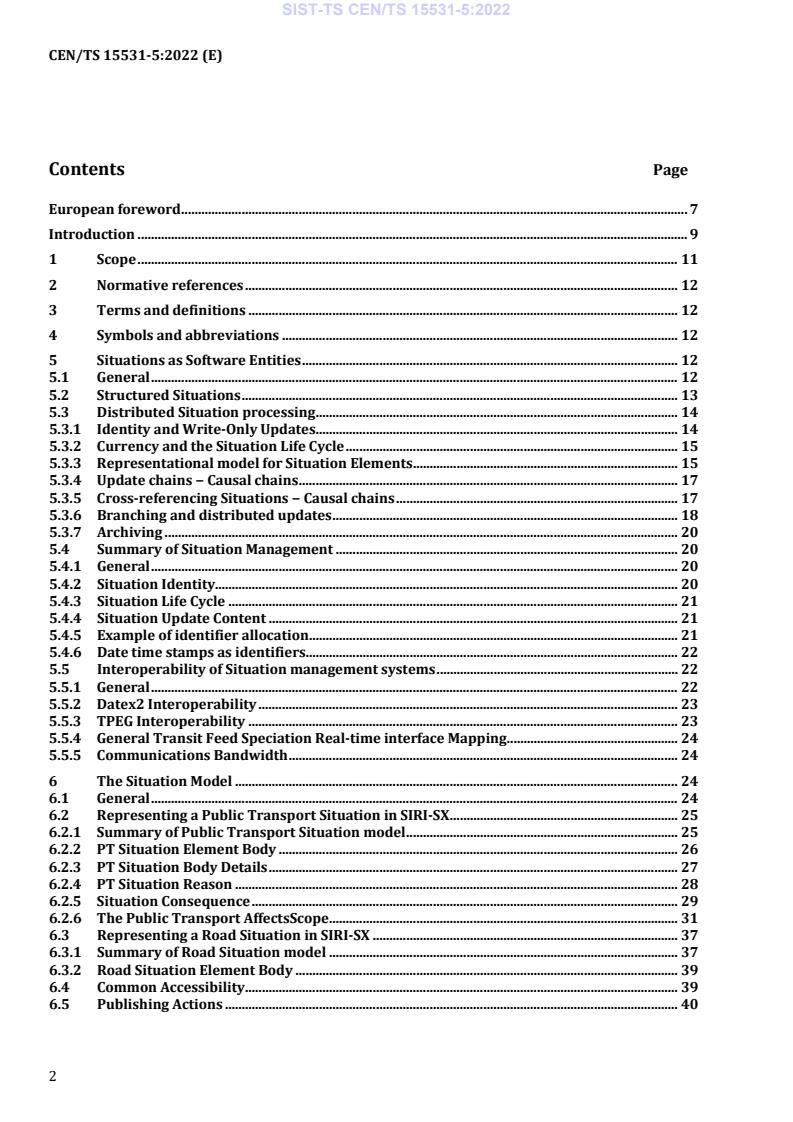
Contents Page
European foreword . 7
Introduction . 9
1 Scope . 11
2 Normative references . 12
3 Terms and definitions . 12
4 Symbols and abbreviations . 12
5 Situations as Software Entities . 12
5.1 General . 12
5.2 Structured Situations . 13
5.3 Distributed Situation processing . 14
5.3.1 Identity and Write-Only Updates. 14
5.3.2 Currency and the Situation Life Cycle . 15
5.3.3 Representational model for Situation Elements . 15
5.3.4 Update chains − Causal chains . 17
5.3.5 Cross-referencing Situations − Causal chains . 17
5.3.6 Branching and distributed updates . 18
5.3.7 Archiving . 20
5.4 Summary of Situation Management . 20
5.4.1 General . 20
5.4.2 Situation Identity. 20
5.4.3 Situation Life Cycle . 21
5.4.4 Situation Update Content . 21
5.4.5 Example of identifier allocation . 21
5.4.6 Date time stamps as identifiers. 22
5.5 Interoperability of Situation management systems . 22
5.5.1 General . 22
5.5.2 Datex2 Interoperability . 23
5.5.3 TPEG Interoperability . 23
5.5.4 General Transit Feed Speciation Real-time interface Mapping . 24
5.5.5 Communications Bandwidth . 24
6 The Situation Model . 24
6.1 General . 24
6.2 Representing a Public Transport Situation in SIRI-SX . 25
6.2.1 Summary of Public Transport Situation model . 25
6.2.2 PT Situation Element Body . 26
6.2.3 PT Situation Body Details . 27
6.2.4 PT Situation Reason . 28
6.2.5 Situation Consequence . 29
6.2.6 The Public Transport AffectsScope . 31
6.3 Representing a Road Situation in SIRI-SX . 37
6.3.1 Summary of Road Situation model . 37
6.3.2 Road Situation Element Body . 39
6.4 Common Accessibility . 39
6.5 Publishing Actions . 40
6.6 Common Types . 42
6.6.1 Common SIRI Data Types . 42
6.6.2 Common General SIRI Enumerations . 42
6.6.3 SIRI-SX Enumerations . 43
6.6.4 TRANSMODEL Enumerations . 43
6.6.5 TPEG Miscellaneous Enumerations . 44
6.6.6 TPEG Mode Enumerations . 45
7 Situation Exchange Service [SX] . 46
7.1 Purpose. 46
7.2 Description . 47
7.3 Reference Data . 47
7.4 Capability and Permission Matrices . 47
7.4.1 Capability Matrix . 47
7.5 UML Diagrammatic Representation . 49
7.5.1 General . 49
7.5.2 UML Summary Diagram of SituationExchangeRequest . 49
7.5.3 UML Detailed Diagram of SituationExchangeRequest . 50
7.5.4 UML Diagram of SituationExchangeDelivery - Summary . 51
7.5.5 UML Diagram of SituationExchangeDelivery - Details . 52
7.5.6 UML Diagram of SituationContext . 53
7.6 SituationExchangeRequest . 54
7.6.1 SituationExchangeRequest Definition . 54
7.6.2 SituationStatusFilterGroup Definition . 56
7.6.3 SituationNetworkFilterGroup Definition . 57
7.6.4 SituationStopPlaceFilterGroup Definition. 58
7.6.5 SituationJourneyFilterGroup Definition . 58
7.6.6 SituationPlaceFilterGroup Definition . 59
7.6.7 SituationRoadFilter Definition . 59
7.6.8 AccessibilityNeedFilter Element . 59
7.6.9 SituationExchangeRequest Example . 60
7.7 SituationExchangeSubscriptionRequest . 60
7.7.1 SituationExchangeSubscriptionRequest Definition . 60
7.7.2 SituationExchangeSubscriptionRequest Example . 61
7.8 SituationExchangeDelivery . 61
7.8.1 ServiceDelivery with a SituationExchangeDelivery . 62
7.8.2 SituationExchangeDelivery Element . 62
7.8.3 PtSituationContext Element . 62
7.8.4 Network Element . 63
7.8.5 PtSituationElement . 63
7.8.6 RoadSituationElement . 110
8 SituationExchangeDelivery Examples . 113
8.1 SituationExchangeDelivery Example . 113
8.2 SituationExchangeDelivery Example with PassengerInformationAction . 114
A.1 General . 117
A.2 Classes . 117
A.3 Enumerations . 117
A.4 Groups . 117
A.5 Notes . 117
A.6 Relationships . 117
A.7 Use of Colour . 118
A.8 Serialisation: Containment and Reference . 118
A.9 Alternative Representations of XML Structures in UML . 119
A.10 XML Fragment for Example . 121
A.11 Order of Attributes . 122
A.12 Direction of Reading . 122
A.13 Simple Data Types . 122
A.14 Reusable Complex Data Types . 122
B.1 SIRI-SX and Datex2 . 123
C.1 General . 126
C.2 Use Cases: Capture and Origination of Situations . 126
C.3 CAPT#01 Situations entered manually by operator staff . 126
C.4 CAPT#02 Situations updated manually by operator staff . 126
C.5 CAPT#03 Situations being generated automatically from a situation analyser . 127
C.6 CAPT#04 Situations arising from Facility Monitoring (e.g. lift failure). 127
C.7 CAPT#05 Situations arising from Control Actions (e.g. short running, platform
change) . 127
C.8 CAPT#06 Situations supplied automatically from a related public transport network
(e.g. rail incidents being fed to bus system) in both SIRI and TPEG formats . 127
C.9 CAPT#07 Situations supplied automatically from a related Road network (e.g. road
situations being fed to bus system) Datex2 formats . 127
C.10 CAPT#08 Road work affecting bus lanes . 127
C.11 CAPT#09 Parking not available at an interchange to PT . 128
C.12 CAPT#10 Weather or non-network specific Situation or event . 128
C.13 CAPT#11 Cross referencing Situations with previous Situations . 128
C.14 CAPT#12 Workflow for verification, validation and editorial correction . 128
C.15 CAPT#13 Providing of collective guidance of passengers . 128
C.16 CAPT#14 Audit trails, retrospectives and process views . 128
C.17 Use Cases: Relating Situations to other SIRI services . 128
C.18 XREF#01 Problem affecting a specific vehicle journey . 129
C.19 XREF#02 Problem at a stop place affecting some or all journeys for some or all
modes . 129
C.20 XREF#03 Problem affecting a whole line or a section of a line between two stop
places . 129
C.21 XREF#04 Problems affecting an interchange . 129
C.22 XREF#05 Problem affecting a whole network . 129
C.23 XREF#06 Disruption (e.g. partial blockage) or degradation (e.g. crowding) of normal
travel . 130
C.24 XREF#07 Problems affecting particular classes of users e.g. impaired mobility . 130
C.25 Use Cases: Onwards Distribution to other systems (e.g. in TPEG and Datex2) . 130
C.26 DIST#01 Distribution of Situations to displays . 130
C.27 DIST#02 Distribution of Situations to external information services, e.g.
broadcasters . 130
C.28 DIST#03 Distribution of Situations to staff . 130
C.29 DIST#04 Distribution of Situations to alerts and travel angels . 131
C.30 DIST#05 Projection of Situations on maps . 131
C.31 DIST#06 Distribution of Situations to journey planners . 131
C.32 DIST#07 Distribution of Situations to personal navigators and smart devices . 131
C.33 DIST#08 Distribution of Situations to other incident management systems . 131
C.34 DIST#09 Distribution of updates to existing Situations . 131
C.35 DIST#10 Aging of Situations and updates . 132
D.1 Mapping of SIRI-SX elements to GTFS-realtime . 133
D.2 Mapping of SIRI-SX Journey Condition to GTFS-realtime ScheduleRelationship . 134
D.3 Mapping of SIRI-SX Situation Categories to GTFS-realtime Cause . 134
D.4 Mapping of SIRI-SX Service Conditions to GTFS Real-time Effect . 134
E.1 Overview of Enumerations . 136
E.2 SituationSource Element . 137
E.2.1 SituationSourceTypeEnumeration (+SIRI v2.1) . 137
E.2.2 SourceTypeEnum (+SIRI v2.1) . 138
E.3 Situation Status Elements . 139
E.3.1 Verification Element Values (TPEG Pti32) (+SIRI v2.1) . 139
E.3.2 Progress Element Values (WorkflowStatusEnumeration) (+SIRI v2.1) . 139
E.3.3 QualityIndex Element Values (+SIRI v2.1) . 140
E.3.4 Reality Element Values (+SIRI v2.1) . 140
E.3.5 Likelihood Element Values (ProbabilityOfOccurrence) (+SIRI v2.1) . 141
E.4 Situation Temporal Elements . 141
E.4.1 Day Type Element Values (TPEG Pti34) (+SIRI v2.1) . 141
E.5 Situation Classifier Elements . 142
E.5.1 Severity Element Values (TPEG Pti26) (+SIRI v2.1) . 142
E.5.2 Audience (+SIRI v2.1) . 142
E.5.3 Sensitivity (+SIRI v2.1) . 143
E.5.4 ReportType (TPEG Pti27) (+SIRI v2.1) . 143
E.5.5 ScopeType. 143
E.5.6 Situation Reason . 144
E.5.7 Mapping Reason codes to TPEG and other systems . 144
E.6 Service Condition (TPEG Pts043) (+SIRI v2.1) . 156
E.6.1 Service Condition deprecated (TPEG Pti13) (+SIRI v2.1) . 157
E.7 DelayBandEnumeration (based on Datex2 DelayBandEnum) (+SIRI v2.1) . 157
E.8 DelaysTypeEnum (Datex2) . 158
E.9 TicketRestrictions (TPEG Pti25). 158
E.10 AdviceType (TPEG Pts039) (+SIRI v2.1) . 159
E.11 AreaOfInterest (based on Datex2) . 159
E.12 RoutePointType (TPEG Pts044 Route) (+SIRI v2.1) . 160
E.13 StopPointType (TPEG Pts017 Stop) (+SIRI v2.1) . 161
E.14 AccessibilityFeatureType (TRANSMODEL) (+SIRI v2.1) . 161
E.15 StopPlaceType (TPEG Pts041 StopPlaceType) (+SIRI v2.1) . 162
E.16 StopPlaceComponentType . 163
E.17 VehicleModesOfTransportationEnumeration (TPEG Pti01) . 163
E.17.1 AirSubmode (TPEG Pti08 air_type, Loc15/air link). 164
E.17.2 BusSubmode (TPEG Pti05 bus_type, Loc10/bus type) . 166
E.17.3 CoachSubmode (TPEG Pti03 coach_type) . 167
E.17.4 MetroSubmode (TPEG Pti04 urban_railway_type / Loc11 metro rail link) . 167
E.17.5 RailSubmode (TPEG Pti02 railway_type) . 167
E.17.6 TramSubmode (TPEG Pti06) . 168
E.17.7 WaterSubmode (TPEG Pti07 WaterTransportType) . 168
E.17.8 TelecabinSubmode (TPEG Pti09 TelecabinType) . 169
E.17.9 FunicularSubmode (TPEG Pti10 FunicularType) . 170
E.17.10 TaxiSubmode (TPEG Pti11 TaxiType) . 170
E.17.11 SelfDriveSubmode (TPEG Pti12 Self-Drive Vehicle) . 170
European foreword
This document (CEN/TS 15531-5:2022) has been prepared by Technical Committee CEN/TC 278
“Intelligent transport systems”, the secretariat of which is held by NEN.
Attention is drawn to the possibility that some of the elements of this document may be the subject of
patent rights. CEN shall not be held responsible for identifying any or all such patent rights.
This document supersedes CEN/TS 15531-5:2016.
SIRI (CEN/EN 15531-1:2006) has been a CEN Technical Specification since 2007 and a European
normative standard since 2013 and has been widely used in Europe and elsewhere and proven its
usefulness. This document proposes a revised version of SIRI as a European Standard, and is currently
submitted to the Formal Vote. The proposed revisions are minor enhancements arising from experience
of the deployment of SIRI in many live systems. This document also clarifies the relationship of SIRI to
NeTEx, the CEN Technical Standard for the XML exchange of Public Transport Reference data based on
the Transmodel CEN European Standard.
This document presents Part 5 of the European Standard known as “SIRI”. SIRI provides a framework
for specifying communications and data exchange protocols for organisations wishing to exchange Real-
time Information (RTI) relating to public transport operations.
The SIRI European Standard is presented in three parts:
— context and framework, including background, scope and role, normative references, terms and
definitions, symbols and abbreviations, business context and use cases (Part 1);
— the mechanisms to be adopted for data exchange communications links (Part 2);
— data structures for a series of individual application interface modules PT, ET, ST, SM, VM, CT, CM,
GM (Part 3).
Two additional parts define additional functional services as CEN Technical Specifications:
— additional data structures for additional application interface module FM (Part 4);
— additional data structures for additional application interface module SX (Part 5).
The XML schema can be downloaded from https://github.com/SIRI-CEN/SIRI, guidance on its use,
example XML files, and case studies of national and local deployments is located at http://siri-cen.eu/.
It is recognised that SIRI is not complete as it stands, and from time to time will need to continue to be
enhanced to add additional capabilities. It is therefore intended that a SIRI Management Group should
continue to exist, at European level, based on the composition of SG7.
Any feedback and questions on this document should be directed to the users’ national standards body.
A complete listing of these bodies can be found on the CEN website.
According to the CEN/CENELEC Internal Regulations, the national standards organisations of the
following countries are bound to announce this Technical Specification: Austria, Belgium, Bulgaria,
Croatia, Cyprus, Czech Republic, Denmark, Estonia, Finland, France, Germany, Greece, Hungary, Iceland,
Ireland, Italy, Latvia, Lithuania, Luxembourg, Malta, Netherlands, Norway, Poland, Portugal, Republic of
North Macedonia, Romania, Serbia, Slovakia, Slovenia, Spain, Sweden, Switzerland, Turkey and the
United Kingdom.
Introduction
Public transport services rely increasingly on information systems to ensure reliable, efficient operation
and widely accessible, accurate passenger information. These systems are used for a range of specific
purposes: setting schedules and timetables; managing vehicle fleets; issuing tickets and receipts;
providing real-time information on service running, and so on.
This European Standard specifies a Service Interface for Real-time Information (SIRI) about Public
Transport. It is intended to be used to exchange information between servers containing real-time
public transport vehicle or journey time data. These include the control centres of transport operators
and information systems that utilise real-time vehicle information, for example, to deliver services such
as travel information.
Well-defined, open interfaces have a crucial role in improving the economic and technical viability of
Public Transport Information Systems of all kinds. Using standardised interfaces, systems can be
implemented as discrete pluggable modules that can be chosen from a wide variety of suppliers in a
competitive market, rather than as monolithic proprietary systems from a single supplier. Interfaces
also allow the systematic automated testing of each functional module, vital for managing the
complexity of increasing large and dynamic systems. Furthermore, individual functional modules can be
replaced or evolved, without unexpected breakages of obscurely dependent function.
This European Standard will improve a number of features of public transport information and service
management:
— Interoperability – the European Standard will facilitate interoperability between information
processing systems of the transport operators by: (i) introducing common architectures for
message exchange; (ii) introducing a modular set of compatible information services for real-time
vehicle information; (iii) using common data models and schemas for the messages exchanged for
each service; and (iv) introducing a consistent approach to data management.
— Improved operations management – the European Standard will assist in better vehicle
management by (i) allowing the precise tracking of both local and roaming vehicles; (ii) providing
data that can be used to improve performance, such as the measurement of schedule adherence;
and (iii) allowing the distribution of schedule updates and other messages in real-time.
— Delivery of real-time information to end-users – the European Standard will assist the economic
provision of improved data by; (i) enabling the gathering and exchange of real-time data between
AVMS systems; (ii) providing standardised, well defined interfaces that can be used to deliver data
to a wide variety of distribution channels. Version 2.0 of SIRI includes a new Simple Web Service
designed to support the widespread, massively scalable use of mobile devices and web browsers
and other applications to display public transport data directly to users.
Technical advantages include the following:
— Reusing a common communication layer for all the various technical services enables cost-effective
implementations and makes the European Standard readily extensible in future.
— This SIRI Situation and Incident Exchange service is used to exchange information messages
between identified participants in a standardised structured format suitable for travel information
services. It enables messages to be sent and to be revoked (Part 5: CEN/TS 15531-5, this
document).
History
Version 1.0 of SIRI was developed in 2004-2005 and submitted to vote, eventually passing through the
CEN process to become an approved CEN Technical Specification in 2007. As well as the normative
Version 1.0 XSD schema, successive informal working versions of the schema (v 1.1 – 1.4) were released
to allow for fixes and to implement some very minor enhancements agreed by the working group. A
WSDL version was also developed.
Version 2.0 of SIRI was developed in 2012 to coincide with making the SIRI standard a full CEN norm.
SIRI includes a Simple Web Services “SIRI-LITE” as an additional transport method and a WSDL
document literal version and a WSDL2 version;
Version 2.1 of SIRI was developed in 2020/21 to address lessons from the now widespread
implementation of SIRI.
The changes in SIRI version 2.1 include:
— remove the direct relationship with TPEG and other standards to enable support as the other
standards change;
— support for new modes in line with TRANSMODEL and NeTEx;
— support for the Reason / Effect / Advice structure for disruptions in SIRI SX;
— increased granularity for occupancy data and Vehicle structures;
— improved subscription renewal options and filtering options;
— additional options and flexibility for STOP POINTS and relationships between journeys;
— migration of XSD to Github to improve access and change control processes.
Compatibility with previous versions
All changes in version 2.1 are intended to be fully backwards compatible, that is to say, existing
documents that validate against earlier versions of the schema will also validate against the 2.1 schema
without alteration (other than to schema version numbers), and version 2.1 documents that do not use
new features will validate against earlier versions. Version 2.1 documents that use new features will not
be backwards compatible.
Earlier version of the SIRI-SX service included data enumerations from TPEG that have since been
superseded. These superseded enumerations will not be integrated into future version of SIRI-SX and
are deprecated. They have been listed in a separate Annex E along with the replacement enumerations.
1 Scope
The SIRI Situation Exchange service (SIRI-SX) allows the efficient exchange of data about Situations
caused by planned and unplanned incidents and events and is intended to support the use cases
identified in Annex C. Situations are actual or potential perturbations to normal operation of a transport
network. The SIRI-SX service uses the common SIRI communication framework and services which are
described in EN 15531-1 and not repeated in this document.
The Situation Exchange service has a rich Situation model, allowing a structured description of all
aspects of multimodal travel Situations, including cause, scope, effect and rules for distribution to an
audience. The structured values enabling computer based distribution through a wide variety of
channels, and the presentation of data in different formats for different device and different audiences.
The Situation Exchange Service allows the exchange of incident and event information between,
amongst others:
— Control centres;
— Operations Staff;
— Public Information systems;
— Alert systems and personalised alert systems;
— UTMC systems;
— Journey planners;
— AVMS (Automatic Vehicle Management Systems).
SIRI-SX uses a network model based on the CEN Transmodel conceptual model for Public Transport
networks, schedules and operations, along with the CEN Identification of Fixed Objects in Public
Transport (IFOPT) model for describing physical transport interchanges that is an integrated part of
CEN Transmodel conceptual model for Public Transport networks.
The Situation Exchange service is envisaged as a 'back office' capture and exchange service that will
feed other public facing travel information dissemination systems in particular those using the TPEG
format. Transport Protocol Expert Group (TPEG) is a European Broadcasting Union fostered standard
for broadcasting travel data over Digital Assisted Broadcasting (DAB) radio and other channels. TPEG is
maintained by the Traveller Information Services Association (TISA). To this end, the SIRI-SX situation
classification model has been harmonized as far as possible with that of TPEG and DATEX2 so that full
interoperability can be achieved. Uses of structured elements from TPEG, for which translations already
exist in most European languages, also facilitates human readability in different national languages.
Maintaining and improving a harmonization with TPEG will be a continuing objective. In addition to the
TPEG exchangeable content, SIRI-SX messages contain additional structured information which allows
them to be processed in additional ways.
Situation and computer systems and applications are typically distributed, that is information will be
captured on one system and exchanged with others for dissemination and further processing. This
means that a message design is needed that allows the management of the identity of distributed
messages over time and across different systems, so that subsequent updates to a Situation can be
reconciled by different systems over a network, and obsolete messages can be retired automatically.
The SIRI-SX SITUATION model is designed to support the distributed management of Situations.
2 Normative references
The following documents, in whole or in part, are normatively referenced in this document and are
indispensable for its application. For dated references, only the edition cited applies. For undated
references, the latest edition of the referenced document (including any amendments) applies.
EN 15531-1:2015, Public transport — Service interface for real-time information relating to public
transport operations — Part 1: Context and framework
3 Terms and definitions
For the purposes of this document, the terms and definitions given in EN 15531-1:2015 apply.
4 Symbols and abbreviations
The common symbols
...