

EN 15551:2009
(Main)Railway applications - Railway rolling stock - Buffers
- Abstract
This European Standard defines the requirements for buffers with 105 mm, 110 mm and 150 mm stroke for vehicles or units which use buffers and screw coupling at the coupling interface with other interoperable rolling stock. It covers the functionality, interfaces and testing procedures, including pass fail criteria, for buffers.
NOTE Typically, buffers with a stroke of 105 mm are used on freight wagons and locomotives, buffers with a stroke of 110 mm are used on coaches and locomotives and buffers with a stroke of 150 mm are used on freight wagons.
It defines the different categories of buffers, the space envelope, static and dynamic characteristics and energy absorption.
It includes a calculation method to determine the minimum size of the buffer head to avoid override between buffers.
It defines the static and dynamic characteristics of the elastic systems.
It also defines the requirements for buffers with integrated crash elements (crashworthy buffers) for tank wagons only according to RID.
The requirements of this European Standard also apply to locomotives and passenger coaches which have to meet the crashworthiness requirements of EN 15227 for buffers in normal service only. The properties for the energy absorbing function are defined in EN 15227 and the requirements specified in Clause 7 for tank wagons according to RID are not applicable to locomotives and passenger coaches.
Diagonal buffers are excluded from this European Standard.
For vehicles which have to comply with crashworthiness requirements (locomotives, cab cars or passenger coaches according to EN 15227, tank wagons according to RID), typically crashworthy buffers (buffers with a deformable housing and/or the need for an opening in their mounting flange) or buffers which form part of a combined system consisting of a special buffer (e.g. middle flange buffer) and a deformation element are used. For these types of buffers, interoperability is possible, but interchangeability with freight wag
- Status
- Withdrawn
- Publication Date
- 17-Mar-2009
- Withdrawal Date
- 02-Nov-2010
- Technical Committee
- CEN/TC 256 - Railway applications
- Drafting Committee
- CEN/TC 256/WG 33 - Coupling devices
- Current Stage
- 9960 - Withdrawal effective - Withdrawal
- Start Date
- 03-Nov-2010
- Completion Date
- 03-Nov-2010
- Directive
- 2001/16/EC - Directive 2001/16/EC of the European Parliament and of the Council of 19 March 2001 on the interoperability of the trans-European conventional rail systemOJ Ref: C, C 97 OJ Date: 16-Apr-2010
96/48/EC - Interoperability of the trans-European high-speed rail systemOJ Ref: C, C 97 OJ Date: 16-Apr-2010

Relations
- Effective Date
- 18-Jan-2023
- Effective Date
- 28-Jan-2026
- Effective Date
- 28-Jan-2026
- Effective Date
- 28-Jan-2026
- Effective Date
- 28-Jan-2026
- Effective Date
- 28-Jan-2026
- Effective Date
- 15-Feb-2010
Get Certified
Connect with accredited certification bodies for this standard

IRIS Certification (UNIFE)
International Railway Industry Standard certification.

TÜV SÜD Rail GmbH
TÜV SÜD railway certification services.

Bureau Veritas Railway Certification
Railway and transportation certification.
Sponsored listings
Frequently Asked Questions
EN 15551:2009 is a standard published by the European Committee for Standardization (CEN). Its full title is "Railway applications - Railway rolling stock - Buffers". This standard covers: This European Standard defines the requirements for buffers with 105 mm, 110 mm and 150 mm stroke for vehicles or units which use buffers and screw coupling at the coupling interface with other interoperable rolling stock. It covers the functionality, interfaces and testing procedures, including pass fail criteria, for buffers. NOTE Typically, buffers with a stroke of 105 mm are used on freight wagons and locomotives, buffers with a stroke of 110 mm are used on coaches and locomotives and buffers with a stroke of 150 mm are used on freight wagons. It defines the different categories of buffers, the space envelope, static and dynamic characteristics and energy absorption. It includes a calculation method to determine the minimum size of the buffer head to avoid override between buffers. It defines the static and dynamic characteristics of the elastic systems. It also defines the requirements for buffers with integrated crash elements (crashworthy buffers) for tank wagons only according to RID. The requirements of this European Standard also apply to locomotives and passenger coaches which have to meet the crashworthiness requirements of EN 15227 for buffers in normal service only. The properties for the energy absorbing function are defined in EN 15227 and the requirements specified in Clause 7 for tank wagons according to RID are not applicable to locomotives and passenger coaches. Diagonal buffers are excluded from this European Standard. For vehicles which have to comply with crashworthiness requirements (locomotives, cab cars or passenger coaches according to EN 15227, tank wagons according to RID), typically crashworthy buffers (buffers with a deformable housing and/or the need for an opening in their mounting flange) or buffers which form part of a combined system consisting of a special buffer (e.g. middle flange buffer) and a deformation element are used. For these types of buffers, interoperability is possible, but interchangeability with freight wag
This European Standard defines the requirements for buffers with 105 mm, 110 mm and 150 mm stroke for vehicles or units which use buffers and screw coupling at the coupling interface with other interoperable rolling stock. It covers the functionality, interfaces and testing procedures, including pass fail criteria, for buffers. NOTE Typically, buffers with a stroke of 105 mm are used on freight wagons and locomotives, buffers with a stroke of 110 mm are used on coaches and locomotives and buffers with a stroke of 150 mm are used on freight wagons. It defines the different categories of buffers, the space envelope, static and dynamic characteristics and energy absorption. It includes a calculation method to determine the minimum size of the buffer head to avoid override between buffers. It defines the static and dynamic characteristics of the elastic systems. It also defines the requirements for buffers with integrated crash elements (crashworthy buffers) for tank wagons only according to RID. The requirements of this European Standard also apply to locomotives and passenger coaches which have to meet the crashworthiness requirements of EN 15227 for buffers in normal service only. The properties for the energy absorbing function are defined in EN 15227 and the requirements specified in Clause 7 for tank wagons according to RID are not applicable to locomotives and passenger coaches. Diagonal buffers are excluded from this European Standard. For vehicles which have to comply with crashworthiness requirements (locomotives, cab cars or passenger coaches according to EN 15227, tank wagons according to RID), typically crashworthy buffers (buffers with a deformable housing and/or the need for an opening in their mounting flange) or buffers which form part of a combined system consisting of a special buffer (e.g. middle flange buffer) and a deformation element are used. For these types of buffers, interoperability is possible, but interchangeability with freight wag
EN 15551:2009 is classified under the following ICS (International Classification for Standards) categories: 45.060.01 - Railway rolling stock in general. The ICS classification helps identify the subject area and facilitates finding related standards.
EN 15551:2009 has the following relationships with other standards: It is inter standard links to EN 15551:2009+A1:2010, EN ISO 23874:2018, EN 12663-2:2010, CEN ISO/TR 24094:2007, EN ISO 23306:2020, EN ISO 2615:2024, EN 15551:2009/FprA1. Understanding these relationships helps ensure you are using the most current and applicable version of the standard.
EN 15551:2009 is associated with the following European legislation: EU Directives/Regulations: 2001/16/EC, 2008/57/EC, 96/48/EC; Standardization Mandates: M/275, M/334. When a standard is cited in the Official Journal of the European Union, products manufactured in conformity with it benefit from a presumption of conformity with the essential requirements of the corresponding EU directive or regulation.
EN 15551:2009 is available in PDF format for immediate download after purchase. The document can be added to your cart and obtained through the secure checkout process. Digital delivery ensures instant access to the complete standard document.
Standards Content (Sample)
2003-01.Slovenski inštitut za standardizacijo. Razmnoževanje celote ali delov tega standarda ni dovoljeno.Železniške naprave - Železniška vozila - OdbojnikiBahnanwendungen - Schienenfahrzeuge - PufferApplications ferroviaires - Matériel roulant ferroviaires - TamponsRailway applications - Railway rolling stock - Buffers45.060.01Železniška vozila na splošnoRailway rolling stock in generalICS:Ta slovenski standard je istoveten z:EN 15551:2009SIST EN 15551:2009en,fr,de01-junij-2009SIST EN 15551:2009SLOVENSKI
STANDARD
EUROPEAN STANDARDNORME EUROPÉENNEEUROPÄISCHE NORMEN 15551March 2009ICS 45.060.01 English VersionRailway applications - Railway rolling stock - BuffersApplications ferroviaires - Matériel roulant ferroviaire -TamponsBahnanwendungen - Schienenfahrzeuge - PufferThis European Standard was approved by CEN on 31 January 2009.CEN members are bound to comply with the CEN/CENELEC Internal Regulations which stipulate the conditions for giving this EuropeanStandard the status of a national standard without any alteration. Up-to-date lists and bibliographical references concerning such nationalstandards may be obtained on application to the CEN Management Centre or to any CEN member.This European Standard exists in three official versions (English, French, German). A version in any other language made by translationunder the responsibility of a CEN member into its own language and notified to the CEN Management Centre has the same status as theofficial versions.CEN members are the national standards bodies of Austria, Belgium, Bulgaria, Cyprus, Czech Republic, Denmark, Estonia, Finland,France, Germany, Greece, Hungary, Iceland, Ireland, Italy, Latvia, Lithuania, Luxembourg, Malta, Netherlands, Norway, Poland, Portugal,Romania, Slovakia, Slovenia, Spain, Sweden, Switzerland and United Kingdom.EUROPEAN COMMITTEE FOR STANDARDIZATIONCOMITÉ EUROPÉEN DE NORMALISATIONEUROPÄISCHES KOMITEE FÜR NORMUNGManagement Centre:
Avenue Marnix 17,
B-1000 Brussels© 2009 CENAll rights of exploitation in any form and by any means reservedworldwide for CEN national Members.Ref. No. EN 15551:2009: ESIST EN 15551:2009
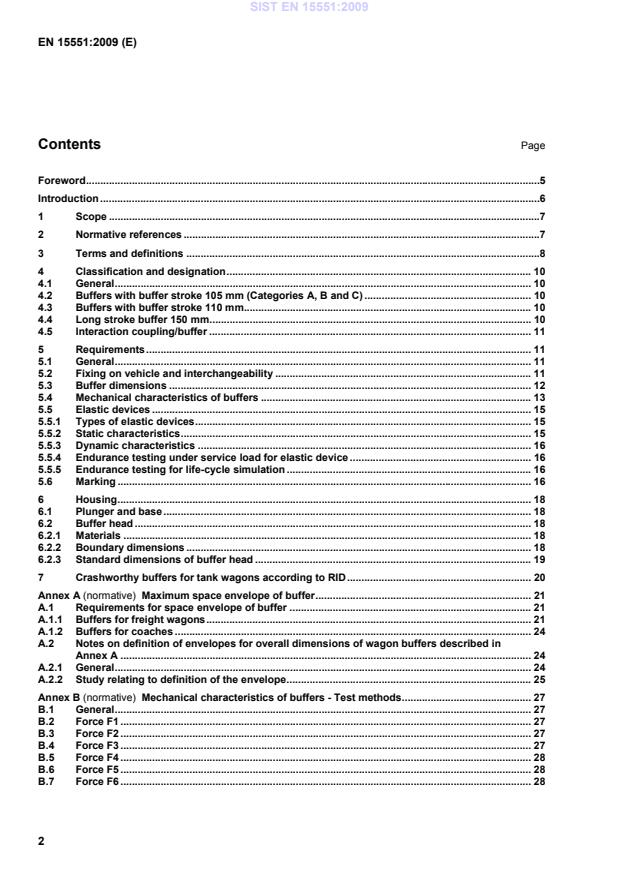
Maximum space envelope of buffer . 21 A.1 Requirements for space envelope of buffer . 21 A.1.1 Buffers for freight wagons . 21 A.1.2 Buffers for coaches . 24 A.2 Notes on definition of envelopes for overall dimensions of wagon buffers described in Annex A . 24 A.2.1 General . 24 A.2.2 Study relating to definition of the envelope . 25 Annex B (normative)
Mechanical characteristics of buffers - Test methods . 27 B.1 General . 27 B.2 Force F1 . 27 B.3 Force F2 . 27 B.4 Force F3 . 27 B.5 Force F4 . 28 B.6 Force F5 . 28 B.7 Force F6 . 28 SIST EN 15551:2009
Requirements for elastic devices . 29 C.1 Rubber elastomer or other elastomer elastic systems . 29 C.1.1 General . 29 C.1.2 Metal inserts . 29 C.1.3 Constituents of rubber elastomer and/or other elastomer systems . 29 C.1.4 Static characteristics of the sets . 31 C.1.5 Dynamic characteristics of the sets . 31 C.1.6 Bonding . 31 C.1.7 Marking . 31 C.1.8 Inspection and tests . 31 C.2 Friction spring/Ring spring . 32 C.2.1 Manufacturer's marks . 32 C.2.2 Flexibility test . 33 C.2.3 Endurance test . 34 C.3 Hydrodynamic or hydrostatic systems . 34 C.3.1 General . 34 C.3.2 Steel parts . 34 C.3.3 Absorbing energy medium . 34 C.3.4 Static tests of capsules . 35 C.4 Combined elastic systems . 35 Annex D (normative)
Testing of static characteristics of buffers . 36 D.1 Test principle . 36 D.2 Test procedure . 36 D.3 Measurements . 36 Annex E (normative)
Dynamic testing . 37 E.1 Dynamic testing of buffer . 37 E.1.1 General . 37 E.1.2 Temperature effects . 38 E.2 Dynamic characteristics of 105 mm stroke buffer . 39 E.2.1 Test programme . 39 E.2.2 Category A . 40 E.2.3 Category B . 40 E.2.4 Category C . 41 E.2.5 Comments on the test conditions . 41 E.3 Dynamic characteristics of 150 mm stroke buffer . 42 E.4 Dynamic characteristics of 110 mm stroke buffer . 43 Annex F (normative)
Endurance testing under service load for elastic device . 44 F.1 Aim of the test . 44 F.2 Test principle . 44 F.3 Test results to be obtained . 45 F.4 Test requirements . 45 F.4.1 Endurance test assembly . 45 F.4.2 Preliminary static test . 46 F.4.3 Endurance test . 46 F.4.4 Final static test . 46 Annex G (normative)
Endurance testing under buffing load for life-cycle simulation . 47 G.1 Endurance tests for hydrodynamic and hydrostatic buffers for wagons . 47 G.1.1 Aim of the test . 47 G.1.2 Test principle . 47 G.1.3 Expected result . 47 G.1.4 Test requirements . 47 G.1.5 Delivery of elastic devices . 50 G.2 Endurance tests for hydrodynamic and hydrostatic buffers for coaches . 50 G.2.1 General . 50 G.2.2 Tests under alternating loads . 50 G.2.3 Repeated buffing tests . 51 G.2.4 Conditions to be observed . 51 SIST EN 15551:2009
Plunger and base . 52 H.1 Plunger and base . 52 H.2 Manufacture of housing . 52 H.2.1 Welding . 52 H.2.2 Initial greasing . 52 Annex I (informative)
Guidelines for buffer head materials . 53 I.1 Example of test program requirements for verification of buffer head materials . 53 I.2 List of existing buffer head materials . 55 Annex J (normative)
Calculation of the width of buffer heads . 56 J.1 General . 56 J.2 Data used in the calculation . 56 J.3 Calculation . 56 Annex K (informative)
Regulations relating to the layout of S-curves . 58 K.1 Data used in the calculation . 58 K.2 Equations to be applied . 58 K.3 Working examples . 59 K.4 Comments on the preparation of the equations in Annex J and Annex K . 60 K.5 Track . 60 K.6 Vehicle . 60 Annex L (normative)
Crashworthy buffers for tank wagons according to RID . 61 L.1 Requirements on crashworthy buffers . 61 L.1.1 Objectives from RID . 61 L.1.2 Additional requirements . 61 L.2 Test procedure for crashworthy buffers . 61 Annex M (normative)
Maximum space envelope of crashworthy buffers . 63 Annex ZA (informative)
Relationship between this European Standard and the Essential Requirements of EU Directive 96/48/EC, as modified by Directive 2004/50/EC . 66 Annex ZB (informative)
Relationship between this European Standard and the Essential Requirements of EU Directive 2001/16/EC of the European Parliament and of the Council of 19 March 2001 on the interoperability of the trans-European conventional rail system, as modified by EU Directive 2004/50/EC of 29 April 2004 . 67 Bibliography . 69
Introduction The main purpose of normative documents used until now for the delivery of buffers (UIC leaflets, national standards) was a complete definition of the acceptance procedures and of the buffers characteristics which were to be verified. Product qualification was sometimes mentioned but the procedures used and the product characteristics to be verified during qualification were not given. This European Standard addresses all buffer characteristics that are assembly characteristics and finished product characteristics and do not arise from a choice of design parameters such as diameters, interferences, materials etc.
The buffer and its components are delivered by suppliers that operate a quality system. NOTE The quality systems used should offer equivalence with EN ISO 9001. This European Standard is based on UIC 526-1, UIC 526-3, UIC 527-1, UIC 528, UIC 573, UIC 827-1 and UIC 827-2. For coaches the technical content at present is limited to that given in UIC 528:2007. SIST EN 15551:2009
1 Scope This European Standard defines the requirements for buffers with 105 mm, 110 mm and 150 mm stroke for vehicles or units which use buffers and screw coupling at the coupling interface with other interoperable rolling stock. It covers the functionality, interfaces and testing procedures, including pass fail criteria, for buffers. NOTE Typically, buffers with a stroke of 105 mm are used on freight wagons and locomotives, buffers with a stroke of 110 mm are used on coaches and locomotives and buffers with a stroke of 150 mm are used on freight wagons. It defines the different categories of buffers, the space envelope, static and dynamic characteristics and energy absorption. It includes a calculation method to determine the minimum size of the buffer head to avoid override between buffers. It defines the static and dynamic characteristics of the elastic systems. It also defines the requirements for buffers with integrated crash elements (crashworthy buffers) for tank wagons only according to RID. The requirements of this European Standard also apply to locomotives and passenger coaches which have to meet the crashworthiness requirements of EN 15227 for buffers in normal service only. The properties for the energy absorbing function are defined in EN 15227 and the requirements specified in Clause 7 for tank wagons according to RID are not applicable to locomotives and passenger coaches. Diagonal buffers are excluded from this European Standard. For vehicles which have to comply with crashworthiness requirements (locomotives, cab cars or passenger coaches according to EN 15227, tank wagons according to RID), typically crashworthy buffers (buffers with a deformable housing and/or the need for an opening in their mounting flange) or buffers which form part of a combined system consisting of a special buffer (e.g. middle flange buffer) and a deformation element are used. For these types of buffers, interoperability is possible, but interchangeability with freight wagon buffers is not required, and therefore the requirements of 5.2 (Fixing on vehicle and interchangeability), 5.3 (Buffer dimensions) do not apply, those of 5.4 (mechanical characteristics of buffers) and 5.6 (marking) apply with restrictions. 2 Normative references The following referenced documents are indispensable for the application of this document. For dated references, only the edition cited applies. For undated references, the latest edition of the referenced document (including any amendments) applies. EN 1369, Founding — Magnetic particle inspection EN 1370, Founding — Surface roughness inspection by visualtactile comparators EN 10025-2, Hot rolled products of structural steels — Part 2: Technical delivery conditions for non-alloy structural steels EN 10204:2004, Metallic products — Types of inspection documents prEN 12663-2, Railway applications — Structural requirements of railway vehicle bodies — Part 2: Freight wagons SIST EN 15551:2009
Key 1
force in kN 2
stroke in mm We
stored energy in kJ Wa
absorbed energy in kJ Figure 1 — Force-stroke diagram for stored and absorbed energy 3.9 dynamic working capacity stored energy under dynamic test conditions obtained during the impact between two wagons 3.10 damping A ratio of absorbed energy divided by stored energy NOTE It is calculated using the following equation: SIST EN 15551:2009
is the absorbed energy; We
is the stored energy. 3.11 crashworthy buffer buffer with an additional function to allow plastic deformation to absorb energy for abnormal impacts 4 Classification and designation 4.1 General Buffers are classified according to their stroke and their dynamic energy capacity Wed. 4.2 Buffers with buffer stroke 105 mm (Categories A, B and C) These buffers are classified according to their dynamic energy capacity Wed as specified in Table 1. Table 1 — Buffer stroke 105 Buffer category Dynamic energy capacity
Wed A ≥ 30 kJ B ≥ 50 kJ C ≥ 70 kJ
4.3 Buffers with buffer stroke 110 mm Buffers with a stroke of 110 mm are generally used on coaches to protect them against buffing impacts at speeds of up to 10 km/h.
Designation is reserved for this issue of the European Standard. NOTE UIC 528 does not specify a designation for this buffer. 4.4 Long stroke buffer 150 mm Wagons used for carriage of impact-sensitive goods may be fitted with 150 mm stroke buffers in order to maintain the accelerations exerted on goods at the lowest level possible while complying with the minimum requirements of prEN 12663-2. NOTE The possibilities for use of hydrodynamic buffers are described in ERRI Report B36/RP 30. 150 mm-stroke buffers are designated by the letter "L". SIST EN 15551:2009
Key 1 Buffer with metallic head 2 Buffer with non-metallic insert or head Figure 2 — Mounting of buffers with non-metallic insert or head (top view for freight wagons) 5.2 Fixing on vehicle and interchangeability The buffers shall be fixed to the vehicle headstock by means of four bolted M 24 fasteners. For 105 mm and 150 mm stroke buffers for freight wagons, dimensions and spacing needed on headstock for the buffer support plate for interchangeability are given in Figure 3. The 105 mm stroke buffer flange shall cover the location for the pin (see cross section A1-A1 of Figure 3). This pin is to prevent the fixing of a 105 mm stroke buffer where a long stroke buffer is required. The 150 mm stroke buffer flange shall have a location for the pin (see the location in cross section A2-A2 of Figure 3). For vehicles which have to comply with crashworthiness requirements (locomotives, cab cars or passenger coaches according to EN 15227, tank wagons according to RID), which use crashworthy buffers or buffers SIST EN 15551:2009
Key A1 section is for 105 mm stroke buffer A2 section is for long stroke buffer a is the stroke 105 mm or 150 mm b is the buffer length (see Table 2) Figure 3 — Fixing dimensions of 105 mm and 150 mm stroke buffers for interchangeability 5.3 Buffer dimensions Common dimensional characteristics for all buffer categories are provided in Table 2. SIST EN 15551:2009
Stroke 105 mm buffer Stroke 110 mm buffer Stroke 150 mm buffer Stroke a 05105− 05110− 05150− Buffer length b 620 650 665
The spacing of the buffer is specified in Annex A. The buffer shall be equipped with an anti-rotation device avoiding free rotation on longitudinal axis. The maximum allowed rotation is set at ± 2° for buffer when they are new. The width of the buffer head shall be as specified in 6.2. For locomotives, cab cars or passenger coaches according to EN 15227 equipped with crashworthy buffers or buffers which form part of a combined element consisting of a special buffer and a deformation element, a different position of the fixation flange and a spacing of bolts different from Figure 3 may be used, and the buffer length b defined in Table 2 is not applicable.
5.4 Mechanical characteristics of buffers The entire buffer unit fitted to the wagon shall be capable of withstanding the loads specified in Table 3: Table 3 — Proof loads for buffers
Force Fi for stroke 105 mm and 150 mm Force Fi for stroke 110 mm
Longitudinal force (centred) F1, exerted on the buffer head
≥ 2 500 kN ≥ 1 250 kN Longitudinal force (off-centre) F2, exerted on the buffer head ≥ 500 kN ≥ 300 kN Vertical force F3, exerted on the body of the buffer ≥ 200 kN ≥ 200 kN Total longitudinal force F4, exerted by the base plate of the buffer on a test frame ≥ 2 500 kN ≥ 1 250 kN Longitudinal force F5 for buffer heads > 450 mm, exerted on the buffer head ≥ 250 kN ------- Life-cycle test on customer request, force F6 ≥ 250 kN -------
Conditions governing the application of these forces are set out in Figure 4. The corresponding test methods are specified in Annex B. After each of the tests F1, F2, F3 and F5, the buffer shall continue to be in a condition that allows normal functioning, and any permanent deformation shall fall within the tolerance range stipulated for manufacture. In addition, the diameters measured on the main buffer components shall not have changed by more than 0,2 %. After Test F4, the base plate shall not show any permanent deformation. After Test F6, no visible cracks shall appear. SIST EN 15551:2009
Key 1 support frame (used with for testing with F4 force) 2
point of application of F2 3
centre line of fastening bolts 4
point of application of F5 5 point of application of F6 R radius of buffer head Figure 4 — Points of application of forces SIST EN 15551:2009
Buffer with
105 mm stroke Buffer with
110 mm stroke with conventional springs Buffer with
110 mm stroke with hydrodynamic and hydrostatic springs Buffer with
150 mm stroke Stroke
Initial 10 kN - 50 kN 7,5 kN - 20 kN 7,5 kN - 50 kN 15 kN - 90 kN after 25 mm 30 kN - 130 kN 10 kN - 40 kN - 60 kN - 130 kN after 50 mm - - 60 kN - 200 kN - after 60 mm 100 kN - 400 kN 50 kN – 150 kN - 100 kN – 220 kN after 100 mm 350 kN – 1000 kN - - 150 kN – 390 kN after 105 mm - 300 kN – 1000 kN≤ 600 kN - after 125 mm - - - 200 kN - 520 kN after 145 mm - - - 350 kN - 880 kN Stored energy (We) for an effort not exceeding 1 000 kN ≥ 12,5 kJ ≥ 10 kJ - - Stored energy (We) for a force ≤ 880 kN - - - ≥ 18 kJ Stored energy (We) for a force ≤ 600 kN - - ≥ 12 kJ - Absorbed energy (Wa) corresponding to the preceding stored energy ≥ 0,5 We ≥ 0,5 We ≥ 0,5 We ≥ 0,5 We
NOTE 1 Table 4 applies to the temperature range - 25 °C to + 45 °C. For temperature range - 40 °C to + 35 °C, performances could be different. SIST EN 15551:2009
Figure 5 — Location of the mark SIST EN 15551:2009
Key 1 stroke – category (for 105 mm and 150 mm stroke buffers) – buffer head radius 2 type of buffer head S – standard H – hardened (for hardness > 450 Hv) P – synthetic material 3 type of elastic system F – friction spring R – rubber spring P – polymer spring S – hydrostatic capsule D – hydrodynamic capsule for combined elastic systems, combine the letters, for example FD – friction spring/hydrodynamic capsule 4 EN 15551 5 space for manufacturer’s logo 6 two last digit of production year 7 space for identification number of Notified Body 8 space for owner’s name/logo Figure 6 — Marking Other layouts may be agreed with customer subject to the manufacturing process used. SIST EN 15551:2009
Key 1 internal limit 2 lower limit 3 level of buffer centre line 4 wagon centre line 5 construction gauge limit
6 limit for vehicles with interconnecting gangway
minimum surface
for wagons for coaches and locomotives with 110 mm stroke buffer a 600 540 Figure 7 — Boundary dimensions and minimum surface of buffer heads For buffers 550 mm wide, the minimum size may be reduced by 2 × R50 in the lower corners of the buffer head. 6.2.3 Standard dimensions of buffer head 6.2.3.1 Buffers with stroke of 105 and 150 mm The standard height of buffer heads shall be 340 mm, i.e. 170 mm on either side of the centre line of the housing. Buffer heads shall be convex and the radius of curvature of their spherical working surfaces shall be (2 750 ± 100) mm. SIST EN 15551:2009
The minimum width of buffer heads on wagons accepted for traffic between the European standard gauge network and the Spanish broad gauge network (distance between centre line of buffer 1 850 mm) shall be 100 mm more than the width calculated in accordance with Annex J and Table 5. The minimum width of buffer heads on wagons accepted for traffic between the European standard gauge network and the Finnish network (distance between centre line of buffer 1 790 mm) shall be 40 mm more than the width calculated in accordance with Annex J and Table 5. The buffer heads shall not have any irregularities that might pose problems for shunting staff. The edges of their working surfaces shall be rounded with a radius of at least 50 mm and the edge of the buffer head shall have a curvature of 5 20+ mm. The regulations relating to the layout of S-curves (length of straight section that may be necessary between a curve and a reverse curve) may influence the dimensioning of the buffer heads and allowing for the running of ve
...