

EN 14710-1:2005+A2:2008
(Main + Amendment)Fire-fighting pumps - Fire-fighting centrifugal pumps without primer - Part 1: Classification, general and safety requirements
- Abstract
This document applies to centrifugal pumps without priming devices for fire-fighting use designed as
- floating pumps (FPN F),
- submersible pumps (FPN S) or
- boosted pumps (FPN B).
Fire-fighting centrifugal pumps without primer are defined as terminated by their inlet and outlet connections as well as by their shaft ends.
This document applies for fire-fighting centrifugal pumps without priming devices for use under ambient temperatures between -15 °C and 40 °C.
NOTE 1 For special conditions, -30 C; see 6.11.
This document does not apply to fire-fighting centrifugal pumps without primer of which the only power source is directly applied manual effort.
This document does not apply to fire-fighting centrifugal pumps without primer, intended to be used as interchangeable equipment (i.e. combined by the user with another machine or vehicle acting as a driver).
This document does not apply to fire-fighting centrifugal pumps without primer with a nominal delivery pressure pN above 15 bar.
NOTE 2 High pressure pumps with primer are dealt with in EN 1028-1 and EN 1028-2.
This document specifies the classification and general requirements for fire-fighting centrifugal pumps without priming devices with a nominal delivery rate of up to 10 000 l/min.
This document deals with significant hazards listed in Clause 4, hazardous situations and events during the commissioning, operation and maintenance of fire-fighting centrifugal pumps without priming devices, used as intended and under the conditions foreseen by the manufacturer.
This document does not deal with the detailed verification of general and safety requirements and/or protective measures. These are covered in EN 14710-2 "Verification of general and safety requirements".
This document does not deal with noise.
This document does not deal with the technical safety requirements for the design or manufacture of drivers or of additional equipment intended to be fitted to inlet and outlet connections.
- Status
- Published
- Publication Date
- 16-Dec-2008
- Withdrawal Date
- 27-Dec-2009
- Technical Committee
- CEN/TC 192 - Fire service equipment
- Drafting Committee
- CEN/TC 192/WG 2 - Firefighting pumps
- Current Stage
- 9060 - Closure of 2 Year Review Enquiry - Review Enquiry
- Start Date
- 04-Jun-2021
- Completion Date
- 04-Jun-2021
- Directive
- 2006/42/EC - Directive 2006/42/EC of the European Parliament and of the Council of 17 May 2006 on machinery, and amending Directive 95/16/EC (recast)OJ Ref: C, C 214 OJ Date: 08-Sep-2009
98/37/EC - MachineryOJ Ref: C, C 74 OJ Date: 28-Mar-2009

Overview
EN 14710-1:2005+A2:2008 is the CEN European standard that defines the classification, general and safety requirements for fire‑fighting centrifugal pumps without primer. It covers pumps designed as floating (FPN‑F), submersible (FPN‑S) or boosted (FPN‑B) units, intended for ambient temperatures between ‑15 °C and 40 °C (special conditions down to ‑30 °C are noted). The standard applies to pumps with nominal delivery rates up to 10 000 l/min and nominal delivery pressures up to 15 bar, and it addresses significant hazards during commissioning, operation and maintenance. Verification of requirements is handled in EN 14710‑2.
Key topics and requirements
- Scope and classification
- Defines pump types: FPN‑F, FPN‑S, FPN‑B and their intended use for fire service applications.
- Limits: excludes manually powered pumps, interchangeable equipment driven by user‑supplied drivers, and pumps with pN > 15 bar.
- Safety requirements
- Identification of significant hazards (Clause 4) and required protective measures for safe commissioning, operation and maintenance.
- Requirements for inlet/outlet terminations and shaft ends - pumps are defined as terminated by connections and shaft ends.
- Performance and operational limits
- Operating ambient temperature range and nominal delivery parameters (up to 10 000 l/min, up to 15 bar).
- Pressure terminology and limits (inlet/outlet section pressures, closing pressure, maximum/limit pressures) are defined for consistent testing and documentation.
- Information and markings
- Requirements for user information, warnings and operational data so users can safely operate and integrate pumps into systems.
- What it does not cover
- Noise, detailed verification procedures (see EN 14710‑2), and design/manufacture of drivers or additional equipment fitted to inlet/outlet connections.
Applications and who uses it
- Fire appliance manufacturers and pump OEMs specifying and designing fire‑fighting centrifugal pumps without primer.
- Vehicle integrators and fleet managers installing pumps in fire‑fighting vehicles or skid/trailer units.
- Procurement officers and safety officers evaluating compliance and safety for fire service equipment.
- Test laboratories and conformity assessors (in conjunction with EN 14710‑2) verifying that pumps meet general and safety requirements.
- Fire brigades and end users referencing standard requirements for operation, installation and maintenance.
Related standards
- EN 14710‑2 - Verification of general and safety requirements (companion part for testing/verification)
- EN 1028‑1 / EN 1028‑2 - High‑pressure pumps (referenced for pumps above 15 bar)
- EN ISO 5199, EN ISO 9905, EN ISO 9908 - Centrifugal pump technical classes and specifications
- EN ISO 12100 - Machinery safety basic concepts and risk assessment
This standard is essential when specifying or assessing fire‑fighting pumps to ensure consistent classification, safety practices and compatibility with fire service operational requirements.
Relations
- Effective Date
- 19-Jan-2023
- Effective Date
- 25-Aug-2026
- Effective Date
- 25-Aug-2026
- Effective Date
- 09-Feb-2026
- Effective Date
- 09-Feb-2026
- Effective Date
- 09-Feb-2026
- Effective Date
- 09-Feb-2026
- Effective Date
- 09-Feb-2026
- Effective Date
- 28-Jan-2026
- Effective Date
- 28-Jan-2026
- Effective Date
- 28-Jan-2026
- Effective Date
- 28-Jan-2026
- Effective Date
- 28-Jan-2026
- Effective Date
- 28-Jan-2026
- Effective Date
- 28-Jan-2026
Get Certified
Connect with accredited certification bodies for this standard

CIS Institut d.o.o.
Personal Protective Equipment (PPE) certification body. Notified Body NB-2890 for EU Regulation 2016/425 PPE.
Institut za varilstvo d.o.o. (Welding Institute)
Slovenia's leading welding institute since 1952. ISO 3834, EN 1090, pressure equipment certification, NDT personnel, welder qualification. Only IIW Au

Kiwa BDA Testing
Building and construction product certification.
Sponsored listings
Frequently Asked Questions
EN 14710-1:2005+A2:2008 is a standard published by the European Committee for Standardization (CEN). Its full title is "Fire-fighting pumps - Fire-fighting centrifugal pumps without primer - Part 1: Classification, general and safety requirements". This standard covers: This document applies to centrifugal pumps without priming devices for fire-fighting use designed as - floating pumps (FPN F), - submersible pumps (FPN S) or - boosted pumps (FPN B). Fire-fighting centrifugal pumps without primer are defined as terminated by their inlet and outlet connections as well as by their shaft ends. This document applies for fire-fighting centrifugal pumps without priming devices for use under ambient temperatures between -15 °C and 40 °C. NOTE 1 For special conditions, -30 C; see 6.11. This document does not apply to fire-fighting centrifugal pumps without primer of which the only power source is directly applied manual effort. This document does not apply to fire-fighting centrifugal pumps without primer, intended to be used as interchangeable equipment (i.e. combined by the user with another machine or vehicle acting as a driver). This document does not apply to fire-fighting centrifugal pumps without primer with a nominal delivery pressure pN above 15 bar. NOTE 2 High pressure pumps with primer are dealt with in EN 1028-1 and EN 1028-2. This document specifies the classification and general requirements for fire-fighting centrifugal pumps without priming devices with a nominal delivery rate of up to 10 000 l/min. This document deals with significant hazards listed in Clause 4, hazardous situations and events during the commissioning, operation and maintenance of fire-fighting centrifugal pumps without priming devices, used as intended and under the conditions foreseen by the manufacturer. This document does not deal with the detailed verification of general and safety requirements and/or protective measures. These are covered in EN 14710-2 "Verification of general and safety requirements". This document does not deal with noise. This document does not deal with the technical safety requirements for the design or manufacture of drivers or of additional equipment intended to be fitted to inlet and outlet connections.
This document applies to centrifugal pumps without priming devices for fire-fighting use designed as - floating pumps (FPN F), - submersible pumps (FPN S) or - boosted pumps (FPN B). Fire-fighting centrifugal pumps without primer are defined as terminated by their inlet and outlet connections as well as by their shaft ends. This document applies for fire-fighting centrifugal pumps without priming devices for use under ambient temperatures between -15 °C and 40 °C. NOTE 1 For special conditions, -30 C; see 6.11. This document does not apply to fire-fighting centrifugal pumps without primer of which the only power source is directly applied manual effort. This document does not apply to fire-fighting centrifugal pumps without primer, intended to be used as interchangeable equipment (i.e. combined by the user with another machine or vehicle acting as a driver). This document does not apply to fire-fighting centrifugal pumps without primer with a nominal delivery pressure pN above 15 bar. NOTE 2 High pressure pumps with primer are dealt with in EN 1028-1 and EN 1028-2. This document specifies the classification and general requirements for fire-fighting centrifugal pumps without priming devices with a nominal delivery rate of up to 10 000 l/min. This document deals with significant hazards listed in Clause 4, hazardous situations and events during the commissioning, operation and maintenance of fire-fighting centrifugal pumps without priming devices, used as intended and under the conditions foreseen by the manufacturer. This document does not deal with the detailed verification of general and safety requirements and/or protective measures. These are covered in EN 14710-2 "Verification of general and safety requirements". This document does not deal with noise. This document does not deal with the technical safety requirements for the design or manufacture of drivers or of additional equipment intended to be fitted to inlet and outlet connections.
EN 14710-1:2005+A2:2008 is classified under the following ICS (International Classification for Standards) categories: 13.220.10 - Fire-fighting; 23.080 - Pumps. The ICS classification helps identify the subject area and facilitates finding related standards.
EN 14710-1:2005+A2:2008 has the following relationships with other standards: It is inter standard links to EN 14710-1:2005, ISO 7010:2003, ISO 8598:1996, EN 61310-1:2008, EN IEC/IEEE 82079-1:2020, EN 61310-2:2008, EN 60529:1991/A1:2000, EN 60529:1991, EN ISO 9905:1997, EN ISO 13857:2019, EN 894-1:1997+A1:2008, EN 4613:2009, EN ISO 9908:1997, EN 842:1996+A1:2008, EN ISO 12100:2010. Understanding these relationships helps ensure you are using the most current and applicable version of the standard.
EN 14710-1:2005+A2:2008 is associated with the following European legislation: EU Directives/Regulations: 2006/42/EC, 98/37/EC; Standardization Mandates: M/079, M/396. When a standard is cited in the Official Journal of the European Union, products manufactured in conformity with it benefit from a presumption of conformity with the essential requirements of the corresponding EU directive or regulation.
EN 14710-1:2005+A2:2008 is available in PDF format for immediate download after purchase. The document can be added to your cart and obtained through the secure checkout process. Digital delivery ensures instant access to the complete standard document.
Standards Content (Sample)
2003-01.Slovenski inštitut za standardizacijo. Razmnoževanje celote ali delov tega standarda ni dovoljeno.Feuerlöschpumpen - Feuerlöschkreiselpumpen ohne Entlüftungseinrichtung - Teil 1: Klassifizierung, allgemeine Anforderungen und SicherheitsanforderungenPompes à usage incendie - Pompes centrifuges à usage incendie sans dispositif d'amorçage - Partie 1: Classification, prescriptions générales et de sécuritéFire-fighting pumps - Fire-fighting centrifugal pumps without primer - Part 1: Classification, general and safety requirements13.220.10Gašenje požaraFire-fightingICS:Ta slovenski standard je istoveten z:EN 14710-1:2005+A2:2008SIST EN 14710-1:2005+A2:2009en,fr,de01-maj-2009SIST EN 14710-1:2005+A2:2009SLOVENSKI
STANDARD
EUROPEAN STANDARD NORME EUROPÉENNE EUROPÄISCHE NORM
EN 14710-1:2005+A2
December 2008 ICS 13.220.10; 23.080 Supersedes EN 14710-1:2005+A1:2008 English Version
Fire-fighting pumps - Fire-fighting centrifugal pumps without primer - Part 1: Classification, general and safety requirements Pompes à usage incendie - Pompes centrifuges à usage incendie sans dispositif d'amorçage - Partie 1: Classification, prescriptions générales et de sécurité
Feuerlöschpumpen - Feuerlöschkreiselpumpen ohne Entlüftungseinrichtung - Teil 1: Klassifizierung, allgemeine Anforderungen und Sicherheitsanforderungen This European Standard was approved by CEN on 17 December 2004 and includes Amendment 1 approved by CEN on 6 June 2008 and Amendment 2 approved by CEN on 16 November 2008.
CEN members are bound to comply with the CEN/CENELEC Internal Regulations which stipulate the conditions for giving this European Standard the status of a national standard without any alteration. Up-to-date lists and bibliographical references concerning such national standards may be obtained on application to the CEN Management Centre or to any CEN member.
This European Standard exists in three official versions (English, French, German). A version in any other language made by translation under the responsibility of a CEN member into its own language and notified to the CEN Management Centre has the same status as the official versions.
CEN members are the national standards bodies of Austria, Belgium, Bulgaria, Cyprus, Czech Republic, Denmark, Estonia, Finland, France, Germany, Greece, Hungary, Iceland, Ireland, Italy, Latvia, Lithuania, Luxembourg, Malta, Netherlands, Norway, Poland, Portugal, Romania, Slovakia, Slovenia, Spain, Sweden, Switzerland and United Kingdom.
EUROPEAN COMMITTEE FOR STANDARDIZATION
COMITÉ EUROPÉEN DE NORMALISATION EUROPÄISCHES KOMITEE FÜR NORMUNG
Management Centre: rue de Stassart, 36
B-1050 Brussels © 2008 CEN All rights of exploitation in any form and by any means reserved worldwide for CEN national Members. Ref. No. EN 14710-1:2005+A2:2008: ESIST EN 14710-1:2005+A2:2009
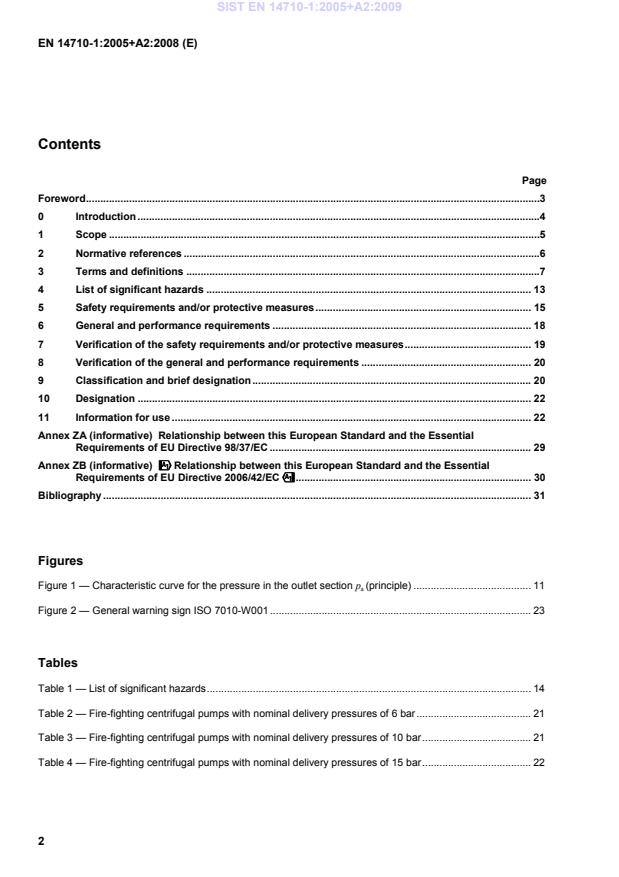
Relationship between this European Standard and the Essential Requirements of EU Directive 98/37/EC . 29Annex ZB (informative)
!!!!Relationship between this European Standard and the Essential Requirements of EU Directive 2006/42/EC"""" . 30Bibliography . 31
Figures Figure 1 — Characteristic curve for the pressure in the outlet section pa (principle) . 11 Figure 2 — General warning sign ISO 7010-W001 . 23
Tables Table 1 — List of significant hazards . 14 Table 2 — Fire-fighting centrifugal pumps with nominal delivery pressures of 6 bar . 21 Table 3 — Fire-fighting centrifugal pumps with nominal delivery pressures of 10 bar . 21 Table 4 — Fire-fighting centrifugal pumps with nominal delivery pressures of 15 bar . 22
!" and # $. This document has been prepared under a mandate given to CEN by the European Commission and the European Free Trade Association, and supports essential requirements of EU Directive(s). !For relationship with EU Directive(s), see informative Annexes ZA and ZB, which are integral parts of this document." This document is intended to be used in conjunction with part 2 of EN 14710 “Verification of general and safety requirements”. EN 14710 "Fire-fighting pumps – Fire-fighting centrifugal pumps without primer" comprises two parts: Part 1: Classification, general and safety requirements; Part 2: Verification of general and safety requirements. For relationship with EN 1028 see EN 14710-2:2005, 4.1. This document includes a Bibliography. According to the CEN/CENELEC Internal Regulations, the national standards organizations of the following countries are bound to implement this European Standard: Austria, Belgium, Bulgaria, Cyprus, Czech Republic, Denmark, Estonia, Finland, France, Germany, Greece, Hungary, Iceland, Ireland, Italy, Latvia, Lithuania, Luxembourg, Malta, Netherlands, Norway, Poland, Portugal, Romania, Slovakia, Slovenia, Spain, Sweden, Switzerland and United Kingdom. SIST EN 14710-1:2005+A2:2009
floating pumps (FPN-F), submersible pumps (FPN-S) or
boosted pumps (FPN-B).
Fire-fighting centrifugal pumps without primer are defined as terminated by their inlet and outlet connections as well as by their shaft ends. This document applies for fire-fighting centrifugal pumps without priming devices for use under ambient temperatures between -15 °C and 40 °C. NOTE 1 For special conditions, -30 °C; see 6.11. This document does not apply to fire-fighting centrifugal pumps without primer of which the only power source is directly applied manual effort. This document does not apply to fire-fighting centrifugal pumps without primer, intended to be used as interchangeable equipment (i.e. combined by the user with another machine or vehicle acting as a driver). This document does not apply to fire-fighting centrifugal pumps without primer with a nominal delivery pressure pN above 15 bar. NOTE 2 High pressure pumps with primer are dealt with in EN 1028-1 and EN 1028-2. #This document specifies the classification and general requirements for fire-fighting centrifugal pumps without priming devices with a nominal delivery rate of up to 10 000 l/min.$ This document deals with significant hazards listed in Clause 4, hazardous situations and events during the commissioning, operation and maintenance of fire-fighting centrifugal pumps without priming devices, used as intended and under the conditions foreseen by the manufacturer. This document does not deal with the detailed verification of general and safety requirements and/or protective measures. These are covered in EN 14710-2 "Verification of general and safety requirements". This document does not deal with noise. This document does not deal with the technical safety requirements for the design or manufacture of drivers or of additional equipment intended to be fitted to inlet and outlet connections. It does not cover risks directly arising from means provided for the portability, transportability, and mobility of pump units during or between periods of operation, or requirements for power transmission devices. In addition, this document does not cover: hazards occurring due to decommissioning; hazards during use due to a specific environment (e.g. traffic during use on public roads, potentially explosive atmospheres). This document does not apply to fire-fighting centrifugal pumps without primer that are manufactured before the date of publication by CEN of this document. SIST EN 14710-1:2005+A2:2009
(ISO 14121-1:2007) $. ISO 7010, Graphical symbols — Safety colours and safety signs — Safety signs used in workplaces and public areas 3 Terms and definitions For the purposes of this document, the terms and definitions given in EN ISO 12100-1:2003 and the following apply. 3.1 Pumps and their applications 3.1.1 fire-fighting centrifugal pump FP mechanically or hydraulically driven fluid flow machine intended for delivery of fluids for fire-fighting purposes NOTE 1 Adapted from EN 1028-1. NOTE 2 Fire-fighting centrifugal pumps without primer are specially designed for use by fire brigades and can be suitable for installation in fire-fighting vehicles as specified in EN 1846-1 and motor pumps. NOTE 3 Fire-fighting centrifugal pumps without primer generally consist of: pump unit; connections for inlet ports; shut off devices and connections for outlet ports; connections between pump, shut off devices and connection couplings; sieves and dirt traps; measuring instruments; safety devices (if provided); additional equipment. 3.1.2 vehicle mounted pump pump permanently installed on a vehicle and driven by the motive power of the vehicle [EN 1028-1:2002] SIST EN 14710-1:2005+A2:2009
HZ geo height difference between the centre of the first impeller inlet and the water level on the inlet side at 1013 mbar and 4 °C water temperature NOTE In case of deviating local air pressure (pb) and deviating water temperatures a correction of the geodetic inlet height is not necessary, due to the constructive characteristics of the pump. Under conditions deviating from 1013 mbar and 4 °C, this may lead to different performance results. 3.2.2 geodetic nominal inlet height
HZ geo N height difference between the centre of the first impeller inlet (in the direction of flow) and the water level on the inlet side of the pump, at 1013 mbar and 4 °C water temperature, as specified for the nominal delivery rate NOTE In case of deviating local air pressure (pb) and deviating water temperatures a correction of the geodetic nominal inlet height is not necessary, due to the constructive characteristics of the pump. Under conditions deviating from 1013 mbar and 4 °C, this may lead to different performance results. 3.3 Pressures NOTE Pressures are manometric pressures given in bar. 3.3.1 inlet section pressure pe inlet pressure, measured at the measurement point specified in Annex B of EN 14710-2:2005 NOTE 1 Adapted from EN 1028-1. NOTE 2 The pressure can be positive or negative. 3.3.2 outlet section pressure pa outlet pressure, measured at the measurement point specified in Annex B of EN 14710-2:2005 NOTE Adapted from EN 1028-1. 3.3.3 maximum pressure pa max maximum pressure that can be attained in the outlet section at geodetic nominal inlet height HZ geoN and maximum speed n0 (see Figure 1) NOTE Adapted from EN 1028-1. 3.3.4 limit pressure pa lim maximum permissible outlet section pressure pa during operation (see Figure 1)
[EN 1028-1:2002] SIST EN 14710-1:2005+A2:2009
NOTE Adapted from EN 1028-1. 3.3.6 delivery pressure p difference between the outlet section pressure pa and the inlet section pressure pe;
p = pa - pe [EN 1028-1:2002] 3.3.7 nominal delivery pressure pN delivery pressure specified for the nominal delivery rate [EN 1028-1:2002] 3.3.8 static test pressure pps pressure used for testing the integrity of the inlet side of the pump when stationary [EN 1028-1:2002] 3.3.9 dynamic test pressure ppd pressure used for testing the integrity of the pressure parts of the pump with the pump running, given by pa lim + 5,5 bar (see Figure 1) [EN 1028-1:2002] SIST EN 14710-1:2005+A2:2009
Key pa
Outlet section pressure pa0
Closing pressure pa max
Maximum pressure pa lim
Limit pressure ppd
Dynamic test pressure Q
Delivery rate Figure 1 — Characteristic curve for the pressure in the outlet section pa (principle) 3.4 Delivery rates NOTE Delivery rates are given in litres per minute. 3.4.1 delivery rate Q volume delivered by the pump per unit of time [EN 1028-1:2002] 3.4.2 nominal delivery rate QN delivery rate specified at nominal delivery pressure
pN, nominal speed
nN and geodetic nominal inlet height HZ geoN NOTE Adapted from EN 1028-1. 3.5 Power NOTE Power values are given in kilowatts. 3.5.1 delivery power PQ power transmitted by the pump at delivery rate Q [EN 1028-1:2002] SIST EN 14710-1:2005+A2:2009
quotient of the delivery power and the driving power [EN 1028-1:2002] 3.7.2 nominal efficiency N efficiency at nominal delivery power [EN 1028-1:2002] SIST EN 14710-1:2005+A2:2009
5.2.1.1 1.2 Shearing 5.2.1.1 1.3 Cutting
5.2.1.1 1.4 Entanglement
5.2.1.1 1.9 High pressure fluid injection or ejection hazard 5.2.1.2 11.3.2.4 2 Electric hazards 2.1 Contact of persons with live parts (direct contact) 5.2.2 11.3.2.4 11.3.2.5 3 Thermal hazards 3.1 Burns, scalds and other injuries by a possible contact of persons with objects or materials with an extreme high or low temperature, by flames or explosions and also by the radiation of heat sources 5.2.1.2.6 5.2.3 4 Hazards generated by noise 4.2 Interference with speech communication, acoustic signals, etc. 11.2 8 Hazards generated by neglecting ergonomic design
principles 8.2 Inadequate consideration of hand-arm or foot-leg anatomy, etc. 5.2.1.1.2 5.2.4 8.7 Inadequate design, location or identification of manual controls 5.2.1.1.2 5.2.4 11.3.2.4 8.8 Inadequate design or location of visual display units 5.2.4 11.2 11.3.2.4 – Hazards caused by missing and/or breakdown and/or
wrong installation of protection devices 15 All types of guards 5.2.5.1 11.3.2.5 8.8 Measuring instruments and measuring instrument connections 5.2.5.2 11.3.2.4 11.3.2.5 7.3.6 Safety devices (by-pass, control valve, pressure relief valve) 5.2.5.3 11.3.2.4 11.3.2.5 11.3.2.6
...