

ASTM C1568-08(2020)
(Test Method)Standard Test Method for Wind Resistance of Concrete and Clay Roof Tiles (Mechanical Uplift Resistance Method)
General Information
- Abstract
SIGNIFICANCE AND USE
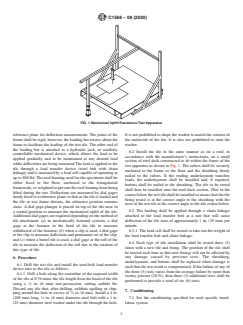
4.1 The method of attachment of roof tiles to the roof deck, or support structure, is one factor in the resistance of concrete and clay roof tiles to the action of wind. Several systems of attachment, and even combinations of systems, are used in the application of tile to a roof. The mechanical uplift resistance of the tile, when applied to the roof by any attachment system approved by, and in accordance with, the manufacturer's instructions, is a primary factor in the tile's resistance to the action of wind. This test method determines the mechanical uplift resistance that is related to resistance to the uplift forces acting as a result of wind. Natural wind conditions differ with respect to intensity, duration, and turbulence; these conditions are beyond the means of this test method to simulate.
SCOPE
1.1 This test method covers a procedure to determine the mechanical uplift resistance of concrete and clay roof tiles, which relates to the wind resistance of an air-permeable roof tile system as applied to a roof.
1.2 The procedure covers mechanically-fastened attachment systems, adhesive-set attachment systems, and mortar-set attachment systems, or combinations of attachment systems, that are used to apply tile to a roof.
1.3 The values stated in inch pound units are to be regarded as the standard. The values in parentheses are given for reference only.
1.4 This standard does not purport to address all of the safety concerns, if any, associated with its use. It is the responsibility of the user of this standard to establish appropriate safety, health, and environmental practices and determine the applicability of regulatory limitations prior to use.
1.5 This international standard was developed in accordance with internationally recognized principles on standardization established in the Decision on Principles for the Development of International Standards, Guides and Recommendations issued by the World Trade Organization Technical Barriers to Trade (TBT) Committee.
- Status
- Published
- Publication Date
- 31-May-2020
- Technical Committee
- C15 - Masonry – Manufactured Masonry Units, Mortars and Grouts
- Drafting Committee
- C15.06 - Roofing Tile
Overview
ASTM C1568-08(2020) - Standard Test Method for Wind Resistance of Concrete and Clay Roof Tiles (Mechanical Uplift Resistance Method) provides a recognized procedure for measuring the mechanical uplift resistance of concrete and clay roof tiles. Developed by ASTM International, this standard focuses on evaluating how different attachment systems-mechanically-fastened, adhesive-set, and mortar-set-perform in resisting wind-induced uplift forces when tiles are installed on roof decks.
The mechanical uplift resistance determined by this method directly relates to a roof system's capacity to withstand wind loads, which is critical for building safety in areas prone to high winds and extreme weather. The method standardizes testing, allowing manufacturers, architects, engineers, and building inspectors to assess the wind resistance of concrete and clay roof tile systems.
Key Topics
- Mechanical Uplift Resistance: Evaluation of the ability of roof tiles to remain secured under wind-induced uplift pressures.
- Attachment Systems: Covers a variety of commonly used systems, including:
- Mechanically-fastened
- Adhesive-set
- Mortar-set
- Combinations of the above
- Installation Practices: Stresses conformity to manufacturer’s installation instructions to ensure results are applicable to real-world scenarios.
- Test Apparatus and Procedure: Describes a standardized test setup involving controlled loading via a hydraulic or mechanical device, measurement devices for tile deflection, and criteria for identifying failure of the tile or attachment system.
- Failure Criteria: Defines specific conditions constituting failure, such as excessive deflection, separation, breaking of tiles, or withdrawal of fasteners.
- Reporting Requirements: Specifies comprehensive documentation, including installation details, test conditions, failure modes, and measurement data, to ensure transparency and repeatability.
Applications
- Roof Tile Manufacturers: Use ASTM C1568 to evaluate and certify new products for wind resistance, optimize attachment methods, and comply with local regulations.
- Architects and Engineers: Reference this standard when designing roofing systems to ensure buildings in high-wind zones meet safety requirements.
- Building Inspectors and Code Officials: Employ the test method to verify that installed roof systems meet code-mandated wind resistance standards.
- Contractors and Installers: Follow guidelines from ASTM C1568 to implement best practices for roof tile installations, reducing the risk of wind damage and ensuring warranty compliance.
- Quality Assurance: Standardized mechanical uplift resistance testing supports robust quality control processes for roof system assemblies.
Related Standards
- ASTM C1167: Specification for Clay Roof Tiles - details requirements for clay tile properties and performance.
- ASTM C1492: Specification for Concrete Roof Tile - specifies properties and testing for concrete roof tiles.
- ASCE 7: Minimum Design Loads for Buildings and Other Structures - referenced for structural load requirements.
- SBCCI SSTD 11 / ICC/SBCCI SSTD 11: Test standards for determining wind resistance of roof tiles.
- ASTM C67 and C140/C140M: Methods for sampling and testing brick, structural clay, and concrete masonry units.
By adhering to ASTM C1568-08(2020), professionals ensure that roof tile systems are robustly tested for wind resistance, promoting safer and more durable building envelopes, particularly in regions exposed to severe weather events. This method supports standardized comparisons and fosters international best practices for roof tile performance and building safety.
Keywords: wind resistance, concrete roof tile, clay roof tile, mechanical uplift resistance, roof tile attachment, mechanically-fastened systems, adhesive-set systems, mortar-set systems, ASTM C1568, roof system testing.
Relations
- Effective Date
- 01-Jun-2020
- Effective Date
- 01-Dec-2023
- Refers
ASTM C67/C67M-19 - Standard Test Methods for Sampling and Testing Brick and Structural Clay Tile - Effective Date
- 01-Jul-2019
- Effective Date
- 15-Jul-2018
- Refers
ASTM C67/C67M-18 - Standard Test Methods for Sampling and Testing Brick and Structural Clay Tile - Effective Date
- 01-Feb-2018
- Effective Date
- 15-Dec-2017
- Effective Date
- 01-Jun-2017
- Effective Date
- 01-Feb-2017
- Effective Date
- 01-Jun-2016
- Effective Date
- 15-Dec-2015
- Effective Date
- 15-Dec-2015
- Effective Date
- 01-Jul-2015
- Effective Date
- 15-Dec-2014
- Effective Date
- 01-Jul-2014
- Effective Date
- 01-Feb-2014
Get Certified
Connect with accredited certification bodies for this standard

DIBt (Deutsches Institut für Bautechnik)
German Institute for Building Technology.
DIN CERTCO
DIN Group product certification.

Aboma Certification B.V.
Specialized in construction, metal, and transport sectors.
Sponsored listings
Frequently Asked Questions
ASTM C1568-08(2020) is a standard published by ASTM International. Its full title is "Standard Test Method for Wind Resistance of Concrete and Clay Roof Tiles (Mechanical Uplift Resistance Method)". This standard covers: SIGNIFICANCE AND USE 4.1 The method of attachment of roof tiles to the roof deck, or support structure, is one factor in the resistance of concrete and clay roof tiles to the action of wind. Several systems of attachment, and even combinations of systems, are used in the application of tile to a roof. The mechanical uplift resistance of the tile, when applied to the roof by any attachment system approved by, and in accordance with, the manufacturer's instructions, is a primary factor in the tile's resistance to the action of wind. This test method determines the mechanical uplift resistance that is related to resistance to the uplift forces acting as a result of wind. Natural wind conditions differ with respect to intensity, duration, and turbulence; these conditions are beyond the means of this test method to simulate. SCOPE 1.1 This test method covers a procedure to determine the mechanical uplift resistance of concrete and clay roof tiles, which relates to the wind resistance of an air-permeable roof tile system as applied to a roof. 1.2 The procedure covers mechanically-fastened attachment systems, adhesive-set attachment systems, and mortar-set attachment systems, or combinations of attachment systems, that are used to apply tile to a roof. 1.3 The values stated in inch pound units are to be regarded as the standard. The values in parentheses are given for reference only. 1.4 This standard does not purport to address all of the safety concerns, if any, associated with its use. It is the responsibility of the user of this standard to establish appropriate safety, health, and environmental practices and determine the applicability of regulatory limitations prior to use. 1.5 This international standard was developed in accordance with internationally recognized principles on standardization established in the Decision on Principles for the Development of International Standards, Guides and Recommendations issued by the World Trade Organization Technical Barriers to Trade (TBT) Committee.
SIGNIFICANCE AND USE 4.1 The method of attachment of roof tiles to the roof deck, or support structure, is one factor in the resistance of concrete and clay roof tiles to the action of wind. Several systems of attachment, and even combinations of systems, are used in the application of tile to a roof. The mechanical uplift resistance of the tile, when applied to the roof by any attachment system approved by, and in accordance with, the manufacturer's instructions, is a primary factor in the tile's resistance to the action of wind. This test method determines the mechanical uplift resistance that is related to resistance to the uplift forces acting as a result of wind. Natural wind conditions differ with respect to intensity, duration, and turbulence; these conditions are beyond the means of this test method to simulate. SCOPE 1.1 This test method covers a procedure to determine the mechanical uplift resistance of concrete and clay roof tiles, which relates to the wind resistance of an air-permeable roof tile system as applied to a roof. 1.2 The procedure covers mechanically-fastened attachment systems, adhesive-set attachment systems, and mortar-set attachment systems, or combinations of attachment systems, that are used to apply tile to a roof. 1.3 The values stated in inch pound units are to be regarded as the standard. The values in parentheses are given for reference only. 1.4 This standard does not purport to address all of the safety concerns, if any, associated with its use. It is the responsibility of the user of this standard to establish appropriate safety, health, and environmental practices and determine the applicability of regulatory limitations prior to use. 1.5 This international standard was developed in accordance with internationally recognized principles on standardization established in the Decision on Principles for the Development of International Standards, Guides and Recommendations issued by the World Trade Organization Technical Barriers to Trade (TBT) Committee.
ASTM C1568-08(2020) is classified under the following ICS (International Classification for Standards) categories: 91.060.20 - Roofs. The ICS classification helps identify the subject area and facilitates finding related standards.
ASTM C1568-08(2020) has the following relationships with other standards: It is inter standard links to ASTM C1568-08(2013), ASTM C140/C140M-23a, ASTM C67/C67M-19, ASTM C140/C140M-18, ASTM C67/C67M-18, ASTM C140/C140M-17b, ASTM C140/C140M-17a, ASTM C140/C140M-17, ASTM C140/C140M-16, ASTM C140/C140M-15ae1, ASTM C140/C140M-15a, ASTM C140/C140M-15, ASTM C140/C140M-14b, ASTM C140/C140M-14a, ASTM C140/C140M-14. Understanding these relationships helps ensure you are using the most current and applicable version of the standard.
ASTM C1568-08(2020) is available in PDF format for immediate download after purchase. The document can be added to your cart and obtained through the secure checkout process. Digital delivery ensures instant access to the complete standard document.
Standards Content (Sample)
This international standard was developed in accordance with internationally recognized principles on standardization established in the Decision on Principles for the
Development of International Standards, Guides and Recommendations issued by the World Trade Organization Technical Barriers to Trade (TBT) Committee.
Designation: C1568 − 08 (Reapproved 2020)
Standard Test Method for
Wind Resistance of Concrete and Clay Roof Tiles
(Mechanical Uplift Resistance Method)
This standard is issued under the fixed designation C1568; the number immediately following the designation indicates the year of
original adoption or, in the case of revision, the year of last revision. A number in parentheses indicates the year of last reapproval. A
superscript epsilon (´) indicates an editorial change since the last revision or reapproval.
1. Scope C140/C140M Test Methods for Sampling and Testing Con-
crete Masonry Units and Related Units
1.1 This test method covers a procedure to determine the
C1167 Specification for Clay Roof Tiles
mechanical uplift resistance of concrete and clay roof tiles,
C1492 Specification for Concrete Roof Tile
which relates to the wind resistance of an air-permeable roof
2.2 SBCCI Standard:
tile system as applied to a roof.
SBCCI SSDT 11 SBCCI Test Standard for Determining
1.2 The procedure covers mechanically-fastened attachment
Wind Resistance of Concrete or Clay Roof Tiles
systems, adhesive-set attachment systems, and mortar-set at-
NOTE 1—This standard is based on the International Code Council’s
tachment systems, or combinations of attachment systems, that
ICC/SBCCI SSTD 11 Test Standard for Determining Wind Resistance of
are used to apply tile to a roof.
Concrete or Clay Roof Tiles, and work derived from the tile industry’s
1.3 The values stated in inch pound units are to be regarded testing programs completed in the Redland Wind Tunnel in the UK.
as the standard. The values in parentheses are given for
2.3 ASCE Standard:
reference only.
ASCE 7 Minimum Design Loads for Buildings and Other
1.4 This standard does not purport to address all of the
Structures
safety concerns, if any, associated with its use. It is the
3. Terminology
responsibility of the user of this standard to establish appro-
priate safety, health, and environmental practices and deter-
3.1 Definitions—For definitions of terms used in this test
mine the applicability of regulatory limitations prior to use.
method refer to Terminology C43, and Specifications C1167
1.5 This international standard was developed in accor-
and C1492.
dance with internationally recognized principles on standard-
ization established in the Decision on Principles for the
4. Significance and Use
Development of International Standards, Guides and Recom-
4.1 The method of attachment of roof tiles to the roof deck,
mendations issued by the World Trade Organization Technical
or support structure, is one factor in the resistance of concrete
Barriers to Trade (TBT) Committee.
and clay roof tiles to the action of wind. Several systems of
attachment, and even combinations of systems, are used in the
2. Referenced Documents
application of tile to a roof.The mechanical uplift resistance of
2.1 ASTM Standards:
the tile, when applied to the roof by any attachment system
C43 Terminology of Structural Clay Products (Withdrawn
approved by, and in accordance with, the manufacturer’s
2009)
instructions, is a primary factor in the tile’s resistance to the
C67/C67M Test Methods for Sampling and Testing Brick
action of wind. This test method determines the mechanical
and Structural Clay Tile
uplift resistance that is related to resistance to the uplift forces
acting as a result of wind. Natural wind conditions differ with
respect to intensity, duration, and turbulence; these conditions
This test method is under the jurisdiction of ASTM Committee C15 on
are beyond the means of this test method to simulate.
Manufactured Masonry Units and is the direct responsibility of Subcommittee
C15.06 on Roofing Tile.
5. Apparatus
Current edition approved June 1, 2020. Published June 2020. Originally
approved in 2003. Last previous edition approved in 2013 as C1568 – 08(2013).
5.1 Atest apparatus shown in Fig. 1 shall be used to test the
DOI: 10.1520/C1568-08R20.
mechanical uplift resistance of roof tiles. The triangulated
For referenced ASTM standards, visit the ASTM website, www.astm.org, or
contact ASTM Customer Service at service@astm.org. For Annual Book of ASTM
framework and loading bar shall be constructed of tubular steel
Standards volume information, refer to the standard’s Document Summary page on
of sufficient strength to remain rigid when loads of up to 500
the ASTM website.
lbf are applied to the test tile. The frame shall be fixed to the
The last approved version of this historical standard is referenced on
www.astm.org. floor to prevent movement of the frame and to provide a solid
Copyright © ASTM International, 100 Barr Harbor Drive, PO Box C700, West Conshohocken, PA 19428-2959. United States
C1568 − 08 (2020)
FIG. 1 Mechanical Uplift Resistance Test Apparatus
reference plane for deflection measurements. The joints of the It is not prohibited to shape the washer to match the contour of
frame shall be rigid, however, the loading bar rotates about the the underside of the tile. It is also not prohibited to omit the
frame to facilitate the loading of the test tile. The other end of washer.
the loading bar is attached to a hydraulic jack, or similarly
6.2 Install the tile in the same manner as on a roof, in
controllable mechanical device, which allows the load to be
accordance with the manufacturer’s instructions, on a small
applied gradually and to be maintained at any desired load
section of roof deck constructed to fit within the frame of the
while deflections are being measuredThe load is applied to the
test apparatus as shown in Fig. 1. The rafters shall be securely
tile through a load transfer device (steel bolt with chain
anchored to the frame or the floor and the sheathing firmly
linkage) and is measured by a load cell capable of operating at
nailed to the rafters. If the roofing underlayment transfers
up to 500 lbf.The roof framing used for the specimens shall be
loads, the underlayment shall be installed and, if required,
either fixed to the floor, anchored to the triangulated
battens shall be nailed to the sheathing. The tile to be tested
framework,orweightedtopreventtheroofframingfrombeing
shall then be installed onto the roof deck section. Tiles in the
lifted during the test. Deflections are measured by dial gages
coursebelowthetesttileshallbeinstalledtoensurethatthetile
firmly fixed to a reference plane so that as the tile is loaded and
being tested is at the correct angle to the sheathing with the
the tile or test frame distorts, the reference position remains
nose of the test tile at the correct angle to the tile course below.
static. A dial gage plunger is placed on top of the tile nose in
6.3 The loading shall be applied through a chain linkage
a central position to measure the mechanical uplift of the tile.
Additional dial gages are required depending on the method of attached to the load transfer bolt at a rate that will cause
deflection of the tile nose of approximately 1 in. (25 mm) per
tile attachment: (a) in mechanically fastened systems, a dial
gage at the fastener in the bead of the tile to measure minute.
withdrawal of the fastener; (b) when a clip is used, a dial gage
6.3.1 The load cell shall be zeroed to take out the weight of
at the clip to measure deflection and permanent set of the clip;
the load transfer bolt and chain linkage.
and (c) when a barrel tile is used, a dial gage at the roll of the
6.4 Each type of tile installation shall be tested three (3)
tile to measure the deflection of the roll due to the rotation of
times with a new tile and fixing. The position of the tile shall
this type of tile.
be moved each time so that new fixings will not be affected by
any damage caused by previous tests. The sheathing,
6. Procedure
underlayment, and battens shall be replaced when damage is
6.1 Drill the test tile and install the steel-bolt load-transfer
such that the test result is compromised. If the failure of any of
device into to the tile as follows:
the three (3) tests varies from the average failure by more than
6.1.1 Drill a hole along the centerline of the exposed width
twenty percent (20 %), then three (3) additional tests shall be
of the tile at 0.76 times the tile length from the head of the tile
performed to provide a total of six (6) tests.
using a ⁄4 in. (6 mm) non-percussion, cutting carbide bit.
Discard any tile that, after drilling, exhibits spalling or chip-
7. Conditioning
ping around the hole in excess of ⁄4 in. (6 mm). Installa4in.
(100 mm) long, ⁄4 in. (6 mm) diameter steel bolt witha1in. 7.1 See the conditioning specified for each specific instal-
(25 mm) diameter steel washer under the tile through the hole. lation system.
C1568 − 08 (2020)
8. Failure deflection of ⁄4 in. (6 mm), the load shall be removed and the
permanent set of the clip measured, then the loading shall be
8.1 The failure criteria are described for each specific
takentoultimatefailureofeitherthefixingorthetile.Foratile
installation system and tile.
fixedwithaclip,onedialgageshallbemountedtomeasurethe
deflection at the clip position.
9. Calculation of Mechanical Uplift Resistance
10.6 Failure Criteria:
9.1 The reported mechanical uplift resistance shall be the
failure load corresponding to the failure criteria described for
10.6.1 For a tile without clips, failure of the tile’s
each specific attachment system, and adjusted as in 9.2.
mechanically-fastened attachment system shall be considered
as the load required to deflect the nose of the tile by two (2) in.
9.2 The failure load shall be adjusted when the attachment
(51 mm), or to break the tile, or to cause ⁄4 in. (6 mm)
systemisusedtoprovideresistancetomorethanone(1)tileby
withdrawal of the fastener (nail, screw, etc.) at the tile head.
dividing the failure load by a load factor of two (2). If the
For a tile with clips, failure of the tile’s mechanically-fastened
attachment system provides resistance for only one (1) roof
attachment system shall be considered as the lower of the loads
tile, the load factor is one (1).
requiredtodevelopapermanentsetattheclipof ⁄8in.(3mm),
9.3 The mechanical uplift resistance is the net result of the
or a ⁄4 in. (6 mm) withdrawal of the fastener (nail, screw, etc.)
Attachment resistance minus the tile’s gravity moment.
at the tile head. For a barrel tile with clips, failure of the tile’s
mechanically-fastened attachment system shall be considered
as the lower of the loads required to develop a permanent set
W = average weight of tile (lbf).
1 1
at the clip of ⁄8 in. (3 mm), or a ⁄4 in. (6 mm) withdrawal of
θ = test roof deck slope (degrees).
the fastener (nail, screw, etc.) at the tile head, or a deflection of
α = installed tile angle with respect to the test roof deck
two (2) in. (51 mm) at the roll of the tile. In all cases, if the
(degrees).
ultimate failure of the mechanically-fastened attachment sys-
L = tile gravitational moment arm (ft). The tile gravita-
g
tem or the tile occurs before any one of the above criteria are
tional moment arm, L , is the orthogonal distance
g
met, then the load at ultimate failure shall be considered as
from the tile’s center of gravity to the tile’s axis of
failure of the tile’s mechanically-fastened attachment system.
rotation.
L = tile attachment moment arm (ft). The tile attachment
10.6.2 The mechanical uplift resistance of the
f
moment arm, L , is the orthogonal distance from the
mechanically-fastened tile is the lowest load corresponding to
f
point of load application to the tile’s axis of rotation.
any of the failure criteria described in 10.6.1, adjusted in
accordance with Section 9.
F = failure load as determined under 9.2 (lbf).
S.F. = safety factor = 2.0.
11. Tile Attachment Using Adhesive-Set Systems
M = tile gravitational moment (ft-lbf). The gravitational
g
11.1 The adhesive system shall be installed in accordance
moment, M , is the moment created by the dead
f
with the manufacturer’s instructions using supplementary clips
weight of the tile for the roof deck slope.
if so specified.
M 5W @cos ~θ2α!~L !
g g
M = fastening system attachment moment (ft-lbf). The
f
11.2 When a hot-mopped underlayment system is used, the
attachment moment, M, is the allowable uplift resis-
f
underlayment shall be left to reach ambient temperature before
tance for the attachment resistance for the roof deck
tile installation.
slope.
M 5F @cos ~θ2α!~L 2M , S.F.!
11.3 Tiles shall be at a temperature of 100°F (38°C) plus or
f f f
minus 5°F (63°C) when installed. The adhesive system shall
10. Tile Installation Usi
...