

ASTM C1570-22
(Test Method)Standard Test Method for Wind Resistance of Concrete and Clay Roof Tiles (Air Permeability Method)
General Information
- Abstract
SIGNIFICANCE AND USE
5.1 The air permeability of roofing systems constructed from discrete elements, as is the case for clay and concrete tile and slate roof systems, is a critical factor in determining the wind resistance of the roof system. The ability of the roof system to relieve wind-induced uplift pressures as a result of the overall air permeability of the roof assembly relates to the resistance of the roof system to damage induced by wind.
5.2 Natural wind conditions differ with respect to intensity, duration, and turbulence; these conditions are beyond the means of this test method to simulate.
SCOPE
1.1 The air permeability of tile roofing systems is a critical factor in determining the wind resistance of tile roofing as applied to a roof. This Standard describes a procedure for measuring the air permeability of clay and concrete tile and slate roof systems when applied to a small section of roof deck in accordance with the manufacturer's instructions.
1.2 This test procedure measures the air permeability of a laid array of unsealed clay or concrete roof tiles or slates. The tiles or slates shall have a thickness between 1/8-in. (3-mm) and 2-in. (51-mm).
1.3 The text of this test method references notes and footnotes, which provide explanatory material. These notes and footnotes (excluding those in tables and figures) shall not be considered as requirements of the standard.
1.4 The values stated in inch-pound units are to be regarded as standard. The values given in parentheses are mathematical conversions to SI units that are provided for information only and are not considered standard.
1.5 This standard does not purport to address all of the safety concerns, if any, associated with its use. It is the responsibility of the user of this standard to establish appropriate safety, health, and environmental practices and determine the applicability of regulatory limitations prior to use.
1.6 This international standard was developed in accordance with internationally recognized principles on standardization established in the Decision on Principles for the Development of International Standards, Guides and Recommendations issued by the World Trade Organization Technical Barriers to Trade (TBT) Committee.
- Status
- Published
- Publication Date
- 28-Feb-2022
- Technical Committee
- C15 - Masonry – Manufactured Masonry Units, Mortars and Grouts
- Drafting Committee
- C15.06 - Roofing Tile
Buy Documents

ASTM C1570-22 - Standard Test Method for Wind Resistance of Concrete and Clay Roof Tiles (Air Permeability Method)
REDLINE ASTM C1570-22 - Standard Test Method for Wind Resistance of Concrete and Clay Roof Tiles (Air Permeability Method)
Overview
ASTM C1570-22: Standard Test Method for Wind Resistance of Concrete and Clay Roof Tiles (Air Permeability Method) establishes a reliable procedure for evaluating the air permeability of clay, concrete, and slate roof tiles. Air permeability is a critical factor affecting the wind resistance of roofing systems constructed from discrete elements. Understanding and measuring air permeability helps assess how effectively a roof system can relieve wind-induced uplift pressures, thereby supporting roofing system integrity during adverse weather events. This test method applies to roof tile assemblies measuring air permeability in accordance with manufacturer installation instructions.
Key Topics
- Air Permeability and Wind Resistance: The standard focuses on how air permeability impacts the ability of tile and slate roofing systems to withstand wind-induced uplift, a primary cause of roofing damage during storms.
- Test Procedure Scope: Covers testing laid arrays of unsealed clay, concrete, or slate tiles between 1/8-inch (3 mm) and 2 inches (51 mm) thick, installed on a representative roof deck section.
- Test Apparatus and Setup: Specifies the use of a plenum chamber, air flow generator, air flow meter, and pressure difference measuring devices to accurately measure how air moves through the roof tile assembly.
- Critical Upward Pressure Difference: Involves measuring and calculating the uplift pressure at which unfastened roof elements would be displaced by wind uplift forces.
- Reporting Requirements: Outlines details for comprehensive reporting, including test specimen dimensions, configuration, apparatus description, uplift force calculations, air flow rates, and test location and date.
Applications
ASTM C1570-22 is essential for:
- Roof System Manufacturers: Validating new clay, concrete, or slate roof tile products for wind resistance performance.
- Building Code Compliance: Providing objective data to satisfy local and international requirements for the wind resistance of roof coverings.
- Architects and Specifiers: Guiding material selection in high-wind zones and informing design decisions to minimize roof uplift risks.
- Quality Assurance in Construction: Enabling contractors and quality inspectors to verify the suitability of roofing system installations against documented standards.
- Insurance and Risk Assessments: Assisting insurers and risk managers in evaluating loss mitigation factors for properties in hurricane-prone or high wind areas.
By applying this standard, industry professionals can ensure that roofing systems made from clay, concrete, or slate tiles meet specified levels of wind resistance, reducing the risk of roof damage and increasing the safety and durability of building envelopes.
Related Standards
- ASTM C1167: Specification for Clay Roof Tiles
- ASTM C1492: Specification for Concrete Roof Tile
- ASTM C43 and ASTM C1232: Terminology for Masonry and Structural Clay Products
- SBCCI SSTD 11: Test Standard for Determining Wind Resistance of Concrete or Clay Roof Tiles
- ASCE 7: Minimum Design Loads for Buildings and Other Structures
Practical Value
By adopting ASTM C1570-22, stakeholders ensure roofing assemblies are systematically tested and measured for air permeability, which is an essential step in confirming wind resistance capabilities. This supports robust roof tile system design, helps achieve regulatory compliance, and ultimately protects buildings and occupants from wind damage. Regular updates and rigorous testing protocols make this standard a cornerstone for performance-driven roofing specification, especially in regions with challenging wind conditions.
Keywords: ASTM C1570-22, wind resistance, air permeability, clay roof tile, concrete roof tile, slate roof systems, uplift resistance, roofing system testing, building envelope durability, roofing standards
Relations
- Effective Date
- 15-Dec-2023
- Effective Date
- 01-Jun-2017
- Effective Date
- 01-Sep-2015
- Effective Date
- 01-Jun-2015
- Effective Date
- 01-Jun-2012
- Effective Date
- 01-Jun-2011
- Effective Date
- 15-Dec-2010
- Effective Date
- 15-Jun-2010
- Effective Date
- 01-May-2010
- Effective Date
- 01-Jan-2010
- Effective Date
- 15-Dec-2009
- Effective Date
- 15-Sep-2009
- Effective Date
- 01-Jul-2009
- Effective Date
- 01-Jun-2009
- Effective Date
- 01-Feb-2009
Buy Documents
ASTM C1570-22 - Standard Test Method for Wind Resistance of Concrete and Clay Roof Tiles (Air Permeability Method)
REDLINE ASTM C1570-22 - Standard Test Method for Wind Resistance of Concrete and Clay Roof Tiles (Air Permeability Method)
Get Certified
Connect with accredited certification bodies for this standard

DIBt (Deutsches Institut für Bautechnik)
German Institute for Building Technology.
DIN CERTCO
DIN Group product certification.

Aboma Certification B.V.
Specialized in construction, metal, and transport sectors.
Sponsored listings
Frequently Asked Questions
ASTM C1570-22 is a standard published by ASTM International. Its full title is "Standard Test Method for Wind Resistance of Concrete and Clay Roof Tiles (Air Permeability Method)". This standard covers: SIGNIFICANCE AND USE 5.1 The air permeability of roofing systems constructed from discrete elements, as is the case for clay and concrete tile and slate roof systems, is a critical factor in determining the wind resistance of the roof system. The ability of the roof system to relieve wind-induced uplift pressures as a result of the overall air permeability of the roof assembly relates to the resistance of the roof system to damage induced by wind. 5.2 Natural wind conditions differ with respect to intensity, duration, and turbulence; these conditions are beyond the means of this test method to simulate. SCOPE 1.1 The air permeability of tile roofing systems is a critical factor in determining the wind resistance of tile roofing as applied to a roof. This Standard describes a procedure for measuring the air permeability of clay and concrete tile and slate roof systems when applied to a small section of roof deck in accordance with the manufacturer's instructions. 1.2 This test procedure measures the air permeability of a laid array of unsealed clay or concrete roof tiles or slates. The tiles or slates shall have a thickness between 1/8-in. (3-mm) and 2-in. (51-mm). 1.3 The text of this test method references notes and footnotes, which provide explanatory material. These notes and footnotes (excluding those in tables and figures) shall not be considered as requirements of the standard. 1.4 The values stated in inch-pound units are to be regarded as standard. The values given in parentheses are mathematical conversions to SI units that are provided for information only and are not considered standard. 1.5 This standard does not purport to address all of the safety concerns, if any, associated with its use. It is the responsibility of the user of this standard to establish appropriate safety, health, and environmental practices and determine the applicability of regulatory limitations prior to use. 1.6 This international standard was developed in accordance with internationally recognized principles on standardization established in the Decision on Principles for the Development of International Standards, Guides and Recommendations issued by the World Trade Organization Technical Barriers to Trade (TBT) Committee.
SIGNIFICANCE AND USE 5.1 The air permeability of roofing systems constructed from discrete elements, as is the case for clay and concrete tile and slate roof systems, is a critical factor in determining the wind resistance of the roof system. The ability of the roof system to relieve wind-induced uplift pressures as a result of the overall air permeability of the roof assembly relates to the resistance of the roof system to damage induced by wind. 5.2 Natural wind conditions differ with respect to intensity, duration, and turbulence; these conditions are beyond the means of this test method to simulate. SCOPE 1.1 The air permeability of tile roofing systems is a critical factor in determining the wind resistance of tile roofing as applied to a roof. This Standard describes a procedure for measuring the air permeability of clay and concrete tile and slate roof systems when applied to a small section of roof deck in accordance with the manufacturer's instructions. 1.2 This test procedure measures the air permeability of a laid array of unsealed clay or concrete roof tiles or slates. The tiles or slates shall have a thickness between 1/8-in. (3-mm) and 2-in. (51-mm). 1.3 The text of this test method references notes and footnotes, which provide explanatory material. These notes and footnotes (excluding those in tables and figures) shall not be considered as requirements of the standard. 1.4 The values stated in inch-pound units are to be regarded as standard. The values given in parentheses are mathematical conversions to SI units that are provided for information only and are not considered standard. 1.5 This standard does not purport to address all of the safety concerns, if any, associated with its use. It is the responsibility of the user of this standard to establish appropriate safety, health, and environmental practices and determine the applicability of regulatory limitations prior to use. 1.6 This international standard was developed in accordance with internationally recognized principles on standardization established in the Decision on Principles for the Development of International Standards, Guides and Recommendations issued by the World Trade Organization Technical Barriers to Trade (TBT) Committee.
ASTM C1570-22 is classified under the following ICS (International Classification for Standards) categories: 91.060.20 - Roofs. The ICS classification helps identify the subject area and facilitates finding related standards.
ASTM C1570-22 has the following relationships with other standards: It is inter standard links to ASTM C1232-23, ASTM C1232-17, ASTM C1232-15a, ASTM C1232-15, ASTM C1232-12, ASTM C1167-11, ASTM C1232-10c, ASTM C1232-10b, ASTM C1232-10a, ASTM C1232-10, ASTM C1232-09b, ASTM C1492-03(2009), ASTM C1232-09a, ASTM C1167-03(2009), ASTM C1232-09. Understanding these relationships helps ensure you are using the most current and applicable version of the standard.
ASTM C1570-22 is available in PDF format for immediate download after purchase. The document can be added to your cart and obtained through the secure checkout process. Digital delivery ensures instant access to the complete standard document.
Standards Content (Sample)
This international standard was developed in accordance with internationally recognized principles on standardization established in the Decision on Principles for the
Development of International Standards, Guides and Recommendations issued by the World Trade Organization Technical Barriers to Trade (TBT) Committee.
Designation: C1570 − 22
Standard Test Method for
Wind Resistance of Concrete and Clay Roof Tiles (Air
Permeability Method)
This standard is issued under the fixed designation C1570; the number immediately following the designation indicates the year of
original adoption or, in the case of revision, the year of last revision.Anumber in parentheses indicates the year of last reapproval.A
superscript epsilon (´) indicates an editorial change since the last revision or reapproval.
1. Scope 2. Referenced Documents
1.1 The air permeability of tile roofing systems is a critical 2.1 ASTM Standards:
factor in determining the wind resistance of tile roofing as C1167Specification for Clay Roof Tiles
applied to a roof. This Standard describes a procedure for C1232Terminology for Masonry
measuring the air permeability of clay and concrete tile and C1492Specification for Concrete Roof Tile
slateroofsystemswhenappliedtoasmallsectionofroofdeck
2.2 SBCCI Standard:
in accordance with the manufacturer’s instructions.
SBCCI SSDT 11,SBCCI Test Standard for Determining
Wind Resistance of Concrete or Clay Roof Tiles
1.2 This test procedure measures the air permeability of a
laid array of unsealed clay or concrete roof tiles or slates. The
NOTE 1—This standard is based on the International Code Council’s
tilesorslatesshallhaveathicknessbetween ⁄8-in.(3-mm)and
ICC/SBCCI SSTD 11 and work derived from the tile industry’s testing
programs completed in the Redland Wind Tunnel in the UK.
2-in. (51-mm).
2.3 ASCE Standard:
1.3 The text of this test method references notes and
ASCE 7,Minimum Design Loads for Buildings and Other
footnotes,whichprovideexplanatorymaterial.Thesenotesand
Structures
footnotes (excluding those in tables and figures) shall not be
considered as requirements of the standard.
3. Terminology
1.4 The values stated in inch-pound units are to be regarded
3.1 Definitions—For definitions of terms used in this test
as standard. The values given in parentheses are mathematical
method refer toTerminologyC1232, and Specifications C1167
conversions to SI units that are provided for information only
and C1492.
and are not considered standard.
1.5 This standard does not purport to address all of the
4. Principle of the Test Method
safety concerns, if any, associated with its use. It is the
4.1 Air pressure is applied to the underside of an air
responsibility of the user of this standard to establish appro-
permeable assembly of a specified type of roofing elements.
priate safety, health, and environmental practices and deter-
The difference in air pressure across the assembly and the
mine the applicability of regulatory limitations prior to use.
volumeairflowratearemeasuredandusedtodeterminetheair
1.6 This international standard was developed in accor-
permeability of the assembly.
dance with internationally recognized principles on standard-
ization established in the Decision on Principles for the
5. Significance and Use
Development of International Standards, Guides and Recom-
5.1 The air permeability of roofing systems constructed
mendations issued by the World Trade Organization Technical
from discrete elements, as is the case for clay and concrete tile
Barriers to Trade (TBT) Committee.
and slate roof systems, is a critical factor in determining the
1 2
This test method is under the jurisdiction of ASTM Committee C15 on For referenced ASTM standards, visit the ASTM website, www.astm.org, or
Manufactured Masonry Units and is the direct responsibility of Subcommittee contact ASTM Customer Service at service@astm.org. For Annual Book of ASTM
C15.06 on Roofing Tile. Standards volume information, refer to the standard’s Document Summary page on
Current edition approved March 1, 2022. Published April 2022. Originally the ASTM website.
approved in 2003. Last previous edition approved in 2016 as C1570–03(2016). Available fromAmerican Society of Civil Engineers (ASCE), 1801Alexander
DOI: 10.1520/C1570-22. Bell Dr., Reston, VA 20191, http://www.asce.org.
Copyright © ASTM International, 100 Barr Harbor Drive, PO Box C700, West Conshohocken, PA 19428-2959. United States
C1570 − 22
wind resistance of the roof system. The ability of the roof 7.2 Supply air from the airflow generator to induce a
system to relieve wind-induced uplift pressures as a result of pressure difference between the inside and outside of the
the overall air permeability of the roof assembly relates to the plenum chamber at test pressure but not less than 10.5 lbf/ft
resistance of the roof system to damage induced by wind. (500 Pa). The air tightness of the plenum chamber shall be
consideredsatisfactoryifthispressuredifferenceismaintained
5.2 Natural wind conditions differ with respect to intensity,
3 3
with an air flow-rate not exceeding 0.15 ft /s (0.004 m /s).
duration, and turbulence; these conditions are beyond the
means of this test method to simulate.
8. Test Specimen
6. Apparatus
8.1 Select, at random, sufficient roofing elements and half
width elements, where appropriate, to assemble an array with
6.1 Aplenum chamber is a rectangular box with a depth of
a minimum of 4 unsealed elements. Roofing elements for
not less than 1.64 ft (500 mm) or one-third of the least lateral
coveringtheperimeterofthemountingboardshallbeprovided
dimension,whicheveristhegreater.Theplenumchambershall
and are to be air-sealed at their appropriate laps, front and side
be made airtight except for an open upper face to receive a
joints.
mounting board or cover panel, a tapping for a pressure
NOTE2—AtypicalarrayillustratedfortilesorslatesisshowninFig.2.
difference gage (relative to atmospheric pressure) and a con-
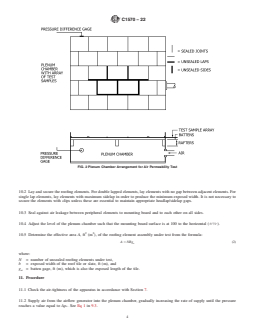
Thisshows5unsealedtiles(5unsealedheadlapsand5unsealedsidelaps).
nection to an air delivery pipe.The tapping shall be positioned
8.2 Providesufficientroofelementfasteningsystems,where
to avoid direct alignment with the air delivery pipe. The shape
appropriate.
and area of the mounting surface shall be capable of accepting
the number of test samples specified in 8.1 as a minimum. A
8.3 Provide sufficient roof substrate materials, such as
schematic of the air permeability apparatus is shown in Fig. 1.
battens and their fasteners.
6.2 An airtight removable cover panel shall be secured
9. Determination of the Critical Uplift Pressure
airtight to the plenum chamber.
Difference,∆p , lbf/ft (Pa)
c
6.3 An open face mounting board to receive the roofing
9.1 Weigh each of the roofing elements in the air-dry
substrate and test samples.
condition.
6.4 A controllable air flow generator shall be capable of
9.2 Calculatetheaverageweight( w),lbm(kg),ofaroofing
continuously delivering air a
...
This document is not an ASTM standard and is intended only to provide the user of an ASTM standard an indication of what changes have been made to the previous version. Because
it may not be technically possible to adequately depict all changes accurately, ASTM recommends that users consult prior editions as appropriate. In all cases only the current version
of the standard as published by ASTM is to be considered the official document.
Designation: C1570 − 03 (Reapproved 2016) C1570 − 22
Standard Test Method for
Wind Resistance of Concrete and Clay Roof Tiles (Air
Permeability Method)
This standard is issued under the fixed designation C1570; the number immediately following the designation indicates the year of
original adoption or, in the case of revision, the year of last revision. A number in parentheses indicates the year of last reapproval. A
superscript epsilon (´) indicates an editorial change since the last revision or reapproval.
1. Scope
1.1 The air permeability of tile roofing systems is a critical factor in determining the wind resistance of tile roofing as applied to
a roof. This Standard describes a procedure for measuring the air permeability of clay and concrete tile and slate roof systems when
applied to a small section of roof deck in accordance with the manufacturer’s instructions.
1.2 This test procedure measures the air permeability of a laid array of unsealed clay or concrete roof tiles or slates. The tiles or
slates shall have a thickness between ⁄8-in. (3-mm) and 2-in. (51-mm).
1.3 The text of this test method references notes and footnotes, which provide explanatory material. These notes and footnotes
(excluding those in tables and figures) shall not be considered as requirements of the standard.
1.4 The values stated in inch-pound units are to be regarded as standard. The values given in parentheses are mathematical
conversions to SI units that are provided for information only and are not considered standard.
1.5 This standard does not purport to address all of the safety concerns, if any, associated with its use. It is the responsibility
of the user of this standard to establish appropriate safety safety, health, and healthenvironmental practices and determine the
applicability of regulatory limitations prior to use.
1.6 This international standard was developed in accordance with internationally recognized principles on standardization
established in the Decision on Principles for the Development of International Standards, Guides and Recommendations issued
by the World Trade Organization Technical Barriers to Trade (TBT) Committee.
2. Referenced Documents
2.1 ASTM Standards:
C43 Terminology of Structural Clay Products (Withdrawn 2009)
C1167 Specification for Clay Roof Tiles
C1232 Terminology for Masonry
C1492 Specification for Concrete Roof Tile
2.2 SBCCI Standard:
SBCCI SSDT 11, SBCCI Test Standard for Determining Wind Resistance of Concrete or Clay Roof Tiles
This test method is under the jurisdiction of ASTM Committee C15 on Manufactured Masonry Units and is the direct responsibility of Subcommittee C15.06 on Roofing
Tile.
Current edition approved Dec. 1, 2016March 1, 2022. Published December 2016April 2022. Originally approved in 2003. Last previous edition approved in 20092016
as C1570 – 03(2009).(2016). DOI: 10.1520/C1570-03R16.10.1520/C1570-22.
For referenced ASTM standards, visit the ASTM website, www.astm.org, or contact ASTM Customer Service at service@astm.org. For Annual Book of ASTM Standards
volume information, refer to the standard’s Document Summary page on the ASTM website.
Copyright © ASTM International, 100 Barr Harbor Drive, PO Box C700, West Conshohocken, PA 19428-2959. United States
C1570 − 22
NOTE 1—This standard is based on the International Code Council’s ICC/SBCCI SSTD 11 and work derived from the tile industry’s testing programs
completed in the Redland Wind Tunnel in the UK.
2.3 ASCE Standard:
ASCE 7, Minimum Design Loads for Buildings and Other Structures
3. Terminology
3.1 Definitions—For definitions of terms used in this test method refer to Terminology C43C1232, and Specifications C1167 and
C1492.
4. Principle of the Test Method
4.1 Air pressure is applied to the underside of an air permeable assembly of a specified type of roofing elements. The difference
in air pressure across the assembly and the volume air flow rate are measured and used to determine the air permeability of the
assembly.
5. Significance and Use
5.1 The air permeability of roofing systems constructed from discrete elements, as is the case for clay and concrete tile and slate
roof systems, is a critical factor in determining the wind resistance of the roof system. The ability of the roof system to relieve
wind-induced uplift pressures as a result of the overall air permeability of the roof assembly relates to the resistance of the roof
system to damage induced by wind.
5.2 Natural wind conditions differ with respect to intensity, duration, and turbulence; these conditions are beyond the means of
this test method to simulate.
6. Apparatus
6.1 A plenum chamber is a rectangular box with a depth of not less than 1.64 ft (500 mm) or one-third of the least lateral
dimension, whichever is the greater. The plenum chamber shall be made airtight except for an open upper face to receive a
mounting board or cover panel, a tapping for a pressure difference gage (relative to atmospheric pressure) and a connection to an
air delivery pipe. The tapping shall be positioned to avoid direct alignment with the air delivery pipe. The shape and area of the
mounting surface shall be capable of accepting the number of test samples specified in 8.1 as a minimum. A schematic of the air
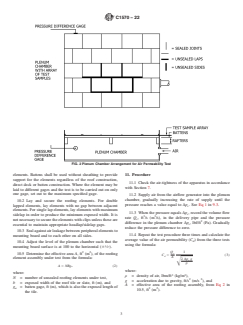
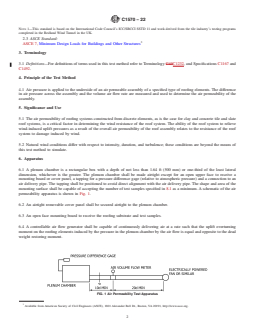
permeability apparatus is shown in Fig. 1.
6.2 An airtight removable cover panel shall be secured airtight to the plenum chamber.
6.3 An open face mounting board to receive the roofing substrate and test samples.
6.4 A controllable air flow generator shall be capable of continuously delivering air at a rate such that the uplift overturning
moment on the roofing elements induced by the pressure in the plenum chamber by the air flow is equal and opposite to the dead
weight restoring moment.
FIG. 1 Air Permeability Test Apparatus
Available from American Society of Civil Engineers (ASCE), 1801 Alexander Bell Dr., Reston, VA 20191, http://www.asce.org.
C1570 − 22
6.5 An airflow meter capable of measuring air volume flow rates in the delivery pipe and having an accuracy of 0.1 ft /s (0.003
m /s) or better.
6.6 A pressure difference measuring device (such as a manometer) connected to the inside and outside of the plenum chamber,
capable of measuring a pressure difference of not less than 0.15 psi (1000 Pa).
6.7 Airtight seals for pipe connections, mounting board and cover panels, and at joints and edges of the roofing assembly.
6.8 A weighing device capable of measuring the dead weight of the roofing elements to the nearest 0.1 lbm (0.05 kg).
7. Check on Air-tightness of the Apparatus
7.1 Close the top of the plenum chamber by attaching and sealing the edges of the mounting board or cover panel so that the
plenum chamber is air-tight except where connected to the delivery pipe.
7.2 Supply air from the airflow ge
...