

ASTM D1790-21
(Test Method)Standard Test Method for Brittleness Temperature of Plastic Sheeting by Impact
General Information
- Abstract
SIGNIFICANCE AND USE
4.1 Data obtained by this test method have been used to predict the behavior of plastic sheeting at low temperatures only if the conditions of deformation are similar to those specified in this test method. This test method is useful for specification testing and for comparative purposes, but does not necessarily determine the lowest use temperature for a particular plastic.
4.2 It has been demonstrated that on calendared sheeting the brittleness temperature is sensitive to the direction of fold. It has also been demonstrated that the brittleness temperature is sensitive to the direction of sampling. Therefore, it is imperative that the procedure for taking specimens and folding be followed explicitly.
SCOPE
1.1 This test method covers the determination of that temperature at which plastic sheeting 1.00 mm (0.040 in.) or less in thickness exhibits a brittle failure under specified impact conditions.
1.2 The values stated in SI units are to be regarded as the standard. The values given in parentheses are for information only.
Note 1: This test method was developed jointly with the Society of the Plastics Industry, primarily for use with plasticized vinyl sheetings. Its applicability to other plastic sheetings must be verified by the user.
1.3 This standard does not purport to address all of the safety concerns, if any, associated with its use. It is the responsibility of the user of this standard to establish appropriate safety, health, and environmental practices and determine the applicability of regulatory limitations prior to use.
Note 2: This test method and ISO 8570 address the same subject matter, but differ in technical content.
1.4 This international standard was developed in accordance with internationally recognized principles on standardization established in the Decision on Principles for the Development of International Standards, Guides and Recommendations issued by the World Trade Organization Technical Barriers to Trade (TBT) Committee.
- Status
- Published
- Publication Date
- 14-Jan-2021
- Technical Committee
- D20 - Plastics
- Drafting Committee
- D20.30 - Thermal Properties
Buy Documents

ASTM D1790-21 - Standard Test Method for Brittleness Temperature of Plastic Sheeting by Impact
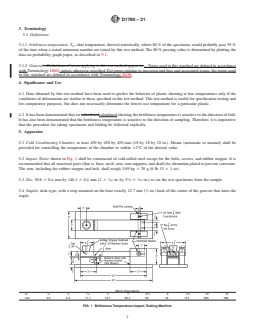
REDLINE ASTM D1790-21 - Standard Test Method for Brittleness Temperature of Plastic Sheeting by Impact
Overview
ASTM D1790-21 is the international standard test method for determining the brittleness temperature of plastic sheeting by impact. Developed by ASTM Committee D20 on Plastics, this method specifically assesses when thin plastic sheeting (1.00 mm or less) exhibits brittle failure under controlled impact at low temperatures. It is particularly valuable for evaluating the cold weather performance of materials such as plasticized vinyl sheeting, although its applicability to other plastic types must be confirmed by users.
This standard is widely adopted for specification testing and comparative studies, helping manufacturers, quality control laboratories, and end users understand the behavior of plastic sheeting in cold environments. While it does not define the absolute lowest usable temperature for every plastic, it provides essential data for product development and quality assurance.
Key Topics
- Brittleness Temperature: Defines the lowest temperature at which plastic sheeting fails under impact, using statistical methods to determine the 80% passing temperature.
- Impact Testing Procedure: Specifies use of a calibrated impact tester and controlled cold conditioning chamber to ensure repeatable results.
- Sample Preparation:
- Specimen thickness uniformity is critical for accurate results.
- Sensitivity to the direction of folding and sampling in calendared sheeting requires strict adherence to specimen preparation protocols.
- Conditioning Requirements:
- Specimens must be conditioned at specified temperature and humidity before testing, following ASTM D618.
- Data Analysis:
- Results are plotted on probability graph paper, and the 20% failure (80% passing) temperature is reported as the brittleness temperature.
- Limitations: The test predicts performance only under similar deformation and impact conditions. It does not determine the absolute lowest service temperature for every plastic material.
Applications
ASTM D1790-21 is used in a variety of industries where plastic sheeting is exposed to cold conditions, including:
- Product Development: Helps manufacturers design materials with specific low-temperature performance requirements, such as automotive interiors, outdoor signage, packaging films, and weatherproof construction materials.
- Quality Control: Assures that production batches of plastic sheeting maintain consistent brittleness temperatures, improving product reliability and safety.
- Material Comparison: Enables engineers and researchers to compare the low-temperature impact behavior of different plastic formulations or processing methods.
- Specification Compliance: Allows material vendors and end users to verify that supplied plastic sheet products meet relevant specifications for cold resistance.
Due to its focus on impact-induced brittle failure, the standard is best suited for plastic sheeting products used in demanding cold environments, ensuring enhanced durability and performance.
Related Standards
ASTM D1790-21 is part of a broader framework of standards addressing plastics testing:
- ASTM D618 - Practice for Conditioning Plastics for Testing
- ASTM D883 - Terminology Relating to Plastics
- ASTM D5947 - Test Methods for Physical Dimensions of Solid Plastics Specimens
- ASTM D6988 - Guide for Determination of Thickness of Plastic Film Test Specimens
- ASTM E456 - Terminology Relating to Quality and Statistics
- ASTM E691 - Practice for Conducting an Interlaboratory Study to Determine the Precision of a Test Method
- ASTM E2935 - Practice for Conducting Equivalence Tests for Comparing Testing Processes
- ISO 8570 - Plastics-Film and Sheeting-Determination of Cold-Crack Temperature
These related documents provide essential guidance on specimen preparation, terminology, and interlaboratory testing, supporting reliable and standardized brittleness temperature testing for plastic sheeting.
Keywords: brittleness temperature, plastic sheeting, cold impact test, ASTM D1790, low-temperature performance, plasticized vinyl, cold-crack temperature, quality control, specification testing, plastics standards.
Relations
- Effective Date
- 01-Feb-2024
- Effective Date
- 01-Nov-2023
- Effective Date
- 01-Apr-2022
- Effective Date
- 01-Jan-2020
- Effective Date
- 01-Aug-2019
- Effective Date
- 15-Apr-2019
- Effective Date
- 01-Feb-2019
- Effective Date
- 01-Dec-2018
- Effective Date
- 01-Nov-2018
- Effective Date
- 01-Oct-2017
- Effective Date
- 01-Oct-2017
- Refers
ASTM E2935-17 - Standard Practice for Conducting Equivalence Testing in Laboratory Applications - Effective Date
- 01-Oct-2017
- Effective Date
- 15-Aug-2017
- Refers
ASTM E2935-16 - Standard Practice for Conducting Equivalence Testing in Laboratory Applications - Effective Date
- 15-Nov-2016
- Refers
ASTM E2935-15 - Standard Practice for Conducting Equivalence Testing in Laboratory Applications - Effective Date
- 01-Oct-2015
Buy Documents
ASTM D1790-21 - Standard Test Method for Brittleness Temperature of Plastic Sheeting by Impact
REDLINE ASTM D1790-21 - Standard Test Method for Brittleness Temperature of Plastic Sheeting by Impact
Get Certified
Connect with accredited certification bodies for this standard

DIN CERTCO
DIN Group product certification.

Smithers Quality Assessments
US management systems and product certification.
Sponsored listings
Frequently Asked Questions
ASTM D1790-21 is a standard published by ASTM International. Its full title is "Standard Test Method for Brittleness Temperature of Plastic Sheeting by Impact". This standard covers: SIGNIFICANCE AND USE 4.1 Data obtained by this test method have been used to predict the behavior of plastic sheeting at low temperatures only if the conditions of deformation are similar to those specified in this test method. This test method is useful for specification testing and for comparative purposes, but does not necessarily determine the lowest use temperature for a particular plastic. 4.2 It has been demonstrated that on calendared sheeting the brittleness temperature is sensitive to the direction of fold. It has also been demonstrated that the brittleness temperature is sensitive to the direction of sampling. Therefore, it is imperative that the procedure for taking specimens and folding be followed explicitly. SCOPE 1.1 This test method covers the determination of that temperature at which plastic sheeting 1.00 mm (0.040 in.) or less in thickness exhibits a brittle failure under specified impact conditions. 1.2 The values stated in SI units are to be regarded as the standard. The values given in parentheses are for information only. Note 1: This test method was developed jointly with the Society of the Plastics Industry, primarily for use with plasticized vinyl sheetings. Its applicability to other plastic sheetings must be verified by the user. 1.3 This standard does not purport to address all of the safety concerns, if any, associated with its use. It is the responsibility of the user of this standard to establish appropriate safety, health, and environmental practices and determine the applicability of regulatory limitations prior to use. Note 2: This test method and ISO 8570 address the same subject matter, but differ in technical content. 1.4 This international standard was developed in accordance with internationally recognized principles on standardization established in the Decision on Principles for the Development of International Standards, Guides and Recommendations issued by the World Trade Organization Technical Barriers to Trade (TBT) Committee.
SIGNIFICANCE AND USE 4.1 Data obtained by this test method have been used to predict the behavior of plastic sheeting at low temperatures only if the conditions of deformation are similar to those specified in this test method. This test method is useful for specification testing and for comparative purposes, but does not necessarily determine the lowest use temperature for a particular plastic. 4.2 It has been demonstrated that on calendared sheeting the brittleness temperature is sensitive to the direction of fold. It has also been demonstrated that the brittleness temperature is sensitive to the direction of sampling. Therefore, it is imperative that the procedure for taking specimens and folding be followed explicitly. SCOPE 1.1 This test method covers the determination of that temperature at which plastic sheeting 1.00 mm (0.040 in.) or less in thickness exhibits a brittle failure under specified impact conditions. 1.2 The values stated in SI units are to be regarded as the standard. The values given in parentheses are for information only. Note 1: This test method was developed jointly with the Society of the Plastics Industry, primarily for use with plasticized vinyl sheetings. Its applicability to other plastic sheetings must be verified by the user. 1.3 This standard does not purport to address all of the safety concerns, if any, associated with its use. It is the responsibility of the user of this standard to establish appropriate safety, health, and environmental practices and determine the applicability of regulatory limitations prior to use. Note 2: This test method and ISO 8570 address the same subject matter, but differ in technical content. 1.4 This international standard was developed in accordance with internationally recognized principles on standardization established in the Decision on Principles for the Development of International Standards, Guides and Recommendations issued by the World Trade Organization Technical Barriers to Trade (TBT) Committee.
ASTM D1790-21 is classified under the following ICS (International Classification for Standards) categories: 83.140.10 - Films and sheets. The ICS classification helps identify the subject area and facilitates finding related standards.
ASTM D1790-21 has the following relationships with other standards: It is inter standard links to ASTM D883-24, ASTM D883-23, ASTM E456-13a(2022)e1, ASTM D883-20, ASTM D883-19c, ASTM D883-19a, ASTM D883-19, ASTM D883-18a, ASTM D883-18, ASTM E456-13A(2017)e3, ASTM E456-13A(2017)e1, ASTM E2935-17, ASTM D883-17, ASTM E2935-16, ASTM E2935-15. Understanding these relationships helps ensure you are using the most current and applicable version of the standard.
ASTM D1790-21 is available in PDF format for immediate download after purchase. The document can be added to your cart and obtained through the secure checkout process. Digital delivery ensures instant access to the complete standard document.
Standards Content (Sample)
This international standard was developed in accordance with internationally recognized principles on standardization established in the Decision on Principles for the
Development of International Standards, Guides and Recommendations issued by the World Trade Organization Technical Barriers to Trade (TBT) Committee.
Designation: D1790 − 21
Standard Test Method for
Brittleness Temperature of Plastic Sheeting by Impact
This standard is issued under the fixed designation D1790; the number immediately following the designation indicates the year of
original adoption or, in the case of revision, the year of last revision. A number in parentheses indicates the year of last reapproval. A
superscript epsilon (´) indicates an editorial change since the last revision or reapproval.
This standard has been approved for use by agencies of the U.S. Department of Defense.
1. Scope* E456 Terminology Relating to Quality and Statistics
E691 Practice for Conducting an Interlaboratory Study to
1.1 This test method covers the determination of that
Determine the Precision of a Test Method
temperature at which plastic sheeting 1.00 mm (0.040 in.) or
E2935 Practice for Conducting Equivalence Tests for Com-
lessinthicknessexhibitsabrittlefailureunderspecifiedimpact
paring Testing Processes
conditions.
2.2 ISO Standard:
1.2 The values stated in SI units are to be regarded as the
ISO 8570 Plastics—Film and Sheeting—Determination of
standard. The values given in parentheses are for information
Cold-Crack Temperature
only.
NOTE1—ThistestmethodwasdevelopedjointlywiththeSocietyofthe
3. Terminology
Plastics Industry, primarily for use with plasticized vinyl sheetings. Its
3.1 Definitions:
applicability to other plastic sheetings must be verified by the user.
3.1.1 brittleness temperature, T —that temperature, derived
1.3 This standard does not purport to address all of the b
statistically, where 80 % of the specimens would probably pass
safety concerns, if any, associated with its use. It is the
95 % of the time when a stated minimum number are tested by
responsibility of the user of this standard to establish appro-
this test method. The 80 %-passing value is determined by
priate safety, health, and environmental practices and deter-
plotting the data on probability graph paper, as described in
mine the applicability of regulatory limitations prior to use.
9.1.
NOTE 2—This test method and ISO 8570 address the same subject
3.1.2 General—Terms used in this standard are defined in
matter, but differ in technical content.
accordance with Terminology D883, unless otherwise speci-
1.4 This international standard was developed in accor-
fied. For terms relating to precision and bias and associated
dance with internationally recognized principles on standard-
issues,thetermsusedinthisstandardaredefinedinaccordance
ization established in the Decision on Principles for the
with Terminology E456.
Development of International Standards, Guides and Recom-
mendations issued by the World Trade Organization Technical
4. Significance and Use
Barriers to Trade (TBT) Committee.
4.1 Data obtained by this test method have been used to
2. Referenced Documents
predict the behavior of plastic sheeting at low temperatures
2.1 ASTM Standards: only if the conditions of deformation are similar to those
D618 Practice for Conditioning Plastics for Testing
specified in this test method. This test method is useful for
D883 Terminology Relating to Plastics specification testing and for comparative purposes, but does
D5947 Test Methods for Physical Dimensions of Solid
not necessarily determine the lowest use temperature for a
Plastics Specimens particular plastic.
D6988 GuideforDeterminationofThicknessofPlasticFilm
4.2 It has been demonstrated that on calendared sheeting the
Test Specimens
brittleness temperature is sensitive to the direction of fold. It
has also been demonstrated that the brittleness temperature is
This test method is under the jurisdiction ofASTM Committee D20 on Plastics
sensitive to the direction of sampling. Therefore, it is impera-
and is the direct responsibility of Subcommittee D20.30 on Thermal Properties.
tive that the procedure for taking specimens and folding be
Current edition approved Jan. 15, 2021. Published February 2021. Originally
followed explicitly.
approved in 1960. Last previous edition approved in 2014 as D1790 - 14. DOI:
10.1520/D1790-21.
For referenced ASTM standards, visit the ASTM website, www.astm.org, or
contact ASTM Customer Service at service@astm.org. For Annual Book of ASTM
Standards volume information, refer to the standard’s Document Summary page on Available from American National Standards Institute (ANSI), 25 W. 43rd St.,
the ASTM website. 4th Floor, New York, NY 10036, http://www.ansi.org.
*A Summary of Changes section appears at the end of this standard
Copyright © ASTM International, 100 Barr Harbor Drive, PO Box C700, West Conshohocken, PA 19428-2959. United States
D1790 − 21
5. Apparatus in thickness and to within 5 % in the case of specimens greater
than 0.25 mm (0.010 in.) in thickness but do not exceed 1.00
5.1 Cold Conditioning Chamber, at least 450 by 450 by 450
mm (0.040 in.) in thickness.
mm(18by18by18in.).Means(automaticormanual)shallbe
provided for controlling the temperature of the chamber to 6.3 The 50-mm (2-in.) ends of each specimen shall be so
within 62°C of the desired value. collected that a gradual, closed loop is formed at room
temperatures. The collected ends of the specimen and one end
5.2 Impact Tester shown in Fig. 1 shall be constructed of
of the 50 by 127-mm (2 by 5-in.) card shall be matched exactly
cold-rolled steel except for the bolts, screws, and rubber
with the body of the loop lying on the card. Two staples shall
stopper. It is recommended that all structural parts (that is,
be crimped through the matched ends of the specimen and
base, anvil, arm, arm supports, and shaft) be chromium plated
card. These staples shall be 13-mm ( ⁄2 in.) from, and parallel
topreventcorrosion.Thearm,includingtherubberstopperand
to, the 50-mm (2-in.) end of the stack.
bolt, shall weigh 3.09 kg 628g(6lb13 6 1 oz).
6.4 Since it has been demonstrated that this test is sensitive
5.3 Die, 50.8 6 0.4 mm by 146.1 6 0.4 mm (2 6 ⁄64 in. by
to the direction of fold on calendered sheeting, it is necessary
3 1
5 ⁄4 6 ⁄64 in.) to cut the test specimens from the sample.
to stipulate that all specimens be folded in the same direction.
5.4 Stapler, desk-type, with a stop mounted on the base
It is recommended that, for materials with no grain, the
exactly 12.7 mm ( ⁄2 in.) back of the center of the groover that
specimen be folded so that the surface last in contact with the
turns the staple.
roll shall be inside the loop following the inherent shape of the
5.5 Index Card Stock, 50 by 127 mm (2 by 5 in.). specimen; grained materials are to be tested with the grained
surface on the inside of the loop.
5.6 Thickness Gauge—A dead-weight dial or digital mi-
crometer as described in D5947 or D6988 as appropriate for
7. Conditioning
the material or specimen geometry being tested.
7.1 Conditioning—Condition the test specimens at 23 6
6. Test Specimens
2°C (73.4 6 3.6°F) and 50 6 10 % relative humidity for not
6.1 The test specimens shall be cut with the die. The length less than 40 h prior to test in accordance with Procedure A of
Practice D618, for those tests where conditioning is required.
of the test specimen shall be parallel to
...
This document is not an ASTM standard and is intended only to provide the user of an ASTM standard an indication of what changes have been made to the previous version. Because
it may not be technically possible to adequately depict all changes accurately, ASTM recommends that users consult prior editions as appropriate. In all cases only the current version
of the standard as published by ASTM is to be considered the official document.
Designation: D1790 − 14 D1790 − 21
Standard Test Method for
Brittleness Temperature of Plastic Sheeting by Impact
This standard is issued under the fixed designation D1790; the number immediately following the designation indicates the year of
original adoption or, in the case of revision, the year of last revision. A number in parentheses indicates the year of last reapproval. A
superscript epsilon (´) indicates an editorial change since the last revision or reapproval.
This standard has been approved for use by agencies of the U.S. Department of Defense.
1. Scope*
1.1 This test method covers the determination of that temperature at which plastic sheeting 1.00 mm (0.040 in.) or less in thickness
exhibits a brittle failure under specified impact conditions.
1.2 The values stated in SI units are to be regarded as the standard. The values given in parentheses are for information only.
NOTE 1—This test method was developed jointly with the Society of the Plastics Industry, primarily for use with plasticized vinyl sheetings. Its
applicability to other plastic sheetings must be verified by the user.
1.3 This standard does not purport to address all of the safety concerns, if any, associated with its use. It is the responsibility
of the user of this standard to establish appropriate safety safety, health, and healthenvironmental practices and determine the
applicability of regulatory limitations prior to use.
NOTE 2—This test method and ISO 8570 address the same subject matter, but differ in technical content.
1.4 This international standard was developed in accordance with internationally recognized principles on standardization
established in the Decision on Principles for the Development of International Standards, Guides and Recommendations issued
by the World Trade Organization Technical Barriers to Trade (TBT) Committee.
2. Referenced Documents
2.1 ASTM Standards:
D618 Practice for Conditioning Plastics for Testing
D883 Terminology Relating to Plastics
D5947 Test Methods for Physical Dimensions of Solid Plastics Specimens
D6988 Guide for Determination of Thickness of Plastic Film Test Specimens
E456 Terminology Relating to Quality and Statistics
E691 Practice for Conducting an Interlaboratory Study to Determine the Precision of a Test Method
E2935 Practice for Conducting Equivalence Tests for Comparing Testing Processes
2.2 ISO Standard:
ISO 8570 Plastics—Film and Sheeting—Determination of Cold-Crack Temperature
This test method is under the jurisdiction of ASTM Committee D20 on Plastics and is the direct responsibility of Subcommittee D20.30 on Thermal Properties.
Current edition approved Oct. 1, 2014Jan. 15, 2021. Published October 2014February 2021. Originally approved in 1960. Last previous edition approved in 20082014
as D1790 - 08.D1790 - 14. DOI: 10.1520/D1790-14.10.1520/D1790-21.
For referenced ASTM standards, visit the ASTM website, www.astm.org, or contact ASTM Customer Service at service@astm.org. For Annual Book of ASTM Standards
volume information, refer to the standard’s Document Summary page on the ASTM website.
Available from American National Standards Institute (ANSI), 25 W. 43rd St., 4th Floor, New York, NY 10036, http://www.ansi.org.
*A Summary of Changes section appears at the end of this standard
Copyright © ASTM International, 100 Barr Harbor Drive, PO Box C700, West Conshohocken, PA 19428-2959. United States
D1790 − 21
3. Terminology
3.1 Definitions:
3.1.1 brittleness temperature, T —that temperature, derived statistically, where 80 % of the specimens would probably pass 95 %
b
of the time when a stated minimum number are tested by this test method. The 80 %-passing value is determined by plotting the
data on probability graph paper, as described in 9.1.
3.1.2 General—Definitions of terms applying to this test method appear in —Terms used in this standard are defined in accordance
with Terminology D883, unless otherwise specified. For terms relating to precision and bias and associated issues, the terms used
in this standard are defined in accordance with Terminology E456.
4. Significance and Use
4.1 Data obtained by this test method have been used to predict the behavior of plastic sheeting at low temperatures only if the
conditions of deformation are similar to those specified in this test method. This test method is useful for specification testing and
for comparative purposes, but does not necessarily determine the lowest use temperature for a particular plastic.
4.2 It has been demonstrated that on calenderedcalendared sheeting the brittleness temperature is sensitive to the direction of fold.
It has also been demonstrated that the brittleness temperature is sensitive to the direction of sampling. Therefore, it is imperative
that the procedure for taking specimens and folding be followed explicitly.
5. Apparatus
5.1 Cold Conditioning Chamber, at least 450 by 450 by 450 mm (18 by 18 by 18 in.). Means (automatic or manual) shall be
provided for controlling the temperature of the chamber to within 62°C of the desired value.
5.2 Impact Tester shown in Fig. 1 shall be constructed of cold-rolled steel except for the bolts, screws, and rubber stopper. It is
recommended that all structural parts (that is, base, anvil, arm, arm supports, and shaft) be chromium plated to prevent corrosion.
The arm, including the rubber stopper and bolt, shall weigh 3.09 kg 6 28 g (6 lb 13 6 1 oz).
1 3 1
5.3 Die, 50.8 6 0.4 mm by 146.1 6 0.4 mm (2 6 ⁄64 in. by 5 ⁄4 6 ⁄64 in.) to cut the test specimens from the sample.
5.4 Stapler, desk-type, with a stop mounted on the base exactly 12.7 mm ( ⁄2 in.) back of the center of the groover that turns the
staple.
Metric Equivalents
1 1 7 1 1 1
in. ⁄8 ⁄4 ⁄16 ⁄2 1 2 ⁄2 3 4 ⁄2 12 14
mm 3.2 6.4 11.1 12.7 25.4 64 76 114 305 356
FIG. 1 Brittleness Temperature Impact Testing Machine
D1790 − 21
5.5 Index Card Stock, 50 by 127 mm (2 by 5 in.).
5.6 Thickness Gauge—A dead-weight dial or digital micrometer as described in D5947 or D6988 as appropriate for the material
or specimen geometry being tested.
6. Test Specimens
6.1 The test specimens shall be cut with the die. The length of the test specimen shall be parallel to the transverse direction of
the sheeting.
6.2 The test specimens shall be selected so that the thickness is uniform to within 10% of the thickness over the length of the
specimen in the case of specimens 0.25 mm (0.010 in.) or less in thickness and to within 5 % in the case of specimens greater than
0.25 mm (0.010 in.) in thickness but do not exceed 1.00 mm (0.040 in.) in thickness.
6.3 The 50-mm (2-in.) ends of each specimen shall be so collected that a gradual, closed loop is formed at room temperatures.
The collected ends of the specimen and one end of the 50 by 127-mm (2 by 5-in.) card shall be matched exactly with the body
of the loop lying on the card. Two staples shall be crimped through the matched ends of the specimen and card. These staples shall
be 13-mm ( ⁄2 in.) from, and parallel to, the 50-mm (2-in.) end of the stack.
6.4 Since it has been demonstrated that this test is sensitive to the direction of fold on calendered sheeting, it is necessary to
stipulate that all specimens be folded in the same direction. It is recommended that, for materials with no grain, the specimen be
folded so that the surface last in contact with the roll shall be inside the loop following the inherent shape of the specimen; grained
materials are to be tested with the grained surface on the inside of the loop.
7. Conditioning
7.1 Conditioning—Condition the test specimens at 23 6 2°C (73.4 6 3.6°F) and 50 6 10 % relative humidity for not less than
40 h prior to test in accordance with Procedure A of Practice D618, for those tests where conditioning is required. In cases of
disagreement, the tolerances shall be 61°C (61.8°F) and 65 % relative humidity.
7.2 Test Conditions—Conduct tests in the standard laboratory environment of 23 6 2°C (73.4 6 3.6°F) and 50 6 10 % relative
humidity, unless otherwise specified in the test methods or in this test method. In cases of disagreements, the tolerances shall be
61°C (61.8°F) and 65 % relative humidity.
8. Procedure
8.1 Measure the thickness of the specimen at several points along its length to an accuracy of 0.0025 mm (0.0001 in.) or better
for specimens 0.25 mm (0.010 in.) or less in thickness and to an accuracy of 1 % or better for s
...