

ASTM D7957/D7957M-22
(Specification)Standard Specification for Solid Round Glass Fiber Reinforced Polymer Bars for Concrete Reinforcement
General Information
- Abstract
ABSTRACT
This specification covers glass fiber reinforced polymer (GFRP) bars, provided in cut lengths and bent shapes and having an external surface enhancement for concrete reinforcement. It specifies the property limits and test methods for qualification, quality control and certification of GFRP bars, the geometric and mechanical property requirements, and minimum inside bend diameter of bent bars. Physical properties include fiber mass content, glass transition temperature, degree of cure, and bar sizes), whereas mechanical properties include ultimate tensile force, tensile modulus of elasticity, ultimate tensile strain, transverse shear strength, and bond strength.
This specification also covers the manufacturing process for constituent materials, namely, reinforcing fibers and matrix resins; durability properties (moisture absorption, resistance to alkaline environment); sampling (product qualification, quality control and certification); product certification; and markings and traceability.
SCOPE
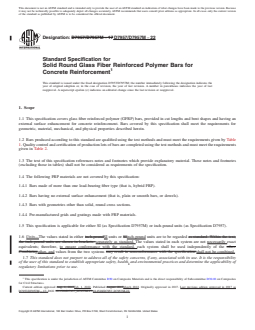
1.1 This specification covers glass fiber reinforced polymer (GFRP) bars, provided in cut lengths and bent shapes and having an external surface enhancement for concrete reinforcement. Bars covered by this specification shall meet the requirements for geometric, material, mechanical, and physical properties described herein.
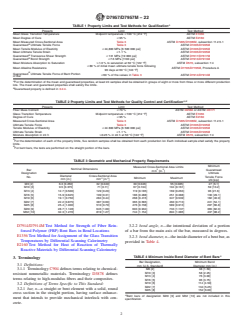
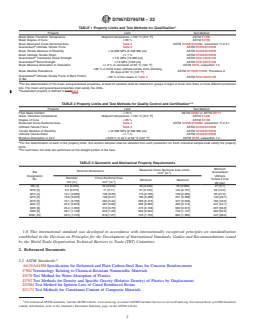
1.2 Bars produced according to this standard are qualified using the test methods and must meet the requirements given by Table 1. Quality control and certification of production lots of bars are completed using the test methods and must meet the requirements given in Table 2.
1.3 The text of this specification references notes and footnotes which provide explanatory material. These notes and footnotes (excluding those in tables) shall not be considered as requirements of the specification.
1.4 The following FRP materials are not covered by this specification:
1.4.1 Bars made of more than one load-bearing fiber type (that is, hybrid FRP).
1.4.2 Bars having no external surface enhancement (that is, plain or smooth bars, or dowels).
1.4.3 Bars with geometries other than solid, round cross sections.
1.4.4 Pre-manufactured grids and gratings made with FRP materials.
1.5 This specification is applicable for either SI (as Specification D7957M) or inch-pound units (as Specification D7957).
1.6 Units—The values stated in either SI units or inch-pound units are to be regarded separately as standard. The values stated in each system are not necessarily exact equivalents; therefore, to ensure conformance with the standard, each system shall be used independently of the other, and values from the two systems shall not be combined.
1.7 This standard does not purport to address all of the safety concerns, if any, associated with its use. It is the responsibility of the user of this standard to establish appropriate safety, health, and environmental practices and determine the applicability of regulatory limitations prior to use.
1.8 This international standard was developed in accordance with internationally recognized principles on standardization established in the Decision on Principles for the Development of International Standards, Guides and Recommendations issued by the World Trade Organization Technical Barriers to Trade (TBT) Committee.
- Status
- Published
- Publication Date
- 31-Jan-2022
- Technical Committee
- D30 - Composite Materials
- Drafting Committee
- D30.10 - Composites for Civil Structures
Buy Documents
ASTM D7957/D7957M-22 - Standard Specification for Solid Round Glass Fiber Reinforced Polymer Bars for Concrete Reinforcement
REDLINE ASTM D7957/D7957M-22 - Standard Specification for Solid Round Glass Fiber Reinforced Polymer Bars for Concrete Reinforcement
Overview
ASTM D7957/D7957M-22: Standard Specification for Solid Round Glass Fiber Reinforced Polymer Bars for Concrete Reinforcement outlines requirements and test methods for glass fiber reinforced polymer (GFRP) bars used in concrete construction. This standard applies to GFRP bars supplied in straight or bent shapes, with external surface enhancements to improve bonding with concrete. It establishes criteria for the bars’ geometric, physical, mechanical, and durability properties, covering aspects critical to qualification, quality control, and product certification.
GFRP bars are increasingly used as an alternative to traditional steel reinforcement in concrete, particularly in environments where corrosion is a concern. ASTM D7957/D7957M-22 provides a clear framework for manufacturers, specifiers, and contractors to ensure consistent product quality and performance.
Key Topics
1. Product Scope and Exclusions
- Applies to solid, round GFRP bars for concrete reinforcement, in both cut lengths and bent forms.
- Bars must have external surface enhancements (protrusions, coatings, or deformations) to promote mechanical bond with concrete.
- Does not cover hybrid FRP bars, plain smooth bars, non-round geometries, or FRP pre-manufactured grids.
2. Property Requirements
- Physical properties:
- Fiber mass content
- Glass transition temperature
- Degree of cure
- Bar size and measured cross-sectional area
- Mechanical properties:
- Ultimate tensile force
- Tensile modulus of elasticity
- Ultimate tensile strain
- Transverse shear strength
- Bond strength to concrete
3. Durability Properties
- Moisture absorption resistance
- Alkaline (chemical) resistance
4. Sampling and Certification
- Requirements for batch sampling for qualification and ongoing quality control.
- Mandatory product marking for traceability, including specification number, manufacturer mark, size designation, and production lot.
5. Test Methods
- Utilizes standardized ASTM test methods for critical performance characteristics such as tensile strength, bond strength, and durability.
6. Manufacturing and Materials
- Specifies use of continuous glass fiber rovings and resin systems (typically vinyl ester, excluding polyester).
- Mandates quality control processes and documentation by manufacturers.
Applications
ASTM D7957/D7957M-22 is highly relevant for:
- Construction projects using non-metallic reinforcement to reduce corrosion risk, such as bridges, marine structures, and chemical plants.
- Situations requiring high durability, low maintenance, and non-conductive rebar.
- Civil engineering applications seeking alternatives to traditional steel reinforcement in challenging environments.
End users include:
- Structural engineers specifying reinforcement for new concrete designs.
- Construction contractors and precast concrete manufacturers.
- Quality assurance professionals in manufacturing and on-site inspection roles.
Following this standard helps ensure GFRP bars meet consistent levels of strength, durability, and bond performance, leading to improved long-term structural integrity in reinforced concrete.
Related Standards
When working with GFRP reinforcement in concrete, the following related standards and test methods are often referenced alongside ASTM D7957/D7957M-22:
- ASTM A615/A615M: Specification for Deformed and Plain Carbon-Steel Bars for Concrete Reinforcement
- ASTM D7205/D7205M: Test Method for Tensile Properties of Fiber Reinforced Polymer Matrix Composite Bars
- ASTM D7617/D7617M: Test Method for Transverse Shear Strength of Fiber-Reinforced Polymer Matrix Composite Bars
- ASTM D7913/D7913M: Test Method for Bond Strength of Fiber-Reinforced Polymer Matrix Composite Bars to Concrete by Pullout Testing
- ASTM D7705/D7705M: Test Method for Alkali Resistance of Fiber Reinforced Polymer (FRP) Bars in Concrete Construction
- ASTM D570: Test Method for Water Absorption of Plastics
These referenced standards provide supporting test methods and terminology essential for the correct application and interpretation of ASTM D7957/D7957M-22 in practice.
Keywords: ASTM D7957, glass fiber reinforced polymer (GFRP) bars, concrete reinforcement, FRP rebar, non-metallic reinforcement, durability, quality control, construction standards.
Relations
- Effective Date
- 01-Nov-2023
- Effective Date
- 01-Feb-2020
- Effective Date
- 15-Oct-2019
- Effective Date
- 15-Apr-2019
- Effective Date
- 01-Feb-2019
- Refers
ASTM C904-01(2018) - Standard Terminology Relating to Chemical-Resistant Nonmetallic Materials - Effective Date
- 01-Nov-2018
- Effective Date
- 15-Sep-2018
- Effective Date
- 01-Apr-2018
- Effective Date
- 01-Apr-2018
- Effective Date
- 01-Aug-2017
- Effective Date
- 01-Aug-2016
- Effective Date
- 01-Jul-2015
- Effective Date
- 01-Apr-2015
- Effective Date
- 15-Aug-2014
- Effective Date
- 01-Apr-2014
Buy Documents
ASTM D7957/D7957M-22 - Standard Specification for Solid Round Glass Fiber Reinforced Polymer Bars for Concrete Reinforcement
REDLINE ASTM D7957/D7957M-22 - Standard Specification for Solid Round Glass Fiber Reinforced Polymer Bars for Concrete Reinforcement
Get Certified
Connect with accredited certification bodies for this standard

DIBt (Deutsches Institut für Bautechnik)
German Institute for Building Technology.
DIN CERTCO
DIN Group product certification.

Aboma Certification B.V.
Specialized in construction, metal, and transport sectors.
Sponsored listings
Frequently Asked Questions
ASTM D7957/D7957M-22 is a technical specification published by ASTM International. Its full title is "Standard Specification for Solid Round Glass Fiber Reinforced Polymer Bars for Concrete Reinforcement". This standard covers: ABSTRACT This specification covers glass fiber reinforced polymer (GFRP) bars, provided in cut lengths and bent shapes and having an external surface enhancement for concrete reinforcement. It specifies the property limits and test methods for qualification, quality control and certification of GFRP bars, the geometric and mechanical property requirements, and minimum inside bend diameter of bent bars. Physical properties include fiber mass content, glass transition temperature, degree of cure, and bar sizes), whereas mechanical properties include ultimate tensile force, tensile modulus of elasticity, ultimate tensile strain, transverse shear strength, and bond strength. This specification also covers the manufacturing process for constituent materials, namely, reinforcing fibers and matrix resins; durability properties (moisture absorption, resistance to alkaline environment); sampling (product qualification, quality control and certification); product certification; and markings and traceability. SCOPE 1.1 This specification covers glass fiber reinforced polymer (GFRP) bars, provided in cut lengths and bent shapes and having an external surface enhancement for concrete reinforcement. Bars covered by this specification shall meet the requirements for geometric, material, mechanical, and physical properties described herein. 1.2 Bars produced according to this standard are qualified using the test methods and must meet the requirements given by Table 1. Quality control and certification of production lots of bars are completed using the test methods and must meet the requirements given in Table 2. 1.3 The text of this specification references notes and footnotes which provide explanatory material. These notes and footnotes (excluding those in tables) shall not be considered as requirements of the specification. 1.4 The following FRP materials are not covered by this specification: 1.4.1 Bars made of more than one load-bearing fiber type (that is, hybrid FRP). 1.4.2 Bars having no external surface enhancement (that is, plain or smooth bars, or dowels). 1.4.3 Bars with geometries other than solid, round cross sections. 1.4.4 Pre-manufactured grids and gratings made with FRP materials. 1.5 This specification is applicable for either SI (as Specification D7957M) or inch-pound units (as Specification D7957). 1.6 Units—The values stated in either SI units or inch-pound units are to be regarded separately as standard. The values stated in each system are not necessarily exact equivalents; therefore, to ensure conformance with the standard, each system shall be used independently of the other, and values from the two systems shall not be combined. 1.7 This standard does not purport to address all of the safety concerns, if any, associated with its use. It is the responsibility of the user of this standard to establish appropriate safety, health, and environmental practices and determine the applicability of regulatory limitations prior to use. 1.8 This international standard was developed in accordance with internationally recognized principles on standardization established in the Decision on Principles for the Development of International Standards, Guides and Recommendations issued by the World Trade Organization Technical Barriers to Trade (TBT) Committee.
ABSTRACT This specification covers glass fiber reinforced polymer (GFRP) bars, provided in cut lengths and bent shapes and having an external surface enhancement for concrete reinforcement. It specifies the property limits and test methods for qualification, quality control and certification of GFRP bars, the geometric and mechanical property requirements, and minimum inside bend diameter of bent bars. Physical properties include fiber mass content, glass transition temperature, degree of cure, and bar sizes), whereas mechanical properties include ultimate tensile force, tensile modulus of elasticity, ultimate tensile strain, transverse shear strength, and bond strength. This specification also covers the manufacturing process for constituent materials, namely, reinforcing fibers and matrix resins; durability properties (moisture absorption, resistance to alkaline environment); sampling (product qualification, quality control and certification); product certification; and markings and traceability. SCOPE 1.1 This specification covers glass fiber reinforced polymer (GFRP) bars, provided in cut lengths and bent shapes and having an external surface enhancement for concrete reinforcement. Bars covered by this specification shall meet the requirements for geometric, material, mechanical, and physical properties described herein. 1.2 Bars produced according to this standard are qualified using the test methods and must meet the requirements given by Table 1. Quality control and certification of production lots of bars are completed using the test methods and must meet the requirements given in Table 2. 1.3 The text of this specification references notes and footnotes which provide explanatory material. These notes and footnotes (excluding those in tables) shall not be considered as requirements of the specification. 1.4 The following FRP materials are not covered by this specification: 1.4.1 Bars made of more than one load-bearing fiber type (that is, hybrid FRP). 1.4.2 Bars having no external surface enhancement (that is, plain or smooth bars, or dowels). 1.4.3 Bars with geometries other than solid, round cross sections. 1.4.4 Pre-manufactured grids and gratings made with FRP materials. 1.5 This specification is applicable for either SI (as Specification D7957M) or inch-pound units (as Specification D7957). 1.6 Units—The values stated in either SI units or inch-pound units are to be regarded separately as standard. The values stated in each system are not necessarily exact equivalents; therefore, to ensure conformance with the standard, each system shall be used independently of the other, and values from the two systems shall not be combined. 1.7 This standard does not purport to address all of the safety concerns, if any, associated with its use. It is the responsibility of the user of this standard to establish appropriate safety, health, and environmental practices and determine the applicability of regulatory limitations prior to use. 1.8 This international standard was developed in accordance with internationally recognized principles on standardization established in the Decision on Principles for the Development of International Standards, Guides and Recommendations issued by the World Trade Organization Technical Barriers to Trade (TBT) Committee.
ASTM D7957/D7957M-22 is classified under the following ICS (International Classification for Standards) categories: 91.100.30 - Concrete and concrete products. The ICS classification helps identify the subject area and facilitates finding related standards.
ASTM D7957/D7957M-22 has the following relationships with other standards: It is inter standard links to ASTM E2160-23, ASTM D7913/D7913M-14(2020), ASTM D3878-19a, ASTM D3878-19, ASTM D7705/D7705M-12(2019), ASTM C904-01(2018), ASTM D2584-18, ASTM D3878-18, ASTM E2160-04(2018), ASTM D7617/D7617M-11(2017), ASTM D3878-16, ASTM D3878-15, ASTM A615/A615M-15, ASTM D7913/D7913M-14, ASTM A615/A615M-14. Understanding these relationships helps ensure you are using the most current and applicable version of the standard.
ASTM D7957/D7957M-22 is available in PDF format for immediate download after purchase. The document can be added to your cart and obtained through the secure checkout process. Digital delivery ensures instant access to the complete standard document.
Standards Content (Sample)
This international standard was developed in accordance with internationally recognized principles on standardization established in the Decision on Principles for the
Development of International Standards, Guides and Recommendations issued by the World Trade Organization Technical Barriers to Trade (TBT) Committee.
Designation:D7957/D7957M −22
Standard Specification for
Solid Round Glass Fiber Reinforced Polymer Bars for
Concrete Reinforcement
This standard is issued under the fixed designation D7957/D7957M; the number immediately following the designation indicates the
year of original adoption or, in the case of revision, the year of last revision. A number in parentheses indicates the year of last
reapproval. A superscript epsilon (´) indicates an editorial change since the last revision or reapproval.
1. Scope system shall be used independently of the other, and values
from the two systems shall not be combined.
1.1 This specification covers glass fiber reinforced polymer
1.7 This standard does not purport to address all of the
(GFRP) bars, provided in cut lengths and bent shapes and
safety concerns, if any, associated with its use. It is the
havinganexternalsurfaceenhancementforconcretereinforce-
responsibility of the user of this standard to establish appro-
ment. Bars covered by this specification shall meet the require-
priate safety, health, and environmental practices and deter-
ments for geometric, material, mechanical, and physical prop-
mine the applicability of regulatory limitations prior to use.
erties described herein.
1.8 This international standard was developed in accor-
1.2 Bars produced according to this standard are qualified
dance with internationally recognized principles on standard-
using the test methods and must meet the requirements given
ization established in the Decision on Principles for the
by Table 1. Quality control and certification of production lots
Development of International Standards, Guides and Recom-
ofbarsarecompletedusingthetestmethodsandmustmeetthe
mendations issued by the World Trade Organization Technical
requirements given in Table 2.
Barriers to Trade (TBT) Committee.
1.3 The text of this specification references notes and
2. Referenced Documents
footnotes which provide explanatory material. These notes and
footnotes (excluding those in tables) shall not be considered as
2.1 ASTM Standards:
requirements of the specification.
A615/A615M SpecificationforDeformedandPlainCarbon-
Steel Bars for Concrete Reinforcement
1.4 The following FRP materials are not covered by this
C904 Terminology Relating to Chemical-Resistant Nonme-
specification:
tallic Materials
1.4.1 Bars made of more than one load-bearing fiber type
D570 Test Method for Water Absorption of Plastics
(that is, hybrid FRP).
D792 Test Methods for Density and Specific Gravity (Rela-
1.4.2 Bars having no external surface enhancement (that is,
tive Density) of Plastics by Displacement
plain or smooth bars, or dowels).
D2584 Test Method for Ignition Loss of Cured Reinforced
1.4.3 Bars with geometries other than solid, round cross
Resins
sections.
D3171 Test Methods for Constituent Content of Composite
1.4.4 Pre-manufactured grids and gratings made with FRP
Materials
materials.
D3878 Terminology for Composite Materials
1.5 This specification is applicable for either SI (as Speci-
D7205/D7205M Test Method for Tensile Properties of Fiber
fication D7957M) or inch-pound units (as Specification
Reinforced Polymer Matrix Composite Bars
D7957).
D7617/D7617M Test Method for Transverse Shear Strength
of Fiber-reinforced Polymer Matrix Composite Bars
1.6 Units—The values stated in either SI units or inch-
D7705/D7705M Test Method for Alkali Resistance of Fiber
pound units are to be regarded separately as standard. The
Reinforced Polymer (FRP) Matrix Composite Bars used
values stated in each system are not necessarily exact equiva-
in Concrete Construction
lents; therefore, to ensure conformance with the standard, each
D7913/D7913M Test Method for Bond Strength of Fiber-
Reinforced Polymer Matrix Composite Bars to Concrete
by Pullout Testing
This specification is under the jurisdiction of ASTM Committee D30 on
Composite Materials and is the direct responsibility of Subcommittee D30.10 on
Composites for Civil Structures. For referenced ASTM standards, visit the ASTM website, www.astm.org, or
Current edition approved Feb. 1, 2022. Published March 2022. Originally contact ASTM Customer Service at service@astm.org. For Annual Book of ASTM
approved in 2017. Last previous edition approved in 2017 as D7957/D7957M – 17. Standards volume information, refer to the standard’s Document Summary page on
DOI: 10.1520/D7957_D7957M-22. the ASTM website.
Copyright © ASTM International, 100 Barr Harbor Drive, PO Box C700, West Conshohocken, PA 19428-2959. United States
D7957/D7957M−22
A
TABLE 1 Property Limits and Test Methods for Qualification
Property Limit Test Method
Mean Glass Transition Temperature Midpoint temperature$100 °C [212 °F] ASTM E1356
Mean Degree of Cure $95 % ASTM E2160
Mean Measured Cross-Sectional Area Table 3 ASTM D7205/D7205M, subsection 11.2.5.1
B
Guaranteed Ultimate Tensile Force Table 3 ASTM D7205/D7205M
Mean Tensile Modulus of Elasticity $44,800 MPa [6 500 000 psi] ASTM D7205/D7205M
Mean Ultimate Tensile Strain $1.1 % ASTM D7205/D7205M
B
Guaranteed Transverse Shear Strength $131 MPa [19 000 psi] ASTM D7617/D7617M
B
Guaranteed Bond Strength $7.6 MPa [1100 psi] ASTM D7913/D7913M
Mean Moisture Absorption to Saturation #1.0 % to saturation at 50 °C [122 °F] ASTM D570, subsection 7.4
$80 % of initial mean ultimate tensile force following
Mean Alkaline Resistance ASTM D7705/D7705M, Procedure A
90 days at 60 °C [140 °F]
B
Guaranteed Ultimate Tensile Force of Bent Portion
$60 % of the values in Table 3 ASTM D7914/D7914M
of Bar
A
For the determination of the mean and guaranteed properties, at least 24 samples shall be obtained in groups of eight or more from three or more different production
lots. The mean and guaranteed properties shall satisfy the limits.
B
Guaranteed property is defined in 3.2.4.
A,B
TABLE 2 Property Limits and Test Methods for Quality Control and Certification
Property Limit Test Method
Fiber Mass Content $70 % ASTM D2584 or ASTM D3171
Glass Transition Temperature Midpoint temperature$100 °C [212 °F] ASTM E1356
Degree of Cure $95 % ASTM E2160
Measured Cross-Sectional Area Table 3 ASTM D7205/D7205M, subsection 11.2.5.1
Ultimate Tensile Force Table 3 ASTM D7205/D7205M
Tensile Modulus of Elasticity $44 800 MPa [6 500 000 psi] ASTM D7205/D7205M
Ultimate Tensile Strain $1.1 % ASTM D7205/D7205M
Moisture Absorption in 24 h #0.25 % in 24 h at 50 °C [122 °F] ASTM D570, subsection 7.4
A
For the determination of each of the property limits, five random samples shall be obtained from each production lot. Each individual sample shall satisfy the property
limits.
B
For bent bars, the tests are performed on the straight portion of the bars.
TABLE 3 Geometric and Mechanical Property Requirements
Minimum
Measured Cross-Sectional Area Limits
Nominal Dimensions
2 2
Bar Guaranteed
mm [in. ]
Designation Ultimate
Diameter Cross-Sectional Area
No. Tensile Force
Minimum Maximum
2 2
mm [in.] mm [in. ]
kN [kip]
M6 [2] 6.3 [0.250] 32 [0.049] 30 [0.046] 55 [0.085] 27 [6.1]
M10 [3] 9.5 [0.375] 71 [0.11] 67 [0.104] 104 [0.161] 59 [13.2]
M13 [4] 12.7 [0.500] 129 [0.20] 119 [0.185] 169 [0.263] 96 [21.6]
M16 [5] 15.9 [0.625] 199 [0.31] 186 [0.288] 251 [0.388] 130 [29.1]
M19 [6] 19.1 [0.750] 284 [0.44] 268 [0.415] 347 [0.539] 182 [40.9]
M22 [7] 22.2 [0.875] 387 [0.60] 365 [0.565] 460 [0.713] 241 [54.1]
M25 [8] 25.4 [1.000] 510 [0.79] 476 [0.738] 589 [0.913] 297 [66.8]
M29 [9] 28.7 [1.128] 645 [1.00] 603 [0.934] 733 [1.137] 365 [82.0]
M32 [10] 32.3 [1.270] 819 [1.27] 744 [1.154] 894 [1.385] 437 [98.2]
D7914/D7914M Test Method for Strength of Fiber Rein- 3.2.2 bend angle, n—the intentional deviation of a portion
forced Polymer (FRP) Bent Bars in Bend Locations of a bar from the main axis of the bar, measured in degrees.
E1356 Test Method for Assignment of the Glass Transition
3.2.3 bend diameter, n—the inside diameter of a bent bar, as
Temperatures by Differential Scanning Calorimetry
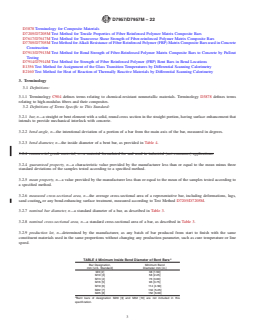
provided in Table 4.
E2160 Test Method for Heat of Reaction of Thermally
Reactive Materials by Differential Scanning Calorimetry
A
TABLE 4 Minimum Inside Bend Diameter of Bent Bars
3. Terminology
Bar Designation, Minimum Bend
3.1 Definitions:
mm [U.S. Standard] Diameter mm [in.]
M6 [2] 38 [1.50]
3.1.1 Terminology C904 defines terms relating to chemical-
M10 [3] 58 [2.25]
resistant nonmetallic materials. Terminology D3878 defines
M13 [4] 76 [3.00]
terms relating to high-modulus fibers and their composites.
M16 [5] 96 [3.75]
M19 [6] 114 [4.50]
3.2 Definitions of Terms Specific to This Standard:
M22 [7] 134 [5.25]
3.2.1 bar, n—a straight or bent element with a solid, round
M25 [8] 152 [6.00]
cross section in the straight portion, having surface enhance-
A
Bent bars of designation M29 [9] and M32 [10] are not included in this
ment that intends to provide mechanical interlock with con-
specification.
crete.
D7957/D7957M−22
3.2.4 guaranteed property, n—a characteristic value pro- 5. Constituent Materials and Manufacture
videdbythemanufacturerlessthanorequaltothemeanminus
5.1 Reinforcing Fibers—Glass fibers shall be in the form of
three standard deviations of the samples tested according to a
continuous unidirectional rovings.
specified method.
5.2 Matrix Resins:
3.2.5 mean property, n—a value provided by the manufac-
5.2.1 Vinyl ester thermoset resin systems are permitted,
turer less than or equal to the mean of the samples tested
provided the finished product meets the physical and durability
according to a specified method.
requirements of this specification.
3.2.6 measured cross-sectional area, n—the average cross-
5.2.2 The base polymer in the resin system should not
sectional area of a representative bar, including deformations,
contain any polyester.
lugs, sand coating, or any bond-enhancing surface treatment,
5.3 Manufacturing Process:
measured according to Test Method D7205/D7205M.
5.3.1 Process or material modifications are not permitted
3.2.7 nominal bar diameter, n—a standard diameter of a bar,
during the production of a single production lot.
as described in Table 3.
5.3.2 The manufacturer shall document the process used
and report the date(s) of production and quantity of material
3.2.8 nominal cross-sectional area, n—a standard cross-
sectional area of a bar, as described in Table 3. produced in the production lot.
5.3.3 Themanufacturershallmaintainadocumentedquality
3.2.9 production lot, n—determined by the manufacturer, as
control plan that details the activities of the process
any batch of bar produced from start to finish with the same
monitoring, production inspection, and record keeping. The
constituent materials used in the same proportions without
plan shall be made available to customers upon request.
changing any production parameter, such as cure temperature
5.3.3.1 ThemanufacturershallusealltestsinTable2aspart
or line speed.
of the quality control process.Arecord of these quality control
3.2.10 size designation, n—an alphanumeric identifier cor-
tests shall be kept for each lot of material and shall be made
responding to the bar designation number of Table 3.
available to the purchaser upon request.The manufacturer may
use other tests as part of internal quality control processes.
3.2.11 surface enhancement, n—protrusions, lugs, sand
Results from such tests are not required to be reported.
coatings,deformations,oranyadditionalsurfacetreatmentthat
providesmeansofmechanicallytransmittingforcebetweenthe
6. Physical Properties
bar and the concrete surrounding the bar in such construction.
3.2.12 test, certification, n—an optional test, specified by 6.1 Fiber Mass Content—The fiber mass content shall be
determined by Test Method D2584 or Test Methods D3171,at
the purchaser, to certify that the material provided for a given
project meets the requirements of the specification. a frequency and number of specimens as indicated in Section
10. The fiber mass content is calculated as the mass of the
3.2.13 test, qualification, n—a test compl
...
This document is not an ASTM standard and is intended only to provide the user of an ASTM standard an indication of what changes have been made to the previous version. Because
it may not be technically possible to adequately depict all changes accurately, ASTM recommends that users consult prior editions as appropriate. In all cases only the current version
of the standard as published by ASTM is to be considered the official document.
Designation: D7957/D7957M − 17 D7957/D7957M − 22
Standard Specification for
Solid Round Glass Fiber Reinforced Polymer Bars for
Concrete Reinforcement
This standard is issued under the fixed designation D7957/D7957M; the number immediately following the designation indicates the
year of original adoption or, in the case of revision, the year of last revision. A number in parentheses indicates the year of last
reapproval. A superscript epsilon (´) indicates an editorial change since the last revision or reapproval.
1. Scope
1.1 This specification covers glass fiber reinforced polymer (GFRP) bars, provided in cut lengths and bent shapes and having an
external surface enhancement for concrete reinforcement. Bars covered by this specification shall meet the requirements for
geometric, material, mechanical, and physical properties described herein.
1.2 Bars produced according to this standard are qualified using the test methods and must meet the requirements given by Table
1. Quality control and certification of production lots of bars are completed using the test methods and must meet the requirements
given in Table 2.
1.3 The text of this specification references notes and footnotes which provide explanatory material. These notes and footnotes
(excluding those in tables) shall not be considered as requirements of the specification.
1.4 The following FRP materials are not covered by this specification:
1.4.1 Bars made of more than one load-bearing fiber type (that is, hybrid FRP).
1.4.2 Bars having no external surface enhancement (that is, plain or smooth bars, or dowels).
1.4.3 Bars with geometries other than solid, round cross sections.
1.4.4 Pre-manufactured grids and gratings made with FRP materials.
1.5 This specification is applicable for either SI (as Specification D7957M) or inch-pound units (as Specification D7957).
1.6 Units—The values stated in either inch-poundSI units or SIinch-pound units are to be regarded as standard. Within the text,
the inch-pound units are shown in brackets. separately as standard. The values stated in each system are not necessarily exact
equivalents; therefore, to ensure conformance with the standard, each system shall be used independently of the other.
Combiningother, and values from the two systems may result in nonconformance with the specification.shall not be combined.
1.7 This standard does not purport to address all of the safety concerns, if any, associated with its use. It is the responsibility
of the user of this standard to establish appropriate safety, health, and environmental practices and determine the applicability of
regulatory limitations prior to use.
This specification is under the jurisdiction of ASTM Committee D30 on Composite Materials and is the direct responsibility of Subcommittee D30.10 on Composites
for Civil Structures.
Current edition approved Aug. 1, 2017Feb. 1, 2022. Published August 2017March 2022. Originally approved in 2017. Last previous edition approved in 2017 as
D7957/D7957M – 17. DOI: 10.1520/D7957_D7957M-17.10.1520/D7957_D7957M-22.
Copyright © ASTM International, 100 Barr Harbor Drive, PO Box C700, West Conshohocken, PA 19428-2959. United States
D7957/D7957M − 22
A
TABLE 1 Property Limits and Test Methods for Qualification
Property Limit Test Method
Mean Glass Transition Temperature Midpoint temperature $100 °C [212 °F] ASTM E1356
Mean Degree of Cure $95 % ASTM E2160
Mean Measured Cross-Sectional Area Table 3 ASTM D7205/D7205M, subsection 11.2.5.1
B
Guaranteed Ultimate Tensile Force Table 3 ASTM D7205/D7205M
Mean Tensile Modulus of Elasticity $44,800 MPa [6 500 000 psi] ASTM D7205/D7205M
Mean Ultimate Tensile Strain $1.1 % ASTM D7205/D7205M
B
Guaranteed Transverse Shear Strength $131 MPa [19 000 psi] ASTM D7617/D7617M
B
Guaranteed Bond Strength $7.6 MPa [1100 psi] ASTM D7913/D7913M
Mean Moisture Absorption to Saturation #1.0 % to saturation at 50 °C [122 °F] ASTM D570, subsection 7.4
$80 % of initial mean ultimate tensile force following
Mean Alkaline Resistance ASTM D7705/D7705M, Procedure A
90 days at 60 °C [140 °F]
B
Guaranteed Ultimate Tensile Force of Bent Portion
$60 % of the values in Table 3 ASTM D7914/D7914M
of Bar
A
For the determination of the mean and guaranteed properties, at least 24 samples shall be obtained in groups of eight or more from three or more different production
lots. The mean and guaranteed properties shall satisfy the limits.
B
Guaranteed property is defined in 3.2.53.2.4.
A,B
TABLE 2 Property Limits and Test Methods for Quality Control and Certification
Property Limit Test Method
Fiber Mass Content $70 % ASTM D2584 or ASTM D3171
Glass Transition Temperature Midpoint temperature $100 °C [212 °F] ASTM E1356
Degree of Cure $95 % ASTM E2160
Measured Cross-Sectional Area Table 3 ASTM D7205/D7205M, subsection 11.2.5.1
Ultimate Tensile Force Table 3 ASTM D7205/D7205M
Tensile Modulus of Elasticity $44 800 MPa [6 500 000 psi] ASTM D7205/D7205M
Ultimate Tensile Strain $1.1 % ASTM D7205/D7205M
Moisture Absorption in 24 h #0.25 % in 24 h at 50 °C [122 °F] ASTM D570, subsection 7.4
A
For the determination of each of the property limits, five random samples shall be obtained from each production lot. Each individual sample shall satisfy the property
limits.
B
For bent bars, the tests are performed on the straight portion of the bars.
TABLE 3 Geometric and Mechanical Property Requirements
Minimum
Measured Cross-Sectional Area Limits
Nominal Dimensions
Bar 2 2 Guaranteed
mm [in. ]
Designation Ultimate
Diameter Cross-Sectional Area
No. Tensile Force
Minimum Maximum
2 2
mm [in.] mm [in. ]
kN [kip]
M6 [2] 6.3 [0.250] 32 [0.049] 30 [0.046] 55 [0.085] 27 [6.1]
M10 [3] 9.5 [0.375] 71 [0.11] 67 [0.104] 104 [0.161] 59 [13.2]
M13 [4] 12.7 [0.500] 129 [0.20] 119 [0.185] 169 [0.263] 96 [21.6]
M16 [5] 15.9 [0.625] 199 [0.31] 186 [0.288] 251 [0.388] 130 [29.1]
M19 [6] 19.1 [0.750] 284 [0.44] 268 [0.415] 347 [0.539] 182 [40.9]
M22 [7] 22.2 [0.875] 387 [0.60] 365 [0.565] 460 [0.713] 241 [54.1]
M25 [8] 25.4 [1.000] 510 [0.79] 476 [0.738] 589 [0.913] 297 [66.8]
M29 [9] 28.7 [1.128] 645 [1.00] 603 [0.934] 733 [1.137] 365 [82.0]
M32 [10] 32.3 [1.270] 819 [1.27] 744 [1.154] 894 [1.385] 437 [98.2]
1.8 This international standard was developed in accordance with internationally recognized principles on standardization
established in the Decision on Principles for the Development of International Standards, Guides and Recommendations issued
by the World Trade Organization Technical Barriers to Trade (TBT) Committee.
2. Referenced Documents
2.1 ASTM Standards:
A615/A615M Specification for Deformed and Plain Carbon-Steel Bars for Concrete Reinforcement
C904 Terminology Relating to Chemical-Resistant Nonmetallic Materials
D570 Test Method for Water Absorption of Plastics
D792 Test Methods for Density and Specific Gravity (Relative Density) of Plastics by Displacement
D2584 Test Method for Ignition Loss of Cured Reinforced Resins
D3171 Test Methods for Constituent Content of Composite Materials
For referenced ASTM standards, visit the ASTM website, www.astm.org, or contact ASTM Customer Service at service@astm.org. For Annual Book of ASTM Standards
volume information, refer to the standard’s Document Summary page on the ASTM website.
D7957/D7957M − 22
D3878 Terminology for Composite Materials
D7205/D7205M Test Method for Tensile Properties of Fiber Reinforced Polymer Matrix Composite Bars
D7617/D7617M Test Method for Transverse Shear Strength of Fiber-reinforced Polymer Matrix Composite Bars
D7705/D7705M Test Method for Alkali Resistance of Fiber Reinforced Polymer (FRP) Matrix Composite Bars used in Concrete
Construction
D7913/D7913M Test Method for Bond Strength of Fiber-Reinforced Polymer Matrix Composite Bars to Concrete by Pullout
Testing
D7914/D7914M Test Method for Strength of Fiber Reinforced Polymer (FRP) Bent Bars in Bend Locations
E1356 Test Method for Assignment of the Glass Transition Temperatures by Differential Scanning Calorimetry
E2160 Test Method for Heat of Reaction of Thermally Reactive Materials by Differential Scanning Calorimetry
3. Terminology
3.1 Definitions:
3.1.1 Terminology C904 defines terms relating to chemical-resistant nonmetallic materials. Terminology D3878 defines terms
relating to high-modulus fibers and their composites.
3.2 Definitions of Terms Specific to This Standard:
3.2.1 bar, n—a straight or bent element with a solid, round cross section in the straight portion, having surface enhancement that
intends to provide mechanical interlock with concrete.
3.2.2 bend angle, n—the intentional deviation of a portion of a bar from the main axis of the bar, measured in degrees.
3.2.3 bend diameter, n—the inside diameter of a bent bar, as provided in Table 4.
3.2.4 commercial grade material, n—a material formulated for and used in industrial (not consumer) applications.
3.2.4 guaranteed property, n—a characteristic value provided by the manufacturer less than or equal to the mean minus three
standard deviations of the samples tested according to a specified method.
3.2.5 mean property, n—a value provided by the manufacturer less than or equal to the mean of the samples tested according to
a specified method.
3.2.6 measured cross-sectional area, n—the average cross-sectional area of a representative bar, including deformations, lugs,
sand coating, or any bond-enhancing surface treatment, measured according to Test Method D7205/D7205M.
3.2.7 nominal bar diameter, n—a standard diameter of a bar, as described in Table 3.
3.2.8 nominal cross-sectional area, n—a standard cross-sectional area of a bar, as described in Table 3.
3.2.9 production lot, n—determined by the manufacturer, as any batch of bar produced from start to finish with the same
constituent materials used in the same proportions without changing any production parameter, such as cure temperature or line
speed.
A
TABLE 4 Minimum Inside Bend Diameter of Bent Bars
Bar Designation, Minimum Bend
mm [U.S. Standard] Diameter mm [in.]
M6 [2] 38 [1.50]
M10 [3] 58 [2.25]
M13 [4] 76 [3.00]
M16 [5] 96 [3.75]
M19 [6] 114 [4.50]
M22 [7] 134 [5.25]
M25 [8] 152 [6.00]
A
Bent bars of designation M29 [9] and M32 [10] are not included in this
specification.
D7957/D7957M − 22
3.2.10 size designation, n—an alphanumeric identifier corresponding to the bar designation number of Table 3.
3.2.11 surface enhancement, n—protrusions, lugs, sand coatings, deformations, or any additional surface treatment that provides
means of mechanically transmitting force between the bar and the concrete surrounding the bar in such construction.
3.2.12 test, certification, n—an optional test, specified by the purchaser, to certify that the material provided for a given project
meets the requirements of the specification.
3.2.13 test, qualification, n—a test completed under the supervision of the manufacturer to ensure conformance of material to the
requirements of a specification.
3.2.14 test, quality control, n—a test completed on each production lot of material, under the supervision of the manufacturer, to
ensure that the process of manufacturing the product remains under control.
4. Ordering Information
4.1 It shall be the responsibility of the purchaser to specify all requirements that are necessary for material ordered to this
specification. Such requirements shall include:
4.1.1 Name of the FRP material (manufacturer’s description),
4.1.2 Quantity of each individual bar length,
4.1.3 Bar designation number (size),
4.1.4 Cut length, and
4.1.5 For bent bars, the shape of the bend, the diameter of the bend, and the length of the legs.
4.1.6 Production lot certification report, if desired.
NOTE 1—Descriptive bar list part numbering can be helpful in communicating the designer’s intent to the fabricator, supplier, placement of the reinforcing,
procurement, and job site inspection. An example of descriptive part numbering for GFRP bars is shown in Appendix X1.
5. Constituent Materials and Manufacture
5.1 Reinforcing Fibers—Glass fibers shall be in the form of continuous unidirectional rovings.
5.2 Matrix Resins:
5.2.1 Vinyl ester thermoset resin systems are permitted, provided the finished product meets the physical and durability
requirements of this specification.
5.2.2 The base polymer in the resin system should not contain any polyester.
5.3 Manufacturing Process:
5.3.1 Process or material modifications are not permitted during the production of a single production lot.
5.3.2 The manufacturer shall document the process used and report the date(s) of production and quantity of material produced
in the production lot.
5.3.3 The manufacturer shall mai
...