

ASTM D7617/D7617M-11(2017)
(Test Method)Standard Test Method for Transverse Shear Strength of Fiber-reinforced Polymer Matrix Composite Bars
General Information
- Abstract
SIGNIFICANCE AND USE
5.1 This test method for transverse shear strength is intended for use in laboratory tests in which the principal variable is the size or type of FRP bars. The test may be used for smooth round rods or on bars with a textured or undulating surface added to promote bond of the bars to Portland cement concrete. This test method establishes values of transverse shear strength for material specifications, quality control, quality assurance, research and development, and may also be used for structural design purposes.
5.2 Experience with this test method and the accompanying fixture is primarily with smooth rods and textured bars with diameters ranging from 6 mm to 25 mm [0.25 in. to 1 in.]. The method may be used for rods or bars of larger diameters, but the overall geometry of the test fixture may need to be increased.
SCOPE
1.1 This test method specifies the test requirements for (FRP) composite smooth round rods and textured bars for determining the transverse shear strength via a double shear fixture. FRP rods and bars are often loaded in transverse shear when these elements are used as dowels in concrete pavements, as stirrups in concrete beams, or as shear reinforcements in glued-laminated wood beams, for example.
1.2 The values stated in either SI units or inch-pound units are to be regarded separately as standard. The values stated in each system may not be exact equivalents; therefore, each system shall be used independently of the other. Combining values from the two systems may result in non-conformance with the standard.
1.2.1 Within the text, the inch-pound units are shown in brackets.
1.3 This standard does not purport to address all of the safety concerns, if any, associated with its use. It is the responsibility of the user of this standard to establish appropriate safety and health practices and determine the applicability of regulatory limitations prior to use.
1.4 This international standard was developed in accordance with internationally recognized principles on standardization established in the Decision on Principles for the Development of International Standards, Guides and Recommendations issued by the World Trade Organization Technical Barriers to Trade (TBT) Committee.
- Status
- Published
- Publication Date
- 31-Jul-2017
- Technical Committee
- D30 - Composite Materials
- Drafting Committee
- D30.10 - Composites for Civil Structures
Overview
ASTM D7617/D7617M-11(2017), "Standard Test Method for Transverse Shear Strength of Fiber-reinforced Polymer Matrix Composite Bars," is an international standard developed by ASTM International. This standard outlines laboratory procedures for determining the transverse shear strength of fiber-reinforced polymer (FRP) composite bars, both smooth rods and textured variants commonly used in civil infrastructure. The test method utilizes a double shear fixture to provide consistent and repeatable results, ensuring accurate evaluation of mechanical performance.
This standard is critical for manufacturers, engineers, and researchers involved in the development, quality control, and structural design of FRP composite materials, particularly where bars are subjected to shear in applications such as concrete reinforcement and glued-laminated wood beams.
Key Topics
- Applicability: Suitable for both smooth round rods and textured bars with surface undulations or coatings intended to promote bonding with concrete.
- Test Method: Specifies the use of a double shear fixture within a universal mechanical testing machine, ensuring precise and consistent loading conditions.
- Sample Sizes and Diameters: Designed for FRP bars with diameters between 6 mm and 25 mm (0.25 in. to 1 in.), but can be adapted for larger sizes with appropriate equipment adjustments.
- Units of Measurement: Permits use of either SI or inch-pound units, but systems are to be used independently to avoid non-conformance.
- Quality Assurance: Supports material specifications, quality control, quality assurance, research and development, and structural design.
Applications
The ASTM D7617/D7617M-11(2017) standard has broad practical value in various sectors:
- Concrete Reinforcement: Used to evaluate the transverse shear strength of FRP bars as dowels in concrete pavements or as stirrups in concrete beams. The mechanical integrity of these elements under shear is crucial for overall structure performance.
- Timber Structures: Assesses FRP bars used as shear reinforcements in glued-laminated wood beams, where shear forces can be significant.
- Product Development and Certification: Manufacturers employ the standard in R&D and product validation to ensure that their composite bars meet required strength criteria.
- Construction Quality Control: Testing per ASTM D7617/D7617M-11(2017) enables effective monitoring of FRP product batches, ensuring consistency and compliance with project specifications.
- Structural Engineering Design: The test data supports engineers in selecting FRP bars with sufficient transverse shear capacity for specific structural applications.
Related Standards
ASTM D7617/D7617M-11(2017) references several related standards and terminology that enhance its application and ensure consistency:
- ASTM D883: Terminology relating to plastics.
- ASTM D3878: Terminology for composite materials.
- ASTM D5229/D5229M: Test method for moisture absorption properties and equilibrium conditioning of polymer matrix composite materials.
- ASTM D7205/D7205M: Test method for tensile properties of fiber-reinforced polymer matrix composite bars.
- ASTM E4: Practices for force verification of testing machines.
- ASTM E6: Terminology relating to methods of mechanical testing.
- ASTM E122: Practice for calculating sample size to estimate the average for a characteristic of a lot or process.
- ASTM E456: Terminology relating to quality and statistics.
Conclusion
Utilizing ASTM D7617/D7617M-11(2017) ensures standardized and reliable assessment of the transverse shear strength of FRP composite bars, supporting safer and more efficient design and construction in civil engineering. Adherence to this standard benefits stakeholders across the supply chain, from material suppliers to engineers and infrastructure owners, by ensuring quality, performance, and regulatory compliance.
Keywords: FRP bars, transverse shear strength, composite materials, ASTM D7617, concrete reinforcement, test method, quality control, structural design.
Relations
- Effective Date
- 01-Aug-2017
- Effective Date
- 01-Feb-2024
- Effective Date
- 01-Nov-2023
- Effective Date
- 01-Apr-2022
- Effective Date
- 01-Mar-2020
- Effective Date
- 01-Jan-2020
- Effective Date
- 15-Oct-2019
- Effective Date
- 01-Aug-2019
- Effective Date
- 15-Apr-2019
- Effective Date
- 15-Apr-2019
- Effective Date
- 01-Feb-2019
- Effective Date
- 01-Dec-2018
- Effective Date
- 01-Nov-2018
- Effective Date
- 01-Apr-2018
- Effective Date
- 01-Oct-2017
Get Certified
Connect with accredited certification bodies for this standard

DIN CERTCO
DIN Group product certification.

Smithers Quality Assessments
US management systems and product certification.
Sponsored listings
Frequently Asked Questions
ASTM D7617/D7617M-11(2017) is a standard published by ASTM International. Its full title is "Standard Test Method for Transverse Shear Strength of Fiber-reinforced Polymer Matrix Composite Bars". This standard covers: SIGNIFICANCE AND USE 5.1 This test method for transverse shear strength is intended for use in laboratory tests in which the principal variable is the size or type of FRP bars. The test may be used for smooth round rods or on bars with a textured or undulating surface added to promote bond of the bars to Portland cement concrete. This test method establishes values of transverse shear strength for material specifications, quality control, quality assurance, research and development, and may also be used for structural design purposes. 5.2 Experience with this test method and the accompanying fixture is primarily with smooth rods and textured bars with diameters ranging from 6 mm to 25 mm [0.25 in. to 1 in.]. The method may be used for rods or bars of larger diameters, but the overall geometry of the test fixture may need to be increased. SCOPE 1.1 This test method specifies the test requirements for (FRP) composite smooth round rods and textured bars for determining the transverse shear strength via a double shear fixture. FRP rods and bars are often loaded in transverse shear when these elements are used as dowels in concrete pavements, as stirrups in concrete beams, or as shear reinforcements in glued-laminated wood beams, for example. 1.2 The values stated in either SI units or inch-pound units are to be regarded separately as standard. The values stated in each system may not be exact equivalents; therefore, each system shall be used independently of the other. Combining values from the two systems may result in non-conformance with the standard. 1.2.1 Within the text, the inch-pound units are shown in brackets. 1.3 This standard does not purport to address all of the safety concerns, if any, associated with its use. It is the responsibility of the user of this standard to establish appropriate safety and health practices and determine the applicability of regulatory limitations prior to use. 1.4 This international standard was developed in accordance with internationally recognized principles on standardization established in the Decision on Principles for the Development of International Standards, Guides and Recommendations issued by the World Trade Organization Technical Barriers to Trade (TBT) Committee.
SIGNIFICANCE AND USE 5.1 This test method for transverse shear strength is intended for use in laboratory tests in which the principal variable is the size or type of FRP bars. The test may be used for smooth round rods or on bars with a textured or undulating surface added to promote bond of the bars to Portland cement concrete. This test method establishes values of transverse shear strength for material specifications, quality control, quality assurance, research and development, and may also be used for structural design purposes. 5.2 Experience with this test method and the accompanying fixture is primarily with smooth rods and textured bars with diameters ranging from 6 mm to 25 mm [0.25 in. to 1 in.]. The method may be used for rods or bars of larger diameters, but the overall geometry of the test fixture may need to be increased. SCOPE 1.1 This test method specifies the test requirements for (FRP) composite smooth round rods and textured bars for determining the transverse shear strength via a double shear fixture. FRP rods and bars are often loaded in transverse shear when these elements are used as dowels in concrete pavements, as stirrups in concrete beams, or as shear reinforcements in glued-laminated wood beams, for example. 1.2 The values stated in either SI units or inch-pound units are to be regarded separately as standard. The values stated in each system may not be exact equivalents; therefore, each system shall be used independently of the other. Combining values from the two systems may result in non-conformance with the standard. 1.2.1 Within the text, the inch-pound units are shown in brackets. 1.3 This standard does not purport to address all of the safety concerns, if any, associated with its use. It is the responsibility of the user of this standard to establish appropriate safety and health practices and determine the applicability of regulatory limitations prior to use. 1.4 This international standard was developed in accordance with internationally recognized principles on standardization established in the Decision on Principles for the Development of International Standards, Guides and Recommendations issued by the World Trade Organization Technical Barriers to Trade (TBT) Committee.
ASTM D7617/D7617M-11(2017) is classified under the following ICS (International Classification for Standards) categories: 83.120 - Reinforced plastics. The ICS classification helps identify the subject area and facilitates finding related standards.
ASTM D7617/D7617M-11(2017) has the following relationships with other standards: It is inter standard links to ASTM D7617/D7617M-11, ASTM D883-24, ASTM D883-23, ASTM E456-13a(2022)e1, ASTM D5229/D5229M-20, ASTM D883-20, ASTM D3878-19a, ASTM D883-19c, ASTM D3878-19, ASTM D883-19a, ASTM D883-19, ASTM D883-18a, ASTM D883-18, ASTM D3878-18, ASTM E456-13A(2017)e3. Understanding these relationships helps ensure you are using the most current and applicable version of the standard.
ASTM D7617/D7617M-11(2017) is available in PDF format for immediate download after purchase. The document can be added to your cart and obtained through the secure checkout process. Digital delivery ensures instant access to the complete standard document.
Standards Content (Sample)
This international standard was developed in accordance with internationally recognized principles on standardization established in the Decision on Principles for the
Development of International Standards, Guides and Recommendations issued by the World Trade Organization Technical Barriers to Trade (TBT) Committee.
Designation: D7617/D7617M − 11 (Reapproved 2017)
Standard Test Method for
Transverse Shear Strength of Fiber-reinforced Polymer
Matrix Composite Bars
This standard is issued under the fixed designation D7617/D7617M; the number immediately following the designation indicates the
year of original adoption or, in the case of revision, the year of last revision. A number in parentheses indicates the year of last
reapproval. A superscript epsilon (´) indicates an editorial change since the last revision or reapproval.
1. Scope D883 Terminology Relating to Plastics
D3878 Terminology for Composite Materials
1.1 This test method specifies the test requirements for
D5229/D5229M TestMethodforMoistureAbsorptionProp-
(FRP) composite smooth round rods and textured bars for
erties and Equilibrium Conditioning of Polymer Matrix
determining the transverse shear strength via a double shear
Composite Materials
fixture. FRP rods and bars are often loaded in transverse shear
D7205/D7205M Test Method for Tensile Properties of Fiber
whentheseelementsareusedasdowelsinconcretepavements,
Reinforced Polymer Matrix Composite Bars
as stirrups in concrete beams, or as shear reinforcements in
E4 Practices for Force Verification of Testing Machines
glued-laminated wood beams, for example.
E6 Terminology Relating to Methods of Mechanical Testing
1.2 The values stated in either SI units or inch-pound units
E122 Practice for Calculating Sample Size to Estimate,With
are to be regarded separately as standard. The values stated in
Specified Precision, the Average for a Characteristic of a
each system may not be exact equivalents; therefore, each
Lot or Process
system shall be used independently of the other. Combining
E456 Terminology Relating to Quality and Statistics
values from the two systems may result in non-conformance
with the standard.
3. Terminology
1.2.1 Within the text, the inch-pound units are shown in
brackets. 3.1 Terminology in D3878 defines terms relating to high-
modulus fibers and their composites. Terminology in D883
1.3 This standard does not purport to address all of the
defines terms relating to plastics. Terminology in E6 defines
safety concerns, if any, associated with its use. It is the
terms relating to mechanical testing. Terminology in E456
responsibility of the user of this standard to establish appro-
defines terms relating to statistics and the selection of sample
priate safety and health practices and determine the applica-
sizes. In the event of a conflict between terms, Terminology in
bility of regulatory limitations prior to use.
D3878 shall have precedence over the other terminology
1.4 This international standard was developed in accor-
standards.
dance with internationally recognized principles on standard-
ization established in the Decision on Principles for the
3.2 Definitions of Terms Specific to This Standard:
Development of International Standards, Guides and Recom-
3.2.1 bar, n—a linear element, with a substantially round
mendations issued by the World Trade Organization Technical
cross section, often with surface undulations or a coating of
Barriers to Trade (TBT) Committee.
particles that promote mechanical interlock with concrete.
3.2.2 double shear fixture, n—atestfixturethatresultsinthe
2. Referenced Documents
desired shear force being applied to two distinct sections of the
2.1 ASTM Standards:
specimen.
A615/A615M SpecificationforDeformedandPlainCarbon-
3.2.3 failure, n—cleavage of the bar under test into three
Steel Bars for Concrete Reinforcement
pieces or into two pieces where the second non-cleaved shear
plane is highly damaged.
This test method is under the jurisdiction of ASTM Committee D30 on
3.2.4 nominal cross sectional area, n—a measure of cross
Composite Materials and is the direct responsibility of Subcommittee D30.10 on
Composites for Civil Structures.
sectional area of a bar, determined over at least one represen-
Current edition approved Aug. 1, 2017. Published September 2017. Originally
tative length, used to calculate stress.
approved in 2011. Last previous edition approved as D7617/D7617M–11. DOI:
10.1520/D7617_D7617M-11R17.
3.2.5 projected outer diameter, n—the smallest diameter of
For referenced ASTM standards, visit the ASTM website, www.astm.org, or
a circle through which a bar, with its undulations or coatings,
contact ASTM Customer Service at service@astm.org. For Annual Book of ASTM
will pass. The bar may touch the circle but must pass through
Standards volume information, refer to the standard’s Document Summary page on
the ASTM website. without undue force.
Copyright © ASTM International, 100 Barr Harbor Drive, PO Box C700, West Conshohocken, PA 19428-2959. United States
D7617/D7617M − 11 (2017)
3.2.6 rod, n—a bar with a smooth circular cross section and variable is the size or type of FRP bars. The test may be used
no texture or deformations. for smooth round rods or on bars with a textured or undulating
surface added to promote bond of the bars to Portland cement
3.2.7 standard cross sectional area, n—the cross sectional
concrete. This test method establishes values of transverse
area of a standard numbered steel concrete reinforcing bar as
shear strength for material specifications, quality control,
given in A615/A615M, Table 1.
quality assurance, research and development, and may also be
3.2.8 surface undulation, n—variation in the area,
used for structural design purposes.
orientation, or shape of cross section of a bar along its length,
5.2 Experience with this test method and the accompanying
intended to enhance mechanical interlock between a bar and
fixture is primarily with smooth rods and textured bars with
concrete, made by any of a number of processes such as, for
diameters ranging from 6 mm to 25 mm [0.25 in. to 1 in.]. The
example, indentation, addition of extra materials, and twisting.
method may be used for rods or bars of larger diameters, but
3.3 Symbols:
the overall geometry of the test fixture may need to be
3.3.1 A—nominalorstandardcrosssectionalareaofarodor
increased.
bar, see D7205/D7205M.
6. Interferences
3.3.2 P —maximum shear force carried by specimen N
S
6.1 Blade Alignment—The two lower and one upper blade
[lbf].
used for shearing the specimen are machined to fit the
3.3.3 τ —transverse shear strength, MPa [psi].
u
projectedouterdiameterofthebar.Theslotwidthanddiameter
4. Summary of Test Method
of the blades should be selected so that the bar fits snugly into
the fixture, but does not bind. The test results may be sensitive
4.1 Alength of fiber-reinforced polymer (FRP) rod or bar is
to the slot width for bars which have significant texture or
fittedintoadoubleshearfixturewithappropriatecuttingblades
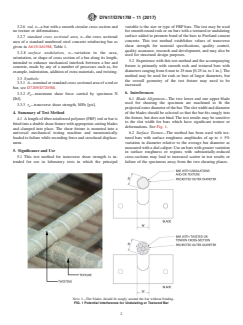
deformations. See Fig. 1.
and clamped into place. The shear fixture is mounted into a
universal mechanical testing machine and monotonically 6.2 Surface Texture—The method has been used with tex-
loaded to failure while recording force and crosshead displace- tured bars with surface roughness amplitudes of up to 6 5%
ment. variation in diameter relative to the average bar diameter as
measured with a dial caliper. Use on bars with greater variation
5. Significance and Use
in surface roughness or regions with substantially-reduced
5.1 This test method for transverse shear strength is in- cross-sections may lead to increased scatter in test results or
tended for use in laboratory tests in which the principal failure of the specimens away from the two shearing planes.
NOTE 1—The blades should fit snugly around the bar without binding.
FIG. 1 Potential Interference for Undulating or Textured Bar
D7617/D7617M − 11 (2017)
6.3 Measurement of Cross Sectional Area—The nominal 7. Apparatus
cross sectional area of textured or undulating bars is measured
7.1 The test fixture consists of two bar seats, two lower
by immersing a prescribed length of the specimen in water to
blades, and two guides machined from steel. These parts are
determine its buoyant weight, as described in D7205/D7205M.
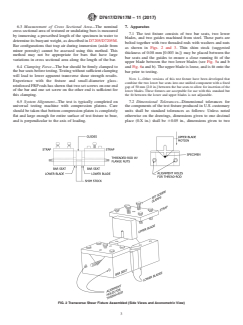
bolted together with two threaded rods with washers and nuts
Bar configurations that trap air during immersion (aside from
as shown in Figs. 2 and 3. Thin shim stock (suggested
minor porosity) cannot be assessed using this method. This
thickness of 0.08 mm [0.003 in.]) may be placed between the
method may not be appropriate for bars that have large
bar seats and the guides to ensure a close running fit of the
variations in cross sectional area along the length of the bar.
upper blade between the two lower blades (see Fig. 5a and b
6.4 Clamping Force—The bar should be firmly clamped to
and Fig. 6a and b). The upper blade is loose, and is fit onto the
the bar seats before testing.Testing without sufficient clamping
bar prior to testing.
will lead to lower apparent transverse shear strength results.
NOTE 1—Other versions of this test fixture have been developed that
Experience with the fixture and small-diameter glass-
combine the two lower bar seats into one unified component with a fixed
reinforced FRProds has shown that two set screws on one end
gap of 50 mm [2.0 in.] between the bar seats to allow for insertion of the
of the bar and one set screw on the other end is sufficient for
lower blades. These fixtures are acceptable for use with this standard but
this clamping. the fit between the lower and upper blades is not adjustable.
6.5 System Alignment—The test is typically completed on 7.2 Dimensional Tolerances—Dimensional tolerances for
universal testing machine with compression platens. Care the components of the test fixture produced in U.S. customary
should be taken that bottom compression platen is completely units shall be standard tolerances as follows: Unless noted
flat and large enough for entire surface of test fixture to bear, otherwise on the drawings, dimensions given to one decimal
and is perpendicular to the axis of loading. place (0.X in.) shall be 60.05 in., dimensions given to two
FIG. 2 Transverse Shear Fixture Assembled (Side Views and Axonometric View)
D7617/D7617M − 11 (2017)
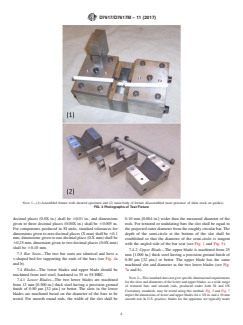
NOTE 1—(1) Assembled fixture with sheared specimen and (2) main body of fixture disassembled (note presence of shim stock on guides).
FIG. 3 Photographs of Test Fixture
decimal places (0.0X in.) shall be 60.01 in., and dimensions 0.10 mm [0.004 in.] wider than the measured diameter of the
given to three decimal places (0.00X in.) shall be 60.005 in. rods. For textured or undulating bars the slot shall be equal to
For components produced in SI units, standard tolerances for
the projected outer diameter from the roughly circular bar. The
dimensions given to zero decimal places (X mm) shall be 60.1
depth of the semi-circle at the bottom of the slot shall be
mm, dimensions given to one decimal place (0.X mm) shall be
established so that the diameter of the semi-circle is tangent
60.25 mm, dimension given to two decimal places (0.0X mm)
with the angled side of the bar seat (see Fig. 1 and Fig. 5).
shall be 60.10 mm.
7.4.2 Upper Blade—The upper blade is machined from 25
7.3 Bar Seats—The two bar seats are identical and have a
mm [1.000 in.] thick steel having a precision ground finish of
v-shaped bed for supporting the ends of the bars (see Fig. 4a
0.80 µm [32 µin.] or better. The upper blade has the same
and b).
machined slot and diameter as the two lower blades (see Fig.
7.4 Blades—The lower blades and upper blade should be 7a and b).
machined from tool steel, hardened to 55 to 58 HRC.
NOTE2—Thisstandarddoesnotgivespecificdimensionalrequirements
7.4.1 Lower Blades—The two lower blades are machined
for the slots and diameters of the lower and upper blades, as a wide range
from 12 mm [0.500 in.] thick steel having a precision ground
of textured bars and smooth rods, produced under both SI and US
finish of 0.80 µm [32 µin.] or better. The slots in the lower
Customary standards, may be tested using this method. Fig. 5 and Fig. 7
blades are machined based on the diameter of the bars to be
depict the dimensions of lower and upper blades for a 3/8 in. and a 10 mm
tested. For smooth round rods, the width of the slot shall be smooth rod. In U.S. practice, blades for the apparatus are typically made
D7617/D7617M − 11 (2017)
FIG. 4 a Bar Seat (U.S. Customary Units)
for smooth and textured rods in diameters that range between 6 mm (0.25
7.7.1 Testing Machine Heads—The testing machine shall
in.) to 25 mm (1 in.).
have both an essentially stationary head and a movable head.
The movable head shall b
...