

ASTM D1142-95(2021)
(Test Method)Standard Test Method for Water Vapor Content of Gaseous Fuels by Measurement of Dew-Point Temperature
General Information
- Abstract
SIGNIFICANCE AND USE
3.1 Generally, contracts governing the pipeline transmission of natural gas contain specifications limiting the maximum concentration of water vapor allowed. Excess water vapor can cause corrosive conditions, degrading pipelines and equipment. It can also condense and freeze or form methane hydrates causing blockages. Water–vapor content also affects the heating value of natural gas, thus influencing the quality of the gas. This test method permits the determination of water content of natural gas.
SCOPE
1.1 This test method covers the determination of the water vapor content of gaseous fuels by measurement of the dew-point temperature and the calculation therefrom of the water vapor content.
Note 1: Some gaseous fuels contain vapors of hydrocarbons or other components that easily condense into liquid and sometimes interfere with or mask the water dew point. When this occurs, it is sometimes very helpful to supplement the apparatus in Fig. 1 with an optical attachment that uniformly illuminates the dew–point mirror and also magnifies the condensate on the mirror. With this attachment it is possible, in some cases, to observe separate condensation points of water vapor, hydrocarbons, and glycolamines as well as ice points. However, if the dew point of the condensable hydrocarbons is higher than the water vapor dew point, when such hydrocarbons are present in large amounts, they may flood the mirror and obscure or wash off the water dew point. Best results in distinguishing multiple component dew points are obtained when they are not too closely spaced.
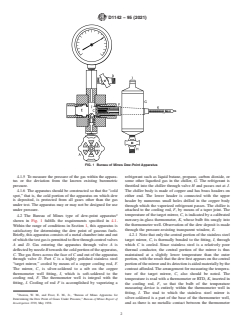
FIG. 1 Bureau of Mines Dew-Point Apparatus
Note 2: Condensation of water vapor on the dew-point mirror may appear as liquid water at temperatures as low as 0 to −10°F (−18 to −23°C). At lower temperatures an ice point rather than a water dew point likely will be observed. The minimum dew point of any vapor that can be observed is limited by the mechanical parts of the equipment. Mirror temperatures as low as −150°F (−100°C) have been measured, using liquid nitrogen as the coolant with a thermocouple attached to the mirror, instead of a thermometer well.
1.2 This standard does not purport to address all of the safety concerns, if any, associated with its use. It is the responsibility of the user of this standard to establish appropriate safety, health, and environmental practices and determine the applicability of regulatory limitations prior to use.
1.3 This international standard was developed in accordance with internationally recognized principles on standardization established in the Decision on Principles for the Development of International Standards, Guides and Recommendations issued by the World Trade Organization Technical Barriers to Trade (TBT) Committee.
- Status
- Published
- Publication Date
- 30-Jun-2021
- Technical Committee
- D03 - Gaseous Fuels
Overview
ASTM D1142-95(2021), Standard Test Method for Water Vapor Content of Gaseous Fuels by Measurement of Dew-Point Temperature, is an essential standard for determining the water vapor content in gaseous fuels-especially natural gas-by measuring the dew-point temperature. The accurate detection of water vapor is a critical aspect of natural gas quality control and pipeline safety, as excess water vapor can lead to operational risks such as corrosion, hydrate formation, and reduced energy content.
This ASTM standard outlines the procedures and equipment requirements for measuring water dew-point temperatures and translating those values into quantifiable water vapor content in various types of gaseous fuels. It is widely recognized in the natural gas and fuel transmission sectors for ensuring compliance with contract specifications and protecting infrastructure.
Key Topics
Significance of Water Vapor in Gaseous Fuels
Contracts for pipeline transmission of natural gas often specify maximum permissible water vapor concentrations. Exceeding these limits can result in:- Corrosive conditions, degrading pipelines and equipment
- Formation of liquid water, ice, or methane hydrates, causing blockages
- Impacted heating value and quality of natural gas
Method Principle
The method involves cooling a surface (mirror) in contact with the gas sample and observing the temperature at which dew appears (dew-point temperature). This value, together with pressure readings, allows calculation of the water vapor content.Apparatus Requirements
A suitable dew-point apparatus must:- Allow controlled flow of gas
- Permit regulated cooling of a target mirror
- Enable observation of dew formation
- Provide accurate temperature and pressure measurements at the dew deposition point
Measurement Considerations
- Samples must be representative, and any line or sample conditioning should avoid moisture loss or gain.
- Dew-point determination should reflect pressure and temperature conditions relevant to the gas’s intended use.
Applications
ASTM D1142-95(2021) is critical for a wide array of applications involving gaseous fuels:
Pipeline Gas Transmission and Distribution
- Ensures compliance with commercial contracts and regulatory limits
- Prevents excessive water vapor leading to pipeline corrosion and flow disruptions
Natural Gas Processing Plants
- Controls water content for safe and efficient processing
- Monitors conditions to avoid hydrate formation and maintain gas quality
Quality Control in Gas Storage and Delivery
- Verifies that stored and delivered gas meets moisture specifications
- Maintains optimal operational performance and safety
Laboratory Analysis
- Used by laboratories and research organizations for evaluating water vapor content in various gaseous fuel samples
Related Standards
- ASTM D5454 - Standard Test Method for Water Vapor Content in Natural Gas Using Length-of-Stain Detector Tubes
- ASTM D2597 - Standard Test Method for Analysis of Natural Gas by Gas Chromatography
- ISO 6326 - Natural Gas - Determination of Sulfur Compounds
- ASTM D1945 - Standard Test Method for Analysis of Natural Gas by Gas Chromatography
Practical Value
ASTM D1142-95(2021) delivers critical benefits to the natural gas industry by:
- Supporting reliability and safety in pipeline networks
- Improving product quality assurance throughout the gas supply chain
- Facilitating regulatory and contractual compliance regarding water vapor content in gaseous fuels
- Minimizing operational risks associated with condensation, corrosion, icing, and equipment malfunction
For organizations involved in natural gas processing, transmission, and distribution, implementing ASTM D1142 is a best practice to ensure accurate water vapor measurement, gas quality, and operational safety.
Get Certified
Connect with accredited certification bodies for this standard

Element Materials Technology
Materials testing and product certification.

ABS Group Brazil
ABS Group certification services in Brazil.

ABS Quality Evaluations Inc.
American Bureau of Shipping quality certification.
Sponsored listings
Frequently Asked Questions
ASTM D1142-95(2021) is a standard published by ASTM International. Its full title is "Standard Test Method for Water Vapor Content of Gaseous Fuels by<brk/> Measurement of Dew-Point Temperature". This standard covers: SIGNIFICANCE AND USE 3.1 Generally, contracts governing the pipeline transmission of natural gas contain specifications limiting the maximum concentration of water vapor allowed. Excess water vapor can cause corrosive conditions, degrading pipelines and equipment. It can also condense and freeze or form methane hydrates causing blockages. Water–vapor content also affects the heating value of natural gas, thus influencing the quality of the gas. This test method permits the determination of water content of natural gas. SCOPE 1.1 This test method covers the determination of the water vapor content of gaseous fuels by measurement of the dew-point temperature and the calculation therefrom of the water vapor content. Note 1: Some gaseous fuels contain vapors of hydrocarbons or other components that easily condense into liquid and sometimes interfere with or mask the water dew point. When this occurs, it is sometimes very helpful to supplement the apparatus in Fig. 1 with an optical attachment that uniformly illuminates the dew–point mirror and also magnifies the condensate on the mirror. With this attachment it is possible, in some cases, to observe separate condensation points of water vapor, hydrocarbons, and glycolamines as well as ice points. However, if the dew point of the condensable hydrocarbons is higher than the water vapor dew point, when such hydrocarbons are present in large amounts, they may flood the mirror and obscure or wash off the water dew point. Best results in distinguishing multiple component dew points are obtained when they are not too closely spaced. FIG. 1 Bureau of Mines Dew-Point Apparatus Note 2: Condensation of water vapor on the dew-point mirror may appear as liquid water at temperatures as low as 0 to −10°F (−18 to −23°C). At lower temperatures an ice point rather than a water dew point likely will be observed. The minimum dew point of any vapor that can be observed is limited by the mechanical parts of the equipment. Mirror temperatures as low as −150°F (−100°C) have been measured, using liquid nitrogen as the coolant with a thermocouple attached to the mirror, instead of a thermometer well. 1.2 This standard does not purport to address all of the safety concerns, if any, associated with its use. It is the responsibility of the user of this standard to establish appropriate safety, health, and environmental practices and determine the applicability of regulatory limitations prior to use. 1.3 This international standard was developed in accordance with internationally recognized principles on standardization established in the Decision on Principles for the Development of International Standards, Guides and Recommendations issued by the World Trade Organization Technical Barriers to Trade (TBT) Committee.
SIGNIFICANCE AND USE 3.1 Generally, contracts governing the pipeline transmission of natural gas contain specifications limiting the maximum concentration of water vapor allowed. Excess water vapor can cause corrosive conditions, degrading pipelines and equipment. It can also condense and freeze or form methane hydrates causing blockages. Water–vapor content also affects the heating value of natural gas, thus influencing the quality of the gas. This test method permits the determination of water content of natural gas. SCOPE 1.1 This test method covers the determination of the water vapor content of gaseous fuels by measurement of the dew-point temperature and the calculation therefrom of the water vapor content. Note 1: Some gaseous fuels contain vapors of hydrocarbons or other components that easily condense into liquid and sometimes interfere with or mask the water dew point. When this occurs, it is sometimes very helpful to supplement the apparatus in Fig. 1 with an optical attachment that uniformly illuminates the dew–point mirror and also magnifies the condensate on the mirror. With this attachment it is possible, in some cases, to observe separate condensation points of water vapor, hydrocarbons, and glycolamines as well as ice points. However, if the dew point of the condensable hydrocarbons is higher than the water vapor dew point, when such hydrocarbons are present in large amounts, they may flood the mirror and obscure or wash off the water dew point. Best results in distinguishing multiple component dew points are obtained when they are not too closely spaced. FIG. 1 Bureau of Mines Dew-Point Apparatus Note 2: Condensation of water vapor on the dew-point mirror may appear as liquid water at temperatures as low as 0 to −10°F (−18 to −23°C). At lower temperatures an ice point rather than a water dew point likely will be observed. The minimum dew point of any vapor that can be observed is limited by the mechanical parts of the equipment. Mirror temperatures as low as −150°F (−100°C) have been measured, using liquid nitrogen as the coolant with a thermocouple attached to the mirror, instead of a thermometer well. 1.2 This standard does not purport to address all of the safety concerns, if any, associated with its use. It is the responsibility of the user of this standard to establish appropriate safety, health, and environmental practices and determine the applicability of regulatory limitations prior to use. 1.3 This international standard was developed in accordance with internationally recognized principles on standardization established in the Decision on Principles for the Development of International Standards, Guides and Recommendations issued by the World Trade Organization Technical Barriers to Trade (TBT) Committee.
ASTM D1142-95(2021) is classified under the following ICS (International Classification for Standards) categories: 75.160.30 - Gaseous fuels. The ICS classification helps identify the subject area and facilitates finding related standards.
ASTM D1142-95(2021) is available in PDF format for immediate download after purchase. The document can be added to your cart and obtained through the secure checkout process. Digital delivery ensures instant access to the complete standard document.
Standards Content (Sample)
This international standard was developed in accordance with internationally recognized principles on standardization established in the Decision on Principles for the
Development of International Standards, Guides and Recommendations issued by the World Trade Organization Technical Barriers to Trade (TBT) Committee.
Designation: D1142 − 95 (Reapproved 2021)
Standard Test Method for
Water Vapor Content of Gaseous Fuels by
Measurement of Dew-Point Temperature
This standard is issued under the fixed designation D1142; the number immediately following the designation indicates the year of
original adoption or, in the case of revision, the year of last revision. A number in parentheses indicates the year of last reapproval. A
superscript epsilon (´) indicates an editorial change since the last revision or reapproval.
This standard has been approved for use by agencies of the U.S. Department of Defense.
1. Scope 2. Terminology
1.1 This test method covers the determination of the water 2.1 Definitions of Terms Specific to This Standard:
vapor content of gaseous fuels by measurement of the dew- 2.1.1 saturated water vapor or equilibrium water–vapor
point temperature and the calculation therefrom of the water content—the water vapor concentration in a gas mixture that is
vapor content. in equilibrium with a liquid phase of pure water that is
saturated with the gas mixture. When a gas containing water
NOTE 1—Some gaseous fuels contain vapors of hydrocarbons or other
vapor is at the water dew-point temperature, it is said to be
components that easily condense into liquid and sometimes interfere with
saturated at the existing pressure.
or mask the water dew point. When this occurs, it is sometimes very
helpful to supplement the apparatus in Fig. 1 with an optical attachment
2.1.2 specific volume—of a gaseous fuel, the volume of the
that uniformly illuminates the dew–point mirror and also magnifies the
gas in cubic feet per pound.
condensate on the mirror. With this attachment it is possible, in some
cases, to observe separate condensation points of water vapor,
2.1.3 water dew-point temperature— of a gaseous fuel, the
hydrocarbons, and glycolamines as well as ice points. However, if the dew
temperature at which the gas is saturated with water vapor at
point of the condensable hydrocarbons is higher than the water vapor dew
the existing pressure.
point, when such hydrocarbons are present in large amounts, they may
flood the mirror and obscure or wash off the water dew point. Best results
in distinguishing multiple component dew points are obtained when they 3. Significance and Use
are not too closely spaced.
3.1 Generally, contracts governing the pipeline transmission
NOTE 2—Condensation of water vapor on the dew-point mirror may
of natural gas contain specifications limiting the maximum
appear as liquid water at temperatures as low as 0 to −10°F (−18
to −23°C). At lower temperatures an ice point rather than a water dew concentration of water vapor allowed. Excess water vapor can
point likely will be observed. The minimum dew point of any vapor that
cause corrosive conditions, degrading pipelines and equipment.
can be observed is limited by the mechanical parts of the equipment.
It can also condense and freeze or form methane hydrates
Mirror temperatures as low as −150°F (−100°C) have been measured,
causing blockages. Water–vapor content also affects the heat-
using liquid nitrogen as the coolant with a thermocouple attached to the
ing value of natural gas, thus influencing the quality of the gas.
mirror, instead of a thermometer well.
This test method permits the determination of water content of
1.2 This standard does not purport to address all of the
natural gas.
safety concerns, if any, associated with its use. It is the
responsibility of the user of this standard to establish appro-
4. Apparatus
priate safety, health, and environmental practices and deter-
mine the applicability of regulatory limitations prior to use.
4.1 Any properly constructed dew-point apparatus may be
1.3 This international standard was developed in accor-
used that satisfies the basic requirements that means must be
dance with internationally recognized principles on standard-
provided:
ization established in the Decision on Principles for the
4.1.1 To permit a controlled flow of gas to enter and leave
Development of International Standards, Guides and Recom-
the apparatus while the apparatus is at a temperature at least
mendations issued by the World Trade Organization Technical
3°F above the dew point of the gas.
Barriers to Trade (TBT) Committee.
4.1.2 To cool and control the cooling rate of a portion
(preferably a small portion) of the apparatus, with which the
flowing gas comes in contact, to a temperature low enough to
cause vapor to condense from the gas.
This test method is under the jurisdiction of ASTM Committee D03 on Gaseous
Fuels and is the direct responsibility of Subcommittee D03.06.04 on Analysis by
4.1.3 To observe the deposition of dew on the cold portion
Colorimetric Techniques.
of the apparatus.
Current edition approved July 1, 2021. Published July 2021. Originally approved
4.1.4 To measure the temperature of the cold portion on the
in 1950. Last previous edition approved in 2012 as D1142 – 95(2012). DOI:
10.1520/D1142-95R21. apparatus on which the dew is deposited, and
Copyright © ASTM International, 100 Barr Harbor Drive, PO Box C700, West Conshohocken, PA 19428-2959. United States
D1142 − 95 (2021)
FIG. 1 Bureau of Mines Dew-Point Apparatus
4.1.5 To measure the pressure of the gas within the appara- refrigerant such as liquid butane, propane, carbon dioxide, or
tus or the deviation from the known existing barometric some other liquefied gas in the chiller, G. The refrigerant is
pressure.
throttled into the chiller through valve H and passes out at J.
4.1.6 The apparatus should be constructed so that the “cold
The chiller body is made of copper and has brass headers on
spot,” that is, the cold portion of the apparatus on which dew
either end. The lower header is connected with the upper
is deposited, is protected from all gases other than the gas
header by numerous small holes drilled in the copper body
under test. The apparatus may or may not be designed for use
through which the vaporized refrigerant passes. The chiller is
under pressure.
attached to the cooling rod, F, by means of a taper joint. The
temperature of the target mirror, C, is indicated by a calibrated
4.2 The Bureau of Mines type of dew-point apparatus
mercury-in-glass thermometer, K, whose bulb fits snugly into
shown in Fig. 1 fulfills the requirements specified in 4.1.
the thermometer well. Observation of the dew deposit is made
Within the range of conditions in Section 1, this apparatus is
through the pressure-resisting transparent window, E.
satisfactory for determining the dew point of gaseous fuels.
Briefly, this apparatus consists of a metal chamber into and out 4.2.1 Note that only the central portion of the stainless steel
of which the test gas is permitted to flow through control valves target mirror, C, is thermally bonded to the fitting, I, through
A and D. Gas entering the apparatus through valve A is which C is cooled. Since stainless steel is a relatively poor
deflected by nozzle B towards the cold portion of the apparatus, thermal conductor, the central portion of the mirror is thus
C. The gas flows across the face of C and out of the apparatus maintained at a slightly lower temperature than the outer
through valve D. Part C is a highly polished stainless steel portion, with the result that the dew first appears on the central
“target mirror,” cooled by means of a copper cooling rod, F. portion of the mirror and its detection is aided materially by the
The mirror, C, is silver-soldered to a nib on the copper contrast afforded. The arrangement for measuring the tempera-
thermometer well fitting, I, which is soft-soldered to the
ture of the target mirror, C, also should be noted. The
cooling rod, F. The thermometer well is integral with the
temperature is read with a thermometer or RTD, K, inserted in
fitting, I. Cooling of rod F is accomplished by vaporizing a
the cooling rod, F, so that the bulb of the temperature
measuring device is entirely within the thermometer well in
fitting, I. The stud to which the stainless steel mirror is
Deaton, W. M., and Frost, E. M., Jr., “Bureau of Mines Apparatus for
silver-soldered is a part of the base of the thermometer well,
Determining the Dew Point of Gases Under Pressure,” Bureau of Mines Report of
Investigation 3399, May 1938. and as there is no metallic contact between the thermometer
D1142 − 95 (2021)
well and the cooling tube, other than through its base, the conditions as nearly as possible. The most satisfactory method
thermometer or RTD indicates the temperature of the mirror is to cool or warm the target mirror stepwise. Steps of about
rather than some compromise temperature influenced by the 0.2°F (0.1°C) allow equilibrium conditions to be approached
temperature gradient along the cooling tube as would be the closely and favor an accurate determination. When dew has
case if this type of construction were not used. The RTD will been deposited, allow the target mirror to warm up at a rate
include suitable electronics and display. comparable to the recommended rate of cooling. The normal
warming rate usually will be faster than desired. To reduce the
4.2.2 Tests with the Bureau of Mines type of dew-point
rate, “crack” valve H momentarily at intervals to supply
apparatus are reported to permit a determination with a
cooling to the cooling tube, F. Repeat the cooling and warming
precision (reproducibility) of 60.2°F (60.1°C) and with an
cycles several times. The arithmetic average of the tempera-
accuracy of 60.2°F (60.1°C) when the dew-point tempera-
tures at which dew is observed to appear and disappear is
tures range from room temperature to a temperature of 32°F
considered to be the observed dew point.
(0°C). It is estimated that water dew points may be determined
with an accuracy of 60.5°F (0.3°C) when they are below 32°F
NOTE 3—If the water–vapor content is to be calculated as described in
(0°C) and not lower than 0°F (−17.8°C), provided ice crystals
6.2, the gas specimen should be throttled at the inlet valve, A, to a pressure
within the apparatus approximately equal to atmospheric pressure. The
do not form during the determination.
outlet valve may be left wide open or restricted, as desired. The pressure
existing within the apparatus must, however, be known to the required
5. Procedure
accuracy.
5.1 General Considerations—Take the specimen so as to be
6. Calculation
representative of the gas at the source. Do not take at a point
6.1 If an acceptable chart showing the variation of water-
where isolation would permit condensate to collect or would
vapor content with saturation or water dew-point temperatures
otherwise allow a vapor content to exist that is not in
over a suitable range of pressures for the gas being tested is
equilibrium with the main stream or supply of gas, such as the
available, the water-vapor content may be read directly, using
sorption or desorption of vapors from the sampling line or from
the observed water dew-point temperature and the pressure at
deposits therein. The temperature of the pipelines leading the
which the determination was made.
specimen directly from the gas source to the dew-point
apparatus, and also the temperature of the apparatus, shall be at
6.2 If such a chart is not available, the water–vapor content
least 3°F (1.7°C) higher than the observed dew point. The
of the gas may be calculated from the water dew-point
determination may be made at any pressure, but the gas
temperature and the pressure at which it was determined (see
pressure within the dew-point apparatus must be known with
Note 3), as follows:
an accuracy appropriate to the accuracy requirements of the
test. The pressure may be read on a calibrated bourdon-type
pressure gage; for very low pressures or more accurate
measurements, a mercury-filled manometer or a dead-weight
gage should be used.
5.2 Detailed Procedure for Operation of Bureau of Mines
Dew-Point Apparatus—Introduce the gas specimen through
valve A (Fig. 1), opening this valve wide if the test is to be
made under full source pressure (Note 3), and controlling the
flow by the small outlet valve, D. The rate of flow is not critical
but should not be so great that there is a measurable or
objectionable drop in pressure through the connecting lines and
dew-point apparatus. A flow of 0.05 to 0.5 ft /min (1.4 to 14
L/min) (measured at atmospheric pressure) usually will be
satisfactory. With liquefied refrigerant gas piped to the chiller
throttle valve, H, “crack” the valve momentarily, allowing the
refrigerant to vaporize in the chiller to produce suitable
lowering in temperature of the chiller tube, F, and target
mirror, C, as indicated by the thermometer, K. The rate of
cooling may be as rapid as desired in making a preliminary
test. After estimating the dew-point temperature, either by a
preliminary test or from other knowledge, control the cooling
or warming rate so that it does not exceed 1°F/min (0.5°C/min)
when this temperature is approached. For accurate results, the
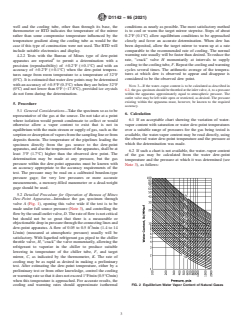
cooling and warming rates should approximate isothermal FIG. 2 Equilibrium Water Vapor Content of Natural Gases
D1142 − 95 (2021)
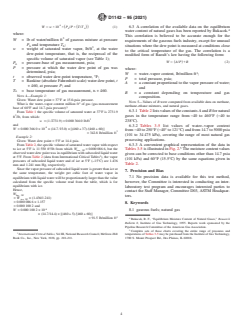
W 5 w × 10 × P /P × T/T (1) 6.3 A correlation of the available data on the equilibrium
~ ~ !!
b b
water content of natural gases has been reported by Bukacek.
where:
This correlation is believed to be accurate enough for the
W = lb of water/million ft of gaseous mixture at pressure
requirements of the gaseous fuels industry, except for unusual
P and temperature T ;
b b situations where the dew point is measured at conditions close
w = weight of saturated water vapor, lb/ft , at the water
to the critical temperature of the gas. The correlation is a
dew-point temperature, that is, the reciprocal of the
modified form of Raoult’s law having the following form:
specific volume of saturated vapor (see Table 1);
W 5 A/P 1B (2)
~ !
P = pressure-base of gas measurement, psia;
b
P = pressure at which the water dew point of gas was
where:
determined, psia;
W = water–vapor content, lb/million ft ;
t = observed water dew-point temperature, °F;
P = total pressure, psia;
T = Rankine (absolute Fahrenheit scale) water dew point, t
A = a constant proportional to the vapor pressure of water;
+ 460, at pressure P; and
and
T = base temperature of gas measurement, t + 460.
b b
B = a constant depending on temperature and gas
NOTE 4—Example 1:
composition.
Given: Water dew point = 37°F at 15.0-psia pressure.
NOTE 5—Values of B were computed from available data on methane,
What is the water–vapor content million ft of gas (gas measurement
methane-ethane mixtures, and natural gases.
base of 60°F and 14.7-psia pressure)?
6.3.1 Table 2 lists values of the constants A and B for natural
From Table 1 the specific volume of saturated water at 37°F is 2731.9
gases in the temperature range from −40 to 460°F (−40 to
ft /lb, from which:
w = (1 ⁄2731.9) = 0.000 366 0 lb/ft
238°C).
and
6.3.2 Tables 3-5 list values of water–vapor content
W = 0.000 366 0 × 10 × (14.7 ⁄15.0) × [(460 + 37) ⁄(460 + 60)]
from −40 to 250°F (−40° to 121°C) and from 14.7 to 5000 psia
= 342.8 lb/million ft
(101 to 34 475 kPa), covering the range of most natural gas
Example 2:
processing applications.
Given: Water dew point = 5°F at 14.4 psia.
6.3.3 A convenient graphical representation of the data in
From Table 2, the specific volume of saturated water vapor with respect
3 5
to ice at 5°F is 11 550 ft /lb from which W = 0.000 086 6, but the
Tables 3-5 is illustrated in Fig. 2. The moisture content values
ice, 5F
observed water dew point was in equilibrium with subcooled liquid water
given can be corrected to base conditions other than 14.7 psia
at 5°F. From Table 2 (data from International Critical Tables ), the vapor
(101 kPa) and 60°F (15.5°C) by the same equations given in
pressures of subcooled liquid water and of ice at 5°F (−15°C) are 1.436
Table 2.
mm and 1.241 mm Hg, respectively.
Since the vapor pressure of subcooled liquid water is greater than ice at
7. Precision and Bias
the same temperature, the weight per cubic foot of water vapor in
7.1 No precision data is available for this test method,
equilibrium with liquid water will be proportionately larger than the value
calculated from the specific volume read from the table, which is for however, the Committee is interested in conducting an inter-
equilibrium with ice.
laboratory test program and encourages interested parties to
Hence,
contact the Staff Manager, Committee D03, ASTM Headquar-
W
liq., 5F
ters.
= W × (1.436/1.241)
ice 5F
= 0.000 086 6 × 1.157
8. Keywords
= 0.000 100 2 and
W = 0.000 100 2 × 10 8.1 gaseous fuels; natural gas
× (14.7/14.4) × [(460 + 5) ⁄[460 + 60)]
= 91.5 lb/million ft 4
Bukacek, R. F., “Equilibrium Moisture Content of Natural Gases,” Research
Bulletin 8, Institute of Gas Technology, 1955. Reports work sponsored by the
Pipeline Research Committee of the American Gas Association.
Complete sets of these charts covering the entire range of pressures and
International Critical Tables, Vol III, National Research Council, McGraw-Hill temperatures of Tables 3-5 may be purchased from the Institute of Gas Technology,
Book Co., Inc., New York, 1928, pp. 210–211. 1700 S. Mount Prospect Rd., Des Plaines, IL 60018.
D1142 − 95 (2021)
A
TABLE 1 Vapor Pressures and Specific Volumes of Saturated Water Vapor at Various Temperatures
Specific
Vapor
Vapor Pressure of Liquid Water Vapor Pressure of Ice
Volume of Specific Volume of
Temperature, Temperature, Pressure of
Saturated Saturated Water
°F °F Liquid Water,
Water Vapor Vapor, ft /lb
mm Hg psia mm Hg psia
psia
ft /lb
0 1.139 0.022 02 0.958 0.018 52 14 810
1 1.195 0.023 11 1.010 0.019 53 14 080 51 0.184 85 1 644.2
2 1.251 0.024 19 1.063 0.020 56 13 400 52 0.191 82 1 587.6
3 1.310 0.025 33 1.120 0.021 66 12 750 53 0.199 01 1 533.2
4 1.373 0.026 55 1.180 0.022 82 12 140 54 0.206 44 1 480.9
5 1.436 0.027 77 1.241 0.024 00 11 550 55 0.214 11 1 430.6
6 1.505 0.029 10 1.308 0.025 29 11 000 56 0.222 03 1 382.2
7 1.573 0.030 42 1.374 0.026 57 10 480 57 0.230 21 1 335.6
8 1.647 0.031 85 1.446 0.027 96 9 979 58 0.238 65 1 290.9
9 1.723 0.033 32 1.521 0.029 41 9 507 59 0.247 36 1 247.8
10 1.807 0.034 94 1.599 0.030 92 9 060 60 0.256 35 1 206.3
11 1.883 0.036 41 1.
...