

ASTM D3370-18
(Practice)Standard Practices for Sampling Water from Flowing Process Streams
General Information
- Abstract
SIGNIFICANCE AND USE
5.1 The goal of sampling is to obtain for analysis a portion of the main body of water that is representative. The most critical factors necessary to achieve this are points of sampling, and materials selection, system design, time of sampling, frequency of sampling, and proper procedures to maintain the integrity of the sample prior to analysis.
5.2 Homogeneity of the process to be sampled is frequently lacking, necessitating multiple-point sampling. If it is impractical to utilize a most-representative sampling point, it may be practical to determine and understand interrelationships so that results obtained at a minimum number of points may be used to characterize the system.
5.3 Samples collected from a single point in a system are always recognized as being non-representative to some degree. For this reason, total representativeness of samples cannot be a prerequisite to the selection of a sampling point. The degree of representativeness of the sample shall be assessed and the assessment made a part of the permanent record. This will prevent an artificial degree of accuracy from being assigned to the data derived from tests on the sample.
5.4 The samples shall be of sufficient volume and shall be taken frequently enough to permit reproducibility of testing requisite for the desired objective, as required by the method of analysis to be used.
5.5 Laboratories or facilities conducting water sampling should be in compliance with Guide D3856.
SCOPE
1.1 These practices cover the equipment and methods for sampling water from closed conduits such as process streams at power stations for chemical, physical, microbiological, and radiological analyses. It does not cover specialized equipment required for and unique to a specific test or method of analysis. The following are included:
Sections
Practice A—Grab Samples
9 – 17
Practice B—Composite Samples
18 – 23
Practice C—On-Line Sampling
24 – 29
1.2 For information on specialized sampling equipment, tests or methods of analysis, reference should be made to Volumes 11.01 and 11.02 of the Annual Book of ASTM Standards, relating to water.
1.3 The values stated in SI units are to be regarded as standard. The values given in parentheses are mathematical conversions to inch-pound units that are provided for information only and are not considered standard.
1.4 This standard does not purport to address all of the safety concerns, if any, associated with its use. It is the responsibility of the user of this standard to establish appropriate safety, health, and environmental practices and determine the applicability of regulatory limitations prior to use. For specific hazards statements, see 8.3 and 13.4.
1.5 This international standard was developed in accordance with internationally recognized principles on standardization established in the Decision on Principles for the Development of International Standards, Guides and Recommendations issued by the World Trade Organization Technical Barriers to Trade (TBT) Committee.
- Status
- Published
- Publication Date
- 14-Dec-2018
- Technical Committee
- D19 - Water
Overview
ASTM D3370-18, officially titled Standard Practices for Sampling Water from Flowing Process Streams, is a critical international standard developed by ASTM International. This standard outlines best practices for obtaining representative samples of water from closed conduits, such as pipelines and process streams, particularly in environments like power stations. The main objective is to ensure that the collected water samples accurately reflect the chemical, physical, microbiological, and radiological characteristics of the main water body for reliable laboratory analysis.
Effective water sampling is essential for process monitoring, regulatory compliance, environmental control, and quality assurance in industries that depend on water as a process medium or utility.
Key Topics
- Representative Sampling: Emphasizes the importance of obtaining samples that accurately depict the characteristics of the primary water stream. Achieving this requires careful selection of sampling points, appropriate material choices, precise system design, optimized timing and frequency, and meticulous sample handling procedures.
- Sampling Methods: The standard provides three key practices:
- Practice A - Grab Sampling: Collection of a single sample at a specific site and time, especially suitable for bacteriological and some radiological analyses.
- Practice B - Composite Sampling: Integration of multiple samples from different times or locations to create a more representative sample.
- Practice C - On-Line Sampling: Continuous sample collection for use with on-line analyzers or convenient grab sampling from a flowing stream.
- Material Selection: Guidance on selecting appropriate materials for sampling lines and containers to minimize contamination and ensure sample integrity, including recommendations for stainless steel and inert plastics.
- Sample Integrity and Storage: Addresses volume requirements, sample labeling, cleaning protocols for containers, and procedures to avoid contamination, especially crucial for trace and microbiological analyses.
- Documentation and Records: Stresses the necessity of evaluating and documenting the representativeness of each sample, ensuring traceability and preventing misinterpretation of test results.
Applications
ASTM D3370-18 is widely applied across industries where accurate water analysis is essential, including:
- Power Generation Plants: Ensures conditioning, boiler, and cooling waters are sampled correctly to monitor chemistry and prevent equipment damage.
- Industrial Process Facilities: Used in chemical, pharmaceutical, and food processing industries to monitor water used in processing, cleaning, or as a component in products.
- Environmental Monitoring: Sample collection for regulatory reporting, wastewater discharge, and compliance with environmental standards.
- Laboratory Analysis: Provides laboratories with standardized sampling protocols, supporting reproducibility and data reliability.
- Water Treatment Plants: Essential in monitoring source and treated water for quality assurance and process control.
Related Standards
ASTM D3370-18 references and is closely linked to several additional standards relevant to water sampling and analysis:
- ASTM D3856 – Guide for management systems in laboratories engaged in water analysis.
- ASTM D1066 – Practices for sampling steam.
- ASTM D1193 – Specification for reagent water quality.
- ASTM D4453 – Practice for handling high purity water samples.
- ASTM D4840/D4841 – Chain-of-custody and holding time estimation for water samples.
- ASTM D5540 – Flow and temperature control for on-line sampling and analysis.
- ASTM A106/A269/A335 – Material standards for sampling line pipes and tubes.
By following ASTM D3370-18, organizations optimize their sampling processes, minimize risk of sample contamination, and build confidence in their analytical data-critical steps for meeting internal quality targets and external regulatory requirements related to water analysis and environmental stewardship.
Relations
- Effective Date
- 01-Apr-2024
- Effective Date
- 01-Apr-2024
- Effective Date
- 01-Mar-2024
- Effective Date
- 29-Sep-2023
- Effective Date
- 01-May-2020
- Effective Date
- 01-Nov-2019
- Effective Date
- 01-Sep-2018
- Effective Date
- 15-Aug-2018
- Effective Date
- 01-Aug-2018
- Effective Date
- 01-Aug-2018
- Effective Date
- 01-Mar-2018
- Effective Date
- 01-Feb-2017
- Effective Date
- 15-Feb-2016
- Effective Date
- 01-Sep-2015
- Effective Date
- 01-May-2015
Get Certified
Connect with accredited certification bodies for this standard

CIS Institut d.o.o.
Personal Protective Equipment (PPE) certification body. Notified Body NB-2890 for EU Regulation 2016/425 PPE.

Kiwa BDA Testing
Building and construction product certification.
Kmetijski inštitut Slovenije
Agricultural Institute of Slovenia. Soil testing, plant health, agricultural product analysis.
Sponsored listings
Frequently Asked Questions
ASTM D3370-18 is a standard published by ASTM International. Its full title is "Standard Practices for Sampling Water from Flowing Process Streams". This standard covers: SIGNIFICANCE AND USE 5.1 The goal of sampling is to obtain for analysis a portion of the main body of water that is representative. The most critical factors necessary to achieve this are points of sampling, and materials selection, system design, time of sampling, frequency of sampling, and proper procedures to maintain the integrity of the sample prior to analysis. 5.2 Homogeneity of the process to be sampled is frequently lacking, necessitating multiple-point sampling. If it is impractical to utilize a most-representative sampling point, it may be practical to determine and understand interrelationships so that results obtained at a minimum number of points may be used to characterize the system. 5.3 Samples collected from a single point in a system are always recognized as being non-representative to some degree. For this reason, total representativeness of samples cannot be a prerequisite to the selection of a sampling point. The degree of representativeness of the sample shall be assessed and the assessment made a part of the permanent record. This will prevent an artificial degree of accuracy from being assigned to the data derived from tests on the sample. 5.4 The samples shall be of sufficient volume and shall be taken frequently enough to permit reproducibility of testing requisite for the desired objective, as required by the method of analysis to be used. 5.5 Laboratories or facilities conducting water sampling should be in compliance with Guide D3856. SCOPE 1.1 These practices cover the equipment and methods for sampling water from closed conduits such as process streams at power stations for chemical, physical, microbiological, and radiological analyses. It does not cover specialized equipment required for and unique to a specific test or method of analysis. The following are included: Sections Practice A—Grab Samples 9 – 17 Practice B—Composite Samples 18 – 23 Practice C—On-Line Sampling 24 – 29 1.2 For information on specialized sampling equipment, tests or methods of analysis, reference should be made to Volumes 11.01 and 11.02 of the Annual Book of ASTM Standards, relating to water. 1.3 The values stated in SI units are to be regarded as standard. The values given in parentheses are mathematical conversions to inch-pound units that are provided for information only and are not considered standard. 1.4 This standard does not purport to address all of the safety concerns, if any, associated with its use. It is the responsibility of the user of this standard to establish appropriate safety, health, and environmental practices and determine the applicability of regulatory limitations prior to use. For specific hazards statements, see 8.3 and 13.4. 1.5 This international standard was developed in accordance with internationally recognized principles on standardization established in the Decision on Principles for the Development of International Standards, Guides and Recommendations issued by the World Trade Organization Technical Barriers to Trade (TBT) Committee.
SIGNIFICANCE AND USE 5.1 The goal of sampling is to obtain for analysis a portion of the main body of water that is representative. The most critical factors necessary to achieve this are points of sampling, and materials selection, system design, time of sampling, frequency of sampling, and proper procedures to maintain the integrity of the sample prior to analysis. 5.2 Homogeneity of the process to be sampled is frequently lacking, necessitating multiple-point sampling. If it is impractical to utilize a most-representative sampling point, it may be practical to determine and understand interrelationships so that results obtained at a minimum number of points may be used to characterize the system. 5.3 Samples collected from a single point in a system are always recognized as being non-representative to some degree. For this reason, total representativeness of samples cannot be a prerequisite to the selection of a sampling point. The degree of representativeness of the sample shall be assessed and the assessment made a part of the permanent record. This will prevent an artificial degree of accuracy from being assigned to the data derived from tests on the sample. 5.4 The samples shall be of sufficient volume and shall be taken frequently enough to permit reproducibility of testing requisite for the desired objective, as required by the method of analysis to be used. 5.5 Laboratories or facilities conducting water sampling should be in compliance with Guide D3856. SCOPE 1.1 These practices cover the equipment and methods for sampling water from closed conduits such as process streams at power stations for chemical, physical, microbiological, and radiological analyses. It does not cover specialized equipment required for and unique to a specific test or method of analysis. The following are included: Sections Practice A—Grab Samples 9 – 17 Practice B—Composite Samples 18 – 23 Practice C—On-Line Sampling 24 – 29 1.2 For information on specialized sampling equipment, tests or methods of analysis, reference should be made to Volumes 11.01 and 11.02 of the Annual Book of ASTM Standards, relating to water. 1.3 The values stated in SI units are to be regarded as standard. The values given in parentheses are mathematical conversions to inch-pound units that are provided for information only and are not considered standard. 1.4 This standard does not purport to address all of the safety concerns, if any, associated with its use. It is the responsibility of the user of this standard to establish appropriate safety, health, and environmental practices and determine the applicability of regulatory limitations prior to use. For specific hazards statements, see 8.3 and 13.4. 1.5 This international standard was developed in accordance with internationally recognized principles on standardization established in the Decision on Principles for the Development of International Standards, Guides and Recommendations issued by the World Trade Organization Technical Barriers to Trade (TBT) Committee.
ASTM D3370-18 is classified under the following ICS (International Classification for Standards) categories: 13.060.30 - Sewage water. The ICS classification helps identify the subject area and facilitates finding related standards.
ASTM D3370-18 has the following relationships with other standards: It is inter standard links to ASTM A335/A335M-24, ASTM D3694-96(2024), ASTM A179/A179M-24, ASTM A335/A335M-95a, ASTM D1129-13(2020)e2, ASTM A106/A106M-19a, ASTM A335/A335M-18a, ASTM D4840-99(2018)e1, ASTM D1066-18, ASTM D1066-18e1, ASTM A335/A335M-18, ASTM D4453-17, ASTM D4453-16, ASTM A335/A335M-15a, ASTM A335/A335M-15. Understanding these relationships helps ensure you are using the most current and applicable version of the standard.
ASTM D3370-18 is available in PDF format for immediate download after purchase. The document can be added to your cart and obtained through the secure checkout process. Digital delivery ensures instant access to the complete standard document.
Standards Content (Sample)
This international standard was developed in accordance with internationally recognized principles on standardization established in the Decision on Principles for the
Development of International Standards, Guides and Recommendations issued by the World Trade Organization Technical Barriers to Trade (TBT) Committee.
Designation: D3370 − 18
Standard Practices for
Sampling Water from Flowing Process Streams
This standard is issued under the fixed designation D3370; the number immediately following the designation indicates the year of
original adoption or, in the case of revision, the year of last revision. A number in parentheses indicates the year of last reapproval. A
superscript epsilon (´) indicates an editorial change since the last revision or reapproval.
This standard has been approved for use by agencies of the U.S. Department of Defense.
1. Scope 2. Referenced Documents
2.1 ASTM Standards:
1.1 These practices cover the equipment and methods for
A106/A106M Specification for Seamless Carbon Steel Pipe
samplingwaterfromclosedconduitssuchasprocessstreamsat
for High-Temperature Service
power stations for chemical, physical, microbiological, and
A179/A179M Specification for Seamless Cold-Drawn Low-
radiological analyses. It does not cover specialized equipment
Carbon Steel Heat-Exchanger and Condenser Tubes
required for and unique to a specific test or method of analysis.
A269 Specification for Seamless and Welded Austenitic
The following are included:
Stainless Steel Tubing for General Service
Sections
A335/A335M Specification for Seamless Ferritic Alloy-
Practice A—Grab Samples 9–17
Steel Pipe for High-Temperature Service
Practice B—Composite Samples 18–23
D1066 Practice for Sampling Steam
Practice C—On-Line Sampling 24–29
D1129 Terminology Relating to Water
1.2 For information on specialized sampling equipment,
D1193 Specification for Reagent Water
tests or methods of analysis, reference should be made to
D3648 Practices for the Measurement of Radioactivity
Volumes 11.01 and 11.02 of the Annual Book of ASTM
D3694 Practices for Preparation of Sample Containers and
Standards, relating to water.
for Preservation of Organic Constituents
D3856 Guide for Management Systems in Laboratories
1.3 The values stated in SI units are to be regarded as
Engaged in Analysis of Water
standard. The values given in parentheses are mathematical
D4453 Practice for Handling of High Purity Water Samples
conversions to inch-pound units that are provided for informa-
D4840 Guide for Sample Chain-of-Custody Procedures
tion only and are not considered standard.
D4841 Practice for Estimation of Holding Time for Water
1.4 This standard does not purport to address all of the
Samples Containing Organic and Inorganic Constituents
safety concerns, if any, associated with its use. It is the
D5540 Practice for Flow Control and Temperature Control
responsibility of the user of this standard to establish appro-
for On-Line Water Sampling and Analysis
priate safety, health, and environmental practices and deter-
mine the applicability of regulatory limitations prior to use. 3. Terminology
For specific hazards statements, see 8.3 and 13.4.
3.1 Definitions:
1.5 This international standard was developed in accor-
3.1.1 For definitions of terms used in this standard, refer to
dance with internationally recognized principles on standard-
Terminology D1129.
ization established in the Decision on Principles for the
3.2 Definitions of Terms Specific to This Standard:
Development of International Standards, Guides and Recom-
3.2.1 back-pressure regulator, n—a device designed to
mendations issued by the World Trade Organization Technical
maintain a constant pressure upstream of itself (variable or
Barriers to Trade (TBT) Committee.
fixed back pressure regulators are available) to maintain
constant flow in analyzers in on-line sampling.
3.2.1.1 Discussion—Contemporary designs of back-
These practices are under the jurisdiction of ASTM Committee D19 on Water
pressure regulators provide excellent sensitivity to pressure
and are the direct responsibility of Subcommittee D19.03 on Sampling Water and
Water-Formed Deposits, Analysis of Water for Power Generation and Process Use,
On-Line Water Analysis, and Surveillance of Water For referenced ASTM standards, visit the ASTM website, www.astm.org, or
Current edition approved Dec. 15, 2018. Published January 2019. Originally contact ASTM Customer Service at service@astm.org. For Annual Book of ASTM
approved in 1974. Last previous edition approved in 2010 as D3370 – 10. DOI: Standards volume information, refer to the standard’s Document Summary page on
10.1520/D3370-18. the ASTM website.
Copyright © ASTM International, 100 Barr Harbor Drive, PO Box C700, West Conshohocken, PA 19428-2959. United States
D3370 − 18
variations. They require less space, have fewer maintenance results obtained at a minimum number of points may be used
problems, and reduce sample-contamination potential. to characterize the system.
3.2.2 composite sample, n—a series of grab samples inte-
5.3 Samples collected from a single point in a system are
grated into a single sample or a sample collected at specific
always recognized as being non-representative to some degree.
time intervals and integrated into a single sample.
For this reason, total representativeness of samples cannot be a
3.2.2.1 Discussion—The goal of a composite sample is to
prerequisite to the selection of a sampling point. The degree of
characterize a process-weighted average in proportion to pro-
representativeness of the sample shall be assessed and the
cess parameters.
assessment made a part of the permanent record. This will
3.2.3 grab sample, n—a single sample from a process
prevent an artificial degree of accuracy from being assigned to
stream (flowing) or from a source of confined-geometry the data derived from tests on the sample.
(stagnant) withdrawn at a specific time.
5.4 The samples shall be of sufficient volume and shall be
3.2.3.1 Discussion—The goal of withdrawing a grab sample
taken frequently enough to permit reproducibility of testing
is to obtain a small portion of the process stream or confined
requisiteforthedesiredobjective,asrequiredbythemethodof
geometry source in order to characterize the entire system.
analysis to be used.
3.2.4 pressure reducer, n—a device designed to reduce
5.5 Laboratories or facilities conducting water sampling
pressure, and therefore control flow, of sample to a pressure
should be in compliance with Guide D3856.
level where regulation is easily achieved.
3.2.4.1 Discussion—This device shall be located down-
6. Interferences
stream of the cooled sample where cooling is required.
3.2.5 sample cooler, n—a small heat exchanger designed to
6.1 If chemicals are injected or other streams are introduced
provide primary or secondary cooling, or both, of sampling
into the medium to be sampled, the sample collection point
streams of water or steam.
should be placed far enough downstream to ensure a com-
3.2.6 variable rod in tube orifice, n—for high pressure pletelymixedsample.Assumingturbulentflow(forexample,a
samples, a type of pressure reducer that uses a retractable Reynolds number of at least 4000), locating the sample
tapered rod inside a reamed tube to provide a variable orifice collection point an equivalent length of 25 diameters down-
for pressure reduction. The rods are parallel with the sample streamofthechemicalinjectionpointisconsideredacceptable.
flow. This design eliminates wear of the orifice and provides An equivalent length of 50 diameters is recommended for
variable pressure-reduction and flow.
laminar flow.
6.2 The sampling of high-purity water requires special
4. Summary of Practices
consideration.Contactwithanymaterialotherthantheoriginal
4.1 These practices include three procedures for sample
container subjects the sample to possible contamination or
collection. The first is for the collection of a grab sample of
alteration. This includes contact with air. Additional require-
water at a specific site representing conditions only at the time
ments are given in Practice D4453.
of sampling. Grab sampling is the only procedure suitable for
bacteriological analysis and some radiological test procedures.
7. Materials and Apparatus
4.2 The second practice is for collection of a composite
7.1 Sample Lines:
sample at a specific site, portions of which are collected at
7.1.1 General—Sample lines should be designed so that the
varied time intervals.Alternatively, the composite may consist
sampleisrepresentativeofthesource.Theyshallbeasshortas
of portions collected at various sites or a combination of both
feasible and of the smallest practicable bore to facilitate
site and time variables.
flushing, minimize conditioning requirements, reduce lag time
4.3 The third practice provides a continuously flowing
and changes in sample composition, and provide adequate
sample from one or more sampling sites, suitable for on-line
velocity and turbulence.The lines shall have sufficient strength
analyzers or for collecting grab samples from a continuously
to prevent structural failure. The designer is responsible for
flowing sample stream.
ensuring that applicable structural integrity requirements are
met. Small tubing is vulnerable to mechanical damage and
5. Significance and Use
should be protected.
5.1 The goal of sampling is to obtain for analysis a portion
7.1.1.1 Traps and pockets in which solids might settle shall
of the main body of water that is representative. The most
be avoided, since they may be partially emptied with changes
criticalfactorsnecessarytoachievethisarepointsofsampling,
in flow conditions and may result in sample contamination.
and materials selection, system design, time of sampling,
Sample tubing shall be shaped so that sharp bends, dips, and
frequency of sampling, and proper procedures to maintain the
low points are avoided, thus preventing particulates from
integrity of the sample prior to analysis.
collecting.Expansionloopsorothermeansshallbeprovidedto
5.2 Homogeneity of the process to be sampled is frequently prevent undue buckling and bending when large temperature
lacking, necessitating multiple-point sampling. If it is imprac- changes occur. Such buckling and bending may damage the
tical to utilize a most-representative sampling point, it may be lines and allied equipment. Routing shall be planned to protect
practical to determine and understand interrelationships so that sample lines from exposure to extreme temperatures.
D3370 − 18
NOTE 1—Studies (1-5) on particle transport in sampling lines have
7.2.3.1 For samples equal to or greater than 500 psig (3447
indicated that sample velocity rate and stability are important factors in
kPa), the pressure reducer shall be a rod-in-tube type orifice or
determining deposition and erosion rates on sample tube walls and time
capillary (variable or fixed). Variable rod-in-tube devices are
required to reach and maintain equilibrium.Although limited, other work
recommended since they offer two advantages: (a) they are
has also noted effects of sorption of dissolved species within tube wall
capable of varying the pressure drop and, therefore, the flow;
deposits.Velocitiesnear1.8m/s(6f/s)seemtooptimizethesefactors,but,
other velocities can provide acceptable results. Sample velocity should be
and (b) they are cleanable in place (exercising the position of
considered as a key design issue along with type of sample, lag time,
the tapered rod in the tube). Forepressure regulators are not
pressuredrop,neworexistingsamplelines,etc.whendeterminingsample
recommended for large pressure reductions because of suscep-
flow rates. Maintaining the selected velocity is necessary to achieve
tibility to erosion, plugging, and wire drawing of the stem or
sample representivity.
seat.
7.1.2 Materials—The material from which the sample lines
7.2.3.2 For samples less than 500 psig (3447 kPa), the
are made shall conform to the requirements of the applicable
pressure reducer shall be a needle valve.
specifications as follows:
7.2.4 Pressure Regulators—Since most on-line analyzers
ASTM Designation
are flow sensitive, as well as temperature sensitive, the flow
Pipe (seamless carbon steel for high-temperature Specification A106/A106M
rate in the branch circuits shall also be controlled to ensure
service)
repeatable analytical results. This is achieved by establishing a
Pipe (seamless ferritic alloy-steel for high- Specification A335/A335M
constant pressure zone where the sample line feeds the
temperature service)
Tubing (seamless carbon-steel for high- Specification A179/A179M
analyzer branch lines. See Practice D5540 for additional
temperature service)
information. Because of the relationship of pressure and flow,
Tubing (seamless or welded alloy-steel for high- Specification A269
temperature service) a zone of constant pressure will ensure that each analyzer fed
Tubing, Plastic (polyethylene), or equivalent non-
from this zone gets a constant flow rate independent of actions
leaching inert materials
taken in the other branch lines while maintaining constant flow
Carbon steel pipe or tubing may be satisfactory for sampling
in the main sample line. Maintaining constant flow is also
lines where levels of contaminants in the sample are high, or
essential in regularly monitored grab samples. Two methods
sample constituents require it. For sampling high-purity waters
are available to achieve this constant pressure zone in conjunc-
or corrosive waters, the sampling lines shall be made of
tion with the upstream pressure reducer: (1) back pressure
stainless steel that is at least as corrosion resistant as 18 %
regulator (fixed or variable) or (2) head cup. Using a forepres-
chromium, 8 % nickel steel (AISI 304 or 316 austenitic
sure regulator without a back pressure regulator or head cup is
stainless steels are commonly used (6).
not recommended. A forepressure regulator alone will not
provide a constant sample line flow. Flow changes in the
NOTE 2—Plastic tubing should be avoided where low values of
dissolved oxygen are to be measured since atmospheric gases may diffuse branch lines below the regulator result in the forepressure
through the tubing and cause an analytical bias. The selection of the
regulator closing or opening to maintain the analyzer inlet
sample line material should be based on the parameters of interest.
pressure thereby changing the main sample line flow and
7.2 Valves and Fittings: disrupting the representivity of the sample from its source.
7.2.1 Materials—Valve and fitting materials should be com-
7.2.4.1 Use of a back pressure regulator is the preferred
patible with the sample and the sample line material selected.
method to achieve the constant pressure zone. Total sample
AISI 316 austenitic stainless steel is commonly used. Pressure
flow is established using the primary pressure reducer with all
and temperature ratings should be selected based on the
flow going through the back pressure regulating valve to drain,
specific service of the valve/fitting.
recovery, or for grab sample. The regulating valve establishes
7.2.2 Isolation Valves—At least one shut off valve (com-
afixedpressureatthevalveinlet.Branchlinestoeachanalyzer
monly referred to as a root valve) shall be placed immediately are connected to this fixed pressure zone. When flow is
after the point from which the sample is withdrawn so that the
initiated to an analyzer, the back pressure regulator will close
sample line may be isolated when desired. For safety purposes, slightly to maintain the pressure at the regulator inlet.
anisolationvalveshouldbeplacedatthesamplecoolerinlet(if
Similarly, when flow to an analyzer is shut off, the regulator
used) and be rated in accordance with the pressure and will open to accommodate the increased flow. Since the
temperature of the sample source.
pressure at the branch connections to the other analyzers is
7.2.3 Pressure Reducers—The pressure reducer, in combi- maintained constant, their flow is not affected by changes of
nation with properly sized sample lines, is the primary com- flow to other analyzers.
ponent necessary to control the sample flow at the rates
7.2.5 Other Valves—Blowdown/flushing valves may be
required to give the most representative sample (see Note 1).
used to purge sample lines that are not in continuous service
Flow control is accomplished at the same time sample pressure
and can be located prior to or after the roughing or primary
is reduced.
sample cooler. Other valves should be selected based on
specific requirements, for example, analyzer flow metering,
secondary isolation, grab sampling, etc. In sampling systems
3 with on-line analyzers, selecting a ball valve for grab sample
The boldface numbers in parentheses refer to the list of references at the end of
this standard. use without a flow metering valve in series with it can starve
D3370 − 18
the constant pressure zone created by the back pressure
regulator/head cup and disrupt sample flow. Systems shall be
provided with a method to protect components from overpres-
surization. Acceptable methods include suitable back pressure
regulator with built in relieving capacity, head cup, or suitable
relief valve.
7.2.6 Fittings—If feasible, bends rather than fittings should
be used to change direction of sample tubing. Compression or
socket weld fittings can be selected for sample lines. Because
improperly welded joints are susceptible to plugging by
suspended solids, compression fittings are preferred. The ends
ofcuttubesshallbereamcuttorestorethefullboreofthepipe
diameter. If not installed properly, both socket weld and
compression fittings can include fine annuli between tube and
fittings that may hold contaminants.
7.3 Sample Cooler or Condenser:
7.3.1 High efficiency sample coolers or condensers used for
primary temperature reduction/condensation shall be capable
of normally reducing the incoming sample temperature to
within 5°F (2.8°C) of the cooling water inlet temperature for
water samples and 10°F (5.6°C) of the cooling water inlet
temperature for steam samples at sample flows that are
sufficient to provide a representative sample (refer to 7.1.1).
Cooling water requirements should be as low as possible but
FIG. 1 Helical Coil Heat Exchanger with Removable Shell
shall not exceed 12 g/m (2.7 m /h) per cooler except for very
large sample flows (1 g/m (0.3 m /h)). Sample coolers used for
secondary cooling shall be capable of a 1°F (0.5°C) approach
to the chilled water temperature when the primary cooler is
specifiedasdetailedabove.Thetubethroughwhichthesample
will flow shall be one continuous piece and shall extend
completely through the cooler without deformation so there is
no possibility of sample contamination or dilution from the
cooling water. The tube shall be of sufficient strength to
withstand the full pressure and temperature of the fluid being
sampled.
7.3.2 The cooler or condenser tube shall be made of
stainless steel that is at least as corrosion resistant as 18 %
chromium, 8 % nickel steel. Specific water chemistry could
dictate different materials for improved corrosion resistance,
for example,Alloy 625 for high chlorides. The diameter of the
tube shall be as small as practicable based on representative FIG. 2 Double-Tube Helical Coil Heat Exchanger
sample flows so that storage within the coil is low and the time
lag of the sample through the cooler is minimal.
algae or suspended solids may cause rapid fouling of the cooling water
7.3.3 Fig. 1 and Fig. 2 show typical sample coolers. Fig. 1
side of the cooler, such that its efficiency may be seriously impaired. If it
is a helical coil heat exchanger with removable one-piece shell
is necessary to use such a cooling water, the sample cooler should be one
typesamplecooler.Fig.2isadoubleconcentrichelicalcoil,or thatcanbecleanedreadilyandeffectivelywiththeleastpossibledelay,for
example, submerged helical coil in shell sample cooler (see Fig. 1).
tube within a tube type sample cooler. The portion of the
Concentric (tube in tube) type coolers (see Fig. 2) are subject to plugging
samplecooler(shelloroutertube)containingthecoolingwater
and fouling.
should provide for adequate cooling water velocity to achieve
7.4 Flow Meters—A visual means of reading main and
required sample cooler efficiency as noted above and be made
branch sample line(s) flow shall be used. Rotameters or other
of material that is corrosion resistant to the cooling water in
mechanical or electronic flow measuring devices are recom-
use. Materials that have corrosion resistance to the ambient
mended. This is the only way to ensure that the sample is
atmosphere around the sample cooler itself should also be
flowingatavelocitythatassuresarepresentativesample.Refer
considered in order to avoid exterior corrosion, pitting, etc., on
to 7.1.1.
the sample cooler.
7.5 Sample Filters—Use of sample filters to remove sus-
NOTE 3—The scaling/fouling tendencies of the cooling water available
pendedsolidssuchasmetaloxidescandramaticallychangethe
should be given careful consideration when selecting a sample cooler or
condenser. Water that is extremely hard or contains considerable slime or analytical results. Metal oxides react with other chemicals in
D3370 − 18
water and steam (6) and change the ratio of the total/dissolved velocity of the fluid approaching the nozzle. If the velocity of
chemicals.Useofsamplefiltersshould,therefore,beevaluated the sample in the nozzle is greater than that of the fluid
with respect to analytical and control requirements. approaching the nozzle, the concentration of particles will be
less than that in the process fluid, whereas the opposite occurs
7.6 Pumps—Withdrawing of a water sample under subat-
when the fluid velocity in the nozzle is less than that approach-
mospheric pressure may require the use of pumps. Small
ing the nozzle. When the velocity of the fluid in the nozzle is
centrifugal pumps with casing or suction side vent to the
equal to that of the fluid approaching the nozzle, isokinetic
source,magneticallycoupledgearpumps,ordiaphragmpumps
samplingisprovided.Isokineticsamplingisrequiredwhentwo
may be used. Pumps employing built in filters should have
phases which have different densities are present and is
them removed. The suction sampling line shall be sloped
recommended for corrosion product sampling.
downward over its entire length without pockets to avoid gas
7.7.3 Caution should be used in designing sample probes
binding. Consideration shall be given to possible contamina-
and nozzles. Corrosion product or sediment (crud) deposits are
tion of the sample due to pump material depending on the
greater on tees than on other tubes, and deposition is linearly
particular constituents to be analyzed.Also, consideration shall
proportional to the length of sample tube (7). Thus, sample
be given to ensure that the pump is designed to handle low net
collection points should be as close to sample probes and
positive suction head (NPSH) which is typically seen in
nozzles as practicable.
subatmospheric samples.
7.8 Degassers—Degassers shall be made of corrosion-
7.7 Sample Probes, Nozzles, and Isokinetic Sampling:
resistant materials similar to materials described in 10.1. The
7.7.1 Multiport and single-port nozzles can be used to
degassers shall be designed to take the full flow required for
obtain representative samples from process streams. Liquid
representative sampling as described in Practice D1066. The
samples may be extracted from the side of horizontal piping
piping ahead of the degasser shall be arranged so that none of
runs. Single-port taps are adequate if sufficient velocity is
the sample is diverted from the degasser.
maintained to avoid deposition, whereas multiport nozzles are
recommended for obtaining samples containing suspended
7.9 Sample Containers—Sample containers shall be made
matter. Multiport nozzles can be provided to extend across a
of materials that will not contaminate the sample and, before
pipe diameter to obtain an average sample of a cross section.
use, shall be cleaned thoroughly to remove all extraneous
Fig. 3 illustrates a single-port sampling nozzle. The impact of
surface dirt. Chemically resistant glass and polyethylene are
sample probe failure on process equipment damage should be suitable materials for the containers. The closures for the
considered.
sample containers shall be glass stoppers that have been
7.7.2 Because of varying sizes and densities of particles, thoroughly washed, or plastic caps with suitable liners. See
samples shall be withdrawn from a flowing stream in a manner
PracticesD3694andD4453foradditionalinformation.Sample
that the velocity of the sample in the nozzle tip is equal to the containers shall be made of materials that will not contaminate
the sample and shall be cleaned thoroughly before use to
remove all extraneous surface contamination. The particular
constituents to be analyzed will determine specific cleaning
practices for sample containers. Generally, chemical cleaning
agents are not used for containers used to collect trace
constituents. Chemically resistant glass and rigid and collaps-
ible plastic containers of polyethylene and polypropylene are
suitable. Some plastic containers are not suitable for samples
collected for organic analyses. Sample containers for high
purity water should be in accordance with Practice D4453.
7.9.1 The collection, storage, and subsequent analytical
determination in plastic containers will result in erroneous pH
values or dissolved oxygen as a result of the permeability of
plastic to gases such as carbon dioxide and oxygen if the
sample is stored for an excessive period prior to analysis. The
user is responsible for determining such effects on analysis
results.
7.9.2 The closures for the sample containers shall be glass
stoppers that have been thoroughly washed, or plastic or metal
caps with suitable liners. Only PTFE or aluminum foil are
suitable as cap liners for samples to be analyzed for organic
constituents.
7.9.3 Wash sample containers with soap or biodegradable
detergentifrequired.Rinsebottlesthathavecontainedsamples
with chromate or heavy metals with dilute nitric acid solution
before final, thorough rinsing with reagent water. Dry by
FIG. 3 Water Sampling Nozzle (3) draining.
D3370 − 18
7.9.4 Formostbacteriologicalsamples,providewide-mouth container, such as “Fragile,” “Liquid,” “Glass,” etc., when
sample bottles of sufficient capacity. The bottles may be of applicable. In cold weather, the label “Keep from Freezing”
borosilicate glass or other material resistant to the solvent shall be attached to the outer container.
action of water. Metal or plastic wide-mouth screw caps may
8. Reagents
be used on sample bottles. Bottles, caps, and their liners shall
becapableofwithstandingsterilizationtemperatures(commer- 8.1 Purity of Reagents—Reagent grade chemicals shall be
ciallyavailablesterilebottlesmaybeused).Theyshallproduce
used.Unlessotherwiseindicated,itisintendedthatallreagents
no compounds by volatization during sterilizing, and they shall shall conform to the specifications of the Committee on
impart no toxic or bacteriostatic compounds to the water
Analytical Reagents of theAmerican Chemical Society, where
sample. such specifications are available. Other grades may be used,
7.9.4.1 Dedicate appropriate sample bottles for microbio- provided it is first ascertained that the reagent is of sufficiently
logical use. Wash bottles with hot detergent water and a brush. high purity to permit its use without lessening the accuracy of
Rinse well with reagent water that meets Grade B specifica- the determination.
tions for bacteria.
8.2 Purity of Water—Reference to water that is used for
7.9.4.2 Loosen the screw caps slightly to prevent possible
reagent preparation, rinsing or dilution shall be understood to
rupture of the container during sterilization. Sterilize the
mean water that conforms to the quantitative specifications of
bottles in a hot-air oven at a minimum of 170°C for at least 1
Type II reagent water of Specification D1193.
h or autoclave at 121°C for 15 min.
8.3 Dilute Nitric Acid Solution (1+4)—Mix 1 volume of
7.9.4.3 AddNa S O (referto8.4)inanamountsufficientto
2 2 3
concentrated nitric acid (HNO , sp gr 1.42) with 4 volumes of
provide a concentration of approximately 100 mg/L in the
reagent water. (Warning—Concentrated nitric acid is a strong
sample if the samples to be taken contain residual chlorine.
oxidant. Contact with other materials may cause fire. It may
7.9.5 When organic constituents are to be determined, refer
cause delayed burns or external ulcers. Keep the container
to Practices D3694.
closed when not in use. Do not get the acid in the eyes, on the
7.9.6 Virgin sample containers are recommended for trace
skin, or on clothing. Vapors are extremely hazardous; do not
constituents unless the same system will be sampled on a
breathe them. Use only in a hood. In case of contact, immedi-
routine basis and the constituents to be analyzed do not show
ately flush the skin or eyes with water for 15 min. If contact
large variations.
with the eyes occurs, obtain medical attention immediately
7.10 Sample Labels—Space shall be provided for the fol-
after flushing.)
lowing information on an etched area of the bottle, a gummed
8.4 Sodium Thiosulfate—(Na S O ), powdered.
2 2 3
label, or a cardboard or linen tag securely affixed to the
8.5 Detergent, suitable for cleaning sample bottles.
container:
7.10.1 Sample number,
PRACTICE A—GRAB SAMPLES
7.10.2 Date and time of sampling,
7.10.3 Source of sample, 9. Scope
7.10.4 Point of sampling (designated in sufficient detail to
9.1 This practice is applicable to sampling water from
enable anyone to collect a second sample from the identical
closed conduits such as pipelines, process streams, processing
spot from which the first sample was taken),
tanks and vats, and steam generators for chemical, physical,
7.10.5 Temperature and rate of flow of the fluid in the
bacteriological, or radiological analyses.
equipment from which the sample was taken,
9.2 Agrab sample represents the conditions existing only at
7.
...
This document is not an ASTM standard and is intended only to provide the user of an ASTM standard an indication of what changes have been made to the previous version. Because
it may not be technically possible to adequately depict all changes accurately, ASTM recommends that users consult prior editions as appropriate. In all cases only the current version
of the standard as published by ASTM is to be considered the official document.
Designation: D3370 − 10 D3370 − 18
Standard Practices for
Sampling Water from Closed ConduitsFlowing Process
Streams
This standard is issued under the fixed designation D3370; the number immediately following the designation indicates the year of
original adoption or, in the case of revision, the year of last revision. A number in parentheses indicates the year of last reapproval. A
superscript epsilon (´) indicates an editorial change since the last revision or reapproval.
This standard has been approved for use by agencies of the U.S. Department of Defense.
1. Scope
1.1 These practices cover the equipment and methods for sampling water from closed conduits such as process streams at power
stations for chemical, physical, microbiological, and radiological analyses. It does not cover specialized equipment required for
and unique to a specific test or method of analysis. The following are included:
Sections
Practice A—Grab Samples 9 – 17
Practice B—Composite Samples 18 – 23
Practice C—On-Line Sampling 24 – 29
Sections
Practice A—Grab Samples 9 – 17
Practice B—Composite Samples 18 – 23
Practice C—On-Line Sampling 24 – 29
1.2 For information on specialized sampling equipment, tests or methods of analysis, reference should be made to Volumes
11.01 and 11.02 of the Annual Book of ASTM Standards, relating to water.
1.3 The values stated in SI units are to be regarded as standard. The values listedgiven in parenthesis are for information
only.parentheses are mathematical conversions to inch-pound units that are provided for information only and are not considered
standard.
1.4 This standard does not purport to address all of the safety concerns, if any, associated with its use. It is the responsibility
of the user of this standard to establish appropriate safety, health, and environmental practices and determine the applicability of
regulatory limitations prior to use. For specific hazards statements, see 8.3 and 13.4.
1.5 This international standard was developed in accordance with internationally recognized principles on standardization
established in the Decision on Principles for the Development of International Standards, Guides and Recommendations issued
by the World Trade Organization Technical Barriers to Trade (TBT) Committee.
2. Referenced Documents
2.1 ASTM Standards:
A106/A106M Specification for Seamless Carbon Steel Pipe for High-Temperature Service
A179/A179M Specification for Seamless Cold-Drawn Low-Carbon Steel Heat-Exchanger and Condenser Tubes
A269 Specification for Seamless and Welded Austenitic Stainless Steel Tubing for General Service
A335/A335M Specification for Seamless Ferritic Alloy-Steel Pipe for High-Temperature Service
D1066 Practice for Sampling Steam
D1129 Terminology Relating to Water
D1193 Specification for Reagent Water
D3648 Practices for the Measurement of Radioactivity
D3694 Practices for Preparation of Sample Containers and for Preservation of Organic Constituents
These practices are under the jurisdiction of ASTM Committee D19 on Water and are the direct responsibility of Subcommittee D19.03 on Sampling Water and
Water-Formed Deposits, Analysis of Water for Power Generation and Process Use, On-Line Water Analysis, and Surveillance of Water
Current edition approved Dec. 1, 2010Dec. 15, 2018. Published December 2010January 2019. Originally approved in 1974. Last previous edition approved in 20092010
as D3370 – 09.D3370 – 10. DOI: 10.1520/D3370-10.10.1520/D3370-18.
For referenced ASTM standards, visit the ASTM website, www.astm.org, or contact ASTM Customer Service at service@astm.org. For Annual Book of ASTM Standards
volume information, refer to the standard’s Document Summary page on the ASTM website.
Copyright © ASTM International, 100 Barr Harbor Drive, PO Box C700, West Conshohocken, PA 19428-2959. United States
D3370 − 18
D3856 Guide for Management Systems in Laboratories Engaged in Analysis of Water
D4453 Practice for Handling of High Purity Water Samples
D4840 Guide for Sample Chain-of-Custody Procedures
D4841 Practice for Estimation of Holding Time for Water Samples Containing Organic and Inorganic Constituents
D5540 Practice for Flow Control and Temperature Control for On-Line Water Sampling and Analysis
3. Terminology
3.1 Definitions—Definitions: For definitions used in these practices, refer to Terminology D1129.
3.1.1 For definitions of terms used in this standard, refer to Terminology D1129.
3.2 Definitions of Terms Specific to This Standard:
3.2.1 back-pressure regulator, n—a device designed to maintain a constant pressure upstream of itself (variable or fixed back
pressure regulators are available) to maintain constant flow in analyzers in on-line sampling.
3.2.1.1 Discussion—
Contemporary designs of back-pressure regulators provide excellent sensitivity to pressure vaiations.variations. They require less
space, have fewer maintenance problems, and reduce sample-contamination potential.
3.2.2 composite sample, n—a series of grab samples integrated into a single sample or a sample collected at specific time
intervals and integrated into a single sample.
3.2.2.1 Discussion—
The goal of a composite sample is to characterize a process-weighted average in proportion to process parameters.
3.2.3 grab sample, n—a single sample from a process stream (flowing) or from a source of confined-geometry (stagnant)
withdrawn at a specific time.
3.2.3.1 Discussion—
The goal of withdrawing a grab sample is to obtain a small portion of the process stream or confined geometry source in order
to characterize the entire system.
3.2.4 pressure reducer, n—a device designed to reduce pressure, and therefore control flow, of sample to a pressure level where
regulation is easily achieved.
3.2.4.1 Discussion—
This device shall be located downstream of the cooled sample where cooling is required.
3.2.5 sample cooler, n—a small heat exchanger designed to provide primary or secondary cooling, or both, of sampling streams
of water or steam.
3.2.6 variable rod in tube orifice, n—for high pressure samples, a type of pressure reducer that uses a retractable tapered rod
inside a reamed tube to provide a variable orifice for pressure reduction. The rods are parallel with the sample flow. This design
eliminates wear of the orifice and provides variable pressure-reduction and flow.
4. Summary of Practices
4.1 These practices include three procedures for sample collection. The first is for the collection of a grab sample of water at
a specific site representing conditions only at the time of sampling. Grab sampling is the only procedure suitable for bacteriological
analysis and some radiological test procedures.
4.2 The second practice is for collection of a composite sample at a specific site, portions of which are collected at varied time
intervals. Alternatively, the composite may consist of portions collected at various sites or a combination of both site and time
variables.
4.3 The third practice provides a continuously flowing sample from one or more sampling sites, suitable for on-line analyzers
or for collecting grab samples from a continuously flowing sample stream.
D3370 − 18
5. Significance and Use
5.1 The goal of sampling is to obtain for analysis a portion of the main body of water that is representative. The most critical
factors necessary to achieve this are points of sampling, and materials selection, system design, time of sampling, frequency of
sampling, and proper procedures to maintain the integrity of the sample prior to analysis.
5.2 Homogeneity of the process to be sampled is frequently lacking, necessitating multiple-point sampling. If it is impractical
to utilize a most-representative sampling point, it may be practical to determine and understand interrelationships so that results
obtained at a minimum number of points may be used to characterize the system.
5.3 Samples collected from a single point in a system are always recognized as being non-representative to some degree. For
this reason, total representativeness of samples cannot be a prerequisite to the selection of a sampling point. The degree of
representativeness of the sample shall be assessed and the assessment made a part of the permanent record. This will prevent an
artificial degree of accuracy from being assigned to the data derived from tests on the sample.
5.4 The samples shall be of sufficient volume and shall be taken frequently enough to permit reproducibility of testing requisite
for the desired objective, as required by the method of analysis to be used.
5.5 Laboratories or facilities conducting water sampling should be in compliance with Guide D3856.
6. Interferences
6.1 If chemicals are injected or other streams are introduced into the medium to be sampled, the sample collection point should
be placed far enough downstream to ensure a completely mixed sample. Assuming turbulent flow (for example, a Reynolds number
of at least 4000), locating the sample collection point an equivalent length of 25 diameters downstream of the chemical injection
point is considered acceptable. An equivalent length of 50 diameters is recommended for laminar flow.
6.2 The sampling of high-purity water requires special consideration. Contact with any material other than the original container
subjects the sample to possible contamination or alteration. This includes contact with air. Additional requirements are given in
Practice D4453.
7. Materials and Apparatus
7.1 Sample Lines:
7.1.1 General—Sample lines should be designed so that the sample is representative of the source. They shall be as short as
feasible and of the smallest practicable bore to facilitate flushing, minimize conditioning requirements, reduce lag time and changes
in sample composition, and provide adequate velocity and turbulence. The lines shall have sufficient strength to prevent structural
failure. The designer is responsible for ensuring that applicable structural integrity requirements are met. Small tubing is vulnerable
to mechanical damage and should be protected.
7.1.1.1 Traps and pockets in which solids might settle shall be avoided, since they may be partially emptied with changes in
flow conditions and may result in sample contamination. Sample tubing shall be shaped so that sharp bends, dips, and low points
are avoided, thus preventing particulates from collecting. Expansion loops or other means shall be provided to prevent undue
buckling and bending when large temperature changes occur. Such buckling and bending may damage the lines and allied
equipment. Routing shall be planned to protect sample lines from exposure to extreme temperatures.
NOTE 1—Studies (1-5) on particle transport in sampling lines have indicated that sample velocity rate and stability are important factors in determining
deposition and erosion rates on sample tube walls and time required to reach and maintain equilibrium. Although limited, other work has also noted effects
of sorption of dissolved species within tube wall deposits. Velocities near 1.8 m/s (6 f/s) seem to optimize these factors, but, other velocities can provide
acceptable results. Sample velocity should be considered as a key design issue along with type of sample, lag time, pressure drop, new or existing sample
lines, etc. when determining sample flow rates. Maintaining the selected velocity is necessary to achieve sample representivity.
7.1.2 Materials—The material from which the sample lines are made shall conform to the requirements of the applicable
specifications as follows:
The boldface numbers in parentheses refer to the list of references at the end of this standard.
D3370 − 18
ASTM Designation
Pipe (seamless carbon steel for high-temperature Specification A106/A106M
service)
Pipe (seamless carbon steel for high-temperature Specification A106/A106M
service)
Pipe (seamless ferritic alloy-steel for high-temperature Specification A335/A335M
service)
Pipe (seamless ferritic alloy-steel for high-temperature Specification A335/A335M
service)
Tubing (seamless carbon-steel for high-temperature Specification A179/A179M
service)
Tubing (seamless carbon-steel for high-temperature Specification A179/A179M
service)
Tubing (seamless or welded alloy-steel for high- Specification A269
temperature service)
Tubing (seamless or welded alloy-steel for high-temperature Specification A269
service)
Tubing, Plastic (polyethylene), or equivalent
non-leaching inert materials
Tubing, Plastic (polyethylene), or equivalent
non-leaching inert materials
Carbon steel pipe or tubing may be satisfactory for sampling lines where levels of contaminants in the sample are high, or sample
constituents require it. For sampling high-purity waters or corrosive waters, the sampling lines shall be made of stainless steel that
is at least as corrosion resistant as 18 % chromium, 8 % nickel steel (AISI 304 or 316 austenitic stainless steels are commonly used
(6).
NOTE 2—Plastic tubing should be avoided where low values of dissolved oxygen are to be measured since atmospheric gases may diffuse through the
tubing and cause an analytical bias. The selection of the sample line material should be based on the parameters of interest.
7.2 Valves and Fittings:
7.2.1 Materials—Valve and fitting materials should be compatible with the sample and the sample line material selected. AISI
316 austenitic stainless steel is commonly used. Pressure and temperature ratings should be selected based on the specific service
of the valve/fitting.
7.2.2 Isolation Valves—At least one shut off valve (commonly referred to as a root valve) shall be placed immediately after the
point from which the sample is withdrawn so that the sample line may be isolated when desired. For safety purposes, an isolation
valve should be placed at the sample cooler inlet (if used) and be rated in accordance with the pressure and temperature of the
sample source.
7.2.3 Pressure Reducers—The pressure reducer, in combination with properly sized sample lines, is the primary component
necessary to control the sample flow at the rates required to give the most representative sample (see Note 1). Flow control is
accomplished at the same time sample pressure is reduced.
7.2.3.1 For samples equal to or greater than 500 psig (3447 kPa), the pressure reducer shall be a rod-in-tube type orifice or
capillary (variable or fixed). Variable rod-in-tube devices are recommended since they offer two advantages: (a) they are capable
of varying the pressure drop and, therefore, the flow; and (b) they are cleanable in place (exercising the position of the tapered rod
in the tube). Forepressure regulators are not recommended for large pressure reductions because of susceptibility to erosion,
plugging, and wire drawing of the stem or seat.
7.2.3.2 For samples less than 500 psig (3447 kPa), the pressure reducer shall be a needle valve.
7.2.4 Pressure Regulators—Since most on-line analyzers are flow sensitive, as well as temperature sensitive, the flow rate in
the branch circuits shall also be controlled to ensure repeatable analytical results. This is achieved by establishing a constant
pressure zone where the sample line feeds the analyzer branch lines. See Practice D5540 for additional information. Because of
the relationship of pressure and flow, a zone of constant pressure will ensure that each analyzer fed from this zone gets a constant
flow rate independent of actions taken in the other branch lines while maintaining constant flow in the main sample line.
Maintaining constant flow is also essential in regularly monitored grab samples. Two methods are available to achieve this constant
pressure zone in conjunction with the upstream pressure reducer: (1) back pressure regulator (fixed or variable) or (2) head cup.
Using a forepressure regulator without a back pressure regulator or head cup is not recommended. A forepressure regulator alone
will not provide a constant sample line flow. Flow changes in the branch lines below the regulator result in the forepressure
regulator closing or opening to maintain the analyzer inlet pressure thereby changing the main sample line flow and disrupting the
representivity of the sample from its source.
7.2.4.1 Use of a back pressure regulator is the preferred method to achieve the constant pressure zone. Total sample flow is
established using the primary pressure reducer with all flow going through the back pressure regulating valve to drain, recovery,
or for grab sample. The regulating valve establishes a fixed pressure at the valve inlet. Branch lines to each analyzer are connected
to this fixed pressure zone. When flow is initiated to an analyzer, the back pressure regulator will close slightly to maintain the
pressure at the regulator inlet. Similarly, when flow to an analyzer is shut off, the regulator will open to accommodate the increased
flow. Since the pressure at the branch connections to the other analyzers is maintained constant, their flow is not affected by
changes of flow to other analyzers.
D3370 − 18
7.2.5 Other Valves—Blowdown/flushing valves may be used to purge sample lines that are not in continuous service and can
be located prior to or after the roughing or primary sample cooler. Other valves should be selected based on specific requirements,
for example, analyzer flow metering, secondary isolation, grab sampling, etc. In sampling systems with on-line analyzers, selecting
a ball valve for grab sample use without a flow metering valve in series with it can starve the constant pressure zone created by
the back pressure regulator/head cup and disrupt sample flow. Systems shall be provided with a method to protect components from
overpressurization. Acceptable methods include suitable back pressure regulator with built in relieving capacity, head cup, or
suitable relief valve.
7.2.6 Fittings—If feasible, bends rather than fittings should be used to change direction of sample tubing. Compression or socket
weld fittings can be selected for sample lines. Because improperly welded joints are susceptible to plugging by suspended solids,
compression fittings are preferred. The ends of cut tubes shall be ream cut to restore the full bore of the pipe diameter. If not
installed properly, both socket weld and compression fittings can include fine annuli between tube and fittings that may hold
contaminants.
7.3 Sample Cooler or Condenser:
7.3.1 High efficiency sample coolers or condensers used for primary temperature reduction/condensation shall be capable of
normally reducing the incoming sample temperature to within 5°F (2.8°C) of the cooling water inlet temperature for water samples
and 10°F (5.6°C) of the cooling water inlet temperature for steam samples at sample flows that are sufficient to provide a
representative sample (refer to 7.1.1). Cooling water requirements should be as low as possible but shall not exceed 12 g/m (2.7
3 3
m /h) per cooler except for very large sample flows (1 g/m (0.3 m /h)). Sample coolers used for secondary cooling shall be capable
of a 1°F (0.5°C) approach to the chilled water temperature when the primary cooler is specified as detailed above. The tube through
which the sample will flow shall be one continuous piece and shall extend completely through the cooler without deformation so
there is no possibility of sample contamination or dilution from the cooling water. The tube shall be of sufficient strength to
withstand the full pressure and temperature of the fluid being sampled.
7.3.2 The cooler or condenser tube shall be made of stainless steel that is at least as corrosion resistant as 18 % chromium, 8 %
nickel steel. Specific water chemistry could dictate different materials for improved corrosion resistance, for example, Alloy 625
for high chlorides. The diameter of the tube shall be as small as practicable based on representative sample flows so that storage
within the coil is low and the time lag of the sample through the cooler is minimal.
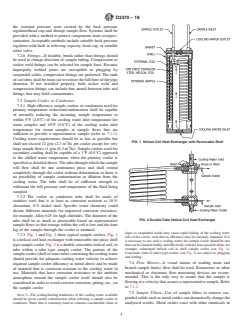
7.3.3 Fig. 1 and Fig. 2 show typical sample coolers. Fig. 1 is a helical coil heat exchanger with removable one-piece shell type
sample cooler. Fig. 2 is a double concentric helical coil, or tube within a tube type sample cooler. The portion of the sample cooler
(shell or outer tube) containing the cooling water should provide for adequate cooling water velocity to achieve required sample
cooler efficiency as noted above and be made of material that is corrosion resistant to the cooling water in use. Materials that have
corrosion resistance to the ambient atmosphere around the sample cooler itself should also be considered in order to avoid exterior
corrosion, pitting, etc., on the sample cooler.
FIG. 1 Helical Coil Heat Exchanger with Removable Shell
D3370 − 18
FIG. 2 Double-Tube Helical Coil Heat Exchanger
NOTE 3—The scaling/fouling tendencies of the cooling water available should be given careful consideration when selecting a sample cooler or
condenser. Water that is extremely hard or contains considerable slime or algae or suspended solids may cause rapid fouling of the cooling water side
of the cooler, such that its efficiency may be seriously impaired. If it is necessary to use such a cooling water, the sample cooler should be one that can
be cleaned readily and effectively with the least possible delay, for example, submerged helical coil in shell sample cooler (see Fig. 1). Concentric (tube
in tube) type coolers (see Fig. 2) are subject to plugging and fouling.
7.4 Flow Meters—A visual means of reading main and branch sample line(s) flow shall be used. Rotameters or other mechanical
or electronic flow measuring devices are recommended. This is the only way to ensure that the sample is flowing at a velocity that
assures a representative sample. Refer to 7.1.1.
7.5 Sample Filters—Use of sample filters to remove suspended solids such as metal oxides can dramatically change the
analytical results. Metal oxides react with other chemicals in water and steam (6) and change the ratio of the total/dissolved
chemicals. Use of sample filters should, therefore, be evaluated with respect to analytical and control requirements.
7.6 Pumps—Withdrawing of a water sample under subatmospheric pressure may require the use of pumps. Small centrifugal
pumps with casing or suction side vent to the source, magnetically coupled gear pumps, or diaphragm pumps may be used. Pumps
employing built in filters should have them removed. The suction sampling line shall be sloped downward over its entire length
without pockets to avoid gas binding. Consideration shall be given to possible contamination of the sample due to pump material
depending on the particular constituents to be analyzed. Also, consideration shall be given to ensure that the pump is designed to
handle low net positive suction head (NPSH) which is typically seen in subatmospheric samples.
7.7 Sample Probes, Nozzles, and Isokinetic Sampling:
7.7.1 Multiport and single-port nozzles can be used to obtain representative samples from process streams. Liquid samples may
be extracted from the side of horizontal piping runs. Single-port taps are adequate if sufficient velocity is maintained to avoid
deposition, whereas multiport nozzles are recommended for obtaining samples containing suspended matter. Multiport nozzles can
be provided to extend across a pipe diameter to obtain an average sample of a cross section. Fig. 3 illustrates a single-port sampling
nozzle. The impact of sample probe failure on process equipment damage should be considered.
7.7.2 Because of varying sizes and densities of particles, samples shall be withdrawn from a flowing stream in a manner that
the velocity of the sample in the nozzle tip is equal to the velocity of the fluid approaching the nozzle. If the velocity of the sample
in the nozzle is greater than that of the fluid approaching the nozzle, the concentration of particles will be less than that in the
process fluid, whereas the opposite occurs when the fluid velocity in the nozzle is less than that approaching the nozzle. When the
velocity of the fluid in the nozzle is equal to that of the fluid approaching the nozzle, isokinetic sampling is provided. Isokinetic
sampling is required when two phases which have different densities are present and is recommended for corrosion product
sampling.
7.7.3 Caution should be used in designing sample probes and nozzles. Corrosion product or sediment (crud) deposits are greater
on tees than on other tubes, and deposition is linearly proportional to the length of sample tube (7). Thus, sample collection points
should be as close to sample probes and nozzles as practicable.
7.8 Degassers—Degassers shall be made of corrosion-resistant materials similar to materials described in 10.1. The degassers
shall be designed to take the full flow required for representative sampling as described in Practice D1066. The piping ahead of
the degasser shall be arranged so that none of the sample is diverted from the degasser.
7.9 Sample Containers—Sample containers shall be made of materials that will not contaminate the sample and, before use,
shall be cleaned thoroughly to remove all extraneous surface dirt. Chemically resistant glass and polyethylene are suitable materials
for the containers. The closures for the sample containers shall be glass stoppers that have been thoroughly washed, or plastic caps
with suitable liners. See Practices D3694 and D4453 for additional information. Sample containers shall be made of materials that
will not contaminate the sample and shall be cleaned thoroughly before use to remove all extraneous surface contamination. The
D3370 − 18
FIG. 3 Water Sampling Nozzle (3)
particular constituents to be analyzed will determine specific cleaning practices for sample containers. Generally, chemical
cleaning agents are not used for containers used to collect trace constituents. Chemically resistant glass and rigid and collapsible
plastic containers of polyethylene and polypropylene are suitable. Some plastic containers are not suitable for samples collected
for organic analyses. Sample containers for high purity water should be in accordance with Practice D4453.
7.9.1 The collection, storage, and subsequent analytical determination in plastic containers will result in erroneous pH values
or dissolved oxygen as a result of the permeability of plastic to gases such as carbon dioxide and oxygen if the sample is stored
for an excessive period prior to analysis. The user is responsible for determining such effects on analysis results.
7.9.2 The closures for the sample containers shall be glass stoppers that have been thoroughly washed, or plastic or metal caps
with suitable liners. Only PTFE or aluminum foil are suitable as cap liners for samples to be analyzed for organic constituents.
7.9.3 Wash sample containers with soap or biodegradable detergent if required. Rinse bottles that have contained samples with
chromate or heavy metals with dilute nitric acid solution before final, thorough rinsing with reagent water. Dry by draining.
7.9.4 For most bacteriological samples, provide wide-mouth sample bottles of sufficient capacity. The bottles may be of
borosilicate glass or other material resistant to the solvent action of water. Metal or plastic wide-mouth screw caps may be used
on sample bottles. Bottles, caps, and their liners shall be capable of withstanding sterilization temperatures (commercially available
sterile bottles may be used). They shall produce no compounds by volatization during sterilizing, and they shall impart no toxic
or bacteriostatic compounds to the water sample.
7.9.4.1 Dedicate appropriate sample bottles for microbiological use. Wash bottles with hot detergent water and a brush. Rinse
well with reagent water that meets Grade B specifications for bacteria.
7.9.4.2 Loosen the screw caps slightly to prevent possible rupture of the container during sterilization. Sterilize the bottles in
a hot-air oven at a minimum of 170°C for at least 1 h or autoclave at 121°C for 15 min.
7.9.4.3 Add Na S O (refer to 8.4) in an amount sufficient to provide a concentration of approximately 100 mg/L in the sample
2 2 3
if the samples to be taken contain residual chlorine.
7.9.5 When organic constituents are to be determined, refer to PracticePractices D3694.
7.9.6 Virgin sample containers are recommended for trace constituents unless the same system will be sampled on a routine
basis and the constituents to be analyzed do not show large variations.
7.10 Sample Labels—Space shall be provided for the following information on an etched area of the bottle, a gummed label,
or a cardboard or linen tag securely affixed to the container:
7.10.1 Sample number,
7.10.2 Date and time of sampling,
7.10.3 Source of sample,
D3370 − 18
7.10.4 Point of sampling (designated in sufficient detail to enable anyone to collect a second sample from the identical spot from
which the first sample was taken),
7.10.5 Temperature and rate of flow of the fluid in the equipment from which the sample was taken,
7.10.6 Temperature of sample,
7.10.7 Results of field tests made on the sample, and
7.10.8 Signature of sampler.
7.11 Sample Shipping Containers—The stoppers closing the sample containers shall be fixed in place by wire, tape, or cord to
prevent leakage in transit. The sample containers shall be of such size that when filled with the desired amount of sample, space
roughly equivalent to 1 % of the volumetric capacity of the containers will be available for expansion of the liquid. The sample
shipping container shall be a case having a separate compartment for each sample container. The compartment around each
container shall be lined with corrugated paper or other suitable material, with the containers held in place with spring clips; or an
elastic packing material may be used.
7.12 Shipping Labels—The addresses of consignee and consignor shall be plainly printed upon two sides of the outer container,
or attached firmly thereon by cards or labels. Warning and descriptive labels shall be attached to the outer container, such as
“Fragile,” “Liquid,” “Glass,” etc., when applicable. In cold weather, the label “Keep from Freezing” shall be attached to the outer
container.
8. Reagents
8.1 Purity of Reagents—Reagent grade chemicals shall be used. Unless otherwise indicated, it is intended that all reagents shall
conform to the specifications of the Committee on Analytical Reagents of the American Chemical Society, where such
specifications are available. Other grades may be used, provided it is first ascertained that the reagent is of sufficiently high purity
to permit its use without lessening the accuracy of the determination.
8.2 Purity of Wate
...