

ASTM D1066-18e1
(Practice)Standard Practice for Sampling Steam
General Information
- Abstract
SIGNIFICANCE AND USE
5.1 It is essential to extract and transport steam in a manner that provides the most representative sample of the process steam in order to accurately determine the amount of all impurities (dissolved chemicals, solid particles, chemicals absorbed on solid particles, water droplets) in it (1).3 An accurate measure of the purity of steam provides information that may be used to determine whether the purity of the steam is within necessary limits to prevent damage or deterioration (corrosion, solid particle erosion, flow-accelerated corrosion, and deposit buildup) of downstream equipment, such as turbines and process heat exchangers. The sources of impurities in the steam can include boiler water carryover, inefficient steam separators, natural salt solubility in the steam and other factors. The most commonly specified and analyzed parameters are sodium, silica, iron, copper, and cation conductivity.
SCOPE
1.1 This practice covers the sampling of saturated and superheated steam. It is applicable to steam produced in fossil fired and nuclear boilers or by any other process means that is at a pressure sufficiently above atmospheric to establish the flow of a representative sample. It is also applicable to steam at lower and subatmospheric pressures for which means must be provided to establish representative flow.
1.2 For information on specialized sampling equipment, tests or methods of analysis, reference should be made to the Annual Book of ASTM Standards, Vols 11.01 and 11.02, relating to water.
1.3 The values stated in SI units are to be regarded as standard. The values given in parentheses are mathematical conversions to inch-pound units that are provided for information only and are not considered standard.
1.4 This standard does not purport to address all of the safety concerns, if any, associated with its use. It is the responsibility of the user of this standard to establish appropriate safety, health, and environmental practices and determine the applicability of regulatory limitations prior to use.
1.5 This international standard was developed in accordance with internationally recognized principles on standardization established in the Decision on Principles for the Development of International Standards, Guides and Recommendations issued by the World Trade Organization Technical Barriers to Trade (TBT) Committee.
- Status
- Published
- Publication Date
- 31-Jul-2018
- Technical Committee
- D19 - Water
Overview
ASTM D1066-18e1 is the international standard practice developed by ASTM International for sampling steam. This standard provides comprehensive guidelines for the extraction and transport of both saturated and superheated steam samples to ensure the most representative sample is delivered for analysis. Correct steam sampling is essential for accurately determining the level of impurities-including dissolved chemicals, solid particles, chemicals adsorbed on solids, and water droplets-found in process steam. These impurities can originate from boiler water carryover, ineffective steam separation, and other factors.
Accurate measurement of steam purity is critical for maintaining the integrity of downstream equipment, such as turbines and process heat exchangers, by helping to prevent damage due to corrosion, solid particle erosion, flow-accelerated corrosion, and deposit buildup.
Key Topics
Sampling Scope:
- Applies to both saturated and superheated steam.
- Relevant for steam produced in fossil-fuel and nuclear boilers or other processes operating above or below atmospheric pressure, provided representative flow is established.
Sampling Techniques:
- Emphasizes the importance of isokinetic sampling to achieve representative samples.
- Includes details on the design and placement of sampling nozzles and proper use of sample coolers.
Representative Sampling:
- Proper sampling ensures accurate detection of common impurities such as sodium, silica, iron, copper, and cation conductivity.
- Sampling lines should minimize sample lag, pressure drop, and sample alteration.
Sample Transport and Handling:
- Recommendations on sample line materials (e.g., stainless steel) and construction.
- Guidance on avoiding sample contamination and ensuring the reliability of the analysis.
Safety and Quality Considerations:
- Users should address steam sampling safety, health, and environmental concerns.
- The standard does not give specific operating procedures for laboratory analysis but refers to related ASTM guides for further detail.
Applications
Power Generation:
- Used extensively in power plants, especially those with fossil-fuel or nuclear boilers, to monitor and control steam purity.
- Vital for preventing operational disruptions or degradation of turbines, condensers, and heat exchangers.
Industrial Steam Systems:
- Applied wherever process steam quality must be monitored to protect equipment, ensure process reliability, and meet regulatory obligations.
Chemical and Petrochemical Operations:
- Ensures that steam used in complex industrial processes remains within desired purity specifications, preventing contamination of final products and equipment fouling.
Equipment Performance and Maintenance:
- Regular steam sampling and analysis inform maintenance schedules and help diagnose potential equipment issues related to steam contamination or improper boiler operation.
Related Standards
ASTM D1066-18e1 references several related ASTM standards and industry best practices, which provide additional technical guidance for specific aspects of water and steam sampling:
- ASTM D1129: Terminology Relating to Water
- ASTM D3370: Practices for Sampling Water from Closed Conduits
- ASTM D5540: Practice for Flow Control and Temperature Control for On-Line Water Sampling and Analysis
- ASTM A269: Specification for Seamless and Welded Austenitic Stainless Steel Tubing for General Service
- ASTM A335/A335M: Specification for Seamless Ferritic Alloy-Steel Pipe for High-Temperature Service
Compliance with these standards ensures a coordinated approach to steam sampling, from sample extraction to analysis, enhancing steam system reliability and the accuracy of steam quality testing in industrial and power applications.
By following ASTM D1066-18e1, organizations ensure robust and representative steam sampling, which is essential for the optimal operation, maintenance, and longevity of critical steam-driven equipment. For more detailed procedures and equipment requirements, refer to the referenced standards and manufacturer guidelines.
Relations
- Effective Date
- 01-Aug-2018
- Effective Date
- 01-Apr-2024
- Effective Date
- 29-Sep-2023
- Effective Date
- 01-May-2020
- Effective Date
- 01-Sep-2018
- Effective Date
- 01-Mar-2018
- Effective Date
- 01-Sep-2015
- Effective Date
- 01-May-2015
- Effective Date
- 01-Oct-2013
- Effective Date
- 01-Oct-2011
- Effective Date
- 01-Dec-2010
- Effective Date
- 01-Nov-2010
- Effective Date
- 01-May-2010
- Effective Date
- 01-Apr-2010
- Effective Date
- 01-Apr-2010
Get Certified
Connect with accredited certification bodies for this standard

CIS Institut d.o.o.
Personal Protective Equipment (PPE) certification body. Notified Body NB-2890 for EU Regulation 2016/425 PPE.

Kiwa BDA Testing
Building and construction product certification.
Kmetijski inštitut Slovenije
Agricultural Institute of Slovenia. Soil testing, plant health, agricultural product analysis.
Sponsored listings
Frequently Asked Questions
ASTM D1066-18e1 is a standard published by ASTM International. Its full title is "Standard Practice for Sampling Steam". This standard covers: SIGNIFICANCE AND USE 5.1 It is essential to extract and transport steam in a manner that provides the most representative sample of the process steam in order to accurately determine the amount of all impurities (dissolved chemicals, solid particles, chemicals absorbed on solid particles, water droplets) in it (1).3 An accurate measure of the purity of steam provides information that may be used to determine whether the purity of the steam is within necessary limits to prevent damage or deterioration (corrosion, solid particle erosion, flow-accelerated corrosion, and deposit buildup) of downstream equipment, such as turbines and process heat exchangers. The sources of impurities in the steam can include boiler water carryover, inefficient steam separators, natural salt solubility in the steam and other factors. The most commonly specified and analyzed parameters are sodium, silica, iron, copper, and cation conductivity. SCOPE 1.1 This practice covers the sampling of saturated and superheated steam. It is applicable to steam produced in fossil fired and nuclear boilers or by any other process means that is at a pressure sufficiently above atmospheric to establish the flow of a representative sample. It is also applicable to steam at lower and subatmospheric pressures for which means must be provided to establish representative flow. 1.2 For information on specialized sampling equipment, tests or methods of analysis, reference should be made to the Annual Book of ASTM Standards, Vols 11.01 and 11.02, relating to water. 1.3 The values stated in SI units are to be regarded as standard. The values given in parentheses are mathematical conversions to inch-pound units that are provided for information only and are not considered standard. 1.4 This standard does not purport to address all of the safety concerns, if any, associated with its use. It is the responsibility of the user of this standard to establish appropriate safety, health, and environmental practices and determine the applicability of regulatory limitations prior to use. 1.5 This international standard was developed in accordance with internationally recognized principles on standardization established in the Decision on Principles for the Development of International Standards, Guides and Recommendations issued by the World Trade Organization Technical Barriers to Trade (TBT) Committee.
SIGNIFICANCE AND USE 5.1 It is essential to extract and transport steam in a manner that provides the most representative sample of the process steam in order to accurately determine the amount of all impurities (dissolved chemicals, solid particles, chemicals absorbed on solid particles, water droplets) in it (1).3 An accurate measure of the purity of steam provides information that may be used to determine whether the purity of the steam is within necessary limits to prevent damage or deterioration (corrosion, solid particle erosion, flow-accelerated corrosion, and deposit buildup) of downstream equipment, such as turbines and process heat exchangers. The sources of impurities in the steam can include boiler water carryover, inefficient steam separators, natural salt solubility in the steam and other factors. The most commonly specified and analyzed parameters are sodium, silica, iron, copper, and cation conductivity. SCOPE 1.1 This practice covers the sampling of saturated and superheated steam. It is applicable to steam produced in fossil fired and nuclear boilers or by any other process means that is at a pressure sufficiently above atmospheric to establish the flow of a representative sample. It is also applicable to steam at lower and subatmospheric pressures for which means must be provided to establish representative flow. 1.2 For information on specialized sampling equipment, tests or methods of analysis, reference should be made to the Annual Book of ASTM Standards, Vols 11.01 and 11.02, relating to water. 1.3 The values stated in SI units are to be regarded as standard. The values given in parentheses are mathematical conversions to inch-pound units that are provided for information only and are not considered standard. 1.4 This standard does not purport to address all of the safety concerns, if any, associated with its use. It is the responsibility of the user of this standard to establish appropriate safety, health, and environmental practices and determine the applicability of regulatory limitations prior to use. 1.5 This international standard was developed in accordance with internationally recognized principles on standardization established in the Decision on Principles for the Development of International Standards, Guides and Recommendations issued by the World Trade Organization Technical Barriers to Trade (TBT) Committee.
ASTM D1066-18e1 is classified under the following ICS (International Classification for Standards) categories: 13.060.30 - Sewage water. The ICS classification helps identify the subject area and facilitates finding related standards.
ASTM D1066-18e1 has the following relationships with other standards: It is inter standard links to ASTM D1066-18, ASTM A335/A335M-24, ASTM A335/A335M-95a, ASTM D1129-13(2020)e2, ASTM A335/A335M-18a, ASTM A335/A335M-18, ASTM A335/A335M-15a, ASTM A335/A335M-15, ASTM A269-13, ASTM A335/A335M-11, ASTM D3370-10, ASTM A335/A335M-10b, ASTM A335/A335M-10a, ASTM A269-10, ASTM A335/A335M-10. Understanding these relationships helps ensure you are using the most current and applicable version of the standard.
ASTM D1066-18e1 is available in PDF format for immediate download after purchase. The document can be added to your cart and obtained through the secure checkout process. Digital delivery ensures instant access to the complete standard document.
Standards Content (Sample)
This international standard was developed in accordance with internationally recognized principles on standardization established in the Decision on Principles for the
Development of International Standards, Guides and Recommendations issued by the World Trade Organization Technical Barriers to Trade (TBT) Committee.
´1
Designation: D1066 − 18
Standard Practice for
Sampling Steam
This standard is issued under the fixed designation D1066; the number immediately following the designation indicates the year of
original adoption or, in the case of revision, the year of last revision. A number in parentheses indicates the year of last reapproval. A
superscript epsilon (´) indicates an editorial change since the last revision or reapproval.
This standard has been approved for use by agencies of the U.S. Department of Defense.
ε NOTE—3.2.1.1 was editorially corrected in December 2018.
1. Scope 2. Referenced Documents
2.1 ASTM Standards:
1.1 This practice covers the sampling of saturated and
A269 Specification for Seamless and Welded Austenitic
superheated steam. It is applicable to steam produced in fossil
Stainless Steel Tubing for General Service
fired and nuclear boilers or by any other process means that is
A335/A335M Specification for Seamless Ferritic Alloy-
at a pressure sufficiently above atmospheric to establish the
Steel Pipe for High-Temperature Service
flowofarepresentativesample.Itisalsoapplicabletosteamat
D1129 Terminology Relating to Water
lower and subatmospheric pressures for which means must be
D3370 Practices for Sampling Water from Closed Conduits
provided to establish representative flow.
D5540 Practice for Flow Control and Temperature Control
1.2 For information on specialized sampling equipment, for On-Line Water Sampling and Analysis
tests or methods of analysis, reference should be made to the
3. Terminology
Annual Book of ASTM Standards, Vols 11.01 and 11.02,
3.1 Definitions:
relating to water.
3.1.1 For definitions of terms used in this standard, refer to
1.3 The values stated in SI units are to be regarded as
Terminology D1129.
standard. The values given in parentheses are mathematical
3.2 Definitions of Terms Specific to This Standard:
conversions to inch-pound units that are provided for informa-
3.2.1 isokinetic sampling, n—a condition wherein the
tion only and are not considered standard.
sample entering the port (tip) of the sampling nozzle has the
1.4 This standard does not purport to address all of the
same velocity vector (velocity and direction) as the stream
safety concerns, if any, associated with its use. It is the
being sampled.
responsibility of the user of this standard to establish appro-
3.2.1.1 Discussion—Isokineticsamplingensuresarepresen-
priate safety, health, and environmental practices and deter-
tative sample of dissolved chemicals, solids, particles, chemi-
mine the applicability of regulatory limitations prior to use.
cals absorbed on solid particles, and in the case of saturated
and wet steam, water droplets are extracted from a process
1.5 This international standard was developed in accor-
stream.
dance with internationally recognized principles on standard-
ization established in the Decision on Principles for the 3.2.2 sample cooler, n—a small heat exchanger designed to
Development of International Standards, Guides and Recom- provide cooling/condensing of process sampling streams of
water or steam.
mendations issued by the World Trade Organization Technical
Barriers to Trade (TBT) Committee.
3.2.3 sampling, n—the extraction of a representative portion
of the steam flowing in the boiler drum lead or pipeline by
means of a sampling nozzle and the delivery of this portion of
steam in a representative manner for analysis.
3.2.4 saturated steam, n—a vapor whose temperature cor-
responds to the boiling water temperature at the particular
This practice is under the jurisdiction of ASTM Committee D19 on Water and existing pressure.
is the direct responsibility of Subcommittee D19.03 on Sampling Water and
Water-Formed Deposits, Analysis of Water for Power Generation and Process Use,
On-Line Water Analysis, and Surveillance of Water. For referenced ASTM standards, visit the ASTM website, www.astm.org, or
Current edition approved Aug. 1, 2018. Published August 2018. Originally contact ASTM Customer Service at service@astm.org. For Annual Book of ASTM
approved in 1949. Last previous edition approved in 2011 as D1066 – 11. DOI: Standards volume information, refer to the standard’s Document Summary page on
10.1520/D1066-18E01. the ASTM website.
Copyright © ASTM International, 100 Barr Harbor Drive, PO Box C700, West Conshohocken, PA 19428-2959. United States
´1
D1066 − 18
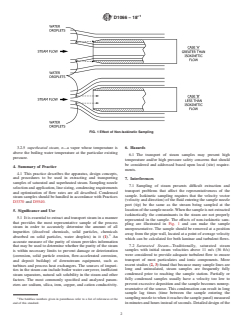
FIG. 1 Effect of Non-Isokinetic Sampling
3.2.5 superheated steam, n—a vapor whose temperature is 6. Hazards
above the boiling water temperature at the particular existing
6.1 The transport of steam samples may present high
pressure.
temperature and/or high pressure safety concerns that should
be considered and addressed based upon local (site) require-
4. Summary of Practice
ments.
4.1 This practice describes the apparatus, design concepts,
and procedures to be used in extracting and transporting
7. Interferences
samples of saturated and superheated steam. Sampling nozzle
7.1 Sampling of steam presents difficult extraction and
selection and application, line sizing, condensing requirements
transport problems that affect the representativeness of the
and optimization of flow rates are all described. Condensed
sample. Isokinetic sampling requires that the velocity vector
steam samples should be handled in accordance with Practices
(velocity and direction) of the fluid entering the sample nozzle
D3370 and D5540.
port (tip) be the same as the stream being sampled at the
locationofthesamplenozzle.Whenthesampleisnotextracted
5. Significance and Use
isokinetically the contaminants in the steam are not properly
5.1 It is essential to extract and transport steam in a manner
represented in the sample. The effects of non-isokinetic sam-
that provides the most representative sample of the process
pling are illustrated in Fig. 1 and can make the sample
steam in order to accurately determine the amount of all
unrepresentative. The sample should be removed at a position
impurities (dissolved chemicals, solid particles, chemicals
away from the pipe wall, located at a point of average velocity
absorbed on solid particles, water droplets) in it (1). An
which can be calculated for both laminar and turbulent flows.
accurate measure of the purity of steam provides information
7.2 Saturated Steam—Traditionally, saturated steam
that may be used to determine whether the purity of the steam
samples with initial steam velocities above 11 m/s (36 ft/s)
is within necessary limits to prevent damage or deterioration
were considered to provide adequate turbulent flow to ensure
(corrosion, solid particle erosion, flow-accelerated corrosion,
transport of most particulates and ionic components. More
and deposit buildup) of downstream equipment, such as
recent studies (2, 3) found that because many sample lines are
turbines and process heat exchangers. The sources of impuri-
long and uninsulated, steam samples are frequently fully
ties in the steam can include boiler water carryover, inefficient
condensed prior to reaching the sample station. Partially or
steam separators, natural salt solubility in the steam and other
fully condensed samples usually have a velocity too low to
factors. The most commonly specified and analyzed param-
prevent excessive deposition and the sample becomes nonrep-
eters are sodium, silica, iron, copper, and cation conductivity.
resentative of the source. This condensation can result in long
sample lag times (time between the sample entering the
samplingnozzletowhenitreachesthesamplepanel)measured
The boldface numbers given in parentheses refer to a list of references at the
end of this standard. in minutes and hours instead of seconds. Detailed design of the
´1
D1066 − 18
sample line to control vapor and liquid velocity can minimize
this interference but cooling of saturated steam samples at the
source is recommended to assure a representative sample. See
Practices D3370 and D5540 for further information on factors
that affect liquid sample transport.
7.3 Superheated Steam—Most contaminants can be dis-
solved in superheated steam. However, as steam pressure and
temperature are reduced the solubility of many contaminants is
decreased and the contaminants precipitate and deposit on the
inner surfaces of the sample line (4). This condition has been
foundtobeprevalentonlyinregionsofdrywalltubewherethe
temperatureofthetubewallexceedsthesaturationtemperature
of the steam.
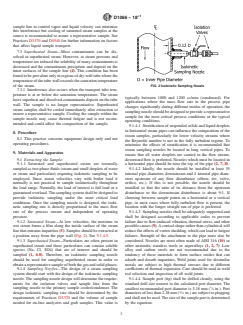
FIG. 2 Isokinetic Sampling Nozzle
7.3.1 Interference also occurs when the transport tube tem-
perature is at or below the saturation temperature. The steam
typically between 1000 and 1200 cc/min (condensed). For
loses superheat and dissolved contaminants deposit on the tube
applications where the mass flow rate in the process pipe
wall. The sample is no longer representative. Superheated
changes significantly during different modes of operation, the
steam samples shall be cooled immediately after extraction to
samplingnozzleshouldbedesignedtoprovidearepresentative
ensure a representative sample. Cooling the sample within the
sample for the most critical process conditions or the typical
sample nozzle may cause thermal fatigue and is not recom-
operating conditions.
mended and could affect the composition of the sample.
9.1.4.1 Stratification of suspended solids and liquid droplets
in horizontal steam pipes can influence the composition of the
8. Procedure
steam samples, particularly for lower velocity streams where
8.1 This practice concerns equipment design only and not
the Reynolds number is not in the fully turbulent regime. To
operating procedures.
minimize the effects of stratification it is recommended that
steam sampling nozzles be located in long vertical pipes. To
9. Materials and Apparatus
ensure that all water droplets are carried in the flow stream,
9.1 Extracting the Sample: downward flow is preferred. Nozzles which must be located in
9.1.1 Saturated and superheated steam are normally a horizontal pipe should be near the top of the pipe (2, 7, 8).
sampledastwo-phasefluids(steamandsmalldropletsofwater 9.1.4.2 Ideally, the nozzle should be installed at least 35
or steam and particulate) requiring isokinetic sampling to be internal pipe diameters downstream and 4 internal pipe diam-
employed. Since steam velocities vary with boiler load it eters upstream of any flow disturbance (elbow, tee, valve,
normally is not practical to sample isokinetically throughout orifice, etc.). If this is not possible, the nozzle should be
the load range. Normally, the load of interest is full load or a installed so that the ratio of its distance from the upstream
guaranteed overload.The sampling system shall be designed to disturbance to the downstream disturbance is about 9:1. If
provide isokinetic sampling under the most critical load choosing between sample points on a horizontal or a vertical
conditions. Once the sampling nozzle is designed, the isoki- pipe, in most cases where fully turbulent flow is present, the
netic sampling rate is directly proportional to the mass flow location with the longer straight run of pipe is preferred.
rate of the process stream and independent of operating 9.1.4.3 Sampling nozzles shall be adequately supported and
pressure. shall be designed according to applicable codes to prevent
9.1.2 Saturated Steam—At low velocities, the moisture in failure due to flow-induced vibration, thermal stress, and other
wet steam forms a film along the inside surface of the steam
possible causes (9).Aconical shape rather than cylindrical will
line that entrains impurities (5). Samples should be extracted at reduce the effects of vortex shedding, which can lead to fatigue
a position away from the pipe wall (Fig. 2). See 9.1.4.5. failures. Strength of the attachment to the pipe must also be
9.1.3 Superheated Steam—Particulates are often present in considered. Nozzles are most often made of AISI 316 (10) or
superheated steam and these particulates can contain soluble other austenitic stainless steels or superalloys (1, 2, 7). Low
species (Na, Cl, SO4) that are of interest and should be alloy and carbon steels are not recommended due to the
sampled (1, 6-8). Therefore, an isokinetic sampling nozzle tendency of these materials to form surface oxides that can
should be used for sampling superheated steam in order to adsorb and desorb impurities, Weld joints used for dissimilar
obtainarepresentativesampleofboththegasandsolidphases. metals are subject to high thermal stresses due to different
9.1.4 Sampling Nozzles—The design of a steam sampling coefficients of thermal expansion. Care should be used in weld
system should start with the design of the isokinetic sampling rod selection and inspection of all weld joints.
nozzle.The sampling nozzle design will determine the require- 9.1.4.4 Sample port (tip) shall be drilled cleanly, using the
ments for the isolation valves and sample line from the standard drill size nearest to the calculated port diameter. The
sampling nozzle to the primary sample cooler/condenser. The smallest recommended port diameter is 3.18 mm ( ⁄8 in.). Port
design isokinetic sampling rate should be determined by the diameters of less than 2.38 mm ( ⁄32 in.) are subject to plugging
requirements of Practices D3370 and the volume of sample andshallnotbeused.Thesizeofthesampleportisdetermined
needed for on-line analyzers and grab samples. This value is by the equation:
´1
D1066 − 18
S 5 ID vρπ /4 (1) sampling nozzle, isolation valve(s), and downstream sample
~ !
tubing before the primary sample cooler or condenser should
where:
be similar (7, 8). The designer is responsible for ensuring that
S = sampling rate (by mass) of the steam,
applicable structural integrity requirements are met to prevent
ID = size of the sample port,
structural failure. Small tubing is vulnerable to mechanical
v = velocity of the steam in the pipe being sampled, and
damageandshouldbeprotected.Oncethesampleiscondensed
ρ = density.
it may be treated as a water sample and Practices D3370 and
9.1.4.5 The center-line of the nozzle tip is most frequently
D5540 should be followed.
located at a distance from the pipe wall where the actual
9.2.1.1 Trapsandpockets(includingtees)inwhichsolidsor
velocity equals the average velocity under laminar flow,
liquid might settle shall be avoided, since they may be partially
typically0.12timesthepipeinnerdiameter(Fig.2) (1, 2, 7, 8).
emptied with changes in flow conditions and may result in
This also ensures that the sample is extracted from a flow
sample contamination. Sample tubing shall be shaped so that
region removed from the pipe inner surface. Where laminar
sharp bends, dips, and low points are avoided, thus preventing
flow is not expected or for sampling in small diameter piping
particulates and condensate from collecting. Expansion loops
(6 in. NPS or smaller) where space limitations restrict the
orothermeansshallbeprovidedtopreventunduebucklingand
sampling nozzle dimensions, greater insertion depths may be
bending when large temperature changes occur. Su
...