

ASTM D1941-21
(Test Method)Standard Test Method for Open Channel Flow Measurement of Water with the Parshall Flume
General Information
- Abstract
SIGNIFICANCE AND USE
5.1 Flume designs are available for throat sizes of 1 in. (2.54 cm) to 50 ft (15.2 m) which cover maximum flows of 0.2 to 3000 ft3/s (0.0057 to 85 m3/s) (1) and (2).4 They can therefore be applied to a wide range of flows, with head losses that are moderate.
5.2 The flume is self-cleansing for moderate solids transport and therefore is suited for wastewater and flows with sediment.
SCOPE
1.1 This test method covers measurement of the volumetric flowrate of water and wastewater in open channels with the Parshall flume.
1.1.1 Information related to this test method can be found in ISO 1438 and ISO 4359.
1.2 The values stated in inch-pound units are to be regarded as standard. The values given in parentheses are mathematical conversions to SI units that are provided for information only and are not considered standard.
1.3 This standard does not purport to address all of the safety concerns, if any, associated with its use. It is the responsibility of the user of this standard to establish appropriate safety, health, and environmental practices and determine the applicability of regulatory limitations prior to use.
1.4 This international standard was developed in accordance with internationally recognized principles on standardization established in the Decision on Principles for the Development of International Standards, Guides and Recommendations issued by the World Trade Organization Technical Barriers to Trade (TBT) Committee.
- Status
- Published
- Publication Date
- 14-Dec-2021
- Technical Committee
- D19 - Water
- Drafting Committee
- D19.07 - Sediments, Geomorphology, and Open-Channel Flow
Buy Documents
ASTM D1941-21 - Standard Test Method for Open Channel Flow Measurement of Water with the Parshall Flume
REDLINE ASTM D1941-21 - Standard Test Method for Open Channel Flow Measurement of Water with the Parshall Flume
Overview
ASTM D1941-21: Standard Test Method for Open Channel Flow Measurement of Water with the Parshall Flume provides a widely recognized methodology for determining the volumetric flowrate of water and wastewater in open channels using the Parshall flume. Developed and maintained by ASTM International, this standard is essential for professionals involved in water resource management, wastewater treatment, and environmental monitoring. It ensures accuracy, repeatability, and reliability in open channel flow measurement, which is critical for regulatory compliance and efficient system operation.
Key Topics
Parshall Flume Design and Application
- Suitable for a wide range of throat sizes (1 inch to 50 feet) and flow rates (0.2 to 3000 ft³/s)
- Moderate head loss and self-cleansing capacity, making it effective for flows containing moderate amounts of sediment or solids
Measurement Principles
- Volumetric flowrate determination is based on empirical relationships between water depth upstream of the flume and flowrate
- Accommodates both free-flow and submerged-flow conditions
- Requires accurate depth measurement, often facilitated by stilling wells and various secondary instruments
Installation and Maintenance
- Emphasizes proper fabrication and installation methods to maintain measurement accuracy
- Recommends free-flow installations whenever possible for best results
- Routine inspection and cleaning are necessary to prevent debris accumulation and ensure continued self-cleansing
Calibration and Validation
- In-situ calibration of both primary (flume) and secondary (instrumentation) systems is recommended
- Encompasses various field calibration techniques such as the velocity-area method, dyed dilution, and volume-based methods
Safety and Compliance
- Users are responsible for establishing safety, health, and environmental protocols
- Developed in line with World Trade Organization TBT Committee standardization principles for international compatibility
Applications
Wastewater Treatment Plants
- Accurate flow measurement for regulatory reporting and process control
- Suitable for channels carrying solids or sediment
Surface Water Monitoring
- Used in streams, irrigation channels, and canals to monitor water resources
Industrial and Municipal Water Management
- Applied in facilities managing process water or stormwater runoff
- Ensures compliance with discharge permits and environmental regulations
Research and Hydrological Studies
- Supports hydrometric studies requiring precise open channel flow data
Flow Calibration and System Performance
- Assists in verifying pump and treatment system performance by providing reliable flow data
Related Standards
- ASTM D1129 - Terminology Relating to Water
- ASTM D2777 - Practice for Determination of Precision and Bias of Applicable Test Methods of Committee D19 on Water
- ASTM D3858 - Test Method for Open-Channel Flow Measurement of Water by Velocity-Area Method
- ISO 1438 - Liquid Flow Measurement in Open Channels Using Thin-Plate Weirs and Venturi Flumes
- ISO 4359 - Liquid Flow Measurement in Open Channels - Rectangular, Trapezoidal, and U-shaped Flumes
- ISO 555-2 - Liquid Flow Measurements in Open Channels - Dilution Methods for Measurement of Steady Flow - Constant Rate Injection Method
By following ASTM D1941-21, water professionals can achieve consistent and trustworthy open channel flow measurements with Parshall flumes, supporting effective water resource management and regulatory adherence. This standard's comprehensive approach to design, installation, calibration, and operation helps safeguard the accuracy of flow data critical to modern water infrastructure.
Relations
- Effective Date
- 01-May-2020
- Effective Date
- 15-Jun-2012
- Effective Date
- 01-Mar-2010
- Effective Date
- 01-Oct-2008
- Effective Date
- 15-Jan-2008
- Effective Date
- 01-Sep-2006
- Effective Date
- 01-Sep-2006
- Effective Date
- 15-Aug-2006
- Effective Date
- 15-Feb-2006
- Effective Date
- 01-Mar-2004
- Effective Date
- 01-Mar-2004
- Effective Date
- 10-Aug-2003
- Effective Date
- 10-Aug-2003
- Effective Date
- 10-Jun-2003
- Effective Date
- 10-Mar-2003
Buy Documents
ASTM D1941-21 - Standard Test Method for Open Channel Flow Measurement of Water with the Parshall Flume
REDLINE ASTM D1941-21 - Standard Test Method for Open Channel Flow Measurement of Water with the Parshall Flume
Get Certified
Connect with accredited certification bodies for this standard

CIS Institut d.o.o.
Personal Protective Equipment (PPE) certification body. Notified Body NB-2890 for EU Regulation 2016/425 PPE.

Kiwa BDA Testing
Building and construction product certification.
Kmetijski inštitut Slovenije
Agricultural Institute of Slovenia. Soil testing, plant health, agricultural product analysis.
Sponsored listings
Frequently Asked Questions
ASTM D1941-21 is a standard published by ASTM International. Its full title is "Standard Test Method for Open Channel Flow Measurement of Water with the Parshall Flume". This standard covers: SIGNIFICANCE AND USE 5.1 Flume designs are available for throat sizes of 1 in. (2.54 cm) to 50 ft (15.2 m) which cover maximum flows of 0.2 to 3000 ft3/s (0.0057 to 85 m3/s) (1) and (2).4 They can therefore be applied to a wide range of flows, with head losses that are moderate. 5.2 The flume is self-cleansing for moderate solids transport and therefore is suited for wastewater and flows with sediment. SCOPE 1.1 This test method covers measurement of the volumetric flowrate of water and wastewater in open channels with the Parshall flume. 1.1.1 Information related to this test method can be found in ISO 1438 and ISO 4359. 1.2 The values stated in inch-pound units are to be regarded as standard. The values given in parentheses are mathematical conversions to SI units that are provided for information only and are not considered standard. 1.3 This standard does not purport to address all of the safety concerns, if any, associated with its use. It is the responsibility of the user of this standard to establish appropriate safety, health, and environmental practices and determine the applicability of regulatory limitations prior to use. 1.4 This international standard was developed in accordance with internationally recognized principles on standardization established in the Decision on Principles for the Development of International Standards, Guides and Recommendations issued by the World Trade Organization Technical Barriers to Trade (TBT) Committee.
SIGNIFICANCE AND USE 5.1 Flume designs are available for throat sizes of 1 in. (2.54 cm) to 50 ft (15.2 m) which cover maximum flows of 0.2 to 3000 ft3/s (0.0057 to 85 m3/s) (1) and (2).4 They can therefore be applied to a wide range of flows, with head losses that are moderate. 5.2 The flume is self-cleansing for moderate solids transport and therefore is suited for wastewater and flows with sediment. SCOPE 1.1 This test method covers measurement of the volumetric flowrate of water and wastewater in open channels with the Parshall flume. 1.1.1 Information related to this test method can be found in ISO 1438 and ISO 4359. 1.2 The values stated in inch-pound units are to be regarded as standard. The values given in parentheses are mathematical conversions to SI units that are provided for information only and are not considered standard. 1.3 This standard does not purport to address all of the safety concerns, if any, associated with its use. It is the responsibility of the user of this standard to establish appropriate safety, health, and environmental practices and determine the applicability of regulatory limitations prior to use. 1.4 This international standard was developed in accordance with internationally recognized principles on standardization established in the Decision on Principles for the Development of International Standards, Guides and Recommendations issued by the World Trade Organization Technical Barriers to Trade (TBT) Committee.
ASTM D1941-21 is classified under the following ICS (International Classification for Standards) categories: 13.060.30 - Sewage water. The ICS classification helps identify the subject area and facilitates finding related standards.
ASTM D1941-21 has the following relationships with other standards: It is inter standard links to ASTM D1129-13(2020)e2, ASTM D2777-12, ASTM D1129-10, ASTM D3858-95(2008), ASTM D2777-08, ASTM D1129-06a, ASTM D1129-06ae1, ASTM D2777-06, ASTM D1129-06, ASTM D1129-04, ASTM D1129-04e1, ASTM D2777-03, ASTM D1129-03a, ASTM D3858-95(2003), ASTM D1129-03. Understanding these relationships helps ensure you are using the most current and applicable version of the standard.
ASTM D1941-21 is available in PDF format for immediate download after purchase. The document can be added to your cart and obtained through the secure checkout process. Digital delivery ensures instant access to the complete standard document.
Standards Content (Sample)
This international standard was developed in accordance with internationally recognized principles on standardization established in the Decision on Principles for the
Development of International Standards, Guides and Recommendations issued by the World Trade Organization Technical Barriers to Trade (TBT) Committee.
Designation: D1941 − 21
Standard Test Method for
Open Channel Flow Measurement of Water with the Parshall
Flume
This standard is issued under the fixed designation D1941; the number immediately following the designation indicates the year of
original adoption or, in the case of revision, the year of last revision. A number in parentheses indicates the year of last reapproval. A
superscript epsilon (´) indicates an editorial change since the last revision or reapproval.
1. Scope 2.2 ISO Standards:
ISO 555-2:1987 Liquid Flow Measurements in Open
1.1 This test method covers measurement of the volumetric
Channels—Dilution Methods for Measurement of Steady
flowrate of water and wastewater in open channels with the
Flow—Constant Rate Injection Method
Parshall flume.
ISO 1438:2017 Liquid Flow Measurement in Open Chan-
1.1.1 Information related to this test method can be found in
nels Using Thin-Plate Weirs
ISO 1438 and ISO 4359.
ISO 4359:2013 Liquid Flow Measurement in Open
1.2 The values stated in inch-pound units are to be regarded
Channels—Rectangular Trapezoidal and U-shaped
as standard. The values given in parentheses are mathematical
Flumes
conversions to SI units that are provided for information only
and are not considered standard. 3. Terminology
1.3 This standard does not purport to address all of the 3.1 Definitions:
safety concerns, if any, associated with its use. It is the 3.1.1 For definitions of terms used in this standard, refer to
responsibility of the user of this standard to establish appro- Terminology D1129.
priate safety, health, and environmental practices and deter-
3.2 Definitions of Terms Specific to This Standard:
mine the applicability of regulatory limitations prior to use.
3.2.1 free flow, n—a condition where the flowrate is gov-
1.4 This international standard was developed in accor-
erned by the state of flow at the crest overfall and hence can be
dance with internationally recognized principles on standard-
determined from a single upstream depth measurement.
ization established in the Decision on Principles for the
3.2.2 head, n—theheightofaliquidaboveaspecifiedpoint.
Development of International Standards, Guides and Recom-
3.2.2.1 Discussion—That is, the flume crest.
mendations issued by the World Trade Organization Technical
3.2.3 hydraulic jump, n—an abrupt transition from super-
Barriers to Trade (TBT) Committee.
critical to subcritical flow, accompanied by considerable tur-
2. Referenced Documents
bulence or gravity waves, or both.
2.1 ASTM Standards: 3.2.4 normal depth, n—the uniform depth of flow for a
D1129 Terminology Relating to Water given flowrate in a long open channel of specific shape,
D2777 Practice for Determination of Precision and Bias of roughness, and slope.
Applicable Test Methods of Committee D19 on Water
3.2.5 primary instrument, n—the device that creates a hy-
D3858 Test Method for Open-Channel Flow Measurement
drodynamic condition that can be sensed by the secondary
of Water by Velocity-Area Method
instrument.
3.2.5.1 Discussion—Inthisexample,theprimaryinstrument
is the flume.
This test method is under the jurisdiction of ASTM Committee D19 on Water
3.2.6 scow float, n—an in-stream flat for depth sensing that
and is the direct responsibility of Subcommittee D19.07 on Sediments,
Geomorphology, and Open-Channel Flow.
is usually mounted on a hinged cantilever.
Current edition approved Dec. 15, 2021. Published February 2022. Originally
3.2.7 secondary instrument, n—a device which measures
approved in 1962. Last previous edition approved in 2013 as D1941 – 91 (2013).
DOI: 10.1520/D1941-21.
the depth of flow at an appropriate location in the flume.
For referenced ASTM standards, visit the ASTM website, www.astm.org, or
contact ASTM Customer Service at service@astm.org. For Annual Book of ASTM
Standards volume information, refer to the standard’s Document Summary page on Available fromAmerican National Standards Institute (ANSI), 25 W. 43rd St.,
the ASTM website. 4th Floor, New York, NY 10036, http://www.ansi.org.
Copyright © ASTM International, 100 Barr Harbor Drive, PO Box C700, West Conshohocken, PA 19428-2959. United States
D1941 − 21
3.2.7.1 Discussion—The secondary instrument may also secondary device can range from a simple scale for manual
convert the measured depth to an indicated flow rate. readings to an instrument which continuously senses the depth,
converts it to flowrate, and provides a readout or record of
3.2.8 stilling well, n—a small reservoir connected through a
instantaneous flowrate or totalized flow, or both.
constricted passage to the main channel, that is, the flume, so
that a depth measurement can be made under quiescent
7.2 The Flume:
conditions.
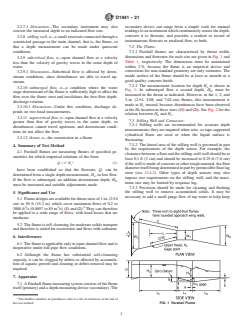
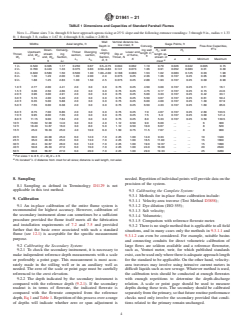
7.2.1 Parshall flumes are characterized by throat width;
dimensions and flowrates for each size are given in Fig. 1 and
3.2.9 subcritical flow, n—open channel flow at a velocity
Table 1, respectively. The dimensions must be maintained
less than the velocity of gravity waves in the same depth of
within 2 %, because the flume is an empirical device and
water.
corrections for non-standard geometry are only estimates. The
3.2.9.1 Discussion—Subcritical flow is affected by down-
inside surface of the flume should be at least as smooth as a
stream conditions, since disturbances are able to travel up-
good quality concrete finish.
stream.
7.2.2 The measurement location for depth H is shown in
a
3.2.10 submerged flow, n—a condition where the water
Fig. 1. In submerged flow a second depth, H , must be
b
stage downstream of the flume is sufficiently high to affect the
measured in the throat as indicated. However, in the 1, 2, and
flow over the flume crest and invalidates the free-flow depth-
3-in. (2.54, 5.08, and 7.62-cm) flumes, this measurement is
discharge relation.
made at H instead, because disturbances have been observed
c
3.2.10.1 Discussion—Under this condition, discharge de-
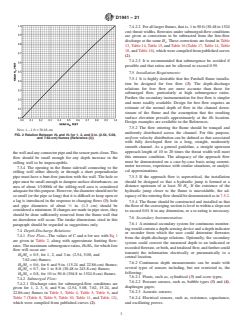
at the H location in these sizes ((1) and (2)). See Fig. 2 for the
b
pends on two head measurements.
relation between H and H .
b c
3.2.11 supercritical flow, n—open channel flow at a velocity
7.3 Stilling Well and Connector:
greater than that of gravity waves in the same depth, so
7.3.1 Stilling wells are recommended for accurate depth
disturbances cannot travel upstream, and downstream condi-
measurements; they are required when wire- or tape-supported
tions do not affect the flow.
cylindrical floats are used or when the liquid surface is
3.2.12 throat, n—the constriction in a flume.
fluctuating.
7.3.2 The lateral area of the stilling well is governed in part
4. Summary of Test Method
by the requirements of the depth sensor. For example, the
4.1 Parshall flumes are measuring flumes of specified ge-
clearancebetweenafloatandthestilling-wellwallshouldbeat
ometries for which empirical relations of the form
least 0.1 ft (3 cm) and should be increased to 0.25 ft (7.6 cm)
n
Q 5CH (1)
ifthewellismadeofconcreteorotherroughmaterial,thefloat
a
diameteritselfbeingdeterminedinpartbypermissiblefloatlag
have been established so that the flowrate, Q, can be
error (see 12.4.2). Other types of depth sensors may also
determined from a single depth measurement, H , in free flow.
a
impose size requirements on the stilling well, and the maxi-
If the flow is submerged, an addition downstream depth, H ,
b
mum size may be limited by response lag.
must be measured and suitable adjustments made.
7.3.3 Provision should be made for cleaning and flushing
the stilling well to remove accumulated solids. It may be
5. Significance and Use
necessary to add a small purge flow of tap water to help keep
5.1 Flumedesignsareavailableforthroatsizesof1in.(2.54
cm) to 50 ft (15.2 m) which cover maximum flows of 0.2 to
3 3 4
3000 ft /s (0.0057 to 85 m /s) (1) and (2). They can therefore
be applied to a wide range of flows, with head losses that are
moderate.
5.2 Theflumeisself-cleansingformoderatesolidstransport
and therefore is suited for wastewater and flows with sediment.
6. Interferences
6.1 Theflumeisapplicableonlytoopenchannelflowandis
inoperative under full-pipe flow conditions.
6.2 Although the flume has substantial self-cleansing
capacity, it can be clogged by debris or affected by accumula-
tion of aquatic growth and cleaning or debris removal may be
required.
7. Apparatus
7.1 AParshallflumemeasuringsystemconsistsoftheflume
itself(primary)andadepth-measuringdevice(secondary).The
The boldface numbers in parentheses refer to a list of references at the end of
this test method. FIG. 1 Parshall Flume
D1941 − 21
7.4.2.2 Foralllargerflumes,thatis,1to50ft(30.48to1524
cm) throat widths, flowrates under submerged-flow conditions
are given as corrections to be subtracted from the free-flow
discharge at the same H . These corrections are found in Table
a
13, Table 14, Table 15, and Table 16 (Table 17, Table 14, Table
18, and Table 16), which were compiled from published curves
(2).
7.4.2.3 It is recommended that submergence be avoided if
possible and that ratios not be allowed to exceed 0.95.
7.5 Installation Requirements:
7.5.1 It is highly desirable that the Parshall flume installa-
tion be designed for free flow (3). The depth-discharge
relations for free flow are more accurate than those for
submerged flow, particularly at high submergence ratios.
Further, the secondary instrumentation for free flow is simpler
and more readily available. Design for free flow requires an
estimate of the normal depth of flow in the channel down-
stream of the flume and the assumption that the resulting
surface elevation prevails approximately at the H location.
b
Design examples are available in the References.
7.5.2 The flow entering the flume should be tranquil and
NOTE 1—1 ft = 30.48 cm
uniformly distributed across the channel. For this purpose,
FIG. 2 Relation BetweenH andH for 1, 2, and 3-in. (2.54, 5.08,
b c
uniform velocity distribution can be defined as that associated
and 7.62-cm) flumes (Reference (2))
with fully developed flow in a long, straight, moderately
smooth channel. As a general guideline, a straight upstream
approach length of 10 to 20 times the throat width will meet
thewellandanyconnectorpipeandthesensorpartsclean.This
this entrance condition. The adequacy of the approach flow
flow should be small enough for any depth increase in the
must be demonstrated on a case-by-case basis using current-
stilling well to be imperceptible.
meter traverses, experience with similar situations, or analyti-
7.3.4 The opening in the flume sidewall connecting to the
cal approximations.
stilling well either directly or through a short perpendicular
7.5.3 If the approach flow is supercritical, the installation
pipe must have a burr-free junction with the wall. The hole or
pipe must be small enough to dampen surface disturbances; an should be designed so that a hydraulic jump is formed at a
distance upstream of at least 30 H . If the existence of the
area of about 1/1000th of the stilling-well area is considered
a
adequateforthispurpose.However,thediametershouldnotbe hydraulic jump closer to the flume is unavoidable, the ad-
equacyoftheenteringflowshouldbedemonstratedasin7.5.2.
so small (or the pipe so long) that it is difficult to keep open or
a lag is introduced in the response to changing flows (3); hole
7.5.4 The flume should be constructed and installed so that
and pipe diameters of about ⁄2 in. (1.3 cm) should be
the floor of the converging section is level to within a slope not
considered a minimum. If changes are made in pipe sizes, they
to exceed 0.01 ft in any dimension, or a re-rating is necessary.
should be done sufficiently removed from the flume wall that
7.6 Secondary Instrumentation:
no drawdown will occur. The intake dimensions cited in this
7.6.1 A minimal secondary system for continuous monitor-
paragraph should be regarded as suggestions only.
ing would contain a depth-sensing device and a depth indicator
7.4 Depth-Discharge Relations:
or recorder from which the user could determine flowrates
7.4.1 Free Flow—The values of C and n for use with Eq 1
from the depth-discharge relations. Optionally, the secondary
are given in Table 2, along with approximate limiting flow-
system could convert the measured depth to an indicated or
rates.Themaximumsubmergenceratios, H /H ,forwhichfree
b a
recordedflowrate,orboth,andtotalizedflow,andfurthercould
flow will occur are:
transmit the information electrically or pneumatically to a
H /H < 0.5, for 1, 2, and 3-in. (2.54, 5.08, and
b a
central location.
7.62-cm) flumes;
7.6.2 Continuous depth measurements can be made with
H /H < 0.6, for 6 and 9-in. (15.24 and 22.86-cm) flumes;
b a
several types of sensors including, but not restricted to, the
H /H < 0.7, for 1 to 8-ft (30.48 to 243.8-cm) flumes;
b a
following:
H /H < 0.8, for 10 to 50-ft (304.8 to 1524.0-cm) flumes.
b a
7.6.2.1 Floats, such as, cylindrical (3) and scow types;
7.4.2 Submerged Flow:
7.6.2.2 Pressure sensors, such as, bubble types (3) and (4),
7.4.2.1 Discharge rates for submerged-flow conditions are
diaphragm gages;
given for 1, 2, 3, 6, and 9-in. (2.54, 5.08, 7.62, 15.24, and
7.6.2.3 Acoustic sensors;
22.86-cm) flumes in Table 3, Table 4, Table 5, Table 6, and
Table 7 (Table 8, Table 9, Table 10, Table 11, and Table 12), 7.6.2.4 Electrical sensors, such as, resistance, capacitance,
which were compiled from published curves (2). and oscillating proves.
D1941 − 21
TABLE 1 Dimensions and Capacities of Standard Parshall Flumes
NOTE 1—Flume sizes 3 in. through 8 ft have approach aprons rising at 25 % slope and the following entrance roundings: 3 through 9 in., radius = 1.33
ft; 1 through 3 ft, radius = 1.67 ft; 4 through 8 ft, radius = 2.00 ft.
Vertical distance be-
Wall
Widths Axial lengths, ft Gage Points, ft
low crest, ft
Free-flow Capacities,
Depth in
Converg-
ft /s
Con-
ing wall
Down- Converg- H , wall H
C T
Upstream Throat Diverging Lower end
A
verging length C,
Throat, stream ing Dip at length up-
end, W , section, section, of flume,
C ft
Section,
W end, W , Section, Throat, N stream of
T D
ft L L K
T D B ab Minimum Maximum
D,ft
ft L crest
C
1 in. 0.549 0.305 1.17 0.250 0.67 0.5–0.75 0.094 0.062 1.19 0.79 0.026 0.042 0.005 0.15
2 in. 0.700 0.443 1.33 0.375 0.83 0.50–0.83 0.141 0.073 1.36 0.91 0.052 0.083 0.01 0.30
3 in. 0.849 0.583 1.50 0.500 1.00 1.00–2.00 0.188 0.083 1.53 1.02 0.083 0.125 0.03 1.90
6 in. 1.30 1.29 2.00 1.00 2.00 2.0 0.375 0.25 2.36 1.36 0.167 0.25 0.05 3.90
9 in. 1.88 1.25 2.83 1.00 1.50 2.5 0.375 0.25 2.88 1.93 0.167 0.25 0.09 8.90
1.0 ft 2.77 2.00 4.41 2.0 3.0 3.0 0.75 0.25 4.50 3.00 0.167 0.25 0.11 16.1
1.5 ft 3.36 2.50 4.66 2.0 3.0 3.0 0.75 0.25 4.75 3.17 0.167 0.25 0.15 24.6
2.0 ft 3.96 3.00 4.91 2.0 3.0 3.0 0.75 0.25 5.00 3.33 0.167 0.25 0.42 33.1
3.0 ft 5.16 4.00 5.40 2.0 3.0 3.0 0.75 0.25 5.50 3.67 0.167 0.25 0.61 50.4
4.0 ft 6.35 5.00 5.88 2.0 3.0 3.0 0.75 0.25 6.00 4.00 0.167 0.25 1.30 67.9
5.0 ft 7.55 6.00 6.38 2.0 3.0 3.0 0.75 0.25 6.50 4.33 0.167 0.25 1.60 85.6
6.0 ft 8.75 7.00 6.86 2.0 3.0 3.0 0.75 0.25 7.0 4.67 0.167 0.25 2.60 103.5
7.0 ft 9.95 8.00 7.35 2.0 3.0 3.0 0.75 0.25 7.5 5.0 0.167 0.25 3.00 121.4
8.0 ft 11.15 9.00 7.84 2.0 3.0 3.0 0.75 0.25 8.0 5.33 0.167 0.25 3.50 139.5
10 ft 15.60 12.00 14.0 3.0 6.0 4.0 1.12 0.50 9.0 6.00 . . 6 300
12 ft 18.40 14.67 16.0 3.0 8.0 5.0 1.12 0.50 10.0 6.67 . . 8 520
15 ft 25.0 18.33 25.0 4.0 10.0 6.0 1.50 0.75 11.5 7.67 . . 8 900
20 ft 30.0 24.00 25.0 6.0 12.0 7.0 2.25 1.00 14.0 9.33 . . 10 1340
25 ft 35.0 29.33 25.0 6.0 13.0 7.0 2.25 1.00 16.5 11.00 . . 15 1660
30 ft 40.4 34.67 26.0 6.0 14.0 7.0 2.25 1.00 19.0 12.67 . . 15 1990
40 ft 50.8 45.33 27.0 6.0 16.0 7.0 2.25 1.00 24.0 16.00 . . 20 2640
50 ft 60.8 56.67 27.0 6.0 20.0 7.0 2.25 1.00 29.0 19.33 . . 25 3280
A
For sizes 1 to 8 ft, C = W /2 + 4 ft.
T
B
H located ⁄3 C distance from crest for all sizes; distance is wall length, not axial.
C
8. Sampling needed.Repetitionofindividualpointswillprovidedataonthe
precision of the system.
8.1 Sampling as defined in Terminology D1129 is not
applicable in this test method. 9.3 Calibrating the Complete System:
9.3.1 Methods for in-place flume calibration include:
9. Calibration
9.3.1.1 Velocity-area traverse (Test Method D3858);
9.1 An in-place calibration of the entire flume system is 9.3.1.2 Dye dilution (ISO 555);
recommended for highest accuracy. However, calibration of
9.3.1.3 Salt velocity;
the secondary instrument alone can sometimes be a sufficient
9.3.1.4 Volumetric;
procedure provided the flume itself meets all the fabrication
9.3.1.5 Comparison with reference flowrate meter.
and installation requirements of 7.2 and 7.5 and provided
9.3.2 There is no single method that is applicable to all field
further that the basic error associated with such a standard
situations, and in many cases only the methods in 9.3.1.1 and
flume (see 12.1) is acceptable for the specific measurement
9.3.1.2 can even be considered. For example, suitable basins
purpose.
and connecting conduits for direct volumetric calibration of
9.2 Calibrating the Secondary System: large flows are seldom available and a reference flowmeter,
9.2.1 To check the secondary instrument, it is necessary to such as, Venturi meter, weir, for which published standards
make independent reference depth measurements with a scale exist,canbeusedonlywherethereisadequateapproachlength
or preferably a point gage. This measurement is most accu- for the standard to be applicable. On the other hand, velocity-
rately made in the stilling well or in an auxiliary well as area traverses may involve using intrusive current meters in
needed. The zero of the scale or point gage must be carefully difficult liquids such as raw sewage. Whatever method is used,
referenced to the crest elevation. the calibration tests should be conducted at enough flowrates
9.2.2 The depth indicated by the secondary instrument is with enough repetitions to determine the depth-discharge
compared with the reference depth (9.2.1). If the secondary relation. A scale or point gage should be used to measure
readout is in terms of flowrate, the indicated flowrate is depths during these tests. The secondary should be calibrated
compared with the flowrate computed from the reference separately from the primary, so that future routine performance
depth,Eq1andTable1.Repetitionofthisprocessoverarange checks need only involve the secondary provided that condi-
of depths will indicate whether zero or span adjustment is tions related to the primary remain unchanged.
D1941 − 21
TABLE 2 Free-Flow Values ofC andn for Parshall Flumes
level, due to the high degree of instability of open-channel
(See Eq 1)
flow. Both temporal and spatial variability of the boundary and
A B B
Throat Width C Q,min Q, max
flow conditions do not allow for a consent standard to be used
n
inch- m ×
3 3 3
for representative sampling.Aminimum bias, measured under
ft-in. cm SI ft /s ft /s m /s
pound 10 /s
ideal conditions, is directly related to the bias of the equipment
0-1 2.54 0.338 0.0479 1.55 0.01 0.28 0.2 0.0057
used and is listed in the remainder of this section.Amaximum
precision and bias cannot be estimated due to the variability of
0-2 5.08 0.676 0.0959 1.55 0.02 0.56 0.5 0.014
the sources of potential errors listed in this section and the
0-3 7.62 0.992 0.141 1.55 0.03 0.85 1.1 0.031
temporal and spatial variability of open-channel flow. Any
0-6 15.24 2.06 0.264 1.58 0.05 1.42 3.9 0.11 estimate of these errors could be very misleading to the user.
0-9 22.80 3.07 0.393 1.53 0.09 2.55 8.9 0.25 12.2 In accordance with 1.6 of Practice D2777, an exemp-
tion to the precision and bias statement required by Practice
1-0 30.48 4.00 0.624 1.522 0.11 3.1 16.1 0.46
D2777 was recommended by the Results Advisor and con-
1-6 45.72 6.00 0.887 1.538 0.15 4.2 24.6 0.69 curred with by the Technical Operations Section of the execu-
tive Subcommittee on June 15, 1990.
2-0 60.96 8.00 1.135 1.550 0.42 11.9 38.1 0.93
12.3 The accuracy of the free-flow discharge relations (Eq 1
3-0 91.44 12.00 1.612 1.566 0.61 17.3 50.4 1.42
and Table 1) can be considered to be within 65 %, for flumes
4-0 121.92 16.00 2.062 1.578 1.3 36.8 67.9 1.92 that meet the standard fabrication and installation require-
5-0 152.40 20.00 2.500 1.587 1.6 45.3 85.6 2.42
ments.The submerged-flow data are considerably less accurate
6-0 182.88 24.00 2.919 1.595 2.6 73.6 103.5 2.93
and the uncertainty depends on the conditions at each instal-
7-0 213.36 28.00 3.337 1.601 3.0 85.0 121.4 3.44
8-0 243.84 32.00 3.736 1.607 3.5 99.1 139.5 3.95 lation. For flumes that are calibrated in-place, an uncertainty
10-0 304.8 39.38 4.709 1.6 6 170 200 5.6
for the resulting depth-discharge relation should be estimated
12-0 365.8 46.75 5.590 1.6 8 227 350 9.9
basedonthemethodofcalibrationandthemannerinwhichthe
19-0 457.2 57.81 6.912 1.6 8 227 600 17.0
20-0 609.6 76.25 9.117 1.6 10 283 1000 28.3 tests were performed. This uncertainty should be combined
25-0 762.0 94.69 11.32 1.6 15 425 1200 34.0
with an estimated uncertainty for the secondary instrumenta-
30-0 914.4 113.13 13.53 1.6 15 425 1500 42.5
tion.
40-0 1219.2 150.00 17.94 1.6 20 566 2000 56.6
50-0 1524.0 186.88 22.35 1.6 25 708 3000 84.9
12.4 Error Sources:
A
Listed values of C should be used in Eq 1 with H in feet to obtain flowrate in
a
12.4.1 The Flume—There is an insufficient experimental or
cubic feet per second. Listed values of C (metric) should be used with H in
a
centimetres to obtain flowrate in litres per second.
analytical base to evaluate errors due to non-standard flume
B
From Ref (1).
construction or installation. However, for smaller flumes such
as 1 to 3 in. (2.54 to 7.62 cm), if the throat deviates from the
prescribed width by a small amount (no more than a few
10. Procedure
percent), it appears reasonable to estimate a corrected flow by
10.1 After initial calibration according to 9.2 or 9.3, the
applying the actual-to-standard width ratio to the standard
secondary measurement should be compared daily with a
discharge. Measurement tolerances should not exceed ⁄64 in.
reference measurement until a suitable frequency of monitor-
(0.4 mm) for width and ⁄32 in. (0.8 mm) for all other
ing can be determined from the accumulated data.
dimensions.Theflumemustbeinstalledandmaintainedsothat
the converging section is level, both laterally and
10.2 Some aspects of routine maintenance depend upon the
longitudinally, to obtain accurate readings. If a Parshall flume
nature of the flowing liquid. There are numerous equipment
isusedwithshallowdepth,excessiveerrorswillresultfromthe
checks that should be made frequently at first—in some cases,
influence of fluid-flow properties and boundary conditions. A
daily—until a more suitable frequency can be derived from the
practicallower H limitof0.1ft(30mm)isrecommended.The
performance history. These include, but are not limited to, a
approach section must be kept clear of moss or other accumu-
purge flows, sediment accumulations, depth-sensor condition,
lation of debris.
flume sliming or surface deterioration, etc. In addition, main-
12.4.2 Secondary Instruments:
tenance should be performed on secondary instrumentation as
recommended by manufacturers’ instructions.
12.4.2.1 Some potential error sources are associated with
specific types of secondary instruments. Examples include, but
11. Quality Control
are not limited to, the following:
...
This document is not an ASTM standard and is intended only to provide the user of an ASTM standard an indication of what changes have been made to the previous version. Because
it may not be technically possible to adequately depict all changes accurately, ASTM recommends that users consult prior editions as appropriate. In all cases only the current version
of the standard as published by ASTM is to be considered the official document.
Designation: D1941 − 91 (Reapproved 2013) D1941 − 21
Standard Test Method for
Open Channel Flow Measurement of Water with the Parshall
Flume
This standard is issued under the fixed designation D1941; the number immediately following the designation indicates the year of
original adoption or, in the case of revision, the year of last revision. A number in parentheses indicates the year of last reapproval. A
superscript epsilon (´) indicates an editorial change since the last revision or reapproval.
1. Scope
1.1 This test method covers measurement of the volumetric flowrate of water and wastewater in open channels with the Parshall
flume.
1.1.1 Information related to this test method can be found in ISO 1438 and ISO 4359.
1.2 The values stated in inch-pound units are to be regarded as standard. The values given in parentheses are mathematical
conversions to SI units that are provided for information only and are not considered standard.
1.3 This standard does not purport to address all of the safety concerns, if any, associated with its use. It is the responsibility
of the user of this standard to establish appropriate safety, health, and environmental practices and determine the applicability of
regulatory limitations prior to use.
1.4 This international standard was developed in accordance with internationally recognized principles on standardization
established in the Decision on Principles for the Development of International Standards, Guides and Recommendations issued
by the World Trade Organization Technical Barriers to Trade (TBT) Committee.
2. Referenced Documents
2.1 ASTM Standards:
D1129 Terminology Relating to Water
D2777 Practice for Determination of Precision and Bias of Applicable Test Methods of Committee D19 on Water
D3858 Test Method for Open-Channel Flow Measurement of Water by Velocity-Area Method
2.2 ISO Standards:
ISO 555555-2:1987 Liquid Flow Measurements in Open Channels—Dilution Methods for Measurement of Steady Flow—
Constant Rate Injection Method
ISO 14381438:2017 Liquid Flow Measurement in Open Channels Using Thin-Plate Weirs and Venturi Flumes
ISO 43594359:2013 Liquid Flow Measurement in Open Channels—Rectangular Trapezoidal and U-shaped Flumes
3. Terminology
3.1 Definitions—Definitions: For definitions of terms used in this test method, refer to Terminology D1129.
This test method is under the jurisdiction of ASTM Committee D19 on Water and is the direct responsibility of Subcommittee D19.07 on Sediments, Geomorphology,
and Open-Channel Flow.
Current edition approved Jan. 1, 2013Dec. 15, 2021. Published January 2013February 2022. Originally approved in 1962. Last previous edition approved in 20072013
as D1941 – 91 (2007).(2013). DOI: 10.1520/D1941-91R13.10.1520/D1941-21.
For referenced ASTM standards, visit the ASTM website, www.astm.org, or contact ASTM Customer Service at service@astm.org. For Annual Book of ASTM Standards
volume information, refer to the standard’s Document Summary page on the ASTM website.
Available from American National Standards Institute (ANSI), 25 W. 43rd St., 4th Floor, New York, NY 10036, http://www.ansi.org.
Copyright © ASTM International, 100 Barr Harbor Drive, PO Box C700, West Conshohocken, PA 19428-2959. United States
D1941 − 21
3.1.1 For definitions of terms used in this standard, refer to Terminology D1129.
3.2 Definitions of Terms Specific to This Standard:
3.2.1 free flow—flow, n—a condition where the flowrate is governed by the state of flow at the crest overfall and hence can be
determined from a single upstream depth measurement.
3.2.2 head—head, n—the height of a liquid above a specified point; that is, the flume crest.point.
3.2.2.1 Discussion—
That is, the flume crest.
3.2.3 hydraulic jump—jump, n—an abrupt transition from supercritical to subcritical flow, accompanied by considerable
turbulence or gravity waves, or both.
3.2.4 normal depth—depth, n—the uniform depth of flow for a given flowrate in a long open channel of specific shape, roughness,
and slope.
3.2.5 primary instrument—instrument, n—the device (in this case, the flume) that creates a hydrodynamic condition that can be
sensed by the secondary instrument.
3.2.5.1 Discussion—
In this example, the primary instrument is the flume.
3.2.6 scow float—float, n—an in-stream flat for depth sensing that is usually mounted on a hinged cantilever.
3.2.7 secondary instrument—instrument, n—in this case, a device which measures the depth of flow at an appropriate location in
the flume. The secondary instrument may also convert the measured depth to an indicated flow rate.
3.2.7.1 Discussion—
The secondary instrument may also convert the measured depth to an indicated flow rate.
3.2.8 stilling well—well, n—a small reservoir connected through a constricted passage to the main channel, that is, the flume, so
that a depth measurement can be made under quiescent conditions.
3.2.9 subcritical flow—flow, n—open channel flow at a velocity less than the velocity of gravity waves in the same depth of water.
Subcritical flow is affected by downstream conditions, since disturbances are able to travel upstream.
3.2.9.1 Discussion—
Subcritical flow is affected by downstream conditions, since disturbances are able to travel upstream.
3.2.10 submerged flow—flow, n—a condition where the water stage downstream of the flume is sufficiently high to affect the flow
over the flume crest and henceinvalidates the free-flow depth-discharge relation no longer applies and discharge depends on two
head measurements.relation.
3.2.10.1 Discussion—
Under this condition, discharge depends on two head measurements.
3.2.11 supercritical flow—flow, n—open channel flow at a velocity greater than that of gravity waves in the same depth, so
disturbances cannot travel upstream, and downstream conditions do not affect the flow.
3.2.12 throat—throat, n—the constriction in a flume.
4. Summary of Test Method
4.1 Parshall flumes are measuring flumes of specified geometries for which empirical relations of the form
n
Q 5 C H (1)
a
have been established so that the flowrate, Q, can be determined from a single depth measurement, H , in free flow. If the flow
a
is submerged, an addition downstream depth, H , must be measured and suitable adjustments made.
b
D1941 − 21
5. Significance and Use
5.1 Flume designs are available for throat sizes of 1 in. (2.54 cm) to 50 ft (15.2 m) which cover maximum flows of 0.2 to 3000
3 3 4
ft /s (0.0057 to 85 m /s) (1) and (2). They can therefore be applied to a wide range of flows, with head losses that are moderate.
5.2 The flume is self-cleansing for moderate solids transport and therefore is suited for wastewater and flows with sediment.
6. Interferences
6.1 The flume is applicable only to open channel flow and is inoperative under full-pipe flow conditions.
6.2 Although the flume has substantial self-cleansing capacity, it can be clogged by debris or affected by accumulation of aquatic
growth and cleaning or debris removal may be required.
7. Apparatus
7.1 A Parshall flume measuring system consists of the flume itself (primary) and a depth-measuring device (secondary). The
secondary device can range from a simple scale for manual readings to an instrument which continuously senses the depth,
converts it to flowrate, and provides a readout or record of instantaneous flowrate or totalized flow, or both.
7.2 The Flume:
7.2.1 Parshall flumes are characterized by throat width; dimensions and flowrates for each size are given in Fig. 1 and Table 1,
respectively. The dimensions must be maintained within 2 %, because the flume is an empirical device and corrections for
non-standard geometry are only estimates. The inside surface of the flume should be at least as smooth as a good quality concrete
finish.
7.2.2 The measurement location for depth H is shown in Fig. 1. In submerged flow a second depth, H , must be measured in the
a b
throat as indicated. However, in the 1, 2, and 3-in. (2.54, 5.08, and 7.62-cm) flumes, this measurement is made at H instead,
c
because disturbances have been observed at the H location in these sizes ((1) and (2)). See Fig. 2 for the relation between H and
b b
H .
c
7.3 Stilling Well and Connector:
FIG. 1 Parshall Flume
The boldface numbers in parentheses refer to a list of references at the end of this test method.
D1941 − 21
NOTE 1—1 ft = 30.48 cm
FIG. 2 Relation Between H and H for 1, 2, and 3-in. (2.54, 5.08, and 7.62-cm) flumes (Reference (2))
b c
7.3.1 Stilling wells are recommended for accurate depth measurements; they are required when wire- or tape-supported cylindrical
floats are used or when the liquid surface is fluctuating.
7.3.2 The lateral area of the stilling well is governed in part by the requirements of the depth sensor. For example, the clearance
between a float and the stilling-well wall should be at least 0.1 ft (3 cm) and should be increased to 0.25 ft (7.6 cm) if the well
is made of concrete or other rough material, the float diameter itself being determined in part by permissible float lag error (see
11.4.212.4.2). Other types of depth sensors may also impose size requirements on the stilling well, and the maximum size may
be limited by response lag.
7.3.3 Provision should be made for cleaning and flushing the stilling well to remove accumulated solids. It may be necessary to
add a small purge flow of tap water to help keep the well and any connector pipe and the sensor parts clean. This flow should be
small enough for any depth increase in the stilling well to be imperceptible.
7.3.4 The opening in the flume sidewall connecting to the stilling well either directly or through a short perpendicular pipe must
have a burr-free junction with the wall. The hole or pipe must be small enough to dampen surface disturbances; an area of about
1/1000th of the stilling-well area is considered adequate for this purpose. However, the diameter should not be so small (or the
pipe so long) that it is difficult to keep open or a lag is introduced in the response to changing flows (3); hole and pipe diameters
of about ⁄2 in. (1.3 cm) should be considered a minimum. If changes are made in pipe sizes, they should be done sufficiently
removed from the flume wall that no drawdown will occur. The intake dimensions cited in this paragraph should be regarded as
suggestions only.
7.4 Depth-Discharge Relations:
7.4.1 Free Flow—The values of C and n for use with Eq 1 are given in Table 2, along with approximate limiting flowrates. The
maximum submergence ratios, H /H , for which free flow will occur are:
b a
H /H < 0.5, for 1, 2, and 3-in. (2.54, 5.08, and
b a
7.62-cm) flumes;
H /H < 0.6, for 6 and 9-in. (15.24 and 22.86-cm) flumes;
b a
H /H < 0.7, for 1 to 8-ft (30.48 to 243.8-cm) flumes;
b a
H /H < 0.8, for 10 to 50-ft (304.8 to 1524.0-cm) flumes.
b a
7.4.2 Submerged Flow:
D1941 − 21
TABLE 1 Dimensions and Capacities of Standard Parshall Flumes
NOTE 1—Flume sizes 3 in. through 8 ft have approach aprons rising at 25 % slope and the following entrance roundings: 3 through 9 in., radius = 1.33
ft; 1 through 3 ft, radius = 1.67 ft; 4 through 8 ft, radius = 2.00 ft.
Vertical distance be-
Wall
Widths Axial lengths, ft Gage Points, ft
low crest, ft
Free-flow Capacities,
Depth in
Converg-
Con- ft /s
ing wall
Down- Converg- H , wall H
C T
Upstream Throat Diverging Lower end
A
verging
Throat, stream ing Dip at length C, length up-
end, W , section, section, of flume,
C
Section, ft
W end, W , Section, Throat, N stream of
T D
ft L L K
a b Minimum Maximum
T D B
D, ft
ft L crest
C
1 in. 0.549 0.305 1.17 0.250 0.67 0.5–0.75 0.094 0.062 1.19 0.79 0.026 0.042 0.005 0.15
2 in. 0.700 0.443 1.33 0.375 0.83 0.50–0.83 0.141 0.073 1.36 0.91 0.052 0.083 0.01 0.30
3 in. 0.849 0.583 1.50 0.500 1.00 1.00–2.00 0.188 0.083 1.53 1.02 0.083 0.125 0.03 1.90
6 in. 1.30 1.29 2.00 1.00 2.00 2.0 0.375 0.25 2.36 1.36 0.167 0.25 0.05 3.90
9 in. 1.88 1.25 2.83 1.00 1.50 2.5 0.375 0.25 2.88 1.93 0.167 0.25 0.09 8.90
1.0 ft 2.77 2.00 4.41 2.0 3.0 3.0 0.75 0.25 4.50 3.00 0.167 0.25 0.11 16.1
1.5 ft 3.36 2.50 4.66 2.0 3.0 3.0 0.75 0.25 4.75 3.17 0.167 0.25 0.15 24.6
2.0 ft 3.96 3.00 4.91 2.0 3.0 3.0 0.75 0.25 5.00 3.33 0.167 0.25 0.42 33.1
3.0 ft 5.16 4.00 5.40 2.0 3.0 3.0 0.75 0.25 5.50 3.67 0.167 0.25 0.61 50.4
4.0 ft 6.35 5.00 5.88 2.0 3.0 3.0 0.75 0.25 6.00 4.00 0.167 0.25 1.30 67.9
5.0 ft 7.55 6.00 6.38 2.0 3.0 3.0 0.75 0.25 6.50 4.33 0.167 0.25 1.60 85.6
6.0 ft 8.75 7.00 6.86 2.0 3.0 3.0 0.75 0.25 7.0 4.67 0.167 0.25 2.60 103.5
7.0 ft 9.95 8.00 7.35 2.0 3.0 3.0 0.75 0.25 7.5 5.0 0.167 0.25 3.00 121.4
8.0 ft 11.15 9.00 7.84 2.0 3.0 3.0 0.75 0.25 8.0 5.33 0.167 0.25 3.50 139.5
10 ft 15.60 12.00 14.0 3.0 6.0 4.0 1.12 0.50 9.0 6.00 . . 6 300
12 ft 18.40 14.67 16.0 3.0 8.0 5.0 1.12 0.50 10.0 6.67 . . 8 520
15 ft 25.0 18.33 25.0 4.0 10.0 6.0 1.50 0.75 11.5 7.67 . . 8 900
20 ft 30.0 24.00 25.0 6.0 12.0 7.0 2.25 1.00 14.0 9.33 . . 10 1340
25 ft 35.0 29.33 25.0 6.0 13.0 7.0 2.25 1.00 16.5 11.00 . . 15 1660
30 ft 40.4 34.67 26.0 6.0 14.0 7.0 2.25 1.00 19.0 12.67 . . 15 1990
40 ft 50.8 45.33 27.0 6.0 16.0 7.0 2.25 1.00 24.0 16.00 . . 20 2640
50 ft 60.8 56.67 27.0 6.0 20.0 7.0 2.25 1.00 29.0 19.33 . . 25 3280
A
For sizes 1 to 8 ft, C = W /2 + 4 ft.
T
B
H located ⁄3 C distance from crest for all sizes; distance is wall length, not axial.
C
7.4.2.1 Discharge rates for submerged-flow conditions are given for 1, 2, 3, 6, and 9-in. (2.54, 5.08, 7.62, 15.24, and 22.86-cm)
flumes in Table 3, Table 4, Table 5, Table 6, and Table 7 (Table 8, Table 9, Table 10, Table 11, and Table 12), which were compiled
from published curves (2).
7.4.2.2 For all larger flumes, that is, 1 to 50 ft (30.48 to 1524 cm) throat widths, flowrates under submerged-flow conditions are
given as corrections to be subtracted from the free-flow discharge at the same H . These corrections are found in Table 13, Table
a
14, Table 15, and Table 16 (Table 17, Table 14, Table 18, and Table 16), which were compiled from published curves (2).
7.4.2.3 It is recommended that submergence be avoided if possible and that ratios not be allowed to exceed 0.95.
7.5 Installation Requirements:
7.5.1 It is highly desirable that the Parshall flume installation be designed for free flow.flow (3). The depth-discharge relations for
free flow are more accurate than those for submerged flow, particularly at high submergence ratios. Further, the secondary
instrumentation for free flow is simpler and more readily available. Design for free flow requires an estimate of the normal depth
of flow in the channel downstream of the flume and the assumption that the resulting surface elevation prevails approximately at
the H location. Design examples are available in the References.
b
7.5.2 The flow entering the flume should be tranquil and uniformly distributed across the channel. For this purpose, uniform
velocity distribution can be defined as that associated with fully developed flow in a long, straight, moderately smooth channel.
As a general guideline, a straight upstream approach length of 10 to 20 times the throat width will meet this entrance condition.
The adequacy of the approach flow must be demonstrated on a case-by-case basis using current-meter traverses, experience with
similar situations, or analytical approximations.
7.5.3 If the approach flow is supercritical, the installation should be designed so that a hydraulic jump is formed at a distance
upstream of at least 30 H . If the existence of the hydraulic jump closer to the flume is unavoidable, the adequacy of the entering
a
flow should be demonstrated as in 7.5.2.
D1941 − 21
TABLE 2 Free-Flow Values of C and n for Parshall Flumes
(See Eq 1)
A B B
Throat Width C Q, min Q, max
n
inch- m ×
3 3 3
ft-in. cm SI ft /s ft /s m /s
pound 10 /s
0-1 2.54 0.338 0.0479 1.55 0.01 0.28 0.2 0.0057
0-2 5.08 0.676 0.0959 1.55 0.02 0.56 0.5 0.014
0-3 7.62 0.992 0.141 1.55 0.03 0.85 1.1 0.031
0-6 15.24 2.06 0.264 1.58 0.05 1.42 3.9 0.11
0-9 22.80 3.07 0.393 1.53 0.09 2.55 8.9 0.25
1-0 30.48 4.00 0.624 1.522 0.11 3.1 16.1 0.46
1-6 45.72 6.00 0.887 1.538 0.15 4.2 24.6 0.69
2-0 60.96 8.00 1.135 1.550 0.42 11.9 38.1 0.93
3-0 91.44 12.00 1.612 1.566 0.61 17.3 50.4 1.42
4-0 121.92 16.00 2.062 1.578 1.3 36.8 67.9 1.92
5-0 152.40 20.00 2.500 1.587 1.6 45.3 85.6 2.42
6-0 182.88 24.00 2.919 1.595 2.6 73.6 103.5 2.93
7-0 213.36 28.00 3.337 1.601 3.0 85.0 121.4 3.44
8-0 243.84 32.00 3.736 1.607 3.5 99.1 139.5 3.95
10-0 304.8 39.38 4.709 1.6 6 170 200 5.6
12-0 365.8 46.75 5.590 1.6 8 227 350 9.9
19-0 457.2 57.81 6.912 1.6 8 227 600 17.0
20-0 609.6 76.25 9.117 1.6 10 283 1000 28.3
25-0 762.0 94.69 11.32 1.6 15 425 1200 34.0
30-0 914.4 113.13 13.53 1.6 15 425 1500 42.5
40-0 1219.2 150.00 17.94 1.6 20 566 2000 56.6
50-0 1524.0 186.88 22.35 1.6 25 708 3000 84.9
A
Listed values of C should be used in Eq 1 with H in feet to obtain flowrate in
a
cubic feet per second. Listed values of C (metric) should be used with H in
a
centimetres to obtain flowrate in litres per second.
B
From Ref (1).
7.5.4 The flume should be constructed and installed so that the floor of the converging section is level to within a slope not to
exceed 0.01 ft in any dimension, or a re-rating is necessary.
D1941 − 21
TABLE 3 Flume, 1-in. (2.54-cm), Submerged—Flowrate, ft /s
H , ft
a
Sub- 0.05 0.06 0.08 0.10 0.15 0.20 0.25 0.30 0.35 0.40 0.45 0.50 0.55 0.60 0.70 0.80
merged,
%
50 0.0033 0.0044 0.0067 0.0095 0.0180 0.028 0.039 0.052 0.066 0.082 0.097 . . . . .
55 0.0032 0.0043 0.0066 0.0094 0.0180 0.028 0.038 0.052 0.065 0.081 0.096 . . . . .
60 0.0032 0.0042 0.0065 0.0093 0.0179 0.027 0.038 0.051 0.064 0.079 0.094 . . . . .
65 0.0031 0.0041 0.0064 0.0090 0.0173 0.026 0.037 0.050 0.061 0.076 0.091 . . . . .
70 0.0030 0.0040 0.0062 0.0087 0.0165 0.025 0.035 0.047 0.058 0.072 0.087 . . . . .
75 . 0.0038 0.0059 0.0083 0.0156 0.024 0.033 0.044 0.055 0.068 0.081 0.096 . . . .
80 . 0.0036 0.0055 0.0077 0.0145 0.022 0.031 0.040 0.051 0.063 0.074 0.088 0.100 . . .
85 . 0.0032 0.0050 0.0069 0.0130 0.020 0.028 0.036 0.045 0.056 0.066 0.077 0.090 0.100 . .
90 . . 0.0042 0.0060 0.0112 0.017 0.024 0.031 0.038 0.046 0.055 0.064 0.074 0.083 . .
95 . . 0.0034 0.0048 0.0089 0.014 0.018 0.024 0.030 0.037 0.042 0.050 0.056 0.062 0.075 0.090
TABLE 4 Flume, 2-in. (5.08-cm), Submerged—Flowrate, ft /s
H , ft
a
Sub- 0.06 0.10 0.15 0.20 0.25 0.30 0.35 0.40 0.45 0.50 0.55 0.60 0.70 0.80 0.90 1.00
merged,
%
50 0.0086 0.0189 0.0350 0.0554 0.080 0.103 0.137 0.165 0.200 0.230 0.271 0.314 . . . .
55 0.0086 0.0188 0.0350 0.0550 0.079 0.103 0.136 0.163 0.198 0.229 0.270 0.314 0.382 . . .
60 0.0085 0.0185 0.0345 0.0549 0.078 0.102 0.134 0.161 0.194 0.226 0.268 0.312 0.377 . . .
65 0.0083 0.0182 0.0340 0.0534 0.077 0.101 0.132 0.158 0.190 0.223 0.263 0.307 0.371 . . .
70 0.0080 0.0175 0.0332 0.0520 0.075 0.098 0.129 0.154 0.186 0.216 0.254 0.296 0.361 . . .
75 0.0077 0.0164 0.0312 0.0498 0.072 0.093 0.123 0.148 0.179 0.207 0.242 0.282 0.344 . . .
80 0.0071 0.0152 0.0289 0.0458 0.067 0.087 0.114 0.139 0.167 0.193 0.228 0.261 0.326 0.396 . .
85 . 0.0138 0.0258 0.0409 0.060 0.080 0.101 0.126 0.151 0.176 0.203 0.235 0.300 0.358 . .
90 . 0.0117 0.0212 0.0346 0.049 0.067 0.087 0.104 0.129 0.150 0.177 0.200 0.259 0.315 0.369 .
95 . 0.0088 0.0158 0.0244 0.035 0.047 0.064 0.078 0.092 0.111 0.130 0.150 0.198 0.250 0.300 0.350
TABLE 5 Flume, 3-in. (7.62-cm), Submerged—Flowrate, ft /s
H , ft
a
Sub- 0.12 0.16 0.20 0.25 0.30 0.35 0.40 0.45 0.50 0.55 0.60 0.70 0.80 0.90 1.0 1.2 1.4 1.6
merged,
%
50 0.037 0.057 0.082 0.117 0.156 0.195 0.240 0.287 0.335 0.397 0.450 0.562 0.700 0.841 0.977 1.31 . .
55 0.037 0.057 0.082 0.117 0.156 0.194 0.239 0.286 0.334 0.394 0.448 0.561 0.696 0.836 0.974 1.31 . .
60 0.037 0.057 0.082 0.116 0.155 0.192 0.238 0.285 0.333 0.390 0.443 0.559 0.686 0.826 0.967 1.29 . .
65 0.037 0.057 0.082 0.115 0.154 0.191 0.236 0.282 0.331 0.383 0.436 0.557 0.680 0.817 0.958 1.27 . .
70 0.036 0.056 0.080 0.113 0.150 0.188 0.230 0.277 0.325 0.374 0.425 0.545 0.665 0.800 0.935 1.25 . .
75 0.036 0.055 0.077 0.108 0.144 0.182 0.221 0.264 0.312 0.359 0.408 0.520 0.642 0.763 0.900 1.19 1.49 .
80 0.034 0.052 0.073 0.101 0.136 0.171 0.206 0.247 0.293 0.339 0.383 0.488 0.604 0.712 0.841 1.12 1.41 .
85 0.031 0.047 0.066 0.092 0.123 0.153 0.188 0.223 0.263 0.309 0.350 0.439 0.545 0.651 0.758 1.00 1.28 .
90 . 0.041 0.057 0.081 0.104 0.134 0.163 0.192 0.225 0.264 0.304 0.379 0.465 0.562 0.653 0.853 1.09 1.33
95 . 0.033 0.045 0.062 0.081 0.098 0.125 0.148 0.174 0.198 0.228 0.290 0.355 0.422 0.500 0.648 0.815 0.988
7.6 Secondary Instrumentation:
7.6.1 A minimal secondary system for continuous monitoring would contain a depth-sensing device and a depth indicator or
recorder from which the user could determine flowrates from the depth-discharge relations. Optionally, the secondary system could
convert the measured depth to an indicated or recorded flowrate, or both, and totalized flow, and further could transmit the
information electrically or pneumatically to a central location.
7.6.2 Continuous depth measurements can be made with several types of sensors including, but not restricted to, the following:
7.6.2.1 Floats, such as, cylindrical (3) and scow types;
7.6.2.2 Pressure sensors, such as, bubble types (3) and (4), diaphragm gages;
7.6.2.3 Acoustic sensors;
7.6.2.4 Electrical sensors, such as, resistance, capacitance, and oscillating proves.
D1941 − 21
TABLE 6 Flume, 6-in. (15.24-cm), Submerged—Flowrate, ft /s
H , ft
a
Sub- 0.1 0.2 0.3 0.4 0.5 0.6 0.7 0.8 0.9 1.0 1.1 1.2 1.3 1.4 1.5
merged,
%
60 0.050 0.162 0.300 0.462 0.655 0.870 1.12 1.40 1.70 2.00 2.34 2.68 3.03 3.38 3.77
62 0.050 0.160 0.297 0.458 0.651 0.865 1.12 1.39 1.67 1.98 2.32 2.65 3.00 3.36 3.74
64 0.050 0.158 0.291 0.455 0.646 0.859 1.11 1.38 1.66 1.96 2.29 2.63 2.97 3.33 3.71
66 0.050 0.156 0.287 0.452 0.639 0.854 1.10 1.37 1.64 1.94 2.26 2.60 2.94 3.30 3.67
68 0.050 0.154 0.285 0.445 0.633 0.849 1.09 1.35 1.63 1.93 2.24 2.56 2.90 3.26 3.64
70 0.050 0.152 0.283 0.440 0.624 0.839 1.07 1.34 1.60 1.90 2.20 2.53 2.85 3.22 3.60
72 0.050 0.150 0.278 0.432 0.617 0.828 1.06 1.33 1.57 1.86 2.16 2.49 2.80 3.17 3.54
74 0.050 0.147 0.274 0.424 0.607 0.817 1.04 1.30 1.54 1.83 2.13 2.44 2.75 3.11 3.47
76 0.050 0.144 0.270 0.414 0.593 0.802 1.02 1.26 1.52 1.80 2.09 2.39 2.70 3.04 3.40
78 0.050 0.141 0.263 0.402 0.580 0.782 1.00 1.23 1.47 1.75 2.04 2.33 2.64 2.97 3.32
80 0.048 0.137 0.252 0.389 0.564 0.764 0.97 1.20 1.44 1.70 1.97 2.26 2.56 2.89 3.22
82 0.045 0.131 0.243 0.377 0.540 0.741 0.94 1.16 1.40 1.65 1.90 2.19 2.48 2.80 3.10
84 0.042 0.125 0.235 0.356 0.520 0.709 0.90 1.12 1.34 1.59 1.83 2.11 2.39 2.68 2.99
86 0.040 0.121 0.224 0.342 0.498 0.674 0.87 1.07 1.29 1.52 1.75 2.02 2.29 2.56 2.85
88 0.038 0.115 0.211 0.322 0.471 0.638 0.82 1.02 1.23 1.44 1.67 1.92 2.17 2.44 2.72
90 0.035 0.106 0.196 0.300 0.438 0.593 0.76 0.95 1.15 1.36 1.57 1.80 2.04 2.30 2.55
92 0.030 0.100 0.175 0.278 0.402 0.544 0.70 0.88 1.07 1.26 1.47 1.67 1.91 2.14 2.38
94 0.028 0.088 0.155 0.250 0.359 0.487 0.64 0.80 0.97 1.15 1.35 1.54 1.74 1.95 2.17
95 0.025 0.083 0.145 0.230 0.330 0.453 0.60 0.75 0.86 1.03 1.21 1.45 1.64 1.85 2.06
TABLE 7 Flume, 9-in. (22.86-cm), Submerged—Flowrate, ft /s
H , ft
a
Sub- 0.1 0.2 0.3 0.4 0.5 0.6 0.7 0.8 0.9 1.0 1.1 1.2 1.3 1.4 1.5
merged,
%
60 0.093 0.276 0.490 0.750 1.05 1.37 1.75 2.17 2.57 3.02 3.52 4.06 4.57 5.10 5.65
62 0.093 0.276 0.486 0.747 1.05 1.37 1.75 2.16 2.56 3.01 3.50 4.04 4.55 5.07 5.62
64 0.090 0.272 0.479 0.745 1.04 1.36 1.74 2.15 2.55 3.00 3.48 4.
...