

ASTM D4440-23
(Test Method)Standard Test Method for Plastics: Dynamic Mechanical Properties Melt Rheology
General Information
- Abstract
SIGNIFICANCE AND USE
5.1 This test method provides a simple means of characterizing the important rheological properties and viscosity of thermoplastic polymers using very small amounts of material (approximately 25 to 50 mm in diameter by 1 to 3 mm in thickness ... approximately 3 to 5 g). Data are generally used for quality control, research and development, and establishment of optimum processing conditions.
5.2 Dynamic mechanical testing provides a sensitive method for determining molten polymer properties by measuring the elastic and loss moduli as a function of frequency, strain, temperature, or time. Plots of viscosity, storage, and loss moduli, and tan delta as a function of the aforementioned process parameters provide graphical representation indicative of molecular weight, molecular weight distribution, effects of chain branching, and melt-processability for specified conditions.
5.2.1 Observed data are specific to experimental conditions. Reporting in full (as described in this test method) the conditions under which the data was obtained is essential to assist users with interpreting the data an reconciling apparent or perceived discrepancies.
5.3 Values obtained in this test method can be used to assess the following:
5.3.1 Complex viscosity of the polymer melt as a function of dynamic oscillation,
5.3.2 Processing viscosity, minimum as well as changes in viscosity as a function of experimental parameters,
5.3.3 Effects of processing treatment,
5.3.4 Relative polymer behavioral properties, including viscosity and damping, and
5.3.5 Effects of formulation additives that might affect processability or performance.
5.4 Before proceeding with this test method, refer to the specification for the material being tested. Any test specimen preparation, conditioning, dimensions, or testing parameters, or combination thereof, covered in the relevant ASTM materials specification shall take precedence over those mentioned in the test method. If there are no r...
SCOPE
1.1 This test method outlines the use of dynamic mechanical instrumentation in determining and reporting the rheological properties of thermoplastic resins and other types of molten polymers. The method is useful for determining the complex viscosity and other significant viscoelastic characteristics of such materials as a function of frequency, strain amplitude, temperature, and time. It is known that fillers and other additives influence rheological properties.
1.2 It incorporates a laboratory test method for determining the relevant rheological properties of a polymer melt subjected to various oscillatory deformations on an instrument of the type commonly referred to as a mechanical or dynamic spectrometer.
1.3 This test method is intended to provide a means of determining the rheological properties of molten polymers, such as thermoplastics and thermoplastic elastomers over a range of temperatures by nonresonant, forced-vibration techniques. Plots of modulus, viscosity, and tan delta as a function of dynamic oscillation (frequency), strain amplitude, temperature, and time are indicative of the viscoelastic properties of a molten polymer.
1.4 This test method is valid for a wide range of frequencies, typically from 0.01 Hz to 100 Hz.
1.5 This test method is intended for homogenous and heterogeneous molten polymeric systems and composite formulations containing chemical additives, including fillers, reinforcements, stabilizers, plasticizers, flame retardants, impact modifiers, processing aids, and other important chemical additives often incorporated into a polymeric system for specific functional properties, and which could affect the processability and functional performance. These polymeric material systems have molten viscosities typically less than 106 Pa·s (107 poise).
1.6 Test data obtained by this test method are relevant and appropriate for use in engineering design.
1.7 The values stated in ...
- Status
- Published
- Publication Date
- 30-Sep-2023
- Technical Committee
- D20 - Plastics
- Drafting Committee
- D20.10 - Mechanical Properties
Buy Documents
ASTM D4440-23 - Standard Test Method for Plastics: Dynamic Mechanical Properties Melt Rheology
REDLINE ASTM D4440-23 - Standard Test Method for Plastics: Dynamic Mechanical Properties Melt Rheology
Overview
ASTM D4440-23: Standard Test Method for Plastics-Dynamic Mechanical Properties Melt Rheology provides a comprehensive laboratory procedure for evaluating the rheological and dynamic mechanical properties of thermoplastic resins and other molten polymer systems. This test method uses dynamic mechanical instrumentation, such as oscillatory rheometers, to assess key viscoelastic properties-primarily by measuring parameters like complex viscosity and elastic/loss moduli across a range of frequencies, strain amplitudes, and temperatures.
Designed for use with both homogeneous and heterogeneous polymeric compositions, the method is applicable to a wide array of plastic materials, including those incorporating fillers, reinforcements, stabilizers, plasticizers, and other additives. ASTM D4440-23 is widely used in quality control, research and development, and for optimizing the processing conditions of thermoplastics and thermoplastic elastomers.
Key Topics
- Dynamic Mechanical Analysis (DMA): This method utilizes forced, nonresonant oscillatory deformation to measure storage modulus (G′), loss modulus (G″), complex viscosity (η*), and tan delta (δ) of polymer melts.
- Frequency and Temperature Ranges: The standard covers a broad frequency range (0.01 Hz to 100 Hz) and assesses material performance over a wide temperature interval.
- Sample Versatility: Small quantities of polymers (approx. 3–5 g) are required, and various sample geometries (disk, pellet, powder) can be tested.
- Material Characterization: Graphical plots of modulus, viscosity, and tan delta as functions of frequency, strain, temperature, or time offer insight into molecular weight, molecular weight distribution, chain branching, and processability.
- Additive Effects: The test method captures the influence of additives (e.g., fillers, impact modifiers, flame retardants) on rheological performance and melt-processability.
- Reporting Requirements: The standard stresses the importance of reporting all experimental conditions for data clarity and reconciliation.
Applications
ASTM D4440-23 is essential in several fields of plastics engineering and polymer science:
- Quality Control: Rapid screening of polymer melt behavior to ensure consistency in material batches.
- Research and Development: Investigating new polymer formulations, blending, and compounding processes.
- Process Optimization: Determining ideal processing temperatures, shear rates, and additive selection for extrusion, molding, or other shaping techniques.
- Material Comparison: Assessing how chemical additives or processing treatments impact the viscoelastic properties relevant to mechanical performance and end-use functionality.
- Engineering Design: Supplying relevant data for simulation, modeling, and structural calculations where melt rheology influences product performance.
Laboratories, manufacturers, and product developers in the plastics industry use this standard to ensure reliable, reproducible, and comparable data for engineering and regulatory purposes.
Related Standards
For a thorough approach to plastics melt rheology and dynamic mechanical testing, ASTM D4440-23 is often used in conjunction with:
- ASTM D883: Terminology Relating to Plastics
- ASTM D4065: Practice for Plastics: Dynamic Mechanical Properties-Determination and Report of Procedures
- ASTM D4092: Terminology for Plastics: Dynamic Mechanical Properties
- ISO 6721 (Part 10): Plastics-Determination of Dynamic Mechanical Properties-Complex Shear Viscosity Using an Oscillatory Rheometer
- ASTM D4000: Classification System for Specifying Plastic Materials
- ASTM E691: Practice for Conducting an Interlaboratory Study to Determine the Precision of a Test Method
These related standards provide additional terminology, calibration procedures, and cross-references that strengthen the quality and comparability of polymer rheology data across the plastics industry. Adhering to ASTM D4440-23 and its related documents underpins best practices for dynamic mechanical testing and ensures robust evaluation of plastics’ melt behavior.
Relations
- Replaces
ASTM D4440-15 - Standard Test Method for Plastics: Dynamic Mechanical Properties Melt Rheology - Effective Date
- 01-Oct-2023
- Effective Date
- 01-Feb-2024
- Effective Date
- 01-Nov-2023
- Effective Date
- 01-Nov-2022
- Effective Date
- 01-Apr-2022
- Effective Date
- 01-Apr-2022
- Effective Date
- 01-Oct-2023
Buy Documents
ASTM D4440-23 - Standard Test Method for Plastics: Dynamic Mechanical Properties Melt Rheology
REDLINE ASTM D4440-23 - Standard Test Method for Plastics: Dynamic Mechanical Properties Melt Rheology
Get Certified
Connect with accredited certification bodies for this standard

DIN CERTCO
DIN Group product certification.

Smithers Quality Assessments
US management systems and product certification.
Sponsored listings
Frequently Asked Questions
ASTM D4440-23 is a standard published by ASTM International. Its full title is "Standard Test Method for Plastics: Dynamic Mechanical Properties Melt Rheology". This standard covers: SIGNIFICANCE AND USE 5.1 This test method provides a simple means of characterizing the important rheological properties and viscosity of thermoplastic polymers using very small amounts of material (approximately 25 to 50 mm in diameter by 1 to 3 mm in thickness ... approximately 3 to 5 g). Data are generally used for quality control, research and development, and establishment of optimum processing conditions. 5.2 Dynamic mechanical testing provides a sensitive method for determining molten polymer properties by measuring the elastic and loss moduli as a function of frequency, strain, temperature, or time. Plots of viscosity, storage, and loss moduli, and tan delta as a function of the aforementioned process parameters provide graphical representation indicative of molecular weight, molecular weight distribution, effects of chain branching, and melt-processability for specified conditions. 5.2.1 Observed data are specific to experimental conditions. Reporting in full (as described in this test method) the conditions under which the data was obtained is essential to assist users with interpreting the data an reconciling apparent or perceived discrepancies. 5.3 Values obtained in this test method can be used to assess the following: 5.3.1 Complex viscosity of the polymer melt as a function of dynamic oscillation, 5.3.2 Processing viscosity, minimum as well as changes in viscosity as a function of experimental parameters, 5.3.3 Effects of processing treatment, 5.3.4 Relative polymer behavioral properties, including viscosity and damping, and 5.3.5 Effects of formulation additives that might affect processability or performance. 5.4 Before proceeding with this test method, refer to the specification for the material being tested. Any test specimen preparation, conditioning, dimensions, or testing parameters, or combination thereof, covered in the relevant ASTM materials specification shall take precedence over those mentioned in the test method. If there are no r... SCOPE 1.1 This test method outlines the use of dynamic mechanical instrumentation in determining and reporting the rheological properties of thermoplastic resins and other types of molten polymers. The method is useful for determining the complex viscosity and other significant viscoelastic characteristics of such materials as a function of frequency, strain amplitude, temperature, and time. It is known that fillers and other additives influence rheological properties. 1.2 It incorporates a laboratory test method for determining the relevant rheological properties of a polymer melt subjected to various oscillatory deformations on an instrument of the type commonly referred to as a mechanical or dynamic spectrometer. 1.3 This test method is intended to provide a means of determining the rheological properties of molten polymers, such as thermoplastics and thermoplastic elastomers over a range of temperatures by nonresonant, forced-vibration techniques. Plots of modulus, viscosity, and tan delta as a function of dynamic oscillation (frequency), strain amplitude, temperature, and time are indicative of the viscoelastic properties of a molten polymer. 1.4 This test method is valid for a wide range of frequencies, typically from 0.01 Hz to 100 Hz. 1.5 This test method is intended for homogenous and heterogeneous molten polymeric systems and composite formulations containing chemical additives, including fillers, reinforcements, stabilizers, plasticizers, flame retardants, impact modifiers, processing aids, and other important chemical additives often incorporated into a polymeric system for specific functional properties, and which could affect the processability and functional performance. These polymeric material systems have molten viscosities typically less than 106 Pa·s (107 poise). 1.6 Test data obtained by this test method are relevant and appropriate for use in engineering design. 1.7 The values stated in ...
SIGNIFICANCE AND USE 5.1 This test method provides a simple means of characterizing the important rheological properties and viscosity of thermoplastic polymers using very small amounts of material (approximately 25 to 50 mm in diameter by 1 to 3 mm in thickness ... approximately 3 to 5 g). Data are generally used for quality control, research and development, and establishment of optimum processing conditions. 5.2 Dynamic mechanical testing provides a sensitive method for determining molten polymer properties by measuring the elastic and loss moduli as a function of frequency, strain, temperature, or time. Plots of viscosity, storage, and loss moduli, and tan delta as a function of the aforementioned process parameters provide graphical representation indicative of molecular weight, molecular weight distribution, effects of chain branching, and melt-processability for specified conditions. 5.2.1 Observed data are specific to experimental conditions. Reporting in full (as described in this test method) the conditions under which the data was obtained is essential to assist users with interpreting the data an reconciling apparent or perceived discrepancies. 5.3 Values obtained in this test method can be used to assess the following: 5.3.1 Complex viscosity of the polymer melt as a function of dynamic oscillation, 5.3.2 Processing viscosity, minimum as well as changes in viscosity as a function of experimental parameters, 5.3.3 Effects of processing treatment, 5.3.4 Relative polymer behavioral properties, including viscosity and damping, and 5.3.5 Effects of formulation additives that might affect processability or performance. 5.4 Before proceeding with this test method, refer to the specification for the material being tested. Any test specimen preparation, conditioning, dimensions, or testing parameters, or combination thereof, covered in the relevant ASTM materials specification shall take precedence over those mentioned in the test method. If there are no r... SCOPE 1.1 This test method outlines the use of dynamic mechanical instrumentation in determining and reporting the rheological properties of thermoplastic resins and other types of molten polymers. The method is useful for determining the complex viscosity and other significant viscoelastic characteristics of such materials as a function of frequency, strain amplitude, temperature, and time. It is known that fillers and other additives influence rheological properties. 1.2 It incorporates a laboratory test method for determining the relevant rheological properties of a polymer melt subjected to various oscillatory deformations on an instrument of the type commonly referred to as a mechanical or dynamic spectrometer. 1.3 This test method is intended to provide a means of determining the rheological properties of molten polymers, such as thermoplastics and thermoplastic elastomers over a range of temperatures by nonresonant, forced-vibration techniques. Plots of modulus, viscosity, and tan delta as a function of dynamic oscillation (frequency), strain amplitude, temperature, and time are indicative of the viscoelastic properties of a molten polymer. 1.4 This test method is valid for a wide range of frequencies, typically from 0.01 Hz to 100 Hz. 1.5 This test method is intended for homogenous and heterogeneous molten polymeric systems and composite formulations containing chemical additives, including fillers, reinforcements, stabilizers, plasticizers, flame retardants, impact modifiers, processing aids, and other important chemical additives often incorporated into a polymeric system for specific functional properties, and which could affect the processability and functional performance. These polymeric material systems have molten viscosities typically less than 106 Pa·s (107 poise). 1.6 Test data obtained by this test method are relevant and appropriate for use in engineering design. 1.7 The values stated in ...
ASTM D4440-23 is classified under the following ICS (International Classification for Standards) categories: 83.080.20 - Thermoplastic materials. The ICS classification helps identify the subject area and facilitates finding related standards.
ASTM D4440-23 has the following relationships with other standards: It is inter standard links to ASTM D4440-15, ASTM D883-24, ASTM D883-23, ASTM D883-22, ASTM E456-13a(2022)e1, ASTM E456-13a(2022), ASTM D4065-20. Understanding these relationships helps ensure you are using the most current and applicable version of the standard.
ASTM D4440-23 is available in PDF format for immediate download after purchase. The document can be added to your cart and obtained through the secure checkout process. Digital delivery ensures instant access to the complete standard document.
Standards Content (Sample)
This international standard was developed in accordance with internationally recognized principles on standardization established in the Decision on Principles for the
Development of International Standards, Guides and Recommendations issued by the World Trade Organization Technical Barriers to Trade (TBT) Committee.
Designation: D4440 − 23
Standard Test Method for
Plastics: Dynamic Mechanical Properties Melt Rheology
This standard is issued under the fixed designation D4440; the number immediately following the designation indicates the year of
original adoption or, in the case of revision, the year of last revision. A number in parentheses indicates the year of last reapproval. A
superscript epsilon (´) indicates an editorial change since the last revision or reapproval.
1. Scope* 1.7 The values stated in SI units are to be regarded as the
standard. The values given in parentheses are for information
1.1 This test method outlines the use of dynamic mechanical
only.
instrumentation in determining and reporting the rheological
1.8 This standard does not purport to address all of the
properties of thermoplastic resins and other types of molten
safety concerns, if any, associated with its use. It is the
polymers. The method is useful for determining the complex
responsibility of the user of this standard to establish appro-
viscosity and other significant viscoelastic characteristics of
priate safety, health, and environmental practices and deter-
such materials as a function of frequency, strain amplitude,
mine the applicability of regulatory limitations prior to use.
temperature, and time. It is known that fillers and other
additives influence rheological properties.
NOTE 1—This test method is equivalent to ISO 6721, Part 10.
1.2 It incorporates a laboratory test method for determining
1.9 This international standard was developed in accor-
the relevant rheological properties of a polymer melt subjected
dance with internationally recognized principles on standard-
to various oscillatory deformations on an instrument of the type
ization established in the Decision on Principles for the
commonly referred to as a mechanical or dynamic spectrom-
Development of International Standards, Guides and Recom-
eter.
mendations issued by the World Trade Organization Technical
Barriers to Trade (TBT) Committee.
1.3 This test method is intended to provide a means of
determining the rheological properties of molten polymers,
2. Referenced Documents
such as thermoplastics and thermoplastic elastomers over a
2.1 ASTM Standards:
range of temperatures by nonresonant, forced-vibration tech-
D883 Terminology Relating to Plastics
niques. Plots of modulus, viscosity, and tan delta as a function
D4000 Classification System for Specifying Plastic Materi-
of dynamic oscillation (frequency), strain amplitude,
als
temperature, and time are indicative of the viscoelastic prop-
D4065 Practice for Plastics: Dynamic Mechanical Proper-
erties of a molten polymer.
ties: Determination and Report of Procedures
1.4 This test method is valid for a wide range of frequencies,
D4092 Terminology for Plastics: Dynamic Mechanical
typically from 0.01 Hz to 100 Hz.
Properties
1.5 This test method is intended for homogenous and
E456 Terminology Relating to Quality and Statistics
heterogeneous molten polymeric systems and composite for-
E691 Practice for Conducting an Interlaboratory Study to
mulations containing chemical additives, including fillers,
Determine the Precision of a Test Method
reinforcements, stabilizers, plasticizers, flame retardants, im-
2.2 ISO Standard:
pact modifiers, processing aids, and other important chemical
ISO 6721, Part 10 Plastics—Determination of Dynamic
additives often incorporated into a polymeric system for
Mechanical Properties, Part 10, Complex Shear Viscosity
specific functional properties, and which could affect the
Using a Parallel-Plate Oscillatory Rheometer
processability and functional performance. These polymeric
3. Terminology
material systems have molten viscosities typically less than 10
Pa·s (10 poise).
3.1 Definitions—Terms used in this standard are defined in
accordance with Terminology D4092 and Terminology D883
1.6 Test data obtained by this test method are relevant and
unless otherwise specified. For terms relating to precision and
appropriate for use in engineering design.
For referenced ASTM standards, visit the ASTM website, www.astm.org, or
This test method is under the jurisdiction of ASTM Committee D20 on Plastics contact ASTM Customer Service at service@astm.org. For Annual Book of ASTM
and is the direct responsibility of Subcommittee D20.10 on Mechanical Properties. Standards volume information, refer to the standard’s Document Summary page on
Current edition approved Oct. 1, 2023. Published November 2023. Originally the ASTM website.
approved in 1984. Last previous edition approved in 2015 as D4440 - 15. DOI: Available from American National Standards Institute (ANSI), 25 W. 43rd St.,
10.1520/D4440-23. 4th Floor, New York, NY 10036, http://www.ansi.org.
*A Summary of Changes section appears at the end of this standard
Copyright © ASTM International, 100 Barr Harbor Drive, PO Box C700, West Conshohocken, PA 19428-2959. United States
D4440 − 23
bias and other associated statistical issues, the terms used in
this standard are defined in accordance with Terminology
E456.
4. Summary of Test Method
4.1 A known amount of thermoplastic polymer (molten
powder or pellet, or solid preform disk) is placed in mechanical
oscillation at a fixed or varying frequency at isothermal
conditions or over a linear temperature increase or a time-
temperature relation simulating a processing condition. Storage
(elastic) modulus, G' or loss (viscous) modulus, G'', or both, or
the corresponding dynamic viscosity functions n' = g'' ⁄w and
n'' = g' ⁄w, of the polymeric material specimen are measured in
shear as a function of frequency, strain, temperature, or time.
5. Significance and Use
FIG. 1 Rheological Properties of a Polymer Melt
5.1 This test method provides a simple means of character-
izing the important rheological properties and viscosity of
6. Interferences
thermoplastic polymers using very small amounts of material
6.1 Since small quantities of polymer are used, it is essential
(approximately 25 to 50 mm in diameter by 1 to 3 mm in
that the specimens be homogeneous and representative.
thickness . approximately 3 to 5 g). Data are generally used
6.2 Toxic or corrosive effluents, or both, have the potential
for quality control, research and development, and establish-
to be released when heating the polymer specimen to its molten
ment of optimum processing conditions.
state and could be harmful to personnel or to the instrumenta-
5.2 Dynamic mechanical testing provides a sensitive
tion.
method for determining molten polymer properties by measur-
6.3 Entrapped air/gas has the potential to affect the results
ing the elastic and loss moduli as a function of frequency,
obtained using powder or pellet-type samples.
strain, temperature, or time. Plots of viscosity, storage, and loss
moduli, and tan delta as a function of the aforementioned
7. Apparatus
process parameters provide graphical representation indicative
7.1 The function of the apparatus is to hold a molten
of molecular weight, molecular weight distribution, effects of
polymer of known volume and dimensions so that the material
chain branching, and melt-processability for specified condi-
acts as the elastic and dissipative element in a mechanically
tions.
driven oscillatory system, as outlined in Practice D4065. These
5.2.1 Observed data are specific to experimental conditions.
instruments operate in one or more of the following modes for
Reporting in full (as described in this test method) the
measuring rheological behavior in dynamic oscillatory shear:
conditions under which the data was obtained is essential to
(1) forced constant amplitude, fixed frequency, (2) forced
assist users with interpreting the data an reconciling apparent
constant amplitude, varying frequency, and (3) forced varying
or perceived discrepancies.
amplitude, fixed frequency.
5.3 Values obtained in this test method can be used to assess
7.2 The apparatus shall consist of the following:
the following:
7.2.1 Test Fixtures—A choice of either polished cone and
5.3.1 Complex viscosity of the polymer melt as a function
plate (having a known cone angle) or parallel plates having
of dynamic oscillation,
either smooth, polished, or serrated surfaces. Variations of this
5.3.2 Processing viscosity, minimum as well as changes in tooling, such as bottom plates with concentric overflow rims,
viscosity as a function of experimental parameters,
can be used as necessary.
7.2.2 Oscillatory Deformation (Strain)—A device for apply-
5.3.3 Effects of processing treatment,
ing a continuous oscillatory deformation (strain) to the speci-
5.3.4 Relative polymer behavioral properties, including vis-
men.
cosity and damping, and
7.2.3 Detectors—A device or devices for determining de-
5.3.5 Effects of formulation additives that might affect
pendent and independent experimental parameters, such as
processability or performance.
force (stress or strain), frequency, and temperature. Measure
5.4 Before proceeding with this test method, refer to the temperature with a precision of 61°C, frequency to 61 %,
specification for the material being tested. Any test specimen strain to 61 %, and force to 61 %.
preparation, conditioning, dimensions, or testing parameters, or 7.2.4 Temperature Controller and Oven—A device for con-
combination thereof, covered in the relevant ASTM materials trolling the specimen temperature, either by heating (in steps or
specification shall take precedence over those mentioned in the ramps), cooling (in steps or ramps), or maintaining a constant
test method. If there are no relevant ASTM material specimen environment, or a combinatio
...
This document is not an ASTM standard and is intended only to provide the user of an ASTM standard an indication of what changes have been made to the previous version. Because
it may not be technically possible to adequately depict all changes accurately, ASTM recommends that users consult prior editions as appropriate. In all cases only the current version
of the standard as published by ASTM is to be considered the official document.
Designation: D4440 − 15 D4440 − 23
Standard Test Method for
Plastics: Dynamic Mechanical Properties Melt Rheology
This standard is issued under the fixed designation D4440; the number immediately following the designation indicates the year of
original adoption or, in the case of revision, the year of last revision. A number in parentheses indicates the year of last reapproval. A
superscript epsilon (´) indicates an editorial change since the last revision or reapproval.
1. Scope*
1.1 This test method outlines the use of dynamic mechanical instrumentation in determining and reporting the rheological
properties of thermoplastic resins and other types of molten polymers. It may be used as a method The method is useful for
determining the complex viscosity and other significant viscoelastic characteristics of such materials as a function of frequency,
strain amplitude, temperature, and time. Such properties may be influenced by It is known that fillers and other additives. additives
influence rheological properties.
1.2 It incorporates a laboratory test method for determining the relevant rheological properties of a polymer melt subjected to
various oscillatory deformations on an instrument of the type commonly referred to as a mechanical or dynamic spectrometer.
1.3 This test method is intended to provide a means of determining the rheological properties of molten polymers, such as
thermoplastics and thermoplastic elastomers over a range of temperatures by nonresonant, forced-vibration techniques. Plots of
modulus, viscosity, and tan delta as a function of dynamic oscillation (frequency), strain amplitude, temperature, and time are
indicative of the viscoelastic properties of a molten polymer.
1.4 This test method is valid for a wide range of frequencies, typically from 0.010.01 Hz to 100 Hz.
1.5 This test method is intended for homogenous and heterogeneous molten polymeric systems and composite formulations
containing chemical additives, including fillers, reinforcements, stabilizers, plasticizers, flame retardants, impact modifiers,
processing aids, and other important chemical additives often incorporated into a polymeric system for specific functional
properties, and which could affect the processability and functional performance. These polymeric material systems have molten
6 7
viscosities typically less than 10 Pa·s (10 poise).
1.6 Apparent discrepancies may arise in results obtained under differing experimental conditions. Without changing the observed
data, reporting in full (as described in this test method) the conditions under which the data was obtained may enable apparent
differences observed in another study to be reconciled.
1.6 Test data obtained by this test method are relevant and appropriate for use in engineering design.
1.7 The values stated in SI units are to be regarded as the standard. The values given in parentheses are for information only.
1.8 This standard does not purport to address all of the safety concerns, if any, associated with its use. It is the responsibility
of the user of this standard to establish appropriate safety and healthsafety, health, and environmental practices and determine
the applicability of regulatory limitations prior to use.
This test method is under the jurisdiction of ASTM Committee D20 on Plastics and is the direct responsibility of Subcommittee D20.10 on Mechanical Properties.
Current edition approved Jan. 15, 2015Oct. 1, 2023. Published February 2015November 2023. Originally approved in 1984. Last previous edition approved in 20082015
as D4440 - 08.D4440 - 15. DOI: 10.1520/D4440-15.10.1520/D4440-23.
*A Summary of Changes section appears at the end of this standard
Copyright © ASTM International, 100 Barr Harbor Drive, PO Box C700, West Conshohocken, PA 19428-2959. United States
D4440 − 23
NOTE 1—This test method is equivalent to ISO 6721, Part 10.
1.9 This international standard was developed in accordance with internationally recognized principles on standardization
established in the Decision on Principles for the Development of International Standards, Guides and Recommendations issued
by the World Trade Organization Technical Barriers to Trade (TBT) Committee.
2. Referenced Documents
2.1 ASTM Standards:
D883 Terminology Relating to Plastics
D4000 Classification System for Specifying Plastic Materials
D4065 Practice for Plastics: Dynamic Mechanical Properties: Determination and Report of Procedures
D4092 Terminology for Plastics: Dynamic Mechanical Properties
E456 Terminology Relating to Quality and Statistics
E691 Practice for Conducting an Interlaboratory Study to Determine the Precision of a Test Method
2.2 ISO Standard:
ISO 6721, Part 10 Plastics—Determination of Dynamic Mechanical Properties, Part 10, Complex Shear Viscosity Using a
Parallel-Plate Oscillatory Rheometer
3. Terminology
3.1 Definitions—Definitions are Terms used in this standard are defined in accordance with Terminology StandardD4092 D4092.
and Terminology D883 unless otherwise specified. For terms relating to precision and bias and other associated statistical issues,
the terms used in this standard are defined in accordance with Terminology E456.
4. Summary of Test Method
4.1 A known amount of thermoplastic polymer (molten powder or pellet, or solid preform disk) is placed in mechanical oscillation
at a fixed or varying frequency at isothermal conditions or over a linear temperature increase or a time-temperature relation
simulating a processing condition. Storage (elastic) modulus, G' or loss (viscous) modulus, G'', or both, or the corresponding
dynamic viscosity functions n' = g'' ⁄w and n'' = g' ⁄w, of the polymeric material specimen are measured in shear as a function of
frequency, strain, temperature, or time.
5. Significance and Use
5.1 This test method provides a simple means of characterizing the important rheological properties and viscosity of thermoplastic
polymers using very small amounts of material (approximately 25 to 50 mm in diameter by 1 to 3 mm in thickness .
approximately 3 to 5 g). Data are generally used for quality control, research and development, and establishment of optimum
processing conditions.
5.2 Dynamic mechanical testing provides a sensitive method for determining molten polymer properties by measuring the elastic
and loss moduli as a function of frequency, strain, temperature, or time. Plots of viscosity, storage, and loss moduli, and tan delta
as a function of the aforementioned process parameters provide graphical representation indicative of molecular weight, molecular
weight distribution, effects of chain branching, and melt-processability for specified conditions.
5.2.1 Observed data are specific to experimental conditions. Reporting in full (as described in this test method) the conditions
under which the data was obtained is essential to assist users with interpreting the data an reconciling apparent or perceived
discrepancies.
5.3 Values obtained in this test method can be used to assess the following:
5.3.1 Complex viscosity of the polymer melt as a function of dynamic oscillation,
For referenced ASTM standards, visit the ASTM website, www.astm.org, or contact ASTM Customer Service at service@astm.org. For Annual Book of ASTM Standards
volume information, refer to the standard’s Document Summary page on the ASTM website.
Available from American National Standards Institute (ANSI), 25 W. 43rd St., 4th Floor, New York, NY 10036, http://www.ansi.org.
D4440 − 23
5.3.2 Processing viscosity, minimum as well as changes in viscosity as a function of experimental parameters,
5.3.3 Effects of processing treatment,
5.3.4 Relative polymer behavioral properties, including viscosity and damping, and
5.3.5 Effects of formulation additives that might affect processability or performance.
5.4 Before proceeding with this test method, refer to the specification for the material being tested. Any test specimen preparation,
conditioning, dimensions, or testing parameters, or combination thereof, covered in the relevant ASTM materials specification shall
take precedence over those mentioned in the test method. If there are no relevant ASTM material specifications, then the default
conditions apply.
6. Interferences
6.1 Since small quantities of polymer are used, it is essential that the specimens be homogeneous and representative.
6.2 Toxic or corrosive effluents, or both, have the potential to be released when heating the polymer specimen to its molten state
and could be harmful to personnel or to the instrumentation.
6.3 Entrapped air/gas has the potential to affect the results obtained using powder or pellet-type samples.
7. Apparatus
7.1 The function of the apparatus is to hold a molten polymer of known volume and dimensions so that the material acts as the
elastic and dissipative element in a mechanically driven oscillatory system, as outlined in Practice D4065. These instruments
operate in one or more of the following modes for measuring rheological behavior in dynamic oscillatory shear: (1) forced constant
amplitude, fixed frequency, (2) forced constant amplitude, varying frequency, and (3) forced varying amplitude, fixed frequency.
7.2 The apparatus shall consist of the following:
7.2.1 Test Fixtures—A choice of either polished cone and plate (having a known cone angle) or parallel plates having either
smooth, polished, or serrated surfaces. Variations of this tooling, such as bottom plates with concentric overflow rims, can be used
as necessary.
7.2.2 Oscillatory Deformation (Strain)—A device for applying a continuous oscillatory deformation (strain) to the specimen.
7.2.3 Detectors—A device or devices for determining dependent and independent experimental parameters, such as force (stress
or strain), frequency, and temperature. Measure temperature with a precision of 61°C, frequency to 61 %, strain to 61 %, and
force to 61 %.
7.2.4 Temperature Controller and Oven—A device for controlling the specimen temperature, either by heating (in steps or ramps),
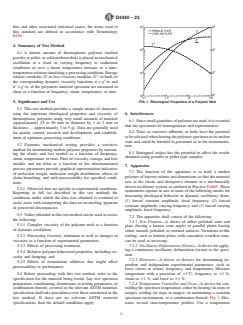
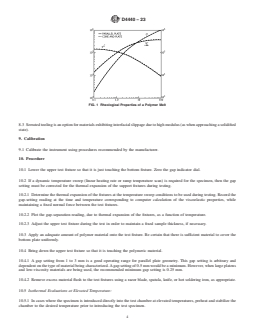
cooling (in steps or ramps), or maintaining a constant specimen environment, or a combination thereof. Fig. 1 illustrates several
time-temperature profiles. A Use a temperature programmer that is sufficiently stable to permit measurement of sample temperature
to 1°C.
7.3 Nitrogen, or other gas supply for purging purposes, if appropriate.
8. Test Specimens
8.1 The molten polymer composition shall be both homogeneous and representative.
8.2 Due to various geometries that might be used for dynamic mechanical characterization of molten polymeric systems, size is
not fixed by this test method; however, sample geometry (diameter and thickness) shall be reported for any series of comparisons.
...