


ASTM E814-23a
(Test Method)Standard Test Method for Fire Tests of Penetration Firestop Systems
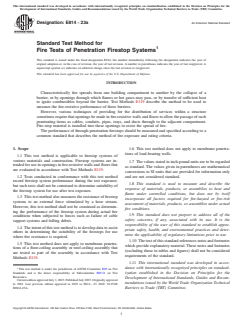
Standard Test Method for Fire Tests of Penetration Firestop Systems
SIGNIFICANCE AND USE
5.1 This test method is used to determine the performance of a firestop system with respect to exposure to a standard time-temperature fire test and a hose stream test. The performance of a firestop system is dependent upon the specific assembly of materials tested including the number, type, and size of penetrations and the floors or walls in which it is installed.
5.2 Two ratings shall be established for each firestop system. An F rating shall be based upon flame occurrence on the unexposed surface, while the T rating shall be based upon the temperature rise as well as flame occurrence on the unexposed side of the firestop system. These ratings, together with detailed performance data such as the location of through-openings and temperatures of penetrating items are intended to be one factor in assessing performance of firestop systems.
SCOPE
1.1 This test method is applicable to firestop systems of various materials and construction. Firestop systems are intended for use in openings in fire-resistive walls and floors that are evaluated in accordance with Test Methods E119.
1.2 Tests conducted in conformance with this test method record firestop system performance during the test exposure; but such tests shall not be construed to determine suitability of the firestop system for use after test exposure.
1.3 This test method also measures the resistance of firestop systems to an external force stimulated by a hose stream. However, this test method shall not be construed as determining the performance of the firestop system during actual fire conditions when subjected to forces such as failure of cable support systems and falling debris.
1.4 The intent of this test method is to develop data to assist others in determining the suitability of the firestops for use where fire resistance is required.
1.5 This test method does not apply to membrane penetrations of a floor-ceiling assembly or roof-ceiling assembly that are tested as part of the assembly in accordance with Test Methods E119.
1.6 This test method does not apply to membrane penetrations of load-bearing walls.
1.7 The values stated in inch-pound units are to be regarded as standard. The values given in parentheses are mathematical conversions to SI units that are provided for information only and are not considered standard.
1.8 This standard is used to measure and describe the response of materials, products, or assemblies to heat and flame under controlled conditions, but does not by itself incorporate all factors required for fire-hazard or fire-risk assessment of materials, products, or assemblies under actual fire conditions.
1.9 This standard does not purport to address all of the safety concerns, if any, associated with its use. It is the responsibility of the user of this standard to establish appropriate safety, health, and environmental practices and determine the applicability of regulatory limitations prior to use.
1.10 The text of this standard references notes and footnotes which provide explanatory material. These notes and footnotes (excluding those in tables and figures) shall not be considered requirements of the standard.
1.11 This international standard was developed in accordance with internationally recognized principles on standardization established in the Decision on Principles for the Development of International Standards, Guides and Recommendations issued by the World Trade Organization Technical Barriers to Trade (TBT) Committee.
General Information
- Status
- Published
- Publication Date
- 30-Jun-2023
- Technical Committee
- E05 - Fire Standards
- Drafting Committee
- E05.11 - Fire Resistance
Relations
- Effective Date
- 01-Jan-2024
- Effective Date
- 01-Dec-2023
- Effective Date
- 15-Oct-2023
- Effective Date
- 01-Oct-2019
- Effective Date
- 01-Mar-2019
- Effective Date
- 15-Dec-2018
- Effective Date
- 01-Nov-2018
- Effective Date
- 01-Nov-2018
- Effective Date
- 01-Sep-2018
- Effective Date
- 01-Jun-2018
- Effective Date
- 01-Mar-2018
- Effective Date
- 01-Mar-2018
- Effective Date
- 01-Jul-2016
- Effective Date
- 01-Apr-2016
- Effective Date
- 01-Oct-2015
Overview
ASTM E814-23a, entitled Standard Test Method for Fire Tests of Penetration Firestop Systems, is a widely recognized ASTM standard developed to evaluate the fire resistance performance of firestop systems installed in openings in fire-resistive walls and floors. This test method measures a system's capability to resist the passage of fire, hot gases, and heat when subjected to controlled fire exposure and subsequent external forces, such as a hose stream, under standardized laboratory conditions. ASTM E814 is essential in the construction, design, and regulatory compliance of buildings to prevent the spread of fire through penetrations made for pipes, cables, ducts, and similar components.
Key Topics
- Test Method Scope: ASTM E814 applies to firestop systems comprised of various materials and designs intended for use in openings in fire-resistive assemblies. It specifically excludes membrane penetrations of floor-ceiling or roof-ceiling assemblies and load-bearing walls, which are evaluated under different standards.
- Performance Evaluation: The method establishes two ratings:
- F Rating: Based on the time a firestop resists the passage of flame to the unexposed surface.
- T Rating: Based on both flame resistance and the temperature rise on the unexposed surface.
- Standard Fire and Hose Stream Exposure: Firestop systems are exposed to a standardized time-temperature curve fire, followed by a hose stream test to simulate the physical impact and cooling effects encountered in real fire events.
- Assembly-Specific Results: Results are dependent on the precise configuration of penetrations, penetrating items, and sealing materials as tested. Each unique assembly must be tested to determine its F and T ratings.
- Comprehensive Reporting: The standard outlines specific reporting requirements, including description of assemblies, test conditions, performance data, and ratings.
Applications
The ASTM E814-23a standard is vital for:
- Building Construction and Safety Compliance: Ensuring fire containment within building compartments by properly assessing firestop systems for penetrations in fire-resistant barriers.
- Regulatory Approval: Satisfying code requirements for fire protection of penetrations in walls and floors, critical for achieving certifications and occupancy approvals.
- Product Development and Certification: Guiding manufacturers in the design and evaluation of firestop products and systems to demonstrate compliance with fire safety standards.
- Facility Maintenance and Retrofitting: Providing a basis for selecting or replacing firestop systems in existing buildings, particularly where new penetrations are introduced for mechanical, plumbing, or electrical upgrades.
Related Standards
Professionals referencing ASTM E814-23a may also consult the following related fire test and terminology standards:
- ASTM E119 - Test Methods for Fire Tests of Building Construction and Materials
Specifies procedures for determining the fire-resistance of structural elements, often referenced for the rating of floors and walls. - ASTM E176 - Terminology of Fire Standards
Provides definitions of terms commonly used across fire safety and fire test methods. - ASTM E2226 - Practice for Application of Hose Stream
Details the procedure for hose stream testing, which is referenced in ASTM E814. - ANSI/UL 1479 - Standard for Fire Tests of Through-Penetration Firestops
A complementary standard commonly referenced in North America for similar firestop performance evaluations.
By employing ASTM E814-23a in the evaluation and specification of firestop systems, designers, builders, and regulatory officials can enhance fire protection strategies, support code compliance, and improve occupant safety in all types of commercial and residential structures. For the most current procedures and updates, reference the latest official version of the standard as published by ASTM International.
Buy Documents
ASTM E814-23a - Standard Test Method for Fire Tests of Penetration Firestop Systems
REDLINE ASTM E814-23a - Standard Test Method for Fire Tests of Penetration Firestop Systems
Get Certified
Connect with accredited certification bodies for this standard

NSF International
Global independent organization facilitating standards development and certification.

CIS Institut d.o.o.
Personal Protective Equipment (PPE) certification body. Notified Body NB-2890 for EU Regulation 2016/425 PPE.

Kiwa BDA Testing
Building and construction product certification.
Sponsored listings
Frequently Asked Questions
ASTM E814-23a is a standard published by ASTM International. Its full title is "Standard Test Method for Fire Tests of Penetration Firestop Systems". This standard covers: SIGNIFICANCE AND USE 5.1 This test method is used to determine the performance of a firestop system with respect to exposure to a standard time-temperature fire test and a hose stream test. The performance of a firestop system is dependent upon the specific assembly of materials tested including the number, type, and size of penetrations and the floors or walls in which it is installed. 5.2 Two ratings shall be established for each firestop system. An F rating shall be based upon flame occurrence on the unexposed surface, while the T rating shall be based upon the temperature rise as well as flame occurrence on the unexposed side of the firestop system. These ratings, together with detailed performance data such as the location of through-openings and temperatures of penetrating items are intended to be one factor in assessing performance of firestop systems. SCOPE 1.1 This test method is applicable to firestop systems of various materials and construction. Firestop systems are intended for use in openings in fire-resistive walls and floors that are evaluated in accordance with Test Methods E119. 1.2 Tests conducted in conformance with this test method record firestop system performance during the test exposure; but such tests shall not be construed to determine suitability of the firestop system for use after test exposure. 1.3 This test method also measures the resistance of firestop systems to an external force stimulated by a hose stream. However, this test method shall not be construed as determining the performance of the firestop system during actual fire conditions when subjected to forces such as failure of cable support systems and falling debris. 1.4 The intent of this test method is to develop data to assist others in determining the suitability of the firestops for use where fire resistance is required. 1.5 This test method does not apply to membrane penetrations of a floor-ceiling assembly or roof-ceiling assembly that are tested as part of the assembly in accordance with Test Methods E119. 1.6 This test method does not apply to membrane penetrations of load-bearing walls. 1.7 The values stated in inch-pound units are to be regarded as standard. The values given in parentheses are mathematical conversions to SI units that are provided for information only and are not considered standard. 1.8 This standard is used to measure and describe the response of materials, products, or assemblies to heat and flame under controlled conditions, but does not by itself incorporate all factors required for fire-hazard or fire-risk assessment of materials, products, or assemblies under actual fire conditions. 1.9 This standard does not purport to address all of the safety concerns, if any, associated with its use. It is the responsibility of the user of this standard to establish appropriate safety, health, and environmental practices and determine the applicability of regulatory limitations prior to use. 1.10 The text of this standard references notes and footnotes which provide explanatory material. These notes and footnotes (excluding those in tables and figures) shall not be considered requirements of the standard. 1.11 This international standard was developed in accordance with internationally recognized principles on standardization established in the Decision on Principles for the Development of International Standards, Guides and Recommendations issued by the World Trade Organization Technical Barriers to Trade (TBT) Committee.
SIGNIFICANCE AND USE 5.1 This test method is used to determine the performance of a firestop system with respect to exposure to a standard time-temperature fire test and a hose stream test. The performance of a firestop system is dependent upon the specific assembly of materials tested including the number, type, and size of penetrations and the floors or walls in which it is installed. 5.2 Two ratings shall be established for each firestop system. An F rating shall be based upon flame occurrence on the unexposed surface, while the T rating shall be based upon the temperature rise as well as flame occurrence on the unexposed side of the firestop system. These ratings, together with detailed performance data such as the location of through-openings and temperatures of penetrating items are intended to be one factor in assessing performance of firestop systems. SCOPE 1.1 This test method is applicable to firestop systems of various materials and construction. Firestop systems are intended for use in openings in fire-resistive walls and floors that are evaluated in accordance with Test Methods E119. 1.2 Tests conducted in conformance with this test method record firestop system performance during the test exposure; but such tests shall not be construed to determine suitability of the firestop system for use after test exposure. 1.3 This test method also measures the resistance of firestop systems to an external force stimulated by a hose stream. However, this test method shall not be construed as determining the performance of the firestop system during actual fire conditions when subjected to forces such as failure of cable support systems and falling debris. 1.4 The intent of this test method is to develop data to assist others in determining the suitability of the firestops for use where fire resistance is required. 1.5 This test method does not apply to membrane penetrations of a floor-ceiling assembly or roof-ceiling assembly that are tested as part of the assembly in accordance with Test Methods E119. 1.6 This test method does not apply to membrane penetrations of load-bearing walls. 1.7 The values stated in inch-pound units are to be regarded as standard. The values given in parentheses are mathematical conversions to SI units that are provided for information only and are not considered standard. 1.8 This standard is used to measure and describe the response of materials, products, or assemblies to heat and flame under controlled conditions, but does not by itself incorporate all factors required for fire-hazard or fire-risk assessment of materials, products, or assemblies under actual fire conditions. 1.9 This standard does not purport to address all of the safety concerns, if any, associated with its use. It is the responsibility of the user of this standard to establish appropriate safety, health, and environmental practices and determine the applicability of regulatory limitations prior to use. 1.10 The text of this standard references notes and footnotes which provide explanatory material. These notes and footnotes (excluding those in tables and figures) shall not be considered requirements of the standard. 1.11 This international standard was developed in accordance with internationally recognized principles on standardization established in the Decision on Principles for the Development of International Standards, Guides and Recommendations issued by the World Trade Organization Technical Barriers to Trade (TBT) Committee.
ASTM E814-23a is classified under the following ICS (International Classification for Standards) categories: 13.220.50 - Fire-resistance of building materials and elements. The ICS classification helps identify the subject area and facilitates finding related standards.
ASTM E814-23a has the following relationships with other standards: It is inter standard links to ASTM E176-24, ASTM E2226-23a, ASTM E2226-23, ASTM E119-19, ASTM E2226-15b(2019), ASTM E176-18a, ASTM E119-18c, ASTM E119-18ce1, ASTM E119-18b, ASTM E119-18a, ASTM E176-18, ASTM E119-18, ASTM E119-16a, ASTM E119-16, ASTM E2226-15b. Understanding these relationships helps ensure you are using the most current and applicable version of the standard.
ASTM E814-23a is available in PDF format for immediate download after purchase. The document can be added to your cart and obtained through the secure checkout process. Digital delivery ensures instant access to the complete standard document.
Standards Content (Sample)
This international standard was developed in accordance with internationally recognized principles on standardization established in the Decision on Principles for the
Development of International Standards, Guides and Recommendations issued by the World Trade Organization Technical Barriers to Trade (TBT) Committee.
Designation: E814 − 23a An American National Standard
Standard Test Method for
Fire Tests of Penetration Firestop Systems
This standard is issued under the fixed designation E814; the number immediately following the designation indicates the year of
original adoption or, in the case of revision, the year of last revision. A number in parentheses indicates the year of last reapproval. A
superscript epsilon (´) indicates an editorial change since the last revision or reapproval.
This standard has been approved for use by agencies of the U.S. Department of Defense.
INTRODUCTION
Characteristically fire spreads from one building compartment to another by the collapse of a
barrier, or by openings through which flames or hot gases may pass, or by transfer of sufficient heat
to ignite combustibles beyond the barrier. Test Methods E119 describe the method to be used to
measure the fire-resistive performance of these barriers.
However, various techniques of providing for the distribution of services within a structure
sometimes require that openings be made in fire-resistive walls and floors to allow the passage of such
penetrating items as cables, conduits, pipes, trays, and ducts through to the adjacent compartment.
Fire-stop material is installed into these openings to resist the spread of fire.
The performance of through-penetration firestops should be measured and specified according to a
common standard that describes the method of fire exposure and rating criteria.
1. Scope 1.6 This test method does not apply to membrane penetra-
tions of load-bearing walls.
1.1 This test method is applicable to firestop systems of
various materials and construction. Firestop systems are in-
1.7 The values stated in inch-pound units are to be regarded
tended for use in openings in fire-resistive walls and floors that
as standard. The values given in parentheses are mathematical
are evaluated in accordance with Test Methods E119.
conversions to SI units that are provided for information only
1.2 Tests conducted in conformance with this test method
and are not considered standard.
record firestop system performance during the test exposure;
1.8 This standard is used to measure and describe the
but such tests shall not be construed to determine suitability of
response of materials, products, or assemblies to heat and
the firestop system for use after test exposure.
flame under controlled conditions, but does not by itself
1.3 This test method also measures the resistance of firestop
incorporate all factors required for fire-hazard or fire-risk
systems to an external force stimulated by a hose stream.
assessment of materials, products, or assemblies under actual
However, this test method shall not be construed as determin-
fire conditions.
ing the performance of the firestop system during actual fire
1.9 This standard does not purport to address all of the
conditions when subjected to forces such as failure of cable
safety concerns, if any, associated with its use. It is the
support systems and falling debris.
responsibility of the user of this standard to establish appro-
1.4 The intent of this test method is to develop data to assist
priate safety, health, and environmental practices and deter-
others in determining the suitability of the firestops for use
mine the applicability of regulatory limitations prior to use.
where fire resistance is required.
1.10 The text of this standard references notes and footnotes
1.5 This test method does not apply to membrane penetra-
which provide explanatory material. These notes and footnotes
tions of a floor-ceiling assembly or roof-ceiling assembly that
(excluding those in tables and figures) shall not be considered
are tested as part of the assembly in accordance with Test
requirements of the standard.
Methods E119.
1.11 This international standard was developed in accor-
dance with internationally recognized principles on standard-
This test method is under the jurisdiction of ASTM Committee E05 on Fire
Standards and is the direct responsibility of Subcommittee E05.11 on Fire ization established in the Decision on Principles for the
Resistance.
Development of International Standards, Guides and Recom-
Current edition approved July 1, 2023. Published July 2023. Originally approved
mendations issued by the World Trade Organization Technical
in 1981. Last previous edition approved in 2023 as E814 – 23. DOI: 10.1520/
E0814-23A. Barriers to Trade (TBT) Committee.
Copyright © ASTM International, 100 Barr Harbor Drive, PO Box C700, West Conshohocken, PA 19428-2959. United States
E814 − 23a
2. Referenced Documents 4.2 Ratings are established on the basis of the period of
2 resistance to the fire exposure, prior to the first development of
2.1 ASTM Standards:
through openings, flaming on the unexposed surface, limiting
E119 Test Methods for Fire Tests of Building Construction
thermal transmission criterion, and acceptable performance
and Materials
under application of a hose stream.
E176 Terminology of Fire Standards
E2226 Practice for Application of Hose Stream
5. Significance and Use
2.2 Other Documents:
5.1 This test method is used to determine the performance
ANSI/UL 1479 Standard for Fire Tests of Through-
of a firestop system with respect to exposure to a standard
Penetration Firestops
time-temperature fire test and a hose stream test. The perfor-
mance of a firestop system is dependent upon the specific
3. Terminology
assembly of materials tested including the number, type, and
3.1 Definitions:
size of penetrations and the floors or walls in which it is
3.1.1 For definitions of terms used in this test method refer
installed.
to Terminology E176.
5.2 Two ratings shall be established for each firestop sys-
3.2 Definitions of Terms Specific to This Standard:
tem. An F rating shall be based upon flame occurrence on the
3.2.1 firestop system, n—a specific combination of penetrat-
unexposed surface, while the T rating shall be based upon the
ing item or items, the specific construction that is penetrated,
temperature rise as well as flame occurrence on the unexposed
and the materials or devices, or both, that seal the opening
side of the firestop system. These ratings, together with
provided to accommodate one or more items that penetrate into
detailed performance data such as the location of through-
or through a fire-resistance rated assembly.
openings and temperatures of penetrating items are intended to
3.2.1.1 Discussion—The materials and devices used to seal
be one factor in assessing performance of firestop systems.
the opening around penetrating items are sometimes referred to
as “firestops.” Note that it is not “firestops” that are tested by
6. Control of Fire Tests
this standard, but rather “firestop systems.” Due to the complex
6.1 Time-Temperature Curve—The fire environment within
interaction during a fire between the penetrant, the penetrated
the furnace shall be in accordance with the standard time-
assembly, the materials and/or devices used to seal the
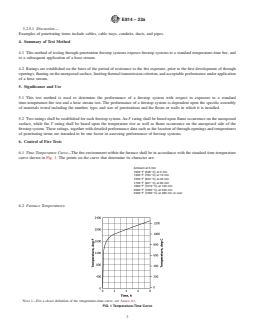
temperature curve shown in Fig. 1. The points on the curve that
penetration, and the specific size and shape of the opening, it is
determine its character are:
not possible to simply test the “firestop” to develop fire
resistance data.
Ambient at 0 min
1000 °F (538 °C) at 5 min
3.2.2 membrane-penetration firestop system, n—a firestop
1300 °F (704 °C) at 10 min
system that seals the opening provided to accommodate one or
1550 °F (843 °C) at 30 min
1700 °F (927 °C) at 60 min
more items that penetrate the membrane on only one side of a
1850 °F (1010 °C) at 120 min
fire-resistance rated assembly.
2000 °F (1093 °C) at 240 min
3.2.2.1 Discussion—Examples of penetrating items include 2300 °F (1260 °C) at 480 min or over
cables, conduits, ducts, pipes, and electrical boxes.
6.2 Furnace Temperatures:
3.2.3 test assembly—the wall or floor that is part of the
firestop system being tested into which the test specimen(s) is
(are) mounted or installed.
3.2.4 test specimen—the penetrating item or items and the
materials or devices, or both, that seal the opening in the
firestop system being tested.
3.2.5 through-penetration firestop system, n—a firestop sys-
tem that seals the opening around penetrating items that pass
through the entire fire-resistance rated assembly.
3.2.5.1 Discussion—Examples of penetrating items include
cables, cable trays, conduits, ducts, and pipes.
4. Summary of Test Method
4.1 This method of testing through-penetration firestop
systems exposes firestop systems to a standard temperature-
time fire, and to a subsequent application of a hose stream.
For referenced ASTM standards, visit the ASTM website, www.astm.org, or
NOTE 1—For a closer definition of the temperature-time curve, see
contact ASTM Customer Service at service@astm.org. For Annual Book of ASTM
Annex A1.
Standards volume information, refer to the standard’s Document Summary page on
the ASTM website. FIG. 1 Temperature-Time Curve
E814 − 23a
6.2.1 The temperature fixed by the curve shall be the 6.2.3 For floors, place the junction of the thermocouples 12
average temperature obtained from the readings of thermo- in. (300 mm) away from the exposed face of the assembly. In
couples symmetrically disposed and distributed within the test the case of walls, place the thermocouples 6.0 in. (150 mm)
furnace to show the temperature near all parts of the assembly. away from the exposed face.
Use a minimum of three thermocouples, with not fewer than
6.2.4 Read the temperature at intervals not exceeding 5 min
2 2
five thermocouples per 100 ft (9.29 m ) of floor surface, and during the first 120 min. Thereafter, the intervals shall not
not fewer than nine thermocouples per 100 ft of wall specimen
exceed 10 min.
surface.
6.2.5 The accuracy of the furnace control shall be such that
6.2.2 Enclose the thermocouples in sealed protection tubes
the area under the temperature-time curve, obtained by aver-
of such materials and dimensions that the time constant of the
aging the results from the pyrometer or thermoelectric device
protected thermocouple assembly lies within the range (see
readings, is within 10 % of the corresponding area under the
Note 1) from 300 to 400 s. The exposed length of the
standard temperature-time curve shown in Fig. 1 for fire tests
pyrometer tube and thermocouple in the furnace chamber shall
of 60 min or less duration; within 7.5 % for those over 60 min
be not less than 12 in. (300 mm). Use of other types of
and not more than 120 min; and within 5 % for tests exceeding
protection tubes or pyrometers shall be acceptable provided
120 min in duration.
that temperature measurements obtained in accordance with
6.3 Unexposed Surface Temperatures:
Fig. 1 are within the limit of accuracy that applies for furnace
6.3.1 Measure temperatures on the surface of the materials,
temperature measurements.
devices, or both, that are used to seal the opening in the test
NOTE 1—A typical thermocouple meeting these time-constant require-
assembly.
ments may be fabricated by fusion-welding the twisted ends of No. 18 B
6.3.2 Measure the temperature of the test assembly.
and S gage (0.040 in.) (1.02 mm) Chromel-Alumel wires, mounting the
6.3.3 Measure temperature at each of the locations on the
leads in porcelain insulators and inserting the assembly so the thermo-
unexposed surface of the penetrating item and floor or wall
couple bead is 0.50 in. (13 mm) from the sealed end of a standard weight,
nominal ⁄2-in. iron, steel, or Inconel pipe. (Inconel is a trademark of Inco
assembly as shown in Fig. 2.
Alloys, Inc., 3800 Riverside Dr., P.O. Box 1958, Huntington, WV 25720.)
6.3.4 For tests of membrane penetration firestop systems, in
The time constant for this and for several other thermocouple assemblies
addition to the requirements of 6.3.3, measure temperature at
was measured in 1976. The time constant may also be calculated from
each of the locations on the non-fire side of the test assembly
knowledge of its physical and thermal properties. See Research Report
RR:E05-1001, available from ASTM Headquarters. as shown in Fig. 3 for test assemblies that include membrane
Legend:
A—At a point on the surface of the materials or devices, or both, that seal the opening 1 in. (25 mm) from one through-penetrating item for each type of penetrating item
employed in the field of the materials or devices, or both, that seal the opening. If the grouping of penetrating items through the test sample prohibits placement of the
thermocouple pad, the thermocouple shall not be required.
B—At a point at the periphery on the surface of the materials or devices, or both, that seal the opening.
C—At a minimum of three points on the surface of the materials that seal the opening, approximately equidistant from a penetrating item or group of penetrating items
in the field of the materials that seal the opening and the periphery.
D—At one point on any frame that is installed about the perimeter of the opening.
E—At one point on the unexposed surface of the wall or floor that is a minimum of 12 in. (305 mm) from any opening.
F—At one point on each type of through-penetrating item. If the through-penetrating item is insulated or coated on the unexposed side, the thermocouple shall be located
on the exterior surface of the insulation or coating. If the coating or insulation does not extend the full length of the penetrating item on the unexposed side, an additional
thermocouple shall be installed on the penetrating item 1.0 in. (25.4 mm) beyond the termination of the insulation or coating.
FIG. 2 Temperature Measurement Locations
E814 − 23a
Legend:
Legend:
G—At a minimum of two points on the non-fire side surface, within the area that
G—At a minimum of two points on the non-fire side surface, within the area that
is a parallel projection onto the non-fire side of the hole made in the floor or wall
is a parallel projection onto the non-fire side of the hole made in the floor or wall
assembly to accommodate the membrane penetration. When the area of the
assembly to accommodate the membrane penetration. When the area of the
projection on the non-fire side is too small to permit the placement of two
projection on the non-fire side is too small to permit the placement of two
thermocouples, one thermocouple shall be used, located at the center of the
thermocouples, one thermocouple shall be used, located at the center of the
projected area.
projected area.
H—At two points on the non-fire side surface, located less than 3 in. (76 mm)
H—At two points on the non-fire side surface, located less than 3 in. (76 mm)
vertically from the inside top of the wall cavity, and each located less than 3 in.
vertically from the inside top of the wall cavity, and each located less than 3 in.
horizontally from the penetration centerline.
horizontally from the penetration centerline.
FIG. 3 Membrane Penetration Firestop System Temperature Mea-
FIG. 4 Membrane Penetration Firestop System Temperature Mea-
surement Locations for Test Assemblies that Include Membrane
surement Locations for Test Assemblies that Include Conditions
Penetrations on Only One Face of the Test Assembly
Representative of Both Sides of the Membrane Penetration on
One Surface of the Assembly
penetrations on only one face of the test assembly, or as shown
in Fig. 4 for test assemblies that include conditions represen-
tative of both sides of the membrane penetration on one surface gage (0.040 in.) (1.02 mm) and shall be electrically insulated
of the wall. with heat-resistant moisture-resistant coverings.
6.3.4.1 Discussion—The area in which thermocouples “G” 6.3.8 For tests of membrane penetration firestop systems,
are located, as shown in Fig. 3 and Fig. 4, is the perpendicular the pads placed over thermocouples used to measure the
projections of the test assemlby opening area on the non-fire non-fire side wall temperature at the top of the wall cavity
side of the un-penetrated membrane. (position H in Fig. 3 and Fig. 4) shall have the properties
6.3.5 Additional temperature measurements shall be made specified in Annex A2, except that they shall have a length and
at the discretion of the testing agency to obtain representative width of 6.00 6 0.04 in. (152 6 1 mm).
information on the performance of the firestop systems.
6.3.8.1 Discussion—The use of thermocouple pads with
6.3.6 For the purpose of obtaining supplementary informa- dimensions of 6 by 6 in. (152 by 152 mm) for position H in Fig.
tion during tests of membrane penetrations, the temperature 3 provides consistency with Test Method E119, which also
inside of each wall cavity having a membrane penetration shall uses that size of thermocouple pad. This thermocouple pad will
be measured using one or more thermocouples. Such thermo- not be constrained by limitations of space, as other thermo-
couples shall be located 3 6 0.25 in. (76 6 6 mm) vertically couple positions are likely to be.
from the inside top of the wall cavity, and each located 3 6 6.3.9 For a through-penetration firestop system, measure
0.25 in. (76 6 6 mm) in. horizontally from the penetration temperatures of each type and size of penetrating item with at
centerline. Wires for the thermocouples shall be routed so as least one thermocouple located 1.0 in. (25.4 mm) from the
not to impact the fire performance measurements that are made unexposed surface of the material, device, or both, that is (are)
on the non-fire side membrane. used to seal the opening in the test assembly. The thermocouple
6.3.7 Temperature measurements shall be made with ther- bead shall be held firmly against the penetrating item. The
mocouples placed under flexible pads specified in Annex A2. thermocouple leads shall not be heavier than No. 22 B and S
The pads shall be held firmly against the surface and shall fit gage (0.025 in.) (0.635 mm) and shall be electrically insulated
closely about the thermocouples. The thermocouple junction with heat-resistant and moisture-resistant coverings. The pads
shall be located under the center of the pads. The thermocouple as described above shall be held firmly against the penetrating
leads under the pads shall be not heavier than No. 18 B and S item and shall fit closely about the thermocouples.
E814 − 23a
6.3.10 Temperature readings shall be taken at intervals not (914 6 25 mm) on the unexposed side, unless otherwise
exceeding 15 min until a reading exceeding 212 °F (100 °C) provided in 7.1.2.1 or 7.1.2.2.
has been obtained at any one point. Thereafter, at the discretion 7.1.2.1 When the field installation of the penetrating item is
of the testing body, the readings shall be taken more frequently, less than either or both of the extensions specified in 7.1.2, the
but the intervals need not be less than 5 min. test shall have extension dimensions that replicate the field
installation.
6.4 Differential Pressure:
7.1.2.2 When additional material is installed with the fire-
6.4.1 The pressure differential between the exposed and
stop system for a limited length on the exposed side of the
unexposed surfaces of the test assembly, as defined in 3.2.3,
through-penetrating item, install the through-penetrating item
shall be measured at two points 0.78 in. (20 mm) from the
so that its length without such material extends 12 6 1 in. (305
exposed surface of the test assembly as follows:
6 25 mm) on the exposed side.
6.4.1.1 Walls—At two points along the vertical center line.
NOTE 3—Additional material covering or shielding a penetrating item
The two points shall be separated by a vertical distance that is
on the exposed side, unexposed side, or both, for a limited distance from
equal to or greater than one-half of the height of the test
the test assembly is sometimes a component of the firestop system,
assembly.
typically used to increase the T-rating of the tested system. Examples of
6.4.1.2 Floors—Two points along the longitudinal center
such materials include insulating materials, endothermic materials, abla-
L L
tive materials, subliming materials, intumescent materials, reflective
line at a distance of ⁄4 6 ⁄8 from the center of the floor where
materials, or a combination of those. When such material is used, 7.1.2.2
L equals the length of the floor.
requires a 12 6 1 in. (305 6 25 mm) length of the penetrating item to be
6.4.2 The pressure-measuring probes shall be a Tee-shaped
exposed to the heat of the furnace without the added material, so that the
probe or a tube probe and shall be manufactured from stainless
12 in. (305 mm) length of unprotected penetrating item is maintained for
steel or other suitable material. all test conditions.
6.4.3 Measure the pressure by means of a manometer or
7.1.3 Through-penetrating items on the exposed side of the
equivalent transducer. The manometer or transducer shall be
test assembly shall be exposed to the furnace temperatures.
capable of reading 0.01-in. H O (2.5-Pa) increments with a
2 Support the extended portion of through-penetrating items on
measurement precision of 0.005 in. H O (1.25 Pa).
2 the unexposed side so as to minimize relative movement
6.4.4 The furnace shall be controlled such that the differen-
between the through-penetrating item and the restraining frame
tial pressure between the exposed and the unexposed surfaces
in which the test assembly is mounted. Cap or otherwise seal
of the test assembly complies with either 6.4.4.1 or 6.4.4.2.
the individual ends of through-penetrating items on the ex-
6.4.4.1 Standard Pressure Condition—Except for the first 5
posed side. When the through-penetrating item is a closed
min. of the test, the furnace pressure shall be at least 0.01 in.
system that in actual field practice is not vented or open to the
wg (2.5 Pa) greater than the pressure on the unexposed side of
atmosphere, the through-penetrating item shall be capped or
the test assembly at the following locations:
sealed on the unexposed side. In such cases, a pressure relief
(1) Walls—At a level 0.78 in. (20 mm) below the lowest
hole shall be provided through the cap or seal on the unexposed
level of materials that fill openings surrounding penetrating
side. Otherwise, through-penetrating items shall not be capped
items passing through vertical test assemblies (walls) (see Note
or sealed on the unexposed side.
2).
7.1.4 The periphery of the materials or devices, or both, that
(2) Floors—At the location of the pressure-measuring
seal the opening in the test assembly shall not be closer than
probes.
1 ⁄2 times the thickness of the test assembly or a minimum of
12 in. (300 mm) to the furnace edge, whichever is greater (see
NOTE 2—A supplementary pressure probe, in addition to the two probes
Note 4).
specified in 6.4.1.1, may be used to determine compliance with this
requirement.
NOTE 4—The distance between the periphery of the materials or
devices, or both, that seal the opening in the test assembly and the furnace
6.4.4.2 Unique Pressure Condition—The differential pres-
edge may be reduced if the testing agency demonstrates and reports that
sure shall be specified by the test sponsor. The furnace shall be
the edge effects do not affect the results.
controlled such that the specified differential pressure is main-
7.2 For wall membrane penetration tests, any linear pen-
tained throughout the duration of the test, excluding the first 10
etrating item shall be routed vertically up from the membrane
min., within 20 % of the specified pressure.
penetration. The linear penetrating item shall exit the wall
cavity 9 6 0.5 in. (229 6 13 mm) below the top-most element
7. Test Specimen
of the test assembly frame through a hole in the wall surface
7.1 Construction and Size:
having an annular space of 0.5 in. (13 mm) or less. The annular
7.1.1 The construction of the test firestop systems shall be of
space of that hole shall be sealed with tightly packed ceramic
sufficient size and include all conduits, pipes, cables (jacket
fiber. Capping of the penetrating item on both the fire side and
types, sizes, conductor types, percent fills), required supports,
non-fire side shall be as specified in 7.1.2. Length of the
or other through-penetrating items so as to produce a repre-
penetrant exposed to furnace conditions on the fire side shall be
sentative firestop system for which evaluation is being sought.
a minimum of 12 in. (305 mm).
Install and test firestop systems for each construction type for
NOTE 5—Although details are provided here to describe how membrane
which ratings are being sought.
penetrations by linear penetrating items (for example, cables, pipes,
7.1.2 Install through-penetrating items so that they extend
conduit) shall be installed in the test assembly, most membrane penetra-
12 6 1 in. (305 6 25 mm) on the exposed side and 36 6 1 in. tions of interest in the built environment will be discrete items. Examples
E814 − 23a
of such discrete items include recessed boxes for electrical, water or gas
9.2.1 For wall assemblies that include membrane penetra-
piping connections, recessed wall-mounted equipment cabinets, and
tions on only one face of the test assembly, conduct a complete
recessed electrical equipment panels. Such items would normally not
fire test and hose stream test as specified in this standard on two
include any elongated parts whose extreme ends would need to be routed
duplicate assemblies, with one fire and hose test for each side
out near the top of the non-fire side of the test assembly.
of the assembly.
8. Protection and Conditioning
NOTE 8—An example of such a test assembly is shown in Fig. 3.
8.1 Prior to fire test, condition the firestop system to provide
9.2.1.1 When the test orientation that will produce the
a moisture condition representative of that existing in similar
lowest fire resistance rating can be established and agreed upon
construction in buildings. For the purposes of standardization,
by the testing laboratory and test sponsor, the fire test and hose
this condition is established at equilibrium resulting from
stream test shall be permitted to be conucted using only that
drying in an ambient atmosphere of 50 % relative humidity at
one orientation.
73 °F (23 °C). However, with some firestop systems it is
9.2.2 When a test assembly is built to include conditions
difficult or impossible to achieve such uniformity. Therefore,
representative of both sides of the membrane penetration on
firestop systems shall be eligible for testing when their dampest
one surface of the wall, a single fire test and hose stream test
portion has achieved a moisture content corresponding to
shall be permitted to be conducted.
drying to equilibrium with air in the range from 50 to 75 %
relative humidity at 73 6 5 °F (23 6 3 °C). If the firestop
NOTE 9—This type of arrangement would allow both sides of the
membrane penetration firestop system to be evaluated for fire resistance
systems dried in a heated building fail to meet these require-
using only one test. This can be accomplished by installing the membrane
ments after a 12-month conditioning period, or if the nature of
penetration two times in the same wall assembly, at the same height, each
the construction is such that drying of the interior of the test
on a different side of the assembly, and each in a different wall cavity. An
assembly or the interior of the material used to seal the opening
example of such an arrangement is shown in Fig. 4.
will be prevented by hermetic sealing, these requirements shall
9.3 Fire Test—Continue the test until the evaluation period
be waived, except as to attainment of the required strength as
being sought is reached or until the rating criteria of Section 10
described in 9.1, and the firestop system is tested in the
are satisfied.
condition in which it then exists.
9.4 Hose Stream Test:
NOTE 6—A method for determining the relative humidity within a
9.4.1 Subject a duplicate specimen to a fire-exposure test for
hardened concrete specimen with electric sensing elements is described in
a period equal to one half of that indicated as the resistance
Appendix I of a paper by C.A. Manzel, “A Method for Determining the
period in the fire test, but not more than 60 min, immediately
Moisture Condition of Hardened Concrete in Terms of Relative
Humidity,” Proceedings, ASTM, Vol 55, 1955, p. 1083. A similar
after which subject the specimen to the impact, erosion, and
procedure with electric sensing elements can be used to determine the
cooling effects of a hose stream as described in Practice E2226,
relative humidity within fire test assemblies and within other materials
and in accordance with the pressures and durations specified in
used as part of the firestop system.
Table 1.
NOTE 7—The conditioning requirements noted here are essentially
identical to the conditioning requirements and allowances in Test Method 9.4.2 When requested by the test sponsor, and with the
E119–12a, with only one exception. In the case where drying the
advice and consent of the testing body, the hose stream test
specimen to equilibrium is not achieved after 12 months, the conditioning
shall be made on the specimen subjected to the fire test
section of Test Method E119 (Section 6.2) states that an assembly is to be
immediately following the fire test.
conditioned for at least as long as it takes for it to attain its full design
strength, while E814 states that the strength need only be sufficient to
10. Rating Criteria
retain the firestop securely in position. Since E814 does not require any
superimposed load on a test specimen, other than that associated with its
10.1 F Rating:
own mass, there is no value in delaying testing until the penetrated
10.1.1 A firestop system shall have met the requirements for
specimen (wall or floor) attains its full design strength.
the F rating when the materials or devices, or both, that seal the
8.2 Protect the testing equipment, specimen, and assembly
opening remain in the opening during the fire test and hose
undergoing the fire test from any condition of wind or weather
stream test and the following conditions are met.
that is capable of leading to abnormal results. The ambient air
temperature at the beginning of the test shall be within the
A
TABLE 1 Pressure and Duration—Hose Stream Test
range from 50 to 90 °F (10 to 32 °C). The velocity of air across
Duration of
Water Pressure at
the unexposed surface measured just before the test begins
Application,
Fire Resistance Rating Base of Nozzle,
2 2
s/ft (m ) of
...
This document is not an ASTM standard and is intended only to provide the user of an ASTM standard an indication of what changes have been made to the previous version. Because
it may not be technically possible to adequately depict all changes accurately, ASTM recommends that users consult prior editions as appropriate. In all cases only the current version
of the standard as published by ASTM is to be considered the official document.
Designation: E814 − 23 E814 − 23a An American National Standard
Standard Test Method for
Fire Tests of Penetration Firestop Systems
This standard is issued under the fixed designation E814; the number immediately following the designation indicates the year of
original adoption or, in the case of revision, the year of last revision. A number in parentheses indicates the year of last reapproval. A
superscript epsilon (´) indicates an editorial change since the last revision or reapproval.
This standard has been approved for use by agencies of the U.S. Department of Defense.
INTRODUCTION
Characteristically fire spreads from one building compartment to another by the collapse of a
barrier, or by openings through which flames or hot gases may pass, or by transfer of sufficient heat
to ignite combustibles beyond the barrier. Test Methods E119 describe the method to be used to
measure the fire-resistive performance of these barriers.
However, various techniques of providing for the distribution of services within a structure
sometimes require that openings be made in fire-resistive walls and floors to allow the passage of such
penetrating items as cables, conduits, pipes, trays, and ducts through to the adjacent compartment.
Fire-stop material is installed into these openings to resist the spread of fire.
The performance of through-penetration firestops should be measured and specified according to a
common standard that describes the method of fire exposure and rating criteria.
1. Scope
1.1 This test method is applicable to firestop systems of various materials and construction. Firestop systems are intended for use
in openings in fire-resistive walls and floors that are evaluated in accordance with Test Methods E119.
1.2 Tests conducted in conformance with this test method record firestop system performance during the test exposure; but such
tests shall not be construed to determine suitability of the firestop system for use after test exposure.
1.3 This test method also measures the resistance of firestop systems to an external force stimulated by a hose stream. However,
this test method shall not be construed as determining the performance of the firestop system during actual fire conditions when
subjected to forces such as failure of cable support systems and falling debris.
1.4 The intent of this test method is to develop data to assist others in determining the suitability of the firestops for use where
fire resistance is required.
1.5 This test method does not apply to membrane penetrations of a floor-ceiling assembly or roof-ceiling assembly that are tested
as part of the assembly in accordance with Test Methods E119.
1.6 This test method does not apply to membrane penetrations of load-bearing walls.
This test method is under the jurisdiction of ASTM Committee E05 on Fire Standards and is the direct responsibility of Subcommittee E05.11 on Fire Resistance.
Current edition approved June 1, 2023July 1, 2023. Published July 2023. Originally approved in 1981. Last previous edition approved in 20172023 as E814 – 13a
(2017).E814 – 23. DOI: 10.1520/E0814-23.10.1520/E0814-23A.
Copyright © ASTM International, 100 Barr Harbor Drive, PO Box C700, West Conshohocken, PA 19428-2959. United States
E814 − 23a
1.7 The values stated in inch-pound units are to be regarded as standard. The values given in parentheses are mathematical
conversions to SI units that are provided for information only and are not considered standard.
1.8 This standard is used to measure and describe the response of materials, products, or assemblies to heat and flame under
controlled conditions, but does not by itself incorporate all factors required for fire-hazard or fire-risk assessment of materials,
products, or assemblies under actual fire conditions.
1.9 This standard does not purport to address all of the safety concerns, if any, associated with its use. It is the responsibility
of the user of this standard to establish appropriate safety, health, and environmental practices and determine the applicability of
regulatory limitations prior to use.
1.10 The text of this standard references notes and footnotes which provide explanatory material. These notes and footnotes
(excluding those in tables and figures) shall not be considered requirements of the standard.
1.11 This international standard was developed in accordance with internationally recognized principles on standardization
established in the Decision on Principles for the Development of International Standards, Guides and Recommendations issued
by the World Trade Organization Technical Barriers to Trade (TBT) Committee.
2. Referenced Documents
2.1 ASTM Standards:
E119 Test Methods for Fire Tests of Building Construction and Materials
E176 Terminology of Fire Standards
E2226 Practice for Application of Hose Stream
2.2 Other Documents:
ANSI/UL 1479 Standard for Fire Tests of Through-Penetration Firestops
3. Terminology
3.1 Definitions:
3.1.1 For definitions of terms used in this test method refer to Terminology E176.
3.2 Definitions of Terms Specific to This Standard:
3.2.1 firestop system, n—a specific combination of penetrating item or items, the specific construction that is penetrated, and the
materials or devices, or both, that seal the opening provided to accommodate one or more items that penetrate into or through a
fire-resistance rated assembly.
3.2.1.1 Discussion—
The materials and devices used to seal the opening around penetrating items are sometimes referred to as “firestops.” Note that
it is not “firestops” that are tested by this standard, but rather “firestop systems.” Due to the complex interaction during a fire
between the penetrant, the penetrated assembly, the materials and/or devices used to seal the penetration, and the specific size and
shape of the opening, it is not possible to simply test the “firestop” to develop fire resistance data.
3.2.2 membrane-penetration firestop system, n—a firestop system that seals the opening provided to accommodate one or more
items that penetrate the membrane on only one side of a fire-resistance rated assembly.
3.2.2.1 Discussion—
Examples of penetrating items include cables, conduits, ducts, pipes, and electrical boxes.
3.2.3 test assembly—the wall or floor that is part of the firestop system being tested into which the test specimen(s) is (are)
mounted or installed.
3.2.4 test specimen—the penetrating item or items and the materials or devices, or both, that seal the opening in the firestop system
being tested.
3.2.5 through-penetration firestop system, n—a firestop system that seals the opening around penetrating items that pass through
the entire fire-resistance rated assembly.
For referenced ASTM standards, visit the ASTM website, www.astm.org, or contact ASTM Customer Service at service@astm.org. For Annual Book of ASTM Standards
volume information, refer to the standard’s Document Summary page on the ASTM website.
E814 − 23a
3.2.5.1 Discussion—
Examples of penetrating items include cables, cable trays, conduits, ducts, and pipes.
4. Summary of Test Method
4.1 This method of testing through-penetration firestop systems exposes firestop systems to a standard temperature-time fire, and
to a subsequent application of a hose stream.
4.2 Ratings are established on the basis of the period of resistance to the fire exposure, prior to the first development of through
openings, flaming on the unexposed surface, limiting thermal transmission criterion, and acceptable performance under application
of a hose stream.
5. Significance and Use
5.1 This test method is used to determine the performance of a firestop system with respect to exposure to a standard
time-temperature fire test and a hose stream test. The performance of a firestop system is dependent upon the specific assembly
of materials tested including the number, type, and size of penetrations and the floors or walls in which it is installed.
5.2 Two ratings shall be established for each firestop system. An F rating shall be based upon flame occurrence on the unexposed
surface, while the T rating shall be based upon the temperature rise as well as flame occurrence on the unexposed side of the
firestop system. These ratings, together with detailed performance data such as the location of through-openings and temperatures
of penetrating items are intended to be one factor in assessing performance of firestop systems.
6. Control of Fire Tests
6.1 Time-Temperature Curve—The fire environment within the furnace shall be in accordance with the standard time-temperature
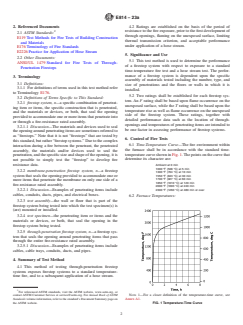
curve shown in Fig. 1. The points on the curve that determine its character are:
Ambient at 0 min
1000 °F (538 °C) at 5 min
1300 °F (704 °C) at 10 min
1550 °F (843 °C) at 30 min
1700 °F (927 °C) at 60 min
1850 °F (1010 °C) at 120 min
2000 °F (1093 °C) at 240 min
2300 °F (1260 °C) at 480 min or over
6.2 Furnace Temperatures:
NOTE 1—For a closer definition of the temperature-time curve, see Annex A1.
FIG. 1 Temperature-Time Curve
E814 − 23a
6.2.1 The temperature fixed by the curve shall be the average temperature obtained from the readings of thermocouples
symmetrically disposed and distributed within the test furnace to show the temperature near all parts of the assembly. Use a
2 2
minimum of three thermocouples, with not fewer than five thermocouples per 100 ft (9.29 m ) of floor surface, and not fewer than
nine thermocouples per 100 ft of wall specimen surface.
6.2.2 Enclose the thermocouples in sealed protection tubes of such materials and dimensions that the time constant of the protected
thermocouple assembly lies within the range (see Note 1) from 300 to 400 s. The exposed length of the pyrometer tube and
thermocouple in the furnace chamber shall be not less than 12 in. (300 mm). Use of other types of protection tubes or pyrometers
shall be acceptable provided that temperature measurements obtained in accordance with Fig. 1 are within the limit of accuracy
that applies for furnace temperature measurements.
NOTE 1—A typical thermocouple meeting these time-constant requirements may be fabricated by fusion-welding the twisted ends of No. 18 B and S gage
(0.040 in.) (1.02 mm) Chromel-Alumel wires, mounting the leads in porcelain insulators and inserting the assembly so the thermocouple bead is 0.50
in. (13 mm) from the sealed end of a standard weight, nominal ⁄2-in. iron, steel, or Inconel pipe. (Inconel is a trademark of Inco Alloys, Inc., 3800
Riverside Dr., P.O. Box 1958, Huntington, WV 25720.) The time constant for this and for several other thermocouple assemblies was measured in 1976.
The time constant may also be calculated from knowledge of its physical and thermal properties. See Research Report RR:E05-1001, available from
ASTM Headquarters.
6.2.3 For floors, place the junction of the thermocouples 12 in. (300 mm) away from the exposed face of the assembly. In the case
of walls, place the thermocouples 6.0 in. (150 mm) away from the exposed face.
6.2.4 Read the temperature at intervals not exceeding 5 min during the first 120 min. Thereafter, the intervals shall not exceed 10
min.
6.2.5 The accuracy of the furnace control shall be such that the area under the temperature-time curve, obtained by averaging the
results from the pyrometer or thermoelectric device readings, is within 10 % of the corresponding area under the standard
temperature-time curve shown in Fig. 1 for fire tests of 60 min or less duration; within 7.5 % for those over 60 min and not more
than 120 min; and within 5 % for tests exceeding 120 min in duration.
6.3 Unexposed Surface Temperatures:
6.3.1 Measure temperatures on the surface of the materials, devices, or both, that are used to seal the opening in the test assembly.
6.3.2 Measure the temperature of the test assembly.
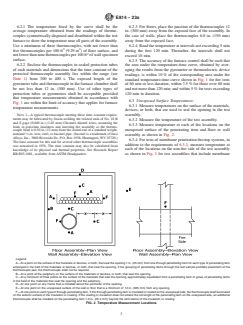
6.3.3 Measure temperature at each of the locations on the unexposed surface of the penetrating item and floor or wall assembly
as shown in Fig. 2.
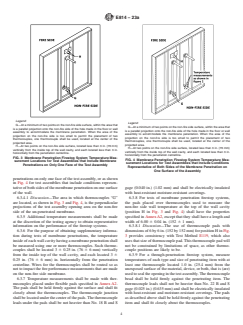
6.3.4 For tests of membrane penetration firestop systems, in addition to the requirements of 6.3.3, measure temperature at each
of the locations on the non-fire side of the test assembly as shown in Fig. 3 for test assemblies that include membrane penetrations
on only one face of the test assembly, or as shown in Fig. 4 for test assemblies that include conditions representative of both sides
of the membrane penetration on one surface of the wall.
6.3.4.1 Discussion—The area in which thermocouples “G” are located, as shown in Fig. 3 and Fig. 4, is the perpendicular
projections of the test assemlby opening area on the non-fire side of the un-penetrated membrane.
6.3.5 Additional temperature measurements shall be made at the discretion of the testing agency to obtain representative
information on the performance of the firestop systems.
6.3.6 For the purpose of obtaining supplementary information during tests of membrane penetrations, the temperature inside of
each wall cavity having a membrane penetration shall be measured using one or more thermocouples. Such thermocouples shall
be located 3 6 0.25 in. (76 6 6 mm) vertically from the inside top of the wall cavity, and each located 3 6 0.25 in. (76 6 6 mm)
in. horizontally from the penetration centerline. Wires for the thermocouples shall be routed so as not to impact the fire
performance measurements that are made on the non-fire side membrane.
6.3.7 Temperature measurements shall be made with thermocouples placed under flexible pads specified in Annex A2. The pads
shall be held firmly against the surface and shall fit closely about the thermocouples. The thermocouple junction shall be located
E814 − 23a
Legend:
A—At a point on the surface of the materials or devices, or both, that seal the opening 1 in. (25 mm) from one through-penetrating item for each type of penetrating item
employed in the field of the materials or devices, or both, that seal the opening. If the grouping of penetrating items through the test sample prohibits placement of the
thermocouple pad, the thermocouple shall not be required.
B—At a point at the periphery on the surface of the materials or devices, or both, that seal the opening.
C—At a minimum of three points on the surface of the materials that seal the opening, approximately equidistant from a penetrating item or group of penetrating items
in the field of the materials that seal the opening and the periphery.
D—At one point on any frame that is installed about the perimeter of the opening.
E—At one point on the unexposed surface of the wall or floor that is a minimum of 12 in. (305 mm) from any opening.
F—At one point on each type of through-penetrating item. If the through-penetrating item is insulated or coated on the unexposed side, the thermocouple shall be located
on the exterior surface of the insulation or coating. If the coating or insulation does not extend the full length of the penetrating item on the unexposed side, an additional
thermocouple shall be installed on the penetrating item 1.0 in. (25.4 mm) beyond the termination of the insulation or coating.
FIG. 2 Temperature Measurement Locations
Legend:
G—At a minimum of two points on the non-fire side surface, within the area that is a parallel projection onto the non-fire side of the hole made in the floor or wall assembly
to accommodate the membrane penetration. When the area of the projection on the non-fire side is too small to permit the placement of two thermocouples, one
thermocouple shall be used, located at the center of the projected area.
H—At two points on the non-fire side surface, located less than 3 in. (76 mm) vertically from the inside top of the wall cavity, and each located less than 3 in. horizontally
from the penetration centerline.
FIG. 3 Membrane Penetration Firestop System Temperature Measurement Locations for Test Assemblies that Include Membrane Pen-
etrations on Only One Face of the Test Assembly
E814 − 23a
Legend:
G—At a minimum of two points on the non-fire side surface, within the area that is a parallel projection onto the non-fire side of the hole made in the floor or wall assembly
to accommodate the membrane penetration. When the area of the projection on the non-fire side is too small to permit the placement of two thermocouples, one
thermocouple shall be used, located at the center of the projected area.
H—At two points on the non-fire side surface, located less than 3 in. (76 mm) vertically from the inside top of the wall cavity, and each located less than 3 in. horizontally
from the penetration centerline.
FIG. 4 Membrane Penetration Firestop System Temperature Measurement Locations for Test Assemblies that Include Conditions Rep-
resentative of Both Sides of the Membrane Penetration on One Surface of the Assembly
under the center of the pads. The thermocouple leads under the pads shall be not heavier than No. 18 B and S gage (0.040 in.)
(1.02 mm) and shall be electrically insulated with heat-resistant moisture-resistant coverings.
6.3.8 For tests of membrane penetration firestop systems, the pads placed over thermocouples used to measure the non-fire side
wall temperature at the top of the wall cavity (position H in Fig. 3 and Fig. 4) shall have the properties specified in Annex A2,
except that they shall have a length and width of 6.00 6 0.04 in. (152 6 1 mm).
6.3.8.1 Discussion—The use of thermocouple pads with dimensions of 6 by 6 in. (152 by 152 mm) for position H in Fig. 3
provides consistency with Test Method E119, which also uses that size of thermocouple pad. This thermocouple pad will not be
constrained by limitations of space, as other thermocouple positions are likely to be.
6.3.9 For a through-penetration firestop system, measure temperatures of each type and size of penetrating item with at least one
thermocouple located 1.0 in. (25.4 mm) from the unexposed surface of the material, device, or both, that is (are) used to seal the
opening in the test assembly. The thermocouple bead shall be held firmly against the penetrating item. The thermocouple leads shall
not be heavier than No. 22 B and S gage (0.025 in.) (0.635 mm) and shall be electrically insulated with heat-resistant and
moisture-resistant coverings. The pads as described above shall be held firmly against the penetrating item and shall fit closely
about the thermocouples.
6.3.10 Temperature readings shall be taken at intervals not exceeding 15 min until a reading exceeding 212 °F (100 °C) has been
obtained at any one point. Thereafter, at the discretion of the testing body, the readings shall be taken more frequently, but the
intervals need not be less than 5 min.
6.4 Differential Pressure:
6.4.1 The pressure differential between the exposed and unexposed surfaces of the test assembly, as defined in 3.2.3, shall be
measured at two points 0.78 in. (20 mm) from the exposed surface of the test assembly as follows:
6.4.1.1 Walls—At two points along the vertical center line. The two points shall be separated by a vertical distance that is equal
to or greater than one-half of the height of the test assembly.
E814 − 23a
L L
6.4.1.2 Floors—Two points along the longitudinal center line at a distance of ⁄4 6 ⁄8 from the center of the floor where L equals
the length of the floor.
6.4.2 The pressure-measuring probes shall be a Tee-shaped probe or a tube probe and shall be manufactured from stainless steel
or other suitable material.
6.4.3 Measure the pressure by means of a manometer or equivalent transducer. The manometer or transducer shall be capable of
reading 0.01-in. H O (2.5-Pa) increments with a measurement precision of 0.005 in. H O (1.25 Pa).
2 2
6.4.4 The furnace shall be controlled such that the differential pressure between the exposed and the unexposed surfaces of the
test assembly complies with either 6.4.4.1 or 6.4.4.2.
6.4.4.1 Standard Pressure Condition—Except for the first 5 min. of the test, the furnace pressure shall be at least 0.01 in. wg (2.5
Pa) greater than the pressure on the unexposed side of the test assembly at the following locations:
(1) Walls—At a level 0.78 in. (20 mm) below the lowest elevation of the test specimen level of materials that fill openings
surrounding penetrating items passing through vertical test assemblies (walls) (see Note 2).
(2) Floors—At the location of the pressure-measuring probes.
NOTE 2—A supplementary pressure probe, in addition to the two probes specified in 6.4.1.1, may be used to determine compliance with this requirement.
6.4.4.2 Unique Pressure Condition—The differential pressure shall be specified by the test sponsor. The furnace shall be controlled
such that the specified differential pressure is maintained throughout the duration of the test, excluding the first 10 min., within
20 % of the specified pressure.
7. Test Specimen
7.1 Construction and Size:
7.1.1 The construction of the test firestop systems shall be of sufficient size and include all conduits, pipes, cables (jacket types,
sizes, conductor types, percent fills), required supports, or other through-penetrating items so as to produce a representative firestop
system for which evaluation is being sought. Install and test firestop systems for each construction type for which ratings are being
sought.
7.1.2 Install through-penetrating items so that they extend 12 6 1 in. (305 6 25 mm) on the exposed side and 36 6 1 in. (914
6 25 mm) on the unexposed side, unless otherwise provided in 7.1.2.1 or 7.1.2.2.
7.1.2.1 When the field installation of the penetrating item is less than either or both of the extensions specified in 7.1.2, the test
shall have extension dimensions that replicate the field installation.
7.1.2.2 When additional material is installed with the firestop system for a limited length on the exposed side of the
through-penetrating item, install the through-penetrating item so that its length without such material extends 12 6 1 in. (305 6
25 mm) on the exposed side.
NOTE 3—Additional material covering or shielding a penetrating item on the exposed side, unexposed side, or both, for a limited distance from the test
assembly is sometimes a component of the firestop system, typically used to increase the T-rating of the tested system. Examples of such materials include
insulating materials, endothermic materials, ablative materials, subliming materials, intumescent materials, reflective materials, or a combination of those.
When such material is used, 7.1.2.2 requires a 12 6 1 in. (305 6 25 mm) length of the penetrating item to be exposed to the heat of the furnace without
the added material, so that the 12 in. (305 mm) length of unprotected penetrating item is maintained for all test conditions.
7.1.3 Through-penetrating items on the exposed side of the test assembly shall be exposed to the furnace temperatures. Support
the extended portion of through-penetrating items on the unexposed side so as to minimize relative movement between the
through-penetrating item and the restraining frame in which the test assembly is mounted. Cap or otherwise seal the individual ends
of through-penetrating items on the exposed side. When the through-penetrating item is a closed system that in actual field practice
is not vented or open to the atmosphere, the through-penetrating item shall be capped or sealed on the unexposed side. In such
cases, a pressure relief hole shall be provided through the cap or seal on the unexposed side. Otherwise, through-penetrating items
shall not be capped or sealed on the unexposed side.
E814 − 23a
7.1.4 The periphery of the materials or devices, or both, that seal the opening in the test assembly shall not be closer than 1 ⁄2 times
the thickness of the test assembly or a minimum of 12 in. (300 mm) to the furnace edge, whichever is greater (see Note 4).
NOTE 4—The distance between the periphery of the materials or devices, or both, that seal the opening in the test assembly and the furnace edge may
be reduced if the testing agency demonstrates and reports that the edge effects do not affect the results.
7.2 For wall membrane penetration tests, any linear penetrating item shall be routed vertically up from the membrane penetration.
The linear penetrating item shall exit the wall cavity 9 6 0.5 in. (229 6 13 mm) below the top-most element of the test assembly
frame through a hole in the wall surface having an annular space of 0.5 in. (13 mm) or less. The annular space of that hole shall
be sealed with tightly packed ceramic fiber. Capping of the penetrating item on both the fire side and non-fire side shall be as
specified in 7.1.2. Length of the penetrant exposed to furnace conditions on the fire side shall be a minimum of 12 in. (305 mm).
NOTE 5—Although details are provided here to describe how membrane penetrations by linear penetrating items (for example, cables, pipes, conduit) shall
be installed in the test assembly, most membrane penetrations of interest in the built environment will be discrete items. Examples of such discrete items
include recessed boxes for electrical, water or gas piping connections, recessed wall-mounted equipment cabinets, and recessed electrical equipment
panels. Such items would normally not include any elongated parts whose extreme ends would need to be routed out near the top of the non-fire side
of the test assembly.
8. Protection and Conditioning
8.1 Prior to fire test, condition the firestop system to provide a moisture condition representative of that existing in similar
construction in buildings. For the purposes of standardization, this condition is established at equilibrium resulting from drying in
an ambient atmosphere of 50 % relative humidity at 73 °F (23 °C). However, with some firestop systems it is difficult or impossible
to achieve such uniformity. Therefore, firestop systems shall be eligible for testing when their dampest portion has achieved a
moisture content corresponding to drying to equilibrium with air in the range from 50 to 75 % relative humidity at 73 6 5 °F (23
6 3 °C). If the firestop systems dried in a heated building fail to meet these requirements after a 12-month conditioning period,
or if the nature of the construction is such that drying of the interior of the test assembly or the interior of the material used to seal
the opening will be prevented by hermetic sealing, these requirements shall be waived, except as to attainment of the required
strength as described in 9.1, and the firestop system is tested in the condition in which it then exists.
NOTE 6—A method for determining the relative humidity within a hardened concrete specimen with electric sensing elements is described in Appendix
I of a paper by C.A. Manzel, “A Method for Determining the Moisture Condition of Hardened Concrete in Terms of Relative Humidity,” Proceedings,
ASTM, Vol 55, 1955, p. 1083. A similar procedure with electric sensing elements can be used to determine the relative humidity within fire test assemblies
and within other materials used as part of the firestop system.
NOTE 7—The conditioning requirements noted here are essentially identical to the conditioning requirements and allowances in Test Method E119–12a,
with only one exception. In the case where drying the specimen to equilibrium is not achieved after 12 months, the conditioning section of Test Method
E119 (Section 6.2) states that an assembly is to be conditioned for at least as long as it takes for it to attain its full design strength, while E814 states
that the strength need only be sufficient to retain the firestop securely in position. Since E814 does not require any superimposed load on a test specimen,
other than that associated with its own mass, there is no value in delaying testing until the penetrated specimen (wall or floor) attains its full design
strength.
8.2 Protect the testing equipment, specimen, and assembly undergoing the fire test from any condition of wind or weather that is
capable of leading to abnormal results. The ambient air temperature at the beginning of the test shall be within the range from 50
to 90 °F (10 to 32 °C). The velocity of air across the unexposed surface measured just before the test begins shall not exceed 4.4
ft/s (1.3 m/s) as determined by an anemometer placed at right angles to the unexposed surface. If mechanical ventilation is
employed during the test, do not direct an air stream across the surface of the specimen.
9. Conduct of Tests
9.1 Time of Testing—Do not test the test specimen until the test assembly has developed sufficient strength to retain securely in
position the materials or devices, or both, that are used to seal the opening.
9.2 Wall Assemblies with Membrane Penetrations:
9.2.1 For wall assemblies that include membrane penetrations on only one face of the test assembly, conduct a complete fire test
and hose stream test as specified in this standard on two duplicate assemblies, with one fire and hose test for each side of the
assembly.
E814 − 23a
NOTE 8—An example of such a test assembly is shown in Fig. 3.
9.2.1.1 When the test orientation that will produce the lowest fire resistance rating can be established and agreed upon by the
testing laboratory and test sponsor, the fire test and hose stream test shall be permitted to be conucted using only that one
orientation.
9.2.2 When a test assembly is built to include conditions representative of both sides of the membrane penetration on one surface
of the wall, a single fire test and hose stream test shall be permitted to be conducted.
NOTE 9—This type of arrangement would allow both sides of the membrane penetration firestop system to be evaluated for fire resistance using only one
test. This can be accomplished by installing the membrane penetration two times in the same wall assembly, at the same height, each on a different side
of the assembly, and each in a different wall cavity. An example of such an arrangement is shown in Fig. 4.
9.3 Fire Test—Continue the test until the evaluation period being sought is reached or until the rating criteria of Section 10 are
satisfied.
9.4 Hose Stream Test:
9.4.1 Subject a duplicate specimen to a fire-exposure test for a period equal to one half of that indicated as the resistance period
in the fire test, but not more than 60 min, immediately after which subject the specimen to the impact, erosion, and cooling effects
of a hose stream as described in Practice E2226, and in accordance with the pressures and durations specified in Table 1.
9.4.2 When request
...
Questions, Comments and Discussion
Ask us and Technical Secretary will try to provide an answer. You can facilitate discussion about the standard in here.
Loading comments...